Figural designs on hand-wrought Indian jewelry were scarce in the early 20th century. On the other hand, tourist adornment and commercial flatware featured human forms as early as the 1890s. Yet those who sold Indian jewelry really wanted something that their Native makers resisted: figures of sacred beings. Since the Knifewing and Rainbow Man were not actual katsinam, Zuni’s jewelry makers agreed to reproduce their images since they’d already been shown to the world at large.
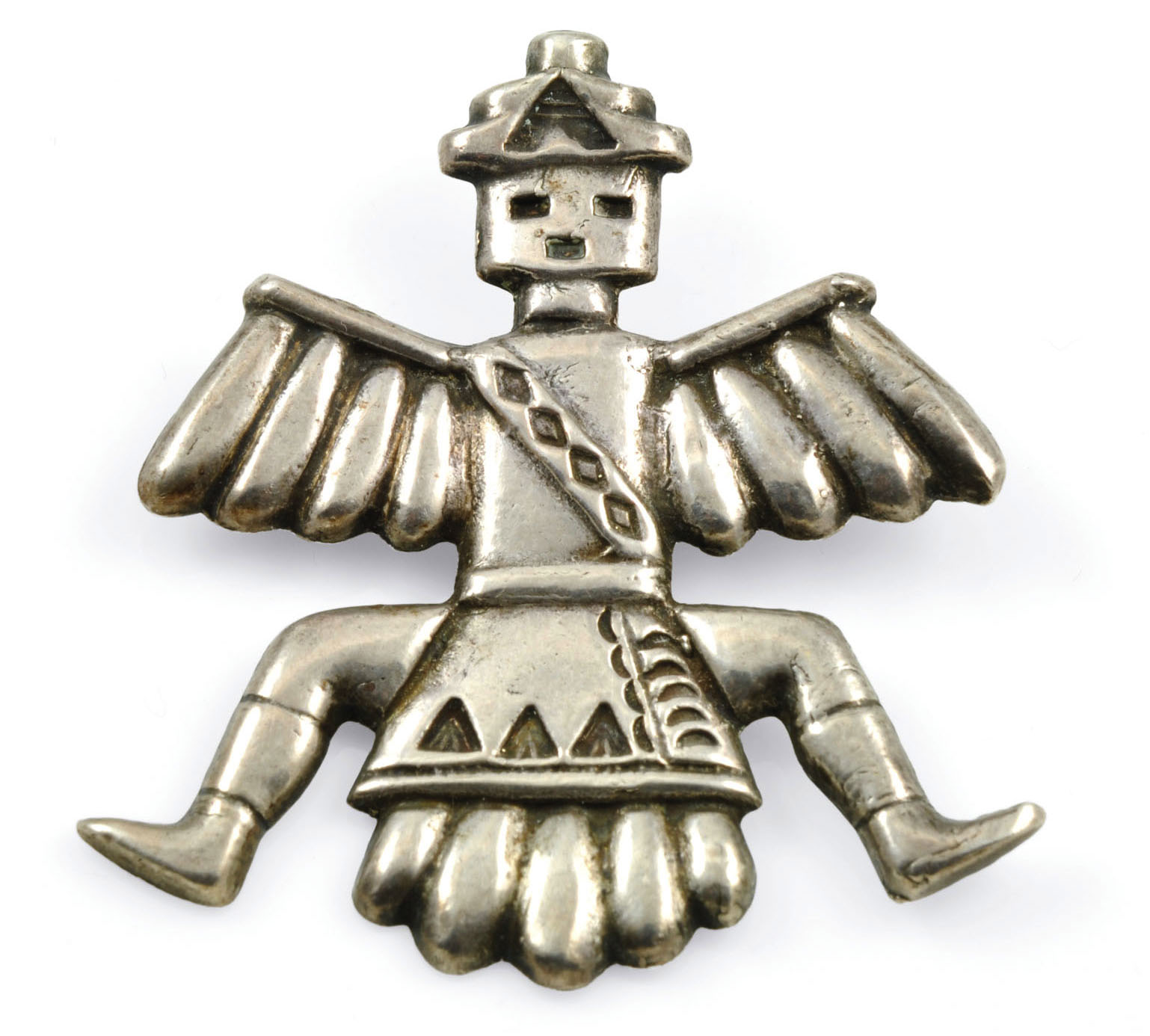 One of the earliest designs for a Knifewing in silver by Horace Iule (Zuni Pueblo, 1901-1978), ca. 1928. Courtesy Paul and Valerie Piazza.
Knifewing and Rainbow Man first appeared to the public in a drawing of war shields by anthropologist Frank Hamilton Cushing after his return from Zuni Pueblo in the 1890s. They were spirits central to the Priesthood of the Bow. Both entities were rendered in a proud anthropomorphic fusion of sacred spirit and human form. Knifewing (Achiya’latopa), a giant eagle/man figure holds an upright, aggressive pose while Rainbow Man floats overhead. These were appropriate stances for beings who dwelt in the sky; Knifewing was known to descend warrior-like from the clouds to steal girls and women and take scalps, and Rainbow Man controlled summer rains and the atmospheric conditions that produced rainbows.
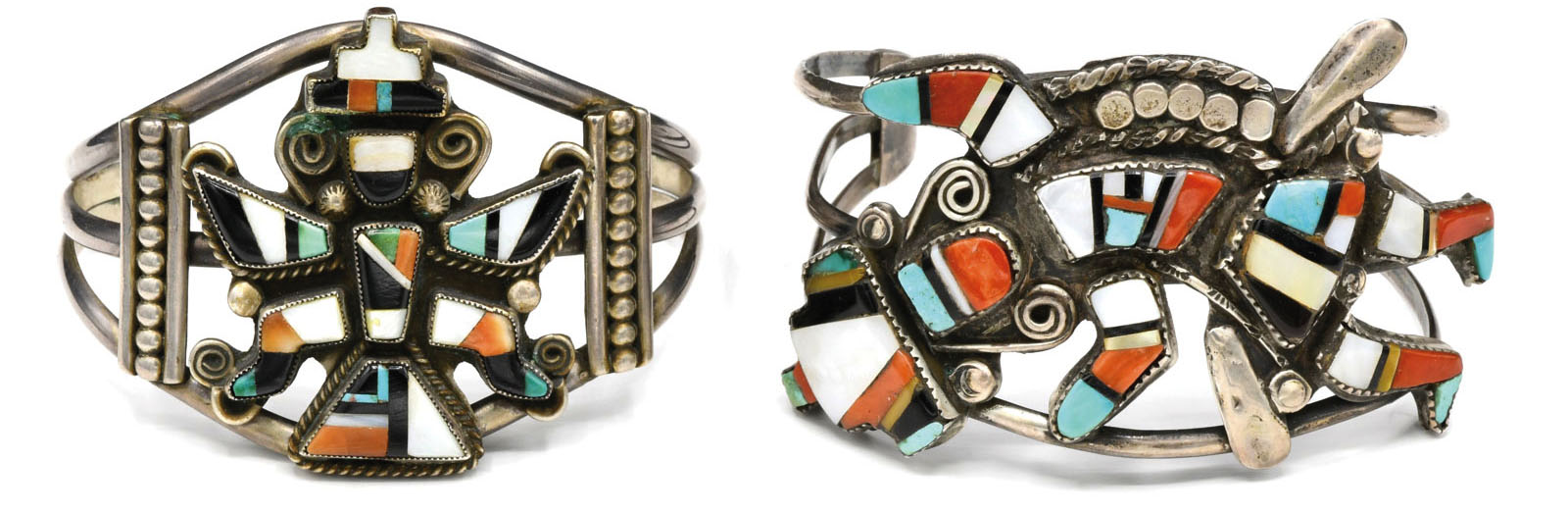 Knifewing bracelet, 1950s, and Rainbow Man bracelet, 1970s. Both pieces unsigned.
These figures became springboard designs for Zuni artistry. Many jewelry makers in the pueblo sought to make affectionate and unique reproductions of their deities. Rendered first in silver, then in varying mosaic inlay techniques, these figural subjects facilitated skilled interpretations of bearing, dress, and distinctive features. The designs flooded the market after World War II, becoming well-known and established jewelry motifs, even though they were almost always unsigned.
When anthropologist John Adair interviewed Horace Iule (1901–1978), the silversmith told him that he’d fashioned the first representation of Knifewing in silver in 1928. His groundbreaking design was then constructed in both tufa cast and wrought forms. Iule’s archetype motif lacks decorative emphasis. The figure is clearly masculine with wide bent legs and wears a crossbody ceremonial pouch and kilt. The black flint-tipped wings and tail are stylized and lack detail.
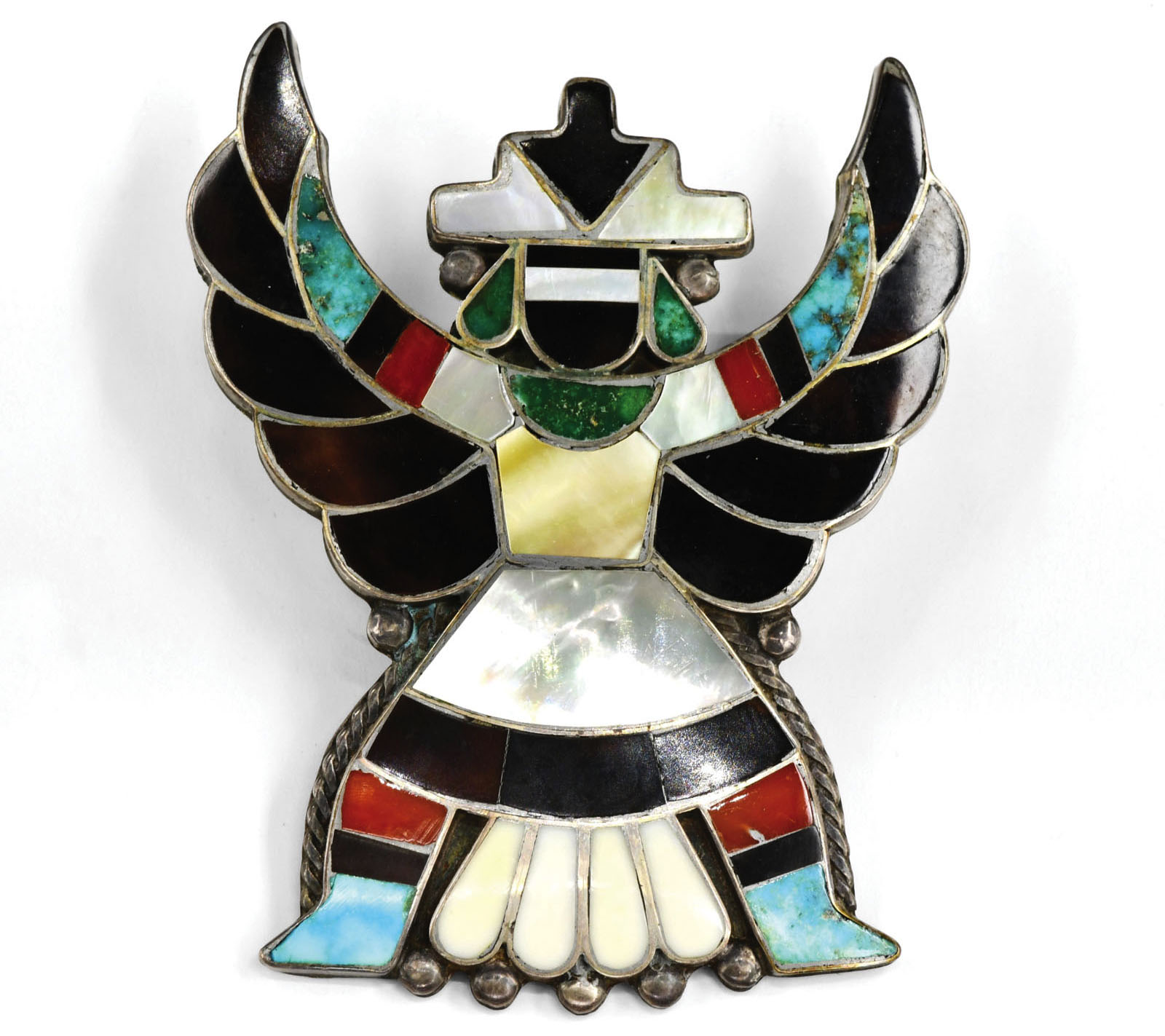 Knifewing pendant attributed to Augustine Pinto (Zuni Pueblo), 1960s, in channel mosaic inlay on silver.
Inlay rapidly replaced silver as the material of choice, although Juan Dedios (1884-1944) also fashioned Knifewing designs in silver, usually with a small amount of turquoise superimposed. The first examples of these figures were generally executed as pin pendants. By the 1950s, however, Zuni jewelry makers crafted these figural motifs for bracelets, earrings and rings, later choosing to feature them on bolos and silver box lids in the 1960s.
Bracelets with these designs seem to be largely mid 20th-century curio work. Knifewing and Rainbow Man bracelets from the 1950s through 1970s are handsome renditions of the sacred duo: the lapidary on silverwork central plates are soldered onto triple shank cuffs. In the examples shown here, the Knifewing stonework plate is flat and uncurved. The Rainbow Man lapidary work, constructed two decades later, has its central plate bent on a mandril so that it gracefully flows along with the silver it sits on. Most of these pieces seem to be intended for smaller, feminine wrists, revealing mid-century changes in gender-sized jewelry production.
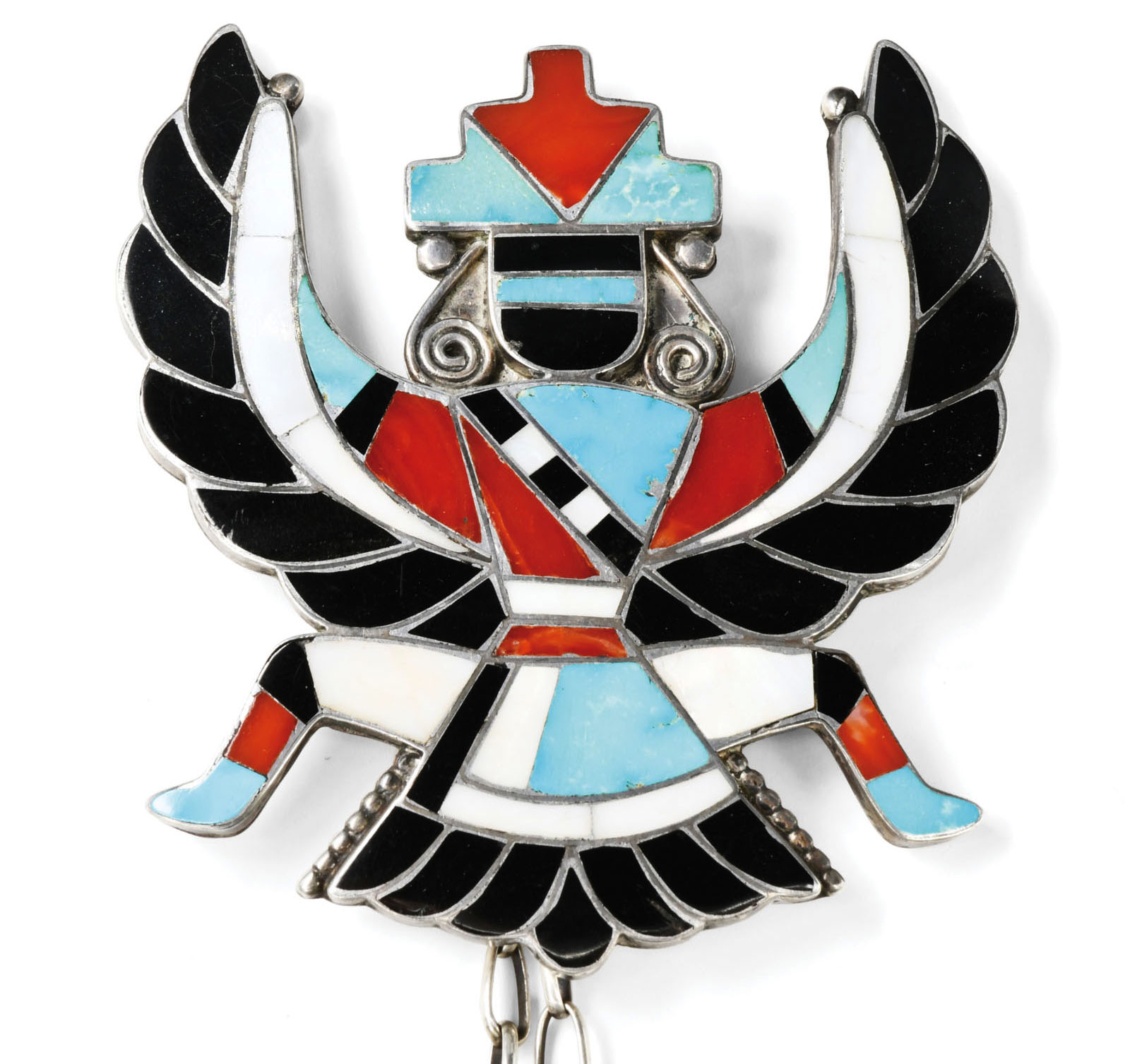 1970s Knifewing mosaic inlay design by unsigned maker, in conventional colors of black, red, white and blue.
Alonzo Hustito (1903–1987) has been credited as the first smith to make the Knifewing in mosaic inlay. His work uses jet, white and red shell, and turquoise materials that will become standard colors for the design. A piece (attributed to Augustine Pinto from the 1960s), using this combination of colors divulges an alternative stance for Knifewing: legs that stand apart but don’t bend. This artist’s work illustrates customary features for the 1960s: black jet upswept wings, a tablita-like decorative cap, and more fully realized garments made from blocks of inlay color set in silver channels. As a result, Knifewing emerges as elegant, but less dramatic.
Looking at the Knifewing motif of the 1970s, we see a more representative return to wide bent legs which convey a decided muscular sense of uplift. The pose enhances the powerful nature of the original design, affirming this being’s ability to swoop and soar. The fine mosaic inlay is set in silver channels and preserves the same overall elegance of execution, a technique that the Zunis have become known for perfecting.
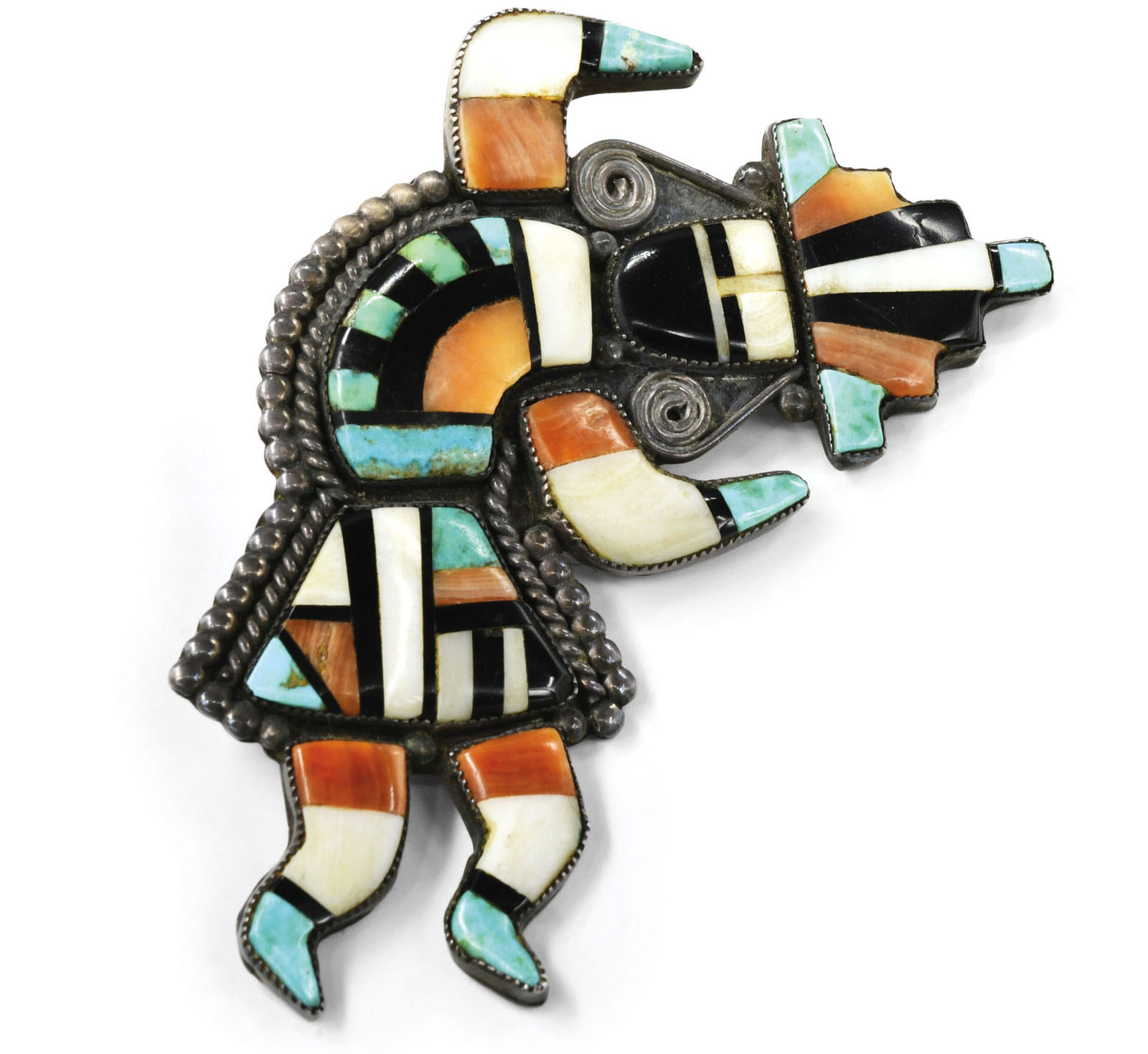 Rainbow Man in mosaic inlay, unsigned, 1960s-1970s.
The Rainbow Man design is somewhat more conventional in its expression of the figure’s body. While this form, seen in a pattern from the 1960s to 1970s, is bent to reference a rainbow’s curve, it is more decisively humanlike. The feathers are gone from the arms, and it’s made in a sophisticated mosaic inlay that no longer requires silver channels. After 1980, however, makers of Rainbow Man designs more often choose to focus on intricately artistic inlay patterns and allow a less arched pose.
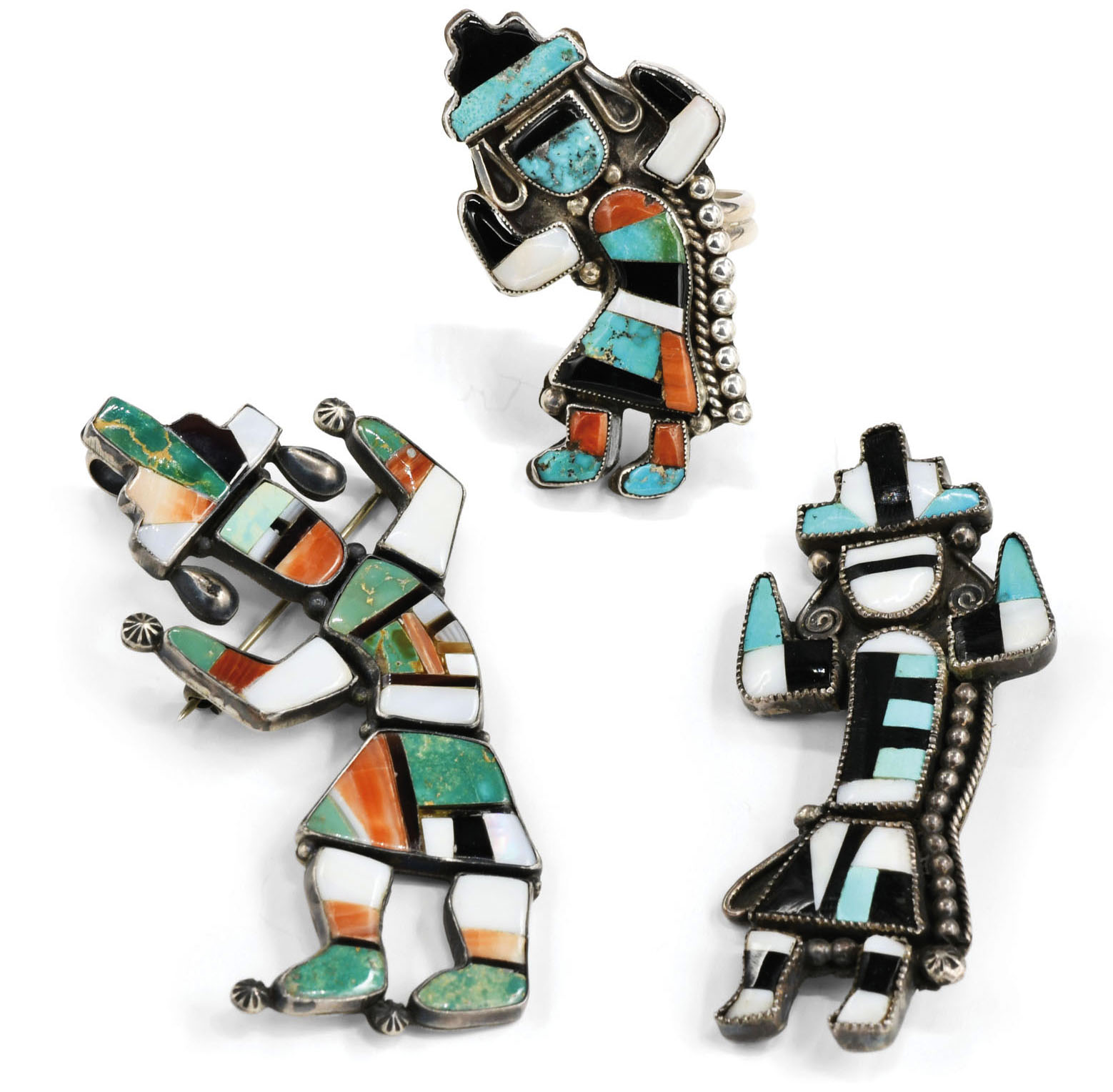 Rainbow Man ring and two small fashionable Rainbow Man pins, 1980s-1990s.
This transition signals a bolder move to individualistic characteristics, while remaining true to the iconic portrayal of heavenly sky spirits. These figural designs became popular with Zuni jewelry makers and their Indian traders. They led to the development of strong physical characteristics and enhanced surface decoration. Avid collectors appreciated the patterns and how they activated the viewer’s aesthetic judgment. In terms of design history, these motifs’ expressive vigor is due to changes in traditional approach, materials and construction, as well as personal vision.
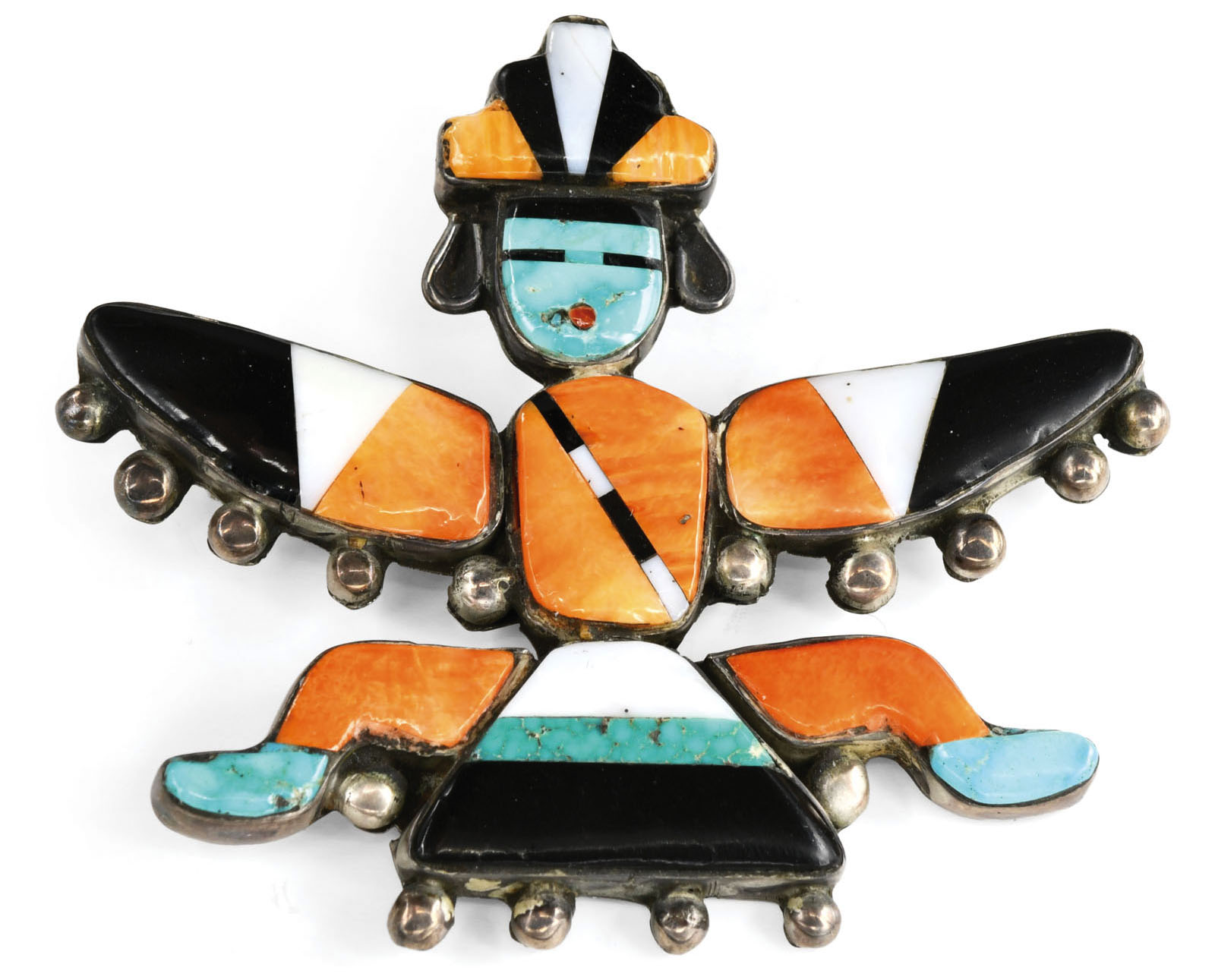 Knifewing pin pendant, unsigned, ca. 2005, in abalone, jet, turquoise and spiny oyster shell.
We can see this in a highly postmodern Knifewing pin pendant made around 2005. The anonymous maker freely returns to the classic pose of Iule and Dedios. Bypassing previous color combinations, an abundance of spiny oyster shell is employed while traditional small stone inlay is abandoned, and the deity’s face seems more suggestively human than previously. Artistic license is also adroitly displayed in a signed work from the early 2010s by Monica Coonsis. Her Rainbow Man is athletic in terms of a strong backward bend pose, highlighted by a rainbow-like midriff. These more recent interpretations confirm how to take a successful design and energize it.
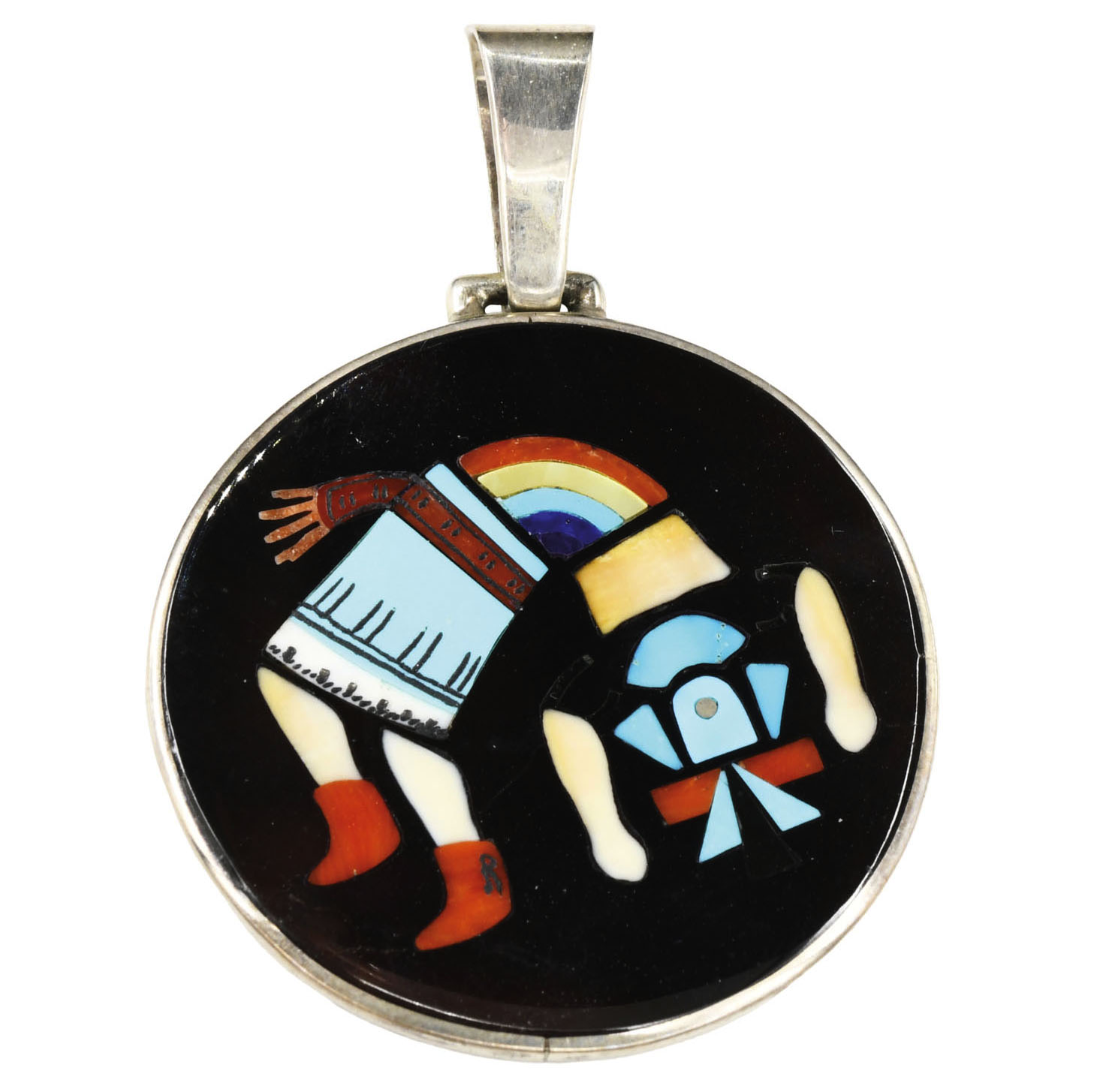 Rainbow Man pendant by Monica Coonsis (Zuni Pueblo), early 2010s.
All these images are valid and have appeal in today’s marketplace. The many varieties of Knifewing and Rainbow Man curio compositions proved to be fertile ground for contemporary inventiveness. While jewelry collectors have a strong preference for named artists, there is much to be said for Zuni’s proud outpouring of unsigned pieces. These works are more than attractive figural motifs. They expose their Native makers’ creative talents at play.
Paula A. Baxter, a former curator and adjunct professor from New York, is an independent design historian living in Scottsdale, Arizona. Her photographer is longtime husband Barry Katzen. Her sixth book, Navajo and Pueblo Jewelry Design: 1870 to 1945, was published in fall 2022. She’s working on a sequel which will cover the years 1946 to 2025, and will include Indigenous jewelers who aren’t Navajo or Pueblo but live and work in the American Southwest. This book, Baxter says, will have “lots of contemporary Native voices.”
Powered by Froala Editor


