
Gomeo Bobelu (1964-2022) was a Zuni silversmith, an Air Force veteran, actor, graphic artist, filmmaker, social justice advocate, tribal elder, father, grandfather and a member of the LGBTQ+ community. He was an advocate for Missing and Murdered Indigenous Persons (MMIP) and he, himself, was released from the hospital after a brutal beating and died several days later.
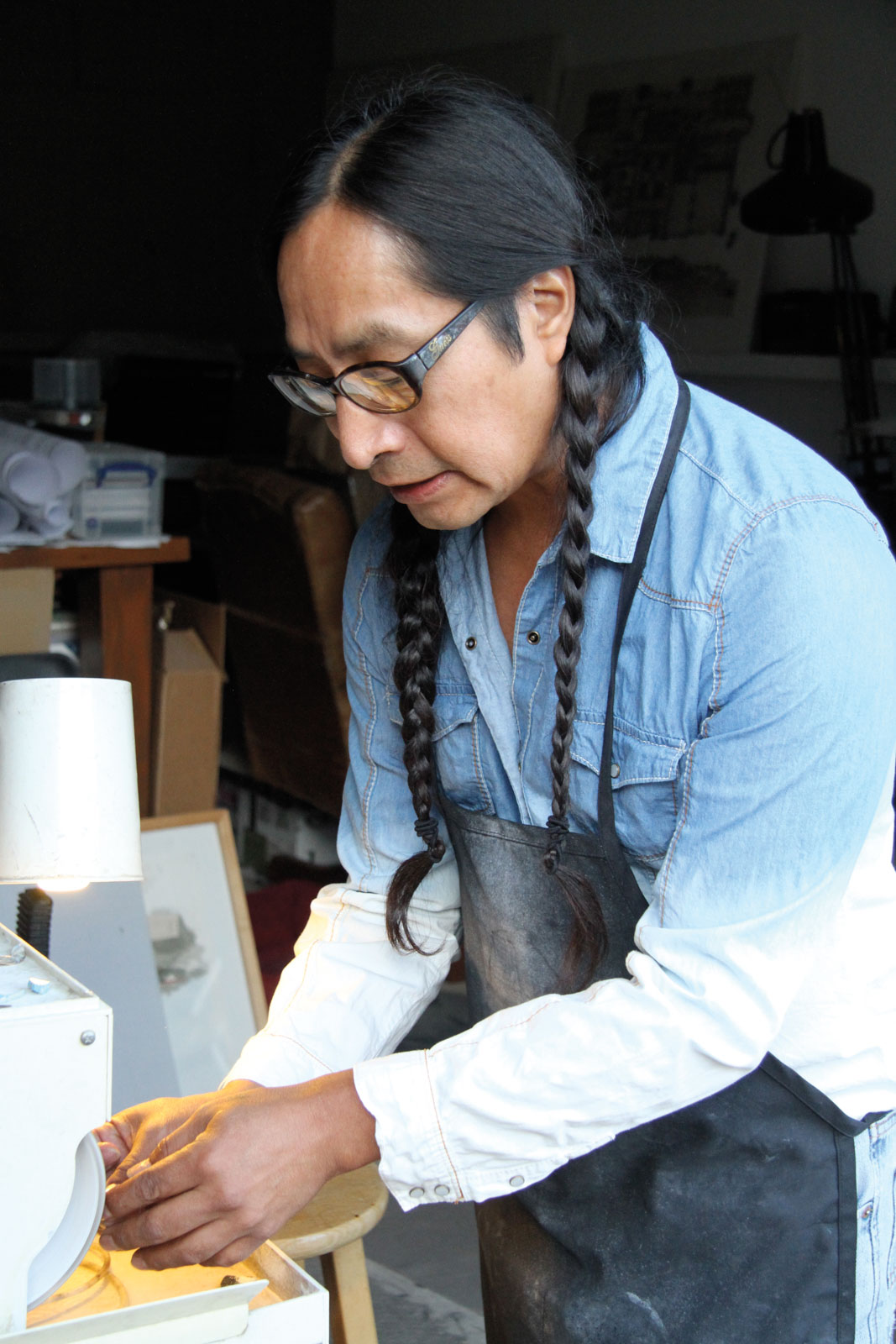 Gomeo Bobelu and the polishing wheel in his Santa Fe studio. Photo by Brian Fishbine
About 8 years ago, painter Roseta Santiago received a call from Gomeo who said he had been told to call her by a friend who recommended him as a model. “We made an appointment,” she recalled, “and he was very nervous when he arrived. There was something magical and mysterious about him. He was very lyrical, if you can call a person lyrical and I could tell he was a super empath. I look for a sense of pain in my models and I saw in him a soul screaming out to be shared.”
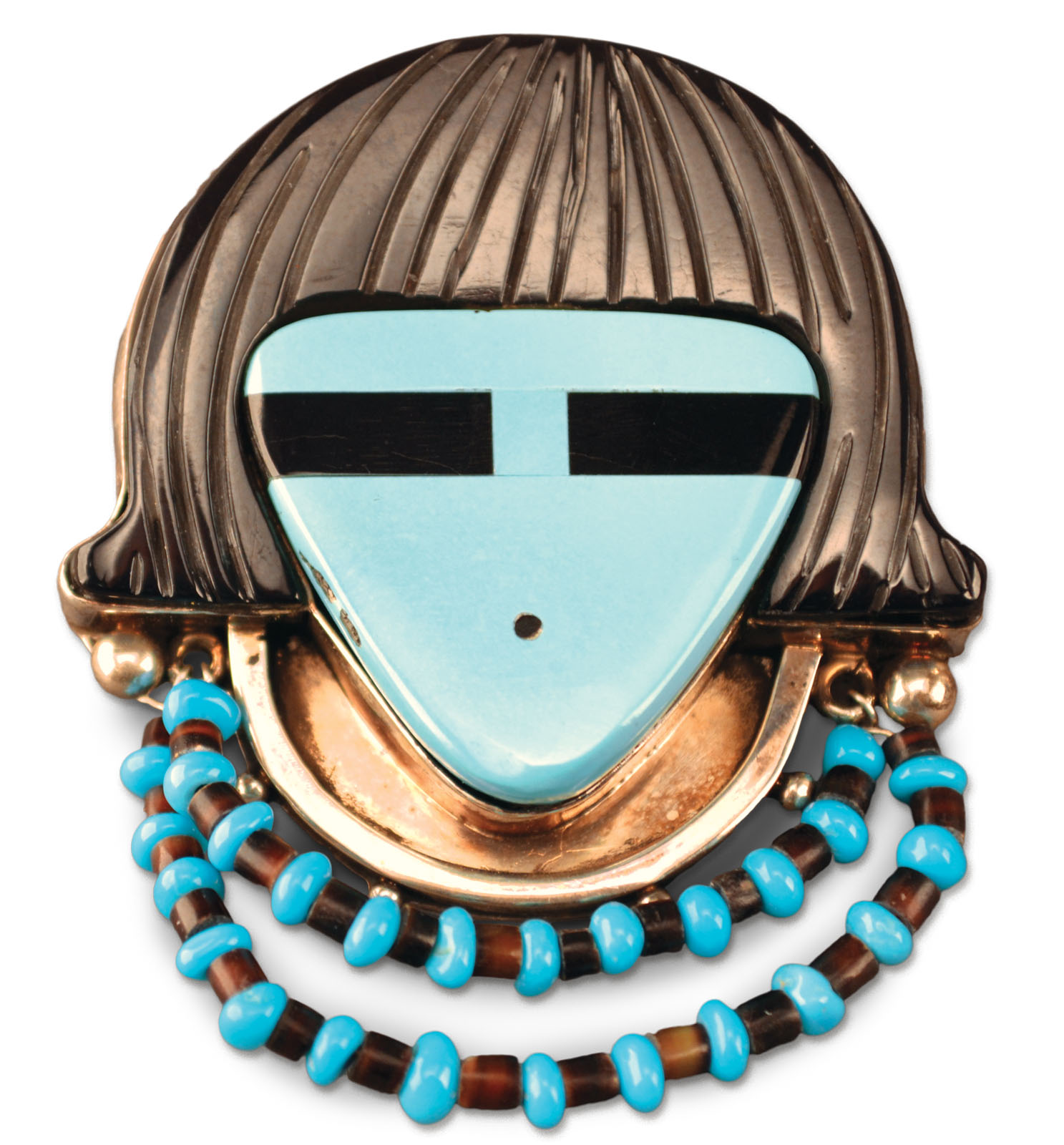 Gomeo Bobelu (Zuni, 1964-2022), Pendant, ca. 2010. Collection of Museum of Indian Arts and Culture, Santa Fe, NM.
Since then, Roseta has painted nearly two dozen paintings with Gomeo as the principal character, often leading others on a journey.
In Dreamcatcher Journey, 2018, Gomeo leads a group of women as he holds a red rattle. “The painting is about our personal belief systems and the journey to self-discovery,” Roseta explains. “The red rattle, made from a gourd, belonged to his grandfather. Dreamcatchers are hung near a bed to protect against bad dreams. The girl directly behind Gomeo is fully committed to the journey. The second is contemplating her commitment and the third looks out at the observer questioning whom she should believe. The fourth girl has turned away from the journey.”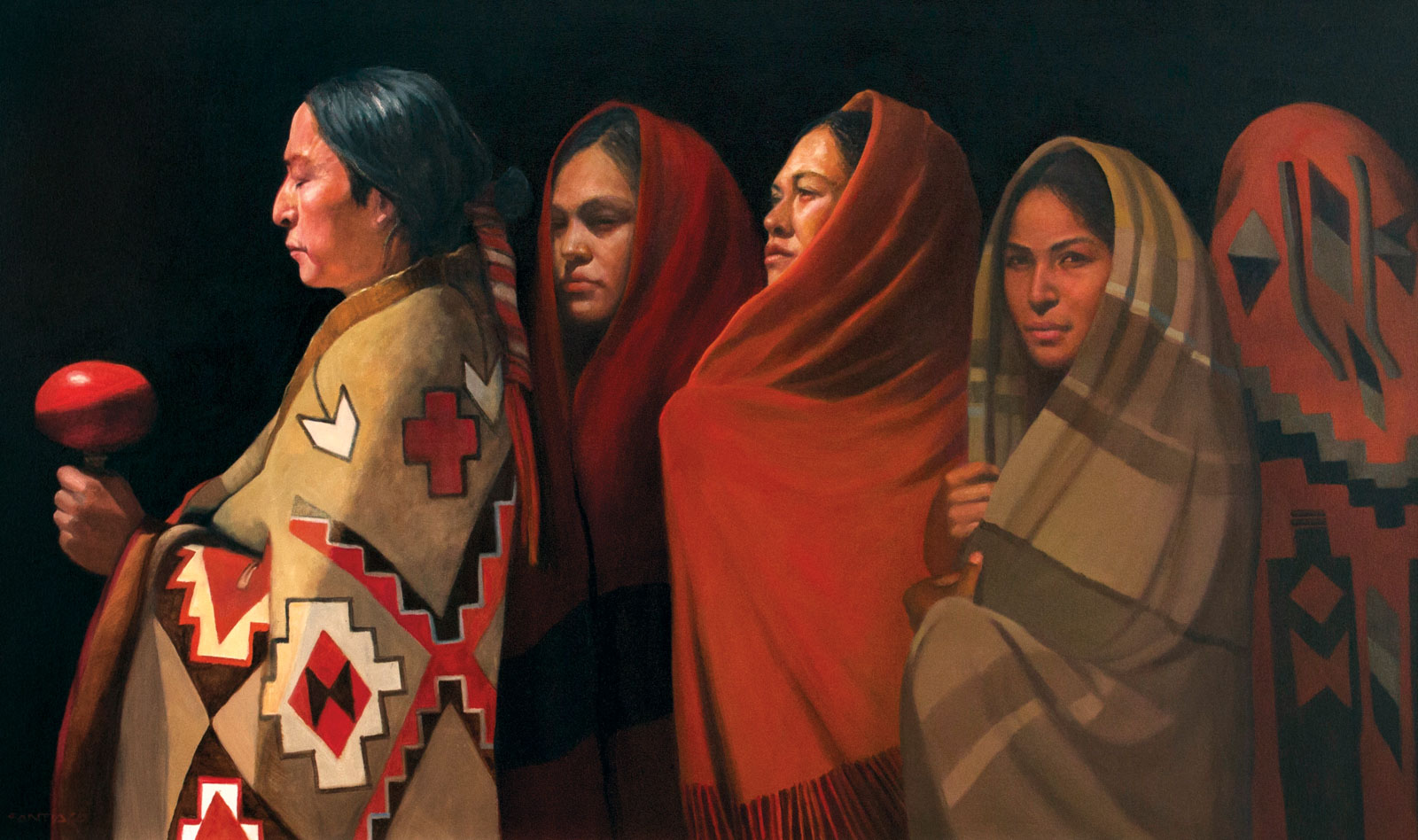 Roseta Santiago, Dreamcatcher Journey, 2018, oil on canvas, 40 x 60". Private Collection.
In another painting, Journey of Journeys, 2022, Gomeo is depicted with a warrior on the left, followed by a philosopher/medicine man and then an artist. “It’s about a journey within yourself and the archetypes you identify with,” Roseta says. “It’s a way of looking within your heart and being honest about who you are.”
Filmmaker and writer Jaima Chevalier had met Gomeo many years ago and in 2017 produced the film Veiled Lightning about the first American revolution, the Pueblo Revolt of 1680, in which he appeared.
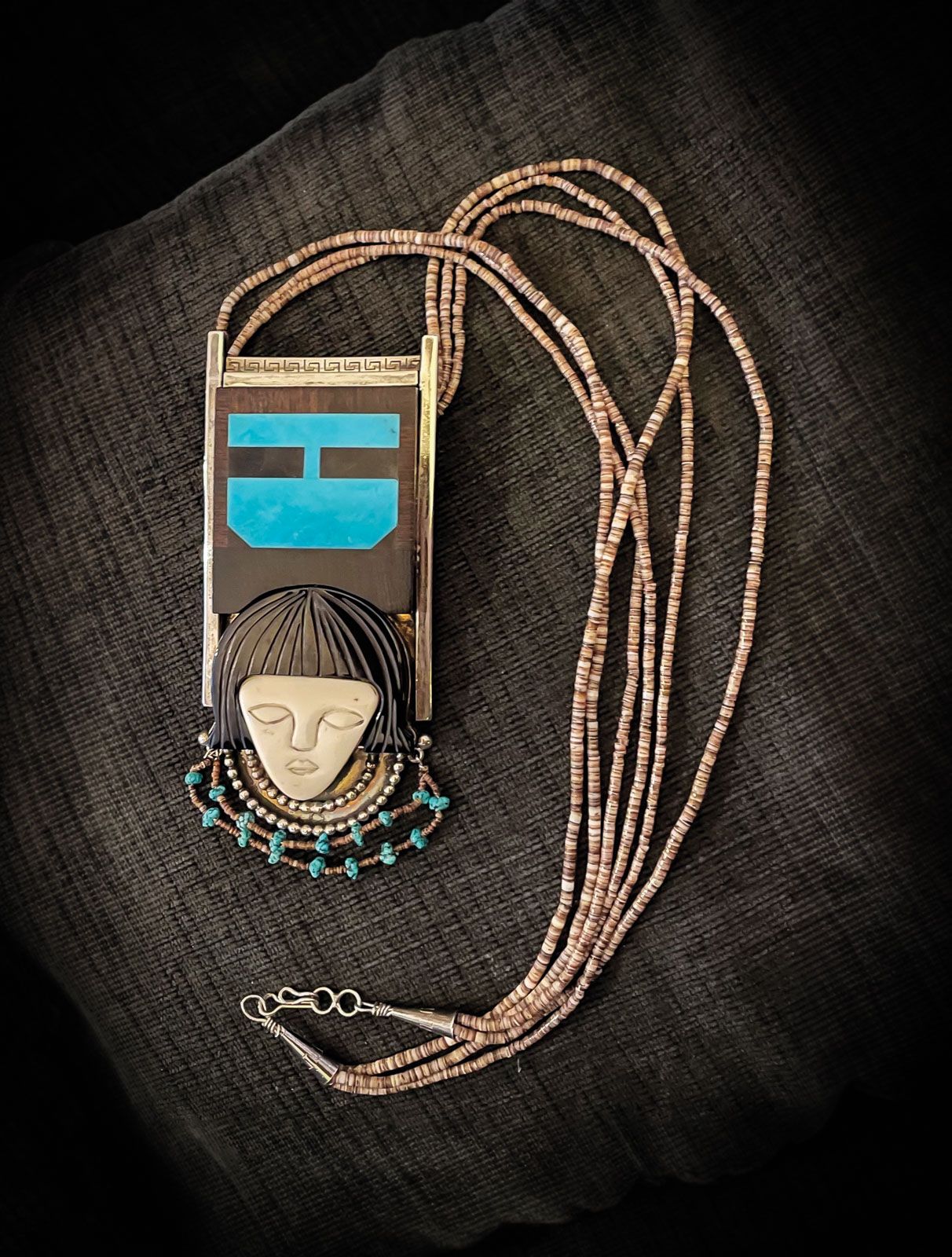 Gomeo Bobelu (Zuni, 1964-2022), Pendant. Private Collection.
“He really had an inner spiritual core that until you got to know him, you just maybe thought, well, he’s kind of goofy and he would often cry,” Jaima says. “We did a reading of the script for Nativo that Oliver Galvan-De La Cruz and I had written about the Pueblo Revolt. I asked Gomeo if he would read the part of Po’pay, the leader of the revolt. He cried. At a showing of our film at Violet Crown in Santa Fe, we were so thrilled, he cried. He had so much trauma pent up inside of him. He was so touched that people cared and that they were coming to see him. They weren’t going to see me, you know. I think it was just overwhelming to him.”
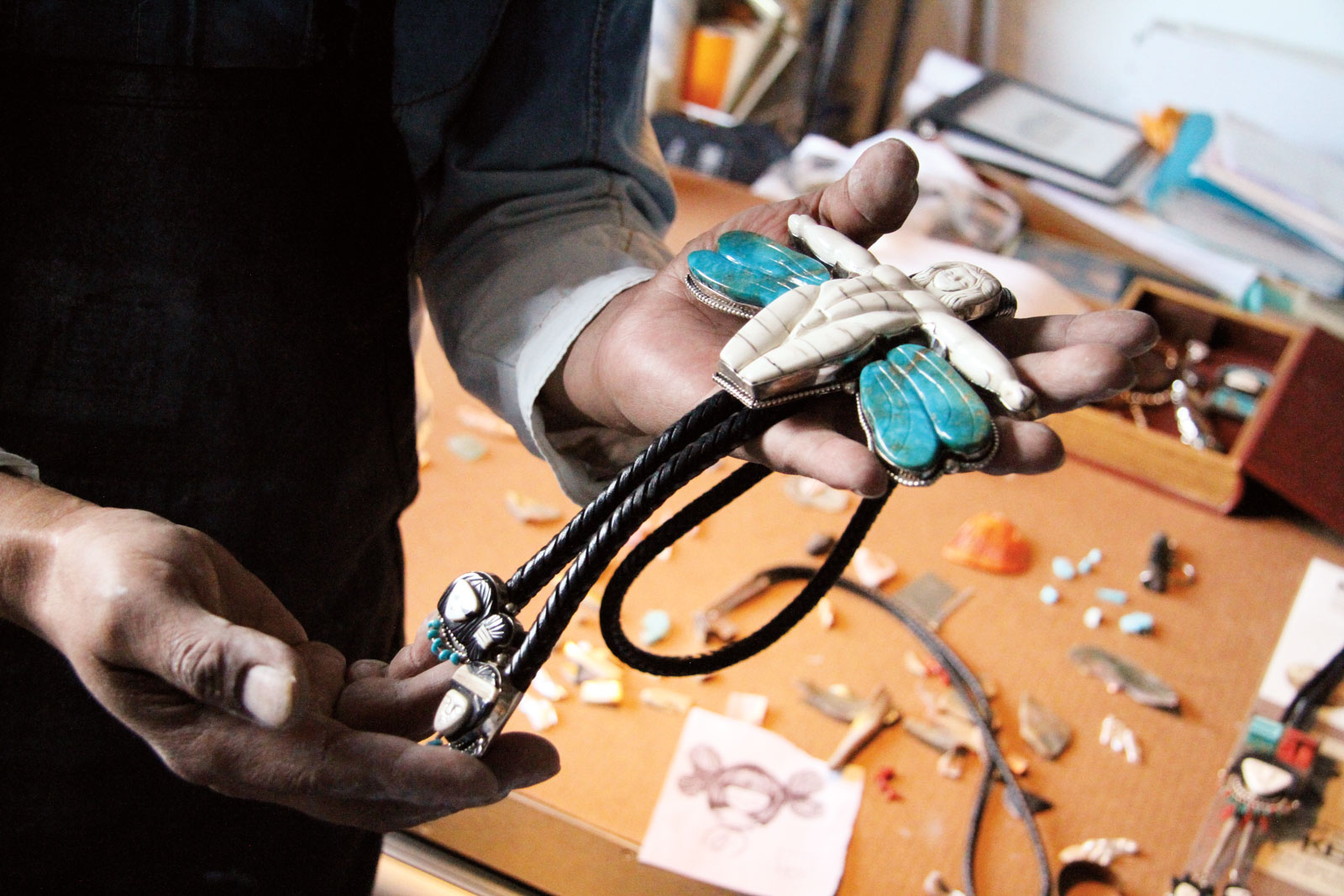 Gomeo Bobelu (Zuni, 1964-2022), Bolo—Boy Who Made Dragonfly, a Zuni legend. Photo by Brian Fishbine.
Jaima planned to make a film about the Taos Pueblo haute couture fashion designer Patricia Michaels and María Benitez, the flamenco dancer and choreographer who has Chippewa, Algonquin, Oneida and Iroquois heritage. Gomeo had been instrumental in obtaining funding from the designer Tom Ford for an Indigenous fashion show. “So I said, ‘Gomeo, can I come out to Zuni and interview you about fashion,’” she recalls. “He said ‘Sure.’ So I told my friends and a film student from LA, ‘let’s go on a picnic. We’ll take our cameras and we’ll be done in 15 minutes. We can have fun.’ How could I have been so wrong? We walked in and as I was setting up the tripods, Gomeo sat on his little couch and he broke the fourth wall talking directly into the camera. I told him he was supposed to look at me but he wouldn’t. I finally realized he’s living out his soul. And I’m just going to sit back and let him do it. So he talked to the camera. For hours. Occasionally we would have to stop the cameras because we were all sobbing.
“I got back here and I thought, OK, forget it,” Jaima continues. “That was a stupid idea. I put the film away and I told Gomeo, you know what my idea was but you have a beautiful film in you. I want to come back. I’m going to find some grant money. We’re going to come back with professional sound recording, the whole nine yards. Then Covid arrived. I thought, well, you know, after Covid, I’m going to get back out there and we’re going to get this film. Then he died. I think somewhere in his soul, he knew that he had a very unique story and that this was his one chance. He almost directed the movie by himself, as if I was just there to serve him—which I happily did.”
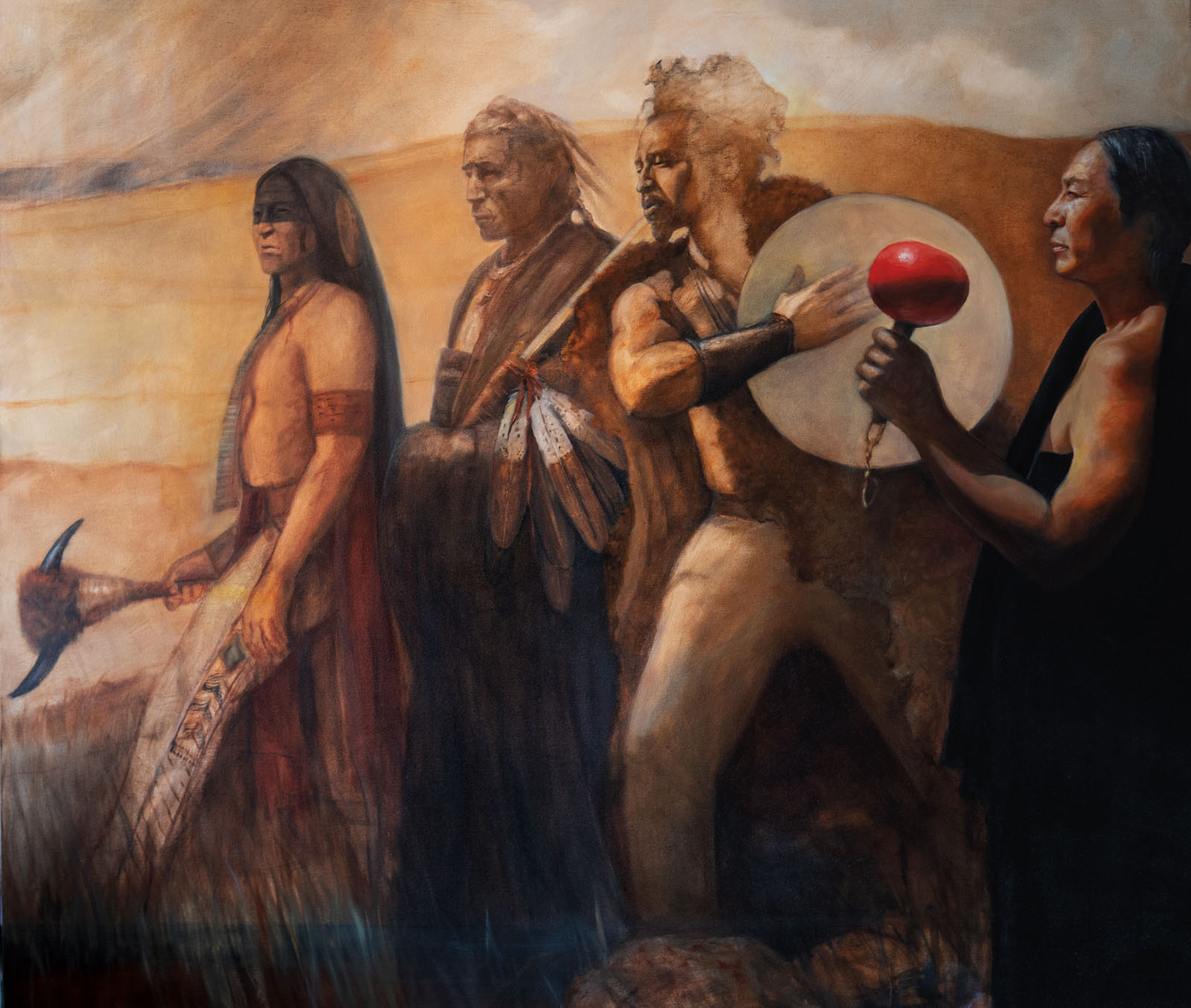 Roseta Santiago, Journey of Journeys, 2022, oil on canvas, 60 x 66”. The VonDerAu Collection.
The footage became the film Gomeo Bobelu that premiered in October 2023 at the Santa Fe International Film Festival, was nominated in the best documentary category and received an Exceptional Merit commendation from the Women’s International Film Festival.
A segment of the film features Roseta’s paintings of Gomeo, a gentle break from Gomeo’s moving monologue. AJ Goldman (Diné/Taos/Jemez Pueblo) was co-director of the film and a friend of Gomeo. Whereas Jaima tapped into the grandfather, the silversmith and the holy man, AJ wanted to film the activist. His footage of Gomeo filmed in the mountains is also included in the film.
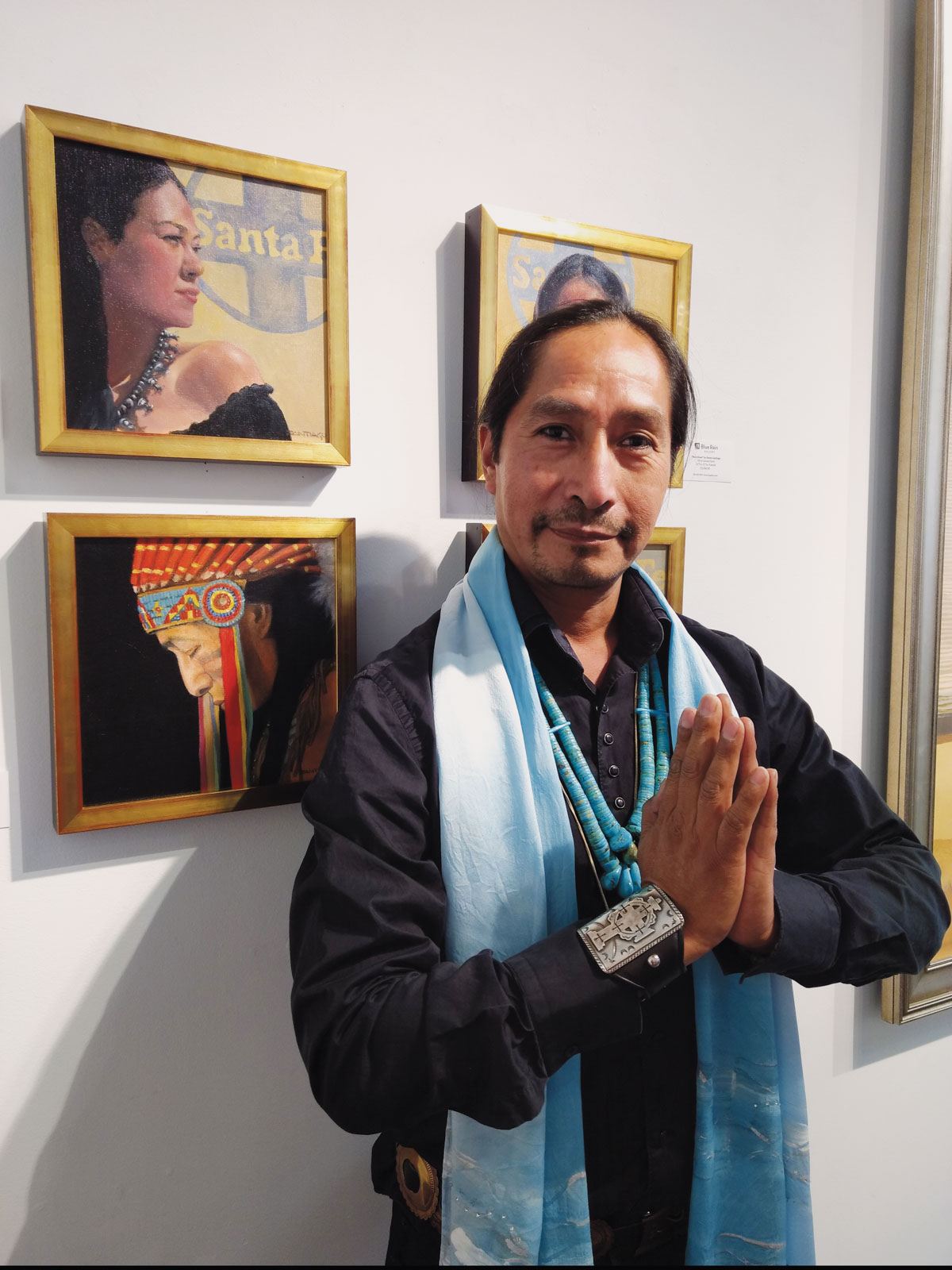 Gomeo Bobelu at an opening of paintings by Roseta Santiago at Blue Rain Gallery in Santa Fe. Next to him is her painting of him, Prayer. Photo by Jaima Chevalier.
In an interview with the Navajo Times, AJ called Gomeo “such a spiritual man, a shaman in his own way.” Commenting on the film he said, “We want to carry his voice on to the general public about the crisis really on our Indigenous people, and that is also the missing and murdered. When you want to make decisions about justice, you want to take risks and to do something right is a very powerful statement.”
The general public included Maria Camilla De Palma, head curator of the Museum of World Cultures in Genoa, Italy. The founder of the museum loved the Southwest and the museum has a dedicated section on Native North American People. De Palma saw the film and invited Jaima and AJ to screen it at the museum, and asked Roseta to show her work and banners of her other paintings in a long-term installation beginning May 30. Roseta has also been invited to speak to students at the Academy of Fine Arts in Genoa.
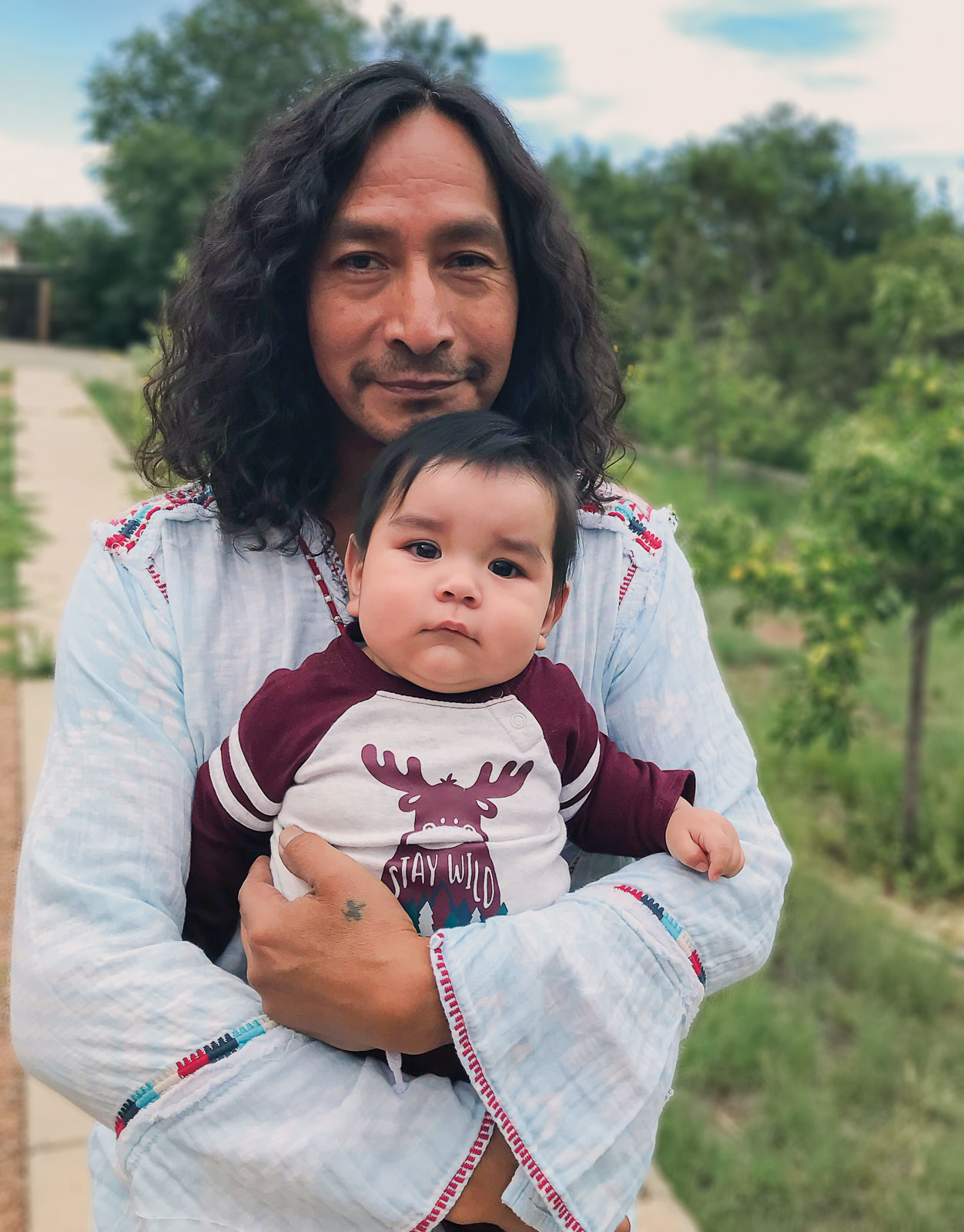 Gomeo Bobelu with his gandson. Photo by Brian Fishbine.
The installation will include examples of Gomeo’s jewelry based on Zuni legends, including that of the dragonfly. The dragonfly symbolizes the stripping away of the negativity that holds us back from our goals and aspirations. There is a Zuni story about the Boy Who Made Dragonfly which Gomeo carved in fossilized ivory.
Because of Gomeo’s advocacy for Missing and Murdered Indigenous Women and Relatives (MMIWR), AJ and Jaima are directing all the proceeds from the film toward MMIP and MMIW organizations.
Powered by Froala Editor


