Twenty-four thousand. That’s the number of ceramic vessels in the collection of the Arizona State Museum at the University of Arizona. This collection—now known as the Pottery Project—began upon the museum’s founding in 1893 and includes vessels that date back 2,000 years.
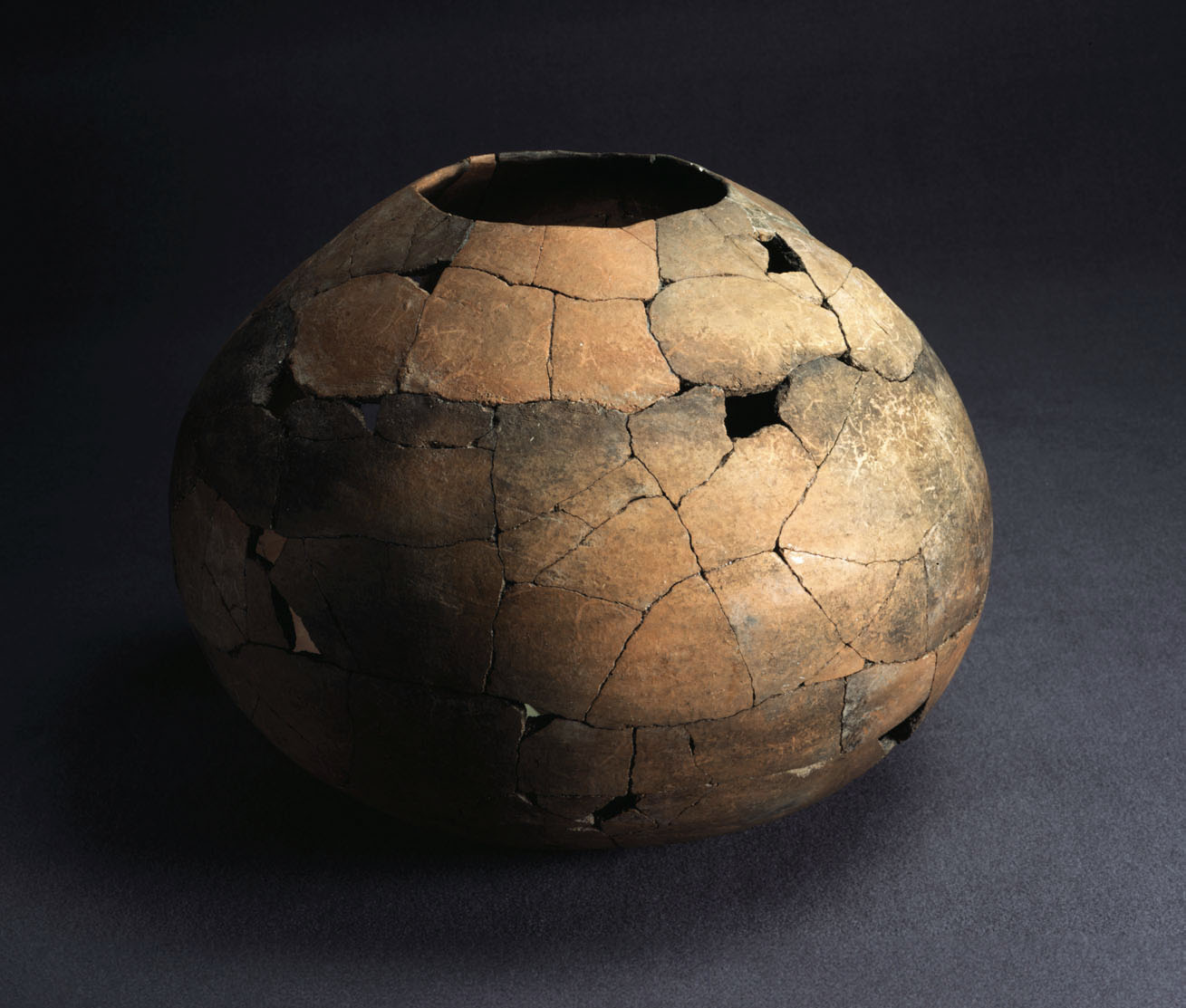 Agua Caliente Plain seed jar (tecomate), early Ceramic period, Tucson Basin, Stone Pipe Site, Tucson Basin, Pima Co., AZ, ca. 450, 112/3 x 121/3”. Cultural resource mgmt. excavation, I-10 improvements, ADOT and Desert Archaeology, Inc., 1998 (98-136-177).
A Deeper Look
Jars of this type date circa 50-500 in the Tucson Basin. This is the most complete specimen of the oldest kind of pottery container yet found in the region. It was found in a pit house at the Stone Pipe Site, near Prince Road and the I-10 frontage road in Tucson. It came into the ASM collections in 1998 as most do, by way of the archaeological repository, discovered as a result of archaeological excavations conducted in advance of a development project. Four-fifths of the objects in the ASM collections are of an archaeological nature. ASM is the largest and busiest state-run archaeological repository in the nation. The great majority of the earliest pottery containers in the Southwest U.S. and northwest Mexico were seed jars like this one. Available evidence suggests they were used for a wide variety of activities, including storage, cooking, and serving. Over the centuries, local potters eventually developed an amazing array of vessel shapes related to different functions, including necked jars, bowls and ladles.
The earliest vessels acquired by the museum came from the first curator, a man named Herbert Brown. “Interestingly, at the same time he was the curator here, he was the warden at the territorial prison in Yuma,” explains Diane D. Dittemore, associate curator of ethnology at the Arizona State Museum. “So the first pieces in our collections are pots that he collected around 1900 from the tribes of the lower Colorado River.”
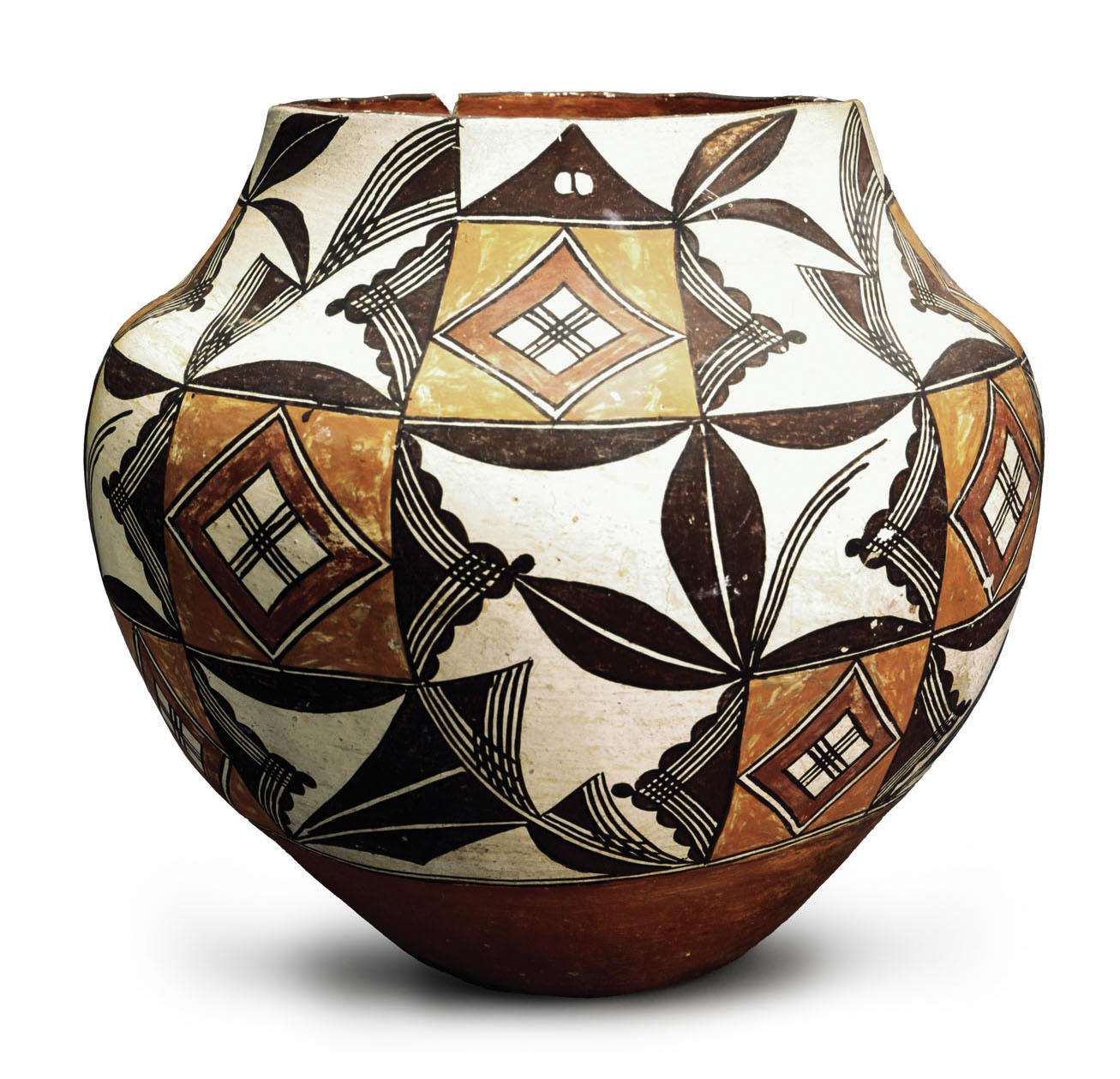 Tzu-chey (Minnie Sice) (Laguna Pueblo), Laguna Polychrome jar, ca. 1900, 122⁄3”. Gift of Mary T. Fitzmaurice, 1975. Collected by Henry G. Peabody. ASM #1975-5-1.
Over the next 130 years, the collection grew through significant donations from private collectors. From 1959 to 1962, the University of Arizona ran a program called the Southwestern Indian Art Project, which was sponsored by the Rockefeller Foundation. “The goal of the program was to introduce some of the promising young Native artists to some of the quote-unquote ‘Western’ artistic techniques,” Dittemore explains. Among the teachers in this program were Charles Loloma and his wife Otellie. As a result, the museum’s collection includes works by students in the program that were inspired by Loloma’s stoneware, as well as stoneware from Loloma himself.
Then, in 1999, the Pottery Project was dubbed an “American Treasure” by the Save America’s Treasures program, which offers federal grants to help preserve nationally significant historic properties. In the two decades since that designation, the museum has raised money to make purchases from more contemporary Native potters.
“The money raised by the Friends of the ASM Collection has enabled us to acquire works from a lot of really amazing contemporary artists like Susan Folwell and Bobby Silas,” Dittemore says. “We don’t want to just wait for people to donate their collections to us.”
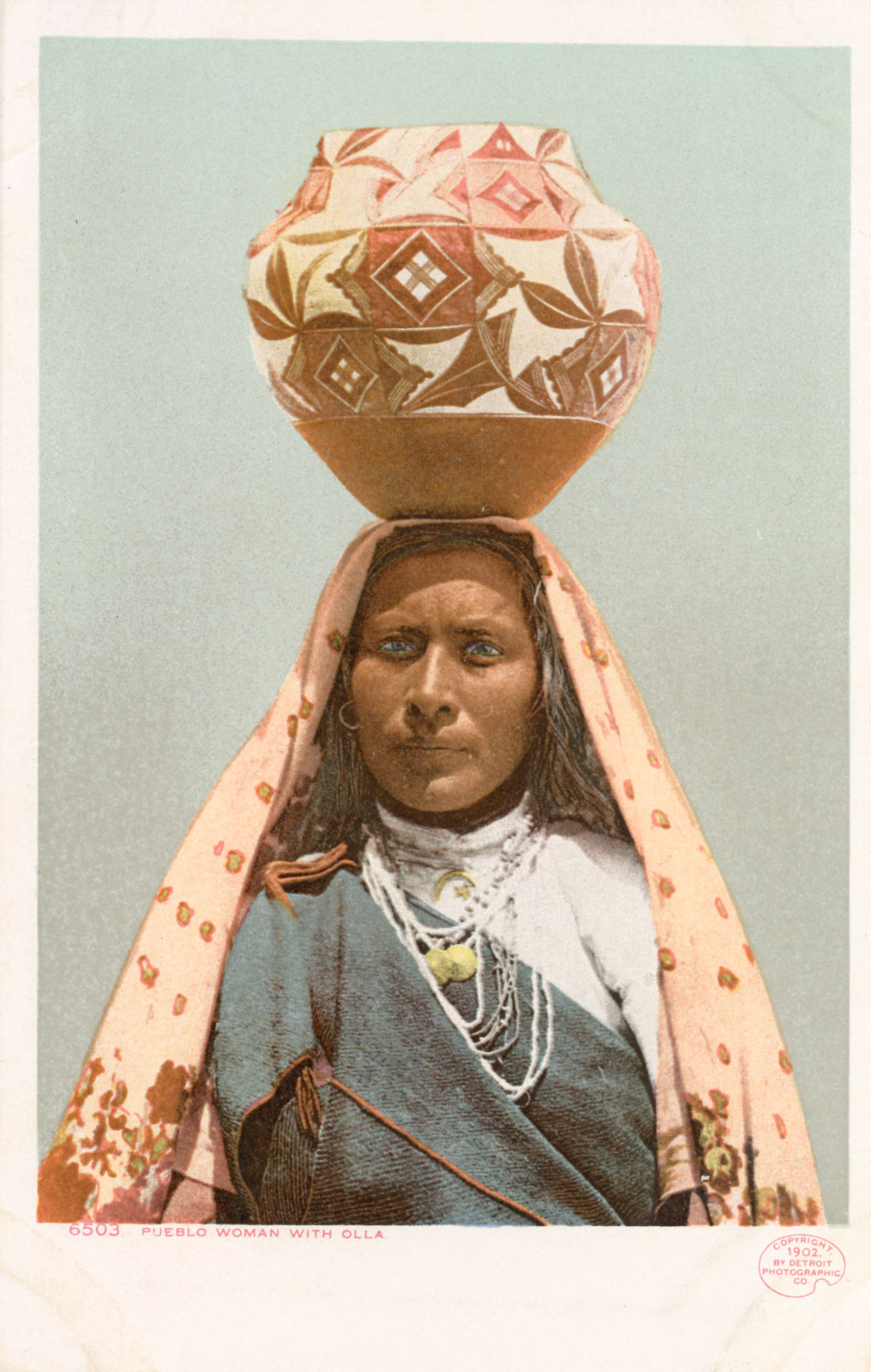 Postcard depicting Tzu-Chey (Minnie Sice), ca. 1900, with her Laguna polychrome jar. Detroit Publishing Company. Photographer William Henry Jackson. ASM Linderman Collection, 1976-104, Box 1.
Around 80 percent of the vessels in the Pottery Project are what is referred to as “archeological” or “pre-Hispanic.” “These types of specimens are used to reconstruct the ancient history of archeological cultures,” explains Patrick D. Lyons, director and curator of the Arizona State Museum. “For this part of the world, the break point for that is the coming of the Spanish in the Coronado Expedition of 1540.”
These archeological vessels include pottery of all shapes, sizes and function. The museum’s collection includes pieces that originate all over the southwestern United States and northwestern Mexico, with a predominant focus on vessels from Arizona, and they are up to 2,000 years old. “Before that, there was a little bit of pottery making, but it was all in miniatures and not particularly functional,” Lyons says. Many of the archaeological pieces included in the Pottery Project were uncovered during the museum’s own archeological efforts.
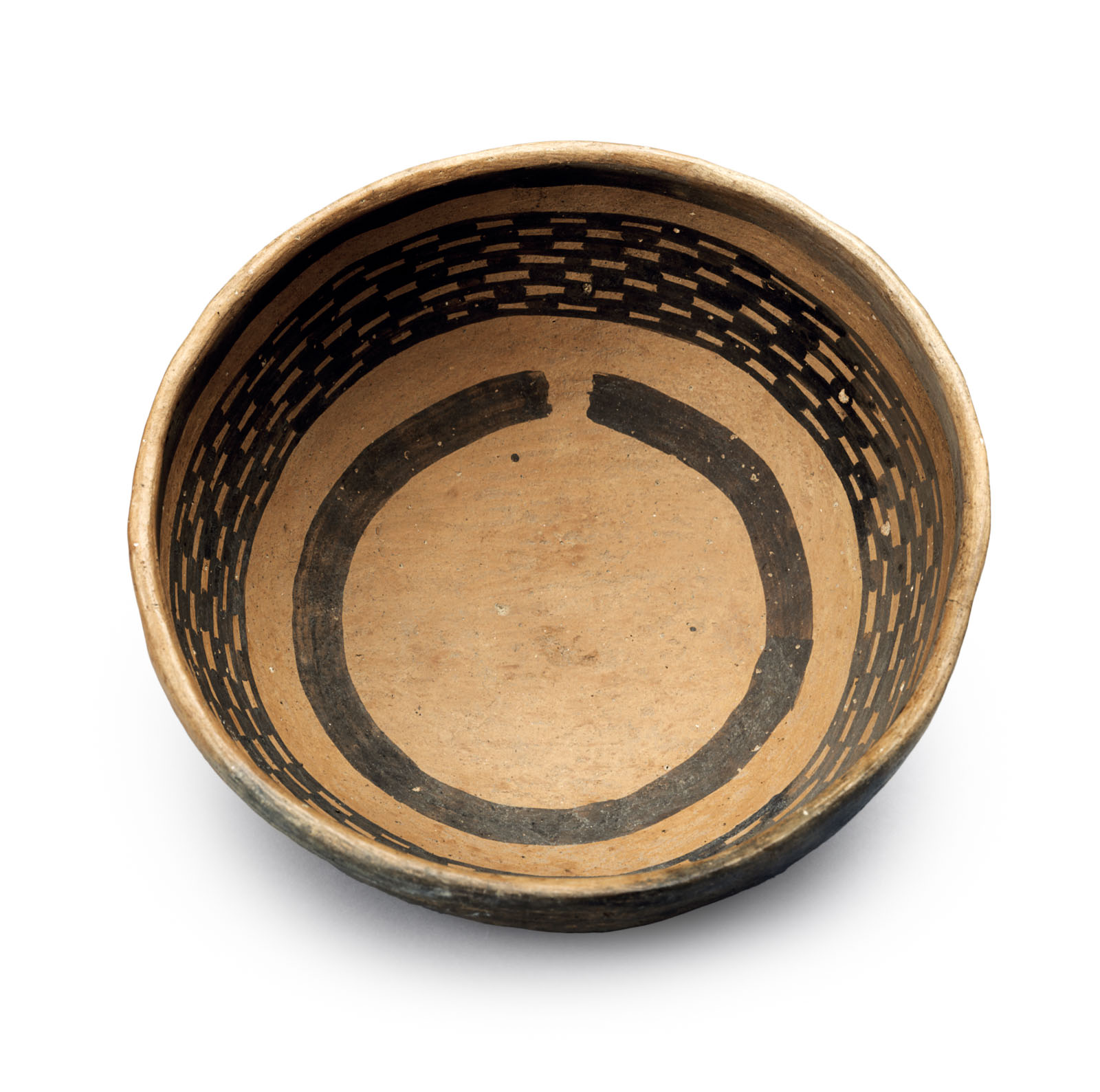 Tuwiuca Black-on-orange bowl, early Hopi, Winslow Province, ca. 1250-1350, 31/3 x 7”. Chavez Pass Ruin, Chavez Pass, Coconino County, AZ. Gift of Gila Pueblo Foundation, 1950. Toelle Collection, GP9129.
A Deeper Look
This vessel represents one of the earliest types of pottery recognizable as being made by the Hopi people of northeastern Arizona. Pots like this also help archaeologists track ancestral Hopi migrations. It was made at one of the Homol’ovi villages, near Winslow, Arizona, by a potter who had relocated there from the Hopi Mesas, about 60 miles to the north.
Deciding how to exhibit these tens of thousands of pieces can be a challenge, but the designation of the Pottery Project as an American Treasure enabled the museum to start to build an exhibition space befitting the collection. “The designation allowed us to get grant funding and raise private donations to create a new gallery along with a state-of-the-art curation facility and conservation laboratory,” Lyons says.
It’s a constant negotiation between protecting and preserving vessels as well as they can, while also creating maximum visibility into the collection. The gallery space includes large windows that peer into a climate-controlled vault, where viewers can see row upon row of pottery pieces.
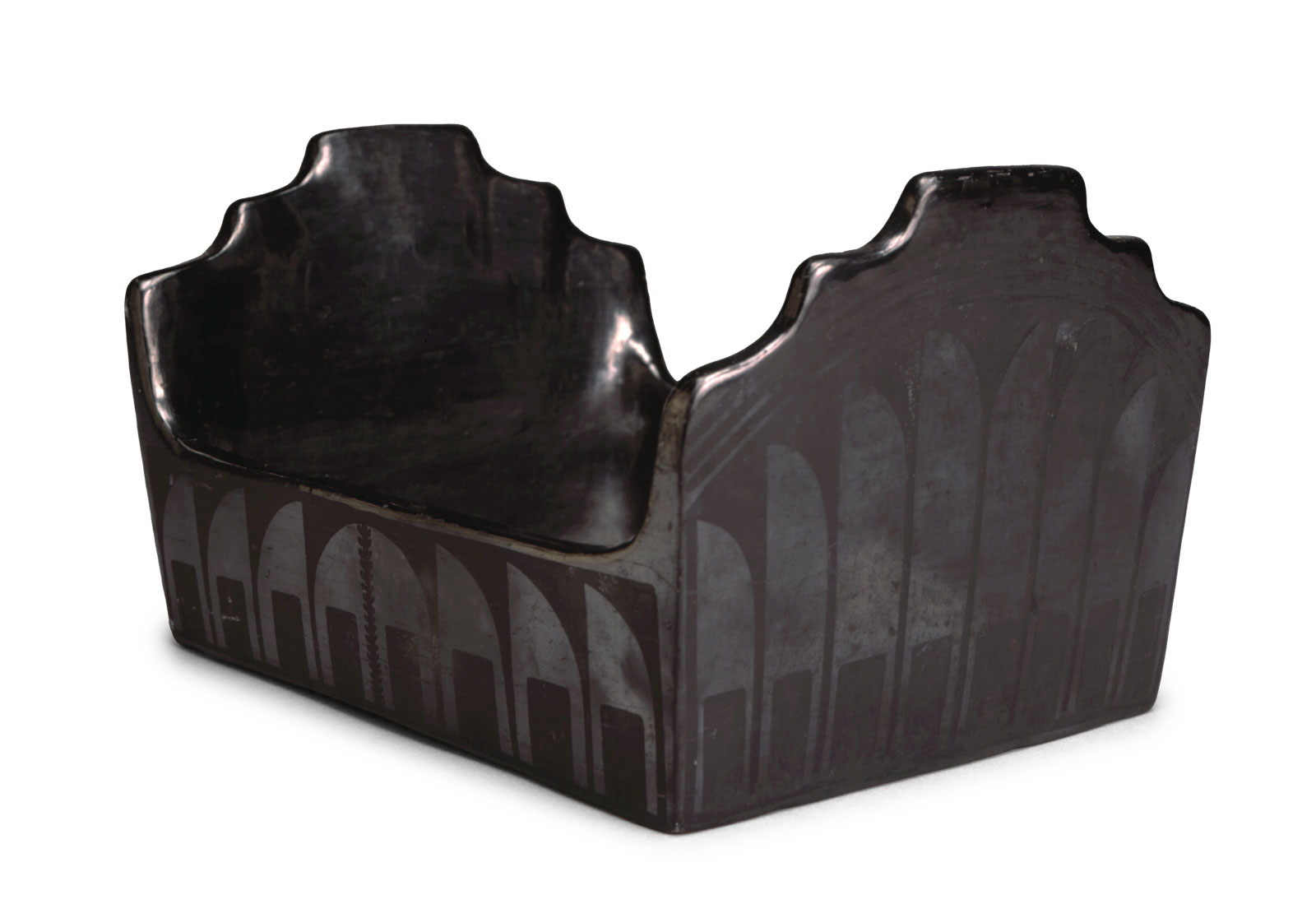 Maria Martinez (San Ildefonso Pueblo, 1887-1980) and Julian Martinez (San Ildefonso Pueblo, 1879-1943), black-on-black vegetable dish, 1929, 92⁄3”. Gift of Ansel and Virginia Adams, 1977. ASM #1977-63-7.
The crown jewel of the exhibition space is known as the “Wall of Pots.” It’s a floor-to-ceiling case with six columns featuring around 170 vessels. “The Wall of Pots allows us to represent material from each of the ancient cultures in the region as well as the contemporary tribal cultures that are represented within our collection,” Lyons says. Three columns are dedicated to ancient groups, and the remaining three are dedicated to the people and cultures of today.
When visitors venture further into the gallery, they’ll see cases that highlight different elements of pottery making. One is themed “Form vs. Function,” which explores how the shape of a vessel reflects its use, whether that’s a beer-brewing pot or a ceramic used to make tortillas.
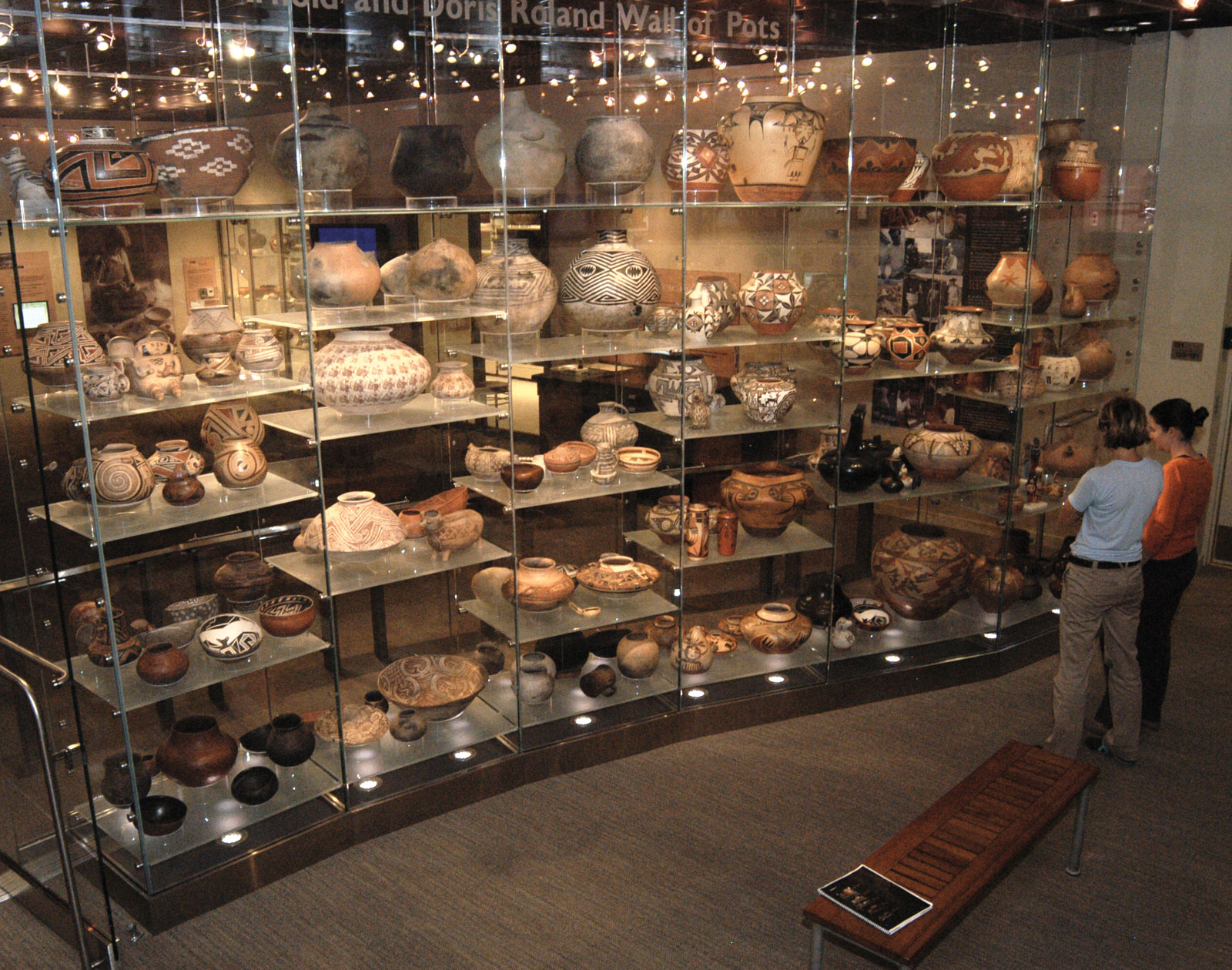 The Wall of Pots at the Arizona State Museum in Tucson, Arizona.
Another case focuses on the curio trade, which captures the intersection of the Native cultures of the region with the Western age, and all the political, economic and social changes that came along with that. “Particularly after the railroad came through the Southwest, people started pouring in from places like New York or Chicago or Philadelphia,” Lyons says. “Suddenly, Native potters had access to a new market and started to innovate and create non-traditional vessel that might be more appealing to an Anglo audience.”
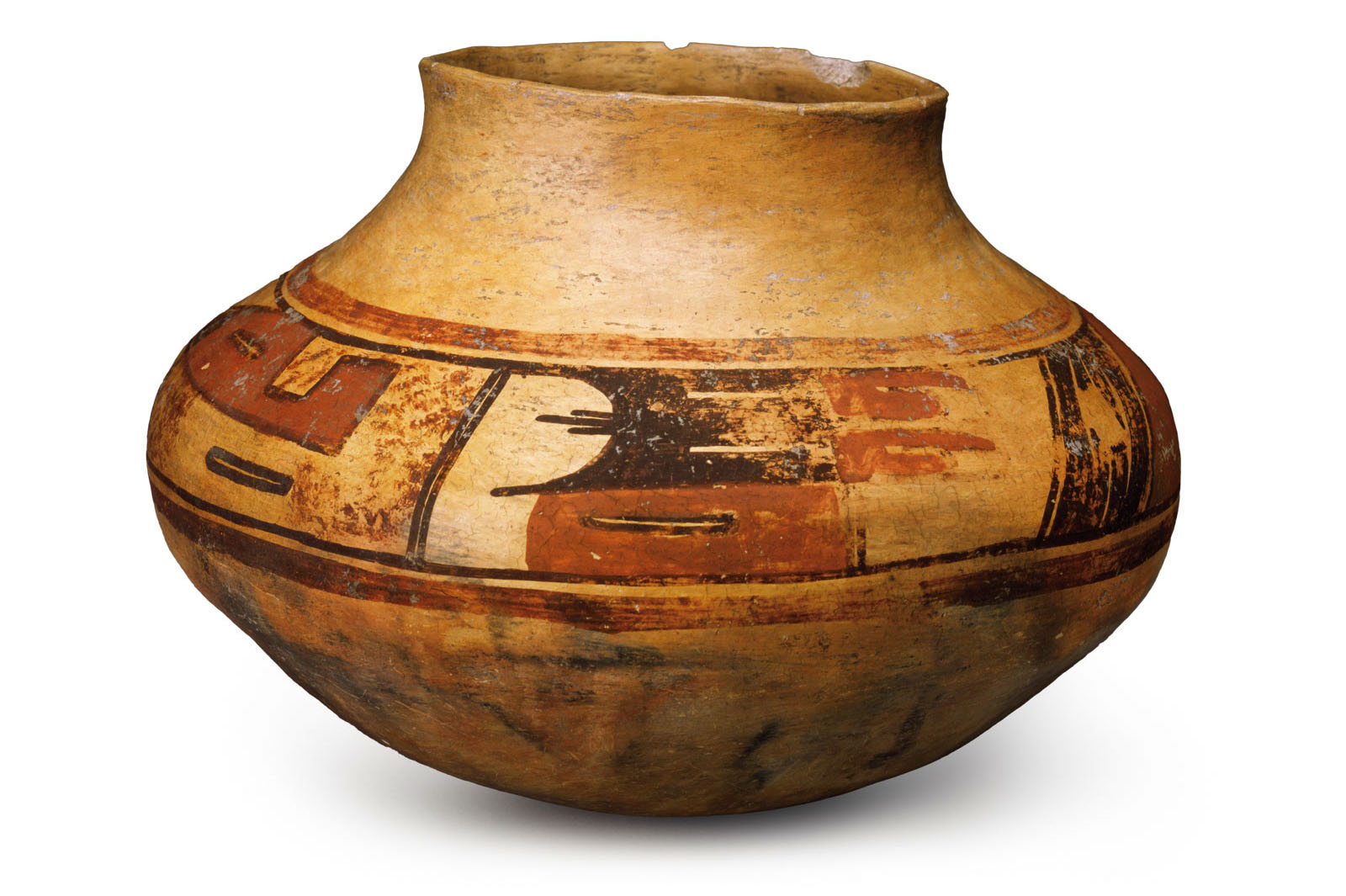 Matsaki Polychrome jar, early Zuni, Zuni Province, ca. 1400-1680, 124/5”. Mats’a:kya, Zuni River, McKinley County, NM. Gift of Museum Friends, 1981 (81-55-1).
A Deeper Look
This vessel, though made in the Zuni area, bears painted Sikyatki-style decoration, named after the ancestral Hopi village of Sikyatki. It was made out of a grayish clay and then covered with a thin layer of a yellow-orange-firing clay (a slip), before the paints were applied, which made it similar in color to vessels made by Hopi potters.
One of the most complete ancient specimens in the Pottery Project is an Agua Caliente plain seed jar, which dates to around 450 C.E. “We like to talk about it as the grandmother of all pots,” Lyons says. These seed jars were used for a variety of different activities, including storage, cooking and serving, and while many of the earliest pots were shaped just like this one, there was eventually an explosion of different vessel shapes that emerged for different functions, like bowls and ladles, as well as long-necked jars.
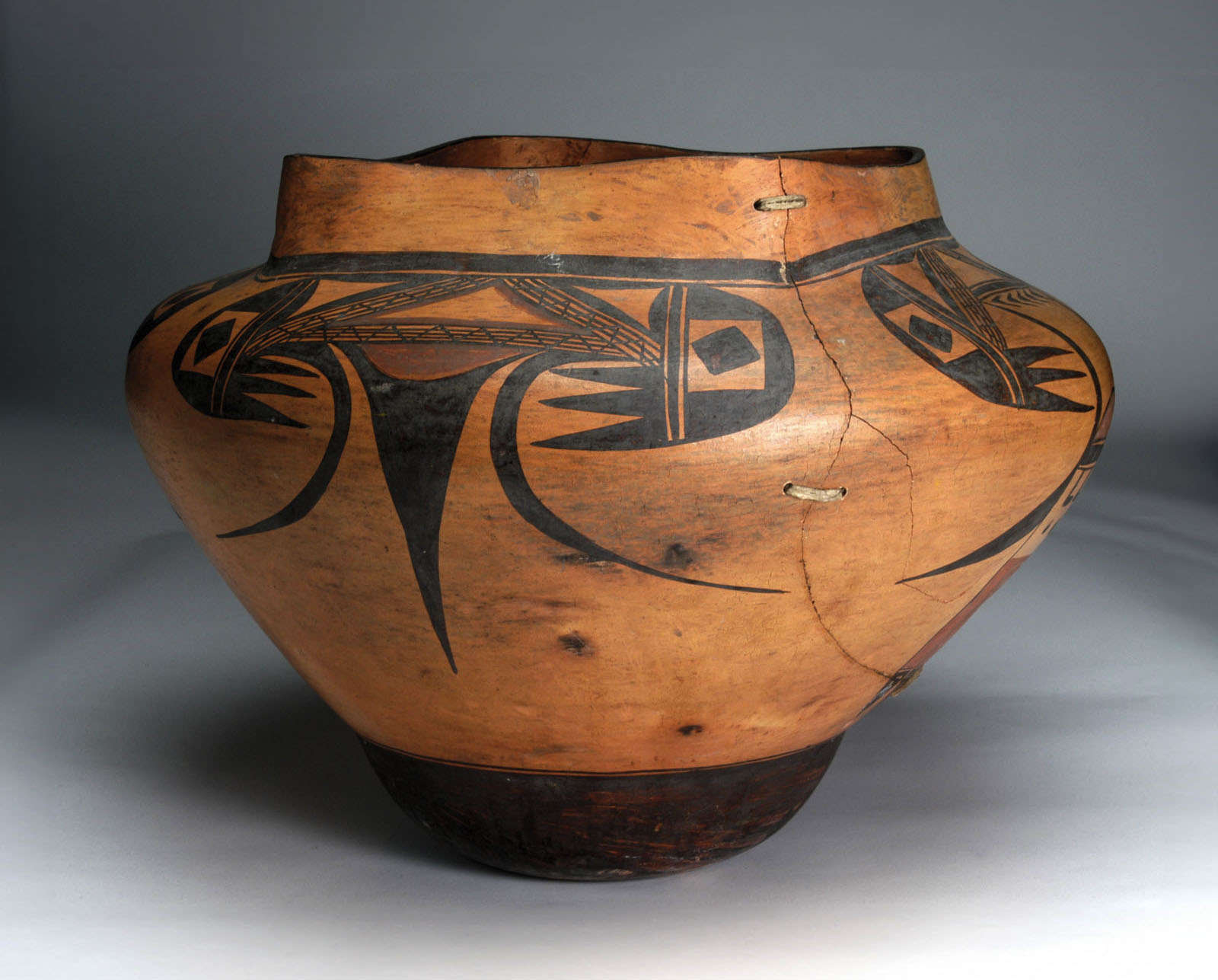 Nampeyo (Hopi-Tewa, 1859-1942) and likely other family member, large square-top polychrome olla, ca. 1900-1920. Gila Pueblo Foundation gift, 1950. ASM #GP-52543.
Another remarkable pre-Hispanic piece is a Tuwiuca black-on-orange bowl, created around the 13th century. “It’s one of the first recognizable pieces of pottery that we can definitely associate with the Hopi as a tribal ethno-linguistic group,” Lyons says. This bowl was created near what is now Winslow, Arizona, by a potter who had immigrated from one of the Hopi mesas.
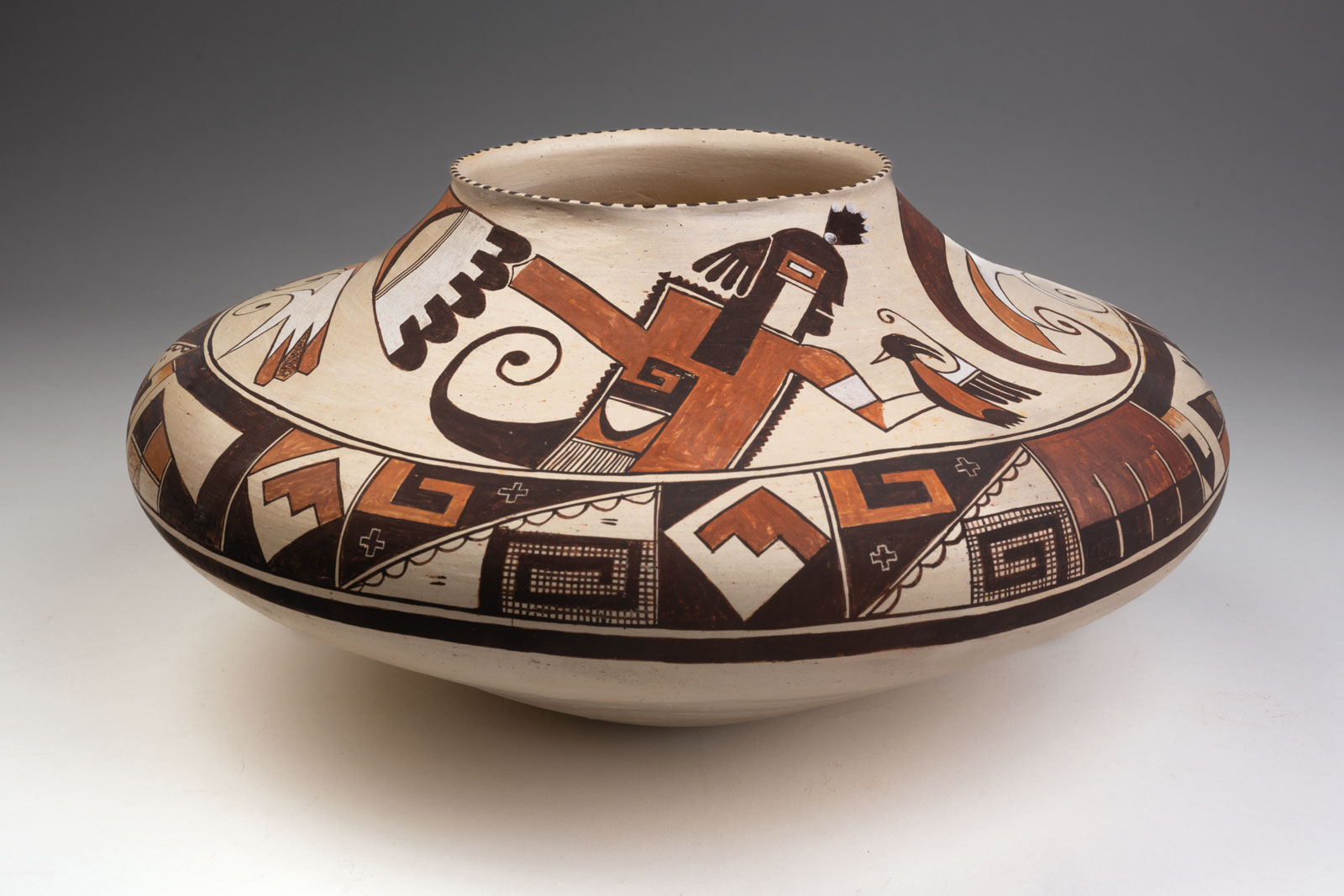 Bobby Silas (Hopi-Tewa), Asking for a Prayer for Rain, 2023, lignite-fired polychrome jar, 15¾”. ASM purchase, 2023. Friends of the ASM Collections funds, 2024-65-1.
On the more contemporary end of the spectrum, the museum has a large series of pots created by Nampeyo. One in particular was donated by a man named Joshua Miller, a doctor who spent summers in the late 1800s providing medical care in the Hopi Pueblo. It was then that he treated Nampeyo for an eye condition, and in exchange, she gave him a canteen with a kachina design on it.
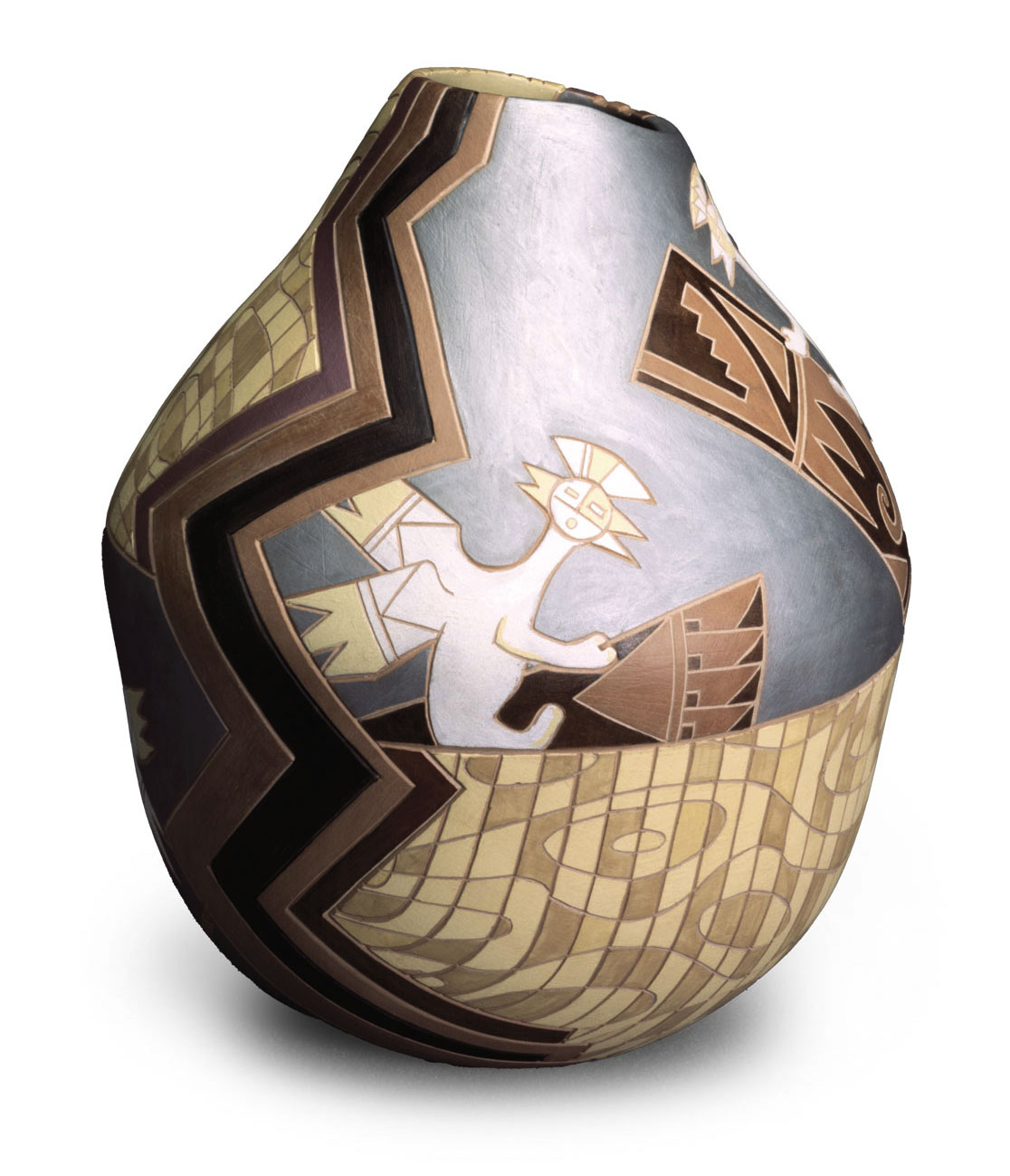 Susan Folwell (Santa Clara Pueblo), Mosquito Man, 2008, Wood stain and acrylic paint, 10¼”. ASM purchase, 2008. Friends of the ASM Collections funds, 2008-344-1.
“There are many museums throughout the country who have collected works by Nampeyo, and it seems like right now there are many scholars who are coming together to try and tell the most truthful story about her life and influence,” Dittemore says. “We’re so excited to be able to contribute to this conversation about Nampeyo, her family and her legacy.” The museum first created a Nampeyo showcase in 2000 and is now planning an update to reflect the current conversation.
Part of the space exhibition is devoted to “Potters of the Vanguard,” spotlighting the innovation of Native artists. “One of the things we’ve heard over and over again from Native artists is that they are tired of being thought of as only Native artists,” Lyons says. “It lays unfair expectations for the type of work they create.” This section includes artists like Virgil Ortiz, Diego Romero and Christina McCourt, who are pushing boundaries and doing things differently. “We don’t want to freeze Native people in the past. We’ve tried to collect what people are doing now.”
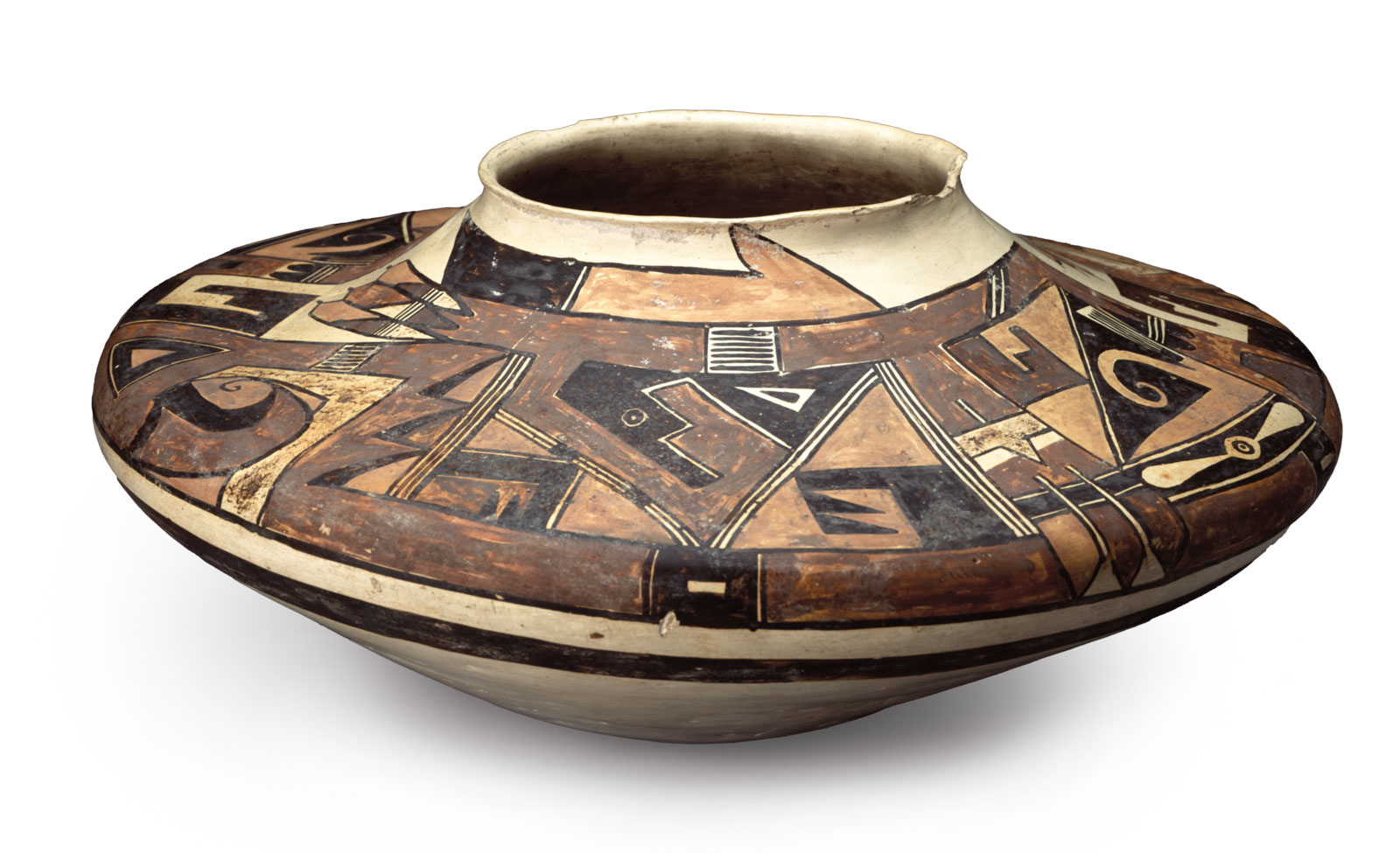 Sikyatki Polychrome jar, late style, early Hopi, Tusayan Province, ca. 1450-1630, 6¾ x 161⁄5”. Keams Canyon, Navajo County, AZ. Gift of Gila Pueblo Foundation, 1950. McAdams Collection, GP4730.
A Deeper Look
This painted jar is referred to as a Sikyatki-style jar, named after the ancestral Hopi village of Sikyatki. Between the 1400s and about 1700, both Hopi potters and Zuni potters painted pots in this style, although it seems to have developed among the Hopi. This specimen was made on the Hopi Mesas out of yellow-firing clay and fired using coal.
A contemporary work by Susan Folwell, titled Mosquito Man, was purchased by the museum in 2008. It’s a piece that features traditional images, but it’s painted with acrylics and wood stain. Dittemore says, “She’s certainly one of the most fascinating creators of Southwestern pottery working today. Every year, it seems like she’s going in some new, amazing direction.”
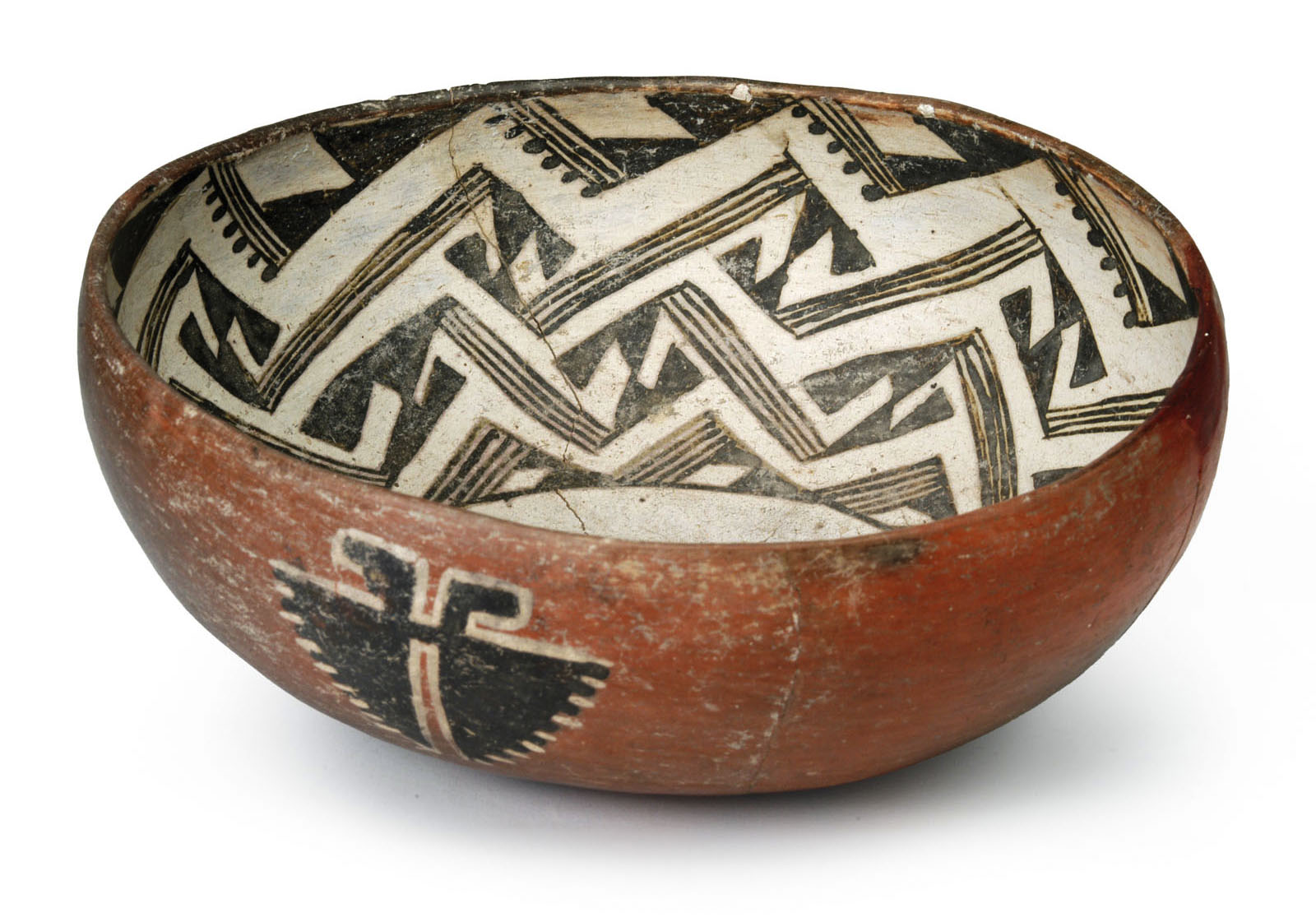 Kwakina Polychrome bowl, early Zuni, White River Province, ca. 1275-1500, 4½ x 11”. Kinishba, White River, Gila County, AZ. University of Arizona Archaeological Project, 1931-1939 (23823).
A Deeper Look
This vessel represents one of the earliest types of pottery recognizable as being made by the Zuni people of west-central New Mexico. It was made in the Zuni region but made its way, either through migration or trade, to Kinishba, a pueblo in east-central Arizona, on the Fort Apache Indian Reservation. The people of Kinishba were most likely ancestors of the Hopi and the Zuni.
Because the Arizona State Museum is part of the University of Arizona, every semester, ceramics students visit the Pottery Project space. Watching them experience the range of Native pottery is a thrill for Dittemore. “Often, this is the first time these students have had the opportunity to see Native pottery,” she says. “It’s so exciting to see them experience examples of pottery going back 2,000 years, then get into the minds of modern artists like Diego Romero and be able to understand the connections between all these pieces.”
Ongoing
The Pottery Project
Arizona State Museum at the University of Arizona
1013 E. University Boulevard, Tucson, AZ 85721
(520) 621-6302, statemuseum.arizona.edu
Powered by Froala Editor


