In the vibrant landscape of contemporary Native American art, modern ledger artist Chris Pappan has emerged as a leader and trailblazer within his discipline and greater community. His artistic expression departs from conventional modes and mediums, charting new courses across the expanding frontier of the artistic movement known as Indigenous futurism.
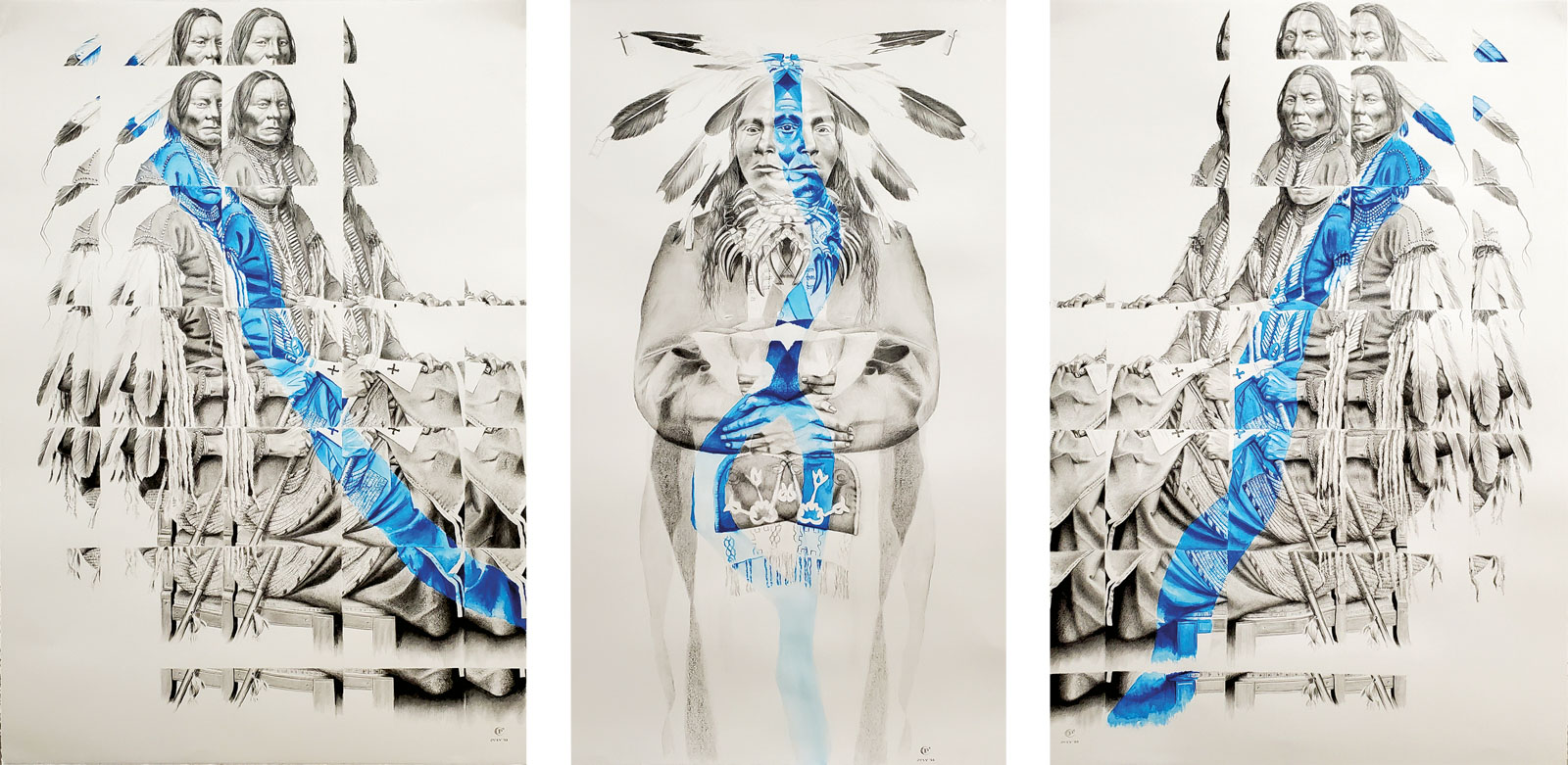 Howageji Nizhuje Akipé (Where the Rivers Meet) 1,2,3, pencil, graphite and gouache on Rives BFK, 44 x 30” each
Pappan, an enrolled member of the Kaw Nation (Kanza), with ancestral ties to the Osage and Lakota, has earned international recognition for his distinctive artwork on ledger canvases. Originating among Great Plains tribes in the mid-1800s, ledger art has a rich historical legacy, and it carries a mantle of time-honored traditions that Native American artists have been expected to uphold.
“Growing up in the Southwest, whenever I saw Native art it was always long hair, feathers, horses—Native artists capitalizing on what they know would sell,” says the artist. “I came into ledger art at a time when there was a relatively small number of living artists doing it, and there were only a couple who were open to the genre changing. And I understand where they were coming from. Galleries and buyers often don’t want anything too different. You never know how work will be received, especially if you’re doing something unusual. When I was starting out there were certain tropes I thought I had to play into if I wanted to be an artist.”
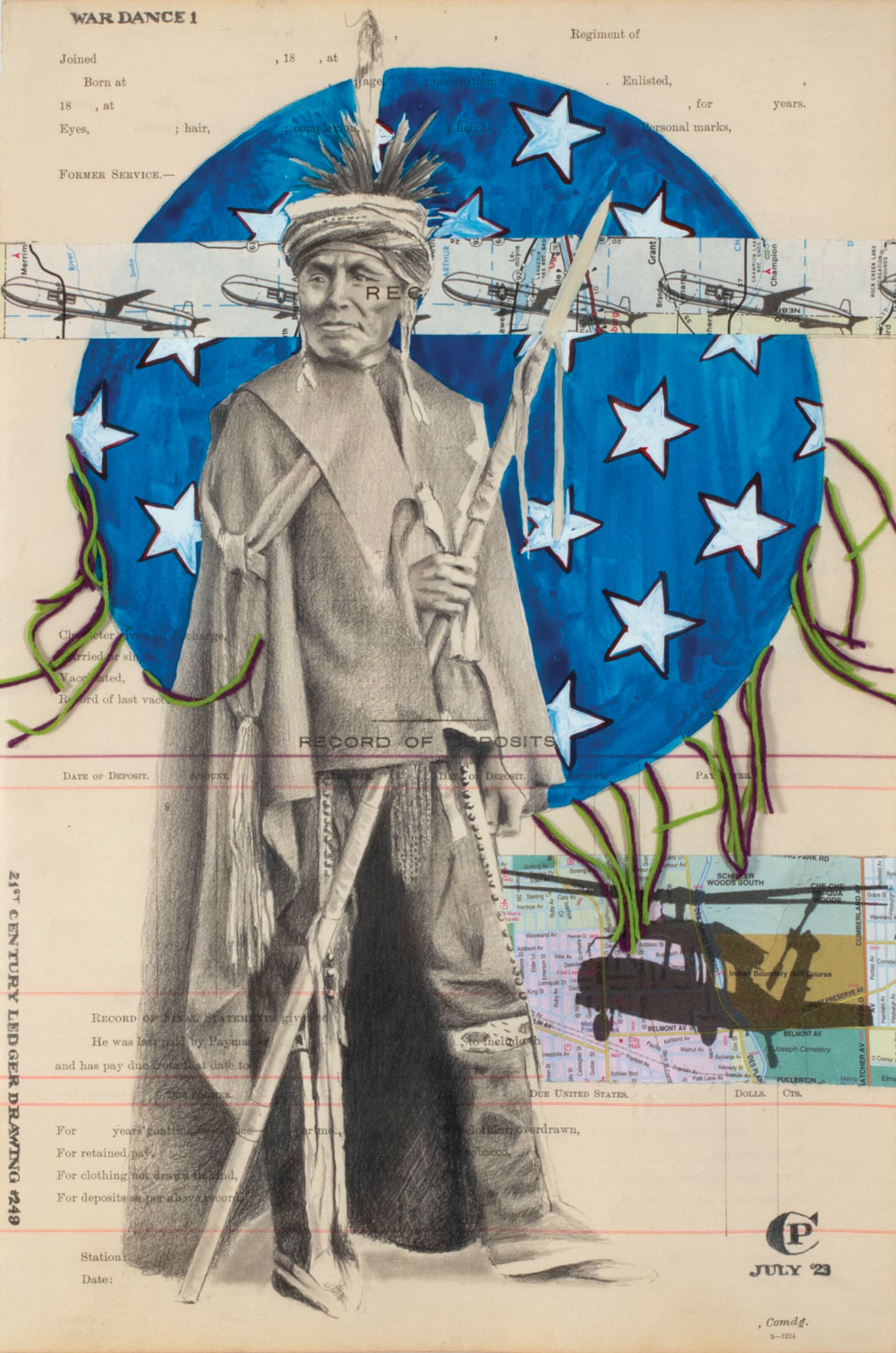 War Dance 1, graphite, gouache, embroidery floss and map collage on U.S. Cavalry recruitment ledger paper, 15½ x 10¼”
Musing on where he is now, working from his studio based in Chicago, Chris admits, “The fact that I don’t have to limit myself to those stereotypes is very liberating. It’s hard for me to stay motivated doing the same thing over and over. I like to try new things. I thrive when I’m evolving. It’s part of living the dream.”
The canvases for Chris Pappan’s expression take various forms, including Rives BFK paper for larger works and antique ledgers from diverse sources. Adorning them with graphite, ink, paint, map pencils, collage and precious metal leaf, Pappan crafts meticulous imagery that transcends the confines of genre norms. His photorealistic depictions of Native subjects and anthropomorphic figures are distorted by fragmentation and experimental patterning, granting them a mesmerizing multiplicity.
“In my most recent series, The Motion of Breathing, I’m working in larger formats and exploring different methods of distortion,” says Pappan. “I’m separating source images into a grid pattern and repeating parts of the image across my canvas, emphasizing the abstraction that occurs in the overlap of an image with itself. Special things happen in that middle ground, where realism and abstraction intersect.”
The Motion of Breathing, a series of approximately 25 new works, is Chris Pappan’s first solo exhibition at Blue Rain Gallery in Santa Fe. The collection will debut on March 29.
Pappan’s ledgers serve as both tessellated windows to the past and as beckoning gateways to unexplored dimensions where ancestral narratives are augmented and immortalized by modern vision. This fusion of tradition and innovation is an increasingly recognizable hallmark of contemporary Native Art, a trend bolstered by the growing influence of Indigenous futurism. Pappan doesn’t see the current progression as a crossroads, but as more of a roundabout.
“Indigenous futurism completes our cycle of self-representation. Our art, our existence and our identity, have for such a long time been represented as being from the past, not as facets of the present or future,” Pappan says. “I hope to change that. Not to say our past isn’t important, it is. But I want to bring the past, present and future together in a holistic way. You can’t have one without the other.”
This perspective of time existing as an all-encompassing whole is a key concept in the overarching philosophy of Indigenous futurism, a term coined by Anishinaabe author and professor Grace Dillon. Indigenous futurism as an artistic movement, emancipates creative possibilities by discarding colonial limitations, allowing Indigenous culture to be woven into the modern mainstream undeterred. The definition of the term is continually evolving, which is part of its power.
“When I respond to questions about the movement, my definition keeps changing,” Pappan says. “I keep coming up with different answers, and they’re all relevant, which I think is fitting for a futurism movement. Art demands freedom. We have to let it be what it needs to be.”
This notion is embodied perfectly in Pappan’s work. The curated ambiguity in his art challenges viewers and peers alike to delve into the many layers of meaning and take on diverse perspectives in the process.
“I want people to be curious and inspired to learn, I don’t want my art to be completely self-serving. Certain elements of my work are especially relatable to my Native audience, there are aspects that I want to translate into community ideas.”
Artistic innovation can have a ripple effect across creative circles, a phenomenon that Pappan has witnessed often in his career.
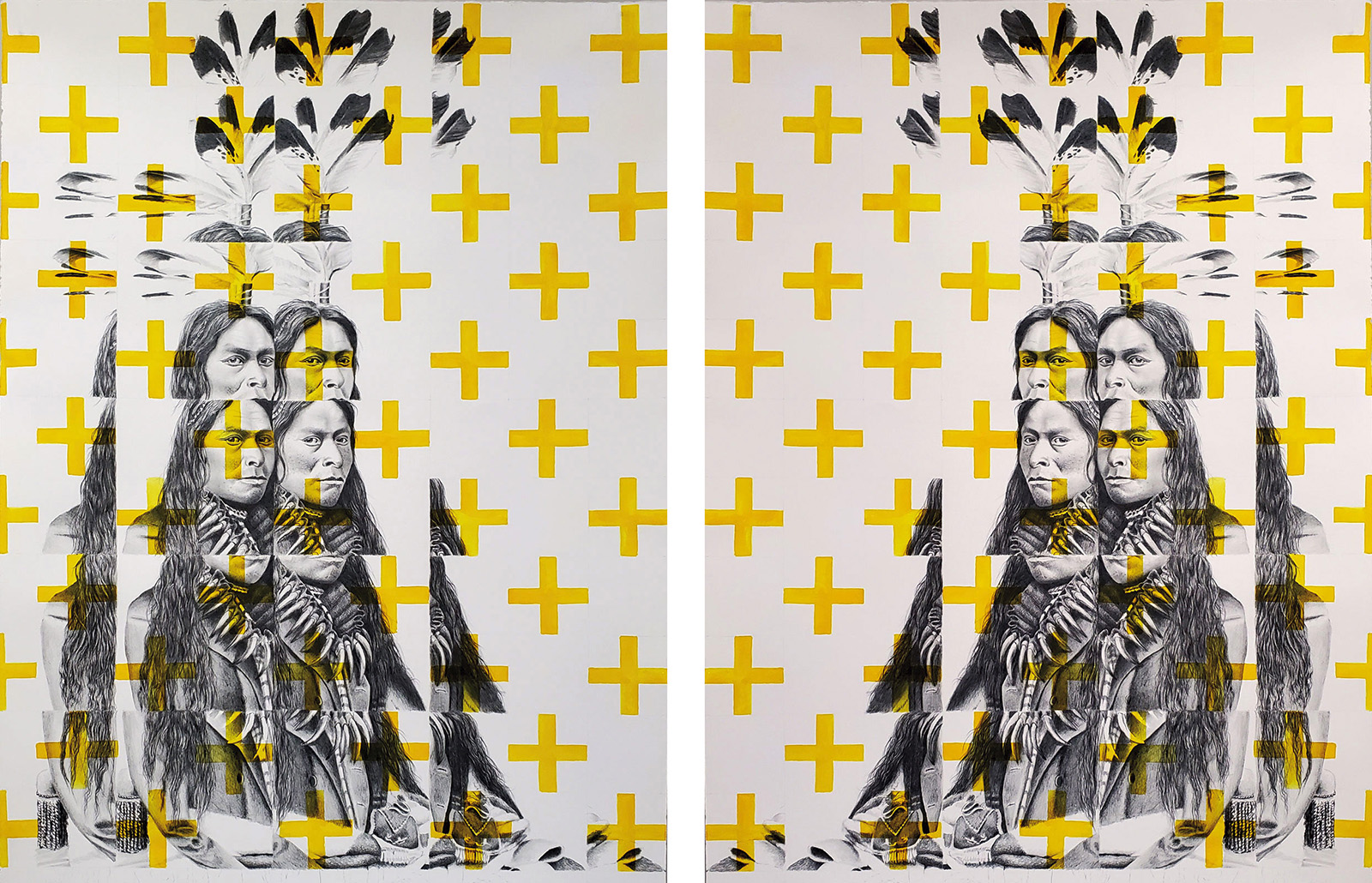 Works in progress, Frequency and Frequency 2.
“When you do something revolutionary, people will always want to emulate it. Some people might say it’s just copying, but that’s not always the case. It’s playing a part in the movement, and it’s something I’ve seen happen in ledger art. There’s more young people exploring like I have, incorporating realism, experimenting with graphical distortion—and there’s still young artists making traditional ledger art too. In the process of changing the genre there’s no loss, only growth and evolution.”
In a candid summation of this concept, Pappan concludes, “Today, we’re seeing a growing awareness and more opportunity, more freedom to dream, make weird art, do crazy things, bend and break barriers, dare to be different.”
Reflecting on the Indigenous futurism movement, Pappan recognizes that the collective exploration of new artistic horizons has not only expanded his own creativity, it has solidified his belief in a shared spirit of innovation that thrives among Native artists.
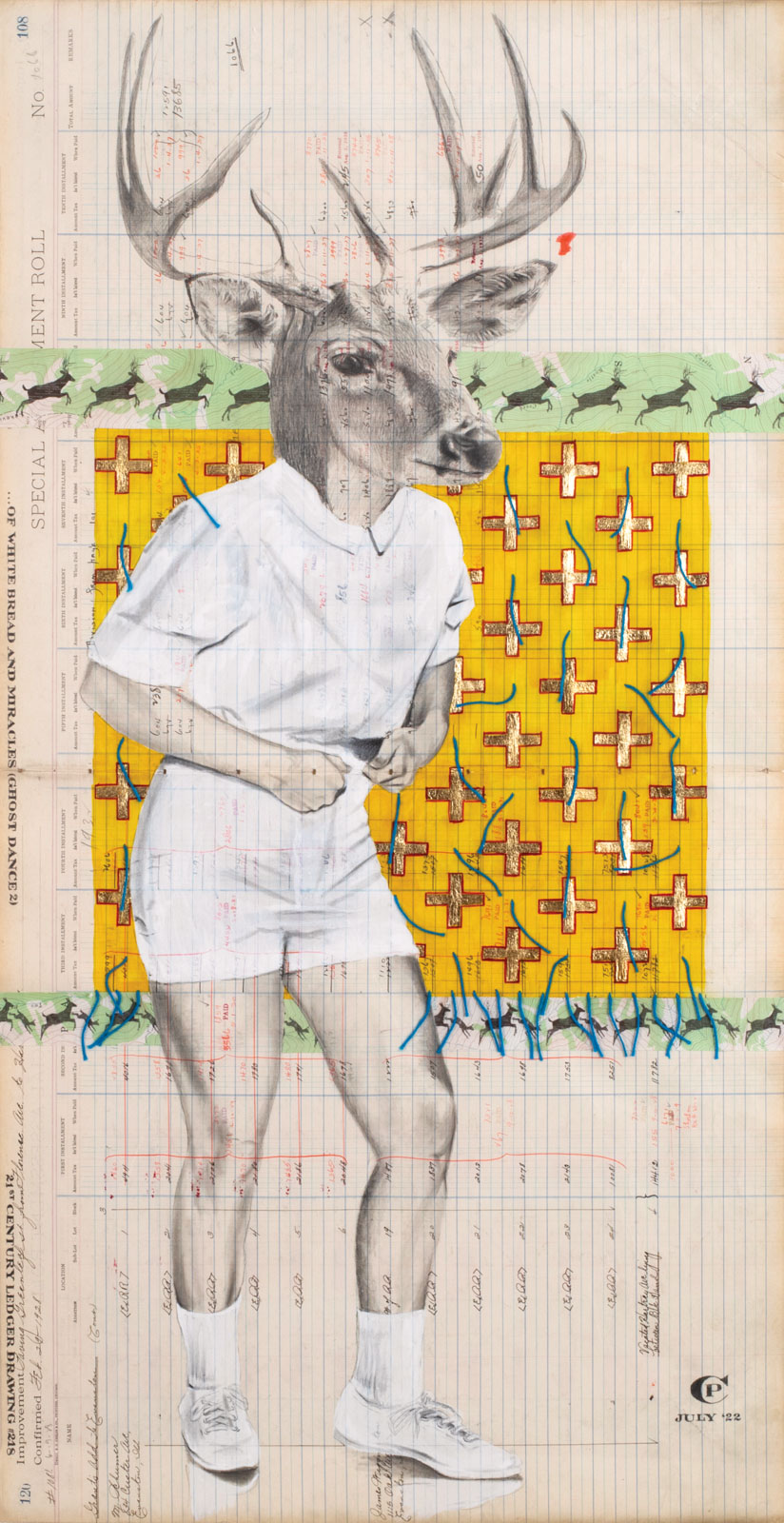 …Of White Bread and Miracles (Ghost Dance 2), pencil, graphite, gouache, ink, map collage, gold leaf and embroidery floss on Evanston municipal ledger, 36 x 18”
“As I’ve opened new doors and gone down new avenues, I’ve noticed my peers on parallel paths, often without seeing each other’s work until it’s done,” he says. “It’s amazing to recognize the shared wavelengths that run through the Native art world.”
To help foster this shared artistic spirit, Chris Pappan, his partner Debra Yepa-Pappan, and Native artists Monica Rickert-Bolter and Andrea Carlson, co-founded the Center for Native Futures (CfNF) in Chicago, in September 2023.
“We founded the Center for Native Futures to have and control our own space in Chicago,” Pappan says of the Center’s mission. “We’re not a museum, we’re a gallery and creator space for contemporary Native artists. Living artists are here creating, sharing ideas, challenging perceptions and selling their art.”
The Center for Native Futures is the only Indigenous artist-run organization in Chicago that is promoting Native fine arts, championing contemporary Native artists and advocating for Indigenous futurists.
“We’re working to promote the truth that Native art exists outside of museum walls. Progress is being made, but never as quickly as it could be. We’re striving to help people move past the idea that Native Art can exist only in one space, to accept that it can be many other things as well.”
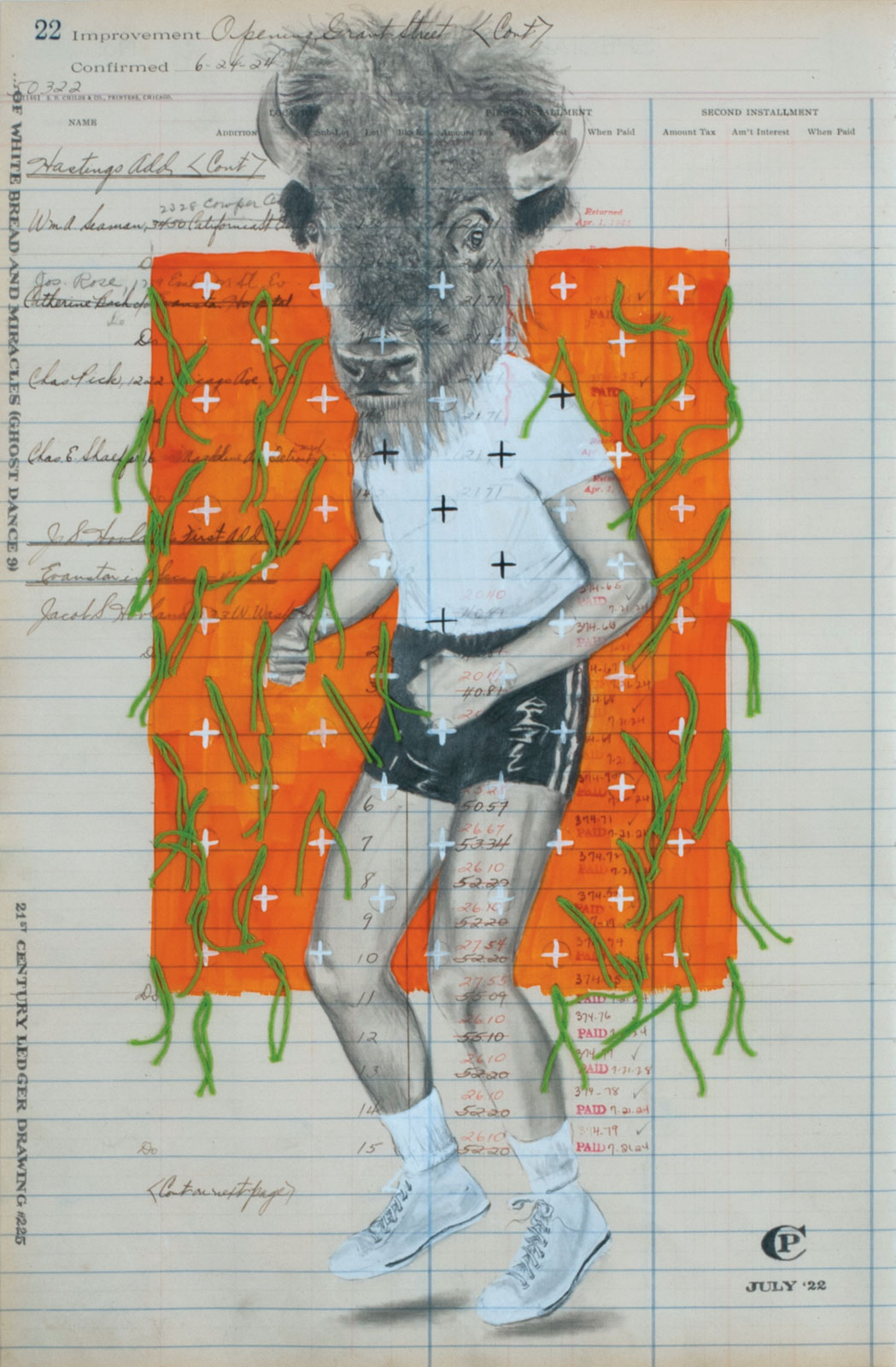 …Of White Bread and Miracles (Ghost Dance 9), pencil, graphite, gouache, ink and embroidery floss on Evanston municipal ledger, 18 x 12”
Looking back on his own journey, Pappan recalls the support he received early on. “When I first started doing ledger drawings, I got a lot of attention, things were going fast, I didn’t feel like I had time to do everything I wanted to. And I feel compelled to say that I wouldn’t be where I am now in terms of my career if it weren’t for the sacrifices my partner, Debra Yepa-Pappan, and my daughter, Ji Hae, have had to make. They deserve a lot of credit.
“Now, I’m in a better position to keep up with myself,” says Pappan. “I have more time to think, work, and keep in touch with what I want to do. I’m doing what I’ve always dreamed of...”
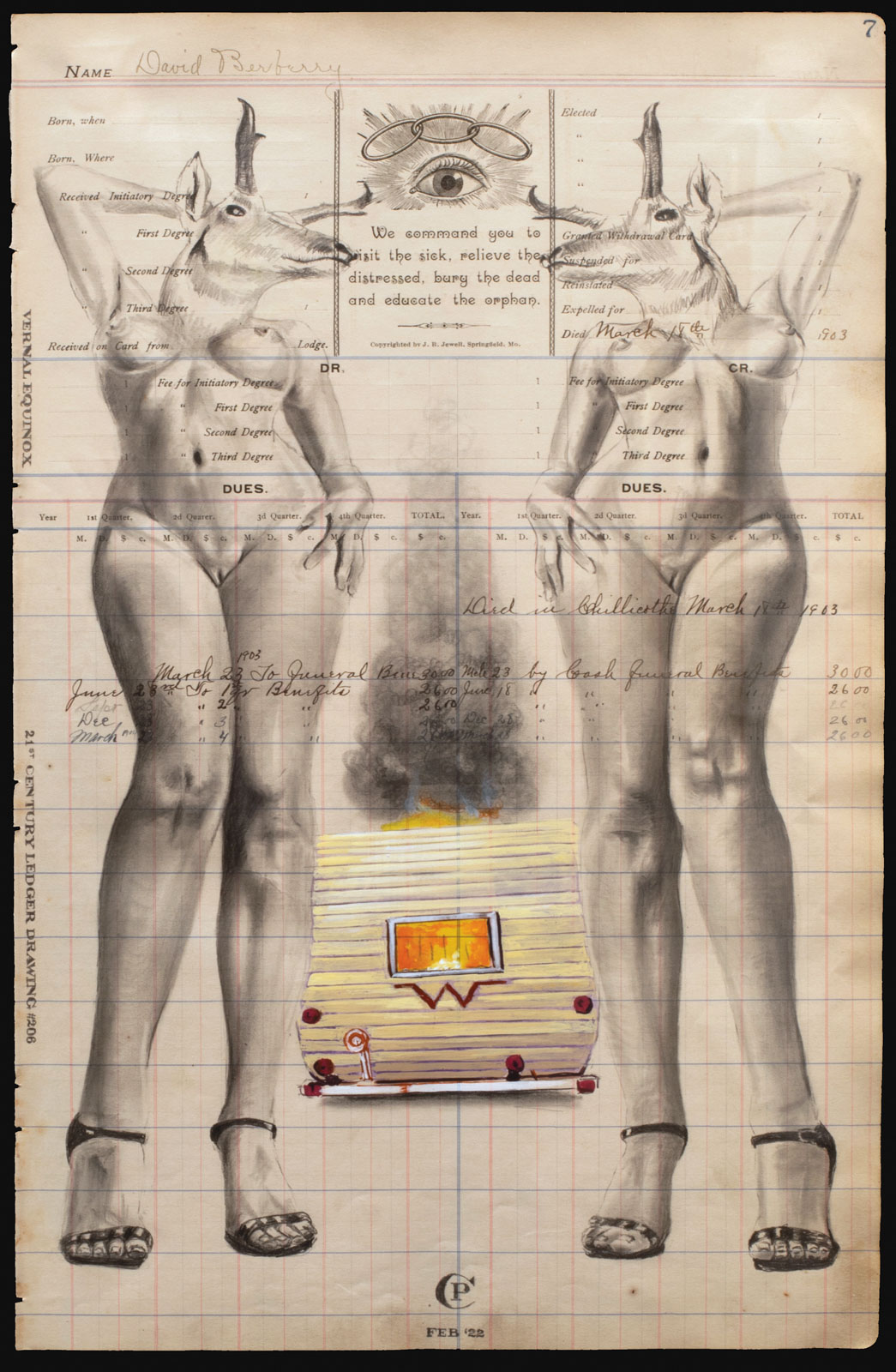 Vernal Equinox, pencil, graphite and gouache on Odd Fellows ledger, 18 x 12”
Chris Pappan’s work, both on and off the ledger, stands as a testament to the transformative impact of authentic expression, reminding us that art is a powerful force that echoes through generations, reshaping the future with every brushstroke, grid, repetition and revolution.
March 29-April 13, 2024
Chris Pappan: The Motion of Breathing
Blue Rain Gallery, 544 S. Guadalupe Street, Santa Fe, NM 87501, (505) 954-9902, www.blueraingallery.com
Powered by Froala Editor