Featuring roughly 60 pieces from nearly 30 artists, The Return of the Force explores the significant impact of Star Wars on contemporary Indigenous art and addresses the question of why this particular piece of popular culture resonates so strongly with Native communities, specifically those in the American Southwest.
On view at the Center of Southwest Studies in Durango, Colorado, the exhibit is a sequel to the Museum of Northern Arizona’s exhibit The Force is With Our People, which opened to great fanfare in 2019.
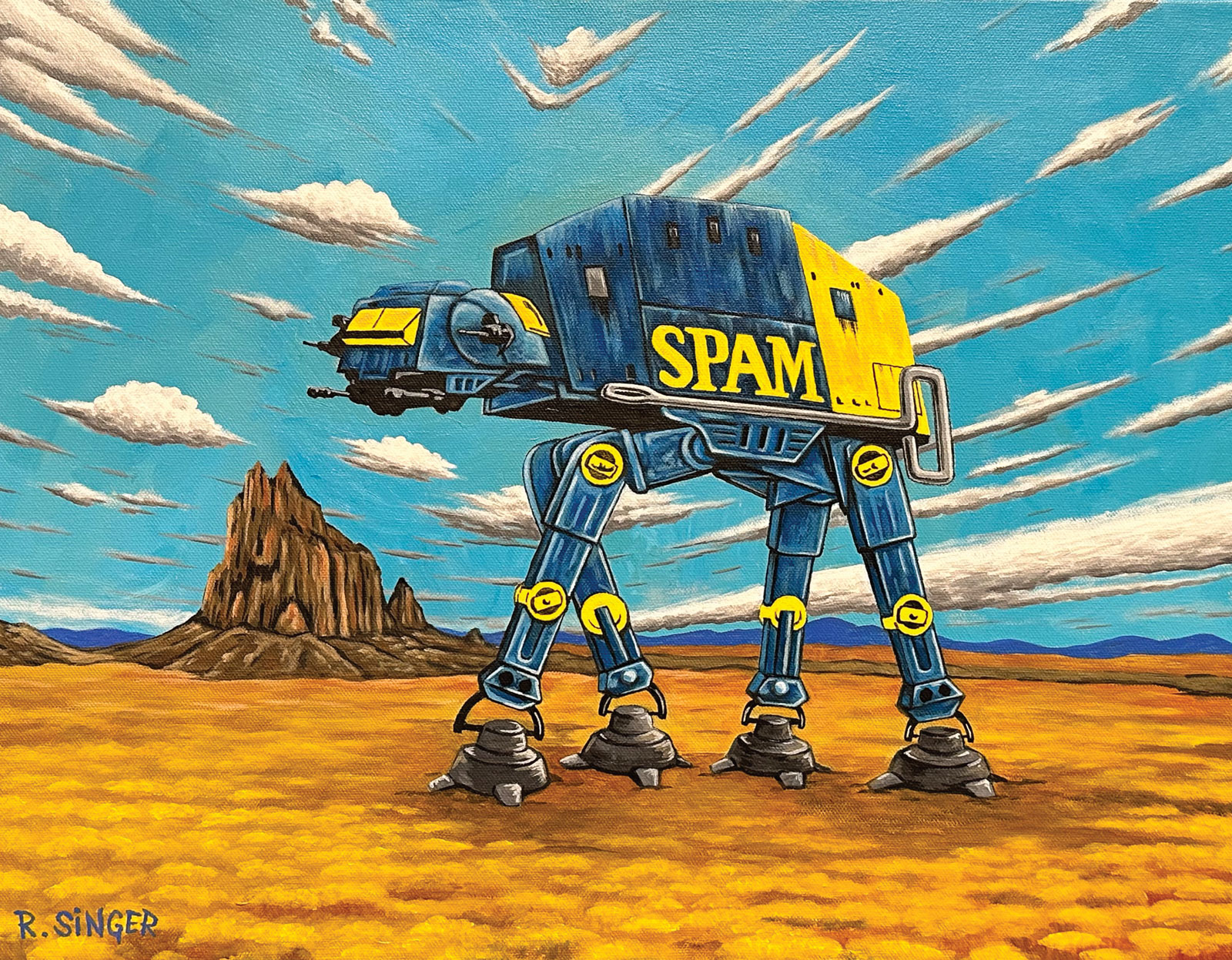 Ryan Singer (Diné), SPAM Walker Near Shiprock, 2023, acrylic on canvas
For the iteration at the Center of Southwest Studies, guest curator and sculptor Duane Koyawena (Hopi/Tewa) expanded the original show by inviting artists from beyond the Southwest to participate in the exhibition, and taking on new topics like the light and dark sides of the Force as they relate to Native culture.
Other themes explored include resistance, place, belonging and Indigenous knowledge. Among the many featured artists are Ryan Singer (Diné), Dwayne Manuel (On’k Akimel O’odham) and Christal Ratt (Algonquins of Barriere Lake).
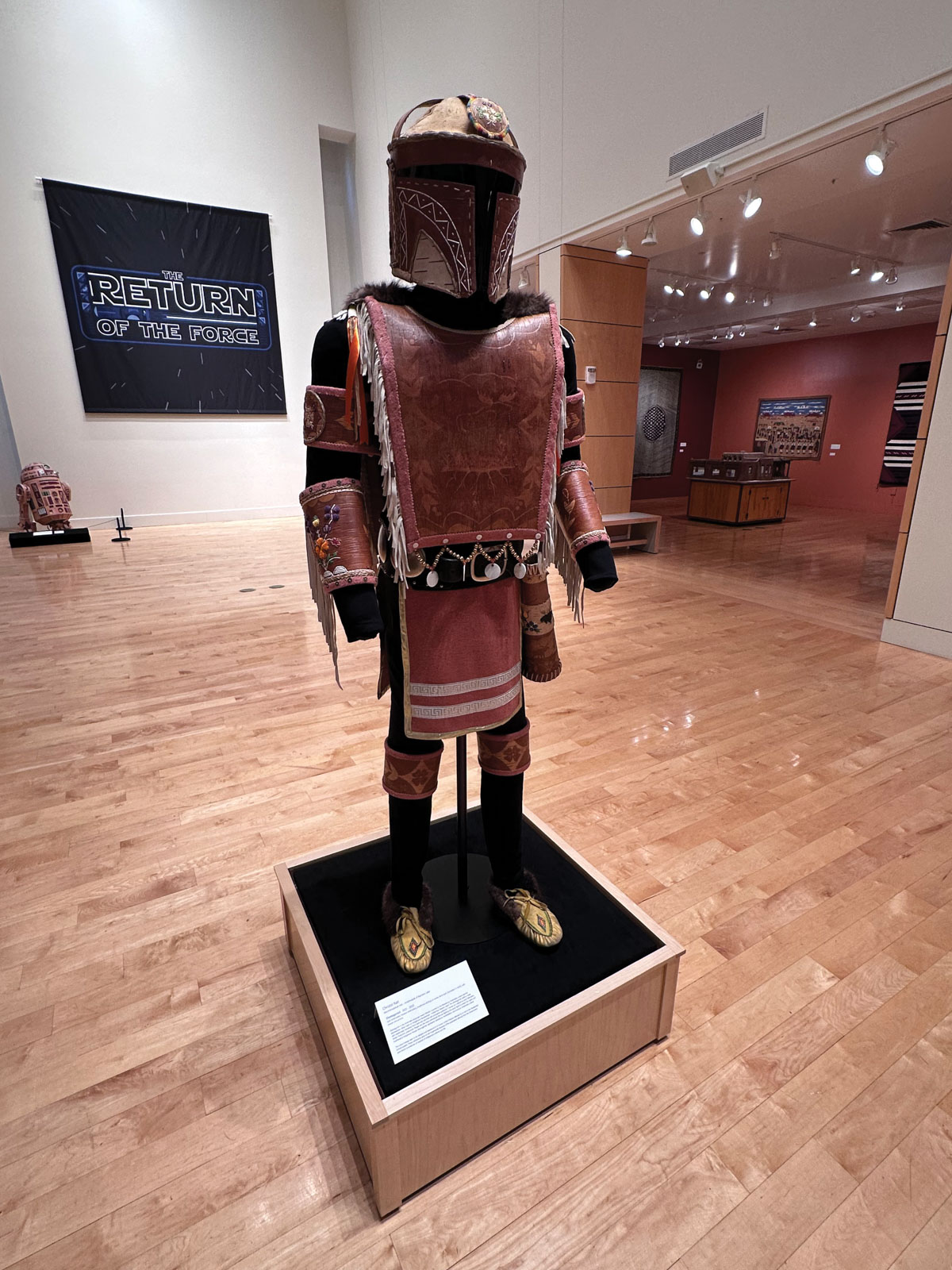 Christal Ratt (Mitchikinabikok Inik—Anishnabek of Barriere Lake), Shemaginish, 2021-2023, quill embroidery, beaded embroidery, traditional etching on winter birch bark (harvested in 2020), with beaver and ermine
Singer is known for paintings that reference both Indigenous and mainstream popular culture. About his show piece, SPAM Walker Near Shiprock, 2023, Singer notes, “The idea of Spam is about survival. The reservation lifestyle consisted of living off the land, herding sheep, gardening, and residing in places where there was no electricity, let alone a refrigerator. Spam was cheap and could sustain itself for a while in its aluminum container. In this painting, I also used the Spam logo as a symbol of big corporations and the ideas of capitalism…There are all these ideas of survival represented in this painting: Spam, the cultural connection to the land, the Empire as a colonizing force, and capitalism marching through the environment.”
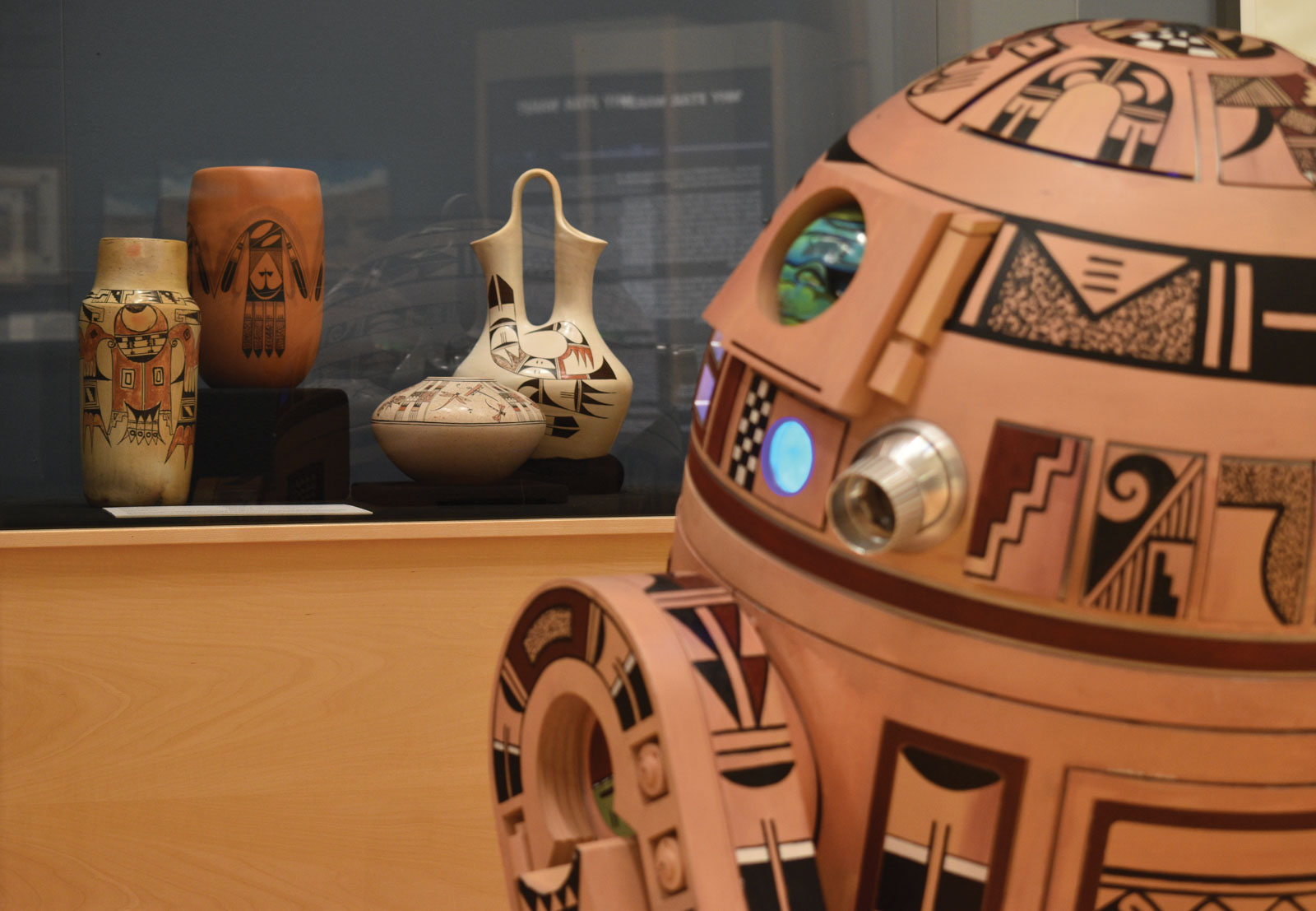 Duane Koyawena (Hopi/Tewa) and Joe Mastroianni (Euro-American), Hopi R-2, 2018, acrylic on metal and electronics with ceramic Hopi vessels (left to right) by Mark Tahbo, Artist Previously Known, Rainy Naha and Helen “Featherwoman” Naha.For this exhibition, Ratt has contributed a wiigwas (birch bark) Mandalorian costume titled Shemaginish, which means “warrior” in the Anishnabe language that poses the question, “What if the Mandalorian were Indigenous?” “The Shemaginish outfit is made with traditionally harvested birch bark and adorned with porcupine quillwork,” explains Ratt. “It serves as a tribute to Land Defenders, Water Protectors, grassroots people and the many individuals who are fighting that good fight to protect the rights and livelihood of Indigenous People. Shemaginish represents resistance, revitalization, and honours Anishnabe culture.”
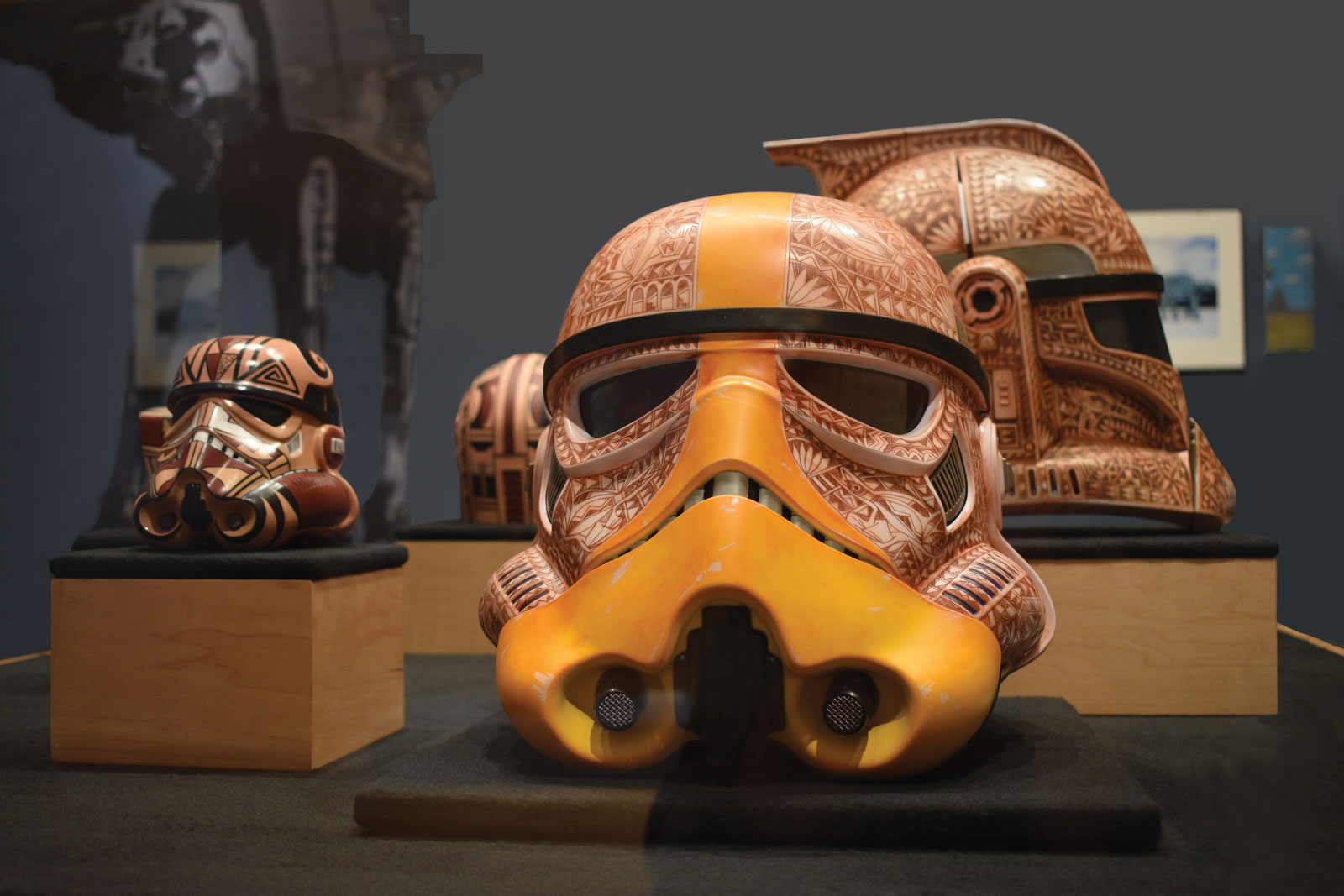 Etched and painted Storm Trooper helmet by Rodrigo Velarde (Jicarilla Apache) with others by Duane Koyawena (Hopi/Tewa).
Also on display is HOPI-R2, a collaborative art piece by Koyawena and engineer Joe Mastroianni. Wired and programmed by Mastroianni, HOPI-R2 is fully functional, controlled by a mobile application and a PlayStation remote controller. Koyawena designed and painted the exterior in the style, colors and symbolism found in traditional Hopi pottery.
Through September 27, 2024
The Return of the Force
Center of Southwest Studies, Fort Lewis College, 100 Rim Drive, Durango, CO 81301
(970) 247-7456, swcenter.fortlewis.edu
Powered by Froala Editor