The Indigenous art of the Northwest Coast of the United States and Canada developed over several thousand years of trade among its many tribes. Characterized by form and line, their art combined myth and historical narrative. In his book Northwest Coast Indian Art: An Analysis of Form, Bill Holm describes the dominant formlines as “continuous, flowing, curvilinear lines that turn, swell and diminish in a prescribed manner. They are used for figure outlines, internal design elements and in abstract compositions.”
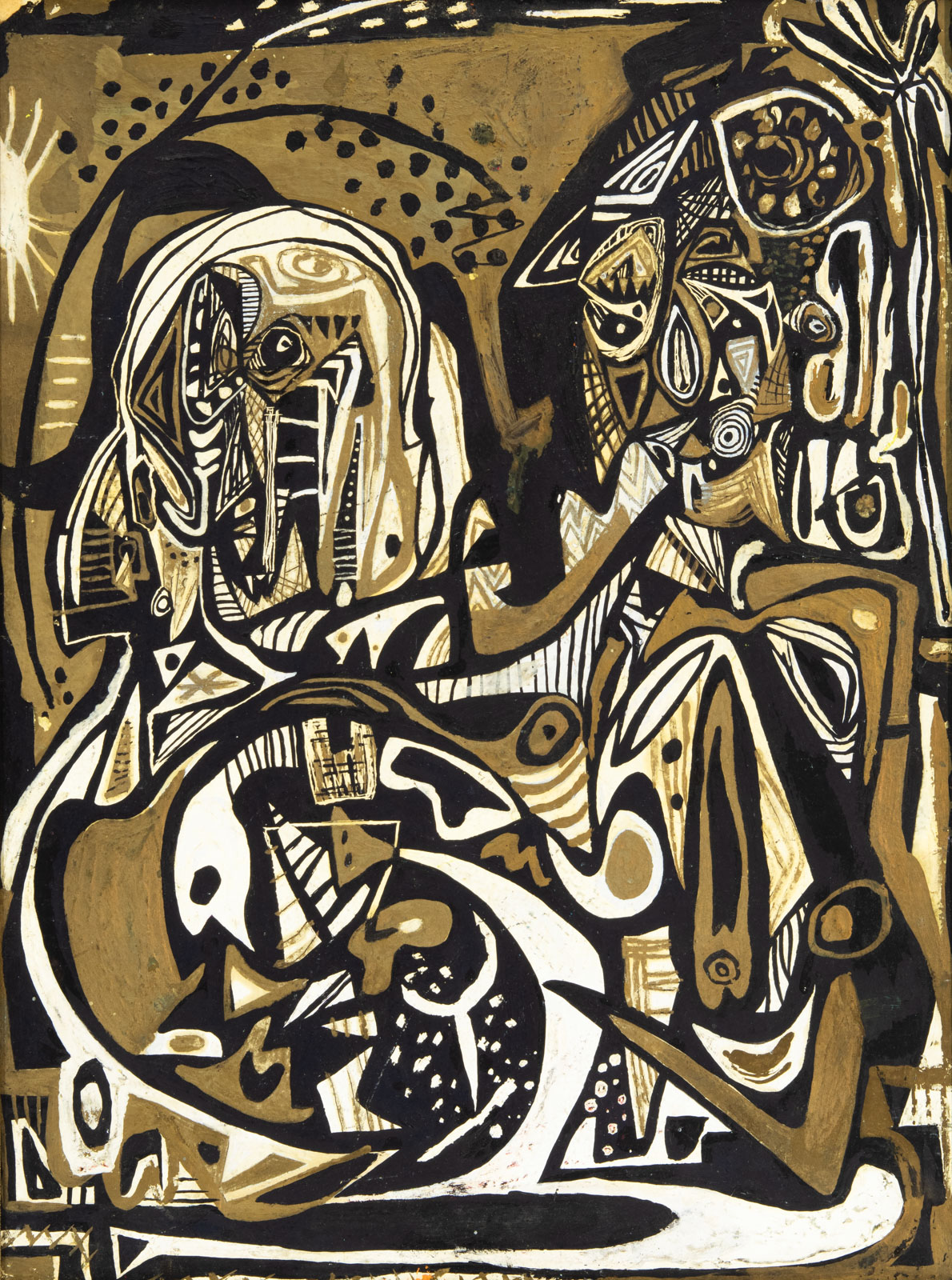 Ruth L. Lewin (1924-1975), Untitled, ca. 1945, tempera on gesso panel, 16 x 12”. Robert Seliger and Mark Seliger.
Around World War II when artists were searching for an American interpretation of the modernist movements in Europe, many turned to the Indigenous arts of North America, especially those of the Pacific Northwest.
Crystal Bridges Museum of American art in Bentonville, Arkansas, explores one of those groups of artists in the exhibition Space Makers: Indigenous Expression and a New American Art, opening April 13 and continuing through September 30.
The museum explains that the exhibition “examines the mid-century American art movement known as the Indian Space Painters and the relationship between those painters, the Indigenous visual and material culture that inspired them, and the artists from the modern Native art movement who expanded upon such creative explorations through their own visual heritage. Investigating these relationships for the first time, Space Makers reconfigures the history of American art and reveals its foundations in Indigenous space—aesthetically, geographically, and socio-politically. The free, focus exhibition features loans from the Charles and Valerie Diker collection, one of the nation’s preeminent collections of the underrecognized Indian Space Painting movement, and is guest curated by Christopher T. Green, Ph.D., Visiting Assistant Professor of Art History at Swarthmore College.”
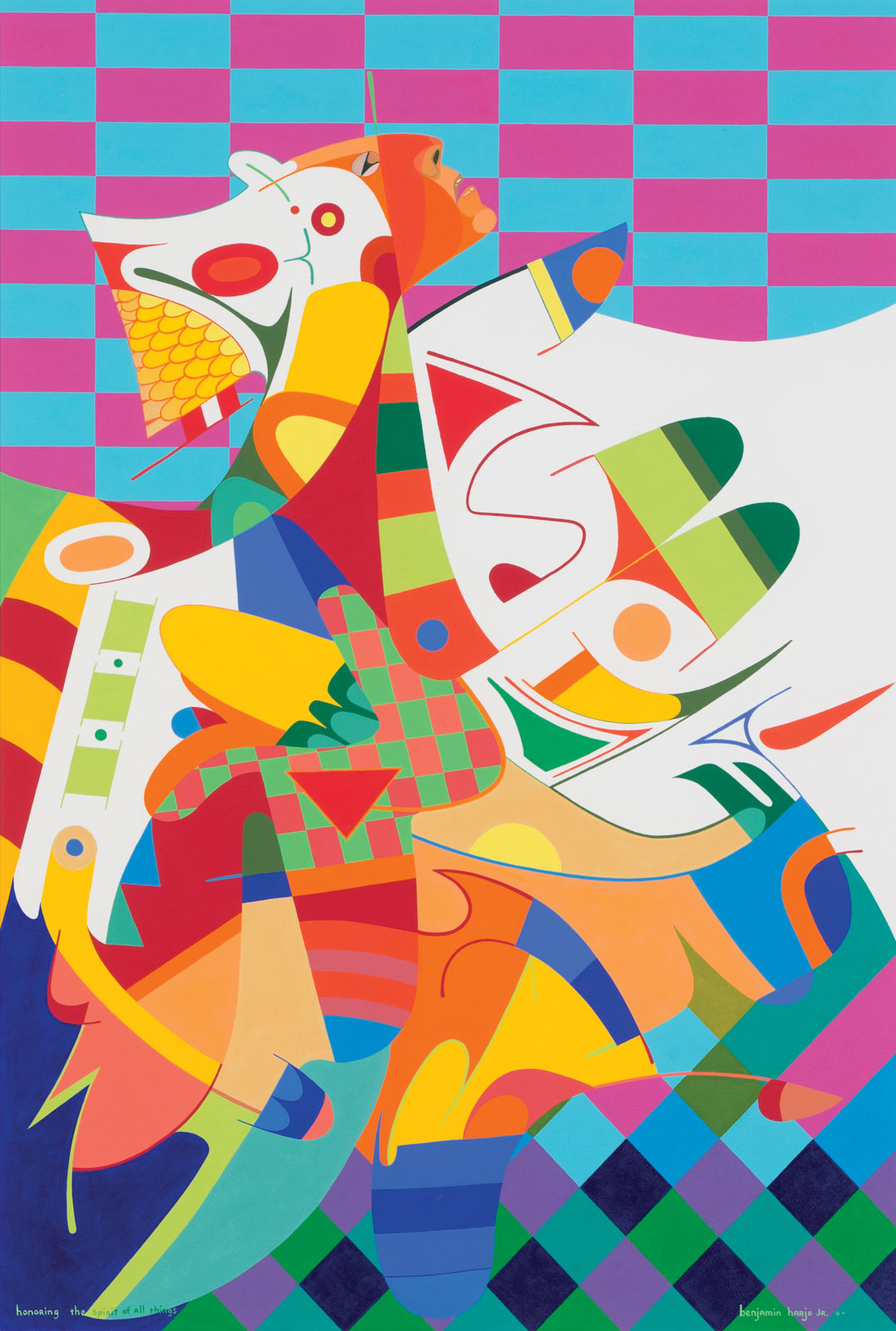 Benjamin Harjo Jr. (1945-2023, Seminole/Absentee Shawnee), Honoring the Spirit of All Things, 2001, opaque watercolor, 39¾ x 27”. Anonymous gift, 2012.009.004.
In an essay for the 1991 exhibition, The Indian Space Painters: Native American Sources for American Abstract Art at Baruch College in New York, Barbara Hollister wrote, “The Indian Space artists saw in the metamorphic power of tribal art a way of fusing the formalism of Cubism with the inner vision of Surrealism. An important feature of the art of the Northwest Coast is ‘the mixing in one space of two or more images that must be seen from different vantage points,’” quoting an essay by S. A. Arutiunov and William W. Fitzhugh in the book Crossroads of Continents: Cultures of Siberia and Alaska edited by William W. Fitzhugh and Aaron Crowell.
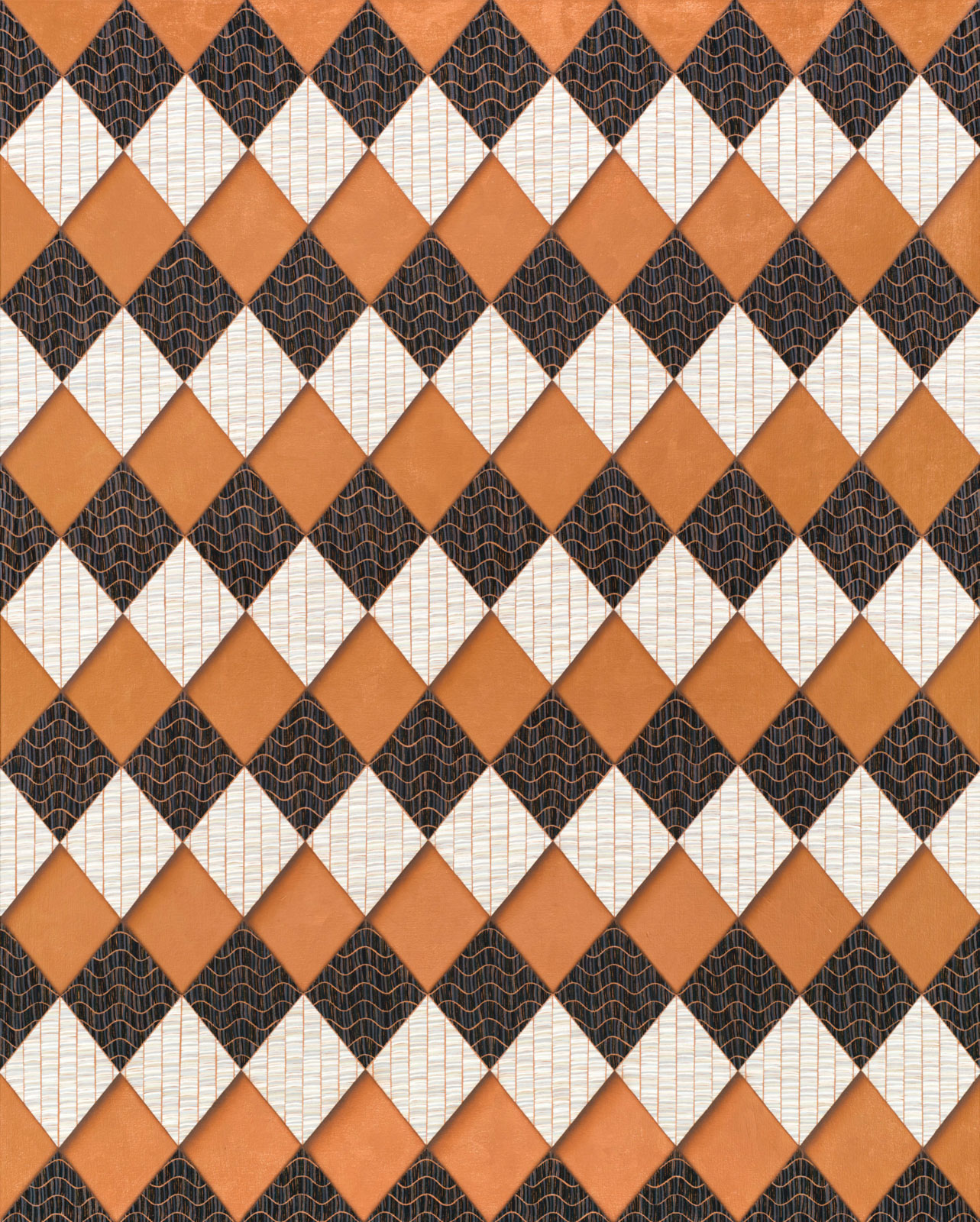 Dyani White Hawk (Sicangu Lakota), She Gives (Quiet Strength V), 2019, acrylic on canvas, 60 x 48”. Crystal Bridges Museum of American Art, Bentonville, Arkansas, 2020.4. Photography by Edward C. Robison III.
Among the early works in the exhibition is an untitled egg tempera painting, circa 1945, a complex composition of two figures by Ruth Lewin (1924-1975). She had developed an interest in Native art while studying at the Art Students League in New York, with which the Indian Space Painters were associated.
Contemporary Native artists continue to explore the roots of their own heritage as the Space Painters explored that of the Pacific Northwest. Benjamin Harjo Jr. (1945-2023, Seminole/Absentee Shawnee) attended the Institute of American Indian Art (IAIA) in Santa Fe, New Mexico, to study cartooning but discovered woodblock printmaking. His opaque watercolor, Honoring the Spirit of All Things, 2001, is in the exhibition. The highly saturated color and his abstract and stylized forms recall Seminole patchwork clothing.
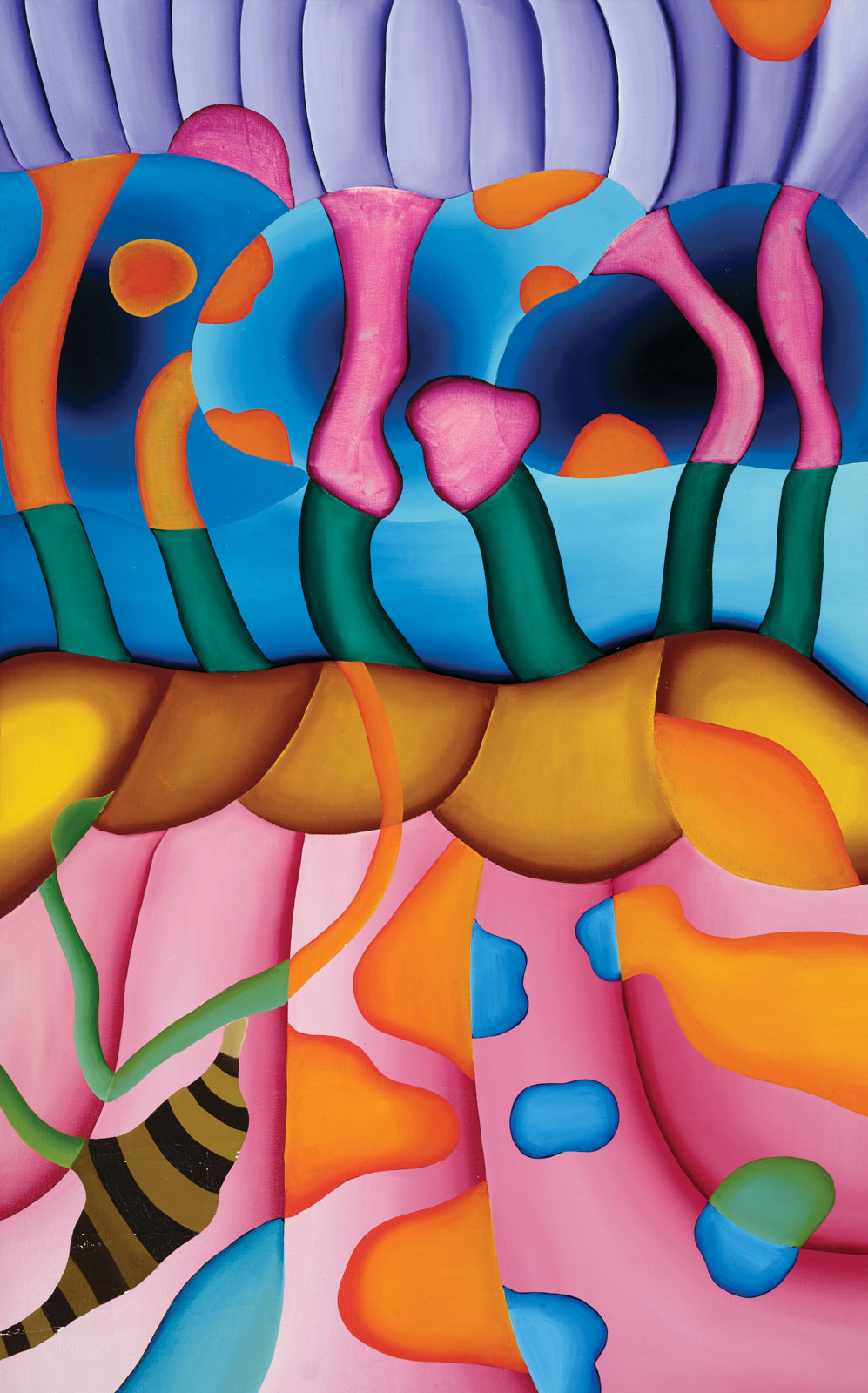 Linda Lomahaftewa (Hopi/Choctaw), Sustenance, late 1960s, oil on canvas, 71 x 42½”. Courtesy of Logan Slock and Ana Kuny. ©Linda Lomahaftewa. Photo by Jason S. Ordaz.
Dyani White Hawk is a multidisciplinary artist and a 2023 MacArthur Fellow. Her acrylic painting, She Gives (Quiet Strength V), 2019, is composed of diamond patterns painted to resemble traditional quill work. The MacArthur Foundation honored her for “revealing the underrecognized yet enduring influence of Indigenous aesthetics on modern and contemporary art. In both her finished objects and art-making process, White Hawk, who is Sičáƞǧu Lakota, centers ideas of connectedness—within community and family, across generations, and between craft and fine art.”
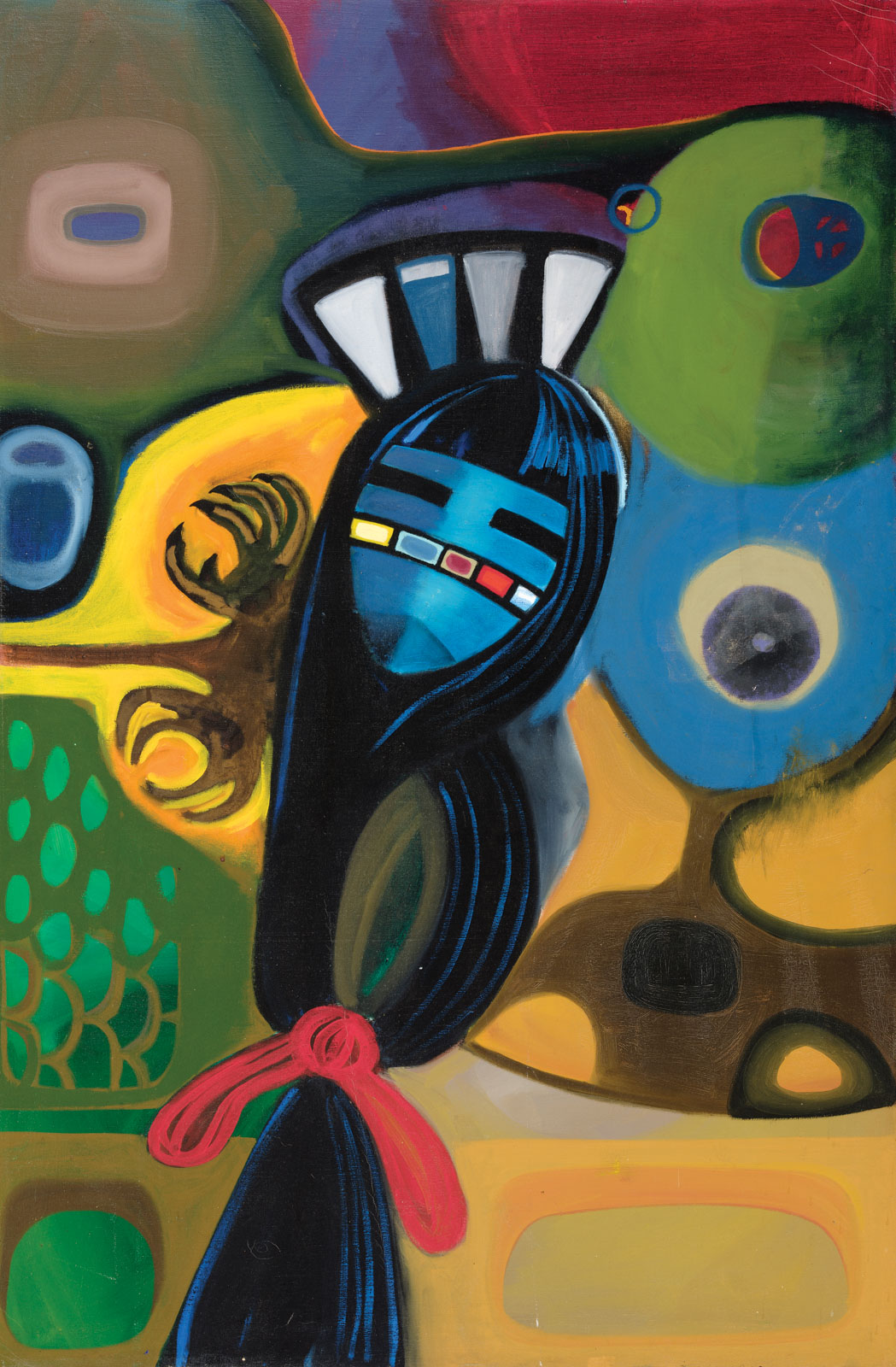 Linda Lomahaftewa (Hopi/Choctaw), Untitled, 1970s, oil on canvas, 36 x 48”. Collection of the artist. ©Linda Lomahaftewa. Photo by Jason S. Ordaz.
She comments in her artist statement, “I was raised within Native and urban American communities. I strive to create honest, inclusive works that draw from the breadth of my life experiences, Native and non-Native, urban, academic and cultural education systems. This allows me to start from center, deepening my own understanding of the intricacies of self and culture, correlations between personal and national history, and Indigenous and mainstream art histories.”
April 13-September 30, 2024
Space Makers: Indigenous Expression and a New American Art
Crystal Bridges Museum of American Art 600 Museum Way, Bentonville, AR 72712 (479) 418-5700, www.crystalbridges.org
Powered by Froala Editor