Anyone born around 1980 will see something tantalizingly familiar in Melissa Cody’s weavings. Just what that is may be hard to put a finger on. The connection is completely unexpected, one not made previously in Navajo textiles.
Video games.
Now you see it.
The static fuzz of a console TV. Donkey Kong ladders. The multi-colored, zig-zag, frozen screen every 40-something ex-gamer recognizes as requiring a reset.
Tetris.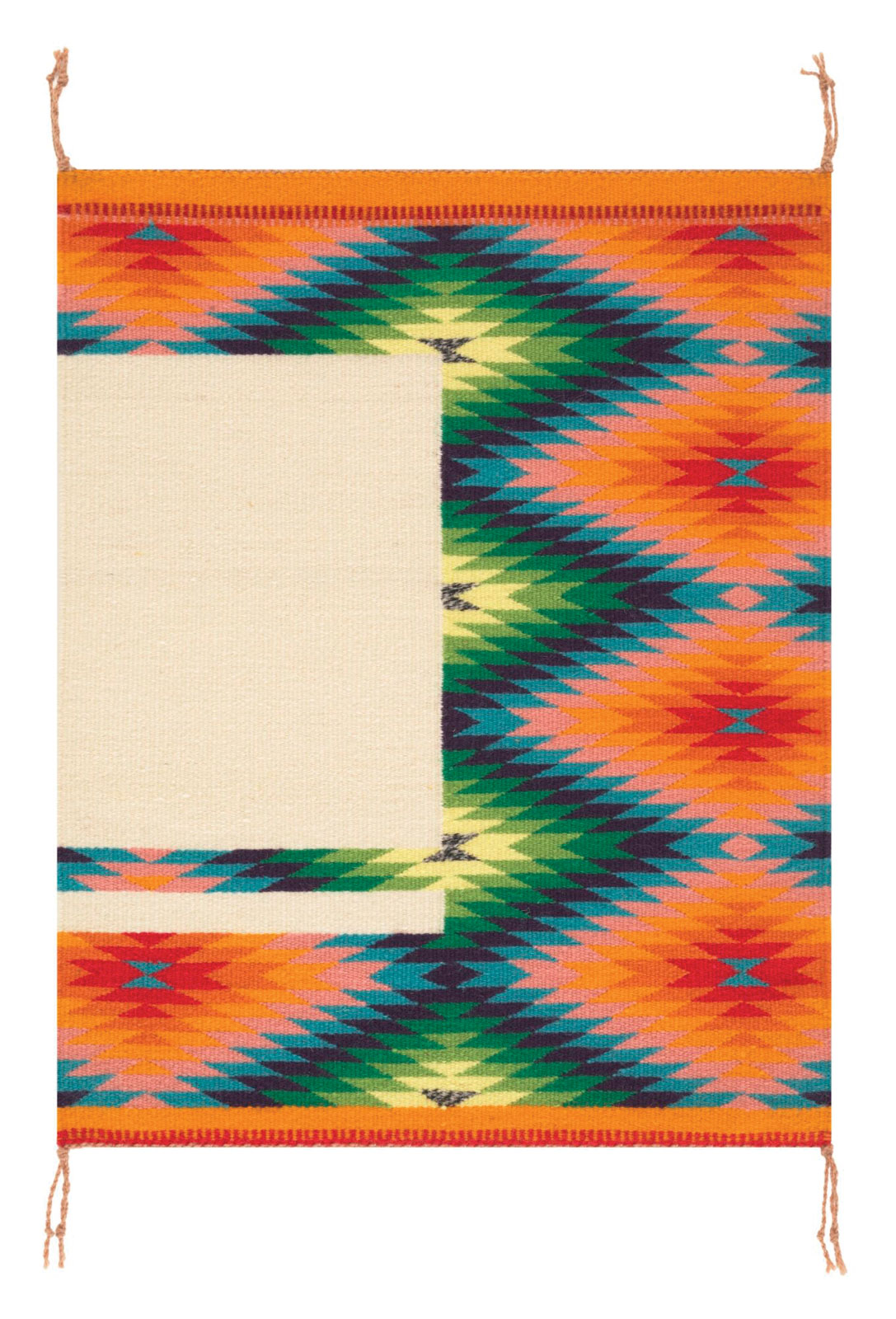 White Out, 2012, thee-ply aniline dyed wool, 17 x 24”. Courtesy the artist.
“That’s the one game I always say is the most like Navajo weaving because when you’re weaving, you weave line by line and every string has to be accounted for, just like in Tetris in order to move the stack down,” Cody says.
Growing up on the Navajo reservation—born 1983, in No Water Mesa, Arizona—owning a video game system was a big deal. “That was our one big gift we got collectively, me and my brother and my sisters,” Cody remembers. “I also grew up in a time when we didn’t have running water, electricity or indoor plumbing, so sometimes when we did want to play a video game, my dad had to fire up the generator and we could play for an hour before the gas ran out.”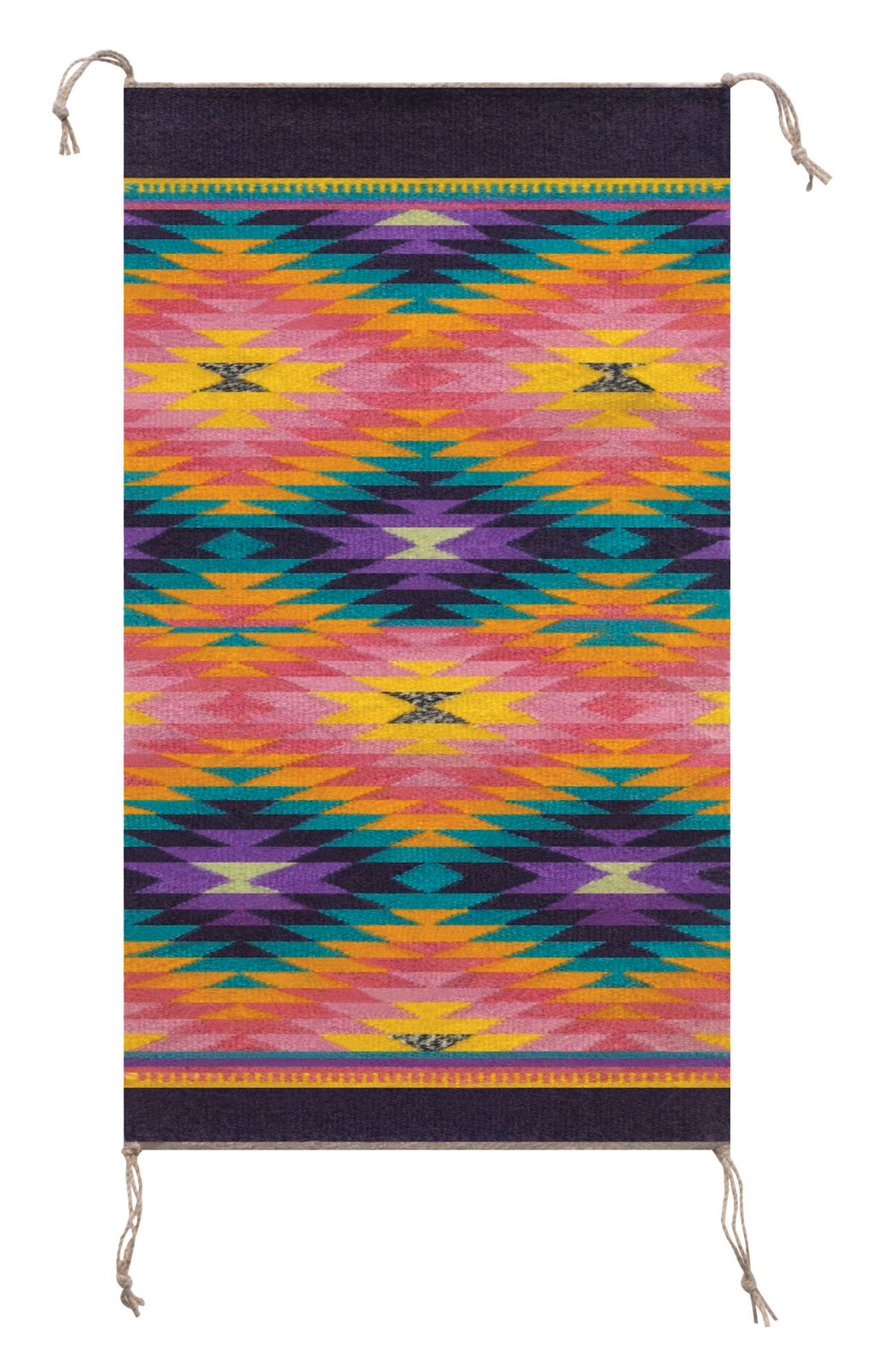 Pocketful of Rainbows, 2019, wool warp, weft, selvedge cords and aniline dyes, 19 x 10¾”. Courtesy the artist.
For the fourth-generation Navajo weaver who began practicing as a 5-year-old, the innovation of marrying 1980s digital technology to historic weaving came naturally. “The foundational technique of Navajo weaving is a grid system which lends itself to the 8-bit format of block pixels making up the entire screen,” Cody explains. “Translating the screen to the woven, rectangular textile, it just kind of fit together.”
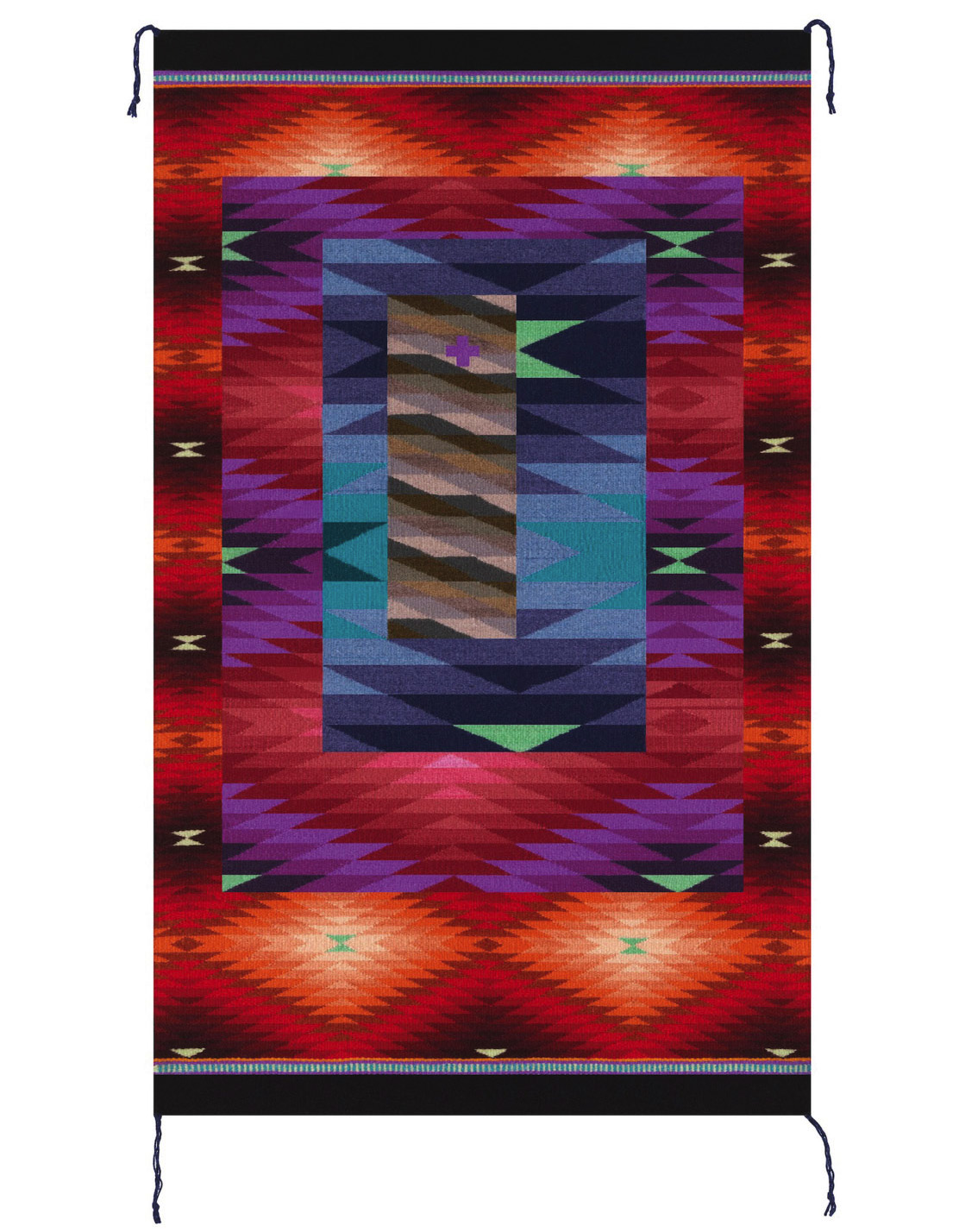 Woven in the Stones, 2018, wool warp, weft, selvedge cords and aniline dyes, 39¼ x 235/8”. Courtesy the artist.
The original Nintendo Entertainment System, the Sega Master System and the Atari 7800 video game platforms were all designed to play games in 8-bit format. Games like Super Mario Bros., The Legend of Zelda and Metroid. Blocky and primitive by today’s standards, but highly graphic, geometric and colorful.
Revolutionary for their time. Same as Cody’s weaving. Which can be a double-edged sword.
Oftentimes, Native artists receive blowback when their creative innovations disrupt centuries-old ways of making. That wasn’t the case for her. “I paid my dues weaving throughout my entire life, and a lot of the noted weavers were seeing me grow, so when I started doing my own thing in the late 90s, it was really, really well received because I was that new generation that was going to keep the tradition moving forward,” Cody says. “Even my own grandmother would say, ‘What are you working on because I’m going to copy it!’ I always had the blessings of the elders, and my mother especially. She was one of the first people who pushed me to think critically about my work and to establish my own personal style.”
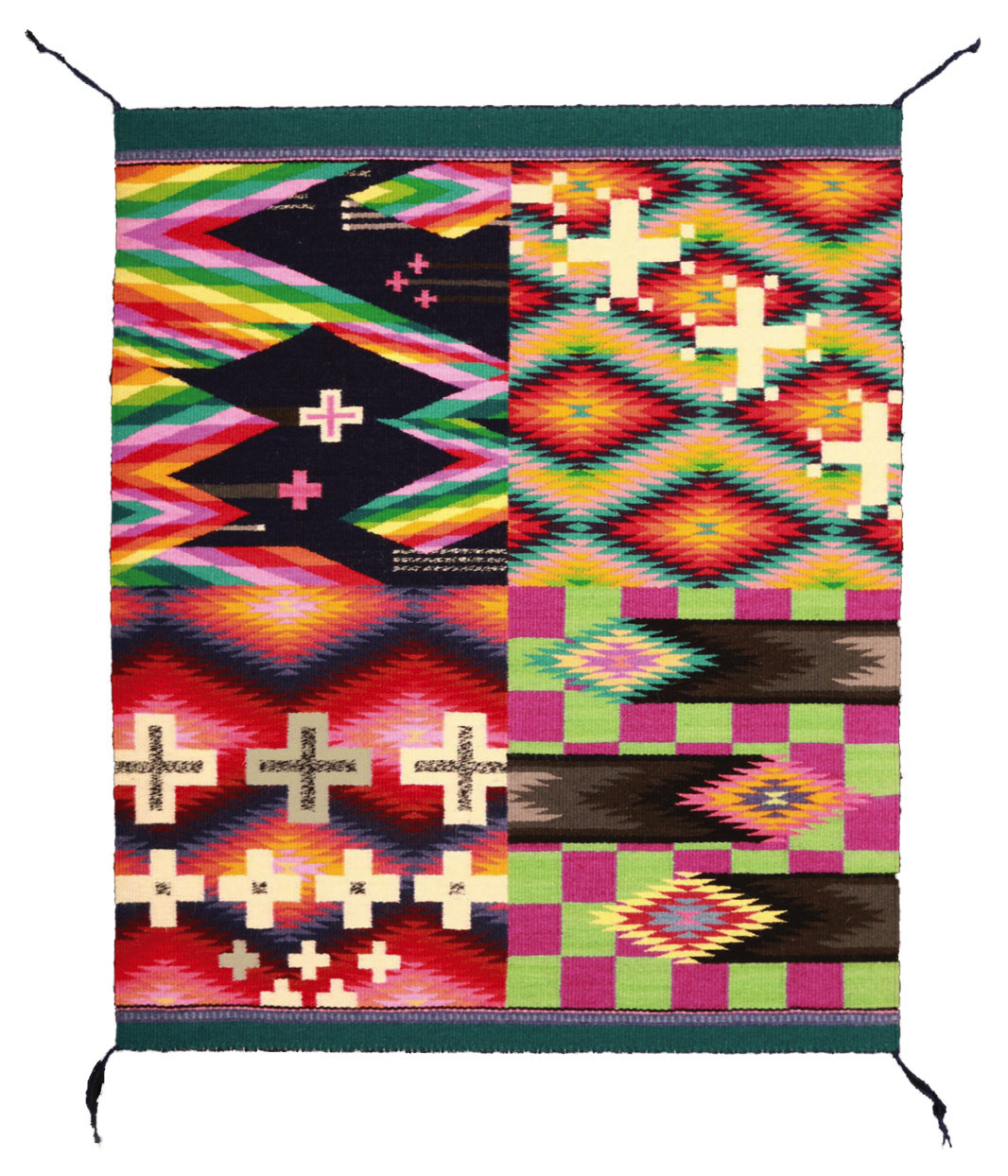 4th Dimension, 2016, three-ply aniline dyed wool, 26 x 28”. Courtesy the artist.
Cody’s style will reach audiences well outside of the Native art world with her first major solo exhibition opening April 4 in New York at MoMA PS1, an outpost of the Museum of Modern Art and one of the most esteemed contemporary art spaces in the world. Melissa Cody: Webbed Skies spans the last decade of her practice, showcasing more than 30 weavings and featuring three major new commissions.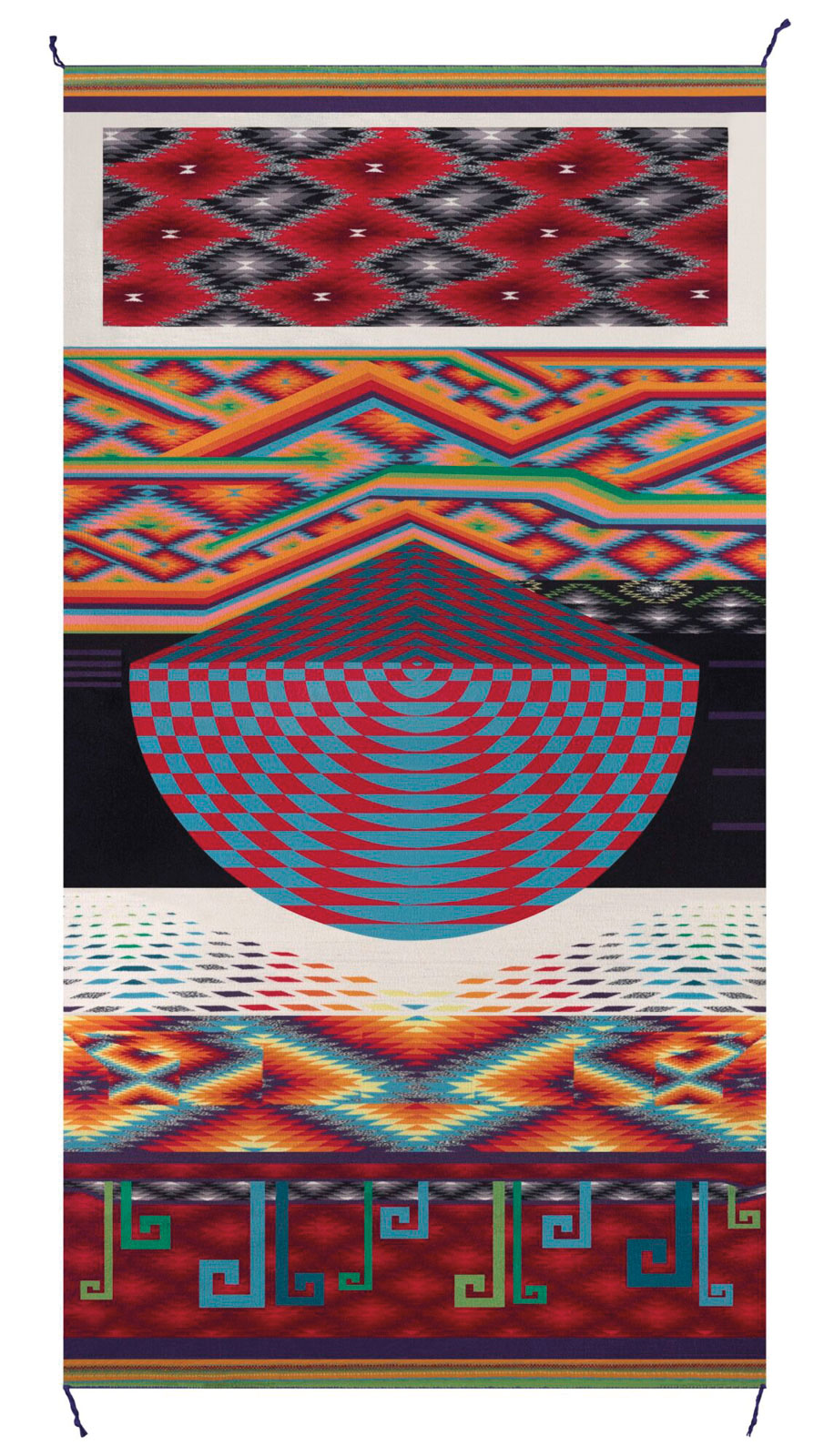 World Traveler, 2014, wool warp, weft, selvedge cords and aniline dyes, 90 x 487/8”. Courtesy the artist.
Cody’s inventiveness extends beyond introducing video game imagery to Navajo weaving. Her World Traveler (2014) reads like a trippy weaving collage, reminiscent of the Magic Eye posters that were all the rage in the 1990s. Those were the posters you could stare at and if your eyes focused and crossed just right you might see dolphins leaping out of the background.
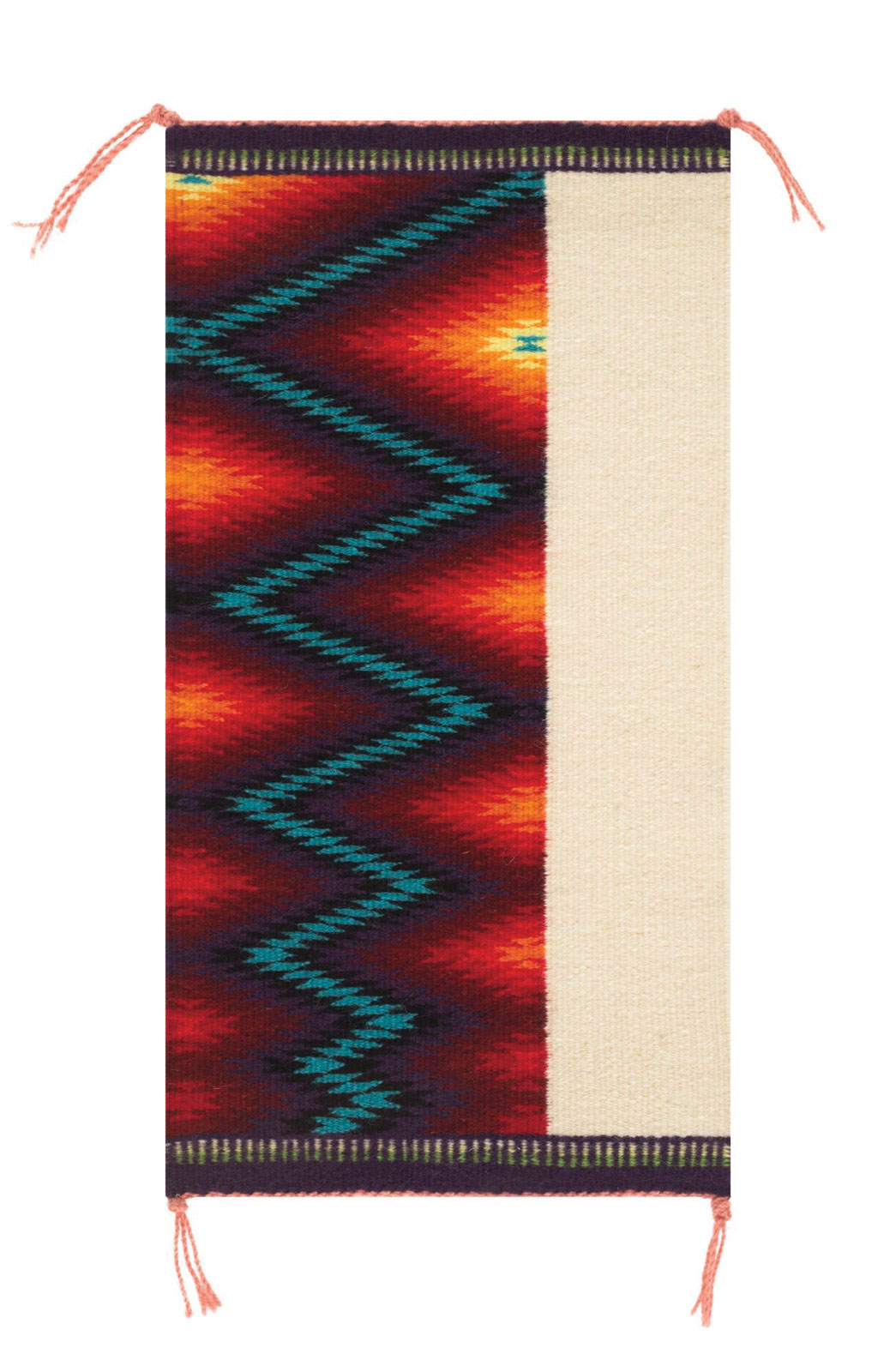 Lightning Storm, 2012, thee-ply aniline dyed wool, 14 x 20”. Courtesy the artist.
“I was studying a lot of Op Art—optical illusion art,” Cody explains of her inspiration for the piece. “I’m using these heavily opposed colors, especially that center motif where you have the concentric half circles that are giving you that rainbow road, kind of like Mario Kart. It’s leading you into the piece and allowing you to travel into these different planes and these different worlds.”
Cody’s work intentionally tests the limits of what can be done on a Navajo loom.
“You don’t see a lot of curved or really finely tuned circles, that was me trying to take a combination of all these years of being at the loom and putting into one piece, that is not only compositionally sound, but is also taking into account the interaction that the viewer is going to have with it,” Cody said.
Another striking signature of Cody’s weavings are large areas of blank space. This stands in dramatic contrast to the traditional Burntwater regional weaving pattern the artist grew up with. Burntwater is highly structured, with intricate detail and geometric patterns where every quadrant of the textile is a mirror image of another. “I had to learn how to embrace the negative space, embrace these areas of rest, embrace areas of unbroken silence if you will,” Cody says. “I was able to do that with these large swaths of negative space.”
Easier said than done.
“I found that incorporating negative space was just as difficult as incorporating heavy, intricate detailing because it was that want and almost an inherent need to fill the space with detail,” she adds. “It was like this inner struggle.”
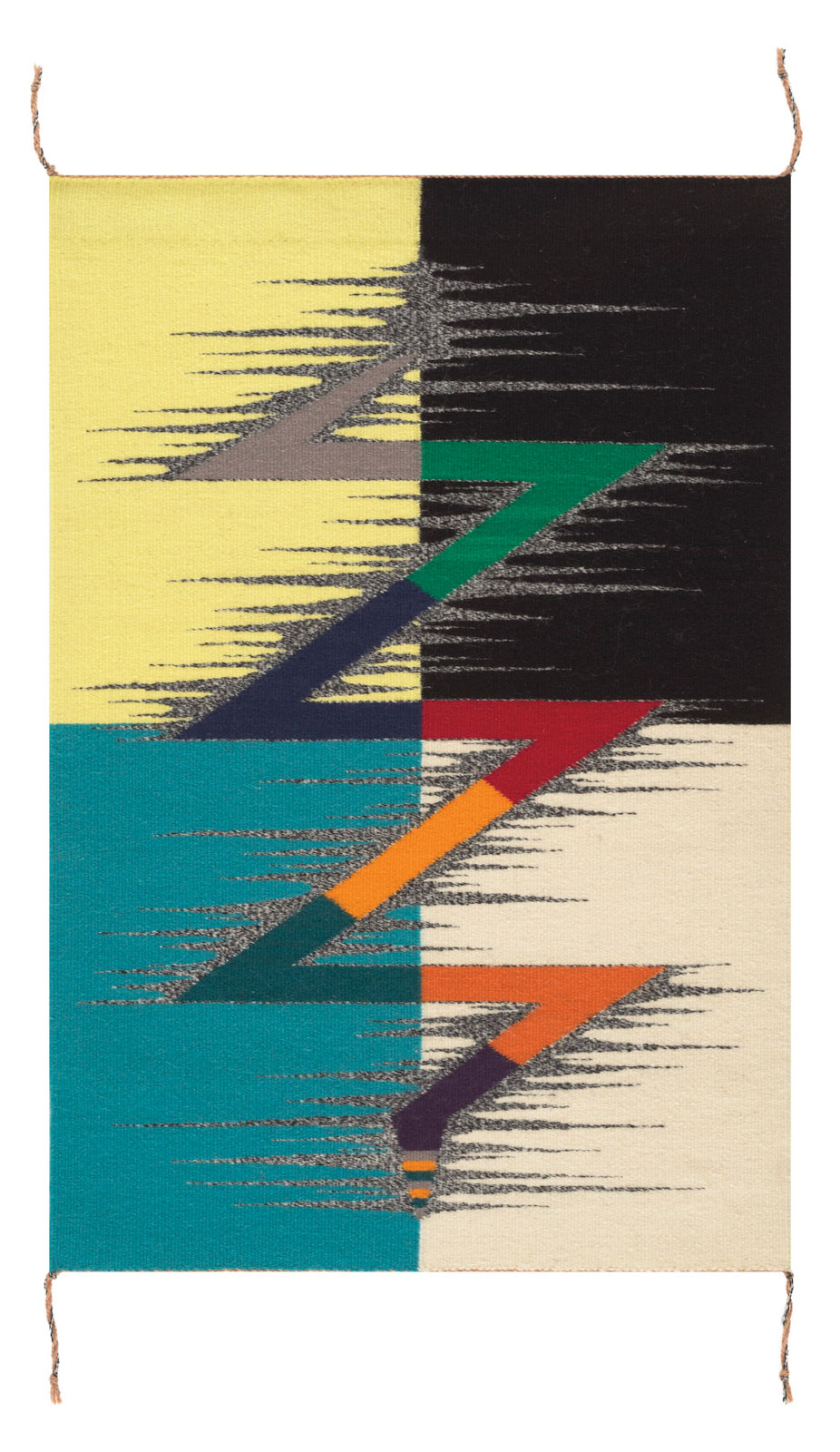 Path of the Snake, 2013, three-ply aniline dyed wool, 36 x 24”. Courtesy the artist.
Op Art, negative space, opposed colors—Cody talks about her weaving the way any contemporary painter out of the Art Students League in New York would describe a canvas. She is a contemporary artist, full stop.
A contemporary artist who happens to use textiles as her medium. A contemporary artist who happens to be Navajo.
Engaging with the wider art world beyond Navajo weaving and Native American art became paramount for Cody while attending the Institute of American Indian Arts where, in addition to studio art, she took museum studies courses.
“The show is trying to open up this dialogue that Indigenous art can be contemporary, that Indigenous art can be shown on these platforms that for a long time were saved for ‘fine art,’ or art that was not craft, or art that was not Folk art,” Cody says.
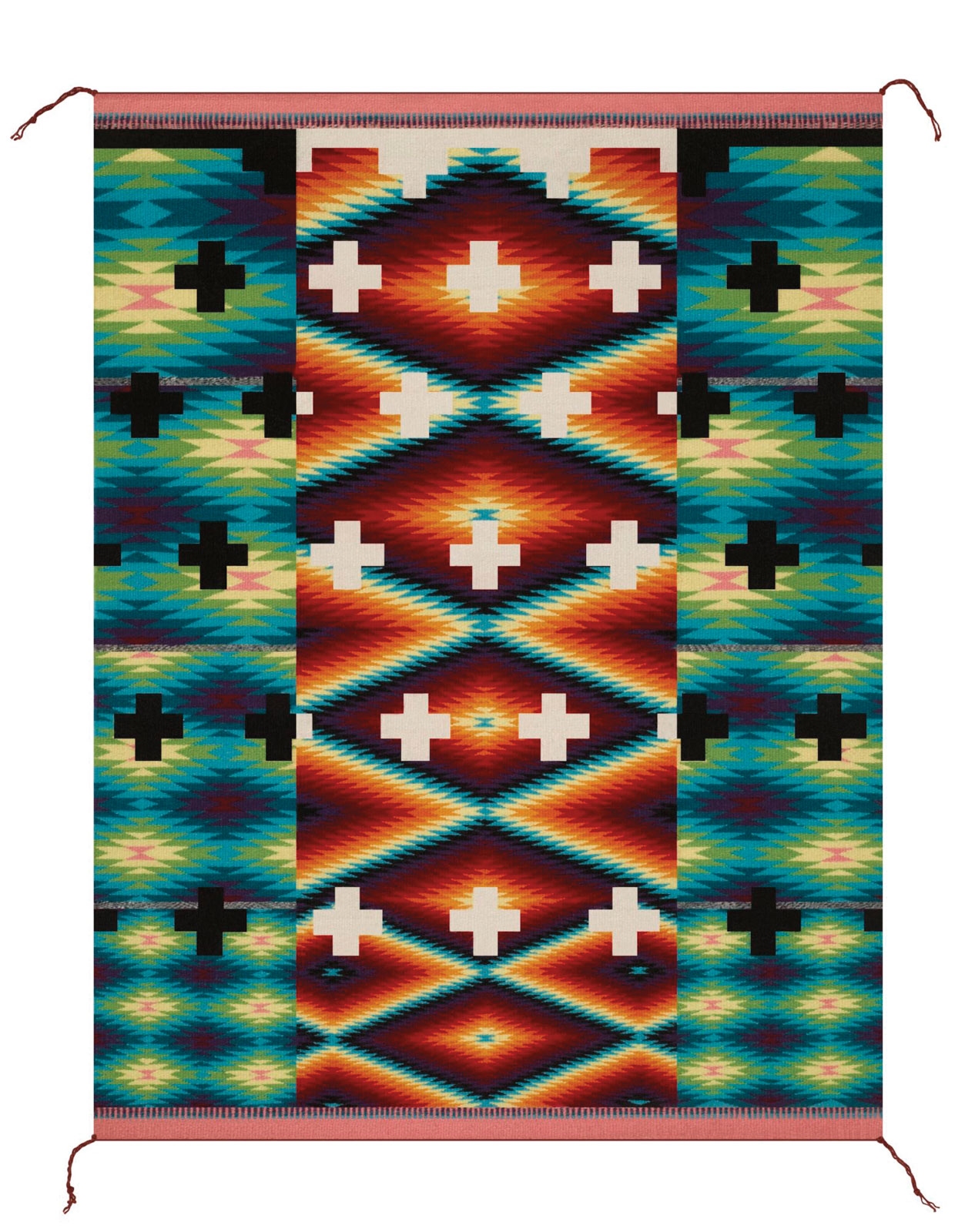 Deep Brain Stimulation, 2011, wool warp, weft, selvedge cords and aniline dyes, 40 x 30¾”. Courtesy the artist.
Indigenous art as contemporary and contemporary art as Indigenous. It’s the cross-pollination that Lloyd Kiva New and the IAIA founders envisioned from its onset. Not Indigenous or contemporary, Indigenous and contemporary. Cody embodies that.
“A lot of the critical thinking that came out of IAIA was, how is my work going to be seen exactly where it’s at now, on a wider platform: is it going to be seen as an ethnographical piece? Is it going to be titled, ‘Navajo weaving?’ Or is it going to be [titled] ‘Melissa Cody?’” She says. “Being an Indigenous artist, we’re kind of pigeonholed into being this stagnant entity of what was historically, but as Indigenous people who are living and breathing in the current world, our cultural traditions are moving forward and that includes artwork.”
No one is moving those traditions forward in more interesting ways than Cody.
Melissa Cody: Webbed Skies can be seen at MoMA PS1 through September 2.
April 4-September 9, 2024
Melissa Cody: Webbed Skies
MoMA PS1, 22-25 Jackson Ave, Queens, NY 11101
(718) 784-2086, www.momaps1.org
Powered by Froala Editor