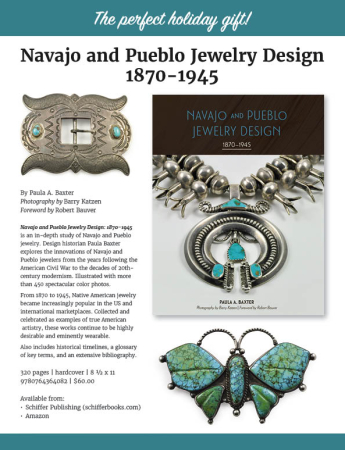
One of the most iconic jewelry design forms from the Native Southwest is the crescent-shaped naja. When the Navajo and pueblo Indians began silversmithing in the last quarter of the 19th century, they created a handsome new jewelry form, a silver crescent pendant, suspended either on a silver chain or leather thong or as a central ornament on a necklace with petal-like beads. Non-Native writers and experts initially assumed that this design was taken from Spanish colonial silver horse stalls.
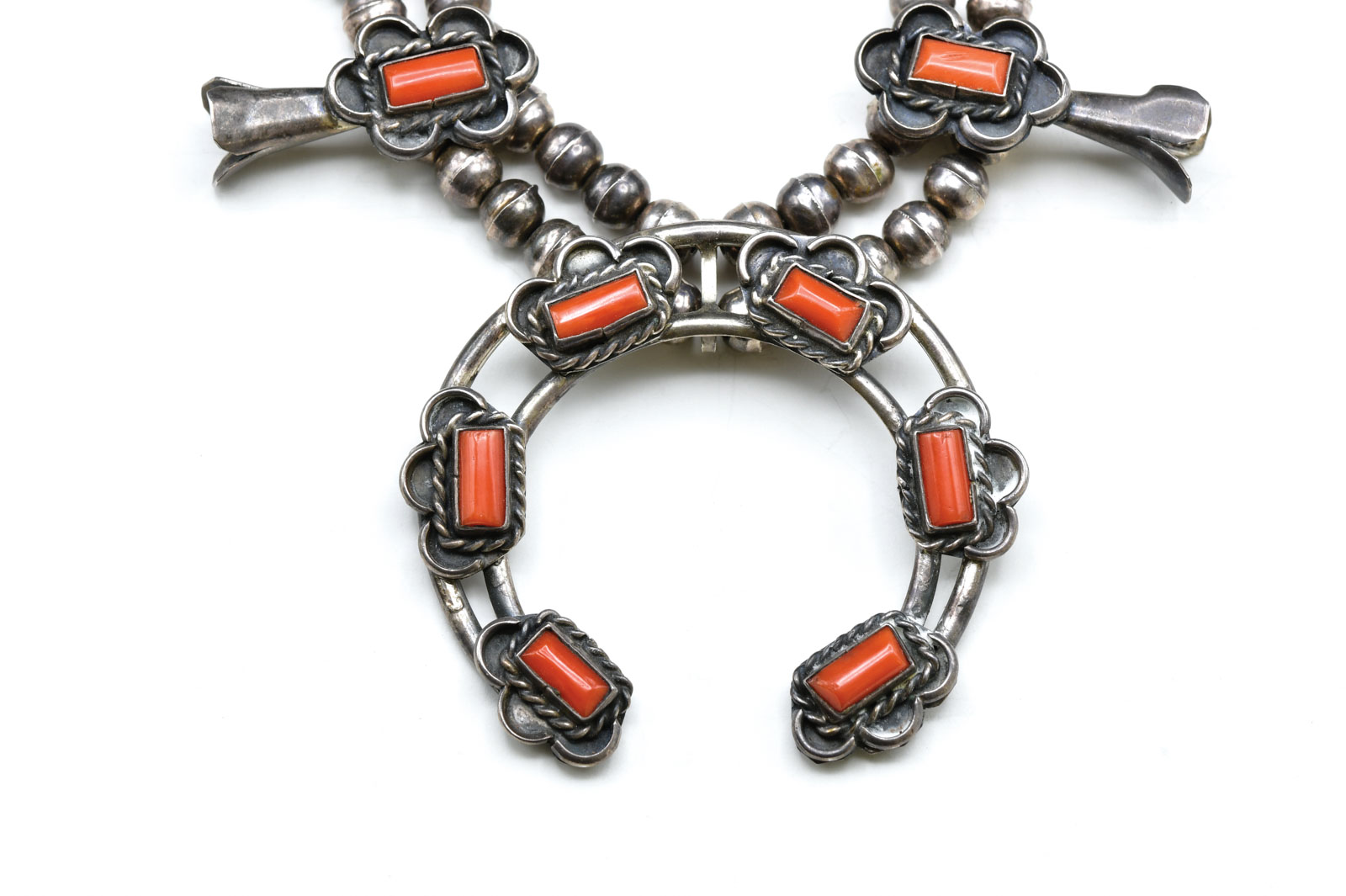 1960s unsigned silver naja on silver squash blossom necklace with coral stones in bezels. Probably Navajo.
In 1982, Southwest scholar Clara Lee Tanner wrote an article in American Indian Art Magazine that laid out several origin theories for the naja. She acknowledged the Spanish silver horse stall model along with possible sources from Plains Indian ornament; Plains tribes traded metalwork items with Southwestern peoples in the mid-19th century. Tanner also made a case for precontact and historic era Puebloan-made pendants from broken shells and loops of stone beads found on wall paintings and turquoise adornment.
The early najas were largely tufa cast or hammered. Stone settings and decorative details evolved quickly. These changes marked early 20th century forms and variations were common by the 1930s. Silver balls, central dangles, and increased elaboration followed up to the 1960s. Naja styles were plentiful, extending to such new forms as brooches and earrings. 1970s patterns are remarkably distinctive. By the 2000s, najas had firmly become part of a fine art legacy in design and innovation.
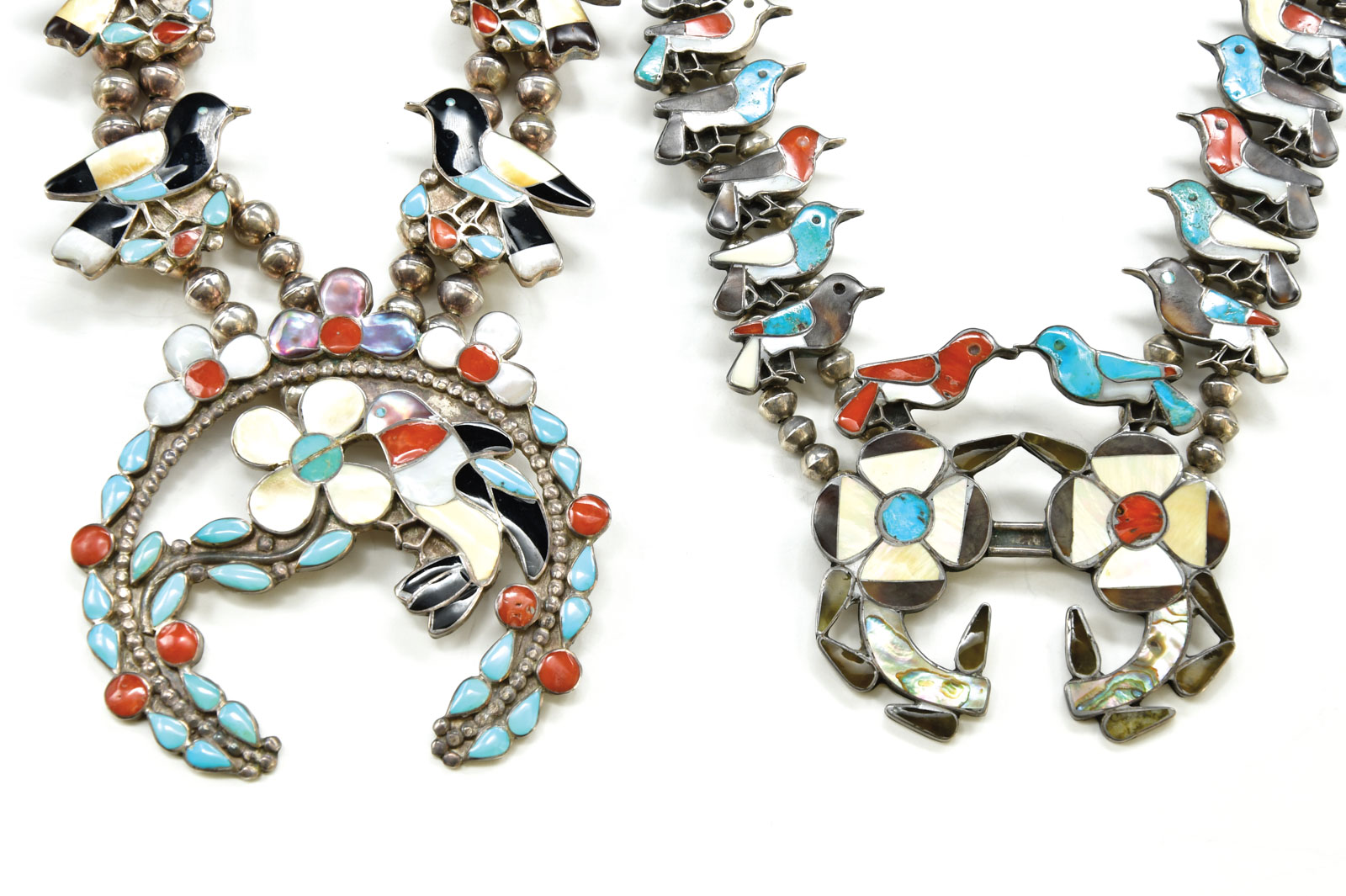 Two Zuni squash blossom necklaces with mosaic inlay najas. Left to right: naja with flowers and hummingbird signed by Wesley and Ella Gia, “73.”; naja with intricate birds and flowers motifs by Anselm and Rosita Wallace, undated but likely 1970s.
It’s interesting to compare and contrast the sheer imaginativeness of contemporary naja forms, especially those meant to be worn as pendants or brooches. Comparing decorative examples from the 1960s and 1970s with 21st-century creations illuminates the changeover from stylized to stylistic design. The necklaces shown from the earlier decades were proudly conventional craft work. The contemporary pieces reflect specific styles: old-style, cutting edge, and evocative fine artistry. All 10 works shown are inventive, but their features have much to say about when they were made.
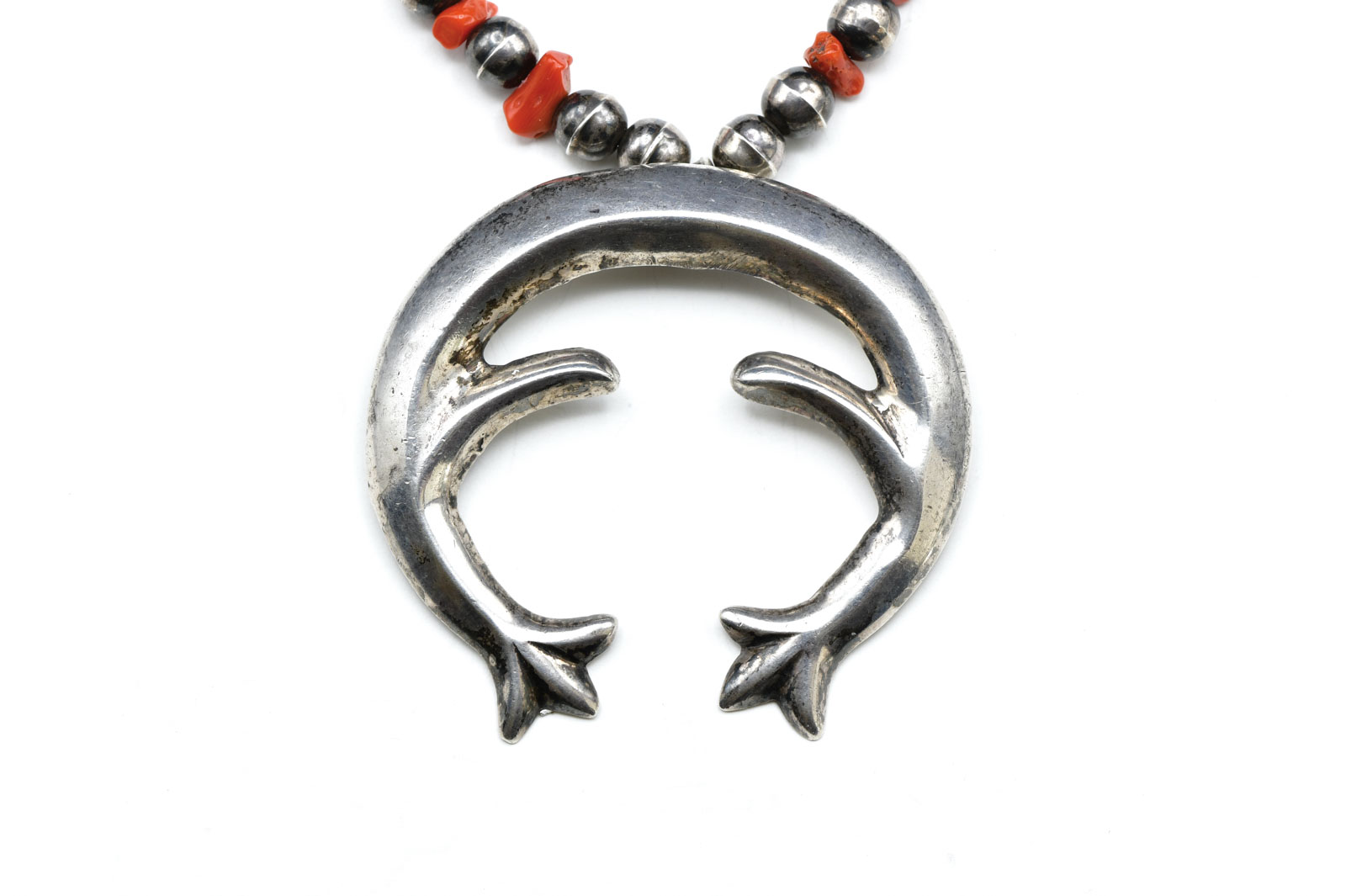 Stylized silver naja pendant on strand of silver and coral beads, Navajo or Pueblo, 1970s.
The 1960s squash blossom necklace is typical of many mid-century necklace designs, with hammered naja and half-round wire. This piece has boxbow ornamentation on the side beads and is set with rectangular coral stones in plain bezels offset by the wire. Early shadow box effect surrounds the stone settings. Overall, the decorative qualities of this piece, especially on the naja, appear somewhat strained; the anonymous maker has dutifully espoused recent and new techniques, but this work still conforms to the conventional designs of 20th-century Southwestern Indian jewelry.
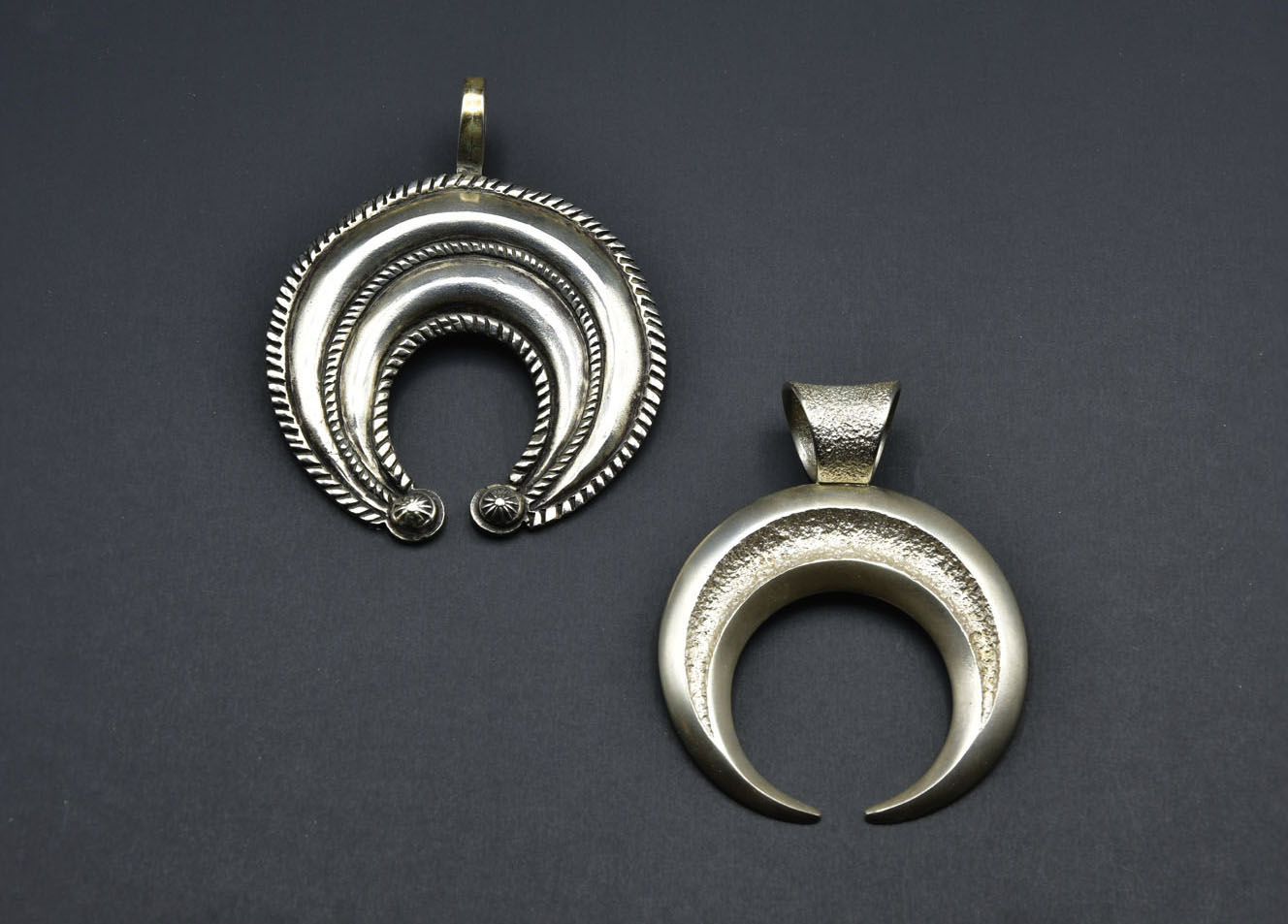 Two Navajo-made silver naja pendants, left to right: old-style cast design by Ernie Lister; ultra-modern design by Rebecca T. Begay, both ca. 2016.
Stylization marks prime examples of 1970s Zuni inlay squash blossom necklaces with najas. The lapidary work on both is exquisite. Both pieces are visually busy, but stylized in a tribal manner reminiscent of folk art. The naja by the Gias is fabricated from sheet silver with a bead strip. The flowers and hummingbirds are nicely placed to frame the naja body. The Wallace naja form is rendered less apparent, yet the small soaring bird terminals are a unique departure from convention.
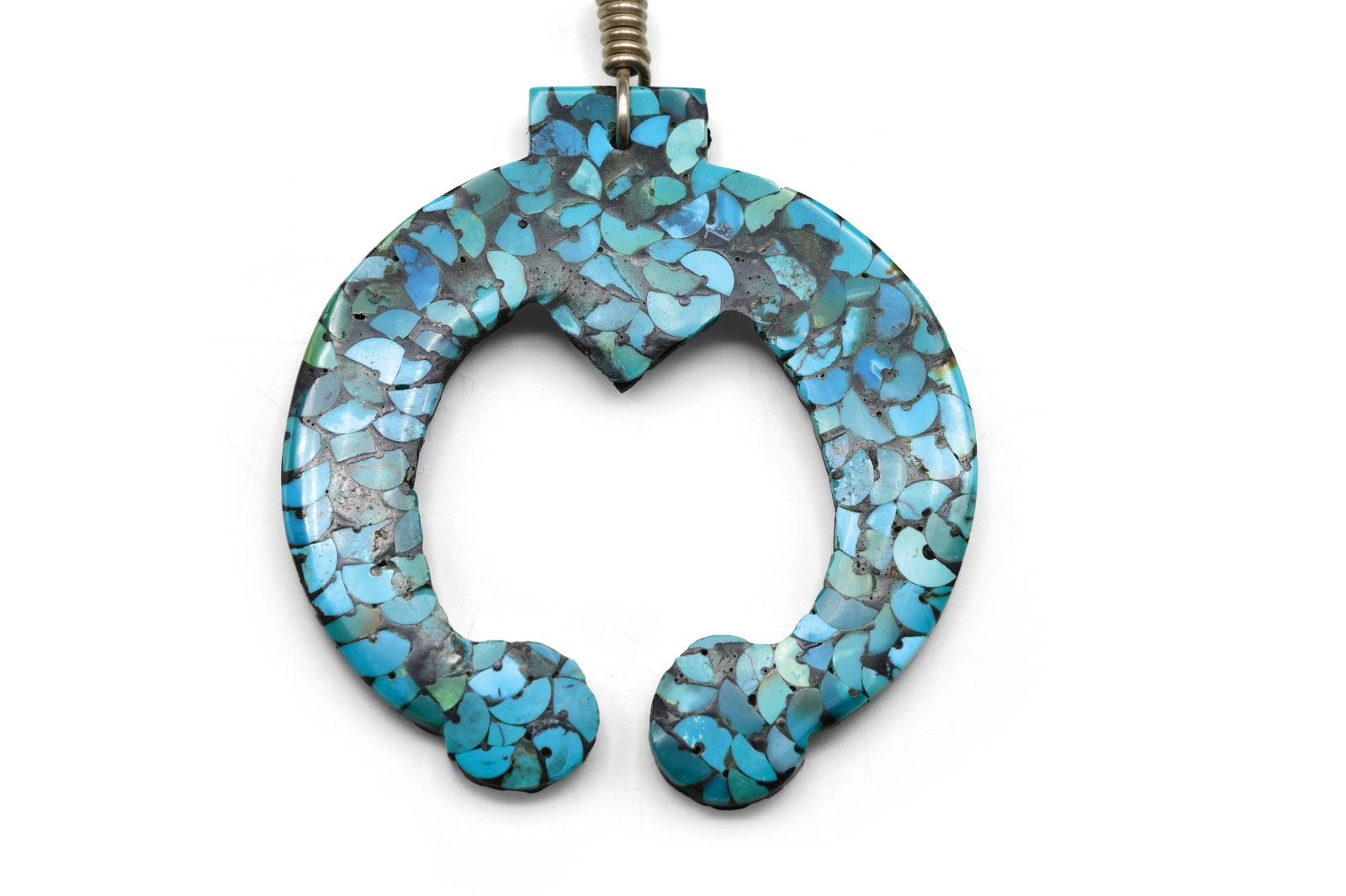 Inlay naja pendant by Isaiah Calabaza with sun maker mark and signature, 2015.
In contrast, an unsigned silver naja pendant from the 1970s shows that its crescent-like body has moved a step away from conventional treatment. This abstract piece suggests an organic stylization; its handmade and production silver bead necklace with cast pendant, possibly Navajo or pueblo, has a vine-like naja motif that expresses refined balance and emphasis design elements.
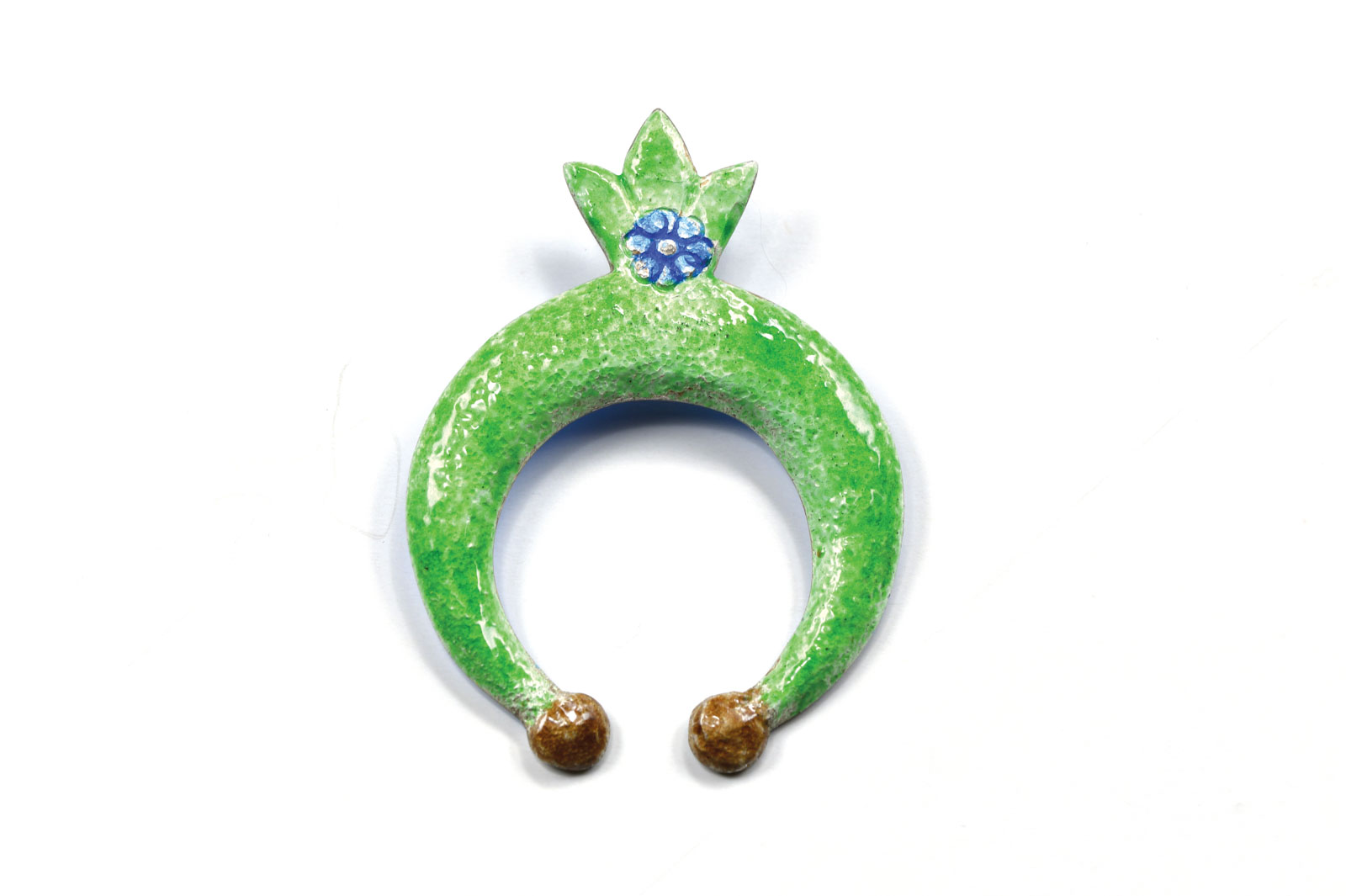 Color enamel on silver small naja pendant by Liz Wallace, ca. 2018.
Nevertheless, when compared to the rather postmodern designs of the 21st century, silver design becomes stylistic. This means that works are created with specific arrangement and meaning. Native jewelry designs from the 2000s now have unique characteristics that reflect design elements and similar styles. In other words, Native techniques can and do drive the composition of a jewelry form like the naja. This change can best be seen in two naja pendants by Ernie Lister and Rebecca T. Begay from the 2010s. Lister’s large piece was made from centrifugal lost wax casting with old-style chisel stamping. His naja was clearly intended to resemble works from the earlier years of jewelry creation. Begay’s classic tufa-cast body and bale, however, was then soldered for a sleek ultra-modern effect.
The stylistic properties of pueblo Depression-era jewelry creativity are echoed in a naja pendant by Isaiah Calabaza. His composition is rendered lively by mosaic overlay drilled beads on polymer. Visual emphasis is placed very firmly on the form’s silhouette. The effect is simple, very contemporary, and somewhat playful. He uses both a sun (drawing) maker mark and his signature on the verso. Innovative jeweler Liz Wallace achieves a similar impact with her first-ever color enamel on a small two-inch-tall silver pendant. Her intention is to show modernist design in a very new light, and this naja’s success derives from its color, texture, and tone.
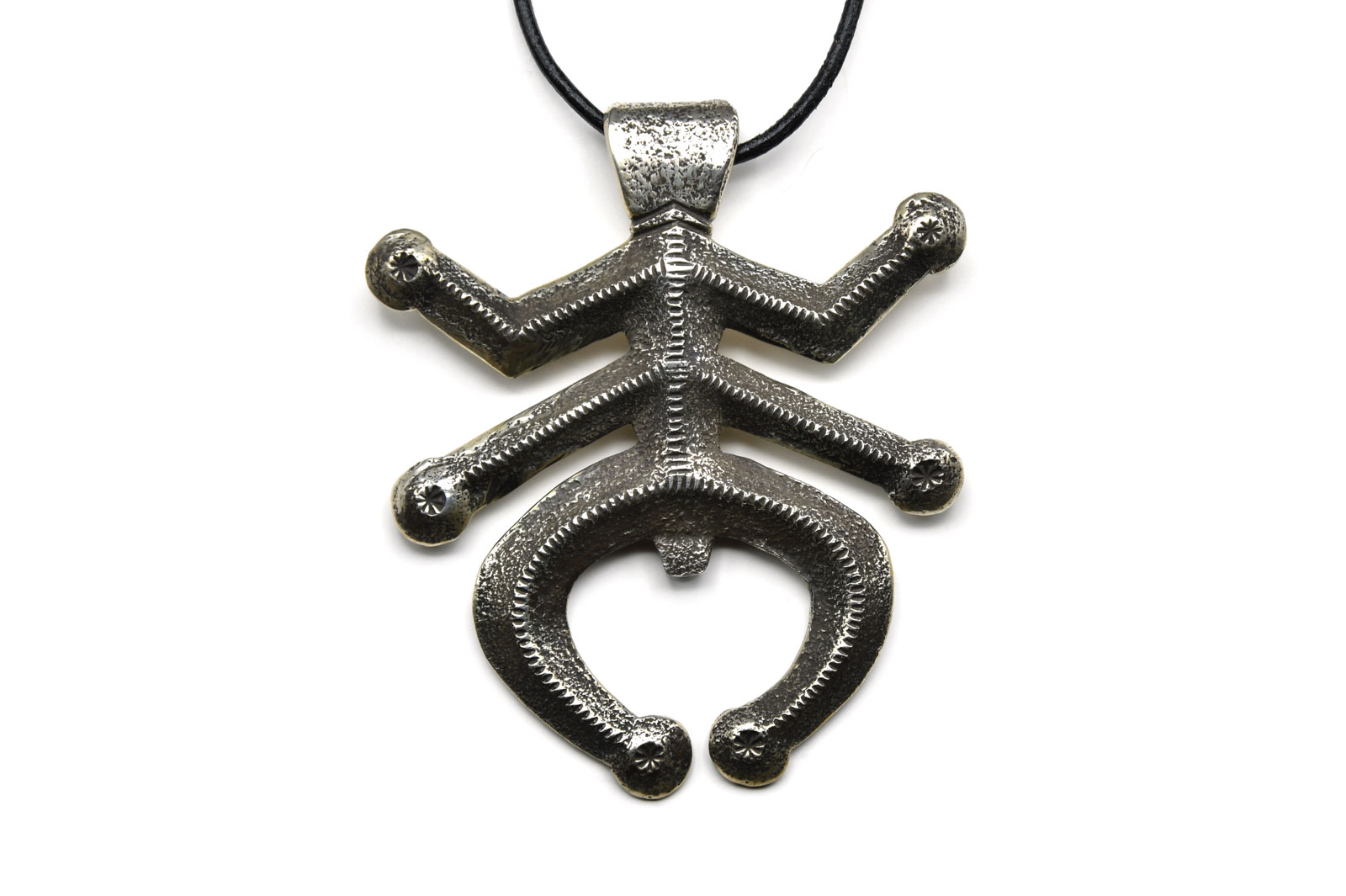 Cast silver figural design with naja-shaped legs by Edison Cummings, ca. 2000s.
Some contemporary Native jewelers find the naja to be personally meaningful as a design motif; these same artists agree, however, with Tanner’s assessment that the Navajos never attached a specific symbolism to this jewelry form. When we look at two quite recent najas, these pieces have a sense of celebrating the naja for its physical properties. Aaron Anderson’s crisp tufa cast naja form serves to surround and frame another historical motif, an abstract dragonfly cross with crescent. This piece is highly descriptive; its pendant shape is simple yet sophisticated—a reminder of the skill and appreciation today’s Native jewelers express for their design heritage.
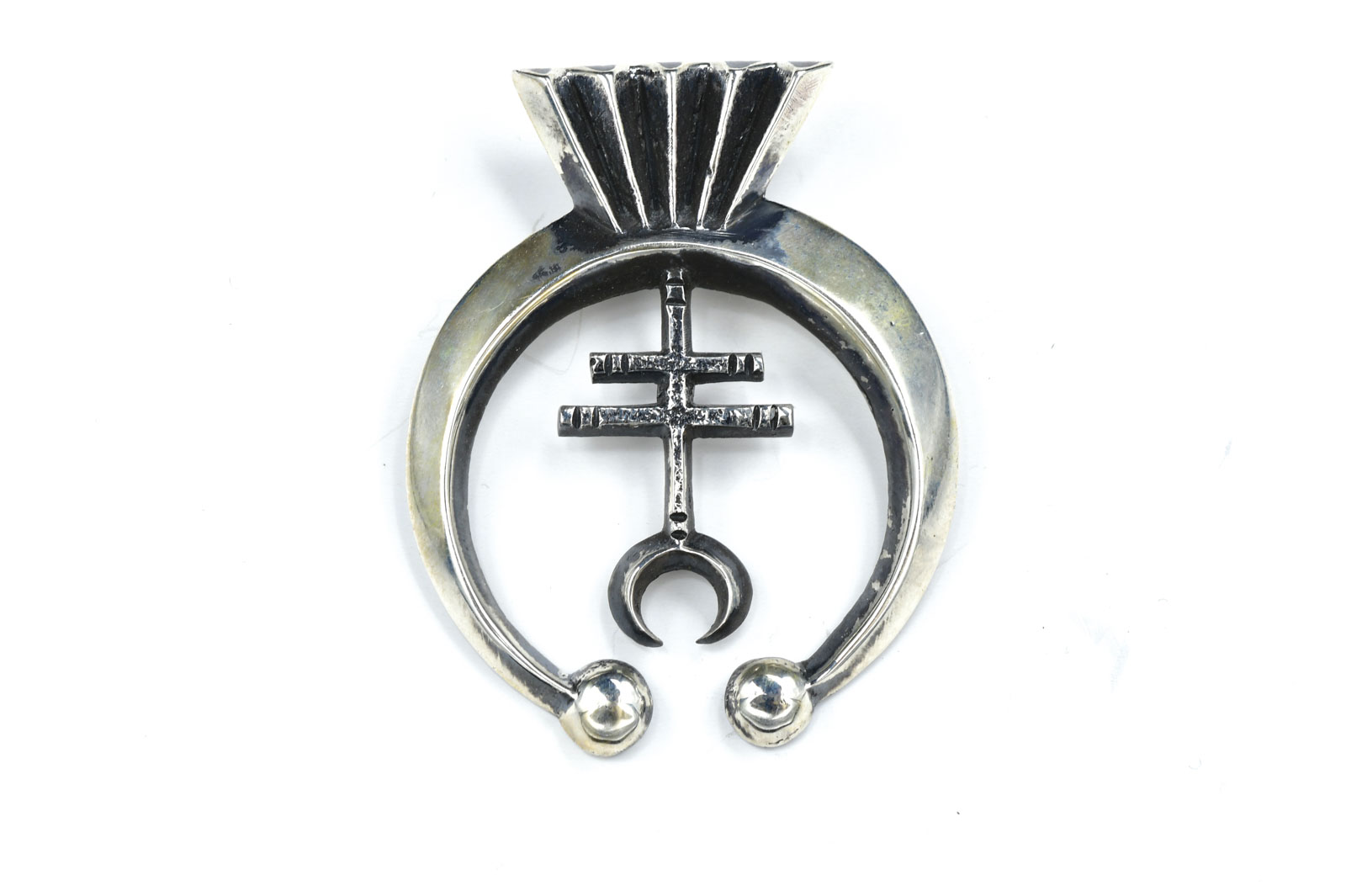 Silver naja pendant with central dragonfly motif by Aaron Anderson, ca. 2022.
In summary, the naja jewelry form moved successfully into the present. The form serves as a motif with formal elements that are positive, refer to the past, and yet remain comfortably abstract. One of the last najas shown here, a pendant by Edison Cummings that has the suggestion of a figural body, is a design that references the jewelry form itself. The piece is highly artistic, the abstraction of a human body (or spirit) whose bowed legs simulate the curves of a naja. This imaginative work captures the essence of how Native jewelers make the naja motif uniquely and enduringly vivid.
Powered by Froala Editor