For her landmark exhibition, T.C. Cannon: At the Edge of America, Karen Kramer wrote, “Through Cannon’s figurative work, he rejected the accepted, expected representations of Native ritual life and instead chose to surface issues of the brutal traumas wrought by colonialism and power dynamics. Concurrently, through his paintings, poetry and music, he also emphasized the ways in which Native Americans persisted and thrived—sometimes in quietly radical everyday ways—in the face of oppression.” Kramer is curator of Native American and oceanic art and culture at the Peabody Essex Museum in Salem, Massachusetts.
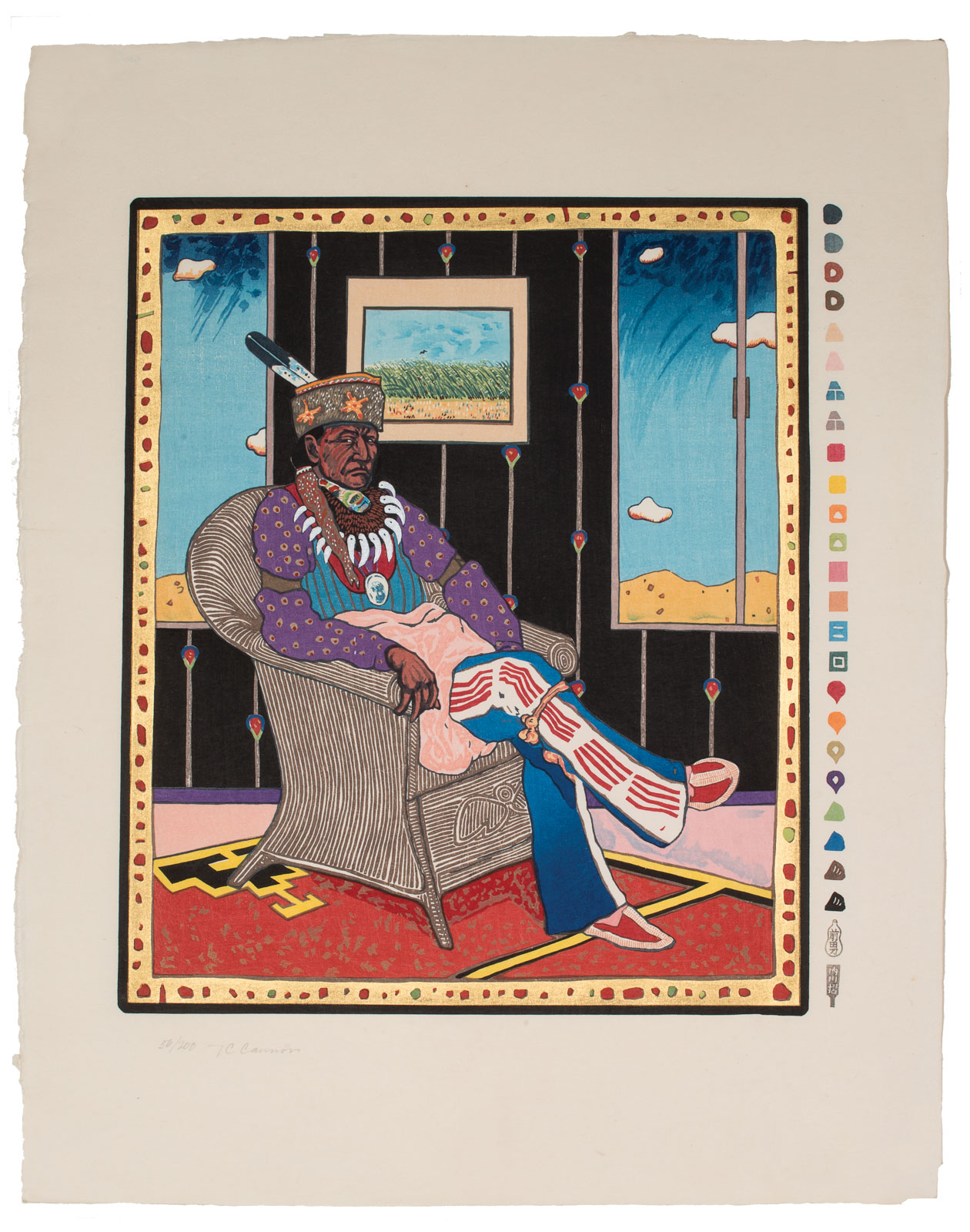 Collector #5, 1977, woodcut print, ed. 56 of 200. Gift of Christy Vezolles in memory of Gil Waldman, 5007-1.
T.C. Cannon (1946-1978) was born in Oklahoma to a Kiowa father and a Caddo mother. During his brief life (he died in a car crash near Santa Fe, New Mexico, when he was 31) he studied at the Institute of American Indian Arts during its vibrant early years, was awarded two Bronze Stars in Vietnam, and put an indelible mark on contemporary Native American art.
In 1975 he began a collaboration with master Japanese woodcutter Maeda and printer Uchikawa to produce woodcuts of several of his paintings.
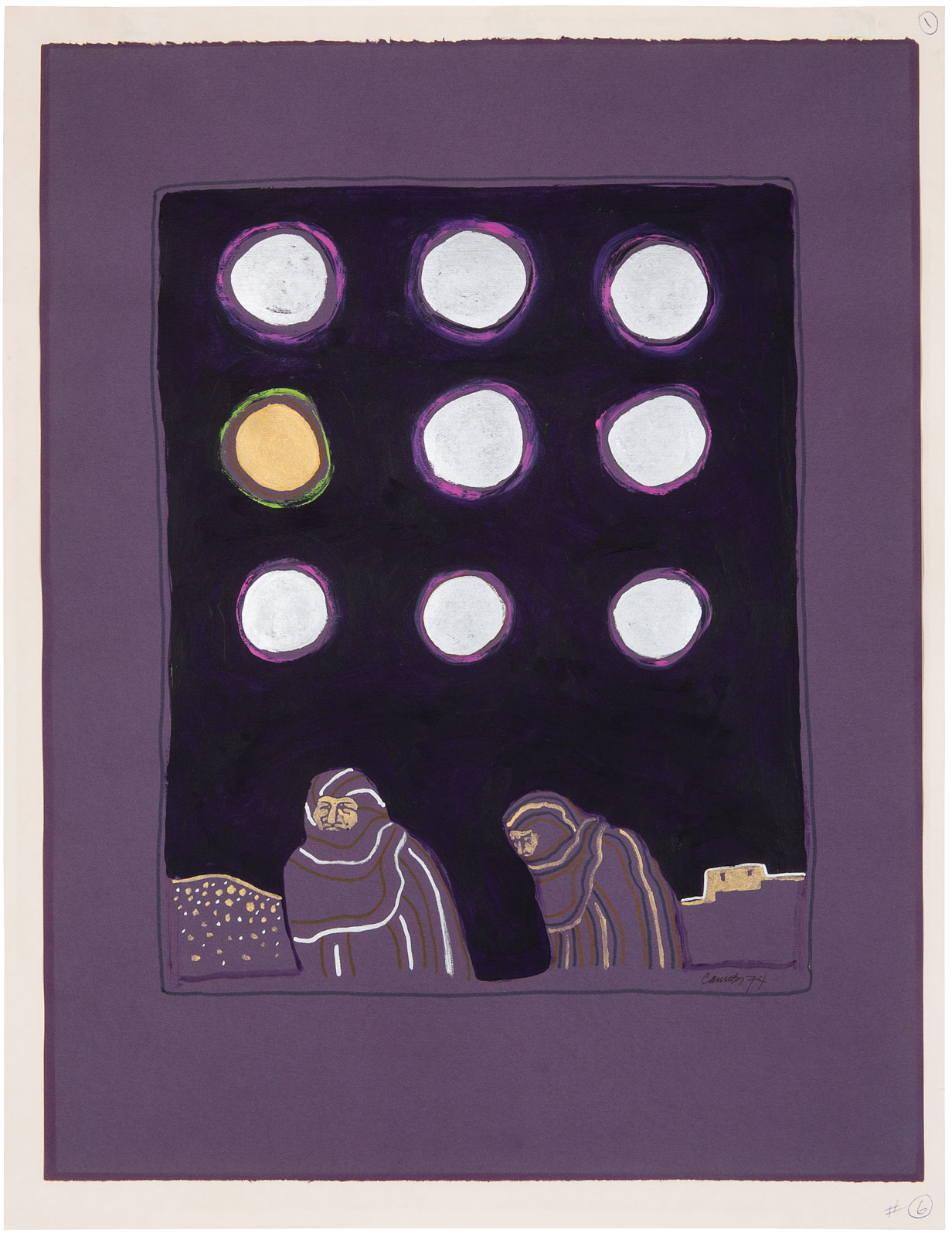 Moon and Stars over Taos, 1974, acrylic and metallic paint on paper. Acquisition made possible thanks to the generosity of the following, in memory of Gil Waldman: Tony Abeyta, Susan Esco Chandler and Alfred D. Chandler, Pam Hait, Vickie Hamilton-Smith and Jerry Smith, Anita Hicks, Linda Herold, Ellen and Steve Hoffman, Kathleen L. and William G. Howard, Annadru and Richard Lampert, Patsy and Ed Lowry, John Otto, The Owings Gallery, Sallyann Paschall, Laura Finlay Smith, Tia Foundation, Christy Vezolles, Paul Vezolles, The Waldman Family, 5038-1.
The Heard Museum in Phoenix is presenting Indeterminate Beauty featuring five of the prints and the recent gift of a painting by the artist. The prints were donated by Christy Vezolles in memory of her husband, Gil Waldman. The painting was donated by 18 supporters in memory of Mr. Waldman. Cannon’s print Collector #5 depicts a Native man in fine regalia, seated in a wicker chair in a fancy room with a view of the plains through the windows. Behind him is Van Gogh’s Wheatfield with Partridge. Cannon subverts the notion that Native Americans lived in isolation away from the culture of the rest of the world. The subject is sitting in a white wicker chair, emblematic of the summer homes of the wealthy in the 19th century, with an iconic 19th-century painting on the wall. The windows are 20th-century plate glass sliders, suggesting “We Are Still Here,” integrated into the greater society with our culture still intact.
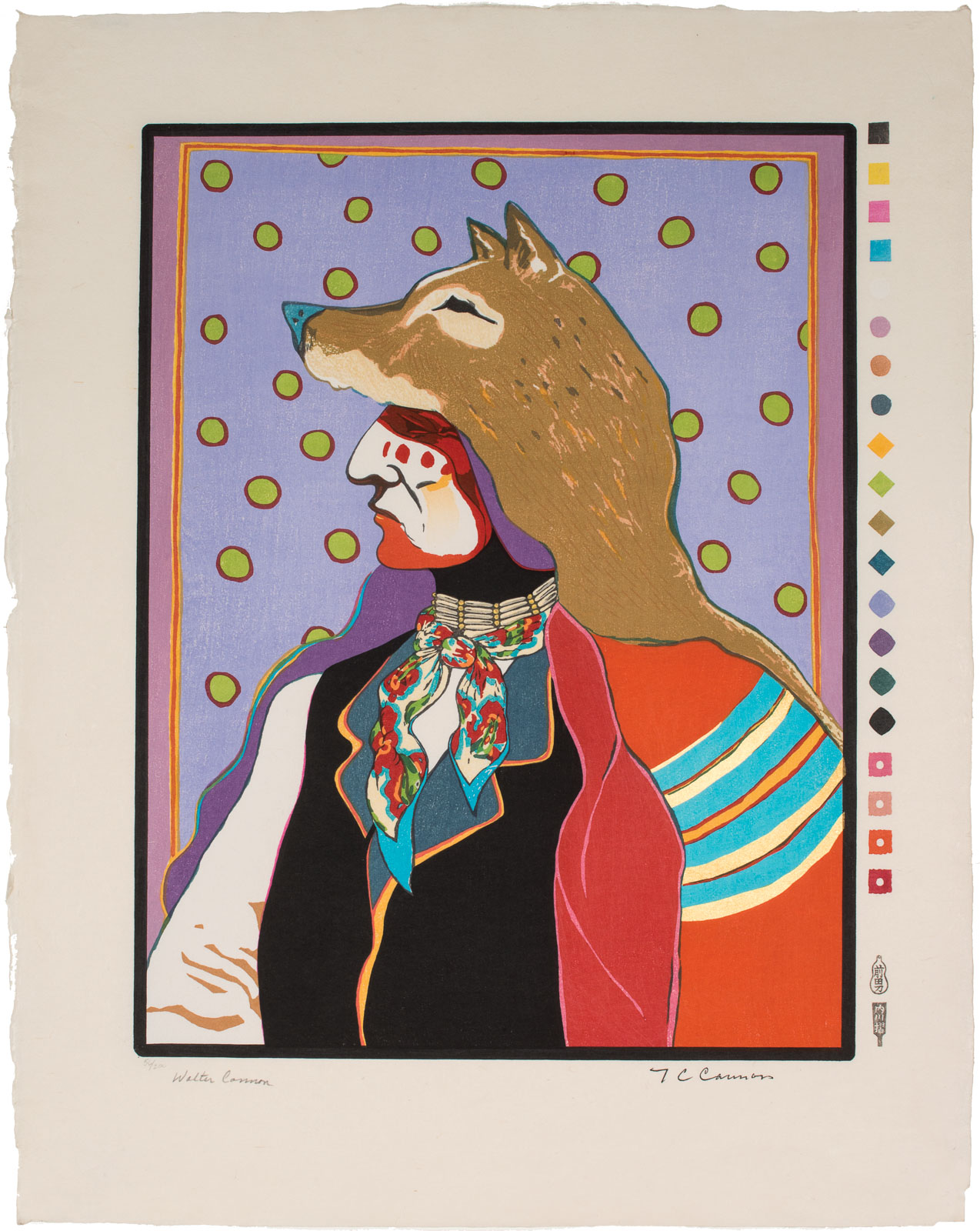 His Hair Flows Like a River, 1977, woodcut print, ed. 56 of 200. Gift of Christy Vezolles in memory of Gil Waldman, 5007-5.
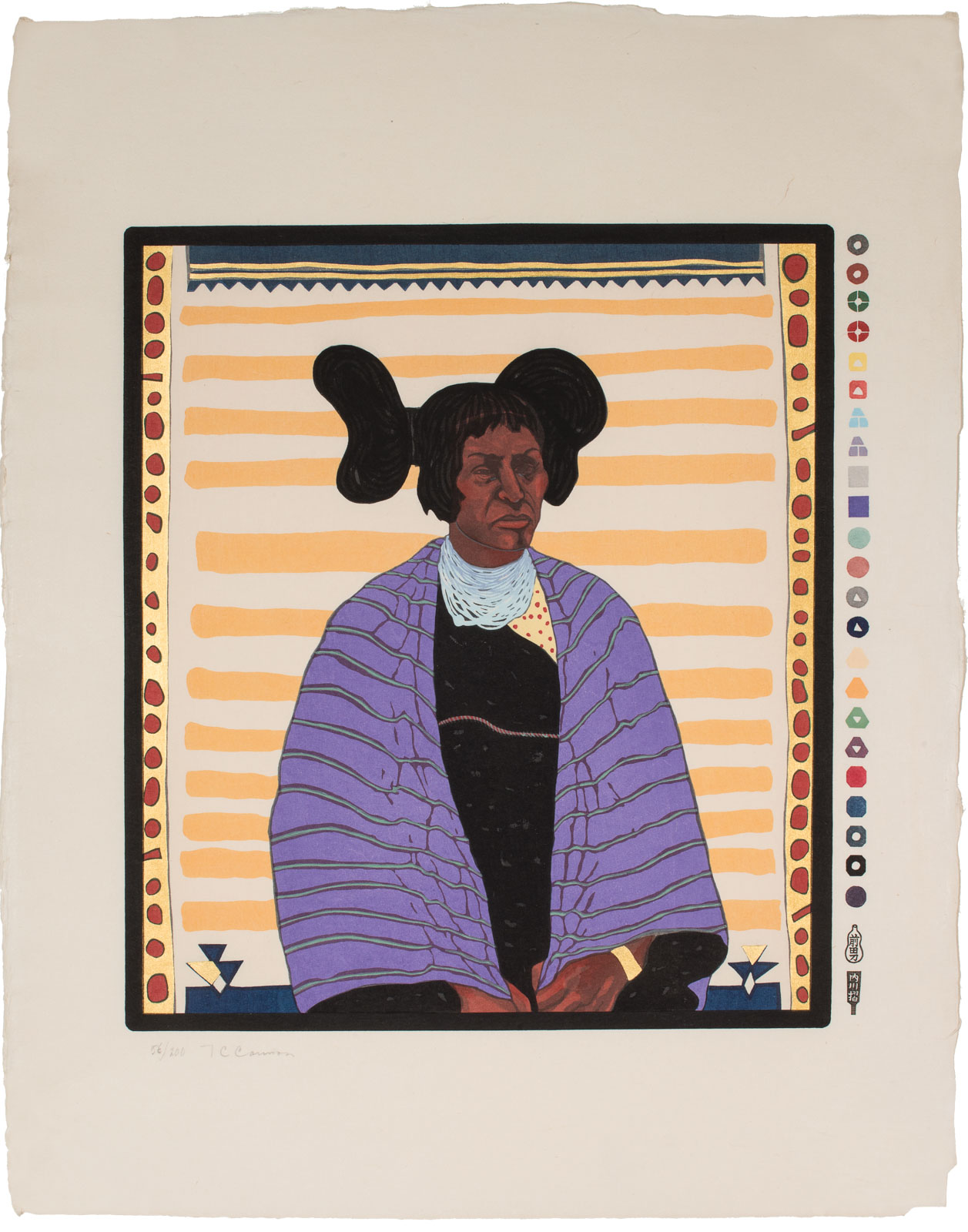 Hopi with Manta, 1977, woodcut print, ed. 56 of 200. Gift of Christy Vezolles in memory of Gil Waldman, 5007-2.
Commenting on Cannon’s painting Moon and Stars over Taos, the Heard comments on his use of metal leaf and his knowledge of international art. “Vast celestial bodies loom over two figures tightly wrapped in striped blankets—Moon and Stars over Taos assumes a quiet stillness emanating from the winter atmosphere…Cannon applies metallic silver and gold to illuminate the sky and provide a glow to the landscape behind the figures. In this technique he draws inspiration form the work of the Austrian artist Gustav Klimt, who made use of dynamic movement through the application of gold leaf in [his] paintings”
The exhibition continues through April 22, 2024.
Through April 22, 2024
T.C. Cannon: Indeterminate Beauty
Heard Museum, 2301 N. Central Avenue, Phoenix, AZ 85004
(602) 252-8840, www.heard.org
Powered by Froala Editor