What would you do with $20,000?
Mikayla Patton (Oglala Lakota Nation) is buying a car. Well, paying off a car more accurately.
Not a Mercedes Benz or a sports car, but a Honda CRV. It’s not even a new car, but a new-to-her old car that her mom has been helping with payments on since Patton had to replace her beloved 2003 Honda CRV after it finally conked out in the summer of 2022. If you think the life of a contemporary artist is glamorous—nightclubs, jet-setting to gallery openings—read that last sentence again.
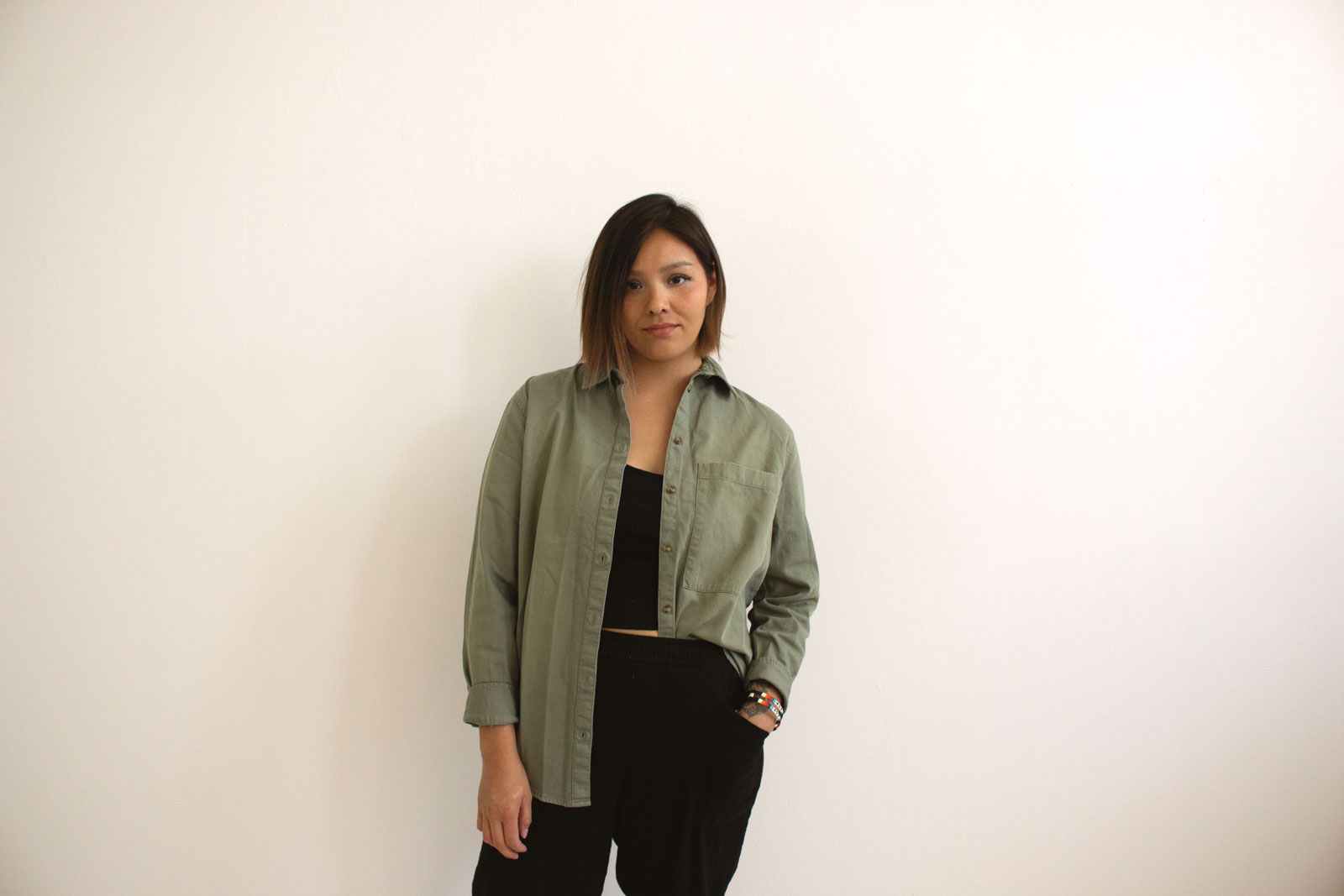 Mikayla Patton (Oglala Lakota Nation). Photo courtesy the artist.
A Joan Mitchell Fellowship comes with an upfront, unrestricted $20,000 payment. Patton is one of 15 winners for 2023. Upon receiving the news in August, paying off that Honda CRV was at the top of her list with what to do with the money.
“I just moved to Pennsylvania and was getting settled in the house, and I was still unpacking my studio,” Patton remembers of receiving the good news. “I usually have my phone on silent and I had a voicemail. On iPhone, you can select the voicemail and it will have [a transcription] of it. It said, ‘I’m from Joan Mitchell,’ and I was like, ‘NO WAY!’. Instantly my body just started getting hot, I was sweating because it felt so unreal. I called them back and they said, ‘Congratulations, you were selected,’ and I was shaking.”
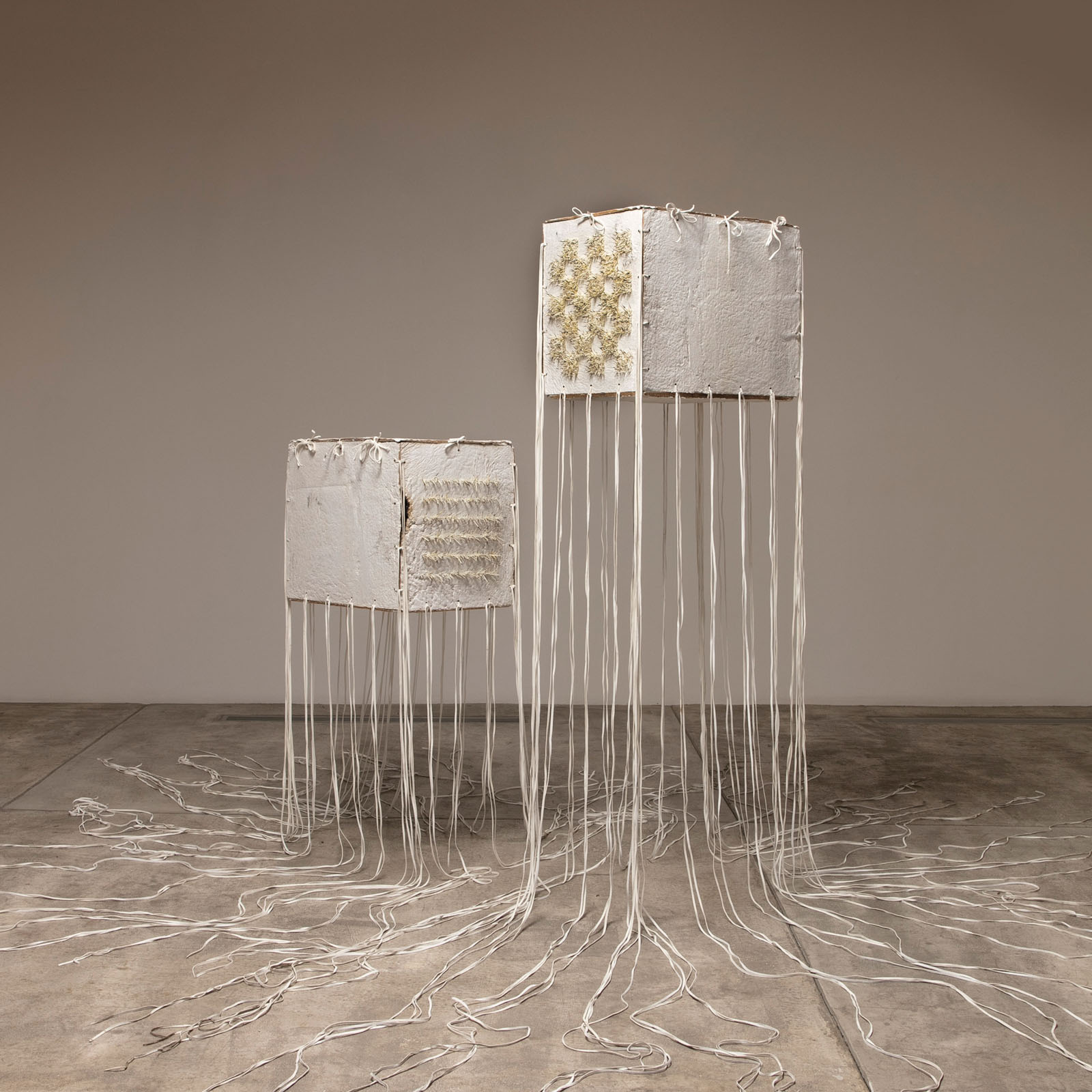 Enduring, 2023, handmade paper, porcupine quills, deer leather lace and ash, 15 x 17 x 22” (each box, installation varies). Photo courtesy Chiaroscuro Contemporary Art.
Joan Mitchell (1925-1992) was a leading abstract expressionist painter throughout the second half of the 20th century. Her artworks were big, physical and audacious. She was lauded in her lifetime with exhibitions at the world’s leading museums.
Paying it forward, her will called for the formation of the Joan Mitchell Foundation with a primary purpose of creating support and recognition for individual artists. The most public of those efforts is the annual Joan Mitchell Fellowships, one of the two or three most prestigious annual awards available to American artists.
The fellowships come with $60,000 in unrestricted funds, an initial $20,000 payment followed by four years of $10,000 installments. The foundation also provides opportunities for artists to engage in programs focused on personal finance, legacy planning and self-advocacy, among other opportunities.
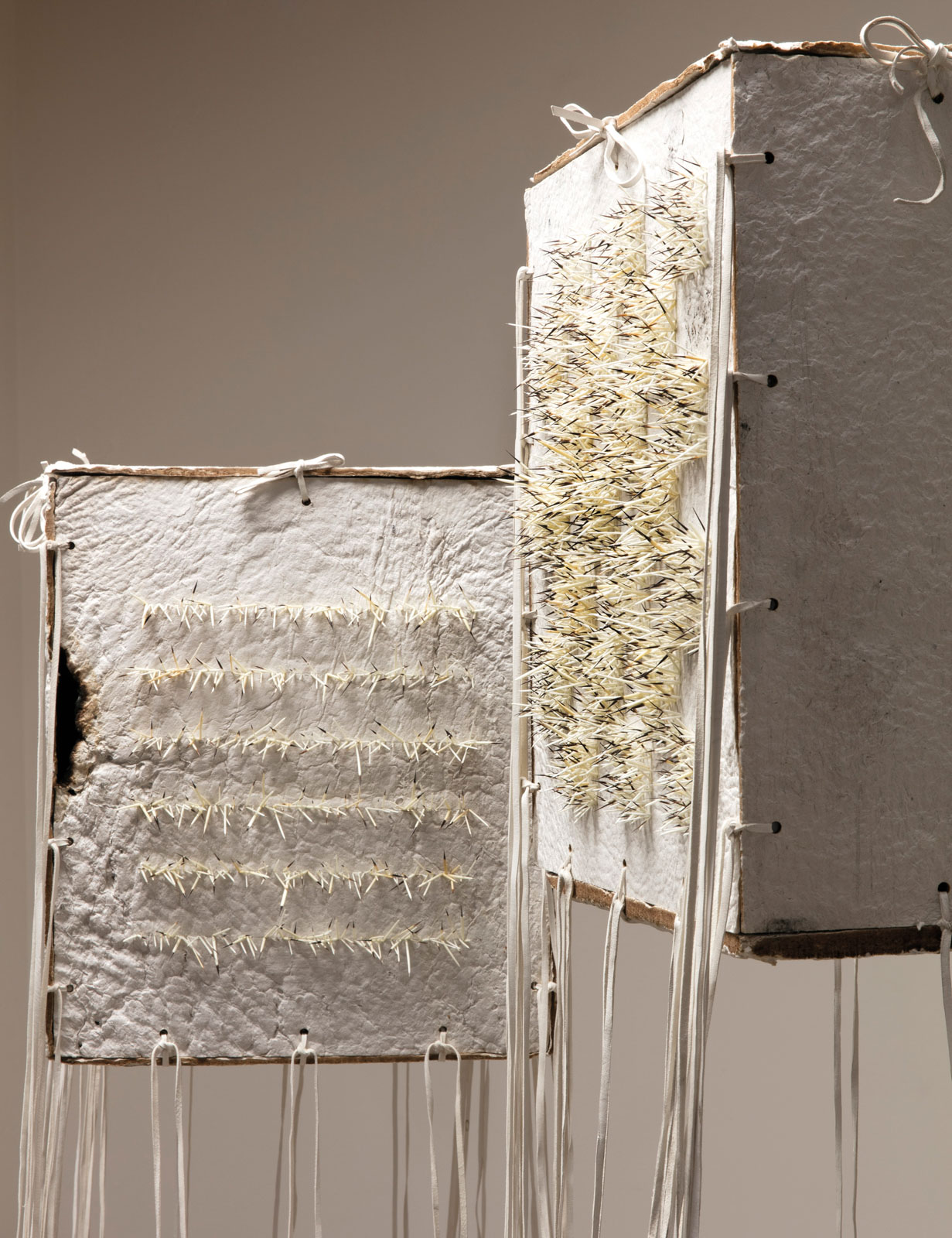 Enduring, 2023, handmade paper, porcupine quills, deer leather lace and ash, 15 x 17 x 22” (each box, installation varies). Photo courtesy Chiaroscuro Contemporary Art.
The process for selecting Joan Mitchell Fellowship recipients begins with the selection of nominators from across the country—the group that makes recommendations to the foundation about artists for fellowship consideration. Eighty-two nominators produced a final group of applications from 148 artists, including Patton.
The criteria for jurors in reviewing applications include the artistic vision of each applicant, the commitment of the artist to an active practice, and potential impact of the award on the artist’s career and life.
Previous winners of the Joan Mitchell Fellowship and its predecessor, which dates to 1994, reads like a who’s who of contemporary art in America: Mark Bradford, Nick Cave, Simone Leigh, Julie Mehretu, Amy Sherald, Mickalene Thomas and Kara Walker.
Previous Native American winners include Julie Buffalohead, Andrea Carlson, Jim Denomie, Brad Kahlhamer, Cannupa Hanska Luger, James Luna, Jaune Quick-to-See Smith, Wendy Red Star, Rose Simpson, Duane Slick, Kay WalkingStick, Marie Watt and Dyani White Hawk.
That is the caliber of artist Patton joins.
Also honored in the 2023 class was Native Alaskan Nicholas Galanin (Lingít/Unangax).
Ascending to this esteemed pedestal of not only leading Native American artists, but leading contemporary artists, will challenge Patton.
“It’s exciting, but also a little scary,” says the artist, who was raised on the Pine Ridge Reservation. “I grew up in my community, I grew up around Native people my whole life, so being in spaces that aren’t exclusively Native, it’s a little intimidating. Going into those type of spaces I am aware that I have to explain a lot—where do I start because there’s so much history.”
All artists are asked to explain their work. Native artists, however, are also expected to be cultural anthropologists, linguists and historians when being quizzed by curators and collectors.
It’s a burden shared by no other sector of contemporary artists.
Patton creates sculptural objects utilizing the Lakota knowledge of being, adornment and artistic methodologies, addressing themes of healing, growth and renewal. She does so using earth elements, but also, prominently, paper she makes herself, a practice initiated while pursuing a BFA with a focus in printmaking from the Institute of American Indian Arts.
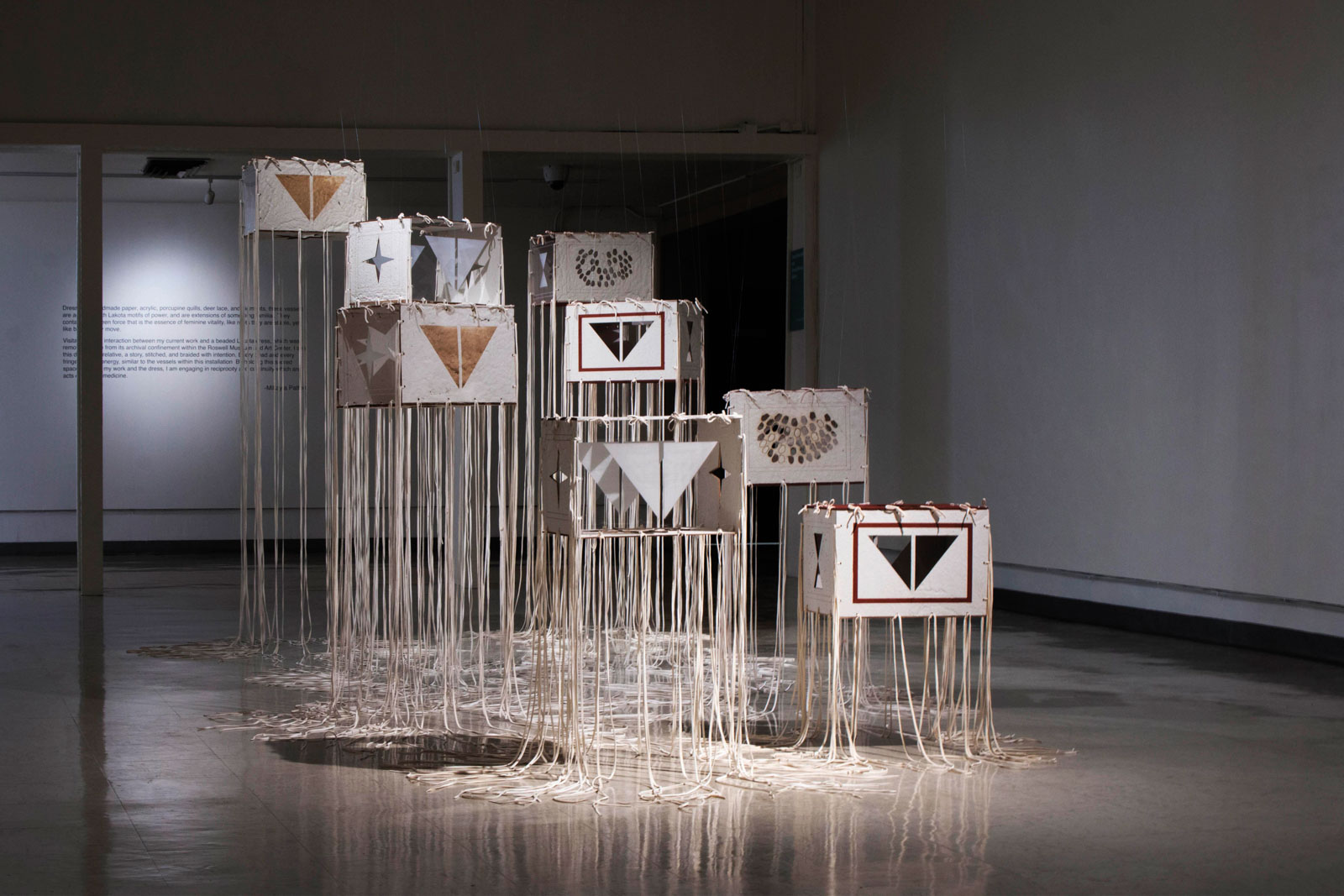 Visitation, 2021, installation varies. Photo courtesy the artist.
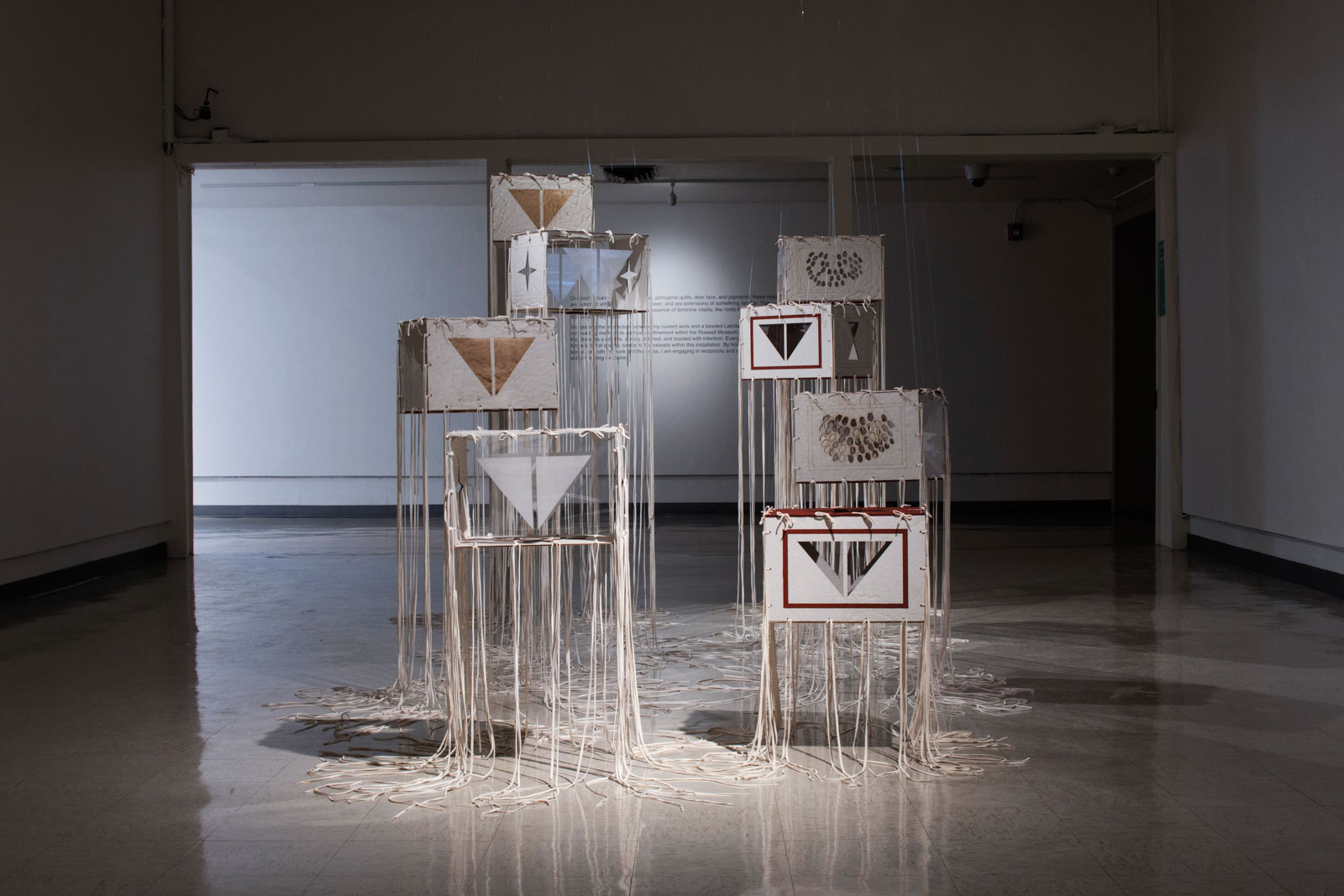
Visitation, 2021, installation varies. Photo courtesy the artist.
What she did have access to was paper. Scrap paper. Paper everywhere. Wasted paper. Every stop along her journey, Patton found paper.
“I was in a class and we were exploring different avenues of how to use paper in other ways, and that naturally turned into papermaking,” Patton remembers. “I grasped on to that. How do I continue to work with the material and push it?”
She’s pushed it into paper parfleche boxes.
“The traveling trunk, known as parfleche, plays an important role in many Plains tribes. Its purpose was vital during time of travel, it was needed to carry belongings. The embellishment of the parfleche was strongly painted by women with earth pigments and abstract symbolism,” Patton explains on her website. “The designs could tell stories, dreams, experiences and were made for specific people. Though representative, the utilitarian trunk may also have been a spiritual form of map and record keeping of land through powerful line formations. Originally made from rawhide (animal skin beaten flat and dried until hard), parfleche is a significant thread of Lakota lineage, intersecting my ancestors’ ingenuity with contemporary Lakota expression.”
Patton familiarized herself with that lineage up close, hands on, while working previously with the collection in her community’s cultural center.
“I was looking at a lot of moccasins, a lot of rawhide, stretched rawhide hand drums, drumsticks. I was working with headdresses and how those were made, how each individual feather was stitched to them,” Patton says. “All these little details. Every little stitch that was happening, I was really engaged in it. I wanted to be able to do that on my own.”
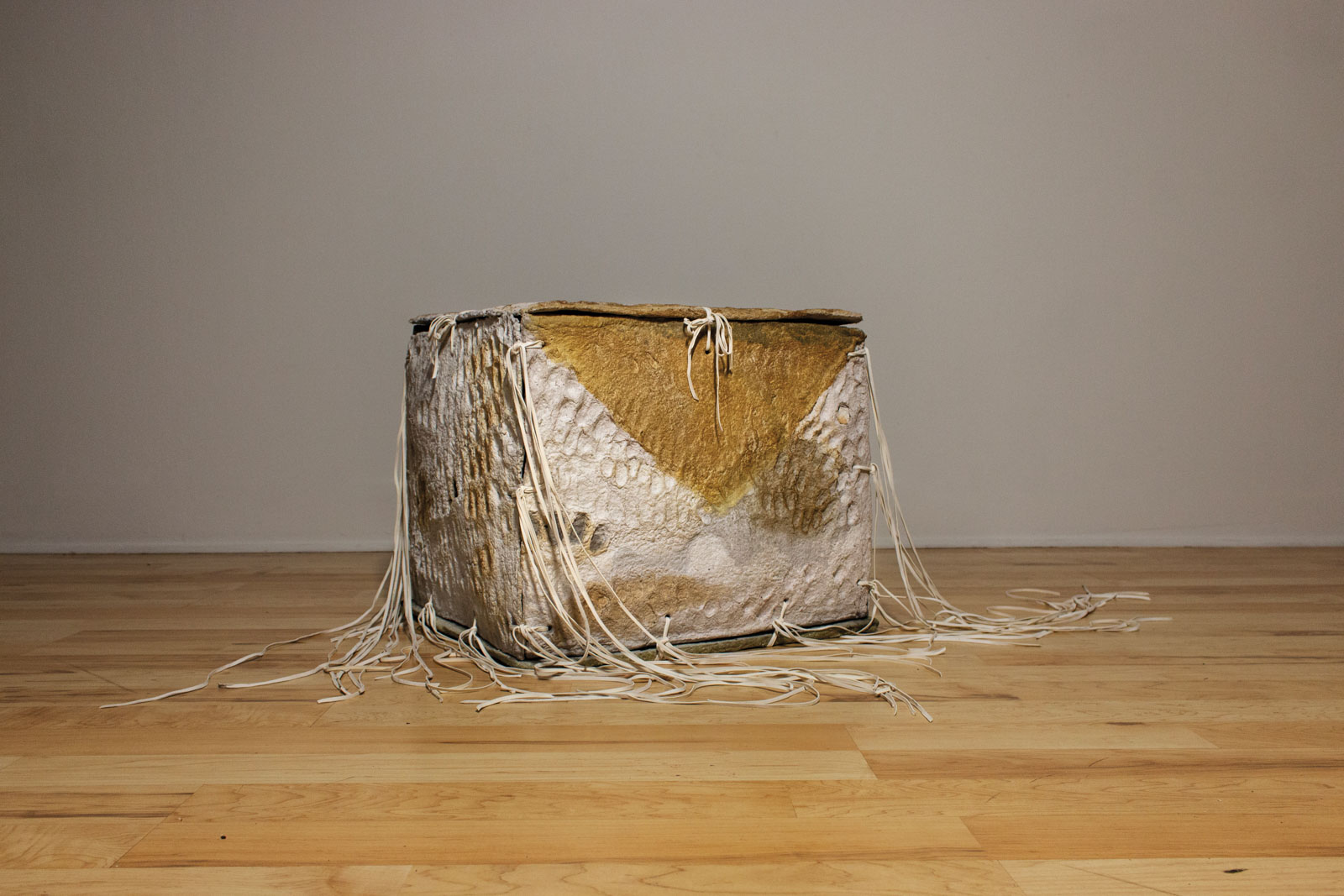 Smells like Sweet Grasses, 2023, handmade paper, sweet grass dye, India ink and leather, 25 x 21 x 23”. Photo courtesy Chiaroscuro Contemporary Art.
She found the surfaces fascinating. The texture. The sensory nature of the items.
Patton’s handmade paper has a rough surface. Texture is critical to her work. Beads. Quills. Everything is coarse, pockmarked, pointy, corrugated, material, tactile.
“I had the opportunity to clean cultural objects, looking and spending a lot of [time in] close contact. I was intrigued with the different mark making that was happening with paint, but also with scratching and carving and even the texture of that animal hide,” Patton remembers. “When bugs start to eat at the skin, those get left behind on the hide, and it leaves a really beautiful, weird texture. I got obsessed with all of that.”
Teachings from the past she absorbed and is carrying to the leading edge of contemporary art. That’s the way it has always been for her.
“I grew up on the reservation in tribal school, and every year we were always meeting with elders and elders were always telling us all these things that we have responsibility of, and that’s something that continues to echo in my head,” Patton says. “That’s something that I try to put within my work.”
Powered by Froala Editor