How does an artist know who they are? Poet John Trudell once said to “follow the lines.” Jaune Quick-to-See Smith has been doing just that for 50 years. Her lines are maps.
After a ground-shaking, blockbuster show at the Whitney Museum of American Art in New York City, Smith, a citizen of the Confederated Salish and Kootenai Nation, was the first Native American woman to have a solo show there and will see the retrospective exhibit, Jaune Quick-to-See Smith: Memory Map, travel to the Modern Art Museum of Fort Worth. It will be on view from October 15 through January 21, 2024.
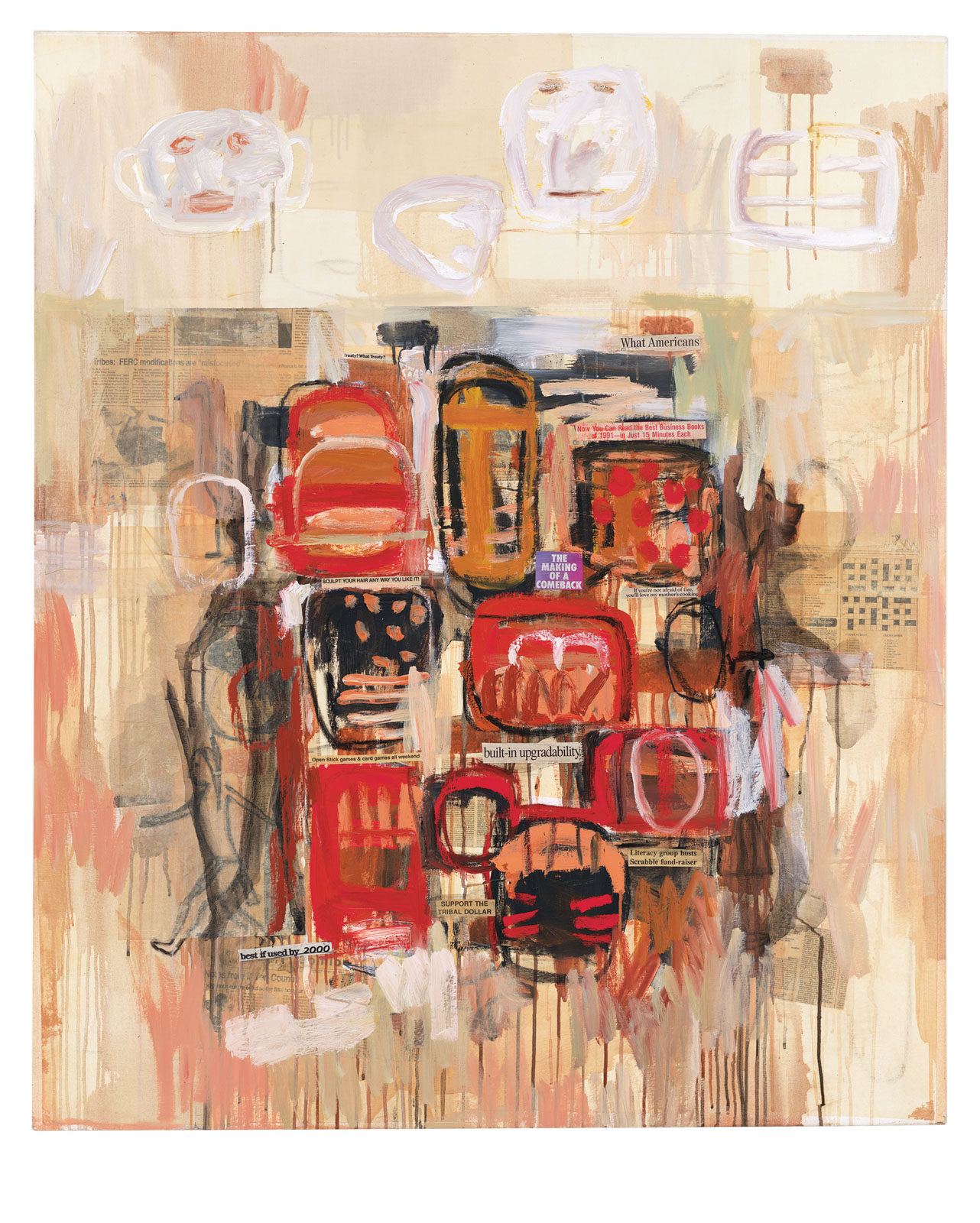 The Vanishing American, 1994, acrylic, newspaper, paper, cotton, printing ink, fabricated chalk and graphite pencil on canvas, 601/8 x 501/8”. Whitney Museum of American Art, New York. Gift of Dorothee Peiper-Riegraf and Hinrich Peiper in memory of Arlene LewAllen 2007.88. © Jaune Quick-to-See Smith. Photo courtesy Whitney Museum of American Art, New York.
Smith has had a nearly five-decade career as an artist, she is also an activist, curator, educator and advocate.
Organized by the Whitney, the show is a recognition of this groundbreaking artist’s work of drawings, prints, paintings and sculptures that twist mainstream historical narratives about Natives and culture.
Memory Map is the largest and most comprehensive showcase of Smith’s career, with more than 100 works. It is organized thematically, offers a new way to consider contemporary Native American art and shows how Smith initiated and then led some of the most pressing dialogues on land, racism and cultural preservation.
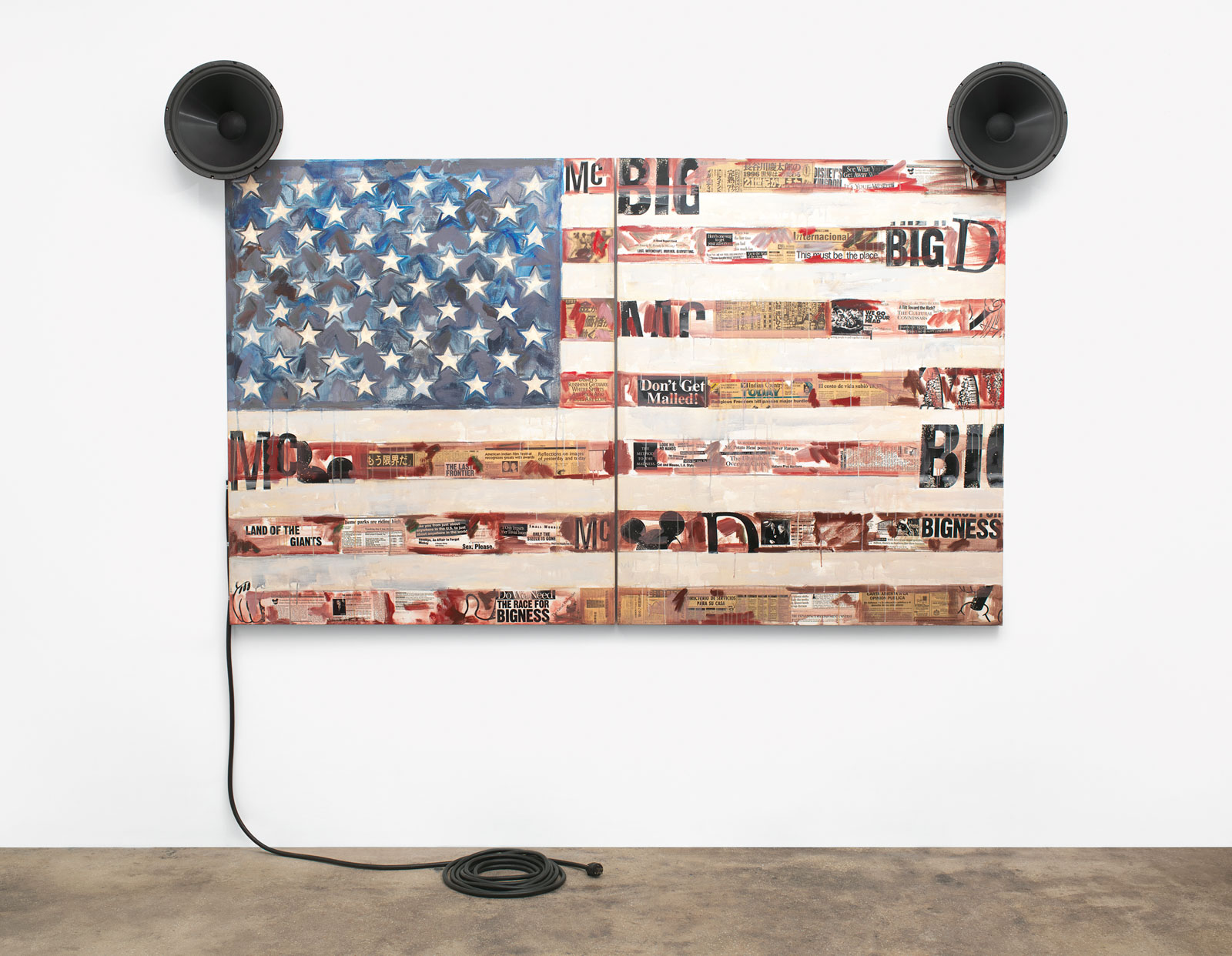 McFlag, 1996, oil, paper, and newspaper on canvas with speakers and electrical cord, three parts, 60 x 100” overall. Tia Collection. Fabricated by Neal Ambrose-Smith. © Jaune Quick-to-See Smith. Photograph courtesy the artist and Garth Greenan Gallery, New York.
Her humble beginnings and struggle to be taken seriously has emerged in triumph as she brings along her cultural iconography of trade canoes, horses, bison and flags that co-exist with newspaper, textiles and commercial objects. Those images allude to ecological disaster, the misreading of Native and colonial history, and the genocide of Indigenous people.
This exhibition is organized by Laura Phipps, assistant curator at the Whitney Museum of American Art, with Caitlin Chaisson, curatorial project assistant.
“Through her sophisticated use of color, materials and humor, Smith’s work prompts important conversations about history and education—and ultimately about the obligations we have to each other and the world around us,” says Phipps. “From the inception of Memory Map, Smith and I had hoped for her messages and her art to reach audiences across the country, and we are so thrilled to see them in the context of the Modern Art Museum of Fort Worth.”
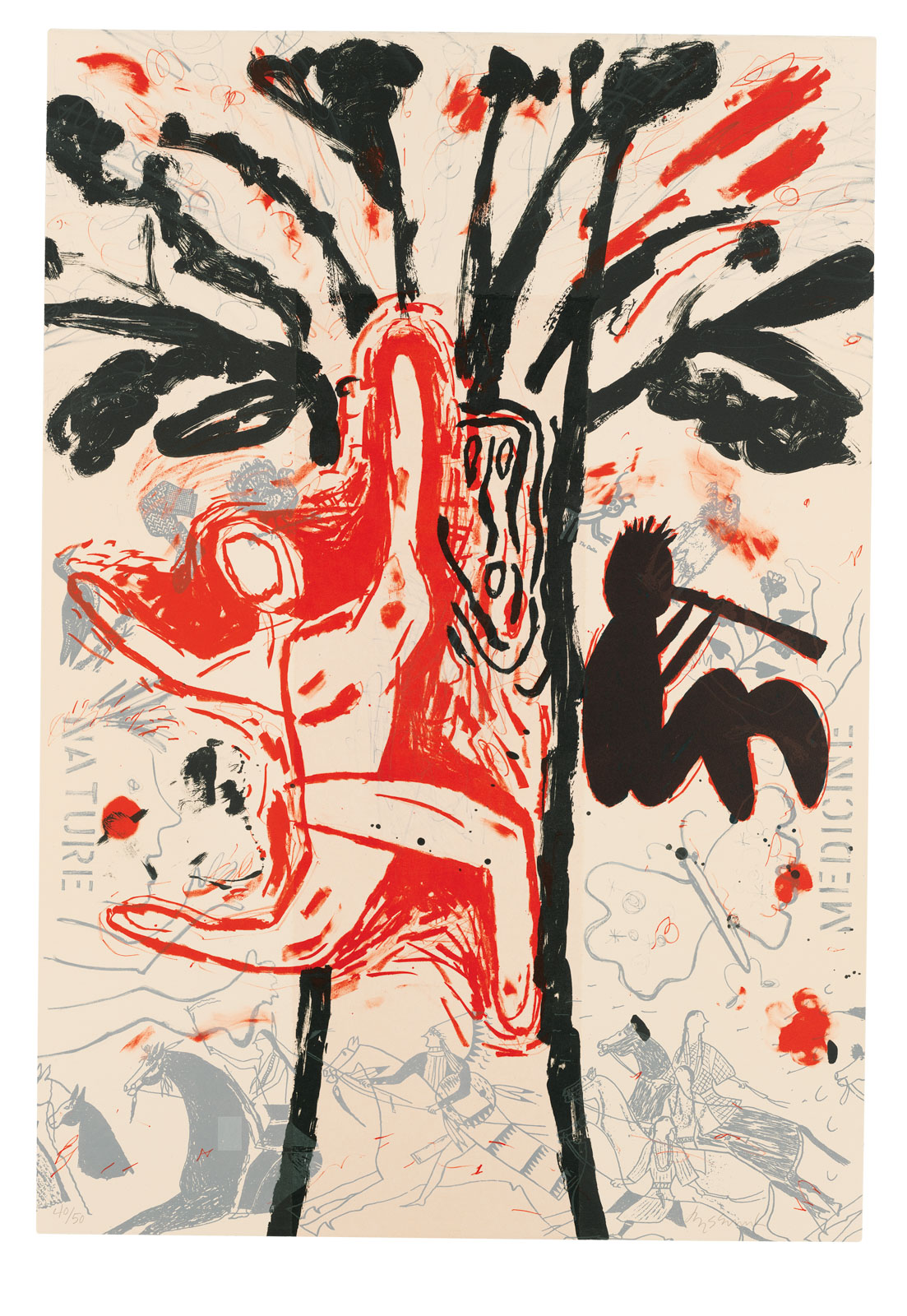 Survival Suite: Nature/Medicine, 1996, lithograph with chine-collé, 361⁄8 x 2413⁄16". Whitney Museum of American Art, New York. Gift of Joe and Barb Zanatta Family in honor of Jaune Quick‑to‑See Smith 2003.28.3. Printed by Lawrence Lithography Workshop, Kansas City, Missouri. Published by Zanatta Editions, Shawnee Kansas. © Jaune Quick-to-See Smith. Photo courtesy Whitney Museum of American Art, New York.
“The Modern is honored to host Jaune Quick-to-See Smith: Memory Map. We are grateful to collaborate with the artist and the Whitney Museum on this important exhibition,” says Dr. Marla Price, director, Modern Art Museum of Fort Worth. “This is the first large-scale presentation of Jaune Quick-to-See Smith’s work in our region, giving our community and visitors the opportunity to experience the important stories she tells throughout her groundbreaking career.”
But don’t look for meaning in her moniker, Quick-to-See Smith says her name is not visual art related.
“My name is an old family name. It doesn’t have anything to do with art. It is not about seeing art, it is about insight,” the artist says. “I’ve been making art as far back as I can remember. When I was in the first grade, I didn’t know the word ‘artist.’ I had never heard that word. I didn’t know anything about it. I just knew that it was my zone—I wanted to be where I could use those materials.”
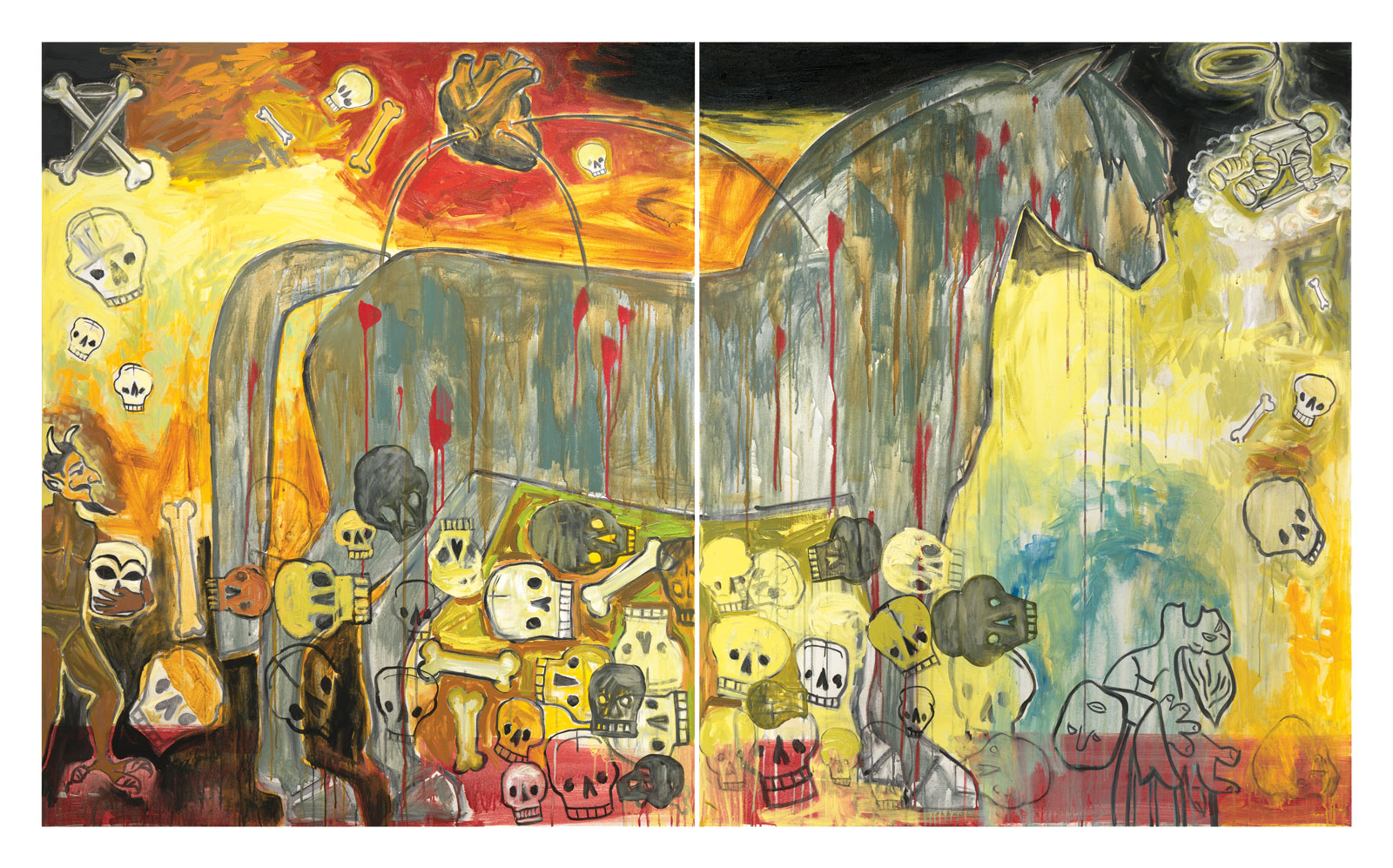 War Horse in Babylon, 2005, oil and acrylic on canvas, two panels, 60 x 100” overall. Forge Project Collection, traditional lands of the Muh-he-con-ne-ok. © Jaune Quick-to-See Smith. Photograph courtesy the artist and Garth Greenan Gallery, New York.
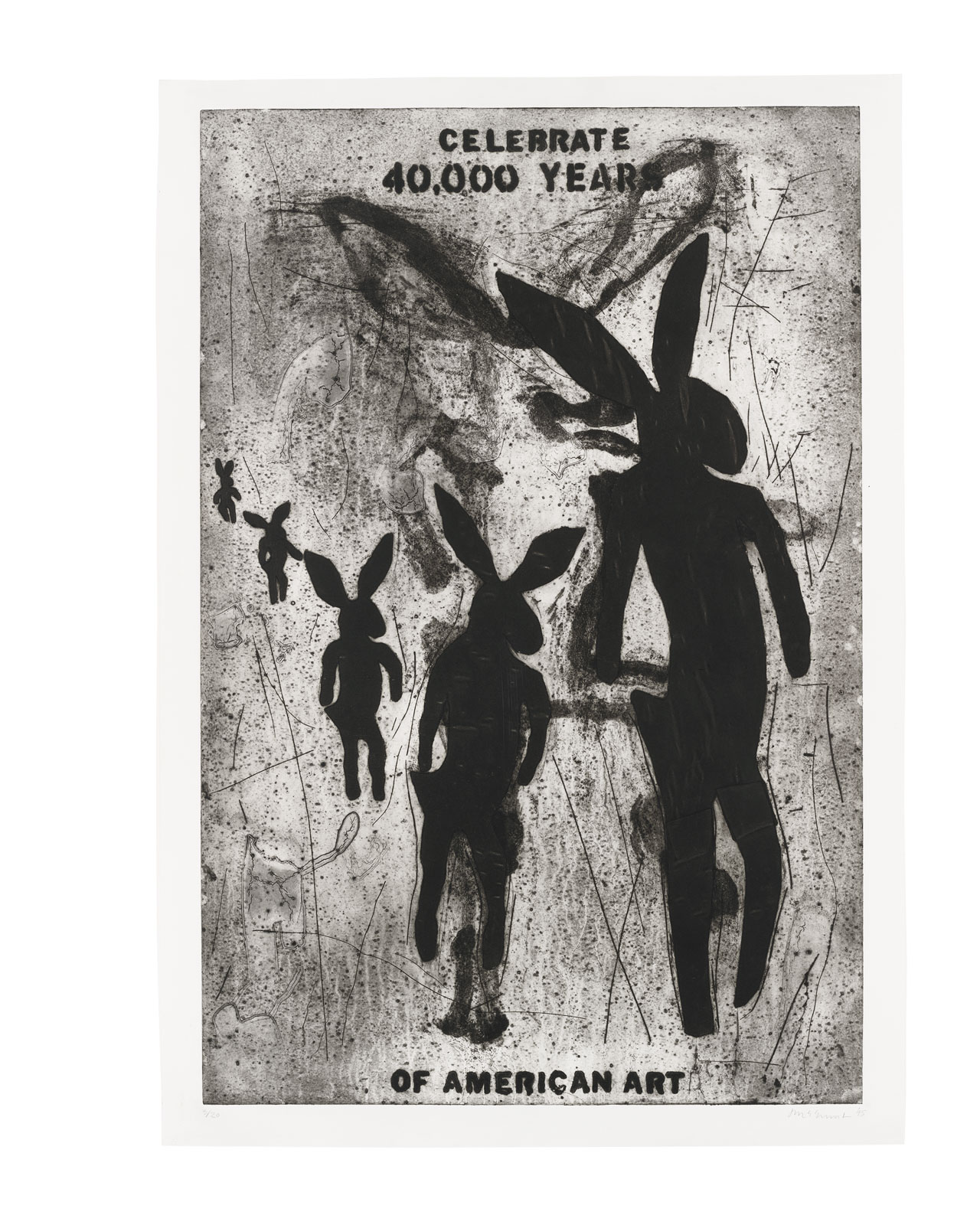 Celebrate 40,000 Years of American Art, 1995, collagraph, 76½ x 53". Whitney Museum of American Art, New York; purchase with funds from The Horace W. Goldsmith Foundation 2000.191. Printed by Kevin Garber. Published by Island Press Collaborative Print Workshop, Saint Louis. © Jaune Quick-to-See Smith. Photo courtesy Whitney Museum of American Art, New York.
“The maps that I’ve been doing,” she continues, “I see them as landscapes, and they all tell stories. My art practice has grown over the years. I always see my works as inhabited landscapes. From early pastel abstract swaths of color to where we are now, even figures, to me it is still landscape.”
Smith lives in Corrales, New Mexico, north of Albuquerque, in a small farm community of about 15,000 people. “Given” to Spanish people, it once belonged to the Pueblo People. Digs reveal doubloons and tin cups and pottery shards and house foundations. An archeological kind of map of time.
Smith says that “Native peoples have always studied the flora, fauna and land here. It is a culmination of figuring out where we came from. All of the origin stories are about that. These stories go back 15,000 years and they match what the scientists are saying about the movement of glaciers. And that is extraordinary, it blows my mind to think that our oral history goes back that far.”
Smith adds, “Our Indian elders studied it so well. Their knowledge of it is so complete. They are always looking back and asking what would the ancestors do? What would they say? And so how can we get some of these messages out there? Part of it is in the work that I do.” In such a long life, Smith has the luxury to look back and learn.
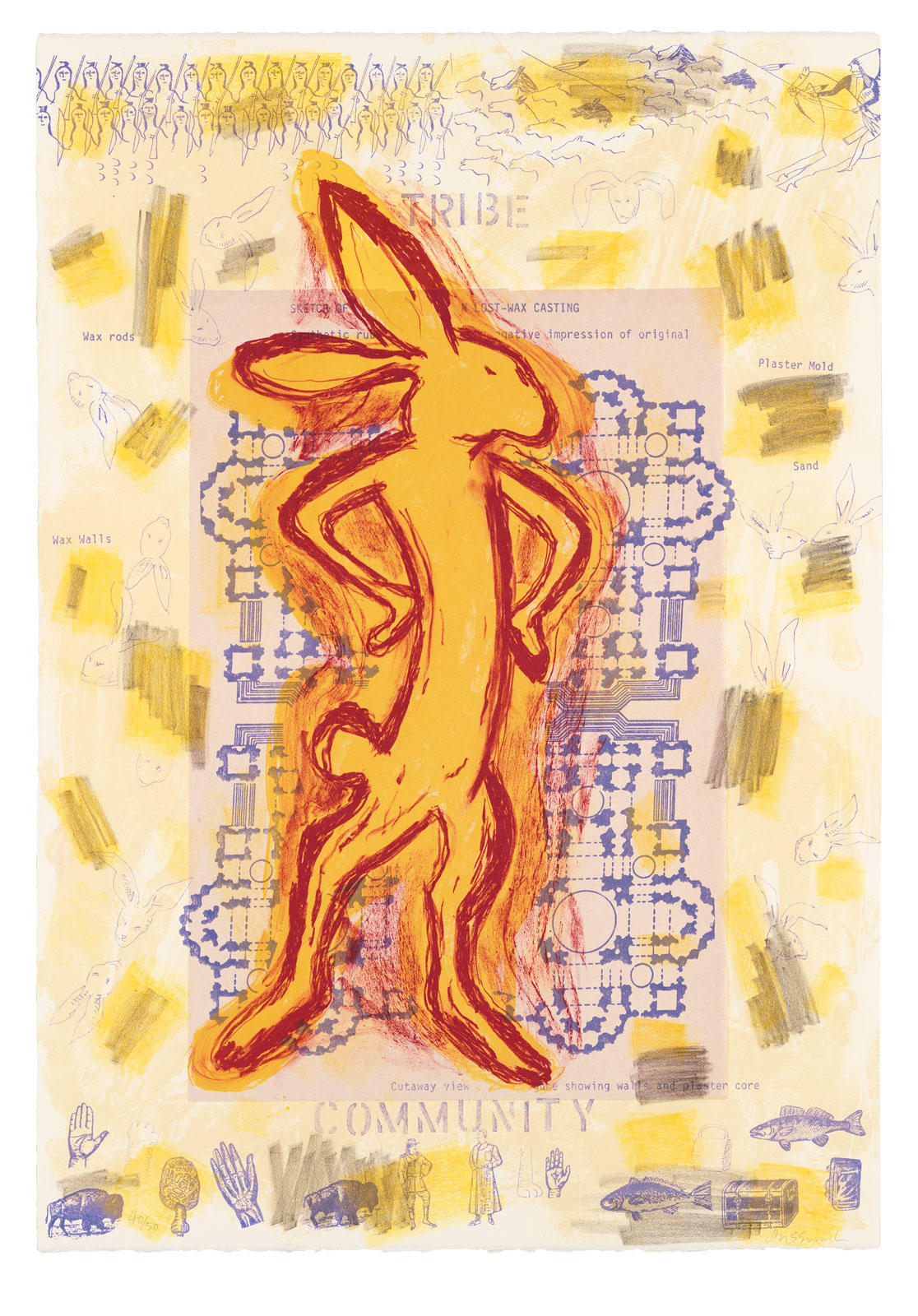 Survival Suite: Tribe/Community, 1996, lithograph with chine-collé, 361⁄16 x 247⁄8". Whitney Museum of American Art, New York; gift of Joe and Barb Zanatta Family in honor of Jaune Quick‑to‑See Smith 2003.28.2. Printed by Lawrence Lithography Workshop, Kansas City, Missouri. Published by Zanatta Editions, Shawnee Kansas. © Jaune Quick-to-See Smith. Photo courtesy Whitney Museum of American Art, New York.
“Being Indigenous and making art means that you are looking at the world through lenses that are curved or changed by your upbringing and by your worldview as an Indigenous person. We get together and talk among ourselves about how we can change things or make things better—how we can put messages out there that have a relationship to the Indigenous world. Indigenous peoples believe that we live in harmony with all of the plants, animals, fishes and cosmos. We really do believe that. So that’s the first thing that is really distinct in our work and in what we present to the public.”
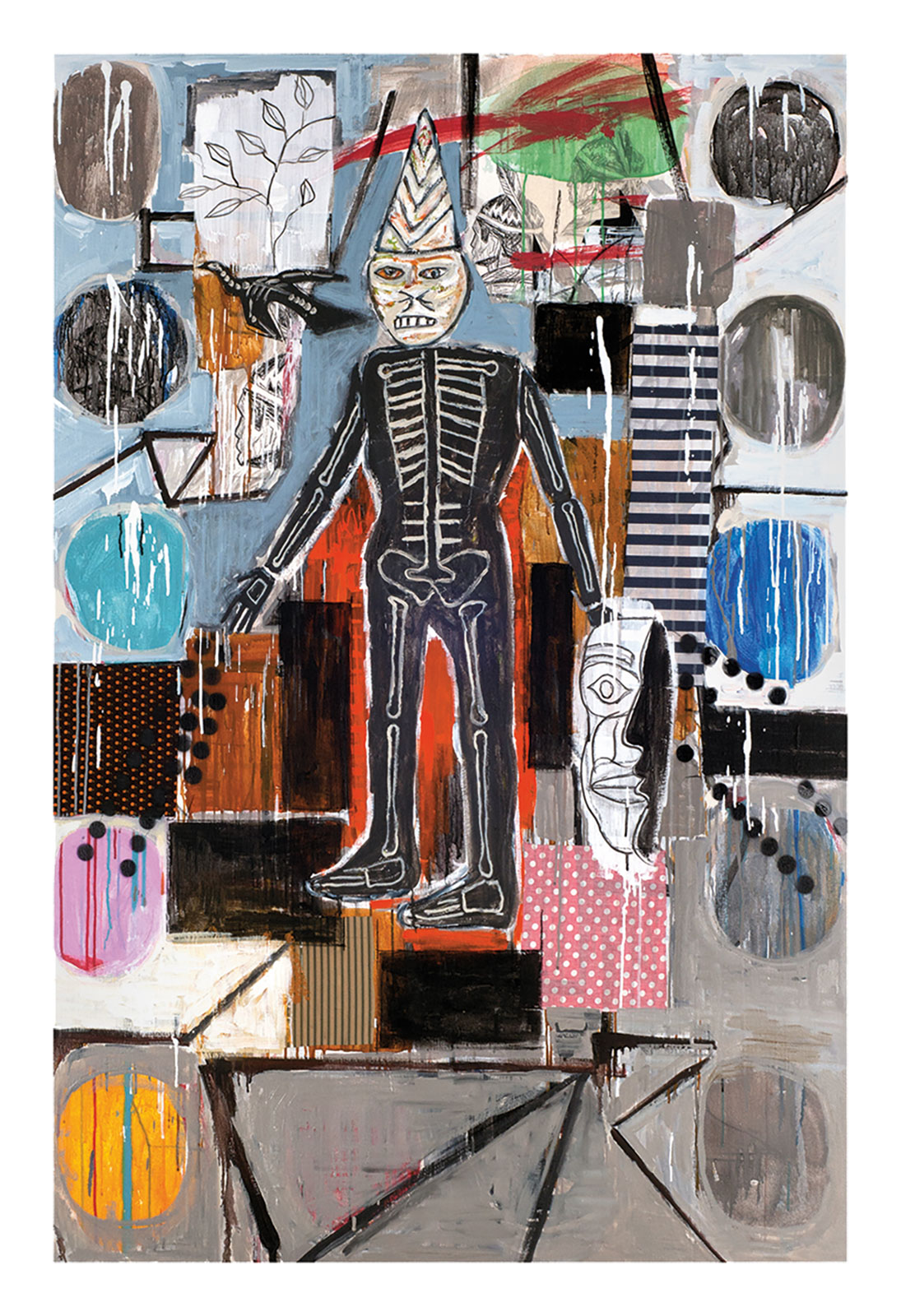 Grasp Tight the Old Ways, 2011, oil, acrylic, paper, fabric and charcoal on canvas, 72 x 48". Sheldon Museum of Art, University of Nebraska-Lincoln; Robert E. Schweser and Fern Beardsley Schweser Acquisition Fund through the University of Nebraska Foundation U-6293.2013. © Jaune Quick-to-See Smith. Photograph courtesy the artist and Garth Greenan Gallery, New York.
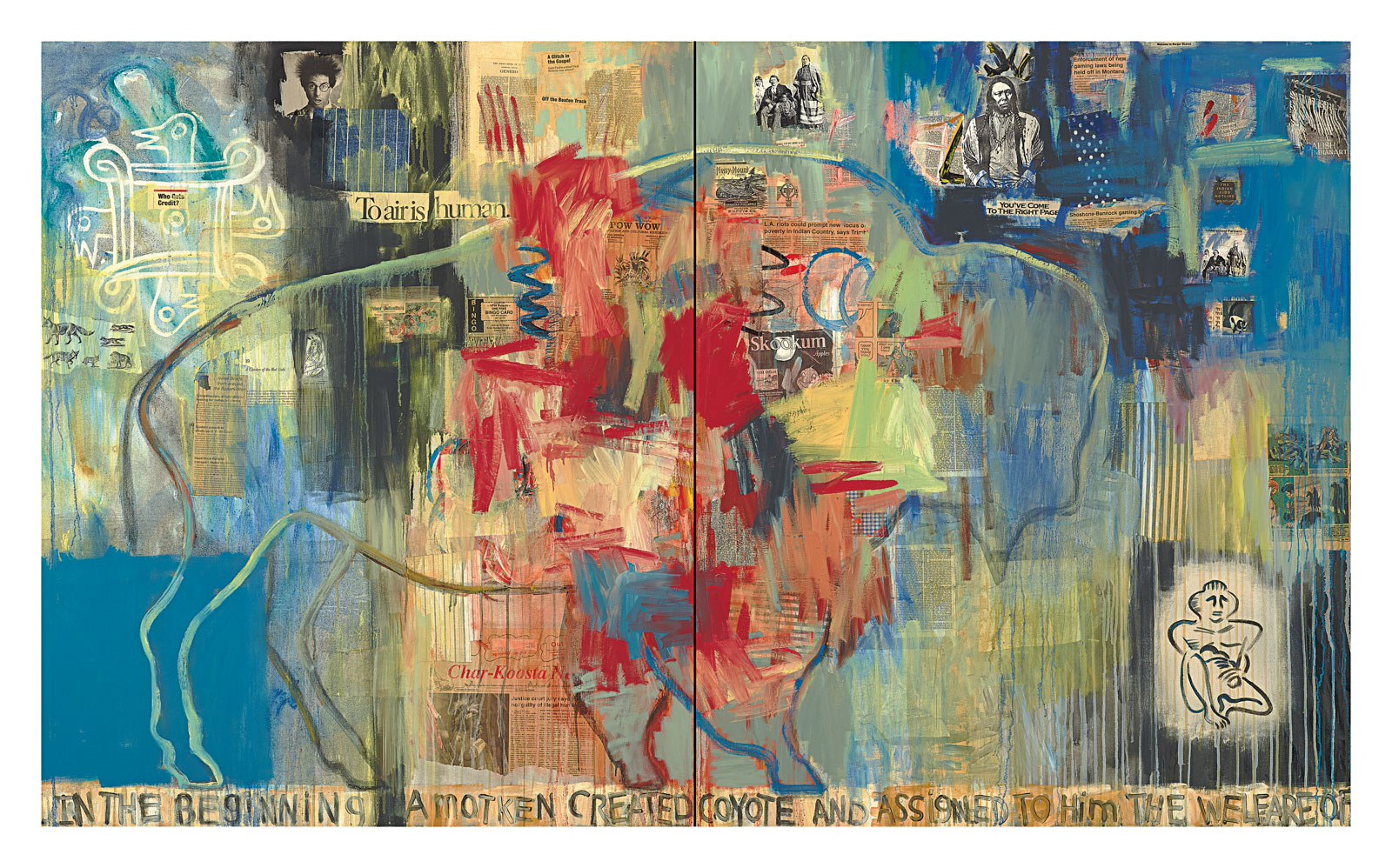 Genesis, 1993, oil, paper, newspaper, fabric, and charcoal on canvas, two panels, 60 x 100”. High Museum of Art, Atlanta. Purchase with funds provided by AT&T NEW ART/NEW VISIONS and with funds from Alfred Austell Thornton in memory of Leila Austell Thornton and Albert Edward Thornton, Sr., and Sarah Miller Venable and William Hoyt Venable 1995.54. © Jaune Quick-to-See Smith. Photograph courtesy the artist and Garth Greenan Gallery, New York.
With a history of dislocation and current Land Back issues at the forefront, Smith sees geography in perspective. “Who has a better reason to paint a map?” she says. “Me, a Native person who is all about the land and the history that’s taken place here. How can I tell it all in a way that is different from what you learned in school? I’m showing you an American map; I’m putting my heritage in there.
“I take newspaper clippings and put them in every single state just to prove that there are Indians doing things there. Yes, there is Indian life there. Yes, they live everywhere all over the United States. When I started using text, it seemed like a way to say something directly instead of just alluding to it—whether it be text from old Indian speeches or headlines from the New York Times or Albuquerque Journal.”
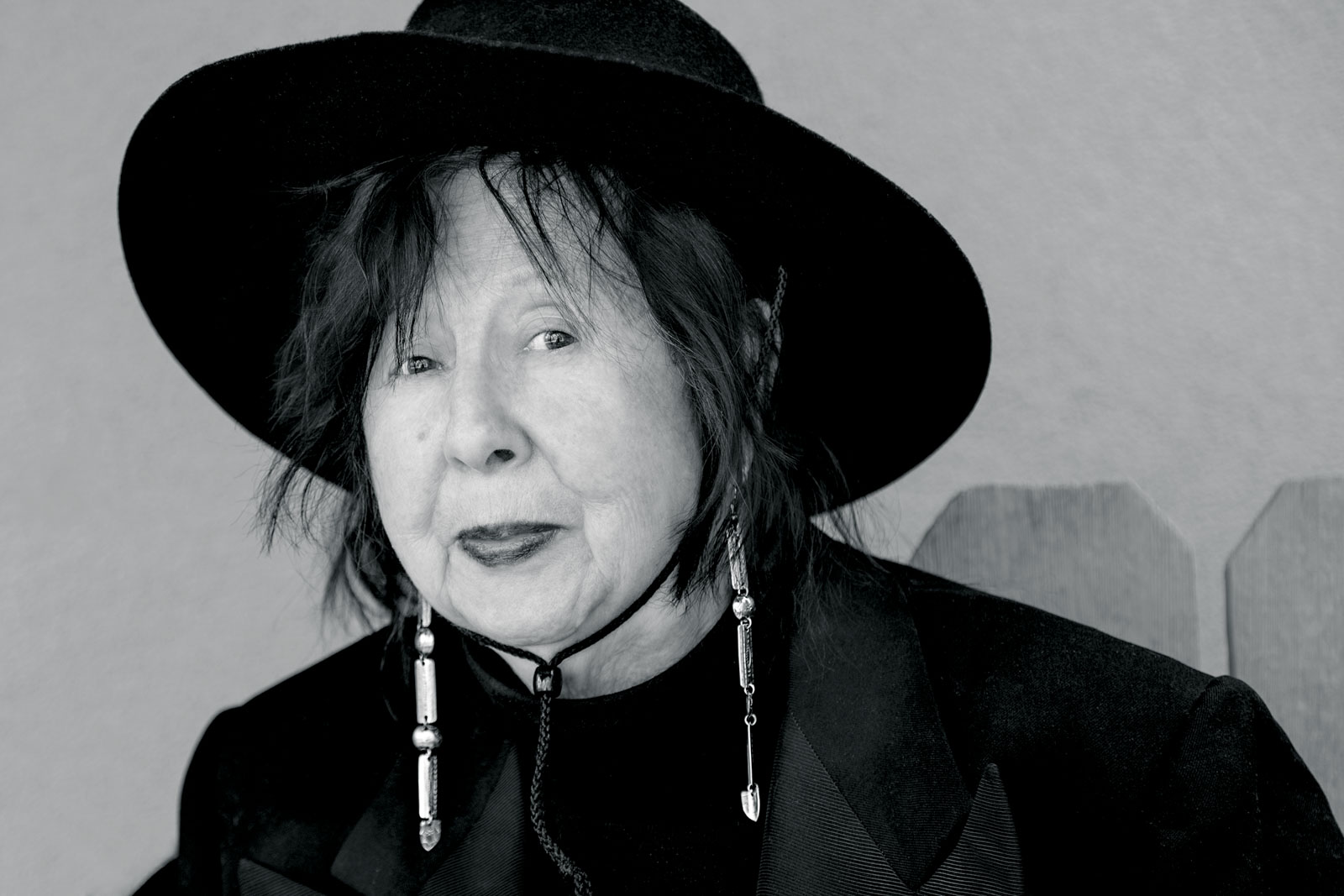 Jaune Quick-to-See Smith (Confederated Salish and Kootenai Nation). Image courtesy Modern Art Museum of Fort Worth.
The exhibit is broken into sections:
- Early Work Pieces from when she drew and painted places with personal significance, including Wallowa, Oregon, and her tribe’s reservation in Montana. Many of the early works like Indian Madonna Enthroned, 1974, have rarely been exhibited.
- Dedication to Land Between 1985 and 1989, Smith concentrated on two series that highlighted her role as an activist and artist: Petroglyph Park is the first series in which Smith responded directly to news media; Chief Seattle (C.S.) series continued the artist’s critique of industrialization and global environmental concerns.
- Depictions of a Postcolonial World In response to the 1992 quincentennial celebration of Christopher Columbus landing in the Americas, Smith brought attention to the largest genocide in human history.
- Reflections on Invasion Throughout the 1990s and 2000s, in response to U.S.-led invasions at home and abroad, Smith’s work considers the conflicts in a series of prints and drawings that depict General George Armstrong Custer, the U.S. Army officer known for his deadly campaigns against Lakota, Arapaho and Northern Cheyenne people in the late 1860s.
- Critiques of Capitalism and Consumerism In recent decades, Smith’s work employs satire and humor, targeting the imported concepts of owning property and commodity goods as wealth, which decimated Indigenous economies, diets and medicinal practices. In works like The Rancher, 2002, Smith draws connections between visual stereotypes of the Wild West, such as the cowboys and Indians seen in advertising and entertainment.
- Legacy and Matriarchy Smith says, “My existence is a miracle.” Surviving genocide, decades of war, forced assimilation and systemic oppression, she is still here to practice and share culture. Smith has represented matriarchal leaders across many works and decades, saluting women who juggle family and community in the face of prejudice and discrimination.
- U.S. Maps The map of the United States is her most central and recognizable image throughout Smith’s paintings, drawings and prints. In her redrawn plans, the land transgresses and overruns borders, moves the populations and notions of citizenship.
- Environment and Intervention Of this section Smith says, “ecology is a science that has been practiced by the Native peoples on this continent for thousands of years. For instance, in my tribe, after harvesting the bitterroot for the spring feast, there is the specific act of cleaning the bitterroot plants to ensure next year’s crop. This is giving back. This has been our way of survival.”
- Trickster Smith heard the creation stories of the Salish people from her grandmothers and aunts. Coyote plays an important role in these stories. Coyote is a teacher but also a trickster. “The creator, inventor, satirist must show the flip side of things,” she says. “What makes us do this is a good question. We can’t help ourselves. We have to do this. Coyote makes us do it.”
The exhibition continues in Forth Worth through January 21, 2024.
October 15, 2023- January 21, 2024
Jaune Quick-to-See Smith: Memory Map
Modern Art Museum of Fort Worth, 3200 Darnell Street, Fort Worth, TX 76107 (817) 738-9215 www.themodern.org
Powered by Froala Editor