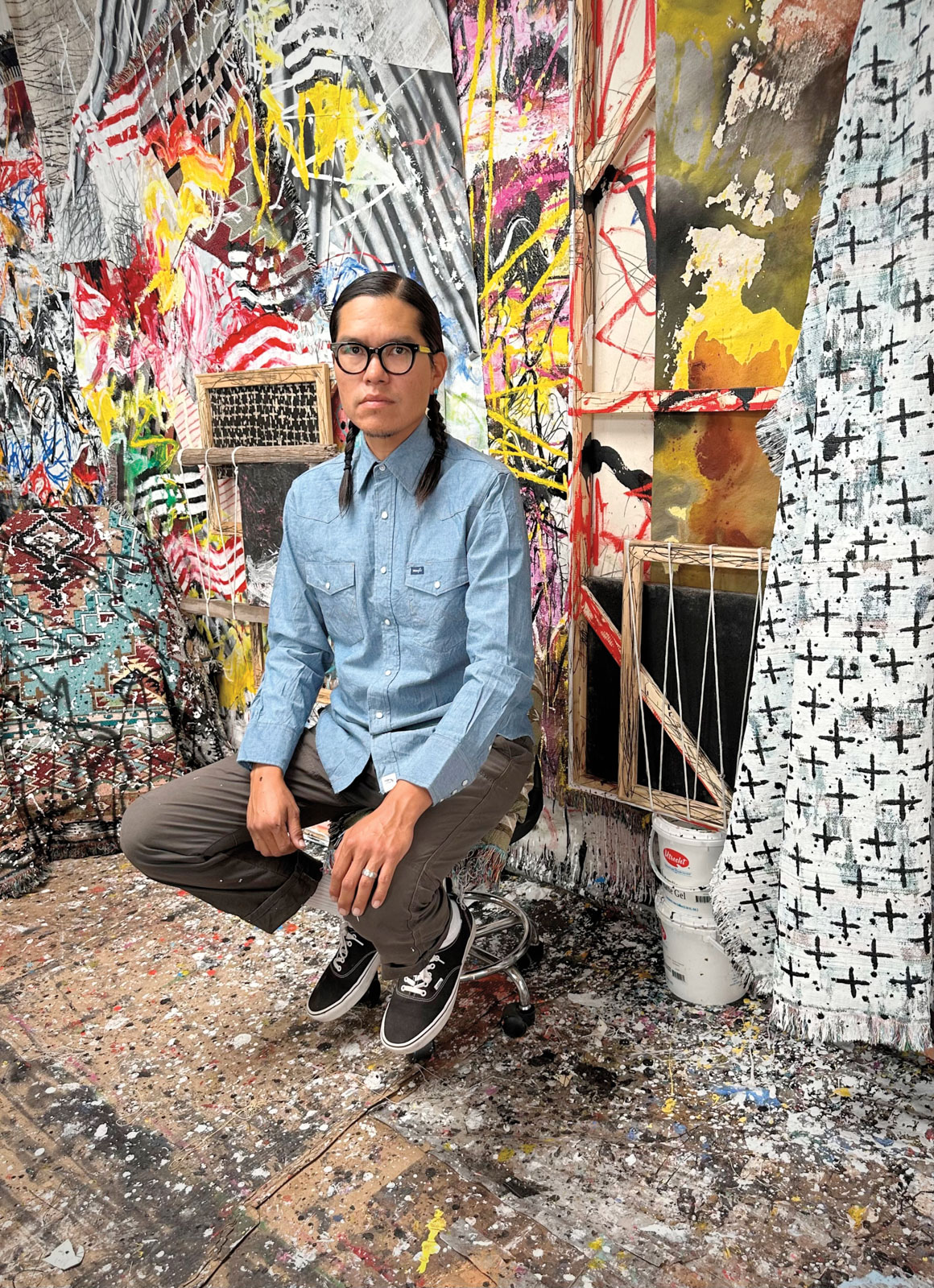
 Patrick Dean Hubbell (Navajo (Diné)) in his studio. Photo courtesy the artist.
From blind contour drawings of “cowboys and Indians” to works that literally deconstruct classical paintings and the tropes that go with them, Hubbell’s physical practice is wide-ranging. Cotton canvas removed from stretcher bars, painted, cut into fringe and rehung. Distorted portraits aggressively breaching gilded frames. Drawings draped over saddle racks, creating forms that feel like blankets and the bodies they might keep warm. Knockoff “tribal” print textiles, their appropriated patterns obscured by action painting and gestural, wildly colored marks.
Hubbell’s 2022 show Tack Room marked a breakthrough for the artist, Gerald Peters Contemporary director Evan Feldman says. “It’s been really terrific to watch him expand and diversify his practice,” she says, noting the artist’s move from conventional abstraction on stretched canvas. “Tack Room, I think, really accelerated his practice. He was cutting canvases from their boards and painting directly onto frames themselves and [it] was very much a powerful and strong response to sort of Eurocentric art history, and of course, representations of Indigenous peoples by painters of European descent.”
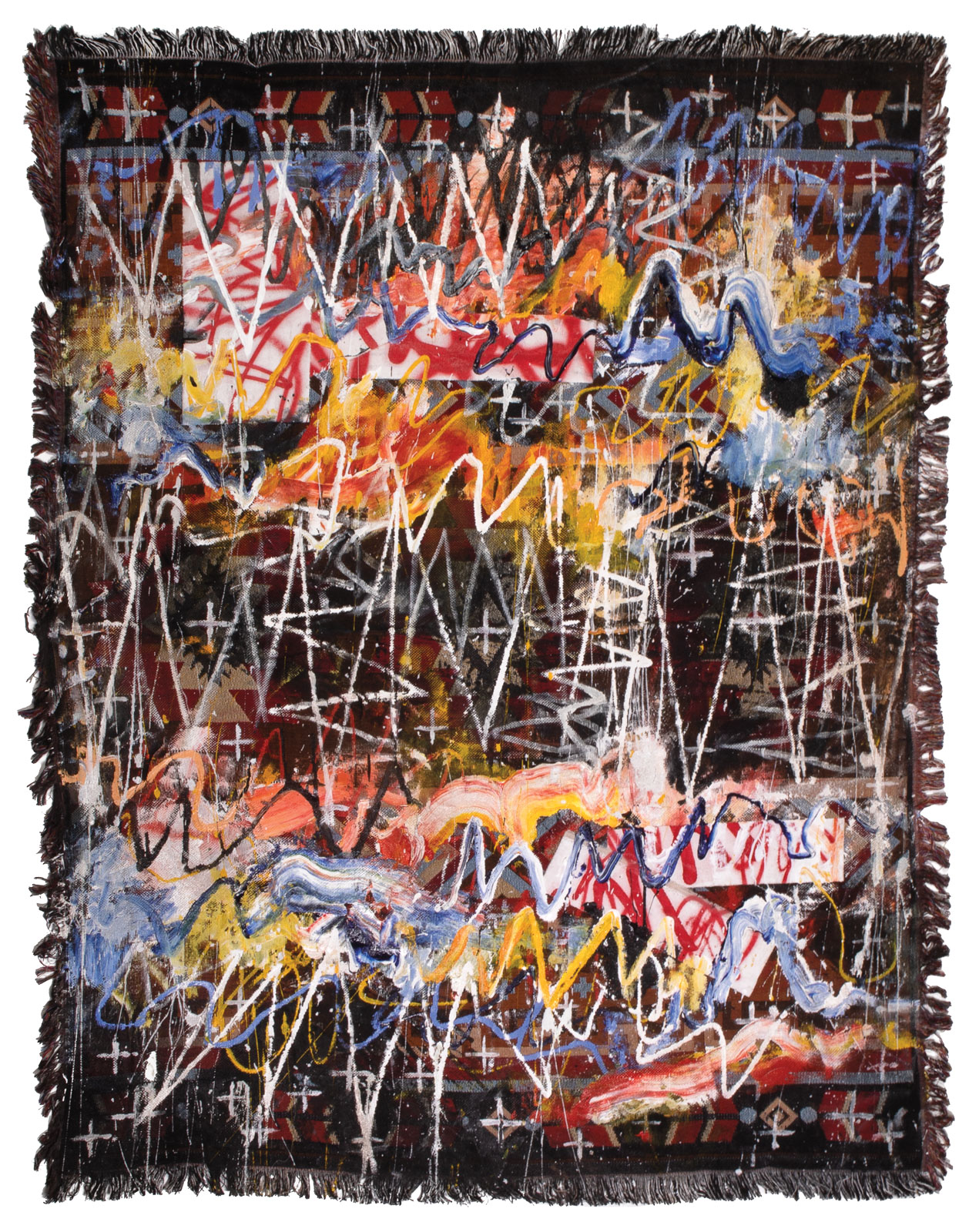 The People Will Always Be of This Earth; And Connected the Stars, 2022, oil, acrylic, enamel, charcoal, paper, polymer, canvas, mass manufactured synthetic textile, 66 x 54”. © 2023 Patrick Dean Hubbell, courtesy of Gerald Peters Contemporary.
“I began to really think about my position—as far as where I stand personally,” says Hubbell, who used the exhibition to continue concepts he explored as a graduate student at the School of the Art Institute of Chicago. “For a long time, I was making work that was speaking to different avenues around art history,” he adds, noting how the MFA program helped him incorporate those narratives together into one practice. “But then really putting myself into the work became a huge growth for me, and American Western art is one aspect that I’m really starting to tear down the layers, peel away the layers.”
He cites the roles of American Western masters like Charles M. Russell, Frederic Remington and George Catlin in shaping the genre through romanticized imagery of Manifest Destiny and “conquering the West,” resulting in stereotypes that persist today. Titles like This Painting Will Diversify Your Collection and I Asked the Only Native I Knew to Sit for This: Western Art, reveal Hubbell’s feelings on Indigenous representation in the art world as well as his winking sense of humor.
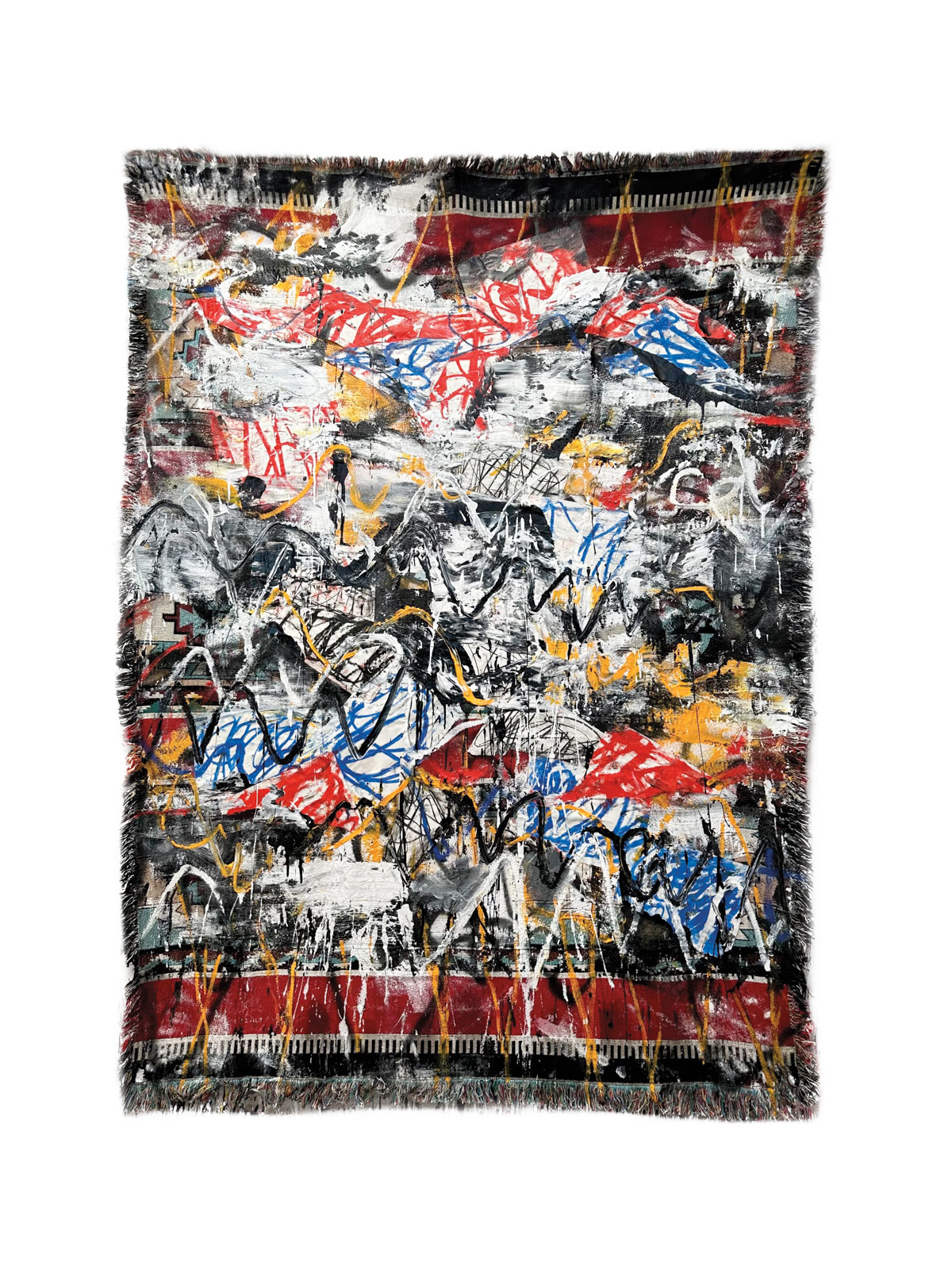 The Way We Talk to Nature Cannot Be Taken, 2023, oil, acrylic, enamel, oil stick, charcoal on paper on synthetic mass-manufactured textile, 57 x 48”. © 2023 Patrick Dean Hubbell, courtesy of Gerald Peters Contemporary.
It’s not as simple as the “cowboys versus Indians” clichés for Hubbell, who lives and works on his family ranch. “I’m situated within not only Western lifestyle,” says Hubbell, noting his background caring for livestock. “And then also, you know, my Indigenous identity—the perspective of how we’re also raised as far as cultural knowledge, ceremonial, communal, family knowledge. That is part of our people’s lineage as well.”
“The way we’re taught—as far as making something for somebody—is really a high significance and reverence for that person,” says Hubbell. “So I began to really think about that part of my work with the intent and the purpose of thinking about cotton canvas—the industrial strength that it has. It’s able to withstand a lot.”
He continues: “I was thinking about that as far as the substrate of holding a painting, holding the history of marks, the process of painting, the canon of art history—of how canvas has been used as a surface. And then really thinking about deconstructing that, away from conventional, two-dimensional substrates within art history. And then more so thinking about that canvas as a blanket and really taking that intent and that care to transform and transfigure…because it is a process, you know.”
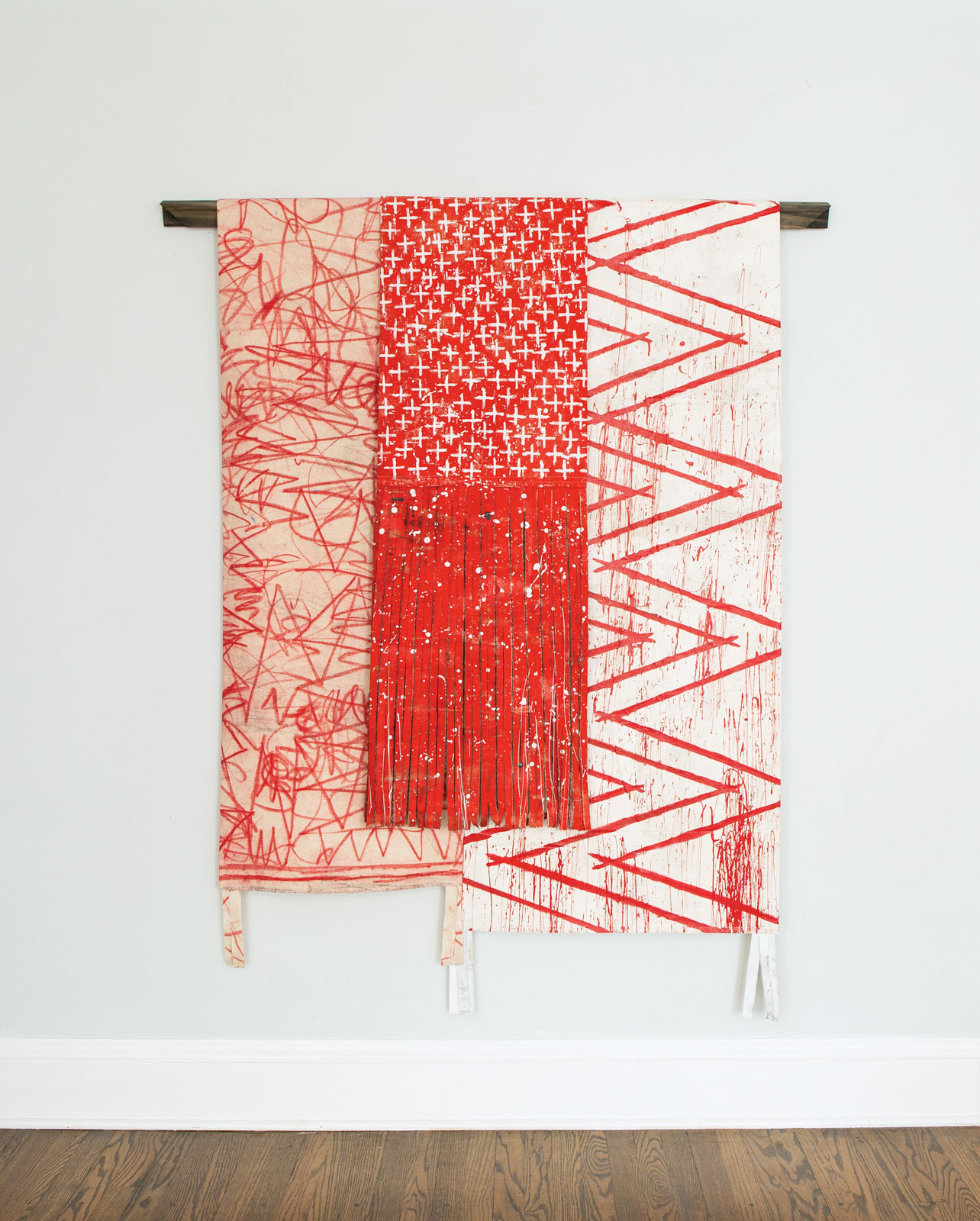 The Movement of Your Spirit Protects Us, 2022, oil, acrylic, enamel, oil pastel, natural earth pigment, synthetic polymer on canvas, wood stretcher bar, 66 x 54”. Photo by Andrea Ashkie.
A lot of reverence and intention go into formulating his compositions, Hubbell says. Deciding which parts will be painted. Taking canvases off the wall. Cutting them into panels and sewing or collaging them back together. “Even the fringe is painted canvas and usually torn into strips,” says Hubbell, describing what he calls a meticulous, meditative process.
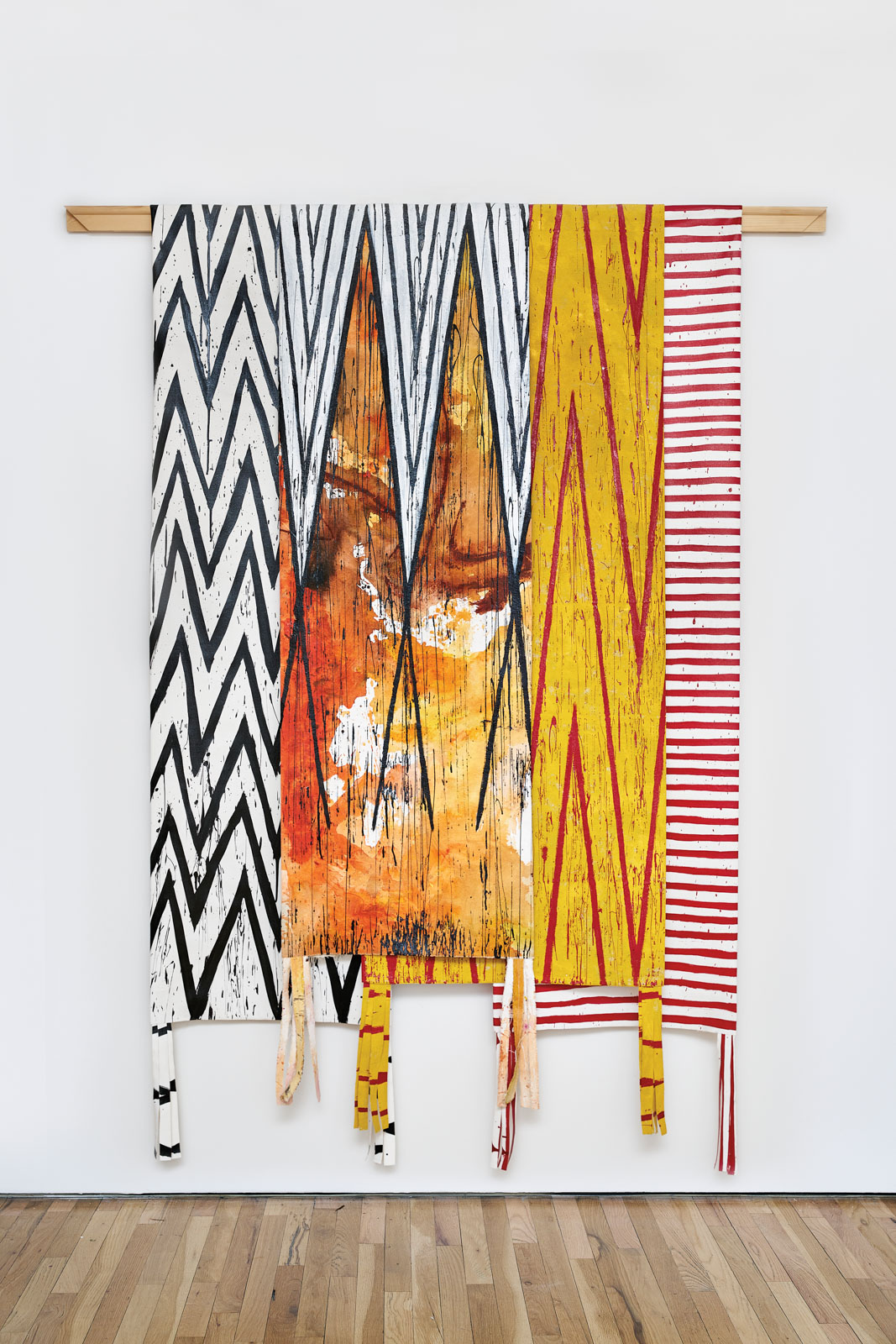 I Look to Your Your Spiritual Light in Moments of Need, 2023, oil, acrylic, enamel, acrylic dispersion on canvas, wood stretcher bar, 76 x 60”. Image courtesy Kunning Huang via Candice Madey Gallery.
You Embrace Us, Hubbell’s latest show at Gerald Peters Contemporary in Santa Fe (on view through October 28), takes on the legacy of the curio industry in the Southwest. Starting with tourist textiles sold in competition with traditional Navajo weavers, Hubbell continues upturning modes of cultural appropriation and addressing their socio-economic impacts head-on. “So, this body of work is kind of thinking about ceremonial goods, Indigenous art that’s also been appropriated and mass manufactured,” explains Hubbell. “Thinking about the poor quality of synthetic materials and then taking those and then having a sense of reclamation.”
Using oil, acrylic, enamel, paper, charcoal—whatever medium serves him best—Hubbell covers the blankets with free-form mark-making and symbols of cultural significance like crosses and chevrons. “I don’t limit myself to just oil paint or just acrylic paint. That’s the part of my process that I really enjoy,” he says. “How is this tool gonna give me the mark that I’m looking for? Or how did this mark arrive and how can I keep going on that trajectory?
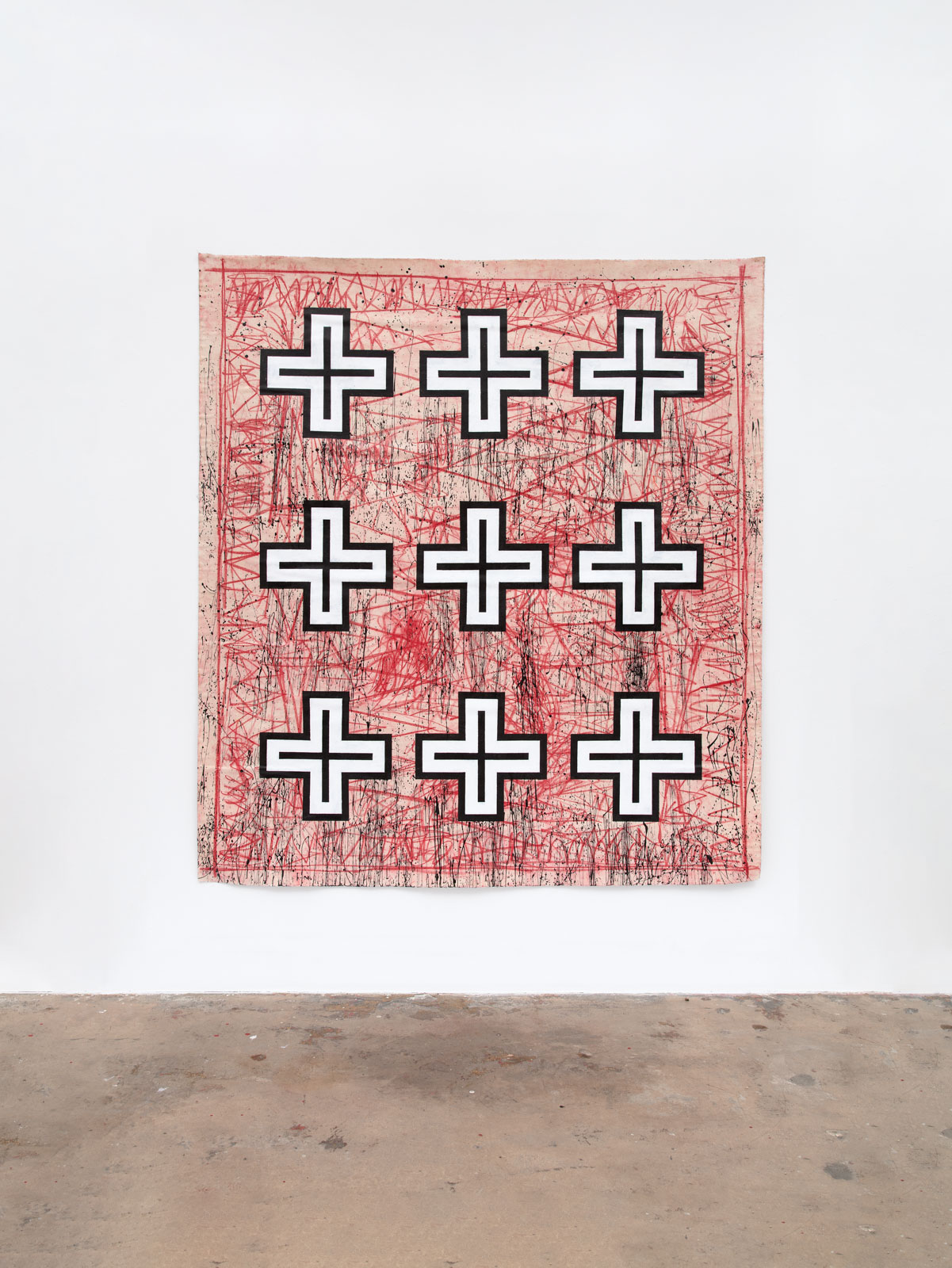 You Balance All the Angst, 2021, oil pastel, acrylic, enamel, natural earth pigment on canvas, 84 x 72”. Image courtesy of Nina Johnson Gallery.
“A lot of the work choices are centered around cultural philosophy—Diné way of thinking—the philosophy around the natural world and how we’re taught as far as humans within the natural world,” Hubbell continues. But also, more specifically myself—and then how I’m situated as far as thinking about things of importance within our culture.
“Times of day. Certain orders of cosmology that we’re taught. The natural world as far as seasons, the sun, the moon, and stars—and then also the holistic thinking of how the natural environment is structured within our cultural philosophies [are all considered],” says Hubbell. “So that has a big part in how I’m actually translating and thinking about those. How it has similarities and then also how it could visually come into life. That’s also important to me because the way I’m translating some of this cultural knowledge [is] just my own personal way…and then someone else might have their own version of telling their own stories.”
Feldman, at Gerald Peters Contemporary, agrees that Hubbell is tapping into a part of himself. “I do feel that, of course, Patrick’s work is unique unto itself, but it’s deeply personal as well,” says Feldman. “I guess in that way [he] could relate to some of the other artists in our stable. We are working closely with artists that are reflecting on their personal experiences and also are specifically rooted in the region.”
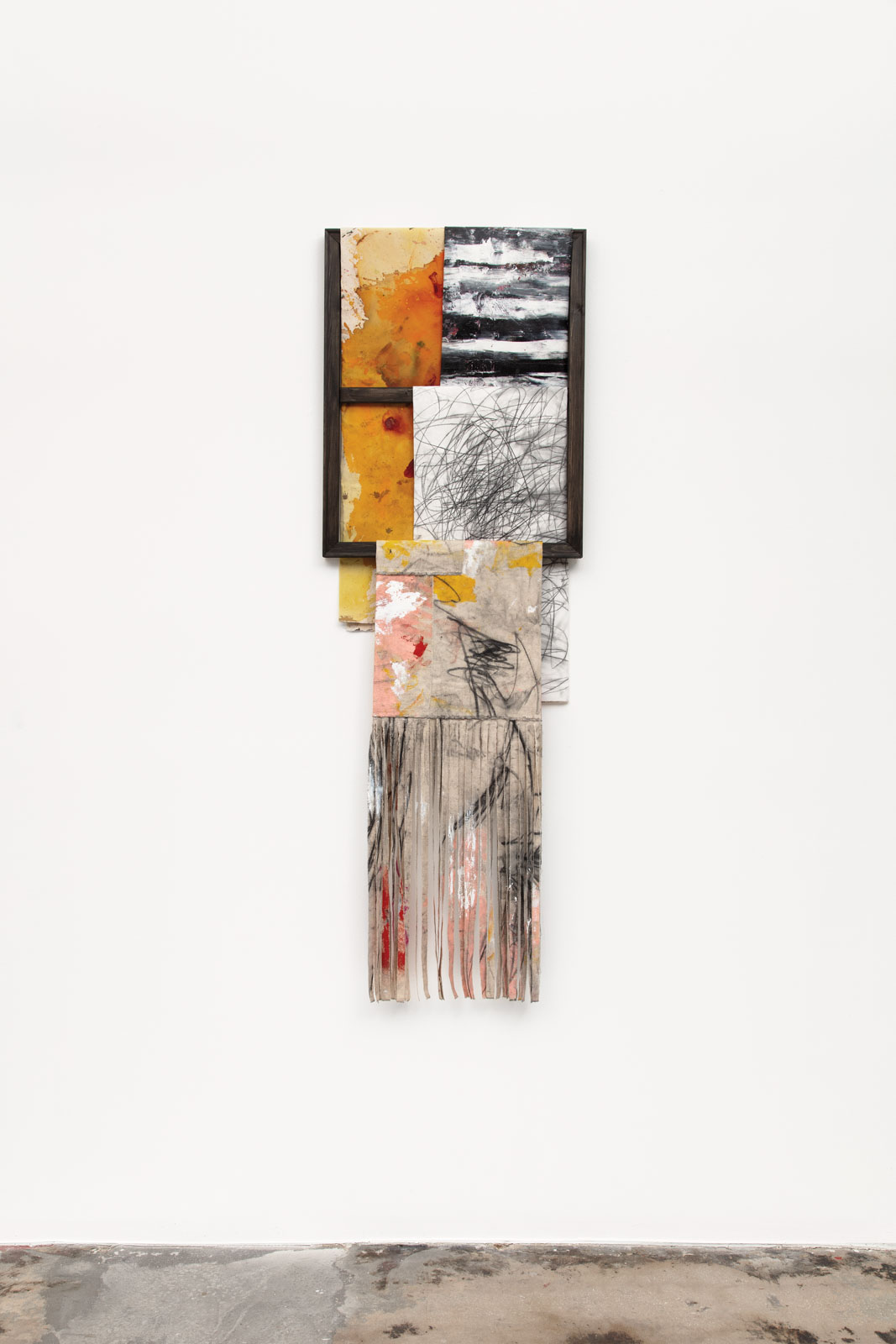 You Always Taught Us to Make Something Out of Nothing, 2022, oil, acrylic, charcoal, acrylic dispersion, sewn thread on canvas, wood stretcher bars, 72 x 24”. Image courtesy of Nina Johnson Gallery.
With representation in Miami and New York and a recent residency at La Napoule Art Foundation in Southern France, Hubbell is taking the conversation beyond Santa Fe and the greater Southwest United States. This year he has exhibited at Expo Chicago and The Armory Show in New York. And while part of the NADA Miami art fair last December, the Pérez Art Museum acquired his 2022 work You Keep Our Spirit Safe Between All Within the Day to Night for its permanent collection. Constructed from cotton canvas draped over a stretcher bar, the blanket-like work employs commercially available materials as well as natural pigments gathered on Hubbell’s ranch—a material expression of an artist thinking about tradition while living in and responding to the modern age.
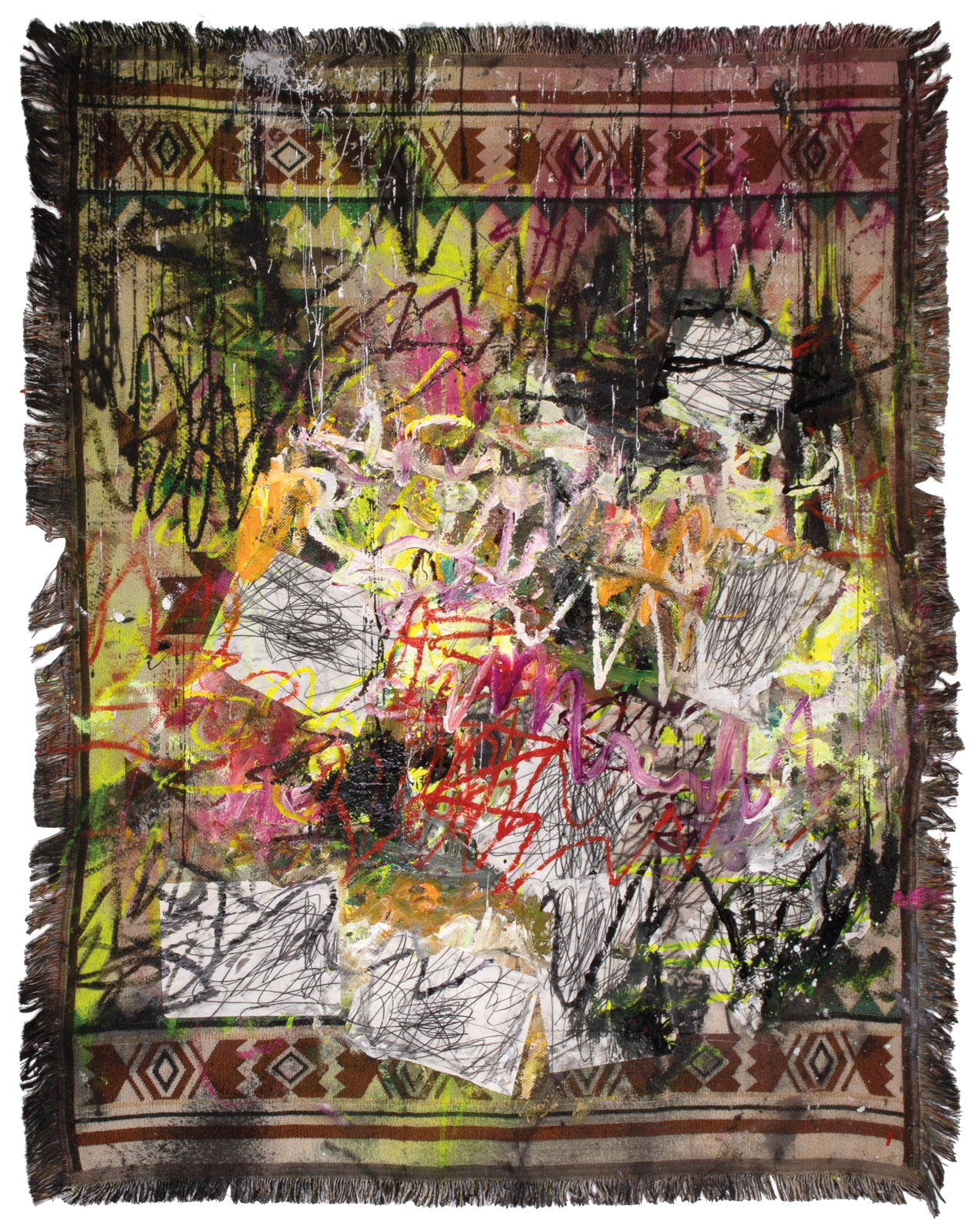 When All is Taken You Protect Our Spirit, 2022, oil, acrylic, enamel, charcoal, paper, polymer, canvas, mass-manufactured synthetic textile, 66 x 54”. © 2023 Patrick Dean Hubbell, courtesy of Gerald Peters Contemporary.
A recipient of the Pollock-Krasner Foundation grant and a star on the rise in the contemporary art world, Hubbell’s thoughtfulness and interest in opening constructive dialog has not gone unnoticed. “Where are we headed?” He asks. “Not only within the art field, but you know, historically? And then also within museums, institutions, collections—how that looks as far as growing with more Indigenous inclusion. That’s where I think my work is most important—as far as opening the gates, as far as conversation—and then really developing a broader scope of perspective.”
Learn more about Hubbell’s work at Gerald Peters Contemporary (Santa Fe), Nina Johnson Gallery (Miami), and Candice Madey Gallery (New York).
Powered by Froala Editor