Nestled far back from Acequia Madre Road on three acres in Santa Fe is a territorial revival home built in 1926 by Eva Scott Muse Fényes (1849-1930), her daughter Leonora Scott Muse Curtin (1879-1972) and her granddaughter Leonora Frances Curtin Paloheimo (1903-1999). Charles Fletcher Lummis, the California journalist and preservationist called it the “house of three wise women.”
Wise women abounded in Northern New Mexico in the early years of the 20th century. Mable Dodge Lujan brought her New York, Provincetown and Florence soirées to Taos, inviting luminaries in the arts to her home. The sisters Amelia and Martha White were real estate developers in Santa Fe and opened the first gallery of Native American art in New York City. Their Santa Fe estate was bequeathed to what is now the School for Advanced Research, which houses one of the world’s finest collections of Southwest Native American art.
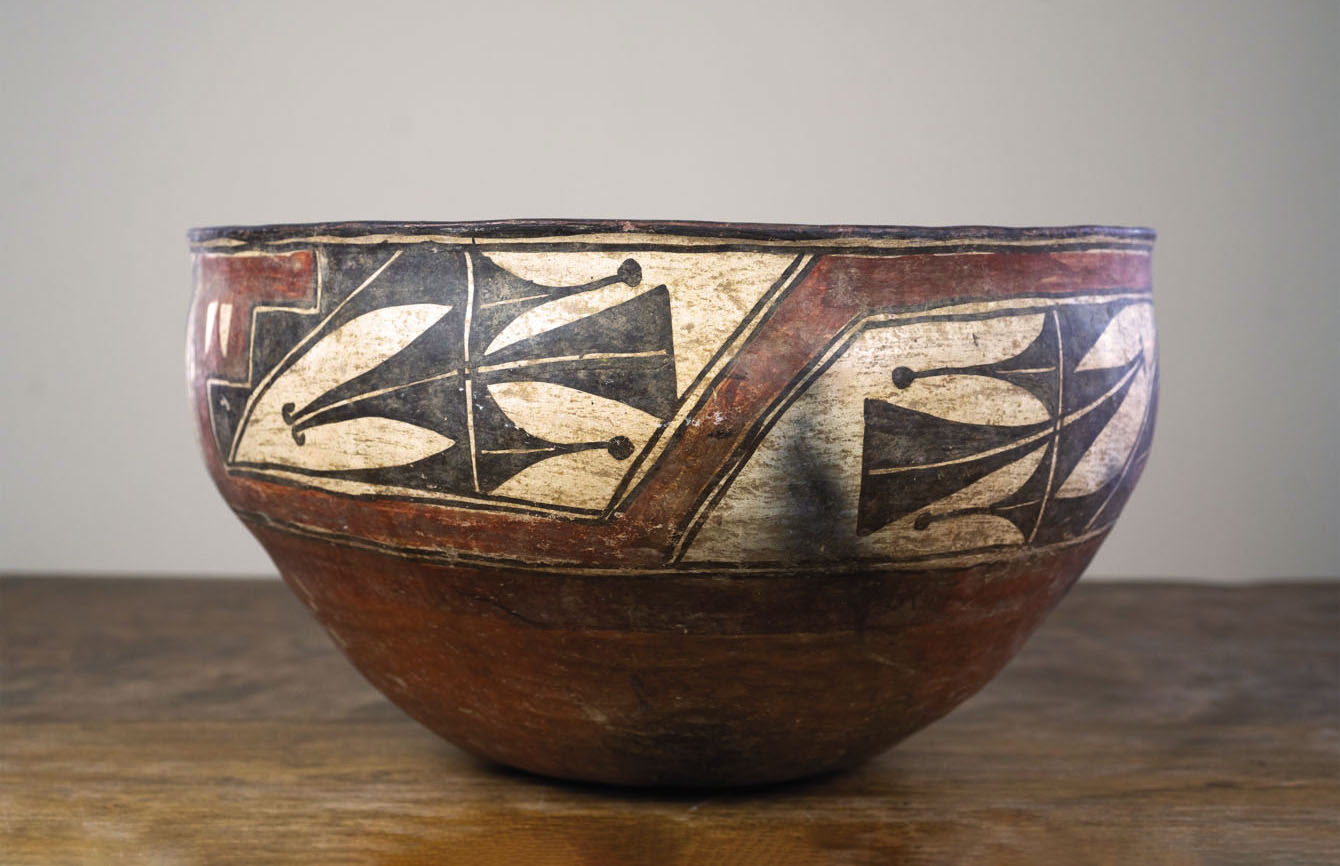
Dough Bowl, Zia Pueblo, late 19th/early 20th century, 9¼ x 17¼”
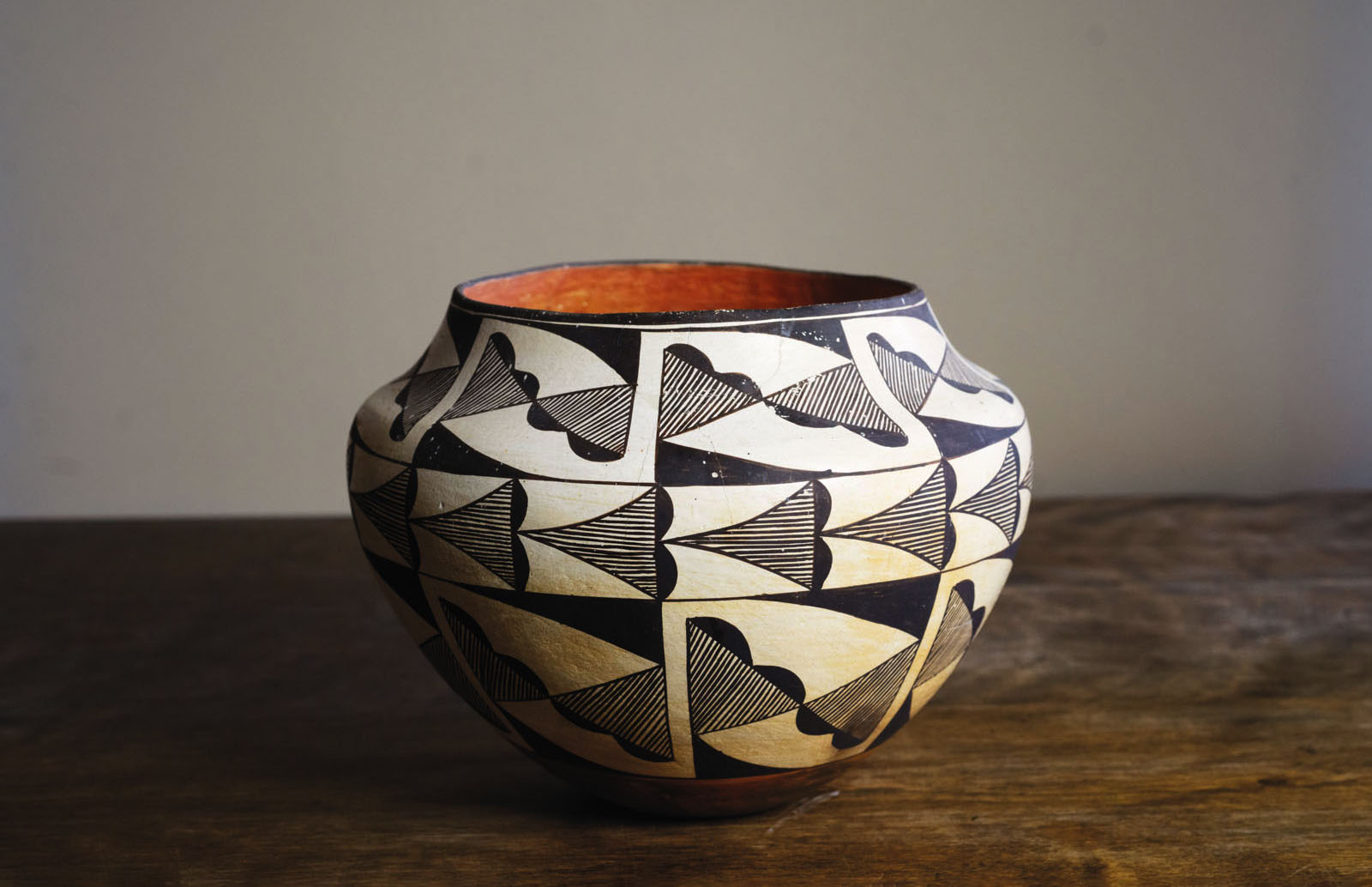
Ella Vallo Peters (Acoma), Jar, ca. mid-20th century, 8½ x 11¼”
The house is also home to extraordinary collections and archives relating to nearly 150 years of Santa Fe history. The women kept their daily correspondence and copious records of their work in cultural conservation including the ethnobotany of Northern New Mexico, Native American languages and songs, Western and Southwestern architecture, and the arts and folk arts of the United States and Finland.
In 1904, Charles Lummis encouraged Eva Féynes to continue her series of paintings of adobe buildings in California where she was then living. He wrote, “It seems to me it would be a very valuable thing if you could carry out your plan to make accurate watercolor studies of the old buildings in this region. Accuracy is the first requirement; and such a series would have serious historical value.” A collection of her watercolors was given to the Southwest Museum after her death. The museum was inspired by Lummis and is now part of the Autry Museum of the American West.
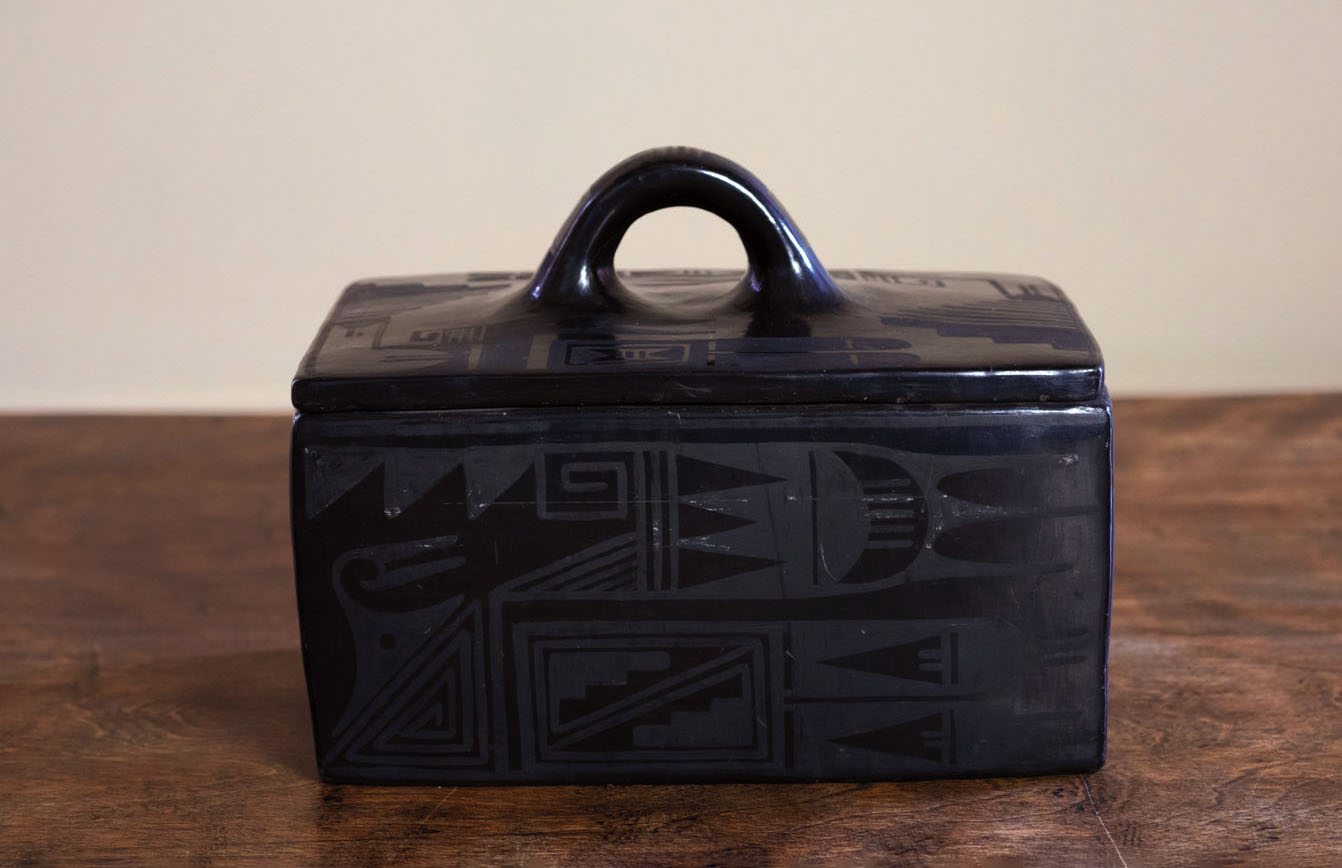
San Ildefonso Pueblo, Covered Box, ca. second quarter of the 20th century, 5 x 6¾ x 43⁄8”
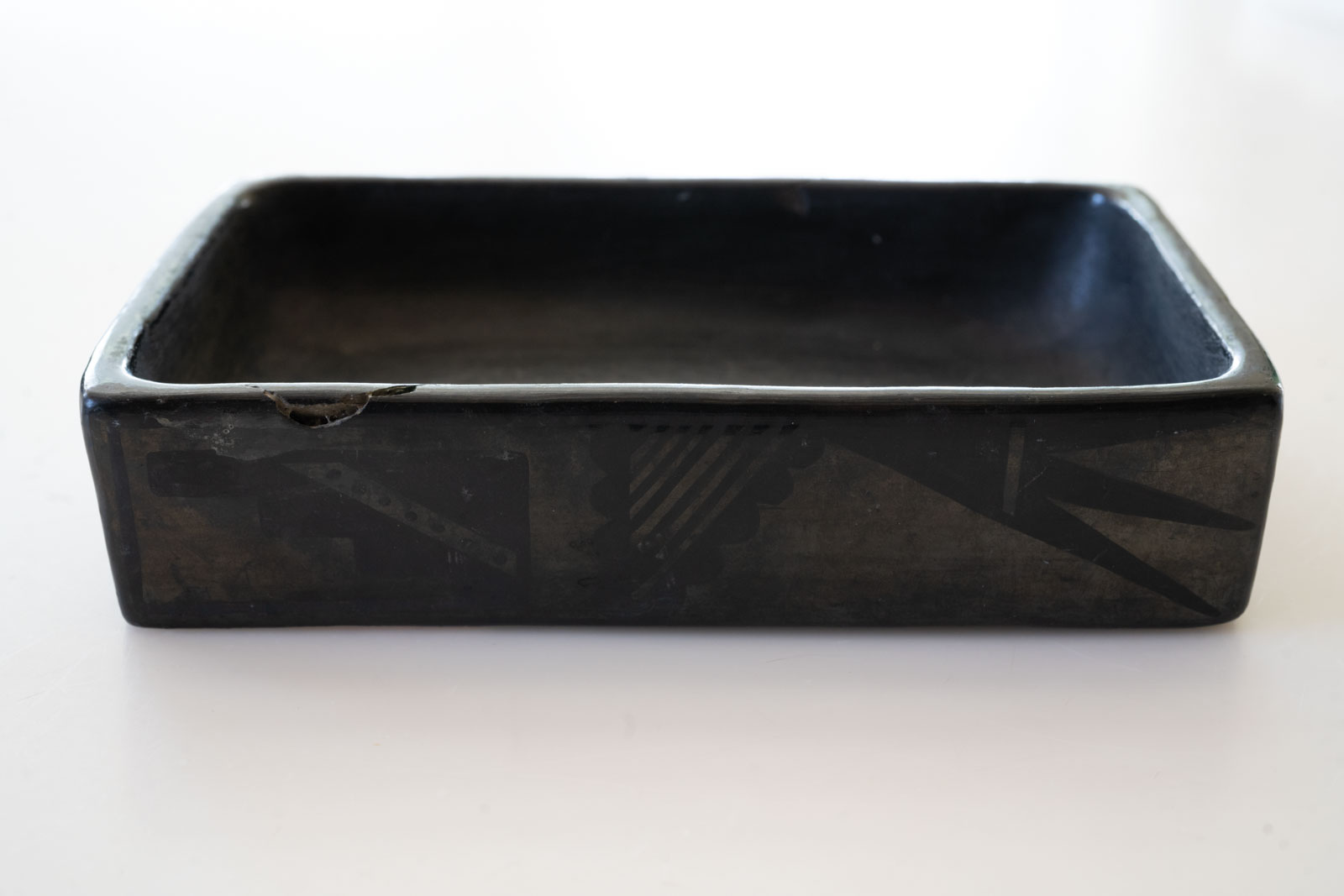
Maria Martinez (San Ildefonso, 1887-1980) and Julian Martinez (San Ildefonso, 1879-1943), Rectangular Bowl, ca. second quarter of the 20th century, signed “Marie”, 1½ x 65⁄8 x 41⁄8”
Eva was the only child of a wealthy New York publisher. In 1889 she moved to Santa Fe with her daughter Leonora where she awaited the finalization of the divorce from her first husband. There she met LeBaron Bradford Prince, governor of New Mexico Territory.
In their essay, “The House of the Three Wise Women: A Family Legacy in the American Southwest” published in the journal of the California History Society, Virginia Scharff and Carolyn Brucken write: “When Eva determined to visit remote villages and pueblos in Northern New Mexico, hoping to learn something of the culture and desiring to collect fine examples of local crafts, Prince provided her with letters of introduction to influential people. During her year in Santa Fe, she festooned the hallway of her Hillside Avenue home with Apache baskets, eagle feathers, Spanish embroideries, an Indian drum and shield, and pottery she had collected. In Santa Fe. Eva, who had supported Native artists since the 1870s, was in the vanguard of a generation of late 19th-century Anglo women who were learning to admire and champion Native arts, and who collected and displayed Indian and Spanish artifacts as both a symbol of taste and an emblem of their progressive sympathies.”
Eva later married a Hungarian nobleman and entomologist, Adalbert Fényes de Csokaly. The palatial Beaux Arts home they built together in Pasadena, California, in 1905, is now the home of the Pasadena Museum of History. Unusual for the time, Eva managed her own wealth, investing in real estate, having been educated in finance by her father. She taught her daughters to be stewards as well.
Leonora Curtin’s husband died in 1911 and she moved to Pasadena with her daughter Leonora Frances, to live with her mother. The family often returned to visit Santa Fe. After Eva’s death in 1930, the Leonoras purchased the historic El Rancho de las Golondrinas in nearby La Cienega, New Mexico, which is now a living history museum. A collector of Southwestern fetishes, she donated a large selection of them to the Wheelwright Museum of the American Indian in Santa Fe. In 1925, she was a founding member of the Spanish Colonial Arts Society.
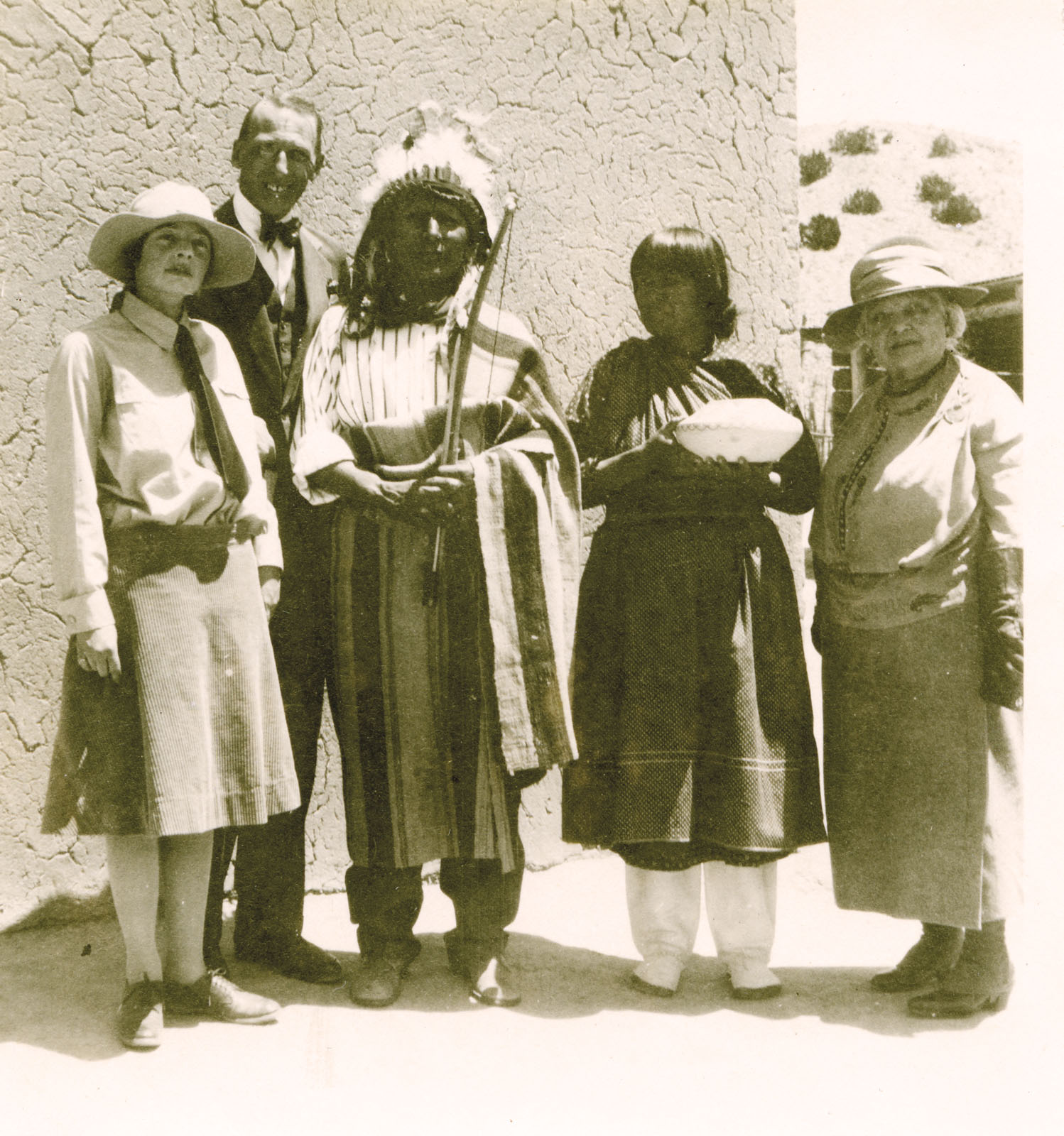
Pictured at San Ildefonso Pueblo are, left to right, Leonora Curtin, Franz Lactanz Count of Firmian, Julian Martinez, Maria Martinez and Eva Fényes.
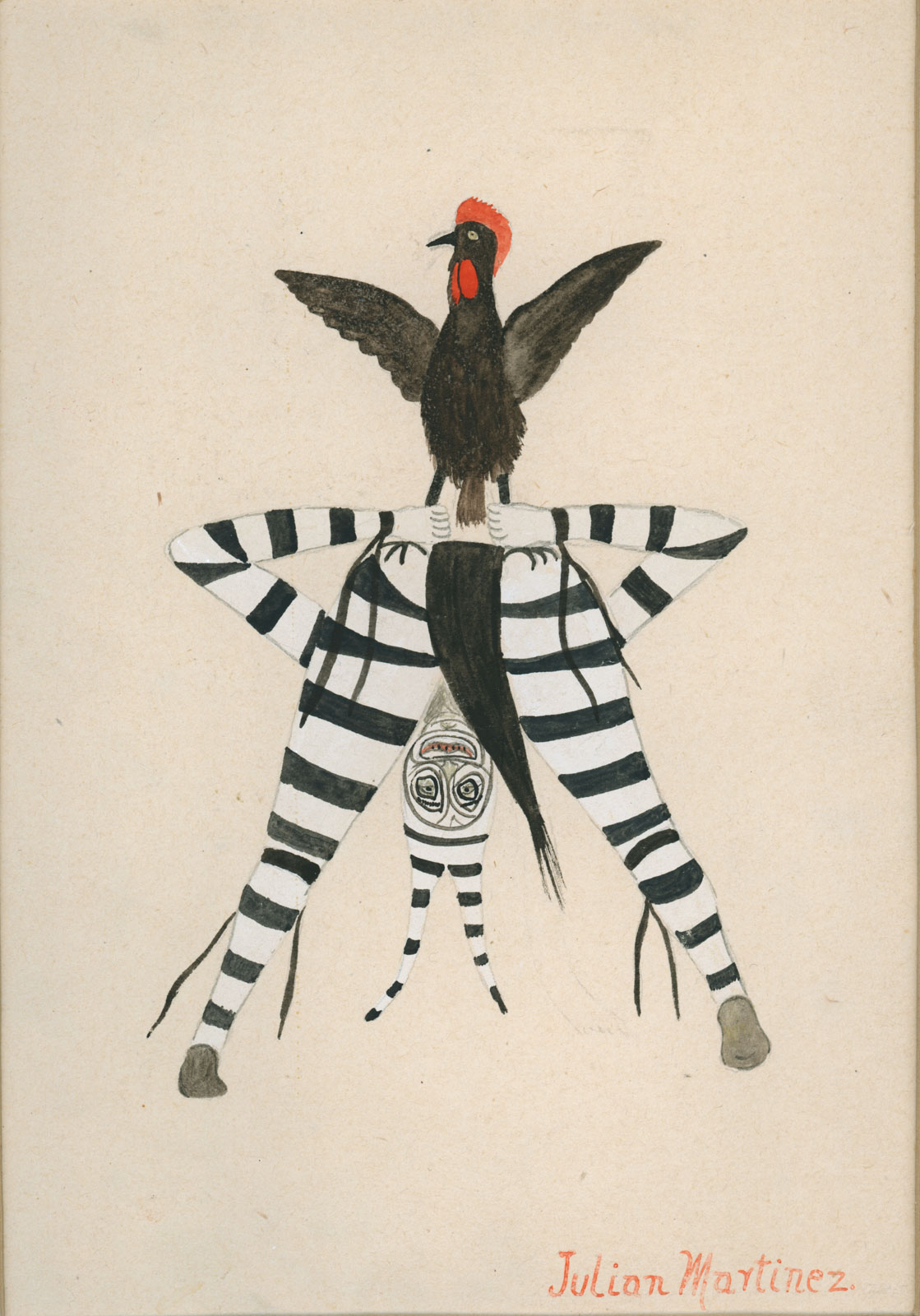
Julian Martinez (San Ildefonso, 1879-1943), Koshare, ca. 1930, watercolor on paper, 9½ x 611/16”
Martin Schultz, curator of Acequia Madre House, explains, “Interest in their environment led to the development of a substantial collection of Native American pottery and drawings and paintings. Some of these works were given to the three ladies by their friends, like Olive Rush and Sheldon Parsons.”The collections also include thousands of photographs taken by the wise women, including photos of San Ildefonso Pueblo in an 1890-91 album. The ladies supported local and pueblo artists financially and with art supplies. Among the many pueblo artists Eva and her daughters met and befriended were Maria and Julian Martinez of San Ildefonso. One piece of theirs in the collection is a black-on-black rectangular box signed “Marie,” the signature she used in the early 1920s. Maria made the pots and Julian painted the designs. She later signed them “Maria + Julian” and, after Julian’s death, included the names of other family members who worked with her.
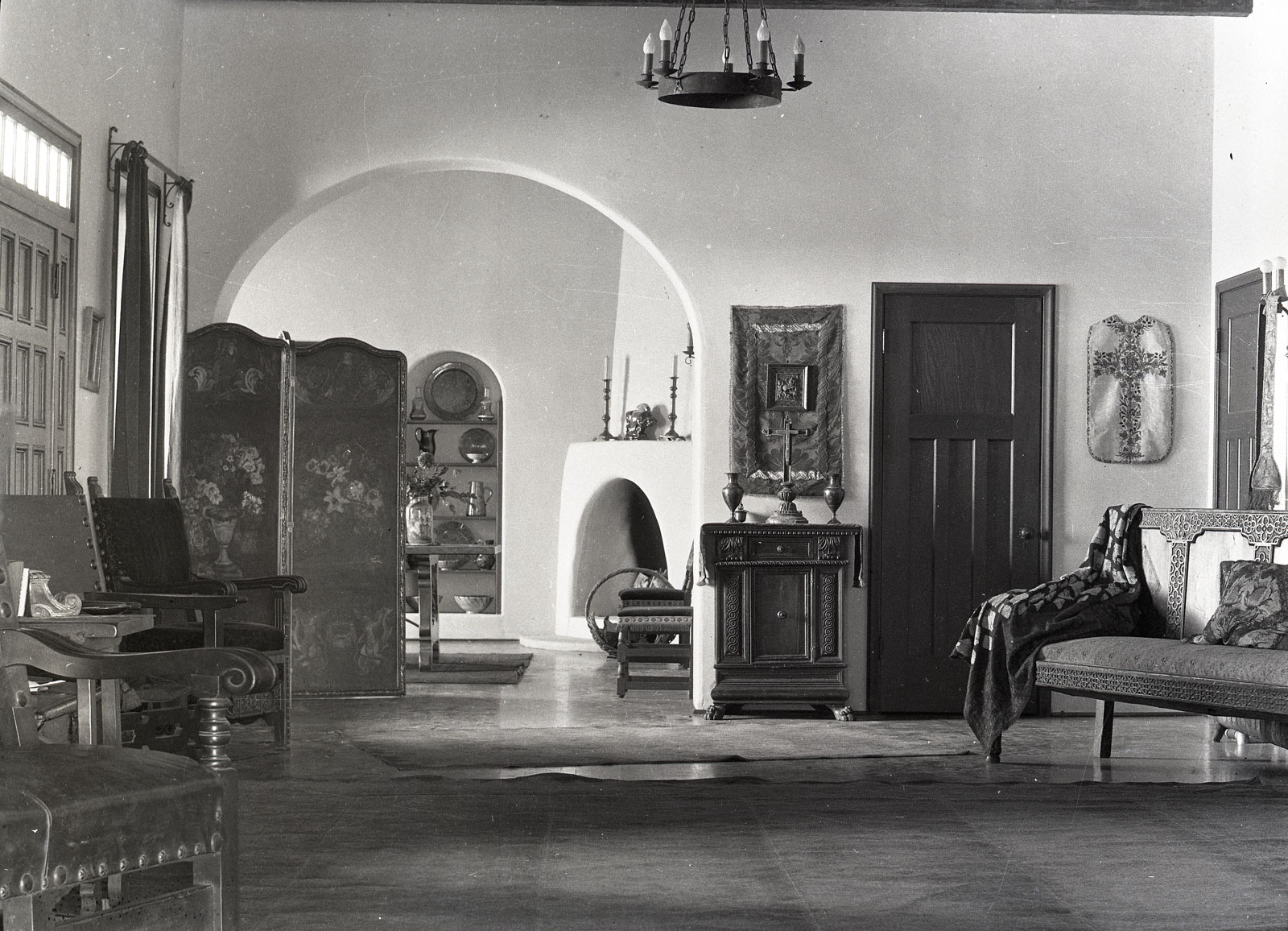
The interior of the Acequia Madre House, Santa Fe, New Mexico, as seen in an undated historic photograph.
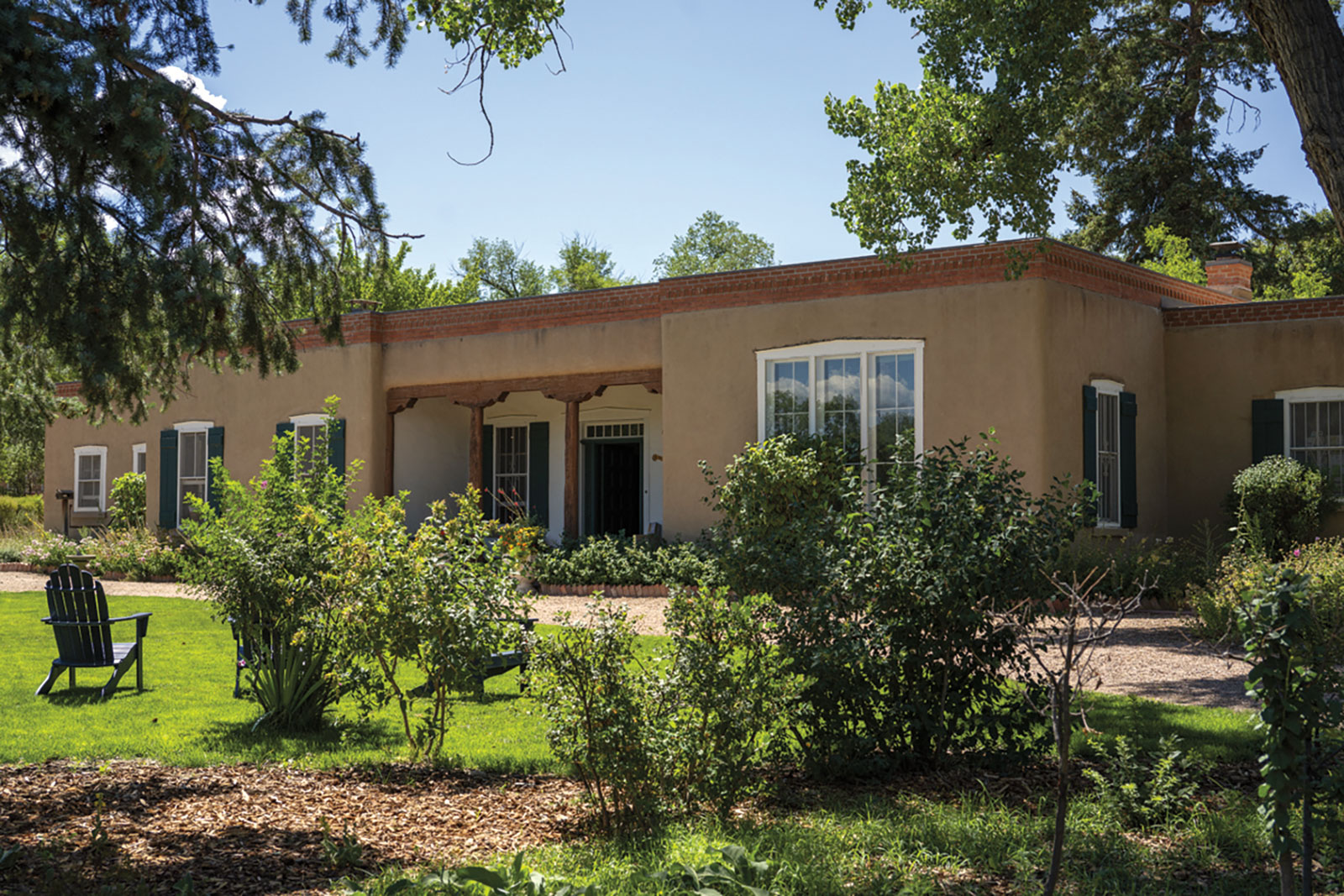
Acequia Madre House, Santa Fe, New Mexico. Photo by Pilar Law.
Atypical of Julian’s work is the pencil drawing Tah—m-povee, “Sun Flower”, Rito de los Frijoles, N.M., 24th August 1920. It was undoubtedly acquired as documentation of his experimenting with work that was different from what collectors wanted to acquire.
The vast collection wasn’t considered a “collection” until late in Leonora Paloheimo’s life. The women observed and documented the life of the region and decorated their home with the objects they acquired. In the paper archives are records of Christmas gifts of pottery from the pieces in their home to other family members.
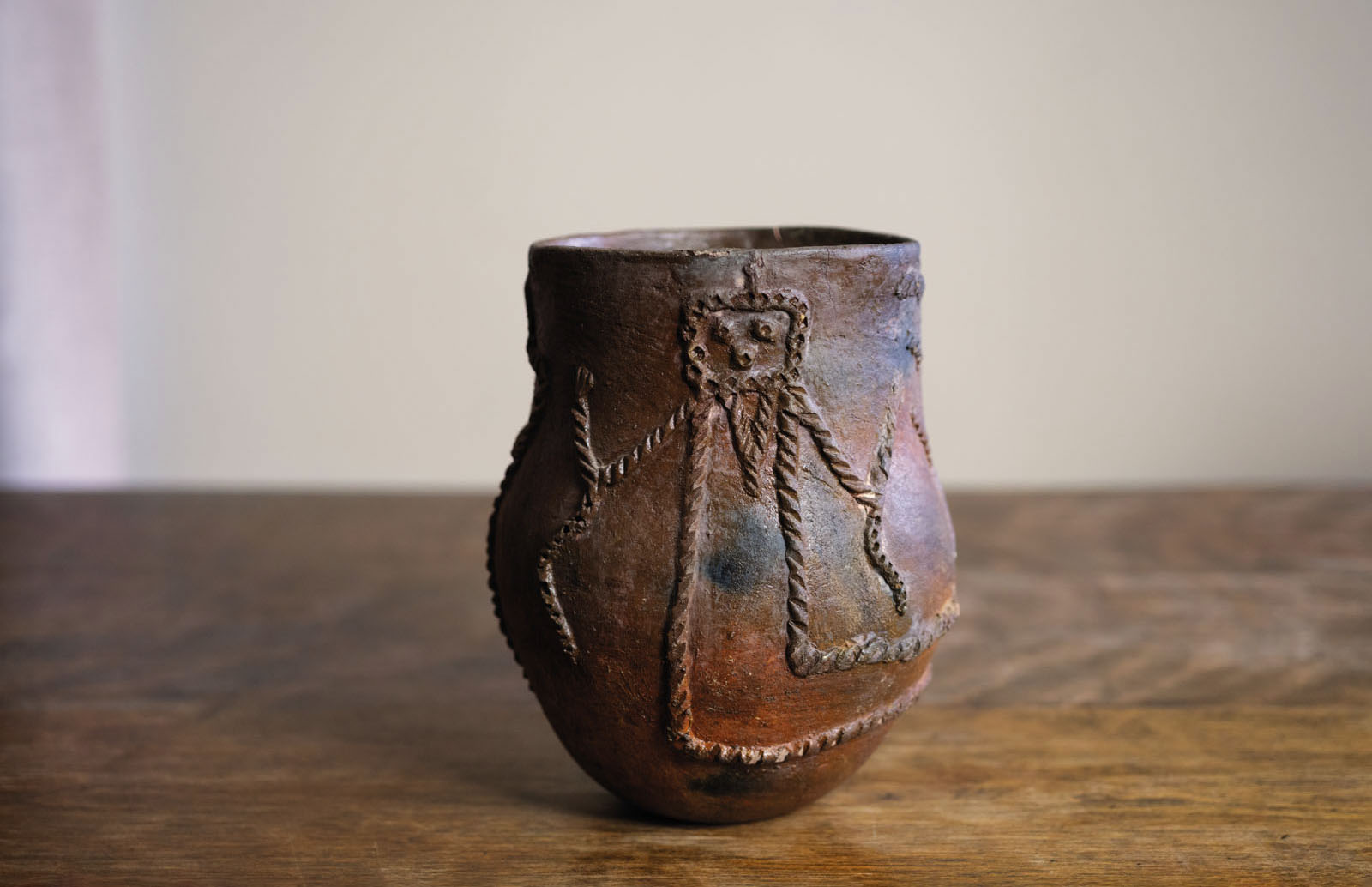
Navajo Bean Pot with corn and Yei decoration
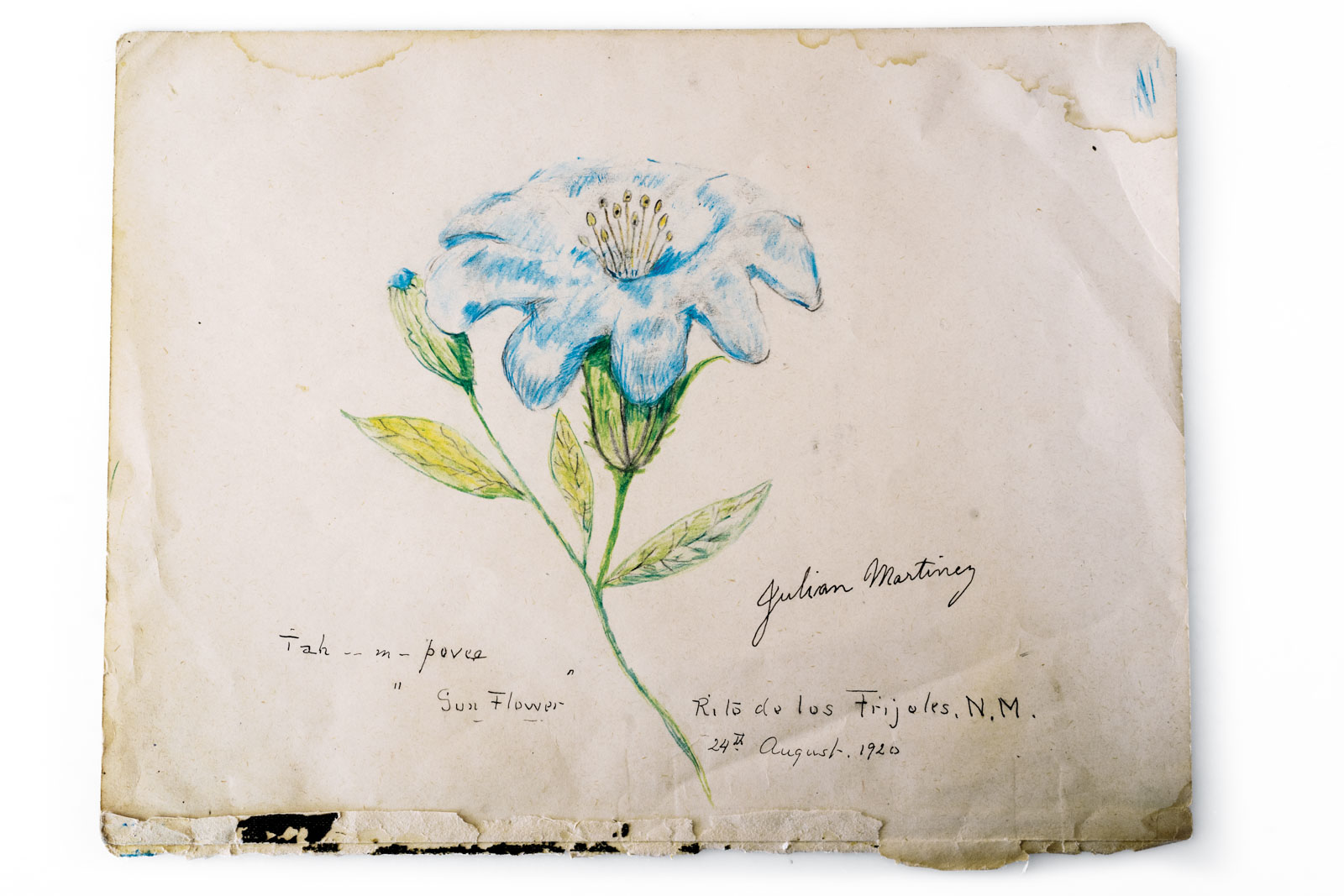
Julian Martinez (San Ildefonso, 1879-1943), Tah—m-povee, “Sun Flower”, Rito de los Frijoles, N.M., 24th August 1920, pencil drawing on paper
Among the pottery collection are a grand Zia dough bowl and a simple Navajo bean pot with an applied corn and Yei design. The identification of pieces in the collection continues today. Recently, Franklin Peters of Acoma Pueblo identified a jar that was made by his mother, Eva Vallo Peters.
A 1926 photo at San Ildefonso Pueblo depicts Leonora Curtin and her mother with Maria and Julian Martinez and Franz Lactanz Count of Firmian, an artist and friend of Eva. Julian had been governor of San Ildefonso. Feathered bonnets had come from the Great Lakes through the plains and to the pueblos. In the photograph, Julian wears a bonnet as a sign of respect and distinction.
Jordan Young, president of Acequia Madre House and executive director of WISC has an MFA in poetry and sometimes refers to the work of Adrienne Rich. Rich could have been acknowledging the three wise woman and the women of WISC when she wrote, “The connections between and among women are the most feared, the most problematic, and the most potentially transforming force on the planet.”
Powered by Froala Editor