The Thomas Cole National Historic Site, home of the 19th-century artist acknowledged as the first significant American landscape painter and “father of the Hudson River School,” is hosting an exhibition on the role of women in American landscape history. Women Reframe American Landscape: Susie Barstow & Her Circle / Contemporary Practices is now open through October 29 in Catskill, New York.
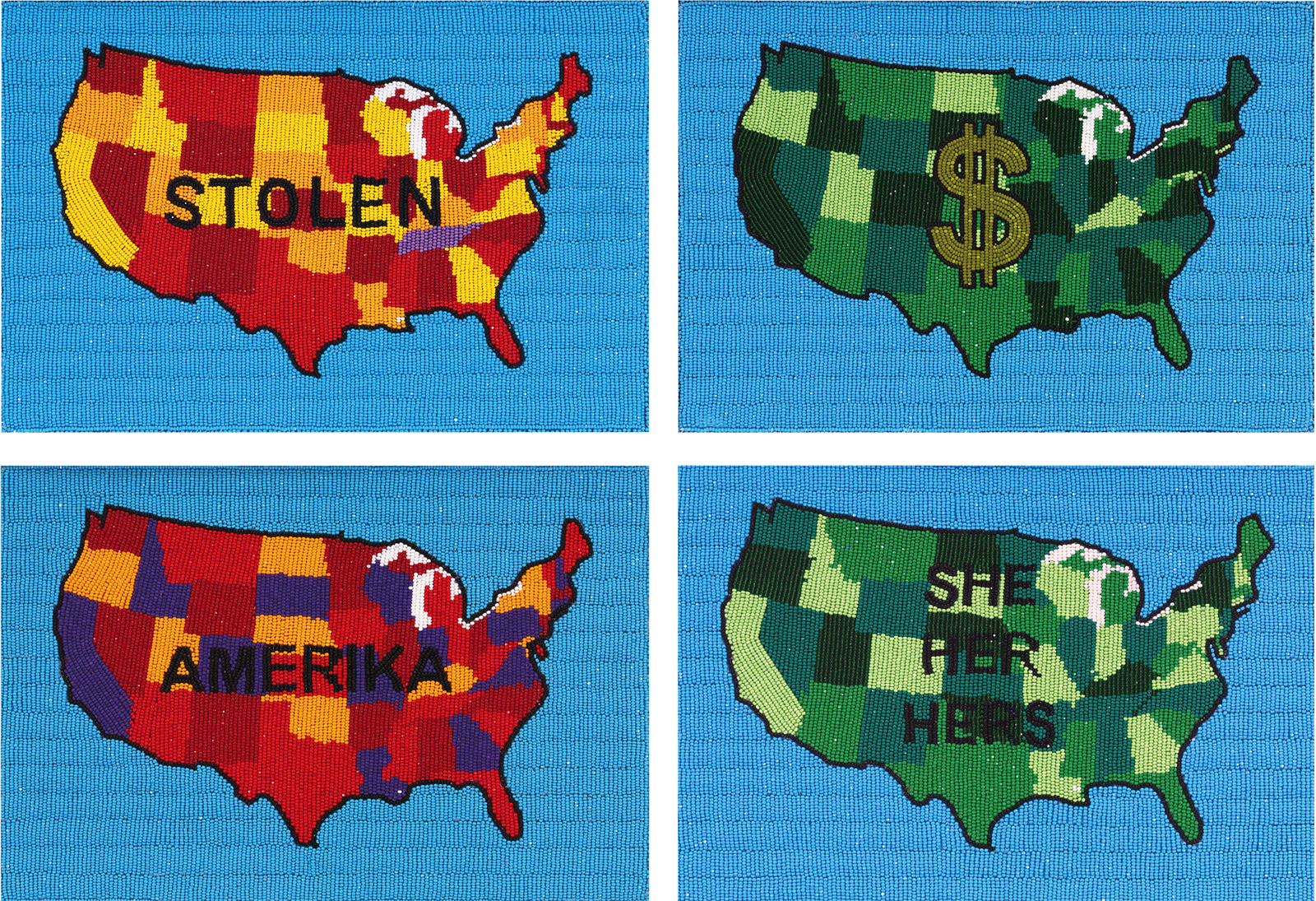
Jaune Quick-to-See-Smith (Confederated Salish/Kootenai Nation), Four works: She, Her, Hers Map; Amerika Map; Stolen Map; $ Map, 2021, beads, 8¼ x 12” (each). Courtesy the artist and Garth Greenan Gallery, New York, NY.
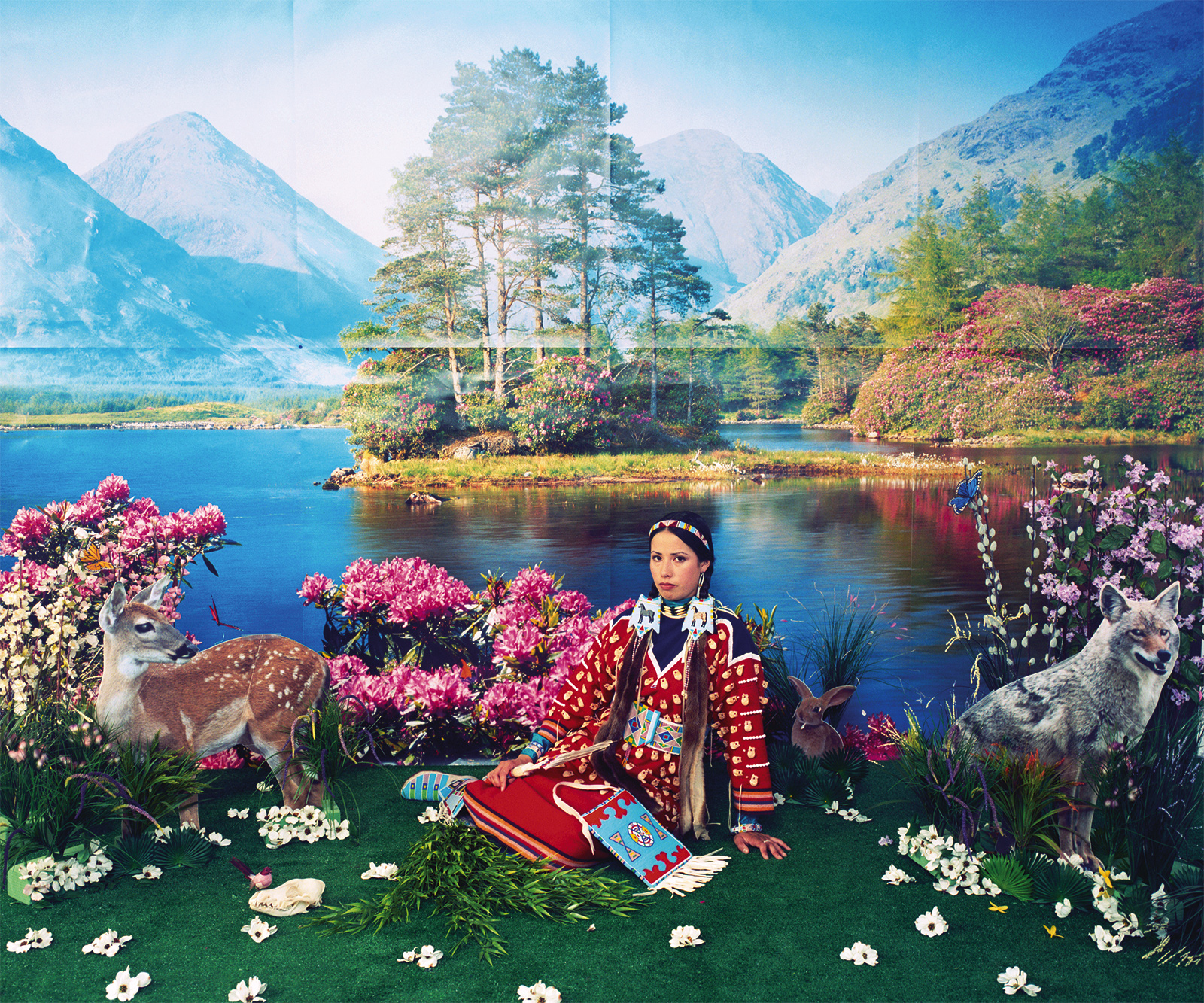
Wendy Red Star (Apsáalooke (Crow), Spring, from Four Seasons, 2006, archival pigment print on Sunset Fiber rag paper, 21 x 24”. Art Museum of West Virginia University, Morgantown, WV, Courtesy the artist and Sargent’s Daughters, New York, NY.
Among the contemporary artists who delve into how we see and use “land” today, are several Native American artists.
The Apsáalooke artist Wendy Red Star turns historical photographs of Native American subjects as a vanishing species on their head. In her series, Four Seasons, 2006, she addresses humorously the dioramas she saw in a natural history museum that depicted Native People as a vanished part of the past. In Spring, for instance, she sits on bright green Astroturf before a large, poorly printed scene of the American West with cutouts of a deer, a coyote, a rabbit and numerous, scattered artificial flowers. She employs Crow humor to address stereotypes and authenticity.
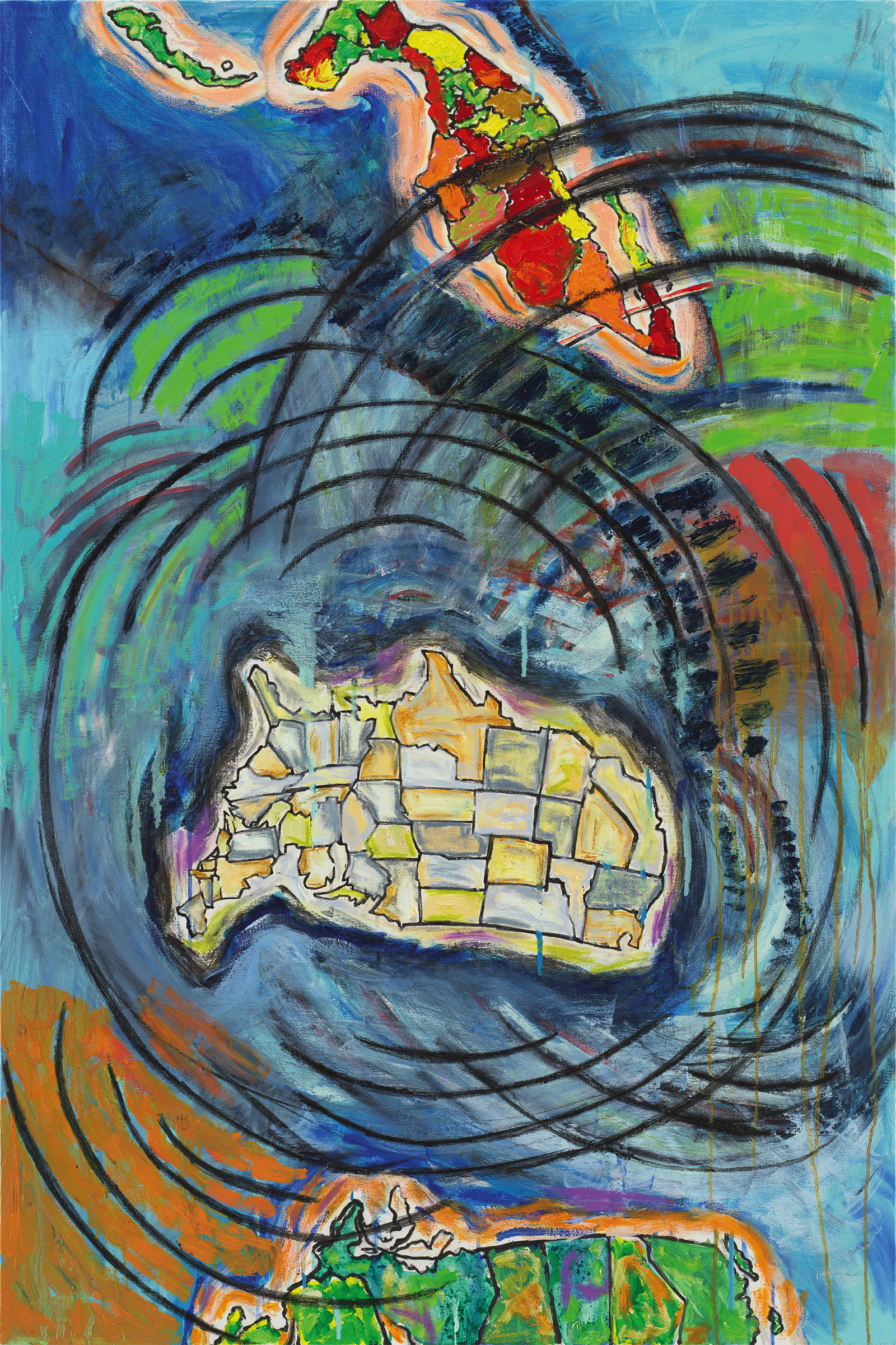
Jaune Quick-to-See-Smith (Confederated Salish/Kootenai Nation), Unhinged (Map), 2018, mixed media on canvas, 60 x 40”. Courtesy the artist and Garth Greenan Gallery, New York, NY.
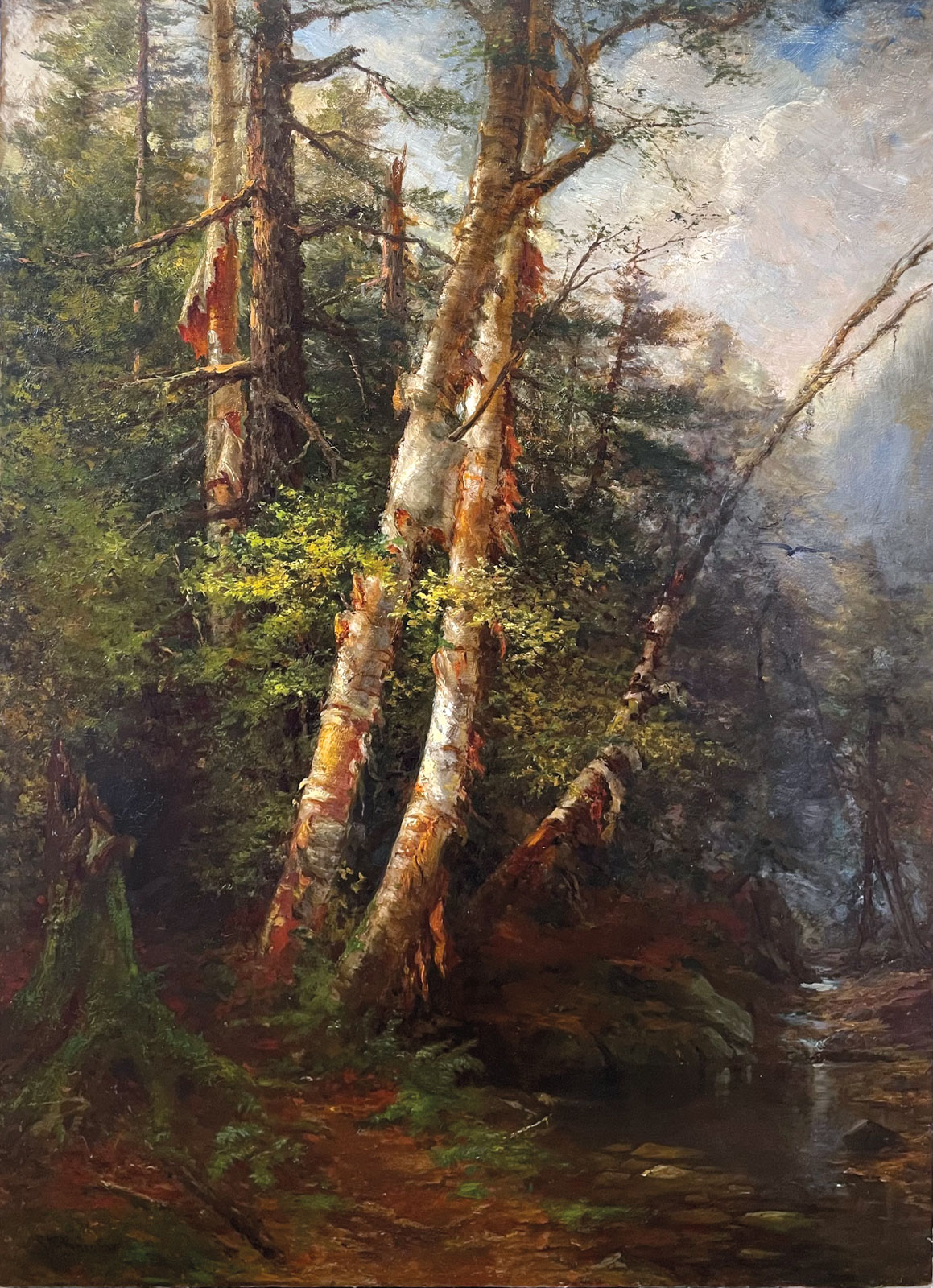
Susie M. Barstow (1836-1923), Wooded Interior, ca. 1865, oil on canvas, 30 x 22”. Thomas and Marilyn Tolska Collection in Memory of Jenni Tolska, Photograph: Chelsea Restoration Associates, New York, NY.
Jaune Quick-to-See Smith often creates maps in media from beads to oil to mixed media. She depicts the unnaturalness of socio-political borders. In Unhinged (Map), 2018, the United States spins in the center of a vortex separated from the other North American countries, almost unrecognizable, floating in isolation. Smith is an enrolled member of the Confederated Salish and Kootenai Tribes and is also of Métis and Shoshone descent.
The exhibition catalog includes a discussion, “Upturning the Map: Native Women and Representations of Land and Landscape,” between Candice Hopkins (Carcross/Tagish First Nation) and Jolene Rickard (Tuscarora Nation).
Kate Menconeri is co-curator of the exhibition and chief curator and director of curatorial affairs at the historic site. She says, “This project is not meant as a survey but as an exhibition that illuminates specific, dynamic and multifaceted perspectives. Together these artists complicate, challenge and transform the way we think about art history, landscape and our critical relationship with land today.”
Through October 29, 2023
Women Reframe American Landscape: Susie Barstow & Her Circle / Contemporary Practices
Thomas Cole National Historic Site, 218 Spring Street, Catskill, NY 12414
(518) 943-7465, www.thomascole.org
Powered by Froala Editor