While Mateo Romero’s traditional background is based in the Cochiti Pueblo, he currently resides among his wife’s people—the Tewa in the Pueblo of Pojoaque, Northern Rio Grande, just north of Santa Fe, New Mexico. His time spent here with his family has been inspiring, compelling his new show Towa Land, consisting of around eight new landscape paintings hosted at Manitou Galleries in Santa Fe.
“Romero’s paintings are based on abstract expressionist references. Bold colors slash across canvas, hot colors vibrate next to cold, drips and smears hover over the surface,” describes Manitou representatives. “Action-painting references abound in stabbing, gestural marks. Artists like Franz Kline, Willem De Kooning, Jackson Pollock and Robert Motherwell are his companions along this urgent pathway of color and surface.”
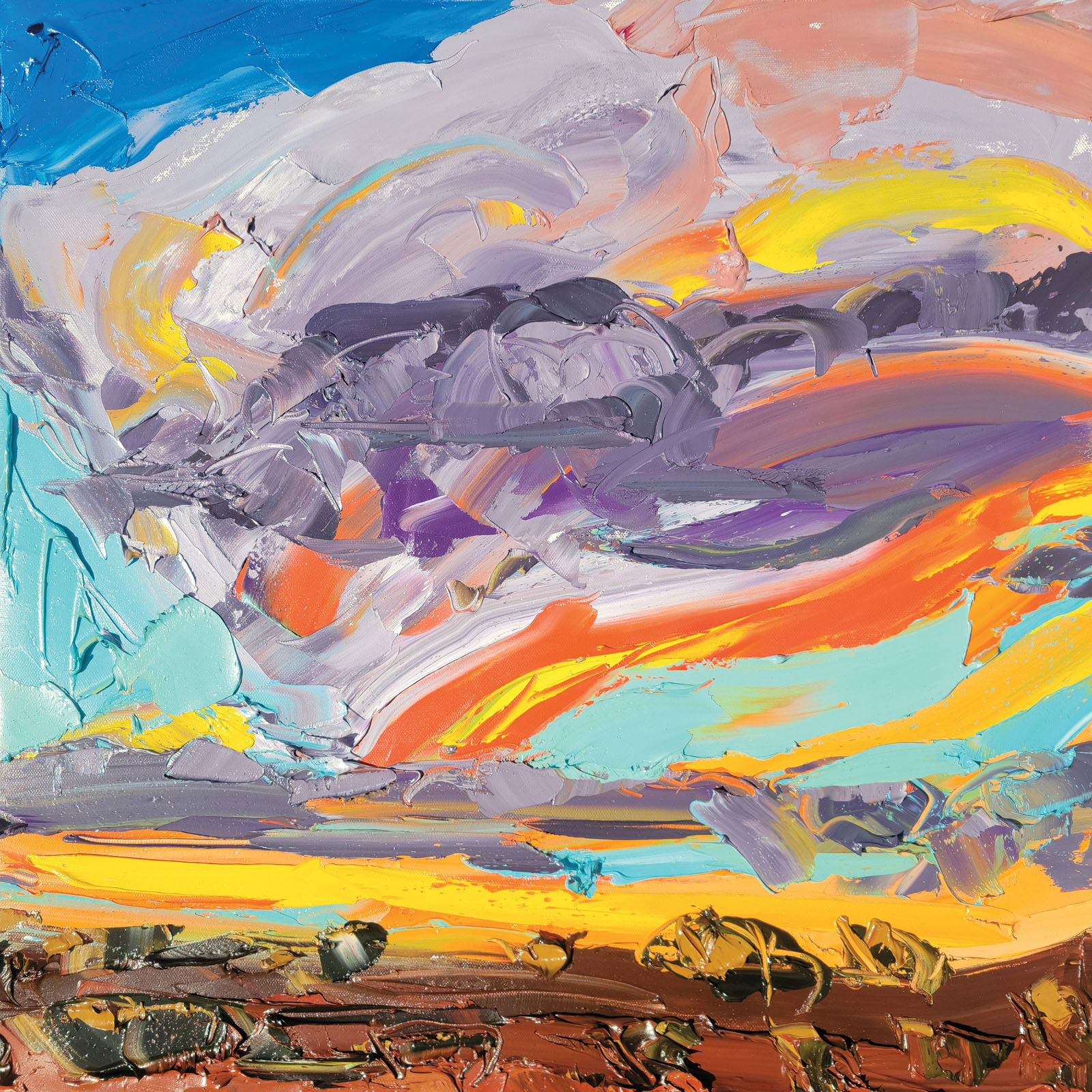
Ogapogeh Series #2, oil on canvas, 24 x 24"
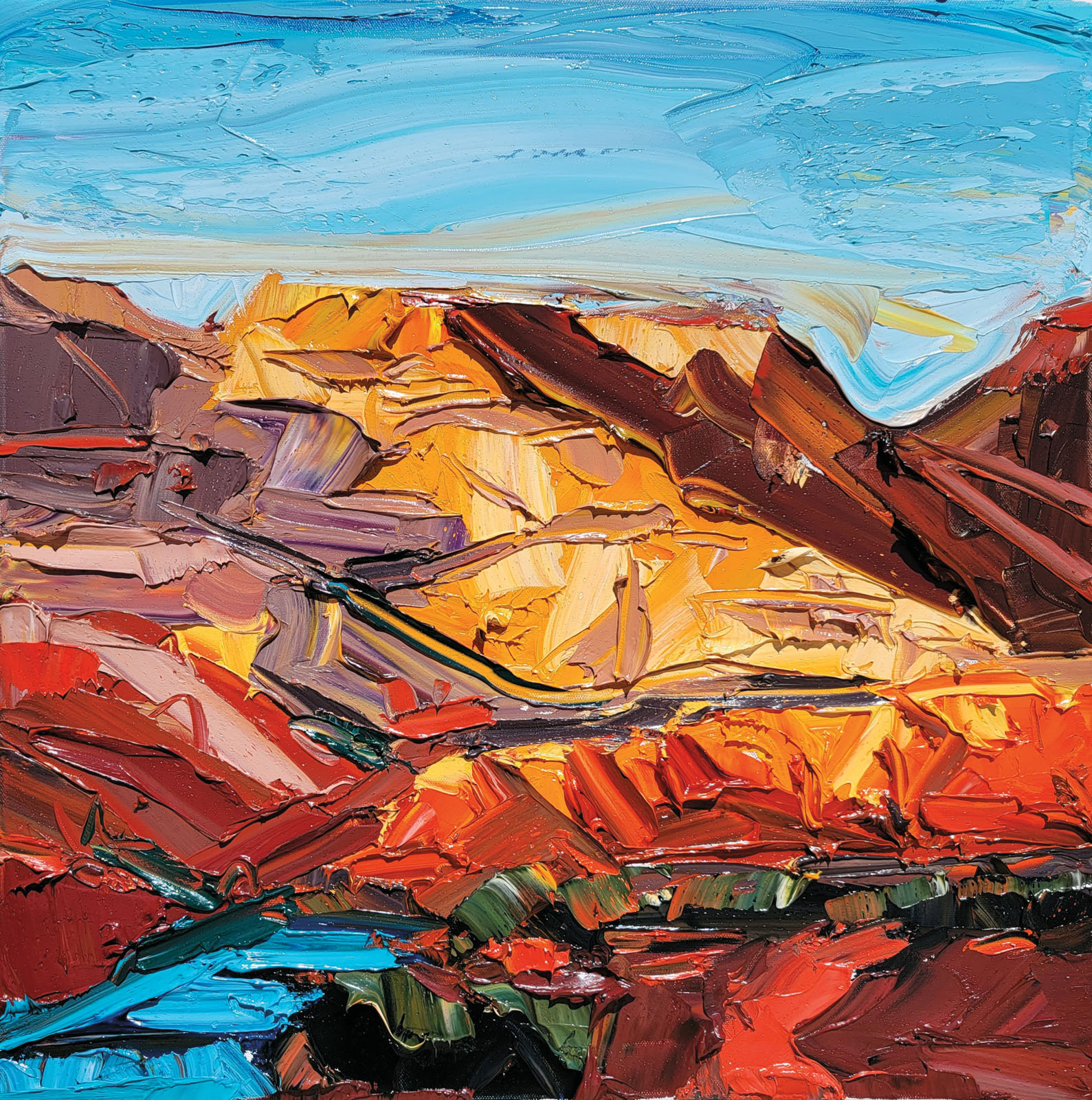
Aveh Tsugeh Series #4, oil on canvas, 24 x 24"
Among these colorful show pieces, primarily landscapes, Romero also presents at least two pieces as reference to earlier work. “I had an earlier style of doing photographic collage that involved photo transfer,” he shares. “While the last six years has been about the landscape, my collage work has always captured Native dance like that of the Eagle Dancer, Buffalo Dancer, Corn Dancer and so much more.”
As for his heavily impasto oil landscape pieces, Romero explains that he’s been “building on these ideas of the Northern Rio Grande landscape, and embedded is a critique about Indigenous sacred space,” he says. “When I was an art history major, there were ideas about man and woman and their place within nature. Often, this is referred to as the sublime from the Western European canon—man’s relationship with nature and the idea that humans are distinct from the landscape.”
However, the Tewa people do not see this distinction with man and woman as separate from the landscape. “Rio Grande people are not in awe of the landscape, but rather a part of it,” Romero continues. “There’s a different ideology and placement, where there is believed to be an energy that moves through people, rock, clouds, etc., and we’re all connected by that cycle. It’s not sublime but rather folded in and part of it.”
This very concept is immersed in the Tewa or Keres language, which is why Romero chose to title his pieces after Tewa words. In pieces like Aveh Tsugeh Series #4, depicting Choke Cherry Valley, Romero discusses how a lot of the names of mountains and other features were given Spanish colonizer versions of preexisting, Indigenous names. The valley is located in the town of what is now known as Abiquiú, but the initial pronunciation was Aveh Tsugeh, to mean “wild choke cherry place.”
The artist also notes that the paintings are taken from actual, physical places, and he relies on certain tools as references. As in Tsi Ping Owingeh Series #3, we see a view of Cerro Pedernal Mountain, with pedernal meaning “flint” in Spanish. “Paintings like these are produced from sketches in my journal, some photography and a little from memory,” Romero says, “My paintings happen pretty quickly, with a lot of action-type painting but I’m not doing it in a performative way. These are heavy, muscular paintings with a lot of palette knife and thick swatches of color.”
Other works like Ogapogeh Series #2, translates from Tewa to mean “white shell water place.” This vibrant work is part of a series Romero calls “big sky paintings” where a large percentage of the piece is mainly sky. “These are about movement, emotion and are meant to be celebratory,” Romero says. “It’s about the things we see out here in this space looking up. It’s very much about joy and being open to the energy of the sky and color.”
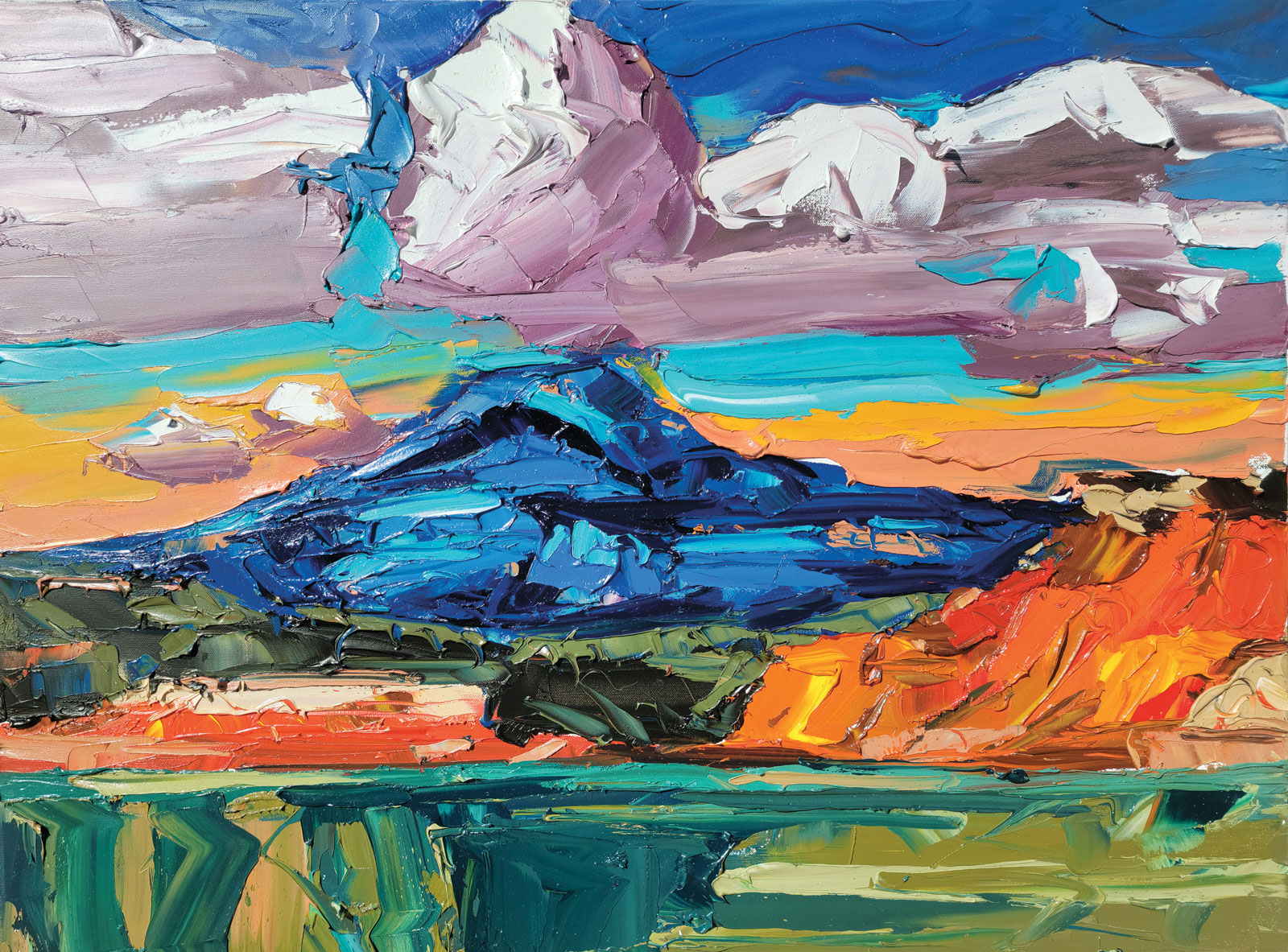
Tsi Ping Owingeh Series #3, oil on canvas, 30 x 40"
In this same vein, Romero considers much of the show to be inspirational or, perhaps, aspirational. “It’s joyful stuff,” he says, “and it’s looking at these landscapes with fresh eyes and falling love with them all over again. It’s about people and connecting with the land, sky and water; about being happy. For me, making these pieces made me happy and joyful, and I hope viewers can catch that when in their presence.”
Towa Land will open with a reception on June 16 from 5 to 7 p.m., and closes on June 26.
Manitou Galleries
June 16-26, 2023
123 W. Palace Avenue, Santa Fe, NM 87501 (505) 986-0440, www.manitougalleries.com
Powered by Froala Editor