The smell of rain. That is how wet clay is often described by Native potters as they begin the process of coil-building their pottery. For generations, the pueblo potters along the Rio Grande River in New Mexico have gathered local clay to engage in a process that may take over a year just to have usable material to make a vessel. These pueblo potters have typically coil-built each piece and then carved, painted or etched designs into the surface. The last step, the firing, has long taken place outdoors and is the riskiest part of the entire process as there has been, and remains, a high breakage rate of pieces in the firing.
Native pottery is no longer a folk art craft or utilitarian, but the source of a dynamic Native American fine art movement. Unlimited creative potential is found in this Indigenous earth. Nancy Youngblood (Santa Clara), Tammy Garcia (Santa Clara), Jennifer Tafoya (Santa Clara), and Susan Folwell (Santa Clara) are four Pueblo women who have dramatically changed the expectations and creative relevance of this art form over the past 50 years.
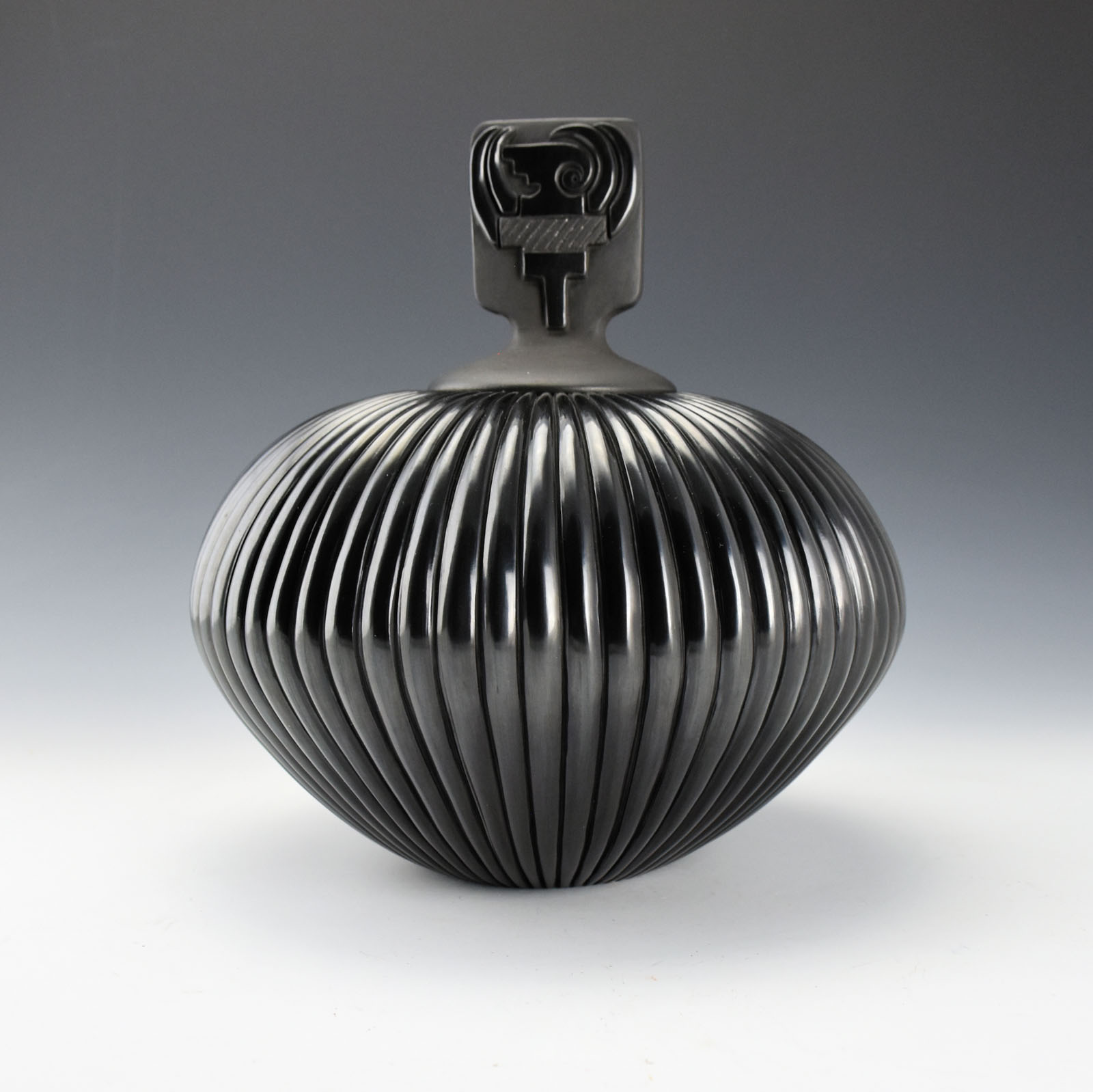
Nancy Youngblood (Santa Clara Pueblo), Rib Melon Bowl with Thunderbird Lid, native clay
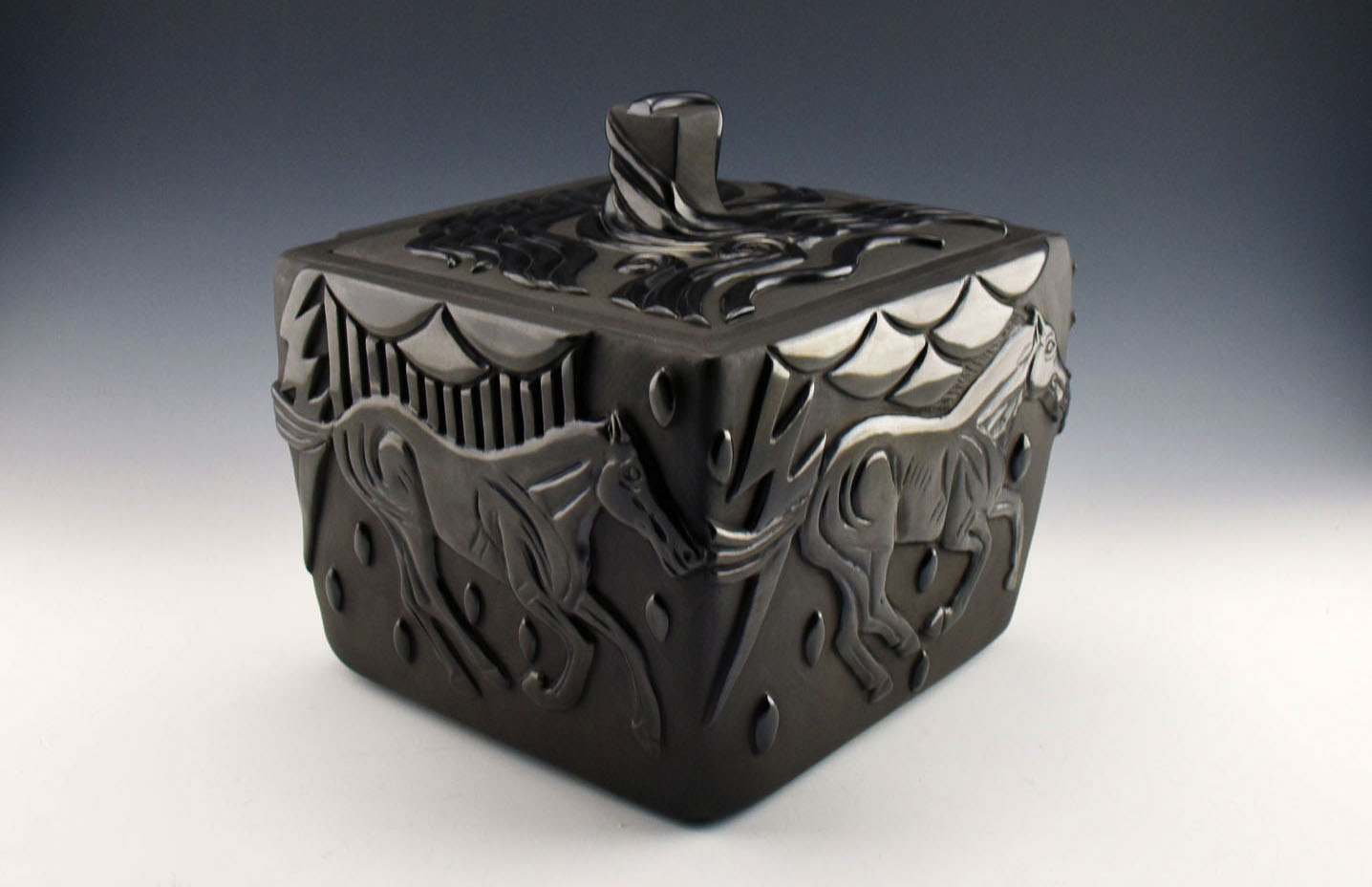
Nancy Youngblood (Santa Clara Pueblo), Horses lidded box, native clay
Nancy Youngblood is renowned for the deeply carved melon ribs that swirl across the surface of her pottery. She learned to make pottery from her grandmother Margaret Tafoya in the early 1970s. She has won hundreds of awards, including 1989 Best of Show at Santa Fe Indian Market. Her pottery is a lesson in patience and precision. “I always self-critique my pieces one last time before I start to polish. I always find something little I can correct. That one last time critiquing can result in a whole extra day working on the piece. That’s who I am. I want each piece to be as good as possible before it goes out the door. When I put my name on the bottom, I guarantee I’m the only one who’s touched that pot.”
Early on, she took inspiration from the vessels of Tony Da and Joseph Lonewolf, who have become iconic for the detail, innovation and precision in their pottery. Her interest was not to replicate their styles but to understand the time and patience that goes into making a masterful work of art in clay. “Every aspect of making a piece is important. I don’t think you can make a beautiful pot without understanding each part of the process and focusing on it. Every step is important to get to the final piece.”
“When I am polishing something complex, it can stress me out. I may put it on the shelf for a week or two and then go back to it. For example, take one of the melon bowls with 64 sections. There is nothing worse than polishing 63 ribs and then having the last rib break. When that happens or it cracks or blows up in fire, it takes a while for me to get back to it. At first, I’ll think to myself that maybe it wasn’t meant to be. But then I go into a different part of myself that says I won’t let it defeat me. I work to figure out what went wrong and make it work out next time.”
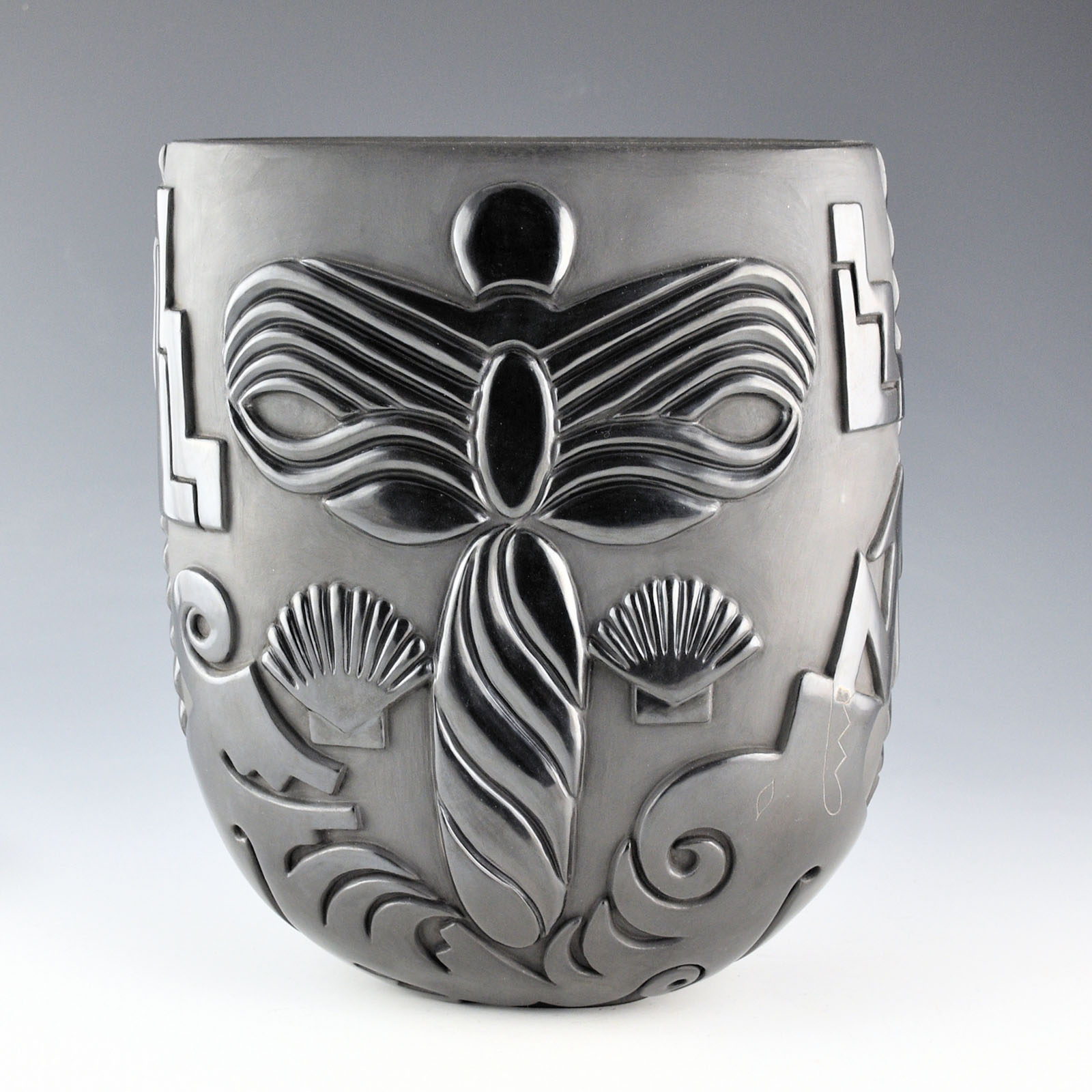
Nancy Youngblood (Santa Clara Pueblo), Dragonfly and Avanyu oval jar, native clay
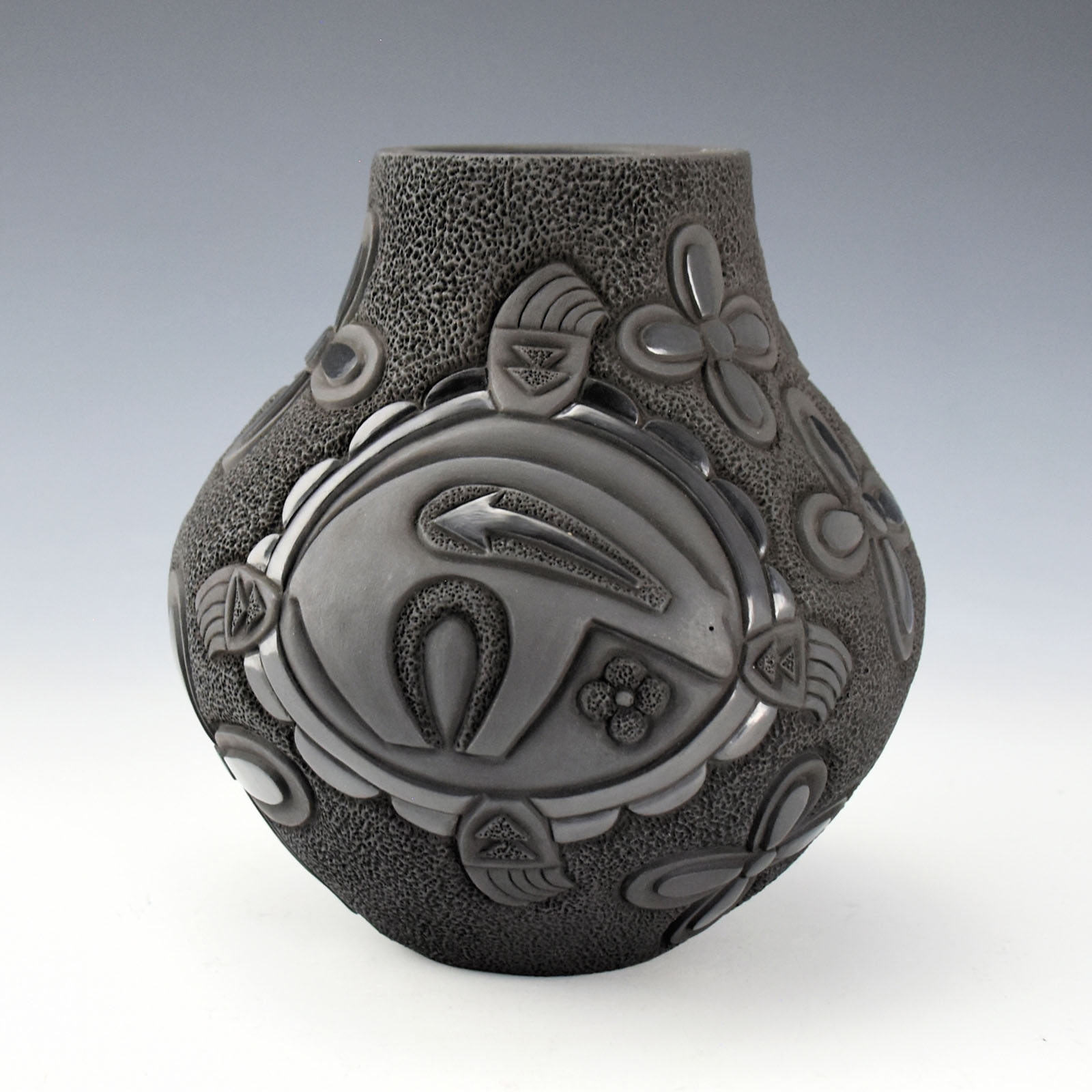
Tammy Garcia (Santa Clara Pueblo), Heartline Bear, native clay
“I love designing and carving. I want potters to see the technical difficulty and be blown away. I want the collectors to see that I took pride in my work and I love to do it. I always wanted, someday down the road, for people to look back and say she really worked at it and did beautiful pottery. I always want to represent my family and Santa Clara in such a way that brings pride to all of them. Being a potter is not an eight-hour-a-day job. This is the kind of thing where you are so into it you lose track of time.”
Each of her pieces is thought out not only in form and design, but even how the angles of the rib will reflect light off the surface. In the end, each piece is a culmination of the time and energy involved. This quickly gets replaced by the overwhelming aesthetic intensity of her art. While the beauty of her pottery speaks for itself, there are underlying lessons in her work for other Native potters. Nancy’s commitment to quality, to consistent pricing, to patience, and near-perfection are a way to tell younger artists to slow down, enjoy the process, take ownership of their careers, focus on quality over quantity and let clay and culture speak through you to be an inspiration for generations to come. As Nancy says, “We are normal people who do extraordinary pottery.”
Tammy Garcia has become one of the most diverse Native potters working today. Her unique design style easily translates from the surface of the clay to bronze, jewelry and glass. A granddaughter of Mary Cain and great-granddaughter of Christina Naranjo, she began her career making traditional Santa Clara pottery. “I saw the passion and excitement my grandmother felt every time she held the clay or talked about pottery. I noticed how collectors coming to her house would examine a piece for quality. As I made pieces, I began to deviate from tradition in design or form. I was 17 when I won my first ribbon at the 1987 Gallup Ceremonials.”
“I love exploring anything different I can within the clay’s ability. Native clay has limits as the drier it gets, the more pressure is put on your hands, your tools, and there is more risk of breakage. When I first learned to make pottery, it was classic Pueblo forms. I remember making little water jars until I could perfect the symmetry of the form. Then I would move onto another shape. The early designs were more traditional from Santa Clara.”
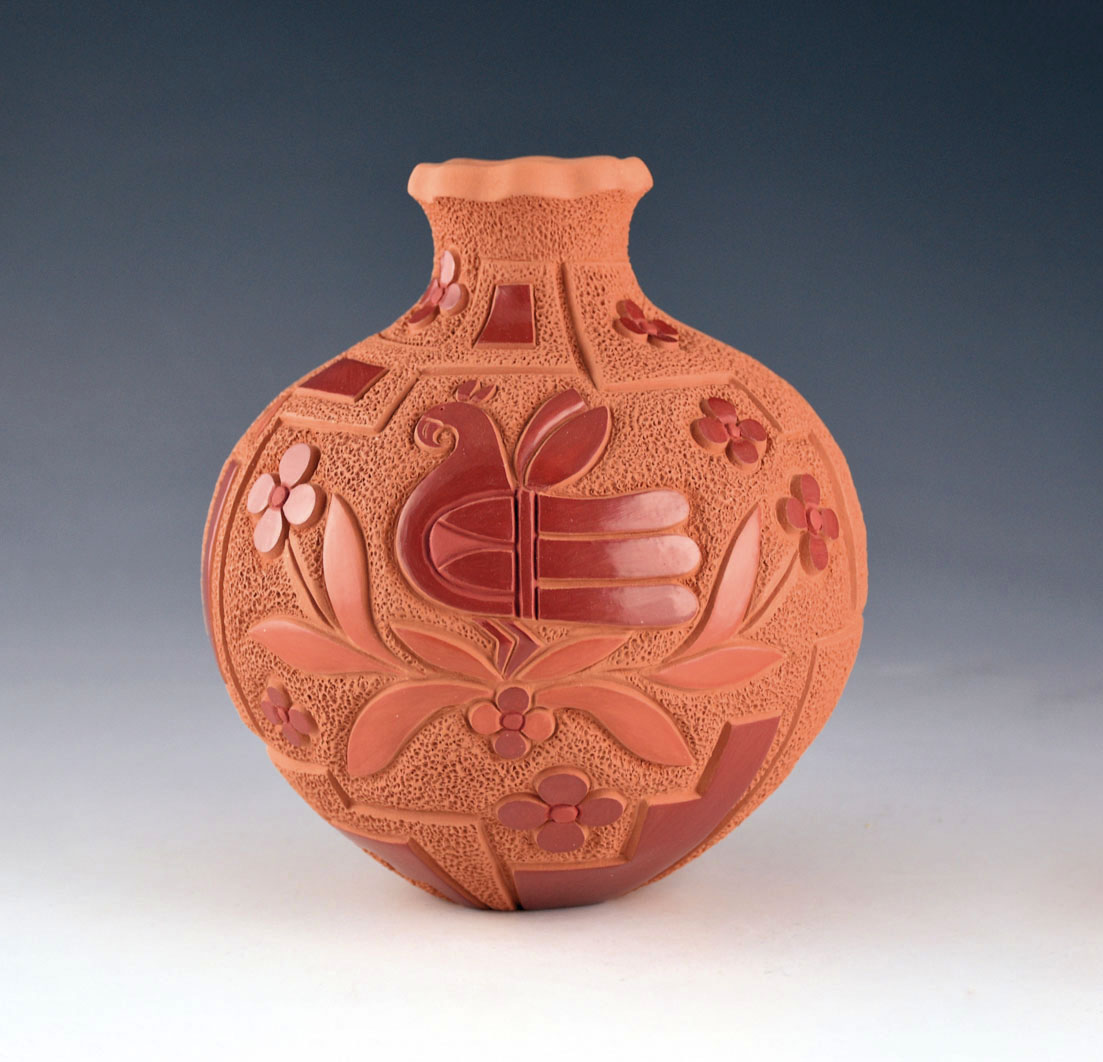
Tammy Garcia (Santa Clara Pueblo), Pueblo Parrots, native clay, water jar
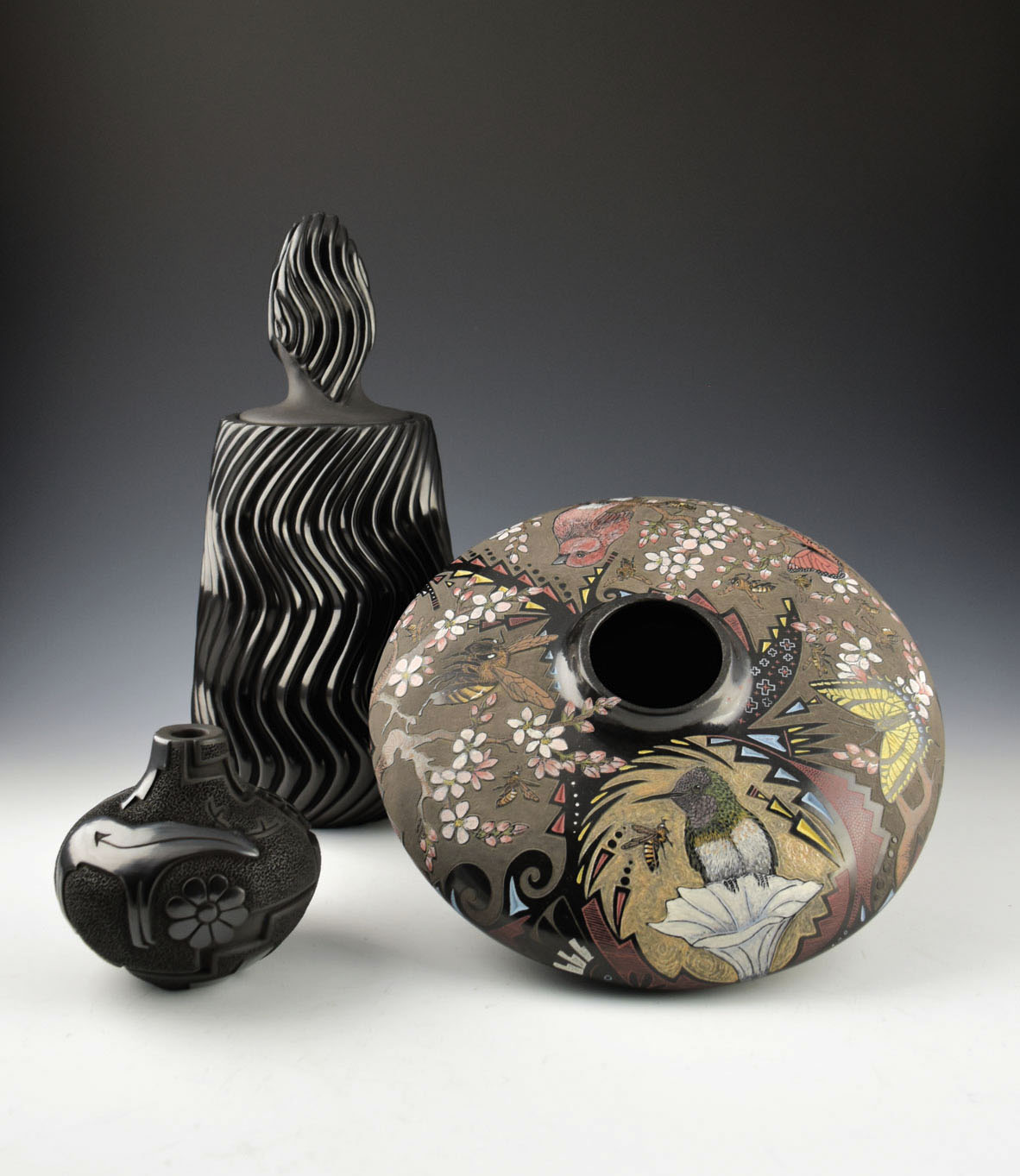
Grouping of pots, clockwise from lower left: Tammy Garcia’s Heartline Deer jar, Nancy Youngblood’s “S” Swirl Jar with lid and Jennifer Tafoya’s Birds and Bees wide jar.
Tammy’s pottery over the past 30 years has been renowned for her creative designs. While they speak of her pueblo, she draws inspiration from the world around her and the pueblo past. “The traditional designs of Santa Clara have a specific story to tell. I looked back further to the Mimbres pottery of the 1100s. Their use of animals and, especially insects, told their own story. You knew that butterflies or dragonflies were as fascinating to them as they are to me.”
Her designs have evolved to include various textures and levels, or layering, of carving. The delicacy and intricacy of her designs reflects her love of jewelry. “Tufa casting creates jewelry with designs on multiple levels and with various textures. I want to create in clay textures to help a design stand out or carve at various levels, creating a ‘pillow’ effect on my most delicate imagery.” In 2022, Smithsonian Enterprises collaborated with her for a line of jewelry. “In jewelry, I can see my designs in a miniature form as wearable art. Jewelry always connects to my pottery, now it connects to pieces people can wear. I dream about what comes next.”
“What is special about being an artist is that people don’t see what goes on behind the scenes. Inspiration can come at any time. There are times I will dream about the designs or shapes or what I’m going to do next. When I see a completed piece after having visualized it in my mind, it is an incredible experience that I go through as an artist. I look at the pottery of Sarafina Tafoya or Christina Naranjo, and these women from my family inspired me. I hope that my pottery and art inspires the youthful generation in the same way. Now with years of experience I can look back at these incredible women and what they did. I’m where I am because of them.”
Susan Folwell may well be one of the most adventurous Native potters working today. A daughter of Jody Folwell, her pottery has been described as “canvas in clay” for decades. Her shapes rarely rely on the classic forms of Santa Clara Pueblo. Instead, they are typically more sculptural or organic in form. The form is not just the “canvas” for her designs, but it often becomes a visual part to the story she wants to tell. “For my pottery, it’s really whatever strikes me at the moment. If there is an idea in my mind, or feelings, thoughts or comments I would like to explore, they initially take form in the shape. I think that when I have the shape and surface design flowing together harmoniously, I’ve created something that really can be visually ‘read,’ like a book. I often create my own iconography on pottery. I’m not sure if people need to understand the meaning or if I need them to even realize it’s there. To me it’s more important that I can recognize it myself. The pots become my own personal timeline and are a reflection of time and place.”
Susan uses both Santa Clara clay, and more recently, micaceous clay. “I’ve fallen in love with micaceous clay. It’s very forgiving when you are building a piece, and I love the way India ink or watercolor lays on the surface with a sparkle underneath. It’s great for creating very sculptural pieces.” It is the sculptural and design aspect that gives her work a distinctive appearance. Over the past several decades, the imagery has ranged from Pop Art and social commentary to giving a Native “spin” on paintings by the Taos Society of Artists. “There is a lot of mental time in designing my pottery. That time is almost incalculable. There can be extraordinary complexity underlying a very simple concept. I think I’ve done my job well if it looks easy because it never is easy. I can’t say that every piece isn’t a challenge on some level. Of course, there is a certain amount of confidence that comes with age. My pottery, in both design and form, has evolved and grown over the years. I struggle less with creating a complete concept as I get older.”
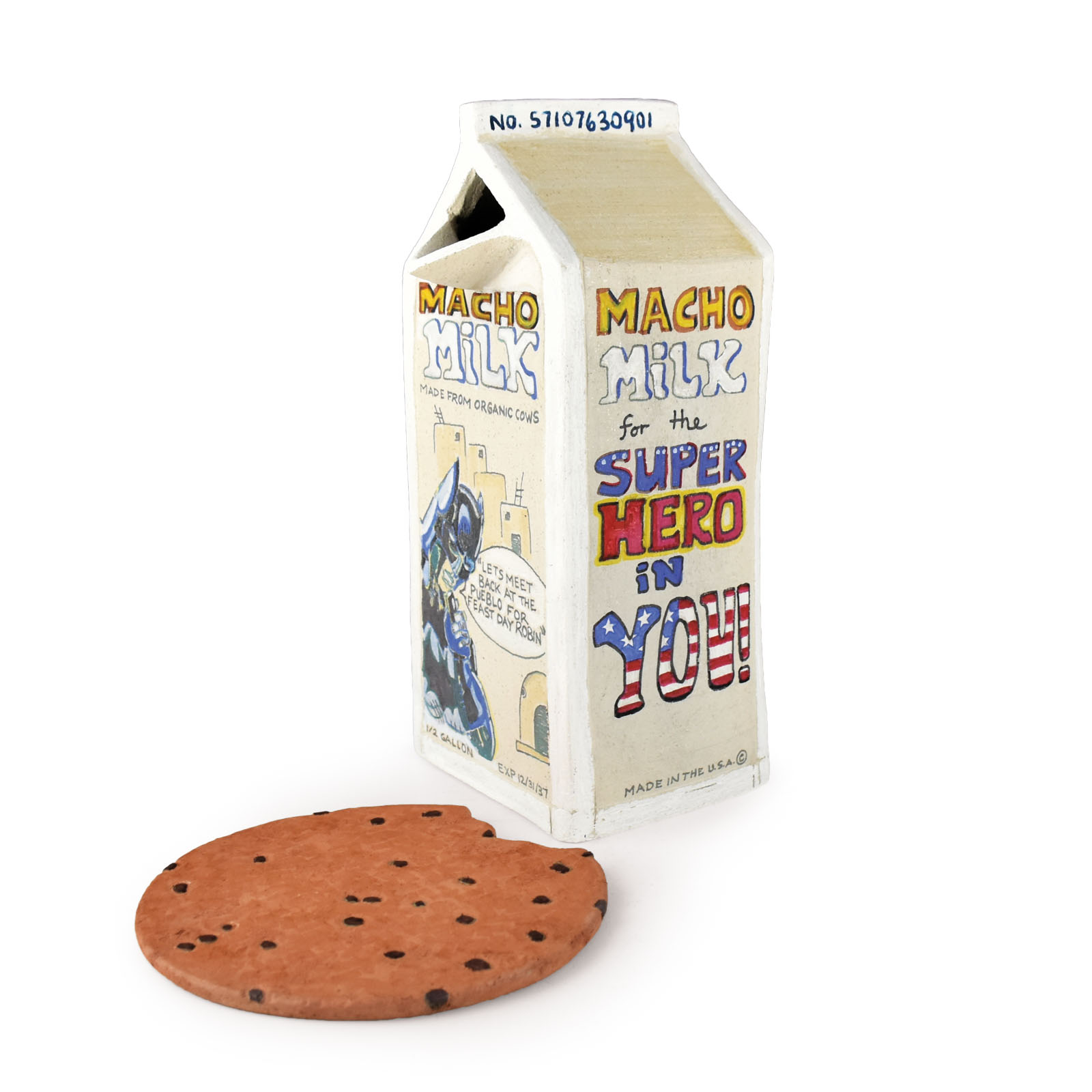
Susan Folwell (Santa Clara Pueblo), Macho Milk, native clay, two pieces
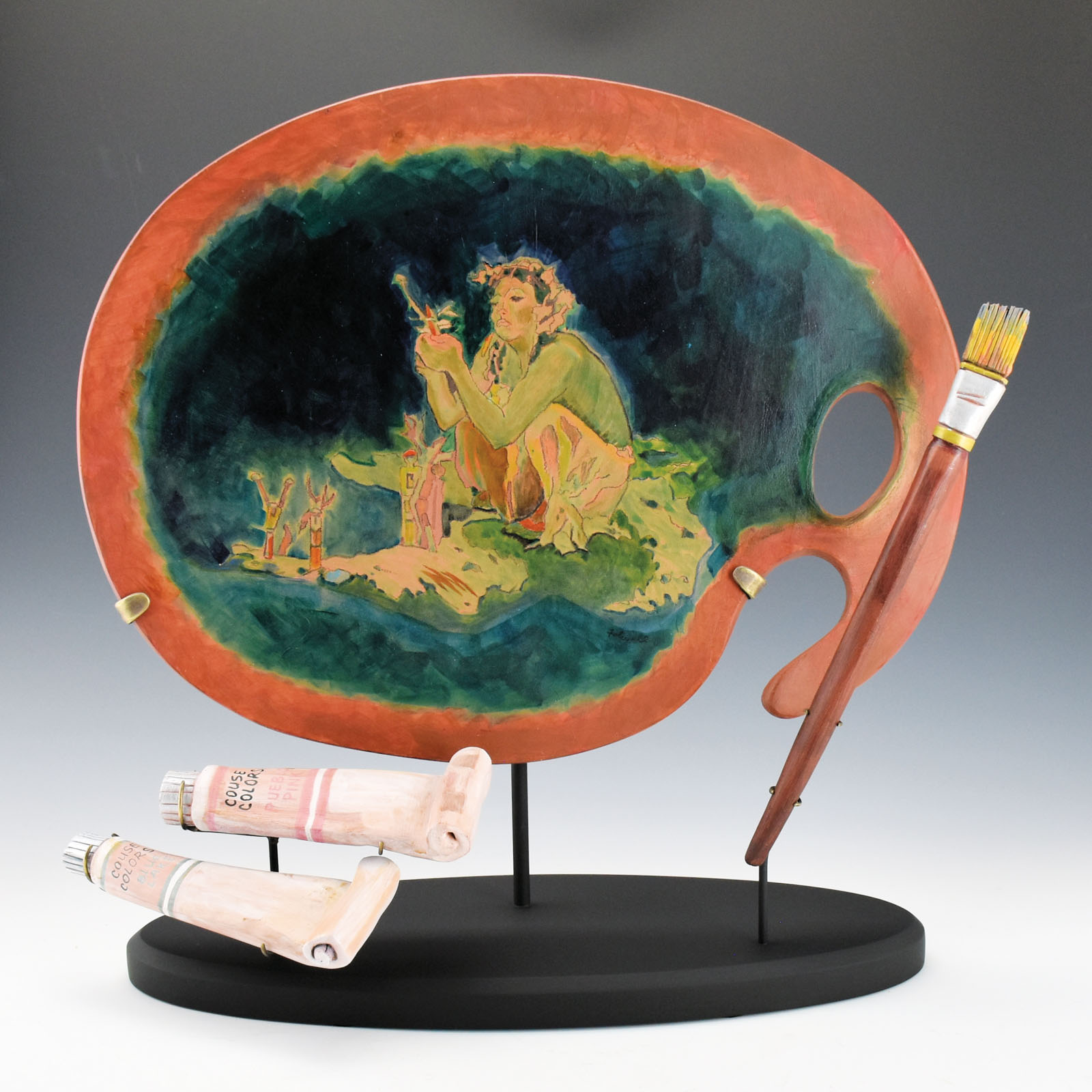
Susan Folwell (Santa Clara Pueblo), A Nocturne Palette, three pieces, native clay.
It is the content of her social commentary that has woven itself into her pottery throughout the years. The social commentary of her pottery is rarely “in your face,” but subtle and very often humorous. “I don’t feel that I have many restrictions in what I put on my pottery in terms of content. I’m grateful that I’ve gotten to a place where I don’t worry much about anything I choose to do. Of course, in the realm of social commentary, there are some issues that are closer to my heart than others. As an artist, creating content is important. However, as I get older, I tend to steer away from some subjects and just enjoy the art. I have started on political pieces and stopped and redirected the design work because I don’t want that energy on my pottery. Clay is a living thing and that’s not what I want on it. It’s like tattooing that pot with something bad on it.”
While her work can be provocative, there remains an underlying continuity within all her themes. “It’s important being a Native woman and growing up on the reservation. There are certain perspectives and nuances about life that you just understand. How I view the world tends to be influenced by my struggles. I hope that when people reflect on my work, they see as me having been able to open doors. Not just for Native potters. I’d like to be thought of as someone who ‘thinks outside of the box.’ I hope that encourages others to do the same and stick to their guns as to what they want to say. Personal, political, social, or just ‘beauty for beauty’s sake.’ Do what you want to do, not just what is ‘appropriate.’ That’s not for anyone but you to decide.”
Jennifer Tafoya brings the natural world, both past and present to life in her realistic pottery art. The coil-built vessels are made from native clay and then highly stone polished and traditionally fired. These are the foundations for her designs. She initially began etching local wildlife, from fish to birds, onto her pottery. Today her source material is unlimited, which is reflected in her winning the Tony Da Award for Innovation at Santa Fe Indian Market in 2019 for a jar with an Asian dragon designed in a pueblo style.
“I was inspired by my parents (Ray and Emily Tafoya). Native clay is important. It’s what everyone from my great-grandparents onward has used, what I’m using today.” Jennifer’s pottery is about design and the dynamic colorations that give them life.
“Multiple clay colors have been used in Santa Clara pottery over the past century, including the polychrome pottery of my great-grandmother Severa Tafoya. However, what I’m doing with color is different. It’s what makes me a contemporary potter.”
“People don’t realize how long it takes to etch the designs. I use a small, needle-sharp tool to cut into the clay. Each line is an individual scratch cut at various levels into the surface. After I finish the designs, I paint over them with more clay colors. The colors are not store-bought, but clay that I found and harvested myself.” The painting process is time-consuming as she layers clay colors as if she is painting a watercolor. Her earlier pieces were more simplistic, but she finds she is not only a potter, or a designer, but also a colorist; mixing clays together or layering them to the tonality she wants. Holding a piece of her pottery up to the light reveals the subtle color variations on the various levels of the etched surface.
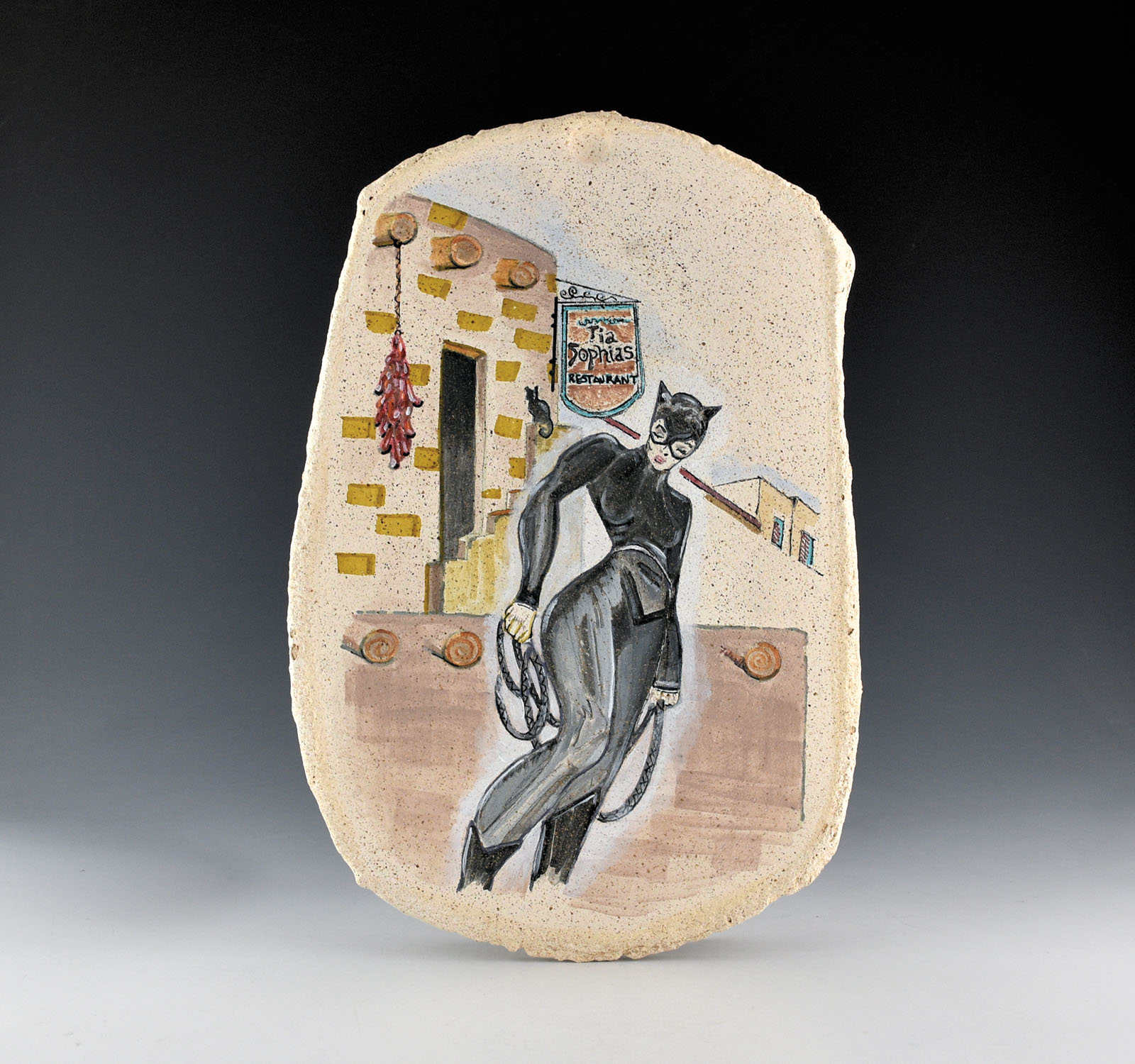
Susan Folwell (Santa Clara Pueblo), On the Prowl, micaceous clay
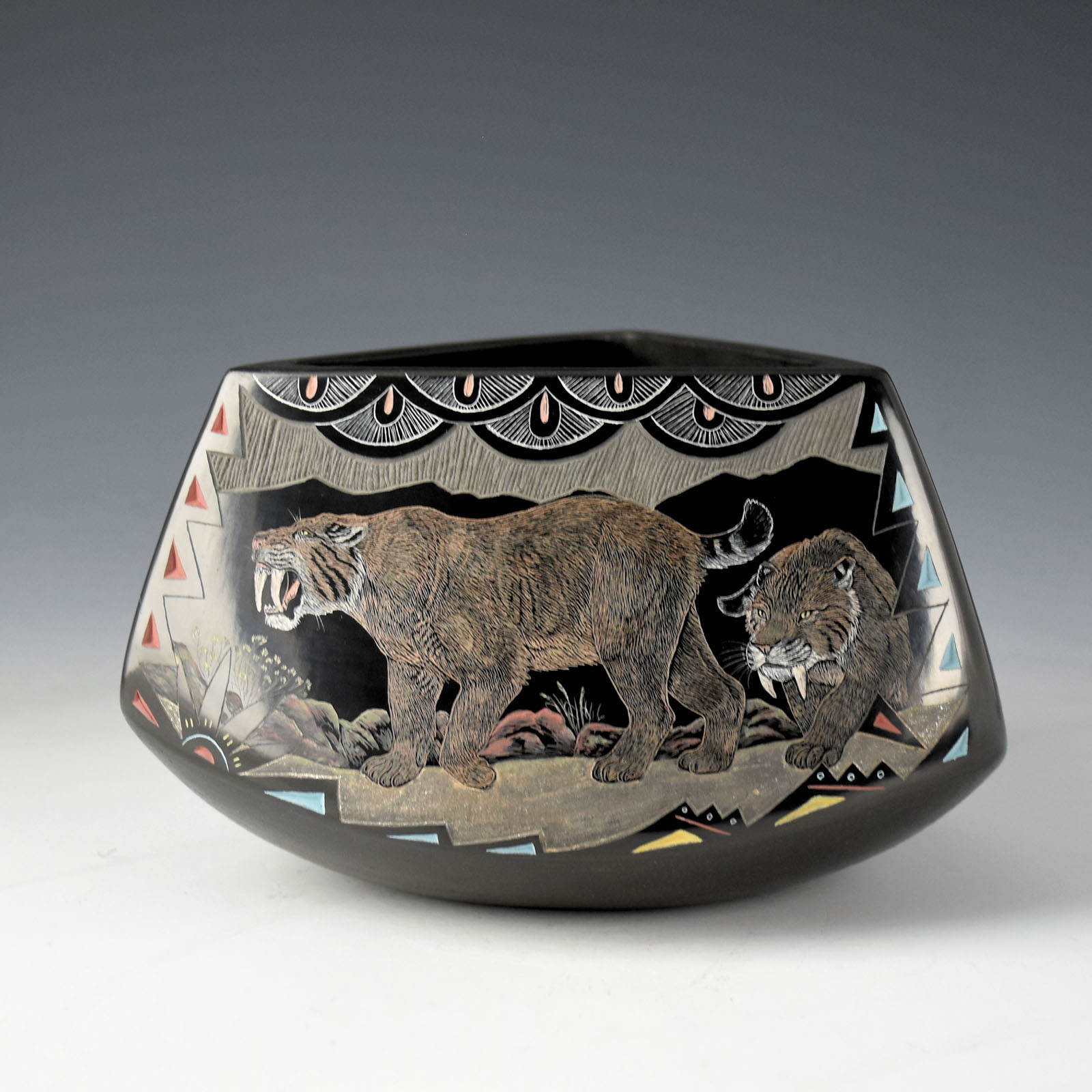
Jennifer Tafoya (Santa Clara Pueblo), Saber Tooth Tiger three-sided jar, native clay, native clay slips.
“I love to draw,” notes Tafoya. “I spend a lot of time drawing on the surface, getting the realism of the animal or bird just right.” She is fearless in venturing beyond the expected animals of the Southwest. Her pottery has included dragons, dinosaurs, insects and just about anything she can see or imagine. One might think this is risky but the more adventurous she is in design, the more detailed and visually complex the figures on her pottery become. Her most sophisticated and detailed artistry often seems to be highlighted in her fantasy or Anthropocene subject matter. It may be that where she can’t reference the actual scales (or feathers) of a dinosaur or the glowing wings of a Phoenix, she can spend the time to dream and create her own world. “I want people to see the small details in my work. At times, fantasy made reality.”
The evolution in detail, color and realism in Jennifer’s work continues unabated each year. “I observe nature when I’m out camping or taking my dog for a walk. I create my own stories in my pottery, and I like to have people figure the pieces out for themselves. Sometimes I’ll even hide small animals in the background and see if anybody ever notices.” Each piece of her etched pottery sets a higher standard for the portrayal of realism, the dreams of fantasy, and the lore of the ancient past made a bit more real in clay.
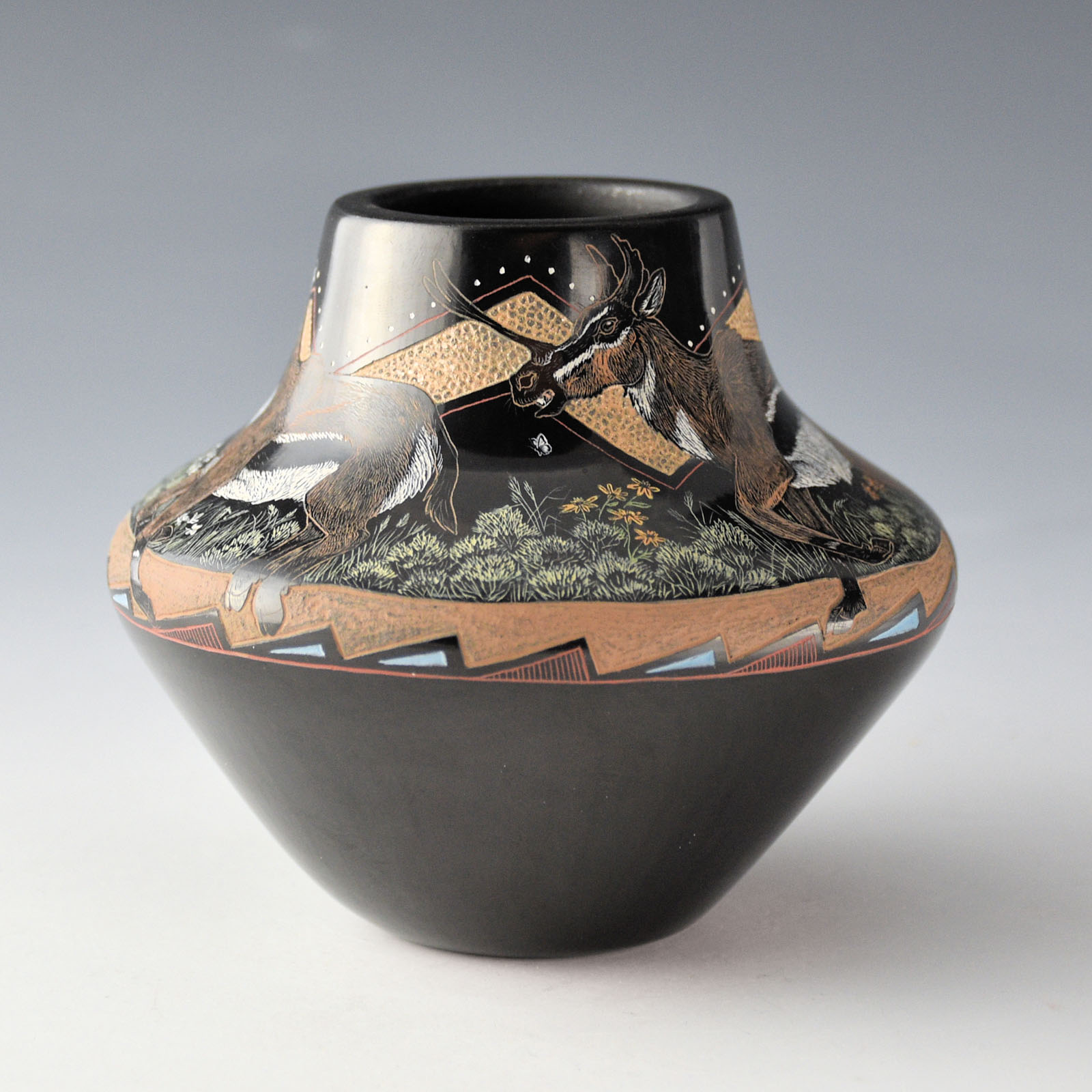
Jennifer Tafoya (Santa Clara Pueblo), Synthetoceras Tricornatus water jar, native clay, native clay slips
The future is closing in on a convergence of Native pottery with the world of contemporary non-Native ceramics. Native pottery came early to the world of fine art, and these four potters have helped lay the groundwork for the next generation of Native potters. Their use of native clay is an important part of their art, keeping it closely tied to pueblo culture, but giving it freedom of expression. From the beautiful and sublime, to commentary that shakes the soul, their voices lead us into the future.
Charles S. King is the author of Spoken Through Clay, Born of Fire, Revolution: Virgil Ortiz, and The Art and Life of Tony Da. He has galleries in Santa Fe, New Mexico, and Scottsdale, Arizona.
Powered by Froala Editor