Carla and Babe Hemlock are married artists from the Kahnawake Mohawk Nation. Despite citizenship, they don’t identify as Canadian or American, but associate just as Mohawk. She describes it by saying, “Our homes in our community are full of old beadwork, our ancestral village was outside of Albany in the Mohawk Valley. Our people moved about three times in about 300 years before settling where we are now.” Their own histories include their own and familial experiences within the Catholic residential schools of Canada and the boarding schools of the United States. Their works together discuss the loss of their own fluency and the reclamation of their language’s fluency through their children. They didn’t want their own children to be without full fluency like they had been subjugated to.
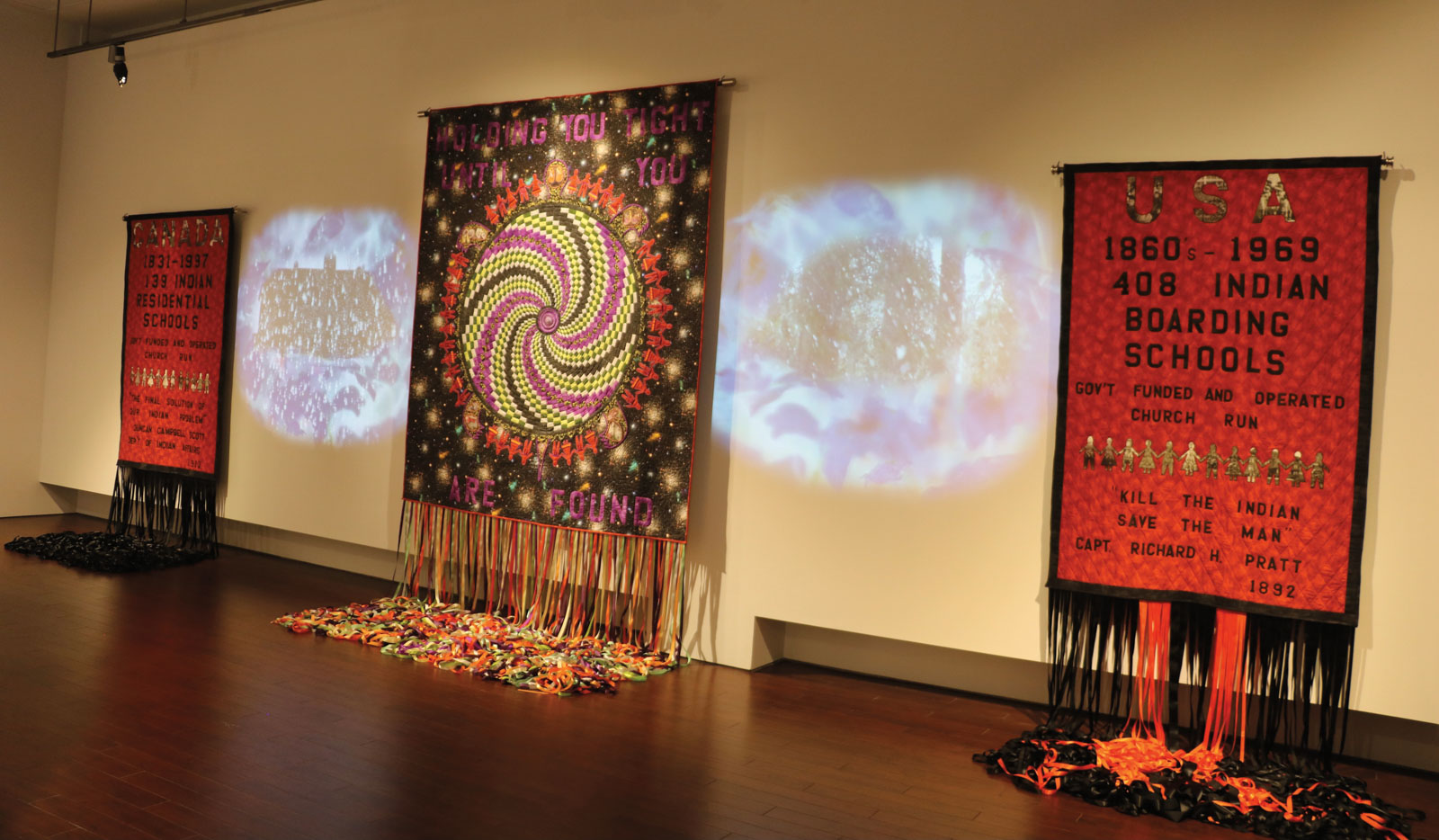
Carla Hemlock (Kahnawake Mohawk Nation) and Raohserahawi Hemlock (Kahnawake Mohawk Nation), In the Arms of the Natural World, 2022, three quilts and two videos.
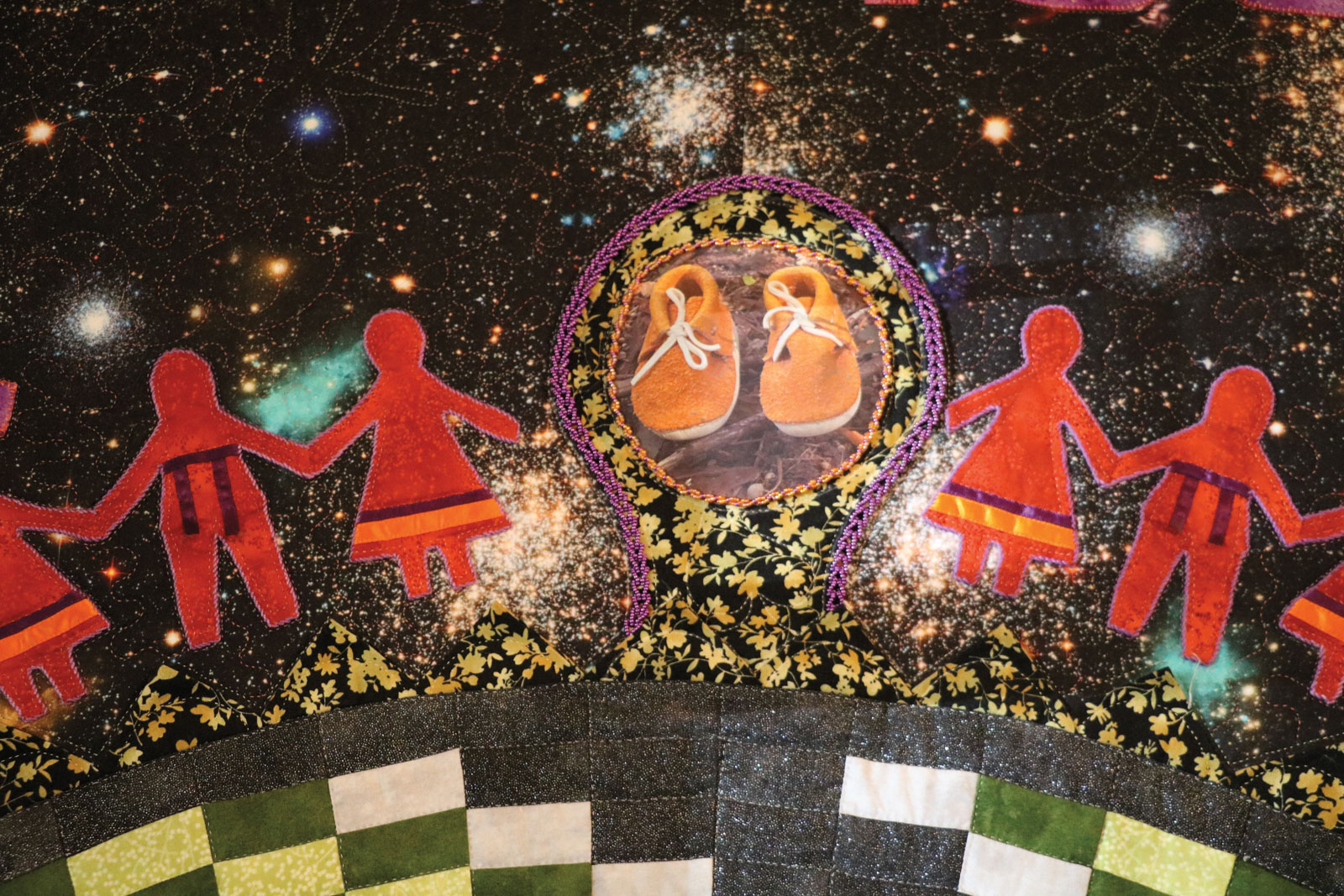
Carla Hemlock (Kahnawake Mohawk Nation) and Raohserahawi Hemlock (Kahnawake Mohawk Nation), In the Arms of the Natural World (detail), 2022, three quilts and two videos.
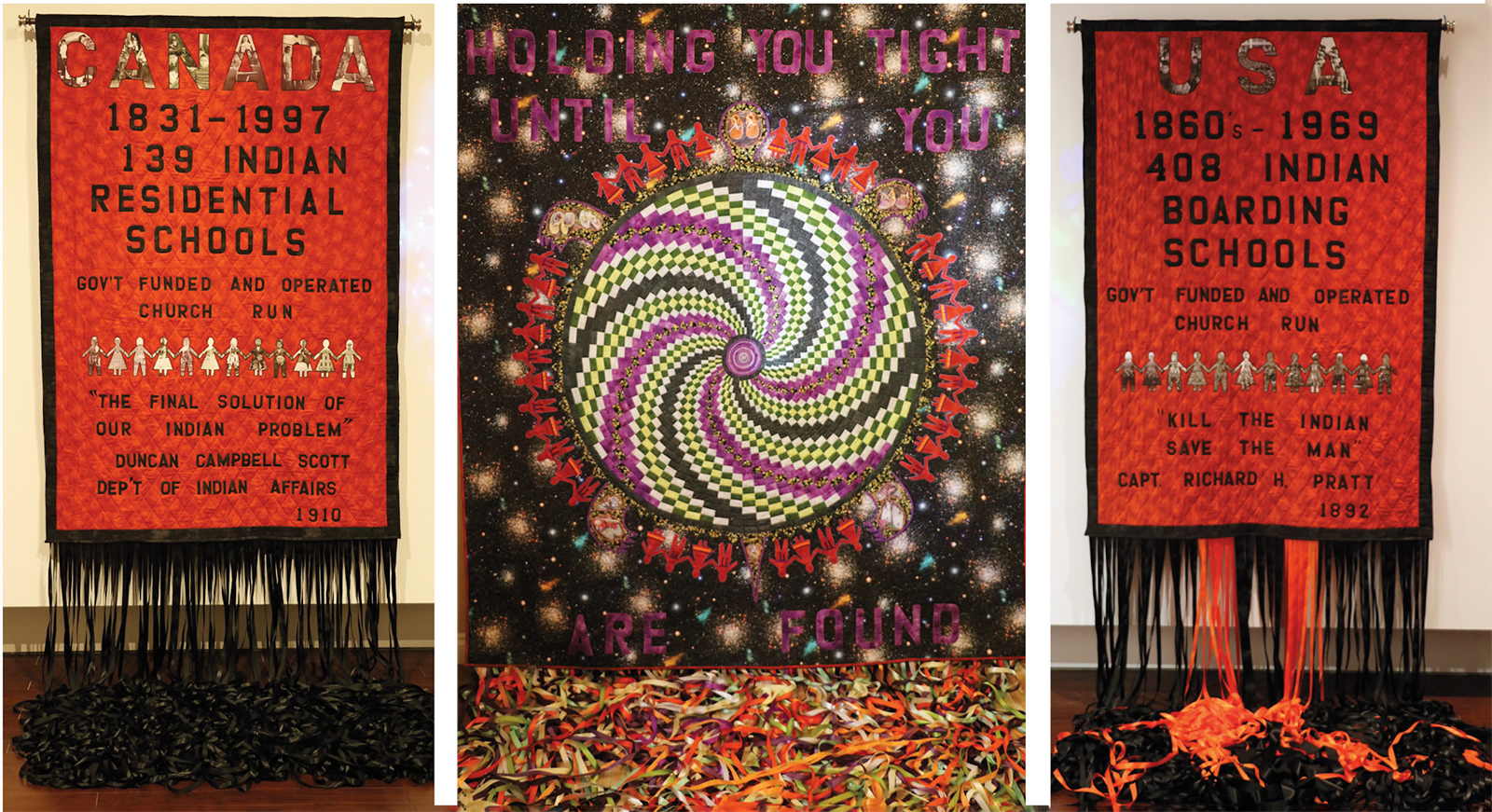
Carla Hemlock (Kahnawake Mohawk Nation) and Raohserahawi Hemlock (Kahnawake Mohawk Nation), In the Arms of the Natural World, 2022, three quilts and two videos.
Carla is a textile and beadwork artist, whereas Babe is most well known for his hand-carved wooden works. At times, their work will either overlap or they will collaborate. Their work beautifully depicts concepts and imagery that can be highly controversial and political in nature. They live close enough to bridge larger ideas between the United States and their home place in Canada. Their work has been shown throughout the world, and Carla’s work was notably included in the landmark exhibition Hearts of Our People, which featured only female First American and Native American artists. Like many artists, their work halted for them during the pandemic. Babe has been doing commission work again recently. Carla reflected on the time: “I’ve always been sewing, mostly for my kids. Making clothes, their traditional clothing, ribbon skirts, baby quilts for baby showers and beading. It all just evolved from there. We started moving into museum work when the National Museum of the American Indian opened in Washington, D.C.
Babe’s work is often about stereotypical Indigenous identity. Babe was about 16 years old when he made his first cradleboard. He experimented and worked until he could create them. Naturally, he then started making them for people in their own community, and then for his own children. He created traditional styles first and then went into contemporary explorations. He goes back and forth between experimenting with new ways while still creating traditional boards. His fine woodworking and painting skills allow him to create beautiful pieces of art with strong symbolism and meaning. Babe is also a fourth-generation Mohawk ironworker, and his father attended Carlisle boarding school. Their family has photos of his father at about 6 years old in uniform at Carlisle boarding school.
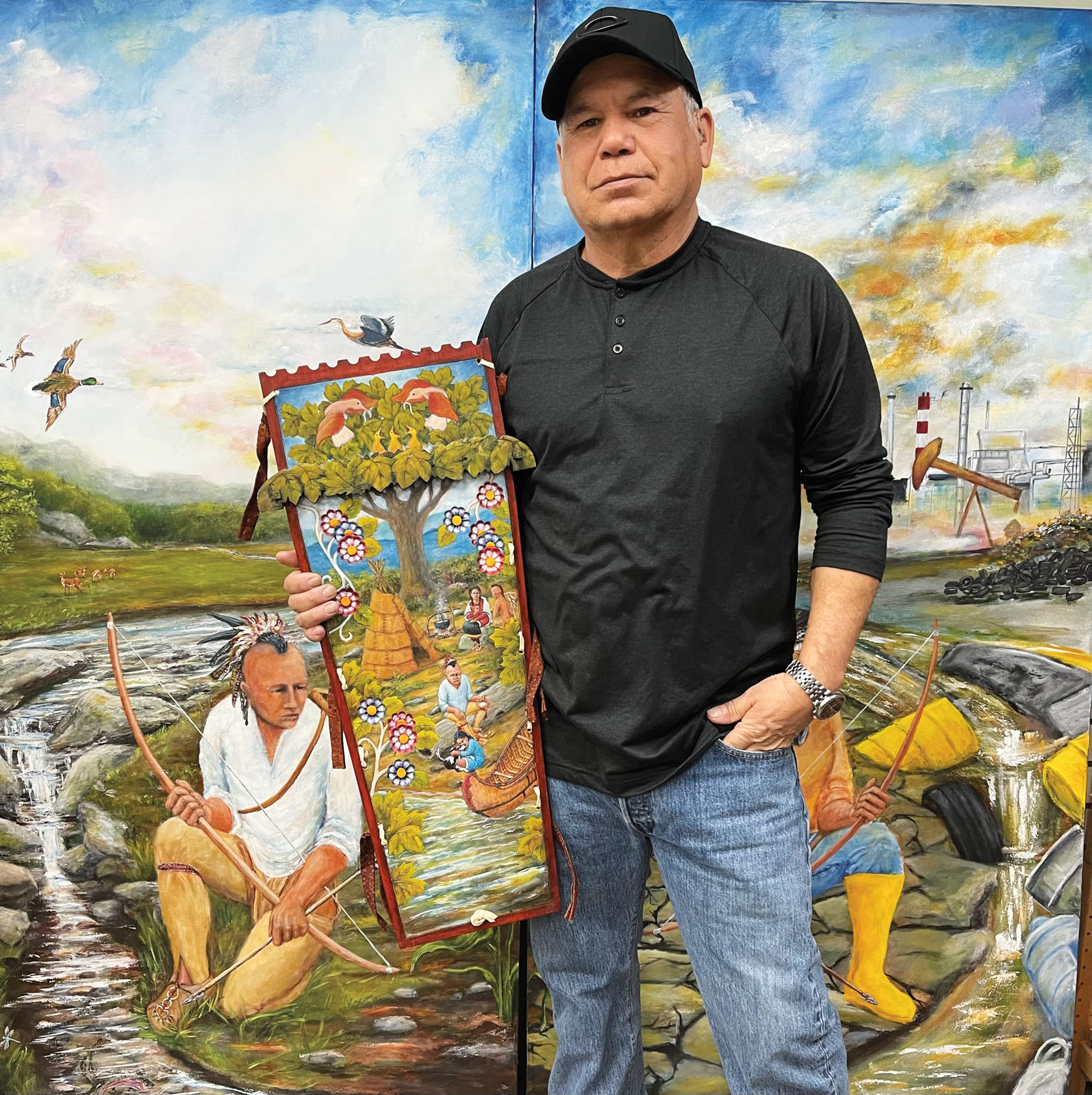
Babe Hemlock with one of his cradleboards.
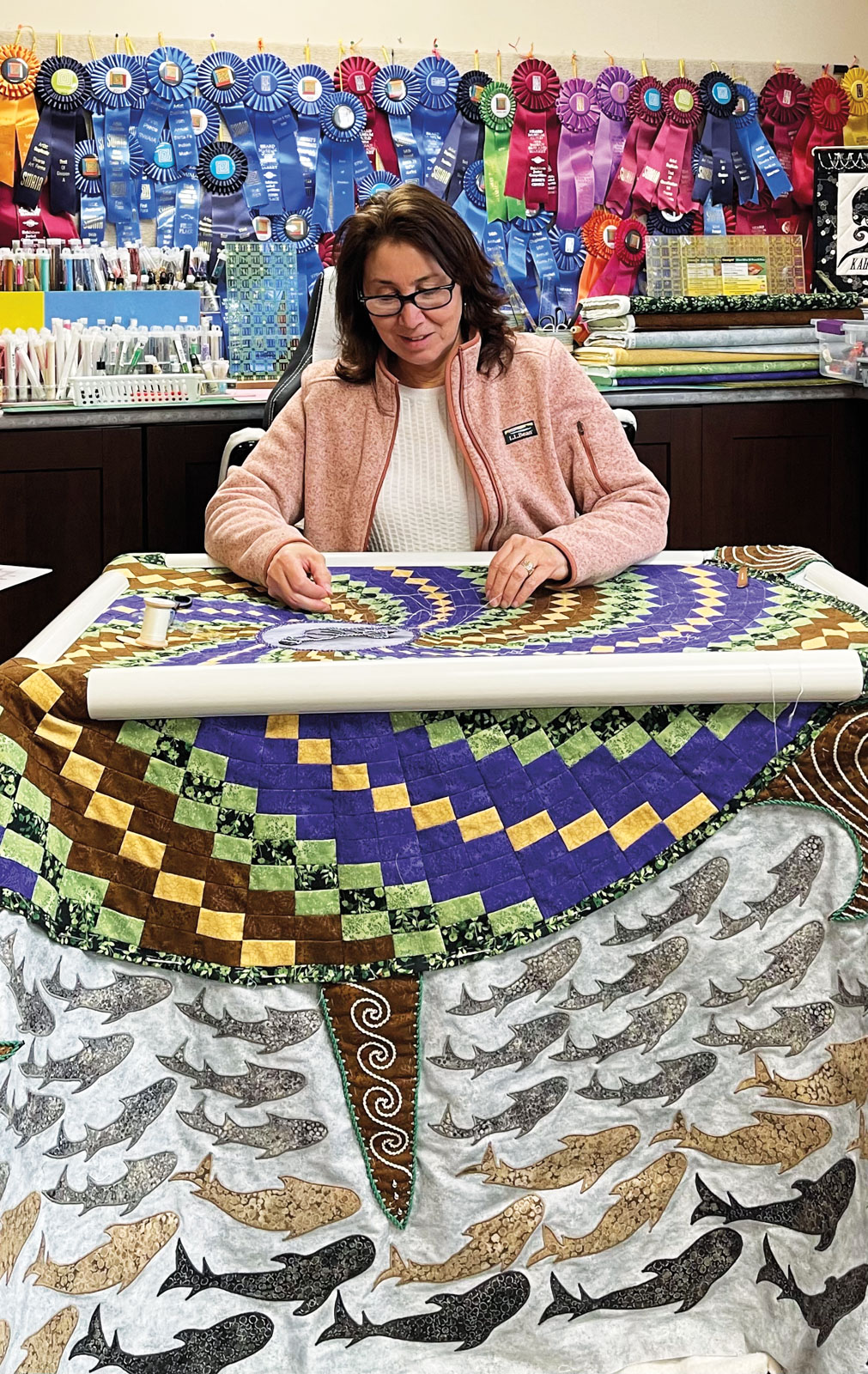
Carla Hemlock working in her studio.
Carla’s work is often described as going far beyond aesthetic, launching into political, social and cultural statements. In the Arms in the Natural World is a multi-disciplinary collaboration piece with textiles and video media with her son. “Most of my work is well known for using a lot of beadwork on my quilts,” she says. She works in the raised Mohawk style of beadwork on cotton fabrics. “Recently though,” she adds, “I’ve been using a lot of ribbon work in my pieces about the residential and boarding school mass graves.” Her quilted work for this piece is in multiple parts, one for Canada, one for the mass graves and one to represent the United States. The 30-foot installation has the quilts suspended and placed along the wall. The film portions by her son, Raohserahawi Hemlock, depict all the regions where the schools existed. He shows the barren land and the unmarked graves—where children lost everything, including their lives, through cultural genocide.
“When you try to extinguish people, that’s genocide. This work is about the genocide against Indigenous peoples in the United States and in Canada. They were unsuccessful in completion, and I’m so thankful some of our ancestors were strong enough to resist to allow us to still be here today,” Carla strongly remarked. She says they were a part of the Catholic-ran Kaperi Indian day schools, but she didn’t stay there overnight. Discussing why she’s not fluent, despite her grandparents and children being fluent, she says, “We don’t fully speak. We were punished for speaking it, but our language was only spoken at home. My generation was very limited in our fluency. We made sure our children were all fluent, and we weren’t going to let that happen to them—to not be able to speak.”
Canadian residential schools were brought to light worldwide with the first mass grave finally being unearthed. “I started in response to May 2021 when 215 First American children were uncovered in unmarked, mass graves at the former Kamloops Indian Residential School in Canada,” Carla says. “That [discovery] would later be followed by more mass grave sites at other residential schools. Like everyone else, I was in shock and felt helpless. I remember telling Babe that I didn’t think I could get through this. I felt like there wasn’t anything I could do. So, I went to my art to help process the atrocity of our child ancestors, and I documented by putting them into quilts.”
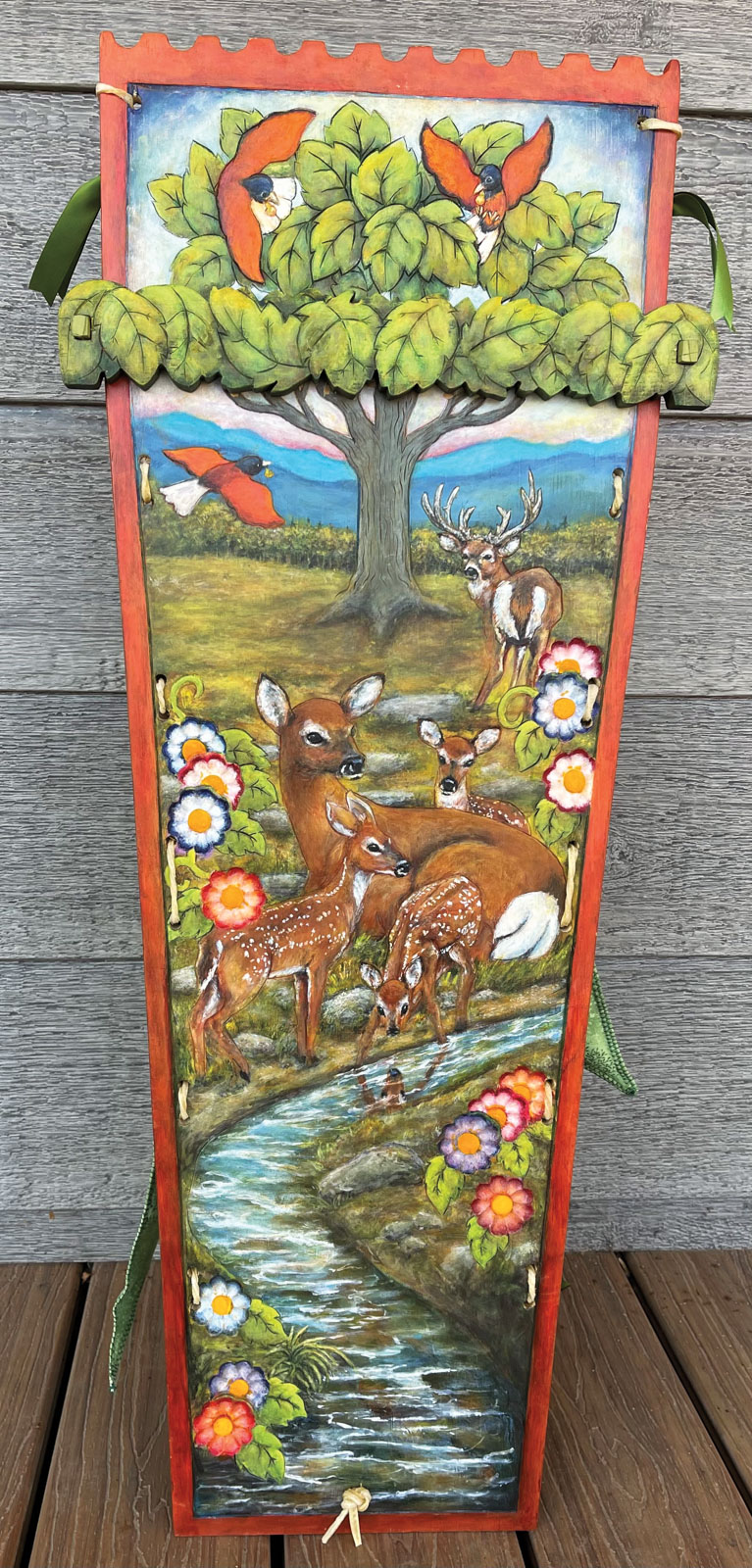
Babe Hemlock (Kahnawake Mohawk Nation), full-size baby cradleboard, 2022, hand-carved and painted, wood, ash and pine, bound by catgut.
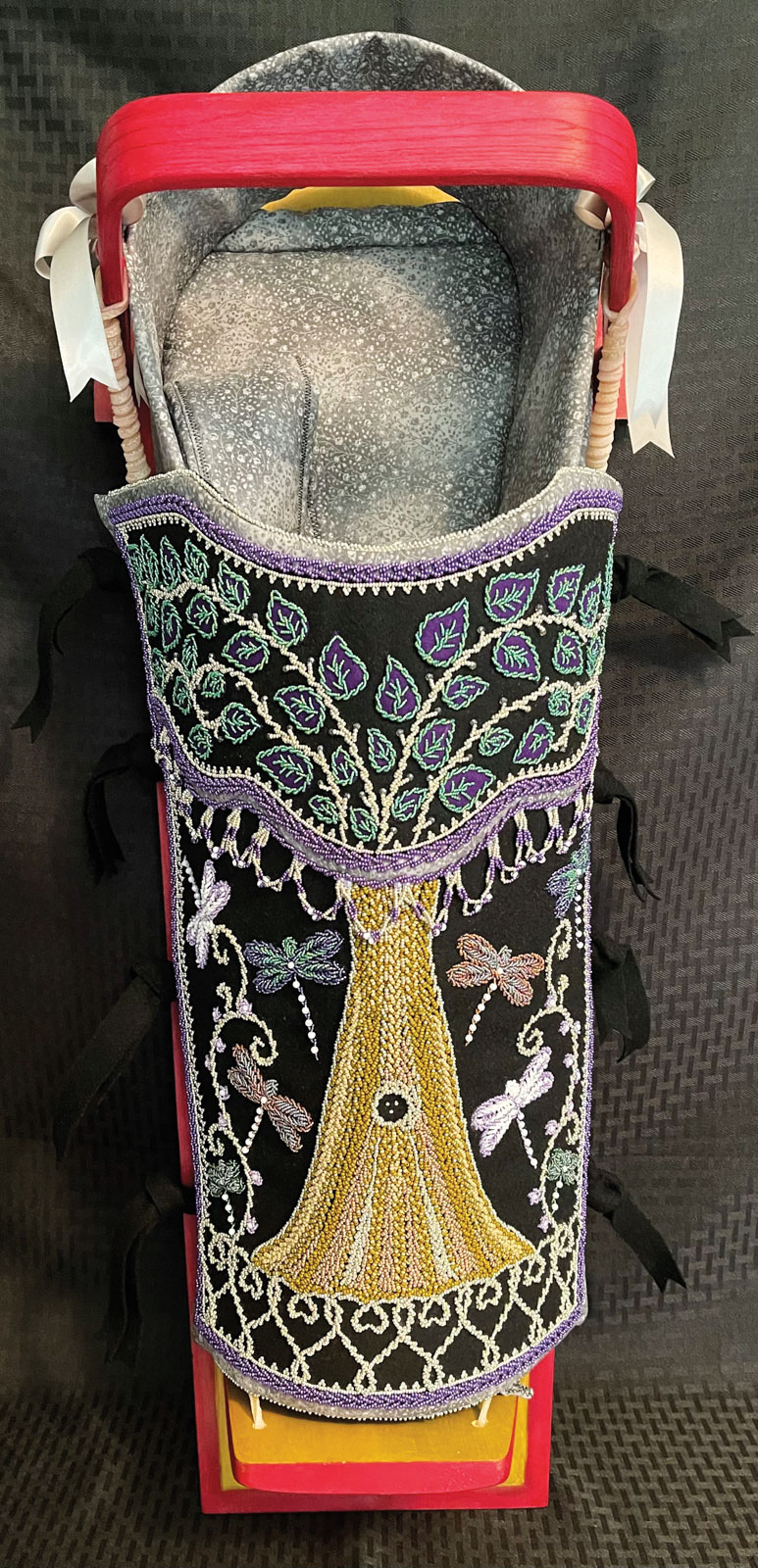
Carla Hemlock (Kahnawake Mohawk Nation), full-size baby cradleboard cover, 2022, wool and glass beads.
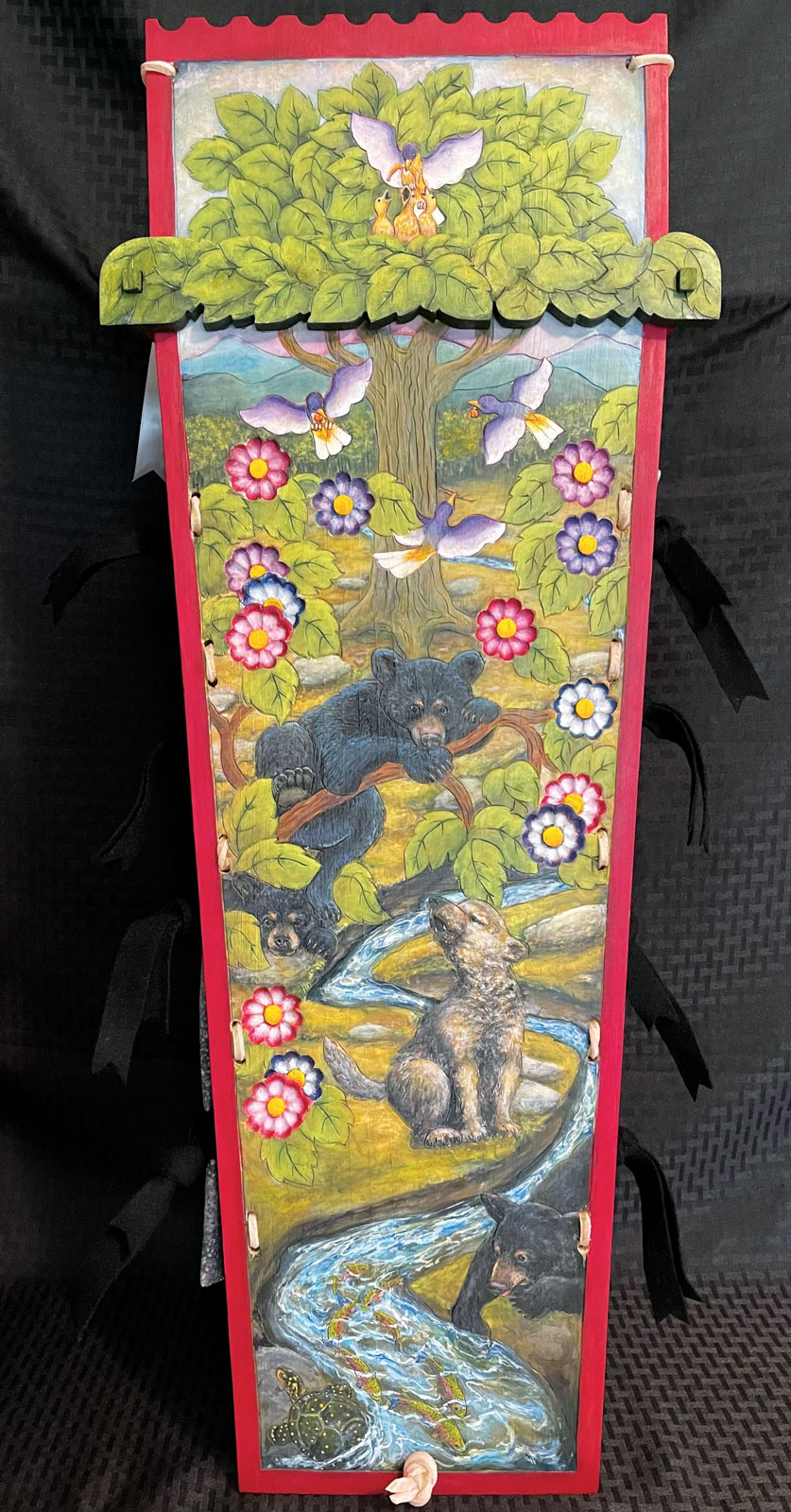
Babe Hemlock (Kahnawake Mohawk Nation), full-size baby cradleboard, 2021, hand-carved and painted, bound by catgut, wood, ash and pine.
She talks about the sadness, anger and disbelief that anyone could murder children, and literally throw them into a mass grave. “It was appalling. Many times, we hear this described by saying our babies were thrown away like they weren’t even human.” The left piece of In the Arms of the Natural World depicts Canada. The middle piece represents the children from the unmarked graves, and the right segment is the United States. The film portions go in between the three panels making the entire piece five parts across. Her son edited the films to be experienced as if the viewer is watching through their own eyes. That personalizes the experience to force people to truly “see” what has been done. She also noted that the United States government has refused to acknowledge their roles in boarding schools, whereas the Canadian government was forced to acknowledge it. She challenges them with the question, “How do you turn a blind eye when 215 children’s bodies were found?”
When it comes to next works, Carla says, “We’ve been doing art markets for the last 13 years. Santa Fe Indian Market and the Heard market were amazing for our reach and opportunities given to us—we’re forever thankful.” Carla is working on a whole new body of work for November 2024, and the couple are ready to keep going in more directions than just art markets. “Larger scale works like the 30-foot wall piece, it won’t be able to fit into a booth,” Carla adds. “We want to expand, try some new ways. Covid really gave us a break to sit back and see a new way to take our work.”
Their strong work will continue to create very important dialogues and to help aid in the return of the children that were illegally taken from Indigenous families.
Kristin Gentry is a citizen of the Choctaw Nation of Oklahoma. They work as a fine artist, writer, curator and educator. They live with their daughter, Jewell Shooting Star, in Oklahoma City, Oklahoma. (www.kreativenative.com)
Powered by Froala Editor