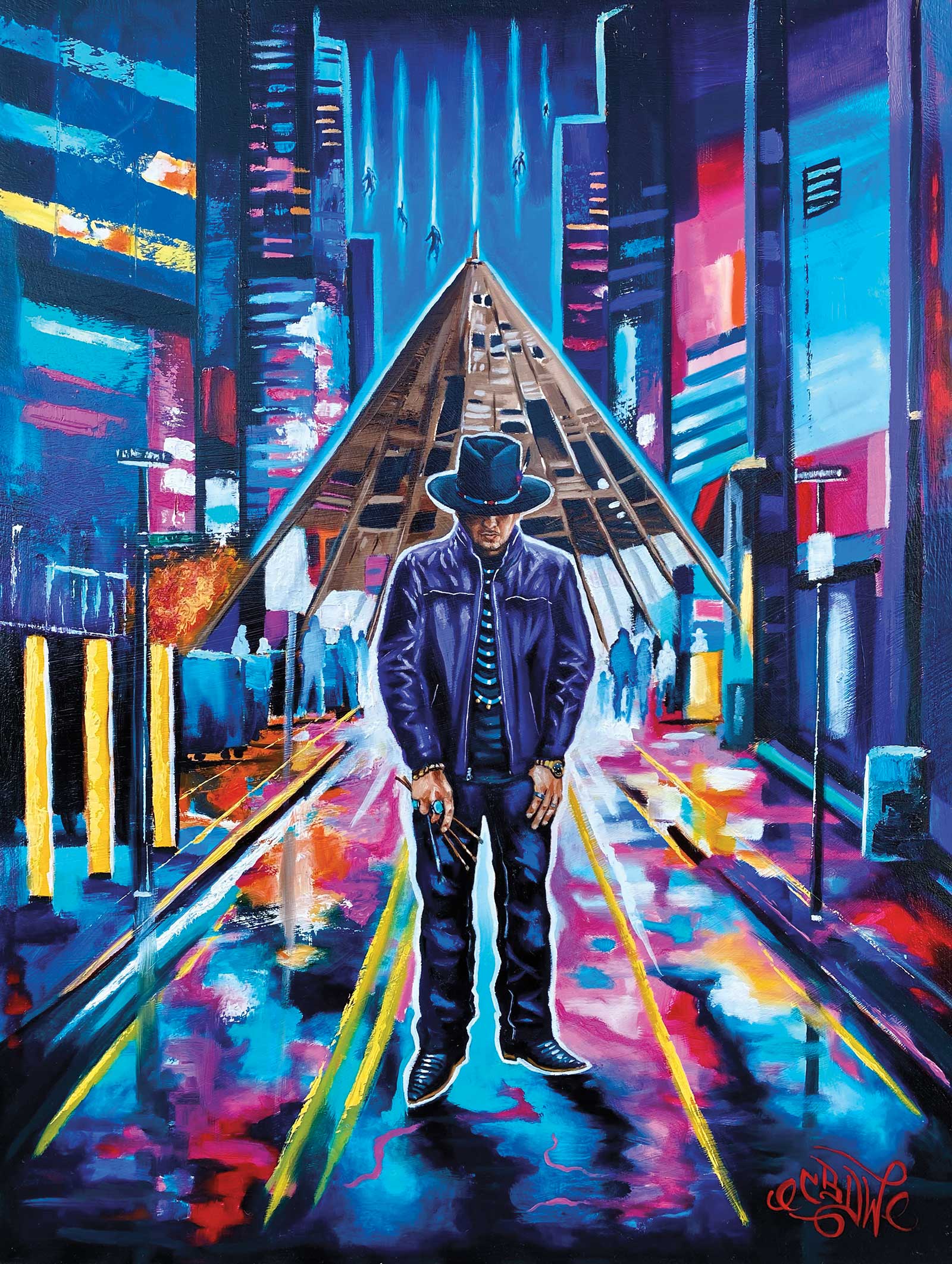
George Alexander, also lovingly nicknamed “Ofuskie” for his Muscogee Creek heritage and hometown near Okfuskee County in Oklahoma, started his artistic journey like so many others—in childhood. While Alexander currently expresses himself in paint, he used drawing as an early outlet for challenging times—like his many visits to the hospital for his dad’s health condition.
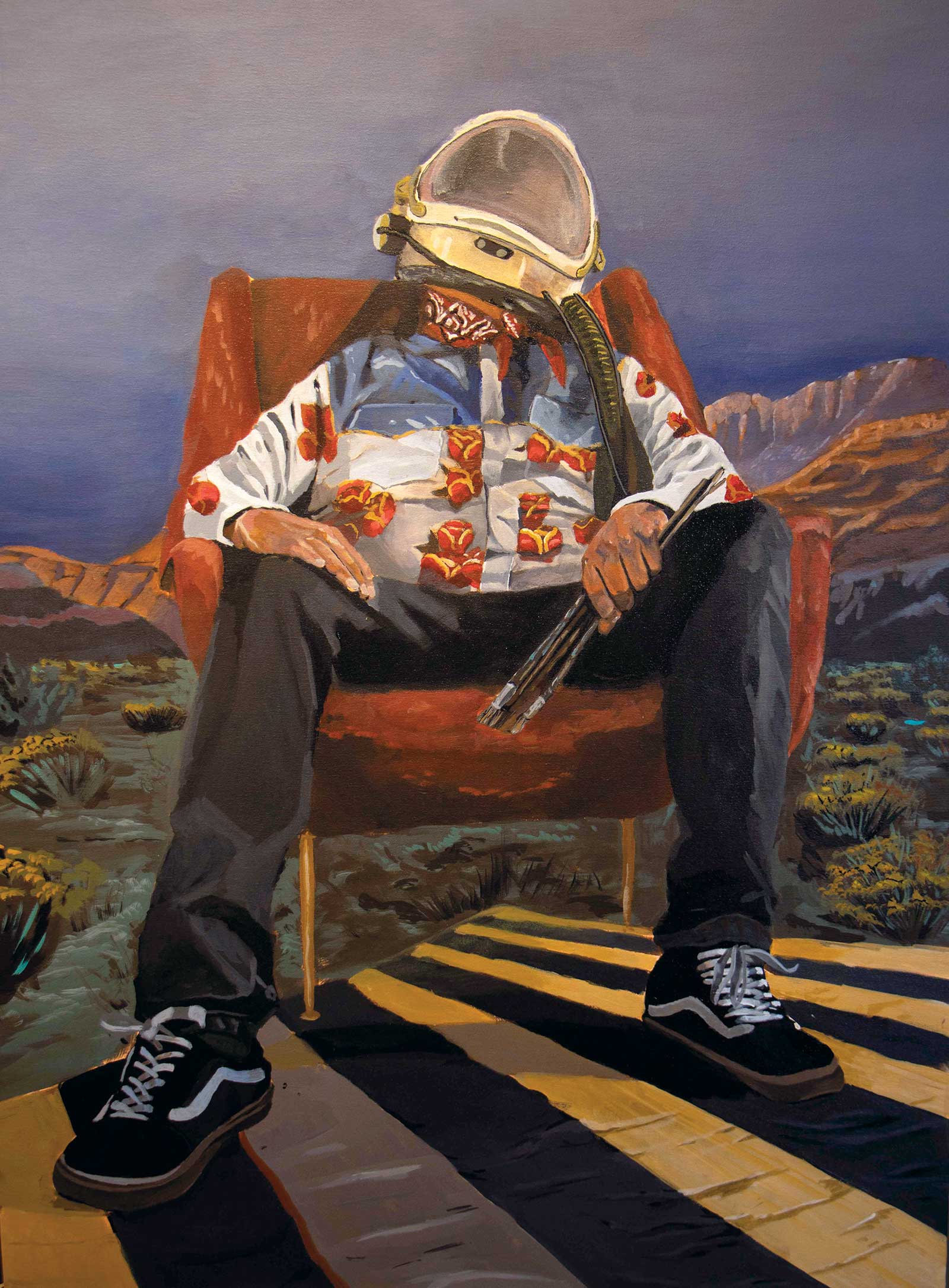
TC Vibes, acrylic on canvas, 40 x 30”
“My mom would often hand me copy paper and pencils to help occupy my time when waiting in the hospital,” the artist explains. “At first, I would draw my favorite cartoon characters and copy from other material. As I got older, I noticed my cousins were drawing as well and we would all sit in church and draw on the bibles or hymnals or really anything that was a piece of paper. My cousins got into graffiti and tattoo design, so I started to gravitate towards that as well.”At 14, Alexander lost both of his parents only months apart, and found himself living with family in Tulsa, Oklahoma. His artistic abilities did not go unnoticed throughout high school and after, when his aunt brought to his attention the prestigious Institute of American Indian Arts (IAIA) as a career furthering option.
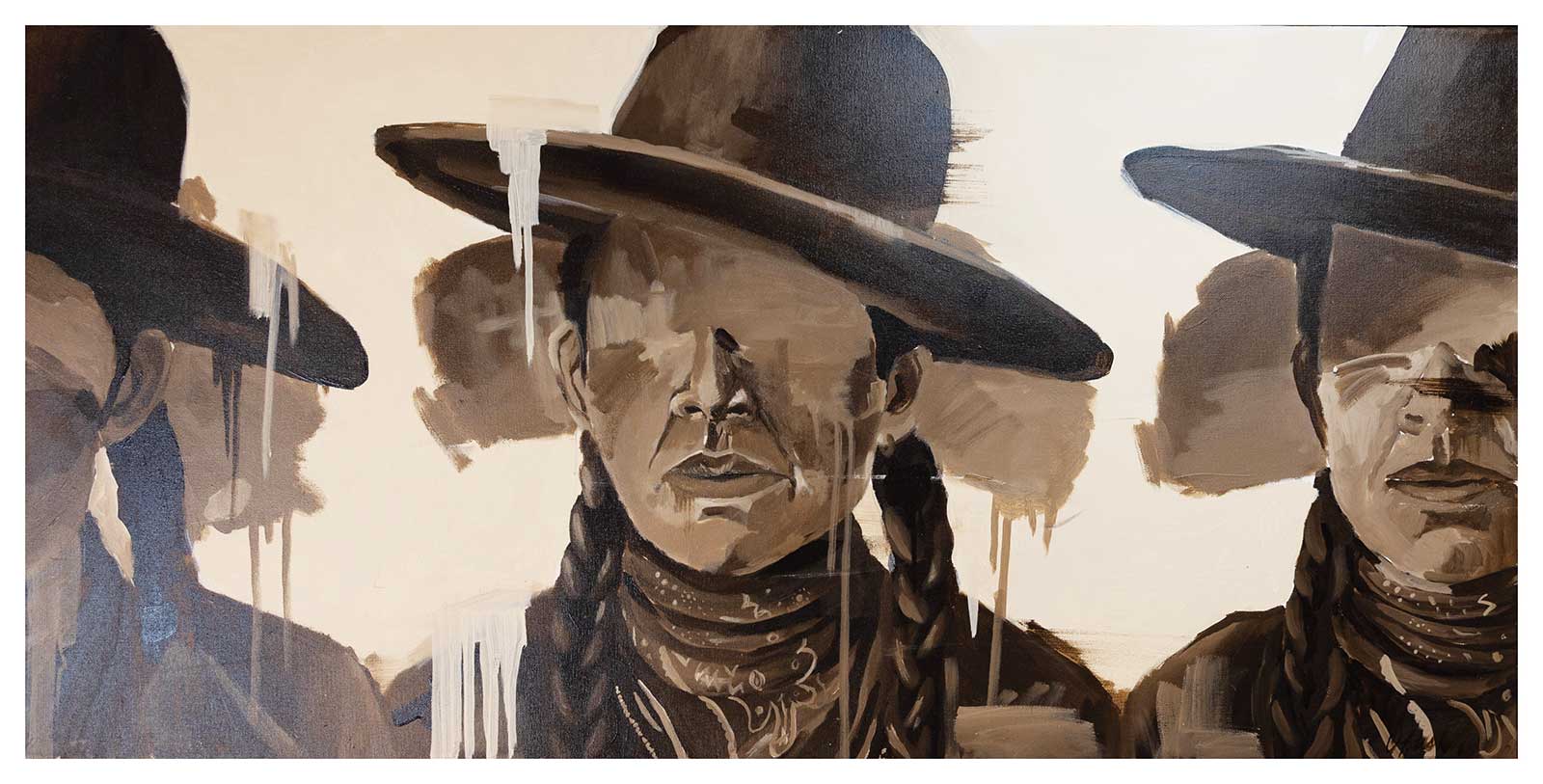
Repetition, acrylic on canvas, 15 x 30”
“At first, I was just there to have a good time and didn’t really focus,” Alexander admits of his early years at IAIA, “but Nocona Burgess came into my studio one day and noticed my paintings. He told me, ‘if you pull your head out of your ass, you could be a decent artist!’” Alexander had other significant influences along the way, including his mentorship with the iconic Tony Abeyta, who took him under his wing as a mentor (and bestowed him with the Ofuskie nickname). He also credits IAIA instructor Jeff Kahm in helping him find his “own path and special way of painting,” Alexander says. “I started to enjoy the [painting] medium more so than drawing. It’s more fast paced and more forgiving...By the time I was 23, painting was the only thing I was doing.”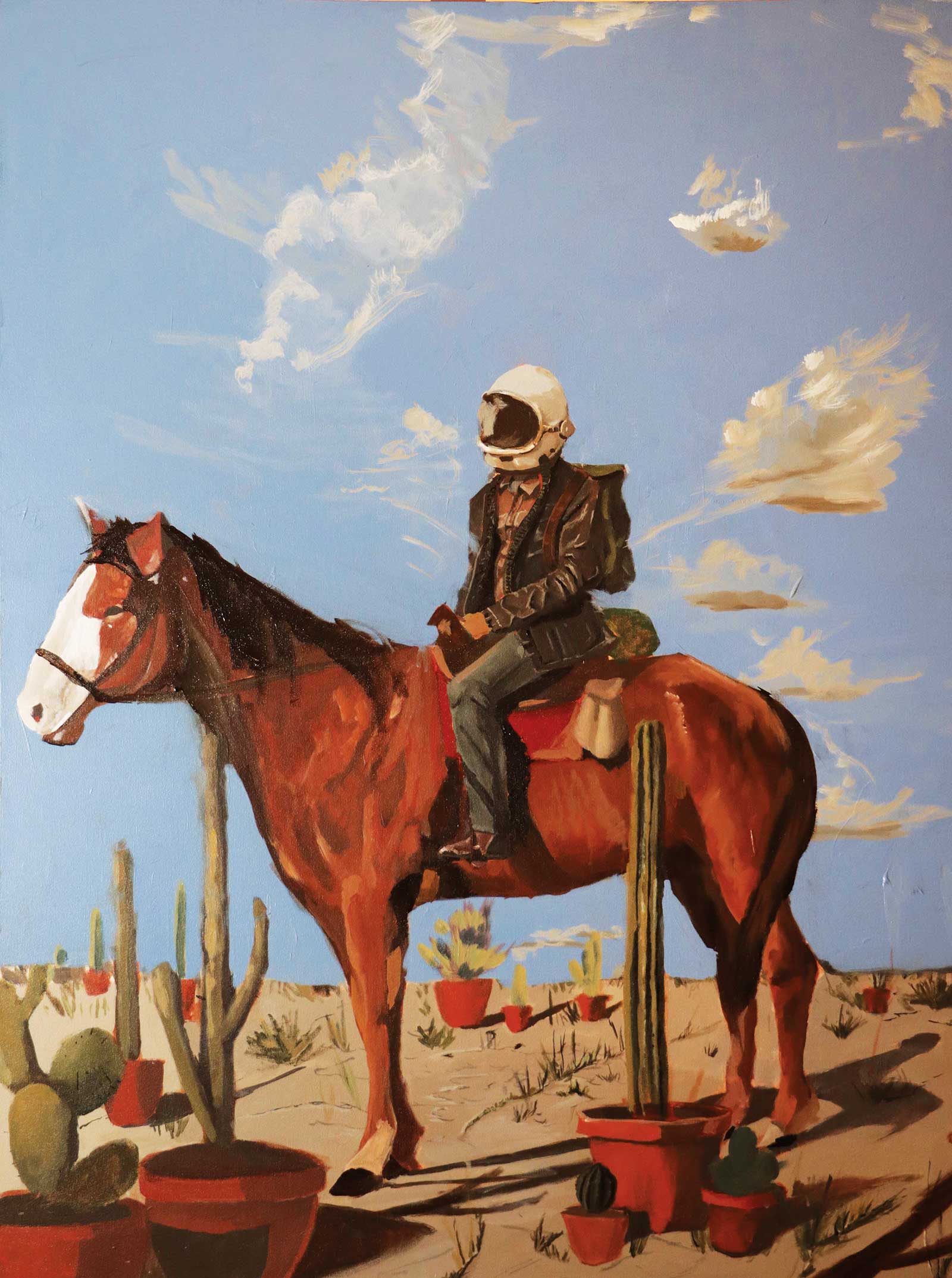
A Horse with No Name, acrylic on canvas, 40 x 30”
In Alexander’s paintings today, we see a fresh, contemporary perspective in the Native art scene, as opposed to some of his peers who stick to depictions that reference their cultural heritage. “I realized I don’t necessarily have to paint things so traditional to me,” he says. “I can paint anything.” He’s developed quite a following for his unique use of an astronaut’s helmet—originally inspired by the movie Interstellar. “At first, there was no conceptual thought behind it other than wanting to show astronauts walking in gravity,” Alexander shares. He even bought a helmet on eBay as source material, and would place it on his friends’ heads with whatever clothes they were wearing.He continues, “I started to see this metaphor emerge of the astronaut perspective brought down to earth. In space, you don’t see race, borders, religion or politics. If we had that perspective on earth, our cultures would be more fluent with one another and wouldn’t see each other as different. I started to [explore] this metaphor of a greater humanity.”
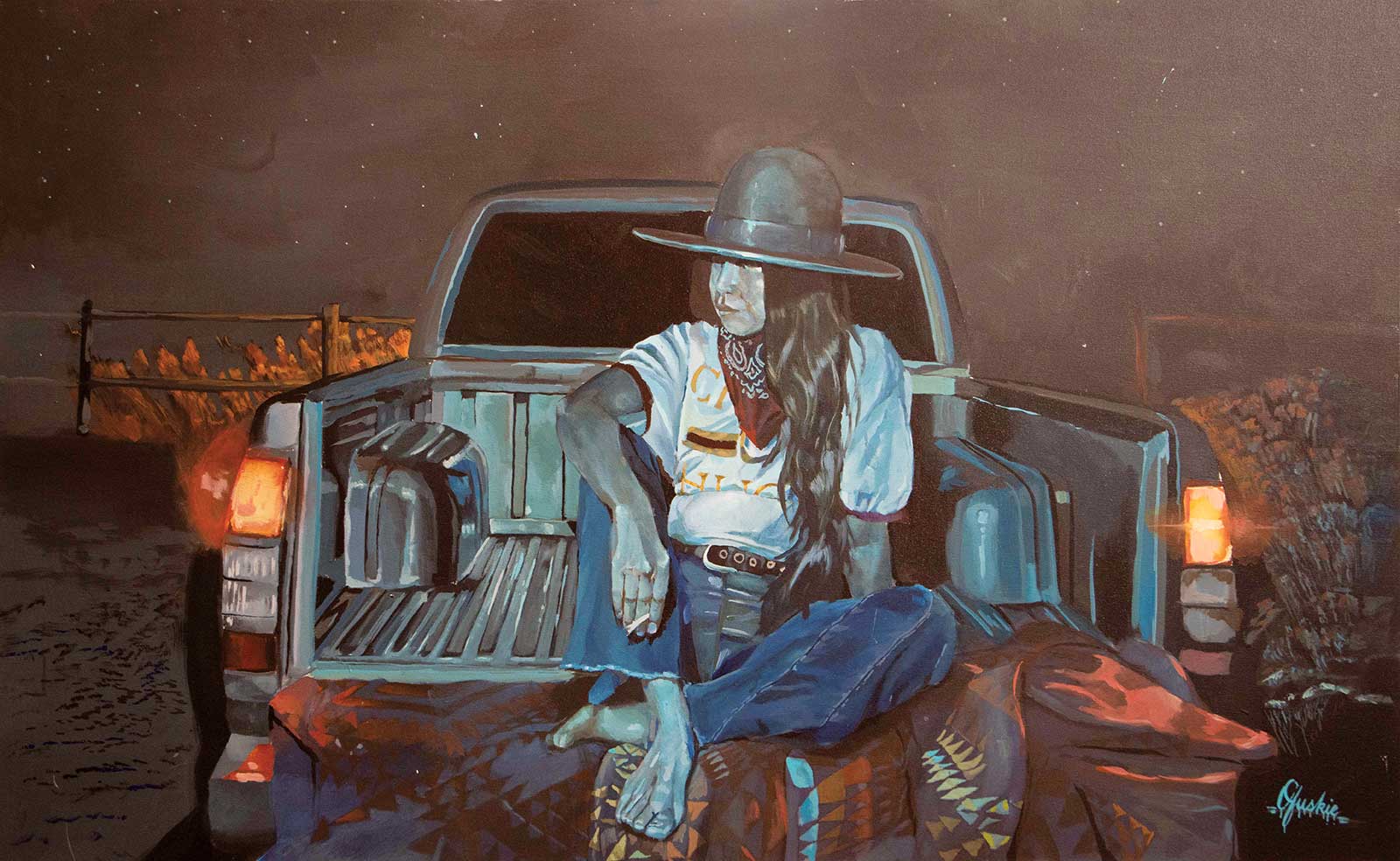
Give Me Some Time, acrylic on canvas, 39 x 59”
This concept is reflected in a series where Alexander depicted figures wearing the helmet, reclined in chairs as if they’re “waiting for us to get our shit together,” he says. In works like TC Vibes, pictured here, we see this reclined figure that’s also paying homage to the great T.C. Cannon, another influence on Alexander—“more so for his radicalness and his way of living,” he remarks. Alexander’s Identity series, seen in works like Repetition, deals with how we identify as humans versus as individuals. “By obscuring the eyes, it allows me to focus on this metaphor; the things that we know and don’t know about ourselves,” he says, suggesting that the more we know about ourselves, we can contribute that back into our communities, “tribal or otherwise.”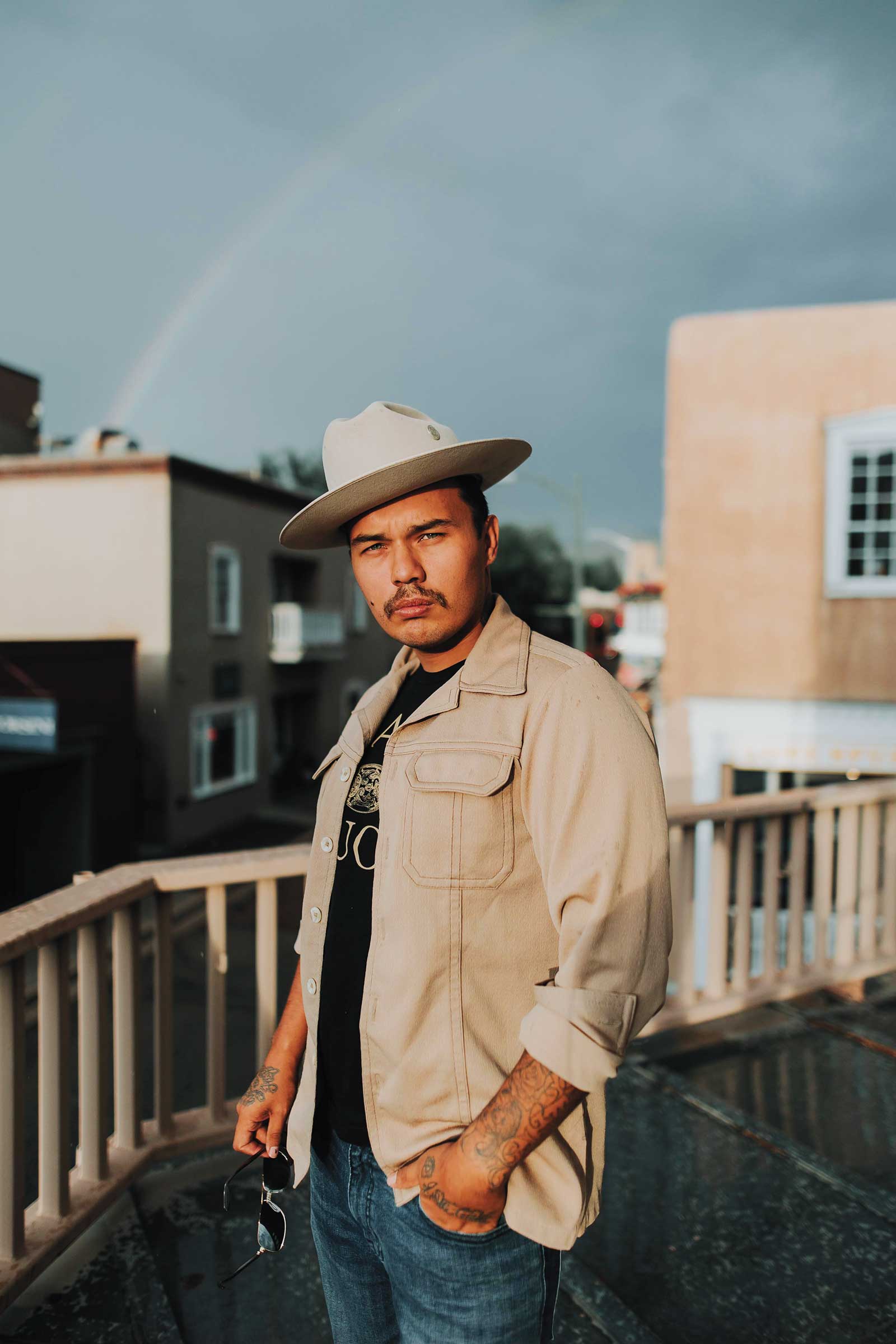
George Alexander portrait. Photo by One Trip Media.
In his recent work, Alexander paints helmets on horses, “representing this timeless journey of humanity trying to find collectiveness,” he shares. “Seeing each other as human beings as opposed to seeing race, religion or politics. The moment it hinders our relationship, we lose our perspective as humans; we see people as labels.”You can follow Alexander as he heads to the Muscogee Art Market on April 23, Santa Fe Indian Market this August, along with many “open studios” the artist hosts at his studio in downtown Santa Fe, New Mexico.
See More
www.ofuskie.com
Artist Spotlights: Dive deeper into the genre with these established artists
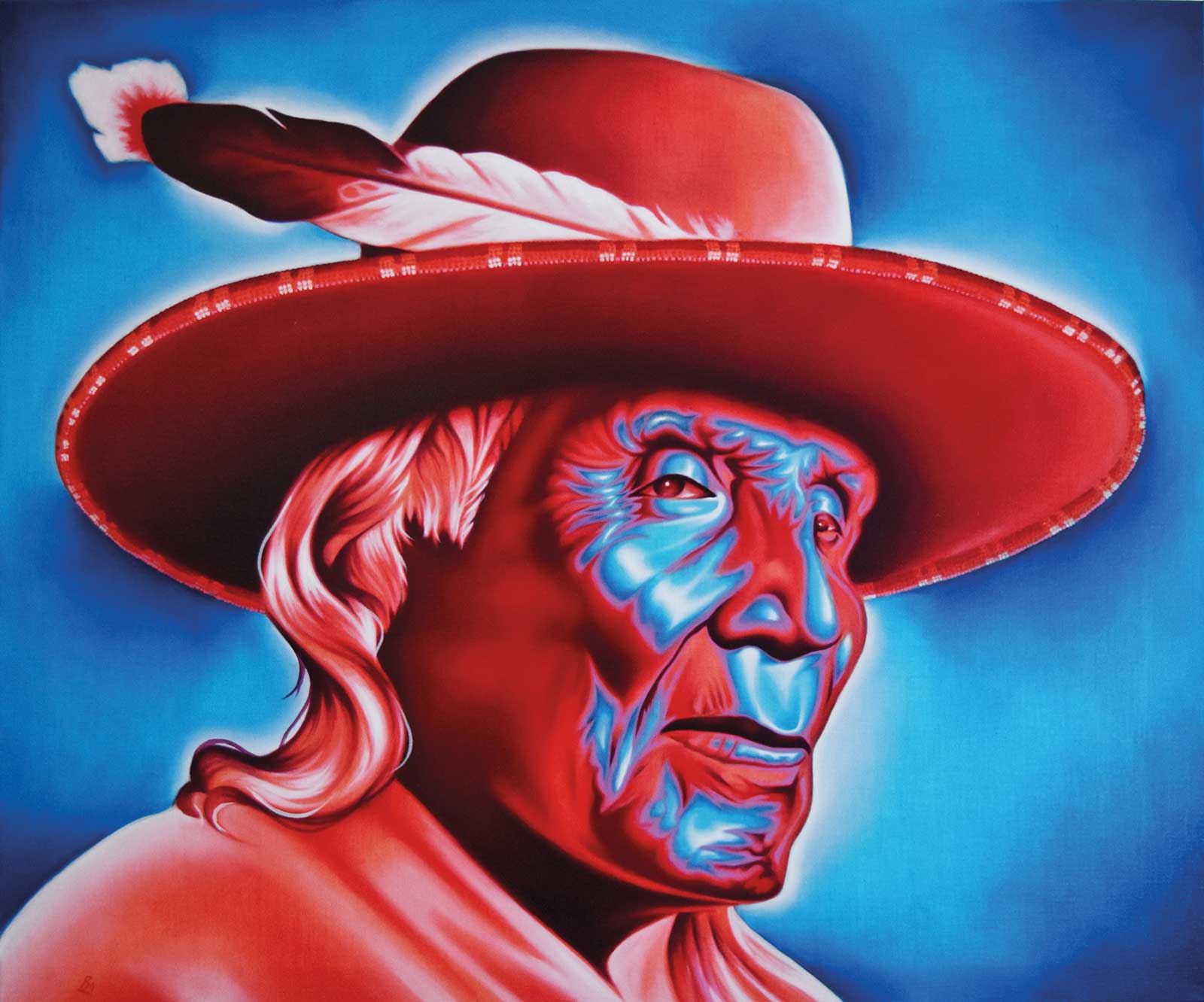
Robert Martinez (Northern Arapaho/Chicano)
www.martinezartdesign.com

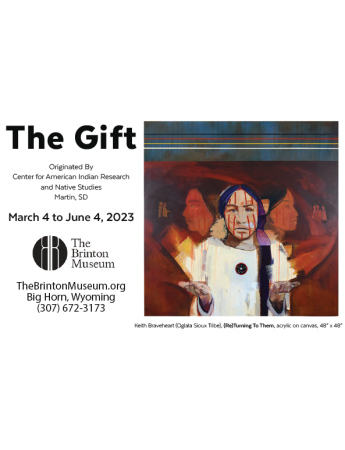
Coming from a mixed heritage influences everything in Robert Martinez’s art, ranging from the materials, to the techniques, to the concept. “The imagery I use often fuses ideas from the past and present,” he shares. “My style of painting combines contemporary airbrushed acrylic and classic oil techniques in vibrant hues, and is in response to the old black and white photos of Indigenous people.” These bold, colorful paintings set Martinez apart. His paintings and drawings have been shown across the Nation and have garnered noted acclaim. Achievements include The 2022 150th Yellowstone National Park Commemoration Poster Artist; the 2022 Capitol Governors Purchase Award, Cheyenne Wyoming; as well as works included in the Smithsonian National Museum of the American Indian and the permanent collection of the Brinton Museum, among others.
Karen Clarkson (Choctaw)
www.clarksonart.com
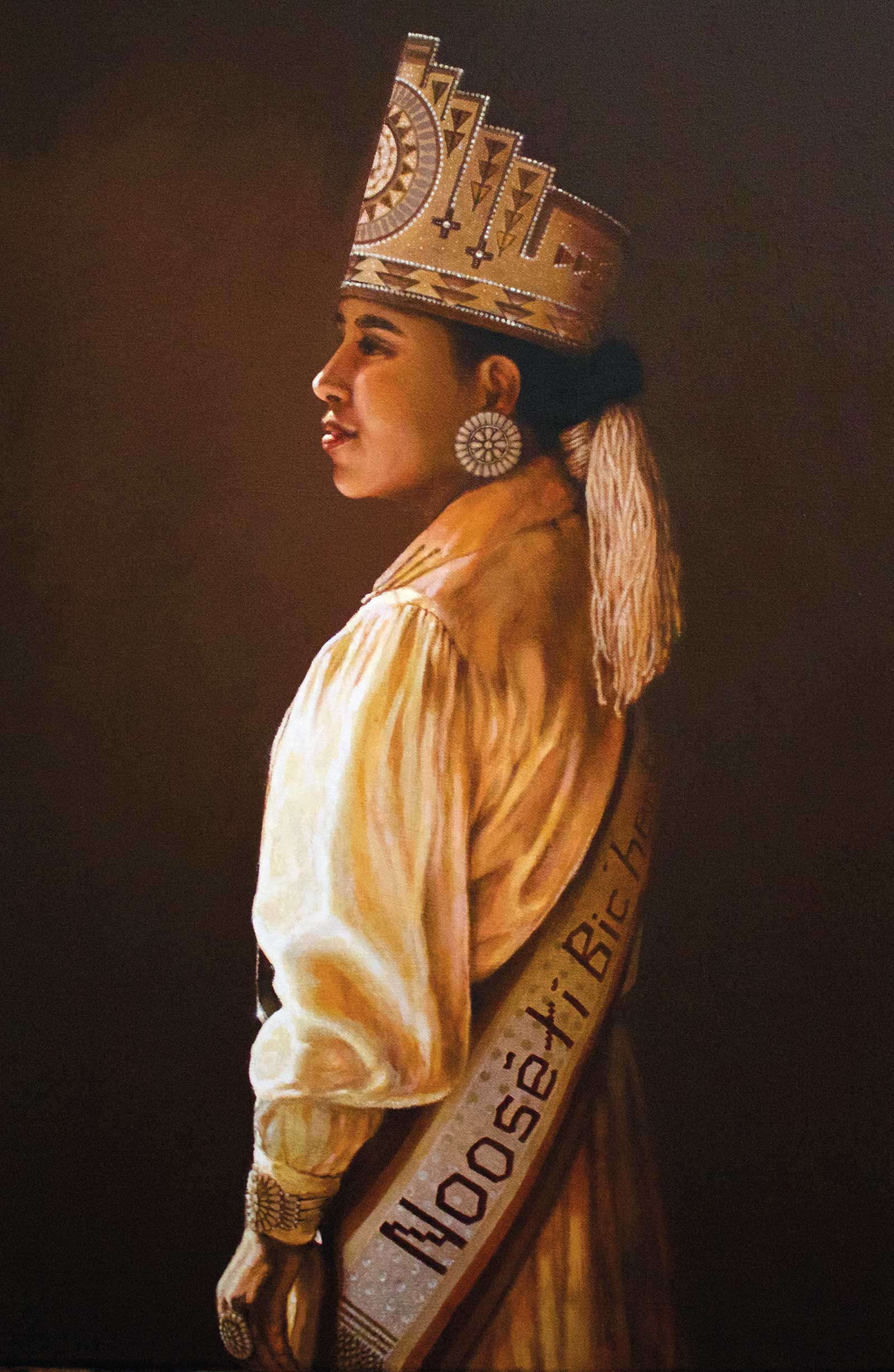
Karen Clarkson is a Choctaw artist rooted in her desire to capture the beauty and strength of Indigenous people. Celebrated for her portraits, she has been featured in many notable venues. Most recently, her art was on the cover of Native American Art magazine’s July/August Santa Fe Indian Market 100th anniversary issue. As an artist, Clarkson is completely self-taught and loves to mix contemporary and traditional elements. Although published extensively on technique, she is proudest of her cover art contribution to the 2022 Choctaw Nation’s Memory Keepers book. Additionally, her watercolor ledger series A Choctaw Story of Land and Blood has achieved national success. Currently, Clarkson is working at home on a painting of a young Diné woman (seen here). You can visit and/or purchase her art at the Heard Museum in Phoenix, Pottery of the Southwest on Canyon Road in Santa Fe or digitally on her website.
Carlin’s oil paint is poetry—an expression of authentic narratives, imperative to where he lives, blended with energetic pigments, reflecting experiences of his ancestors and relatives. “I stay true to self and true to form on every level because it embodies the essence of my existence from the perspective of my people,” he says. “The passion behind my purpose is wielding the power to inspire and motivate through the context of creation to help those actualize aspirations—giving viewers a glimpse into that ‘reservation window’ where I come from. This is the realness. I’m showing people a side of life that is often ignored and neglected because it needs to be heard and seen. I do this out of love and dedication to represent my community and be their voice, to tell their story in a way nobody has done it before.” You can find Carlin’s work at this year’s Heard Museum Indian Market, where he won first place in the Best of Class Division II for 2D art in 2022.
Powered by Froala Editor