There is something familiar and comforting when witnessing Lehuauakea and Ian Kuali‘i’s artwork. Both are remarkable individual artists whose work has been transformative for Kānaka Maoli (Native Hawaiian) representation within the Native art worlds. Together, as life partners, they’ve continued to inspire and support one another. But there is also a conversation between their works; past, present and future, across generations of knowledge and geographies their work has spoken not only to one another but for one another—and it continues to speak for those who need to hear it. Beneath the calming aesthetics of both artists’ work, it is the natural fibers that speak volumes; as Lehuauakea says, “it is the fibers that connect us.”
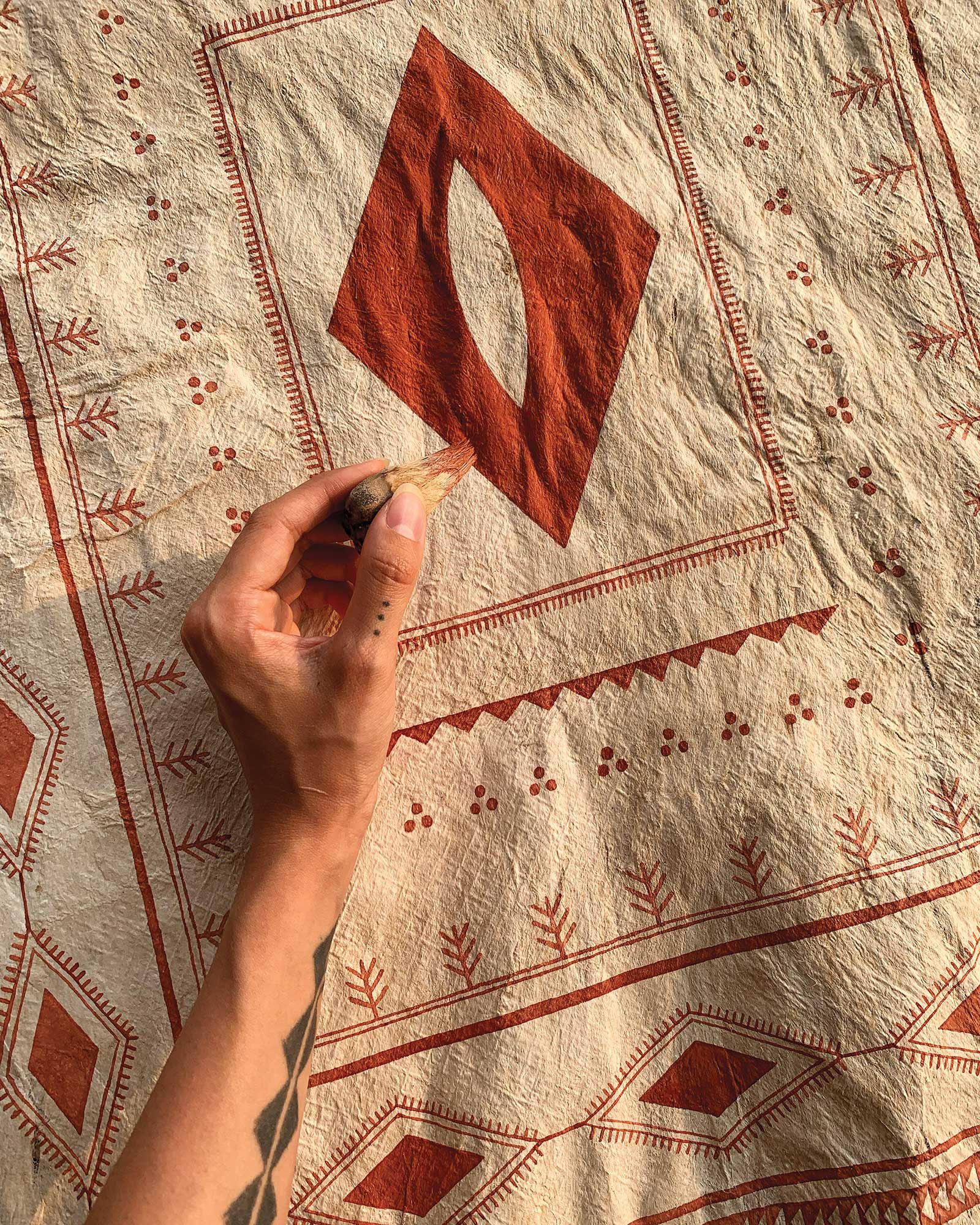
Lehuauakea (Kanaka Maoli), O Haumea Kino Paha‘oha‘o, red ochre pigment on kapa, 27 x 32”
To understand the significance of these Kānaka artists, both emphasize the Hawaiian Renaissance as a pivotal moment that has shaped their work. During the 1960s to 1970s, Lehuauakea explains there was a “renewed sense of Hawaiian identity and reclamation” due to the resurgence of many Kānaka cultural practices. Both Lehuauakea and Ian explain this history is important to include because of the genealogy, “from a lineal sense but also culturally.” Meaning, for Indigenous artists that are practicing and living in a contemporary western world, to know who, when, how, and all of the in-between details that give you the gift to create art right-in-this-moment, it is about respect. These Kānaka individuals include Puanani Van Dorpe, who is considered the primary practitioner who helped revitalize kapa making. Puanani’s efforts went on to inspire other kapa masters like Wesley Sen, Dalani Tanahy, Bernice Akamine, Verna Takashima, Maile Andrade, Sabra Kauka, along with many others. Other key Hawaiian Renaissance respects include Ka Lāhui Hawai‘i under Mililani Trask, her sister Haunani-Kay Trask, former state senator Kalani English, Sam Ka’ai (master carver, early Hōkūle’a voyager, member of the Council of Kūpuna, and helped re-establish the Hale Mua/men’s house), Thelma Kahaiali’i Ka’awaloa (member of the Council of Kūpuna and involved with the Pu’ukoholā Heiau re-dedication) and Kumu John Keolamaka’āinana Lake. All of these figures, including others, have worked tirelessly to strengthen Kānaka cultural practices and political sovereignty—engaging with Kānaka artists means engaging with these fundamental histories because these individuals have created the tools for Kānaka arts and cultural practices.
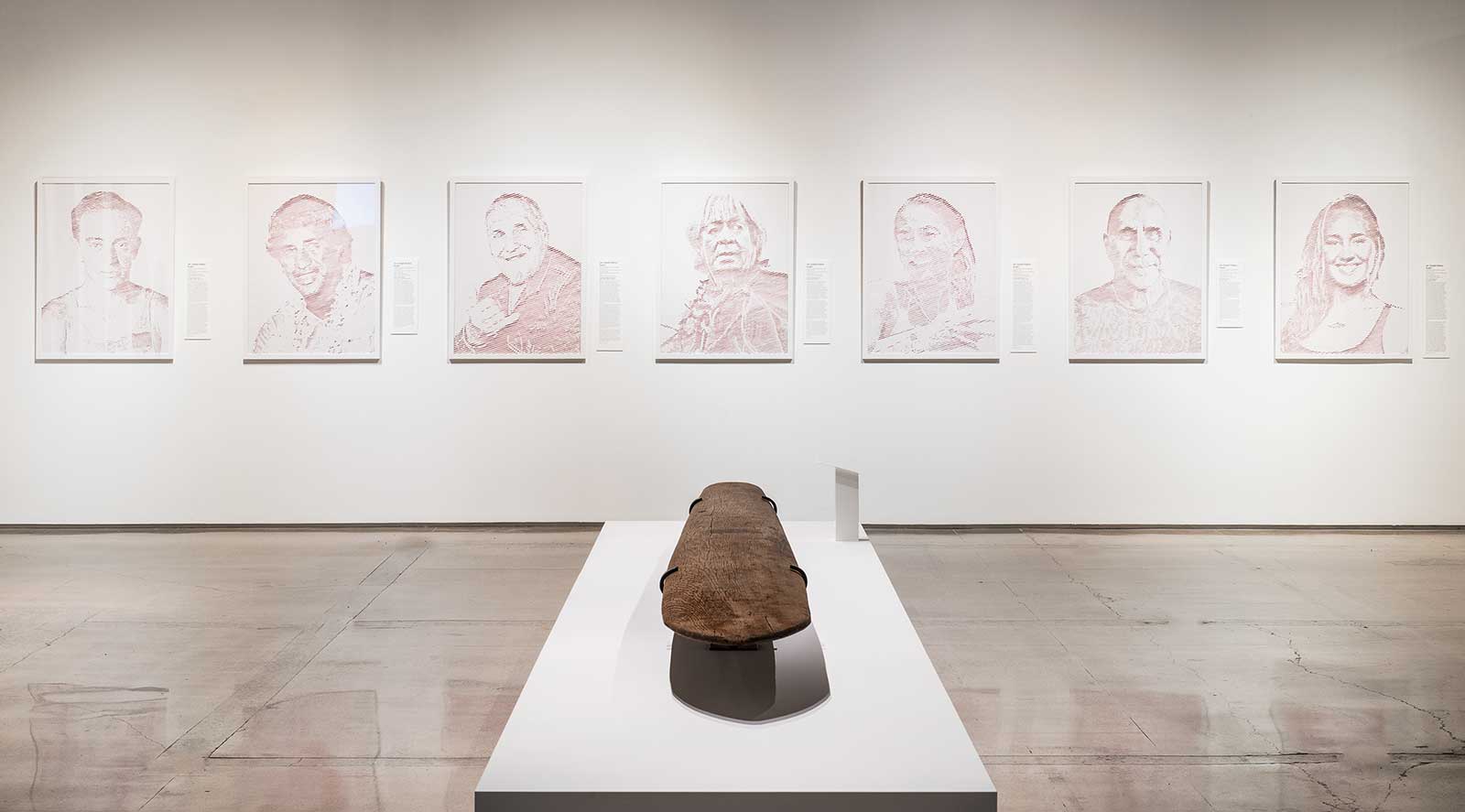
Ian Kuali‘i (Kanaka Maoli/Mescalero Apache), Kai He‘enalu Ho‘ilina (The Ones Who are the Legacy of Surfing). Installation view from He‘e Nalu: The Art and Legacy of Hawaiian Surfing, Heard Museum, Phoenix, AZ. Photo courtesy of Craig Smith, Heard Museum.
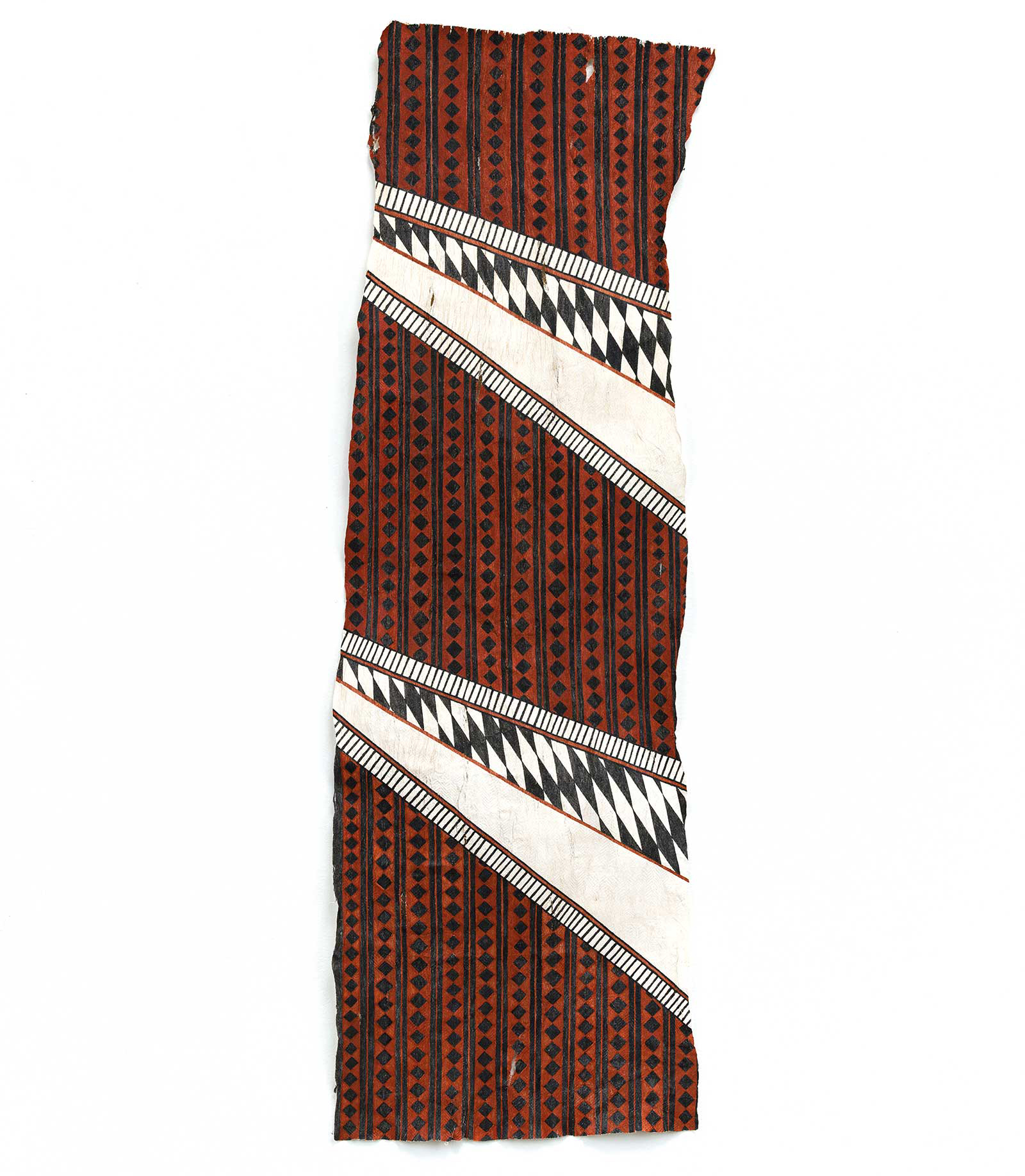
Lehuauakea (Kanaka Maoli), Kānekauilanuimakehaikalani, earth pigment and wildfire charcoal on kapa, 32 x 10”. Image credit: Mario Gallucci.
Lehuauakea (they/them) is a mixed-Kanaka kapa maker. Kapa, which is a rich traditional art form for Kānaka Maoli, is a traditional barkcloth, most commonly made from wauke (paper mulberry). The extensive process of creating kapa includes harvesting the bark in one piece, extended periods of soaking, and several beatings to spread the fibers to create the non-woven textile. Lehuauakea can spend months working with the bark before it makes it to the next process of kapa making, which involves using natural pigments they gather and process to create the distinct “patterned watermark that is pressed into the fibers during the final beating.” The final result of this multi-use textile is a remarkable physical product created entirely from its maker’s natural environment. The calm earth tones and striking geometrics unleash a familiar emotion. Lehuauakea’s kapa work is a physical representation—and manifestation—of Indigenous connections to the environment, their gentle reminder that “fibers, they’re home.”
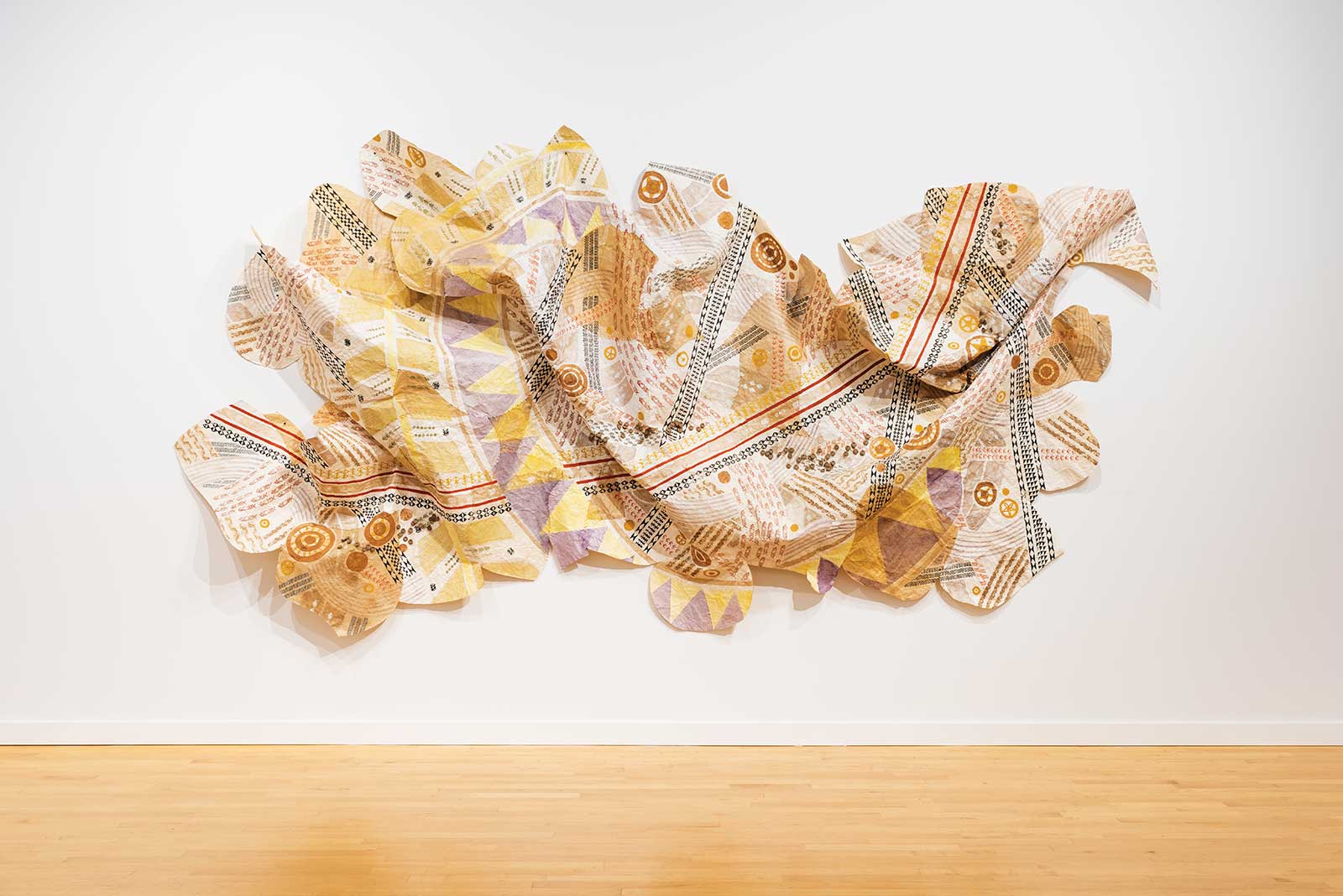
Lehuauakea (Kanaka Maoli), Mele O Nā Kaukani Wai (Song of a Thousand Waters), mixed mulberry papers, plant dyes, earth pigments, gouache, ceramic beads, thread, 132 x 84”. Image credit: Mario Gallucci.
Lehuauakea’s family is from Pāpa‘ikou on Moku O Keawe, “the east side of the Big Island” in Hawai‘i. They were born and raised between Oregon and their homelands on the Big Island. Lehuauakea is māhūwahine (interchangeable with “māhū” for many people), which is outside of the gender binary and acknowledges the fluidity of the masculine and feminine; this spectrum remains fluid for every individual to identify in different ways. This cultural identification is woven within their practice as a kapa maker. Kapa making, like many traditional Indigenous art forms, involves different gender roles within the process. The beating of the bark was reserved for gendered women and the making of the tools were reserved for gendered men. A lot of contemporary kapa practitioners do both out of necessity, but for Lehuauakea it is a part of being māhū; “I intentionally bridge the masculine and feminine parts of the process.” Along with being a kapa maker, Lehuauakea makes all of their tools, including ‘ohe kāpala (carved bamboo printing tools). To master the multiple knowledges involved with kapa making is an immense responsibility, which is something Lehuauakea gracefully embraces because being māhū guides the process.
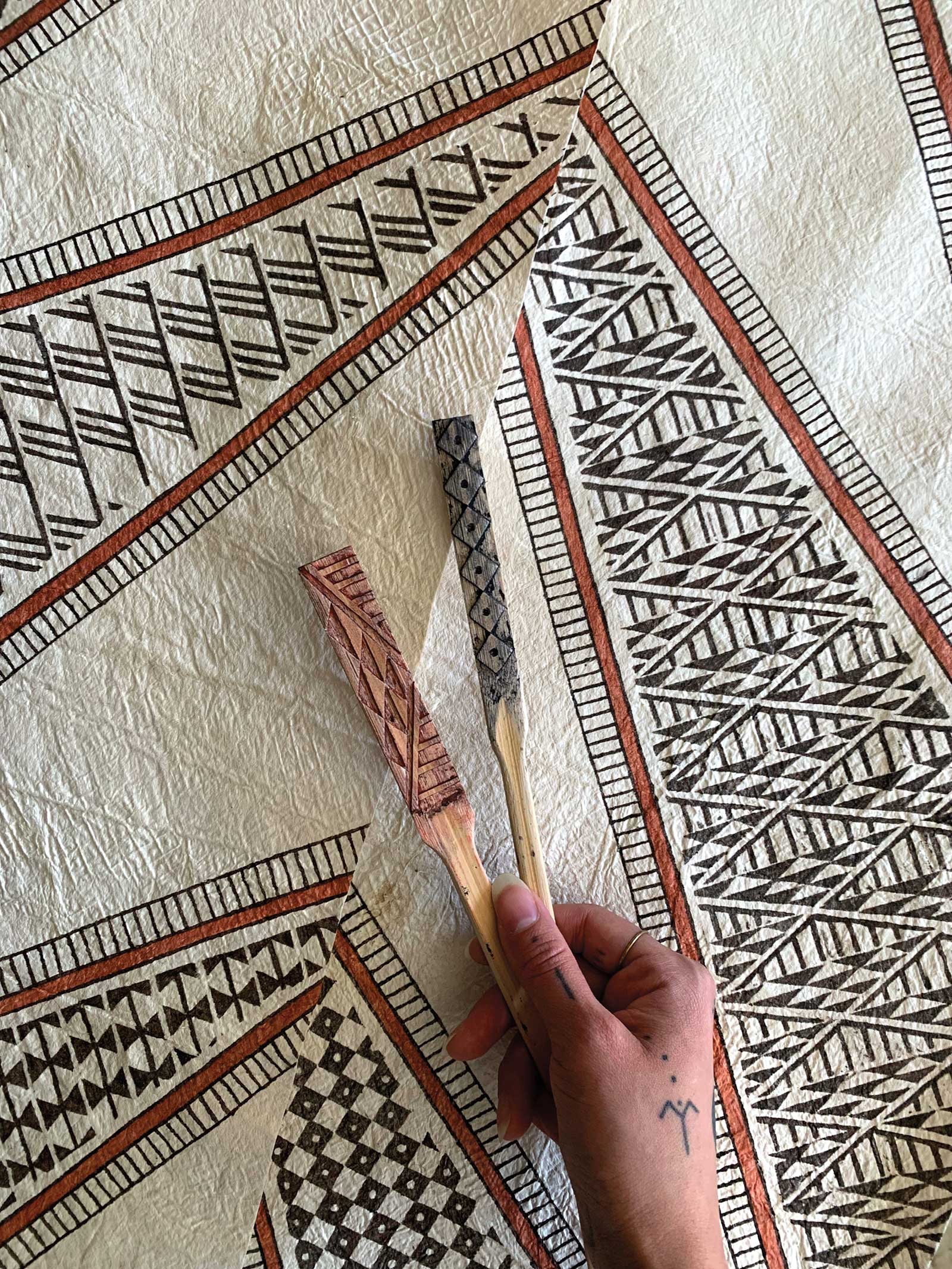
Lehuauakea (Kanaka Maoli), Ua Ka Ua, Kahe Ka Wai (detail), earth pigment and wildfire charcoal on kapa, 11½ x 72”
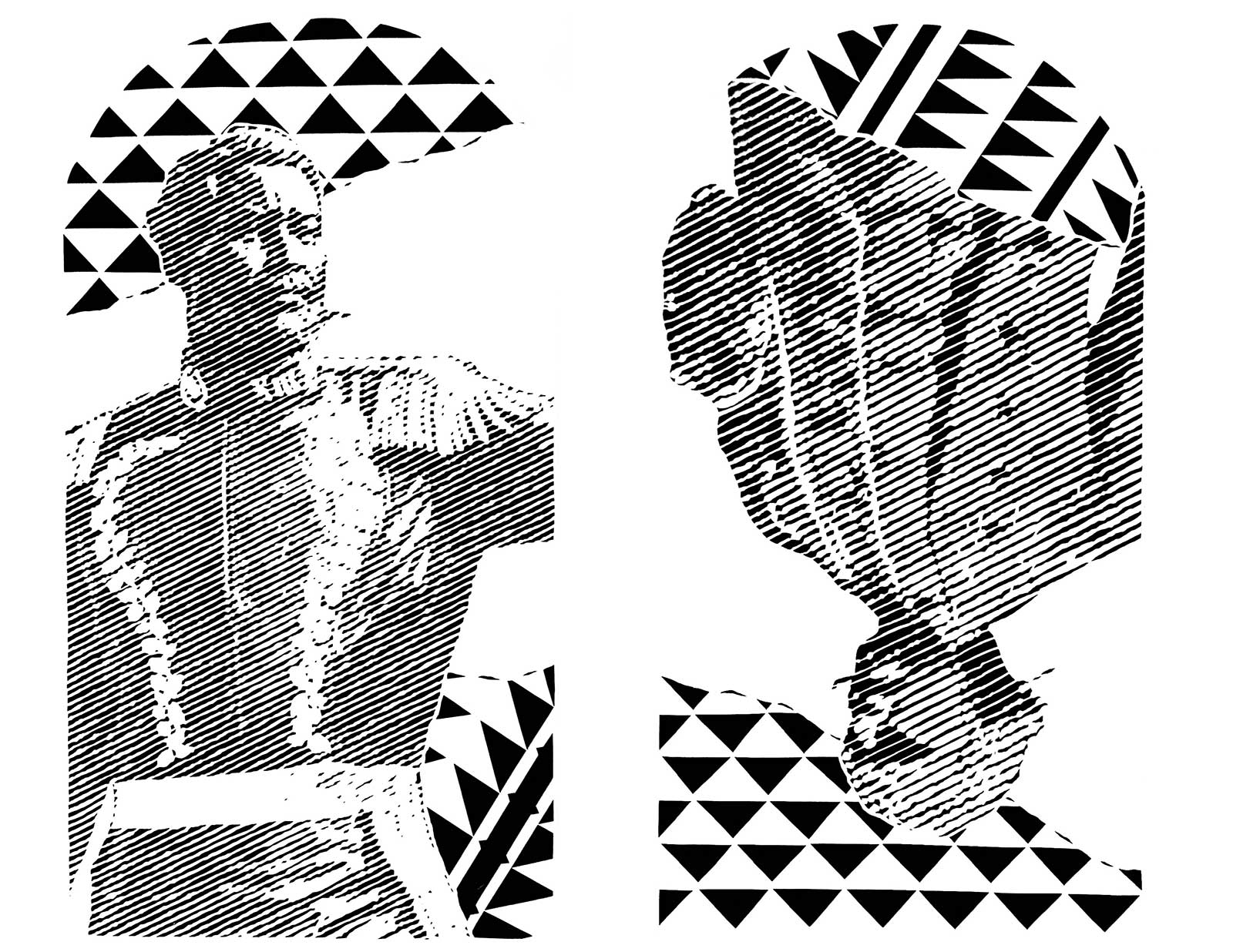
Ian Kuali‘i (Kanaka Maoli/Mescalero Apache), Monument Pillar (installation part of Larger Than Memory at the Heard Museum in Phoenix), hand-cut paper, 26 x 12’
Ian Kuali‘i (he/him) is someone who could probably pick up any medium and run with it. His work spans graffiti, installation, mural and public art, land art, sculpture, and his breathtaking hand-cut paper work. As a self-taught multi-and-interdisciplinary artist, he’ll be the first to tell you it’s all about genealogy. Ian got his start in urban contemporary arts. He has a cultural background of being Kanaka Maoli and Mescalero Apache, but he was “raised in Hawaiian and cultural hip hop.” Growing up between Southern California and Hawai‘i, his mother, Carolyn Kuali‘i, was incredibly hands-on and supportive of anything and everything the kids were up to—including breakdancing, “mom was super on that.” This supportive upbringing allowed Ian to explore his creative expressions that were driven by his surrounding communities. During a pivotal moment in hip hop culture, “when East Coast styles were coming to the West Coast,” Ian found himself drawn to the east where he let his creativity be fully mentored by the greats, including the late Clarence “Cuba” Silas Robbs. It was his ties in the cultural hip hop community that got him to fully embrace his Kanaka lineage within his creative identity.
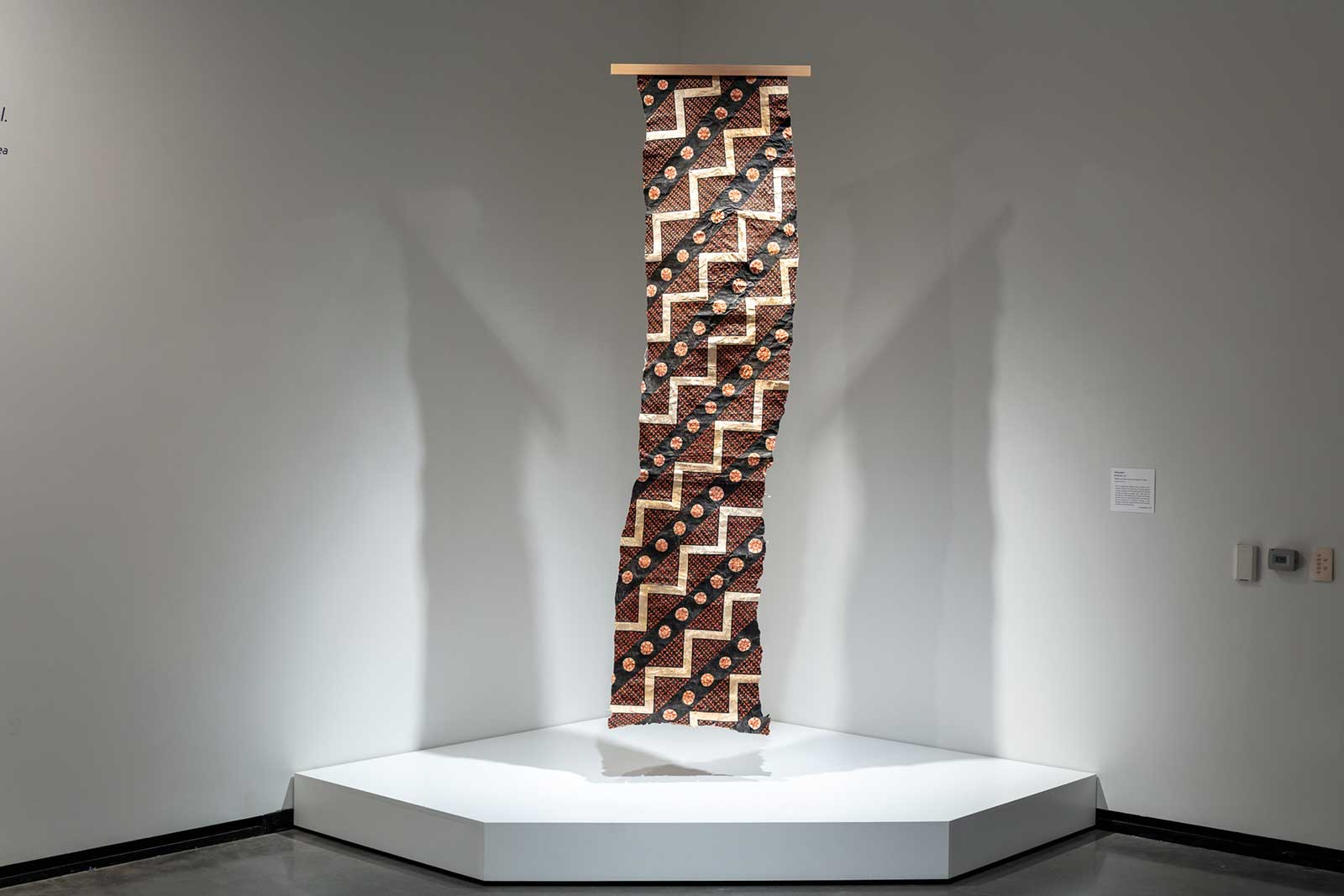
Lehuauakea (Kanaka Maoli), EA EA EA, red ochre pigment and wildfire charcoal on kapa, 108 x 24”. Image credit: Jon Richardson.
Ian’s work with paper came from his stencil use within the graffiti scene. By the tail end of the 1990s, Ian expanded his interest in paper and began developing hand cut paper techniques. The evolution of Ian’s work is remarkable and genealogy is key—for any artist—to understand the moments of growth, lessons learned, and true inspiration. He will always give credit to his mentors, community and mother; but the truth is, no one quite does what Ian does. He takes paper, a milled fiber that holds environmental memory, destroys it with an X-Acto blade, and (re)creates magnificent portraits and compositions. He has a distinct gentleness with his line work—that undoubtedly stems from his graffiti background—that has the ability to pull out prominent facial features against bold geometric patterns, which isn’t an easy design task. Other artists work with paper, but Ian creates.
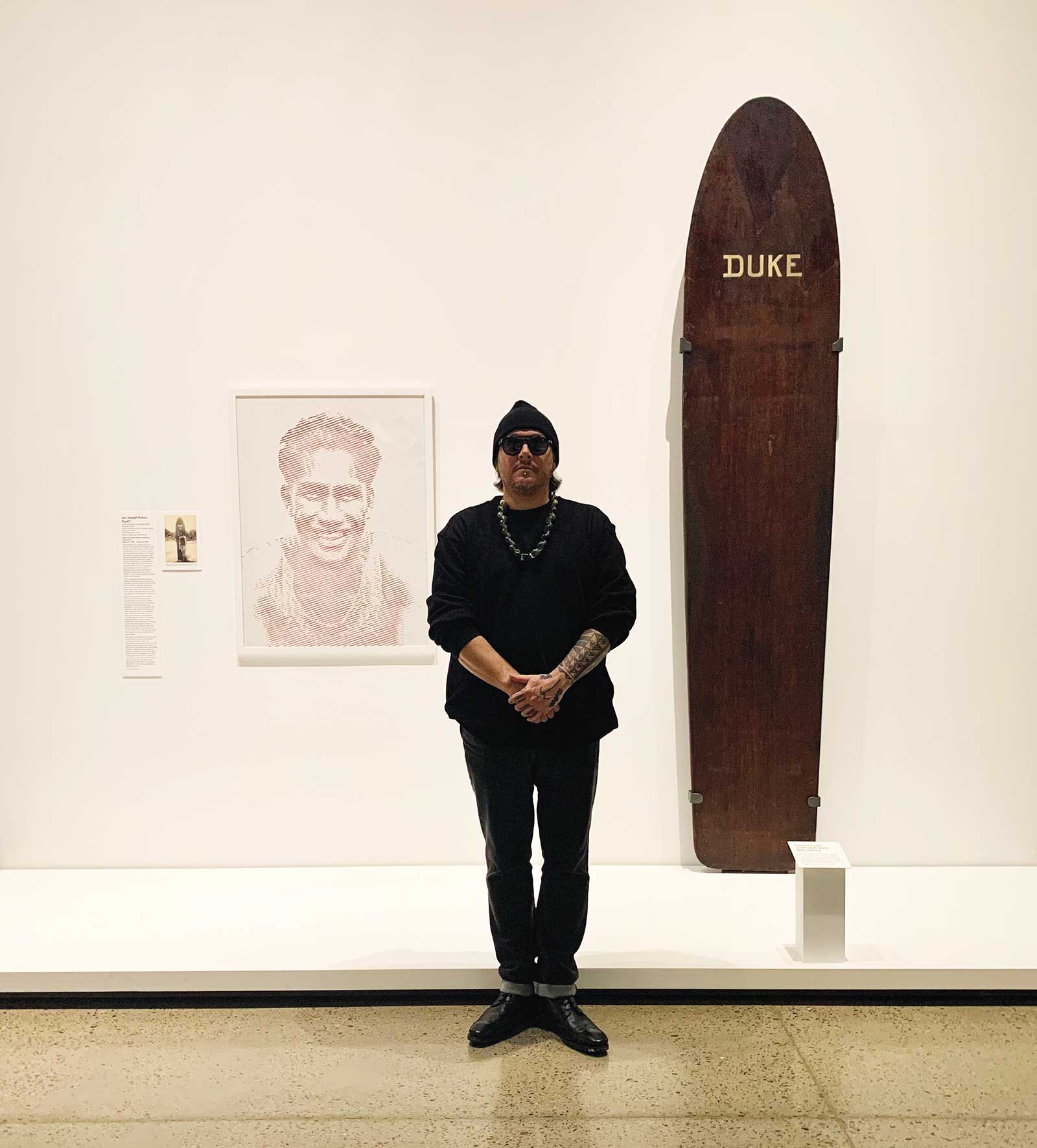
Portrait of Ian Kuali‘i beside a hand-cut paper portrait of Duke Paoa Kahinu Mokoe Hulikohola Kahanamoku and his famous surfboard. Part of He‘e Nalu: The Art and Legacy of Hawaiian Surfing at the Heard Museum in Phoenix. Image credit: Lehuauakea.
Lehuauakea and Ian have been intertwined in the Kānaka Maoli circles in various ways, through mentors involved with the Hawaiian Renaissance, extended families, art spaces, and of course, through the fibers that connect them. In many ways, their connection feels like it has always existed, especially with their art. Both work with fibers in different ways—Lehuauakea in a very direct and grounded method of kapa making, and Ian with a more abstract yet natural connection with his paper cutting techniques. But upon following the common thread of fiber, there are even more connections between the two artists; it appears the fibers have always been pulling them together in a way that only the ancestors can understand. Perhaps it is through Ian’s work with fibers in other ways, including yucca weaving and his experiments with kapa. He will explain, “fiber is a part of Kānaka culture” and that he has always wanted to move away from milled paper and work solely with kapa.
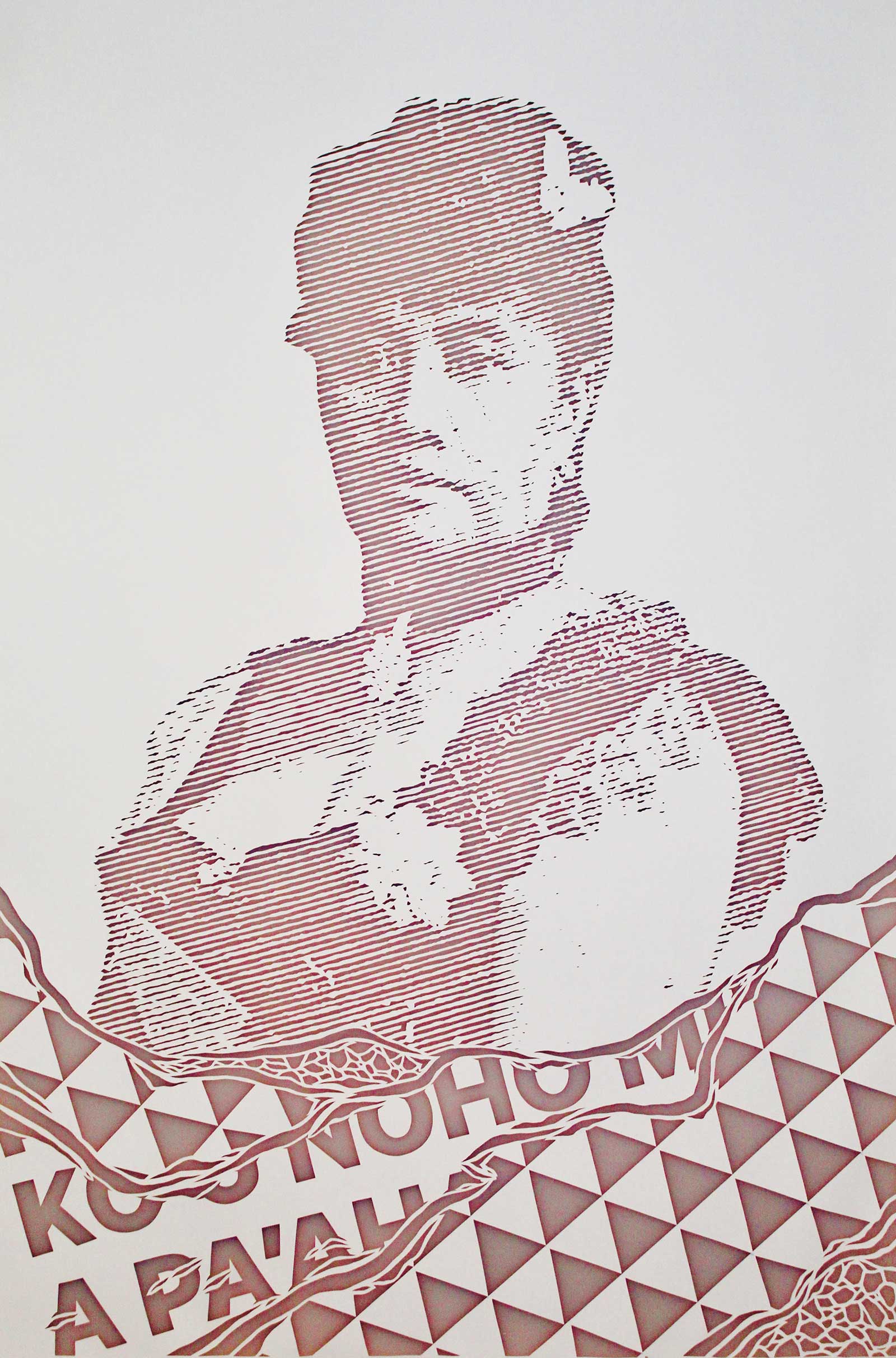
Ian Kuali‘i (Kanaka Maoli/Mescalero Apache), Portrait of Queen Lili‘uokalani, hand-cut paper with painted verso, 72 x 48”
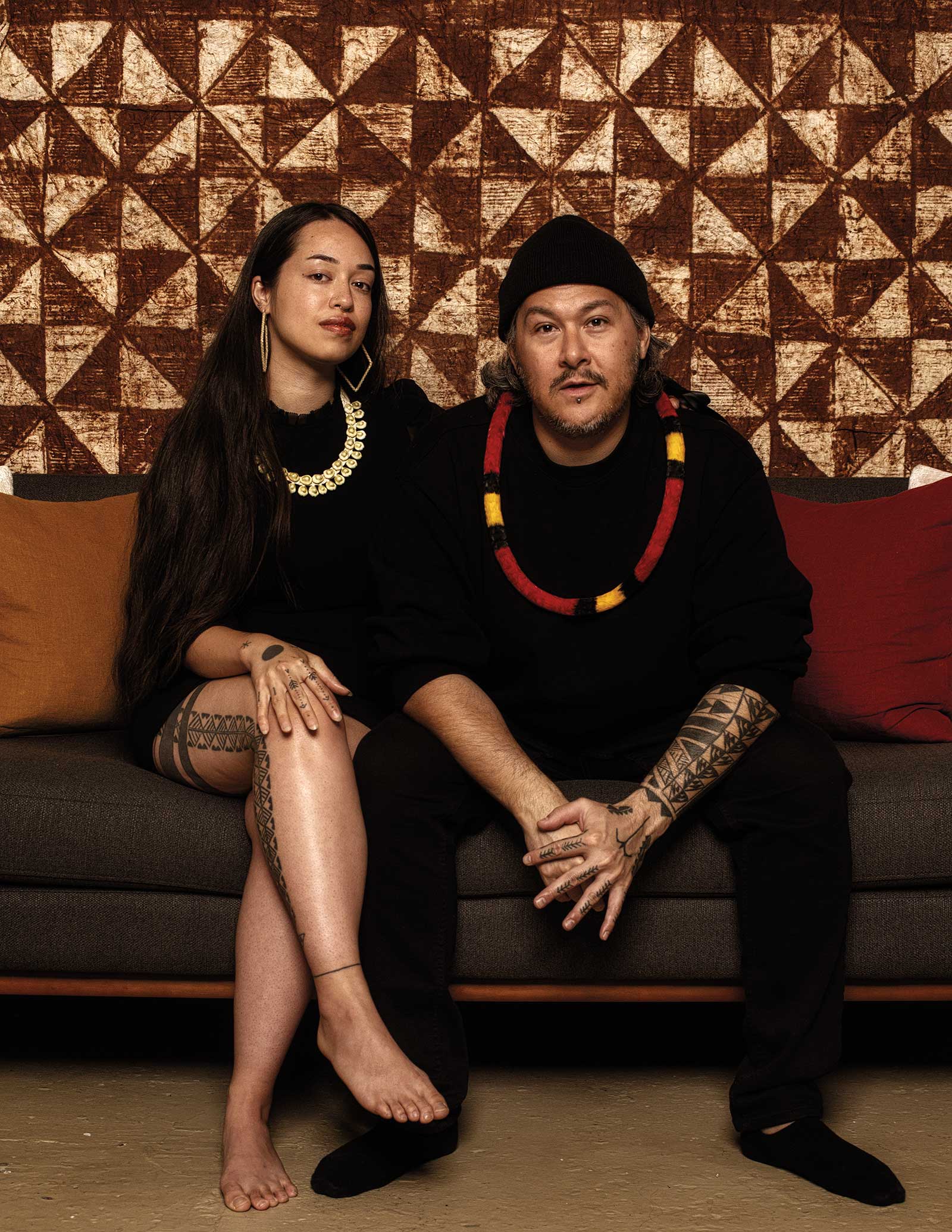
Artists Lehuauakea and Ian Kuali‘i. Photo by Leah Rose (Keweenaw Bay Ojibwa). Lehuauakea and Ian Kuali‘i
When you ask Lehuauakea and Ian about their work and their futures in the art worlds, both quickly turn it back to genealogy, responsibility and connection. Lehuauakea recalls being a young person and never seeing Kānaka representation in institutions. Now it is Kānaka Maoli like Leahuauakea and Ian who are working hard to create new opportunities for communities. “When we have a conversation about how institutions are lacking in Kānaka representation, and to have the ability to step into these spaces and kick the door open,” Ian explains, “that is the importance behind it.” These representative opportunities are heavy responsibilities because of how much they offer; these opportunities strengthen cultural practices, knowledges, individual and community confidence, and lead to further actions of inclusion. Lehuauakea solidifies this work by explaining, “we do what we do because it’s for the greater purpose.”
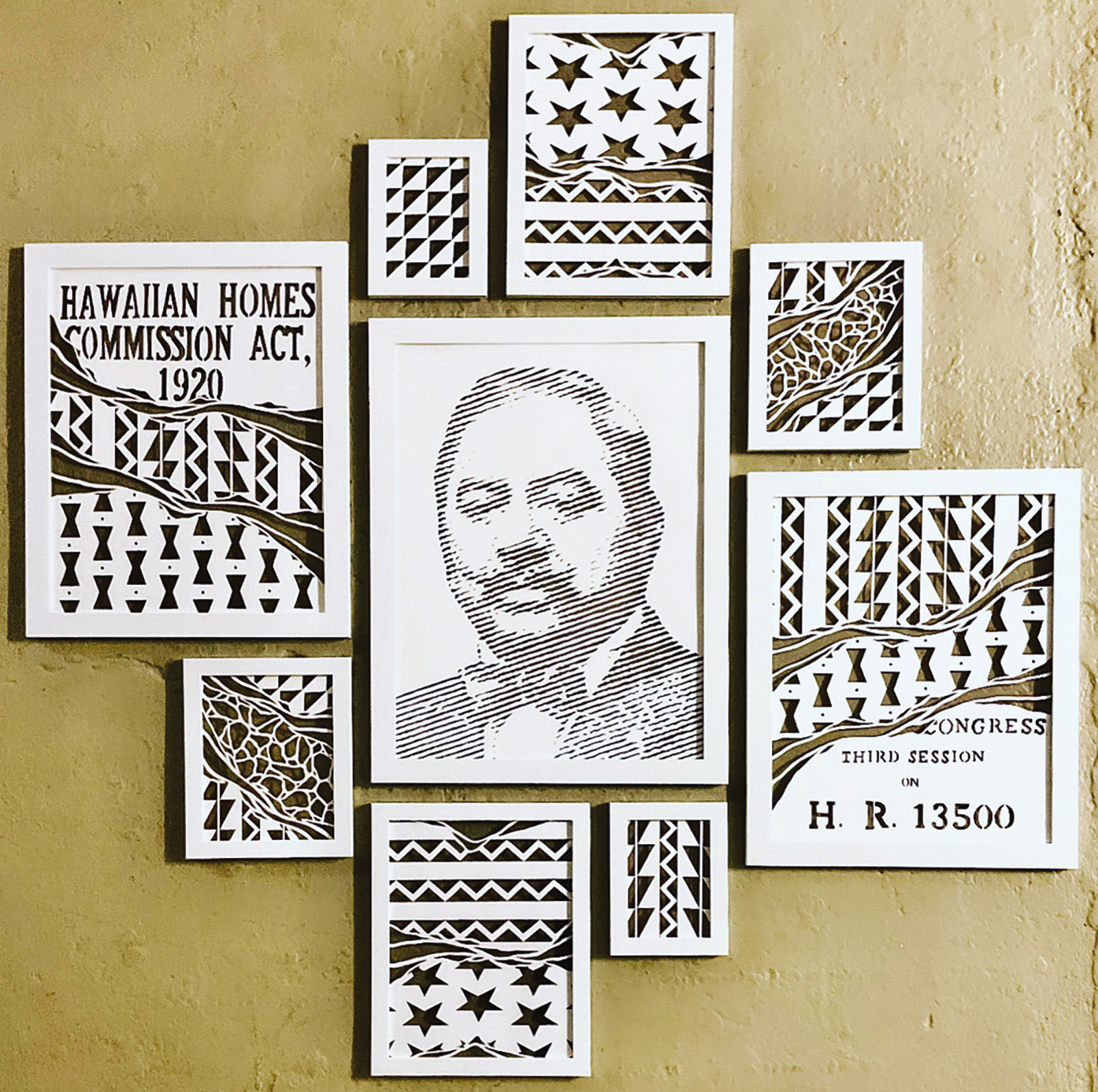
Ian Kuali‘i (Kanaka Maoli/Mescalero Apache), Ke Ali‘i Maka‘ainana (The Prince of the People), hand-cut paper with painted verso, 65 x 65”
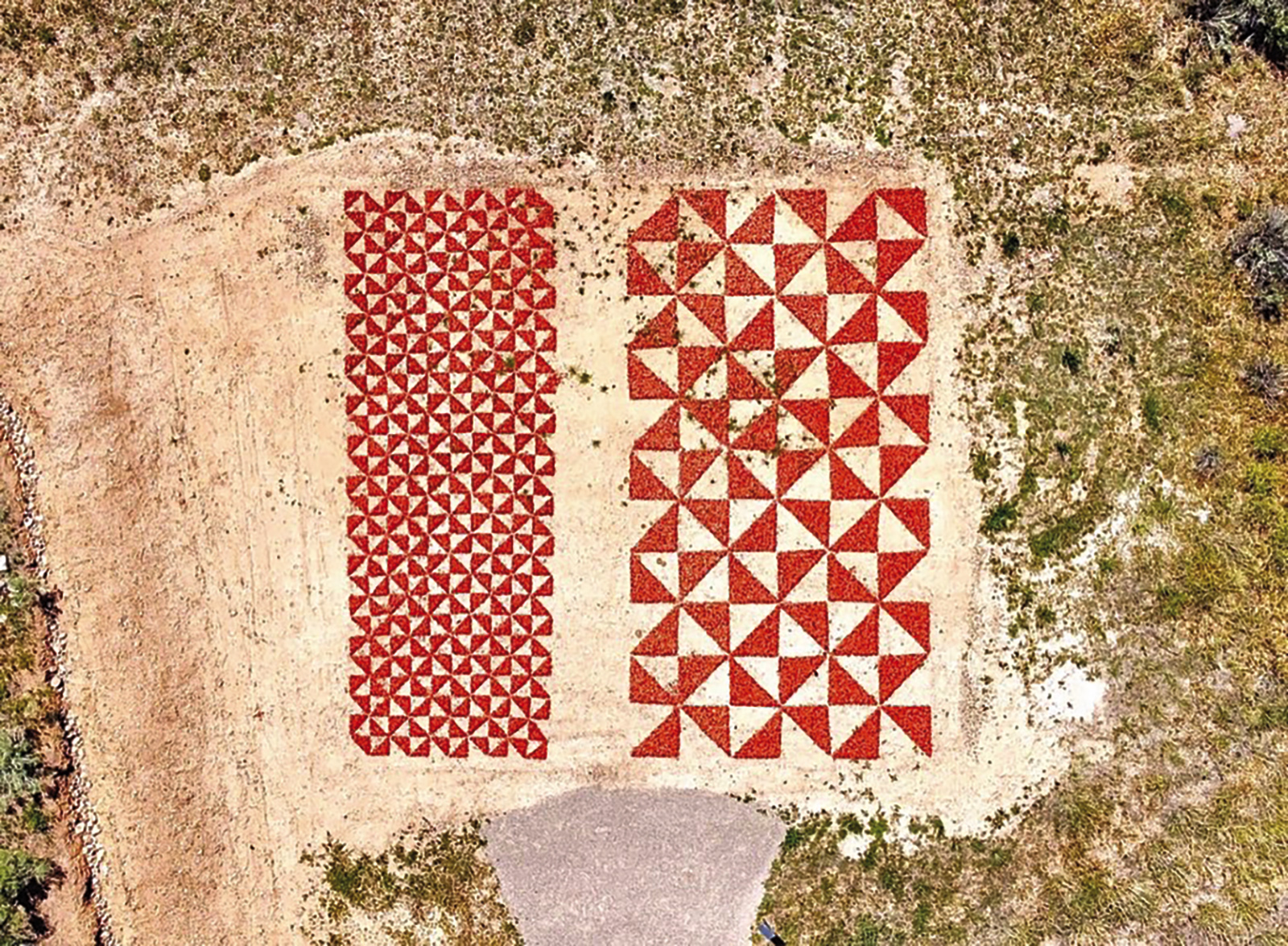
Ian Kuali‘i (Kanaka Maoli/Mescalero Apache), He Manulua Ma Ka Panoa Ki‘eki‘e (Two Seabirds in the High Desert), site-specific installation at Center for Contemporary Art Santa Fe, New Mexico, 40 x 40’
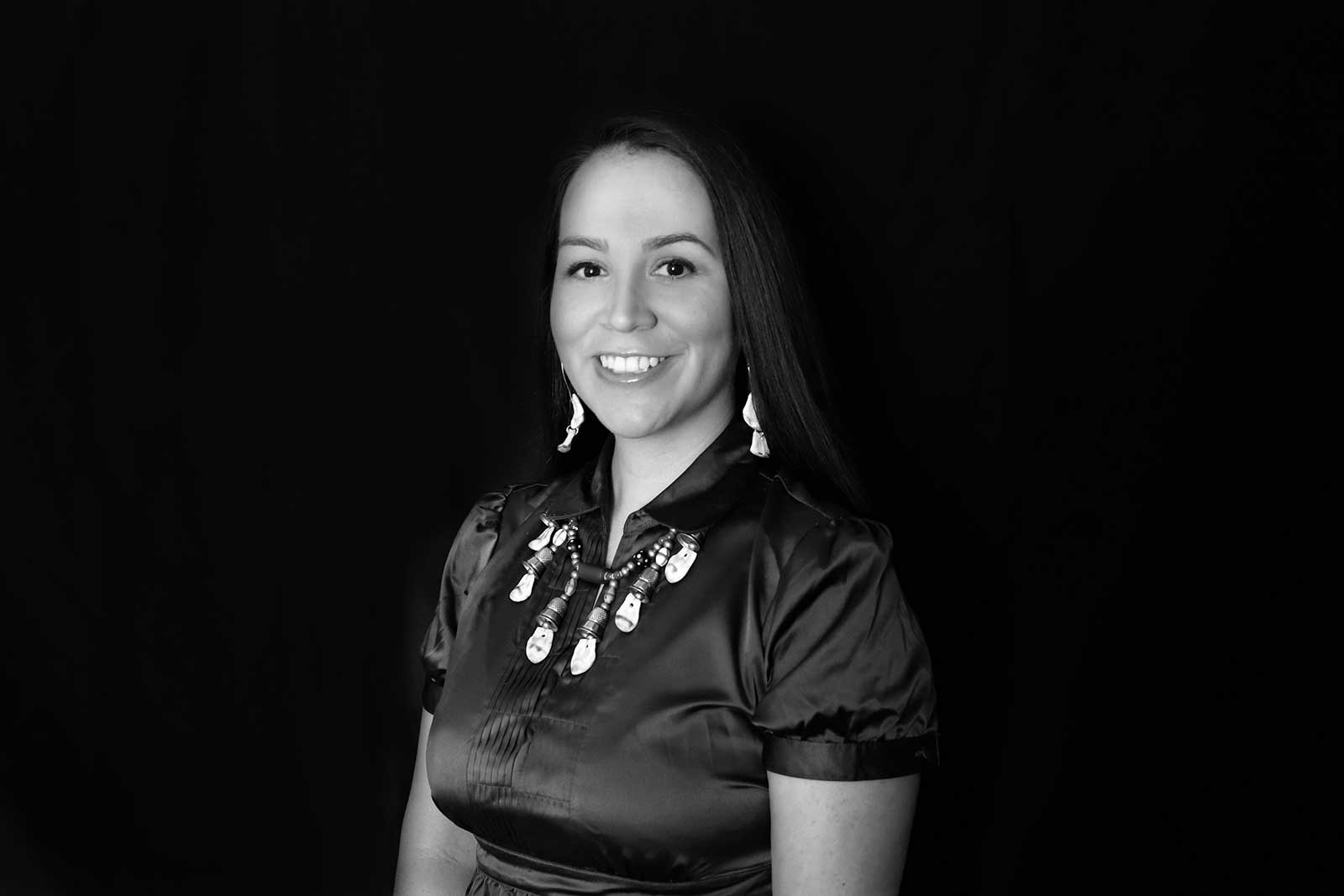
Jessa Rae Growing Thunder comes from the Fort Peck Assiniboine/Sioux tribes in northeastern Montana. She is a third-generation traditional beadwork and quillworker who has spent her life learning from her mother and grandmother. As a scholar, Jessa Rae is an Indigenous feminist historian who specializes in Indigenous-led arts research-creation.
Powered by Froala Editor