In 2002, the Algonquin artist Nadia Myre wrote, “Beading is political, whether it’s simply the personal contribution to an age-old continuum or consciously reworking loaded imagery. I really do see beading as an act of silent resistance.”
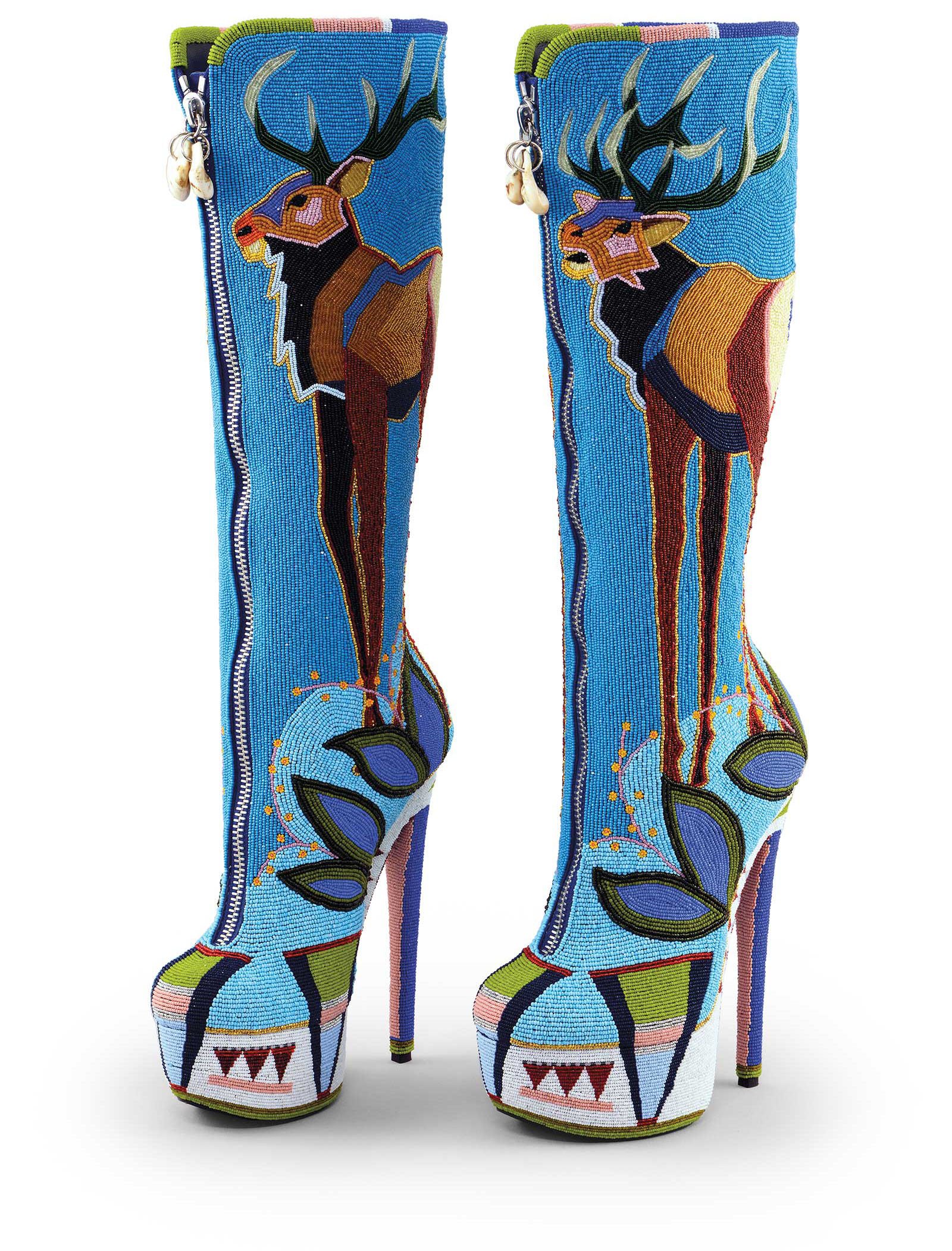 Jamie Okuma (Luiseno/Shoshone-Bannock’Wailaki/Okinawan), Elk Beaded Boots, 2017, antique glass, steel, brass and aluminum on re-appropriated Commercial Boots by Giuseppe Zanotti. Collection of Ellen and Bill Taubman. Photo by: Don Hall, Courtesy of the MacKenzie Art Gallery.
That year, she exhibited the 56 pages of the Canadian government’s Indian Act which she and 230 of her compatriots beaded over with red beads—white beads replacing each word. Passed in 1876, the act was an attempt to assimilate First Peoples into non-Indigenous society.
Beautiful and decorative Indigenous beadwork as social commentary is the subject of the exhibition Radical Stitch being shown at the Art Gallery of Hamilton in Ontario, Canada, through May 28. It was organized by the Mackenzie Art Gallery in Regina, Saskatchewan.
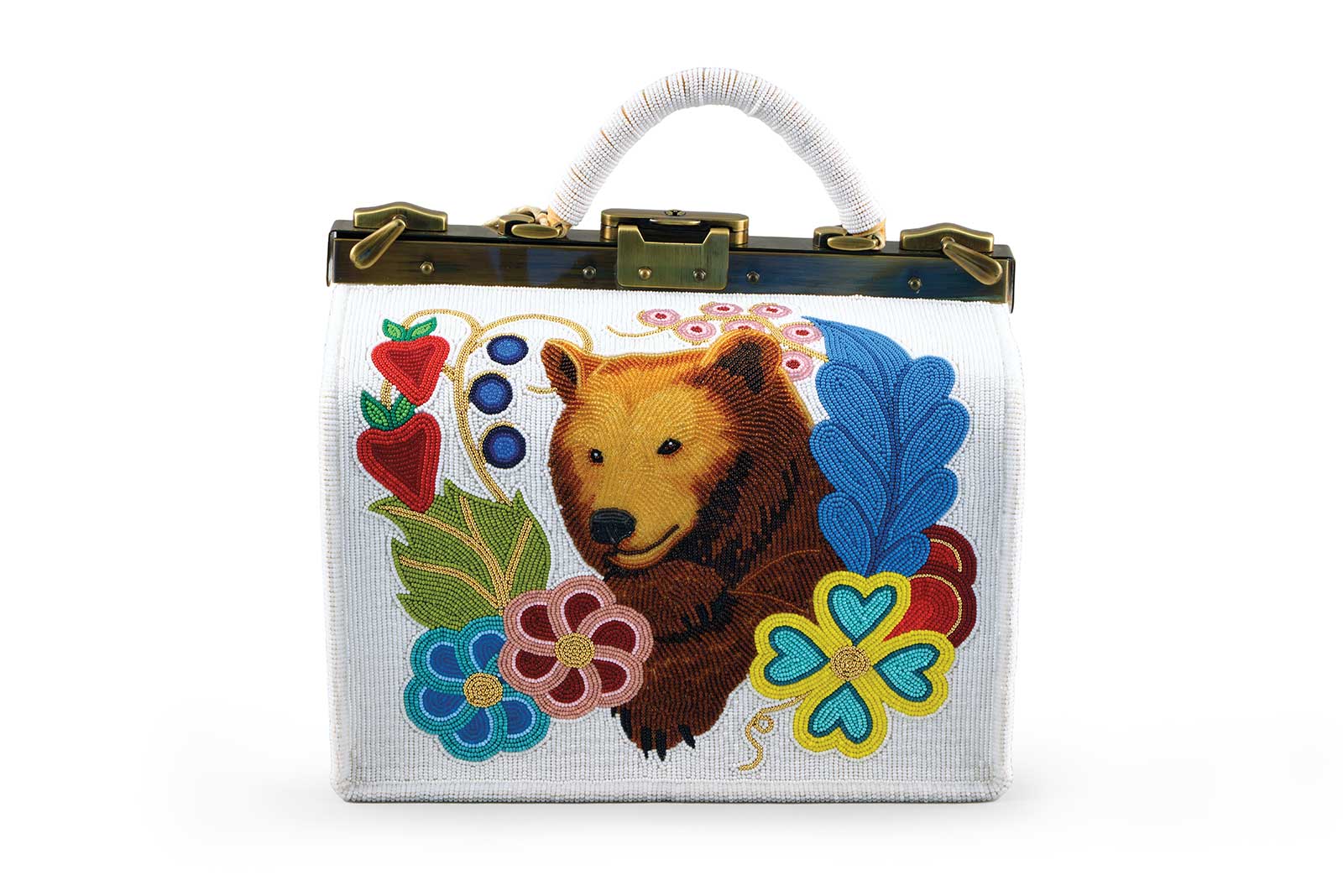 Justine Gustafson (Ojibwe), Let’s Heal Together, 2020, felt, satin, seed beads, metal clasp, smoked deer hide, brass sequins. Collection of the Artist. Photo by: Don Hall, Courtesy of the MacKenzie Art Gallery.
The museums explain, “Beading is one of the defining mediums of contemporary Indigenous art on this continent, and this landmark exhibition will bring much-needed critical attention to the breadth and impact of this practice.
“Radical Stitch looks at the contemporary and transformative context of beading through the aesthetic innovations of artists and the tactile beauty of beads,” the museum notes. “Beading materials and techniques are rooted in both culturally informed traditions and cultural adaptation, and function as a place of encounter, knowledge transfer and acts of resistance. Connecting to a tradition of making, exercised over thousands of years, this skill-based practice ties one artist to another, past to present and beyond. The exhibition includes a range of work from the customary to the contemporary, with a variety of approaches, concepts and purposes. Gathering together top artists from across North America/Turtle Island, the selected pieces exemplify current and future directions of some of the most exciting and impressive practices. The works in Radical Stitch invite viewers to immerse themselves in the political, creative and aesthetic dimensions of beadwork.”
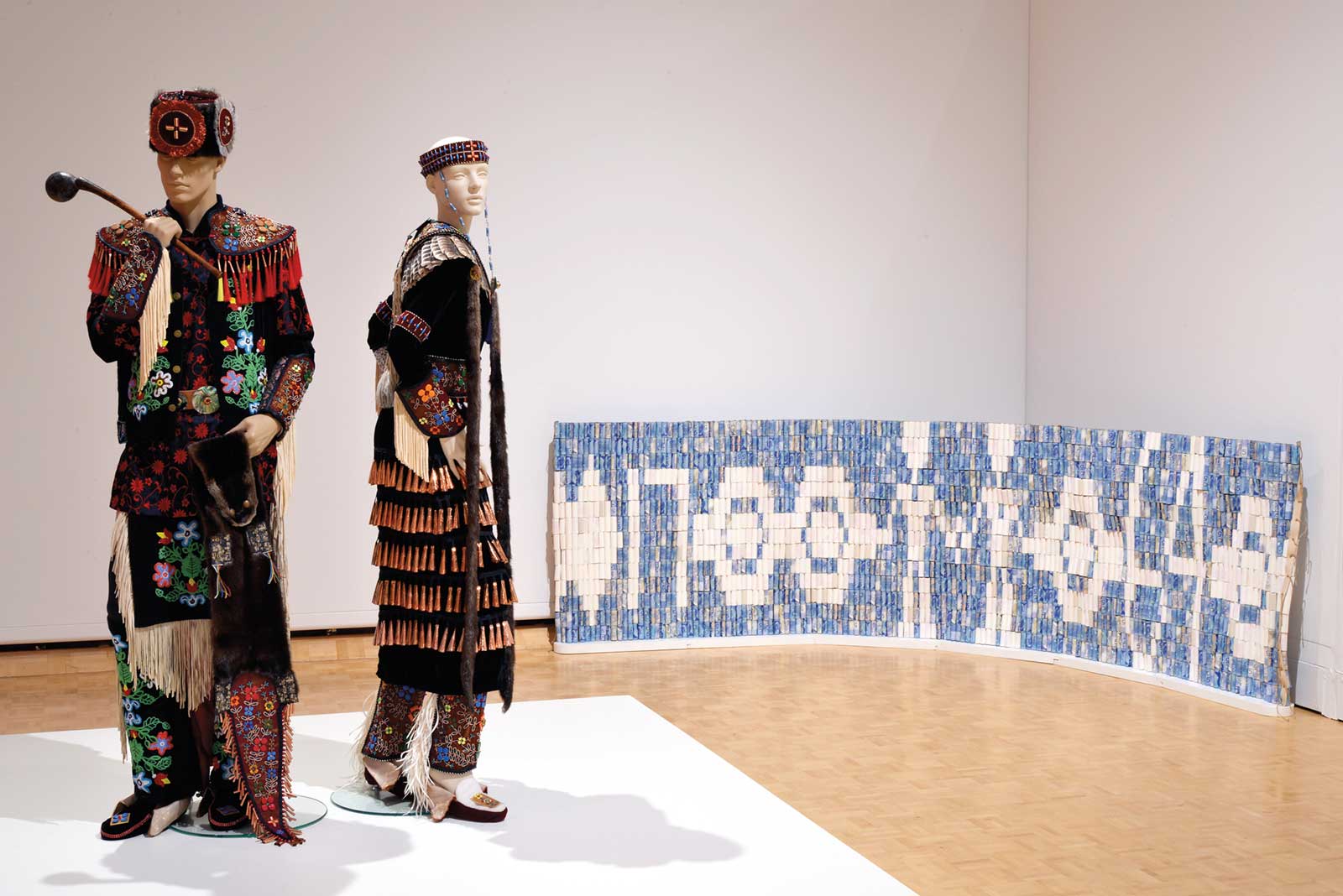 Installation view, Radical Stitch, Mackenzie Art Gallery, 2022. Photo by: Don Hall, courtesy of the MacKenzie Art Gallery.
The exhibition was curated by Sherry Farrell Racette (Métis/Algonquin/Irish) an interdisciplinary scholar with an active arts and curatorial practice, Michelle LaVallee (Anishinaabe), director of Indigenous ways and decolonization at the National Gallery of Canada, and Cathy Mattes, a Michif curator, writer and art history professor based in Sprucewoods, Manitoba.
Indigenous people of North America traditionally decorated their regalia with dyed porcupine quills, bone, shells, pebbles, coral, wood, elk teeth and semi-precious stones. Glass beads were introduced by Europeans in the 16th century and early designs often copied those made with quills and other materials.
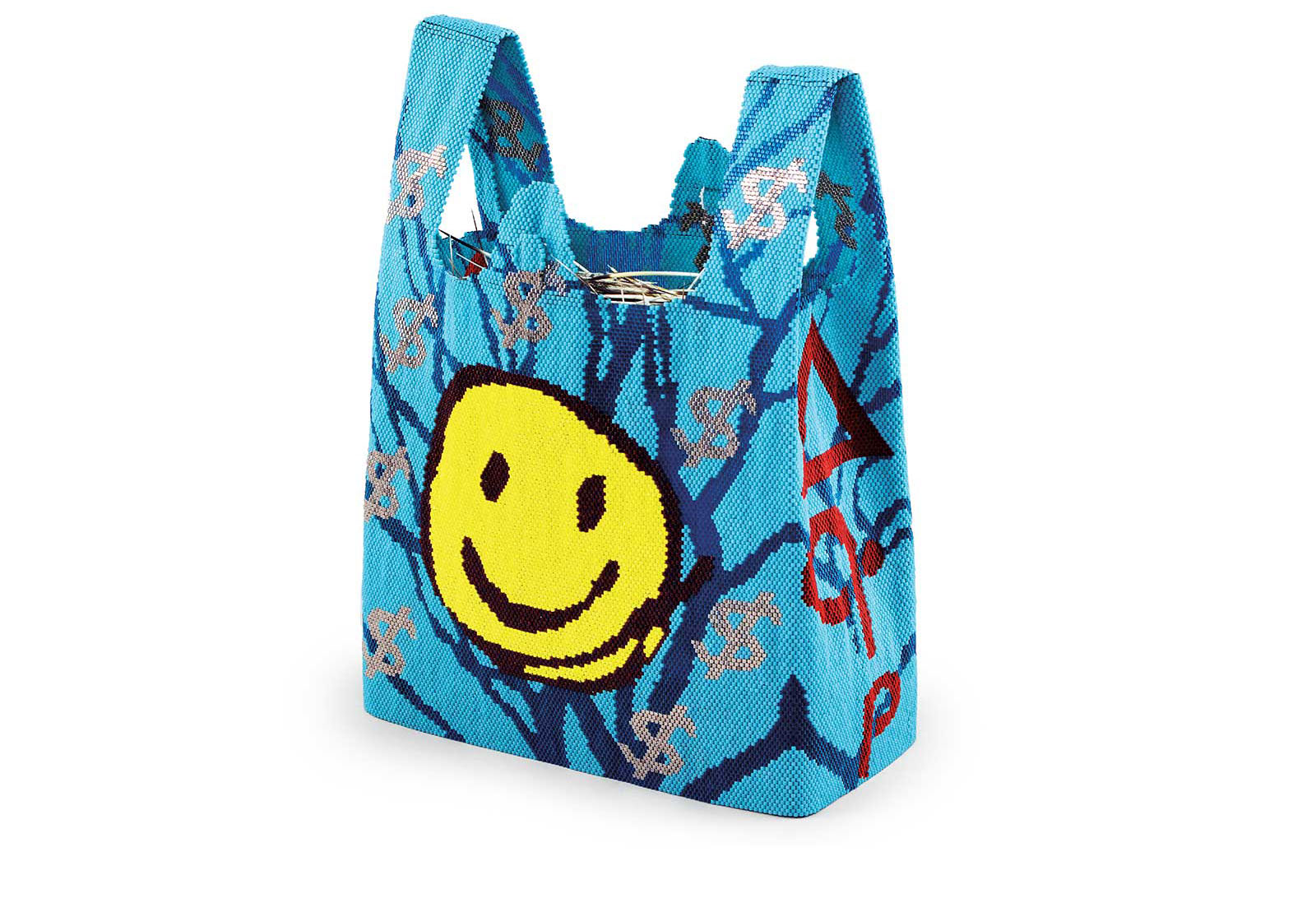 Nico Williams (Anishinabe/Aamjiwnaang First Nation), Aaniin, 2022, glass beads. Collection of the Artist. Photo by: Don Hall, Courtesy of the MacKenzie Art Gallery.
At the time of the exhibition Stitched in Sovereignty: Contemporary Beadwork from Indigenous North America at the Couse-Sharp Historic Site in Taos, New Mexico, Dr. Chelsea Herr, now curator of Indigenous art and culture at the Gilcrease Museum, wrote that beadwork “highlights how Indigenous peoples maintain control of their own cultures, social and governing systems, belief and knowledge systems and relationships with other sovereign groups. These concepts are expressed in the materials and processes of beadwork, a medium that has a long tradition in Indigenous North America and continues to evolve today.”
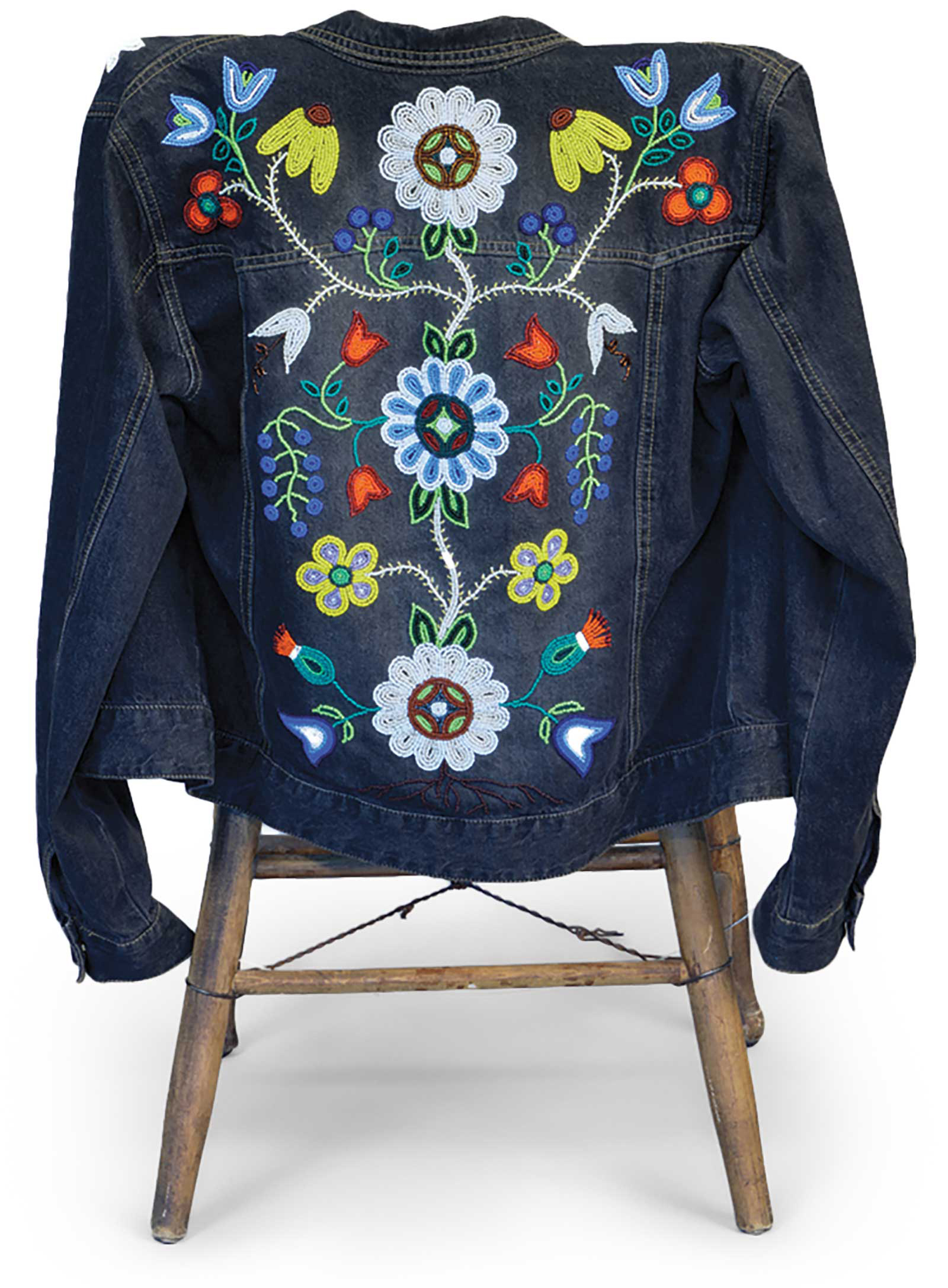 Christi Belcourt (Métis), Untitled, ca. 2000, seed beads, thread, dental floss, jean jacket, cotton cloth. Collection of the Artist. Photo by: Don Hall, Courtesy of the MacKenzie Art Gallery.
Jamie Okuma is a fashion artist and enrolled member of the La Jolla Band of Mission Indians, Shoshone-Bannock, Wailaki, Luiseño and Okinawan. She works in California. Her Elk Beaded Boots, 2017, are in the current exhibition. Traditionally, leggings and moccasins were beaded for ceremonial and daily wear. Okuma has re-appropriated commercial high-heeled boots by Giuseppe Zanotti, the high-fashion Italian footwear designer. She has beaded them with traditional motifs using antique glass, steel, brass and aluminum beads, an Indigenous take on contemporary haute couture. She has won seven best of show awards at the Heard Museum Guild Indian Fair & Market in Phoenix and at the Santa Fe Indian Market in Santa Fe. Her work is also in the collection of the the Costume Institute of the Metropolitan Museum of Art in New York.
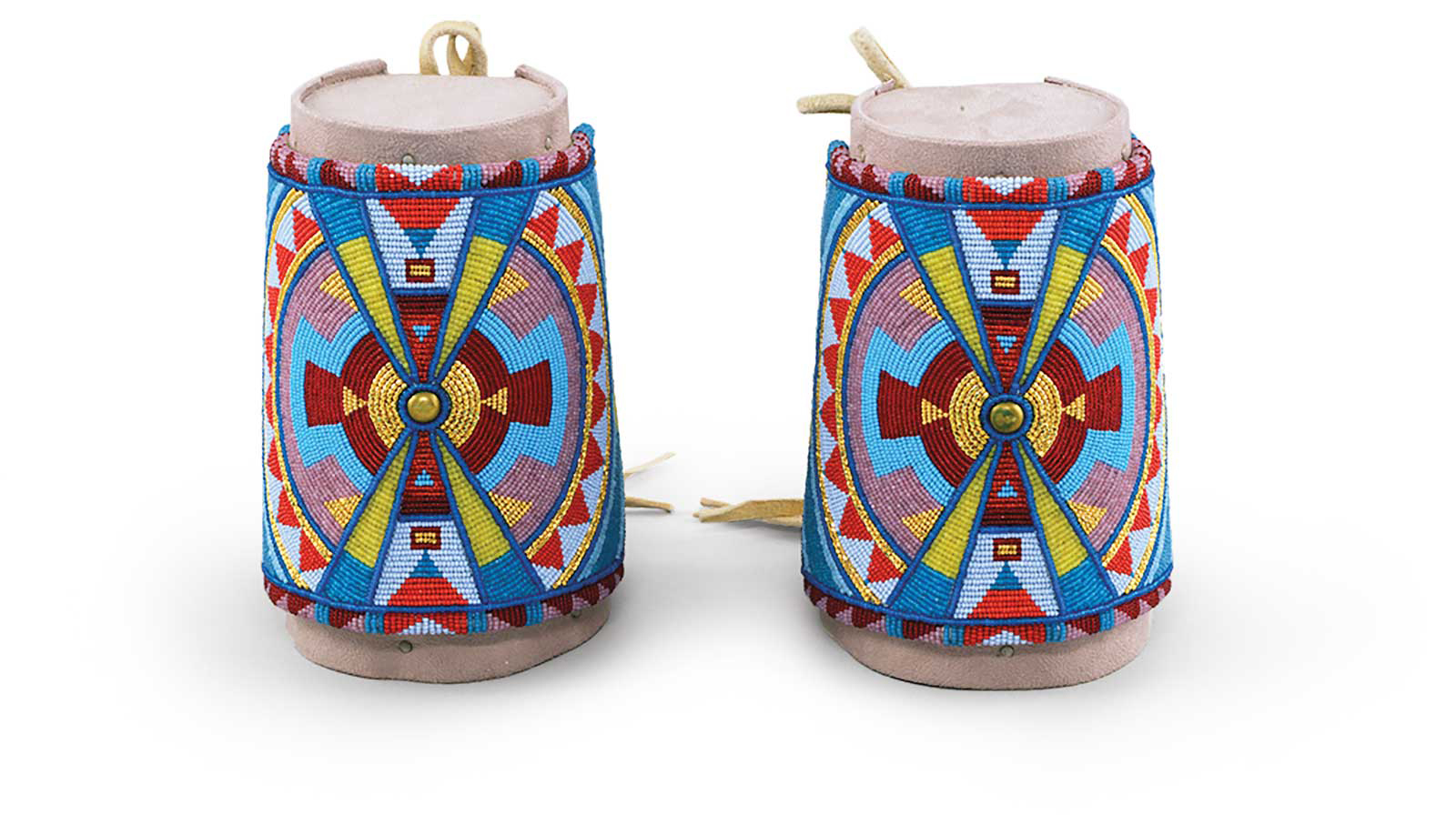 Elias Not Afraid (Apsaalooké (Crow)), Warrior Women beaded cuffs, 2018, glass beads, brass, brain-tanned smoked mule deer hide and kevlar fabric. Private collection of Don & Liza Siegel, New Mexico. Photo by: Don Hall, Courtesy of the MacKenzie Art Gallery.
In 2016, Métis artist Christi Belcourt was the recipient of the Premier’s Award for Excellence in the Arts by the government of Ontario. The award noted, “Like generations of Indigenous artists before her, Belcourt’s work celebrates the beauty of the natural world while exploring its symbolic properties.” She is represented in the exhibition by Untitled, circa 2000, seed beads, thread, dental floss, jean jacket and cotton cloth.
She states, “The great power and mystery surrounds us every minute of every day. Everything—the plants, insects, winds, stars, rocks, animals, us—is a giant web of pure spirit. Nothing is separate from anything else. The spirit world surrounds us at all moments and is present in all things. If its possible we live in a planet surrounded by stars, then nothing is impossible.”
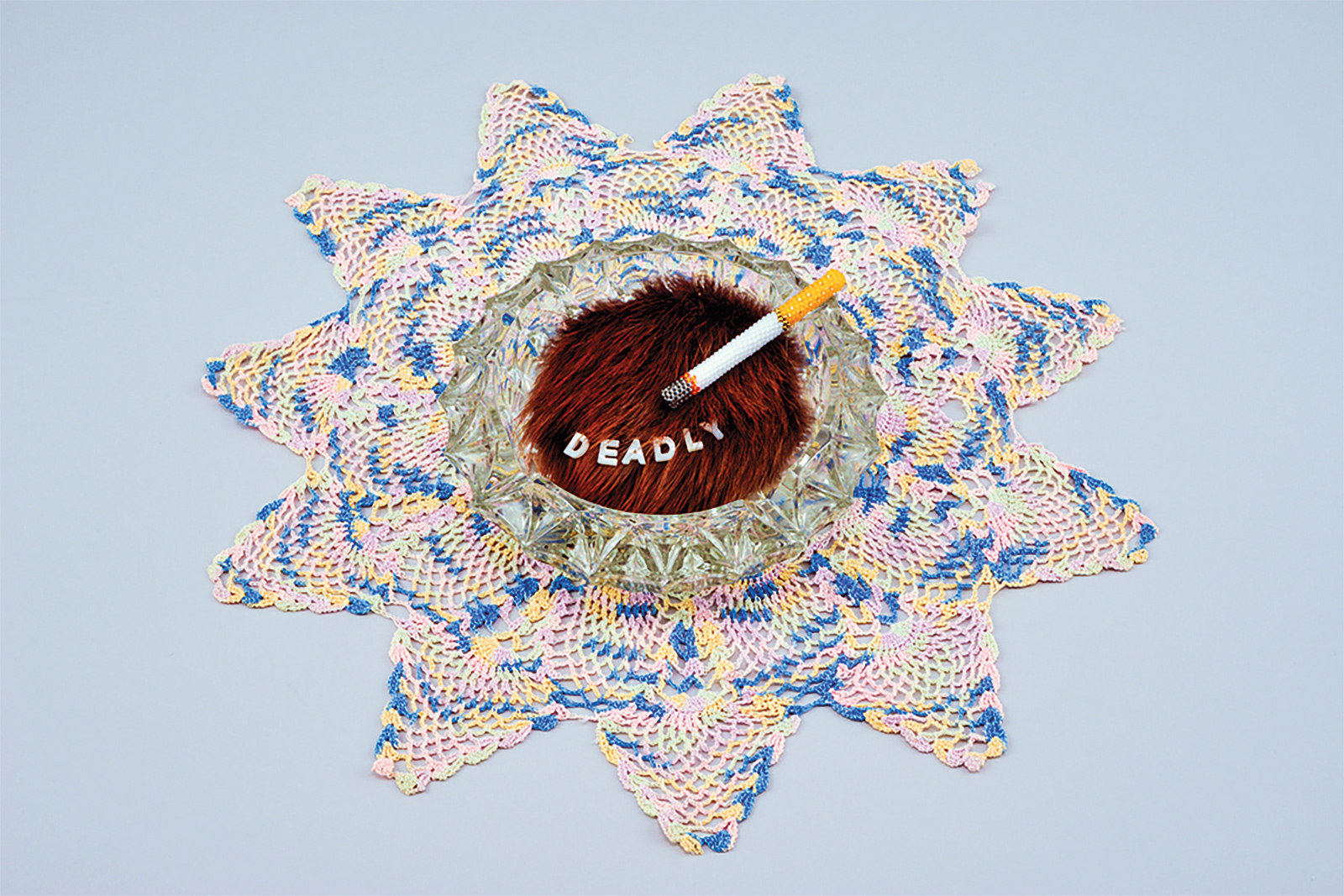 Candace Neumann (Métis), Deadly, 2021, glass beads, cotton rope, copper wire, beaver fur, vintage ashtray, vintage doily, shell letters. Collection of the Artist. Photo by: Don Hall, courtesy of the MacKenzie Art Gallery.
With this belief, she was outspoken when she received her award. “Young people and others have repeatedly linked the 150 years of dispossession, residential schools, ongoing colonialism and assimilation policies of successive Canadian governments to many of these crises. Youth have also made it very clear what they believe the solutions are. They want access to land-based education, their languages, they want to inherit a clean environment from us, and they want their cultures restored with access to their traditional forms of spirituality.”
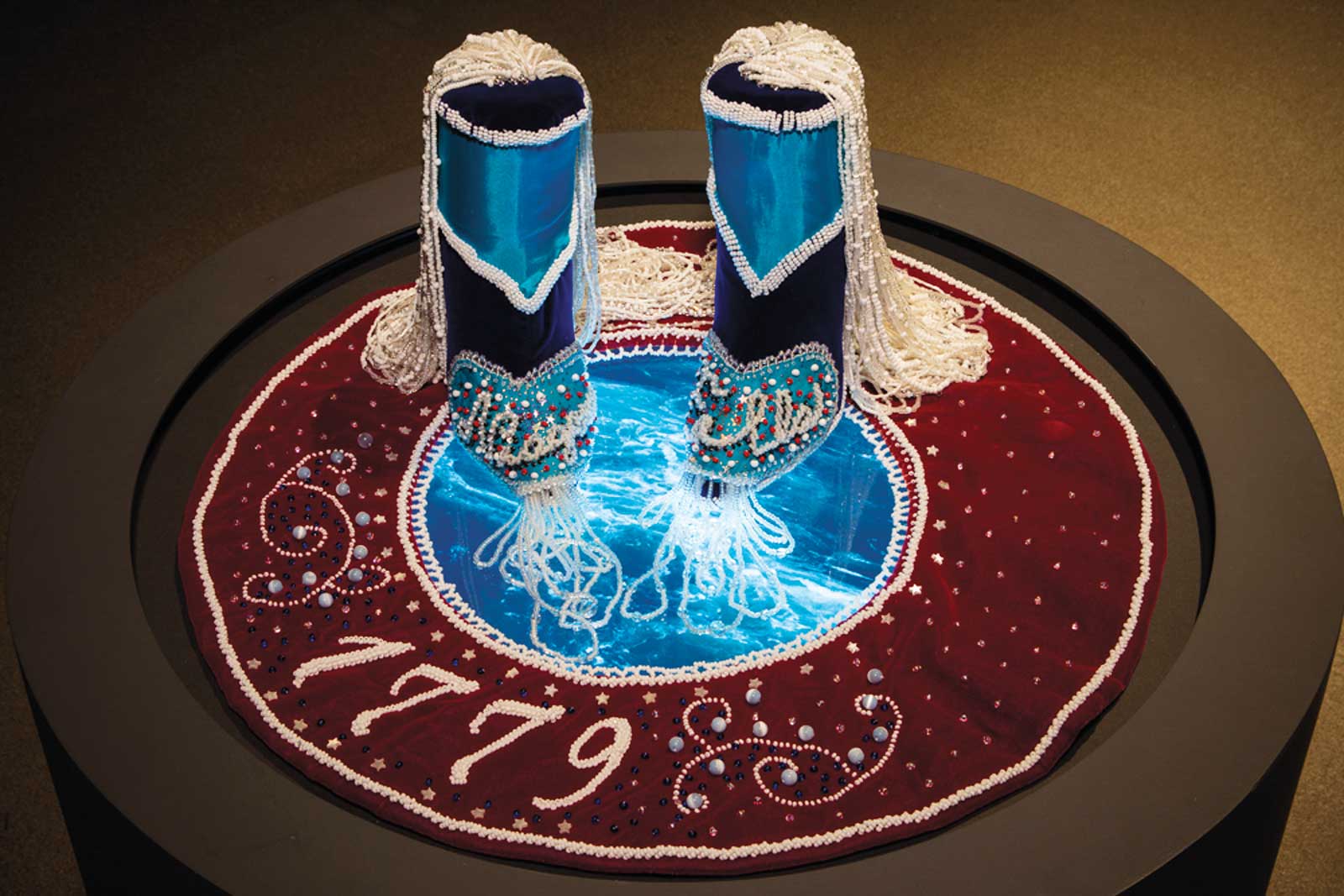 Shelley Niro (Mohawk), 1779, 2017, mixed media sculpture with video, velvet, beads, stiletto heels. Art Gallery of Hamilton, Gift of the Women’s Art Association of Hamilton, 2018. Photo by: Don Hall, Courtesy of the MacKenzie Art Gallery.
The Anishnaabe artist Justine Gustafson has adorned every surface of a doctor’s bag with traditional motifs. Let’s Heal Together, 2020, is made of felt, satin, seed beads, metal clasp, smoked deer hide and brass sequins. She made it for her parents to commemorate the death of their son and her brother, Jesse, in an automobile accident. The wolf and bear are her parents’ clan animals and the paw prints of the animals adorn the bottom of the bag to symbolize their walking ahead together. On the ends of the bags, Gustafson beaded representations of the four sacred medicines: tobacco, sweetgrass, sage and cedar. Her mother comments, “Justine beaded four medicines on this bag to remind her parents to use the plant medicine to help them when they need strength. This bag exudes Justine’s love she carries for her family…A fully beaded physician’s bag to represent the healing that has taken place within our family. We are bound by love and loss. A bag to symbolically hold the tools that support our healing journey.”
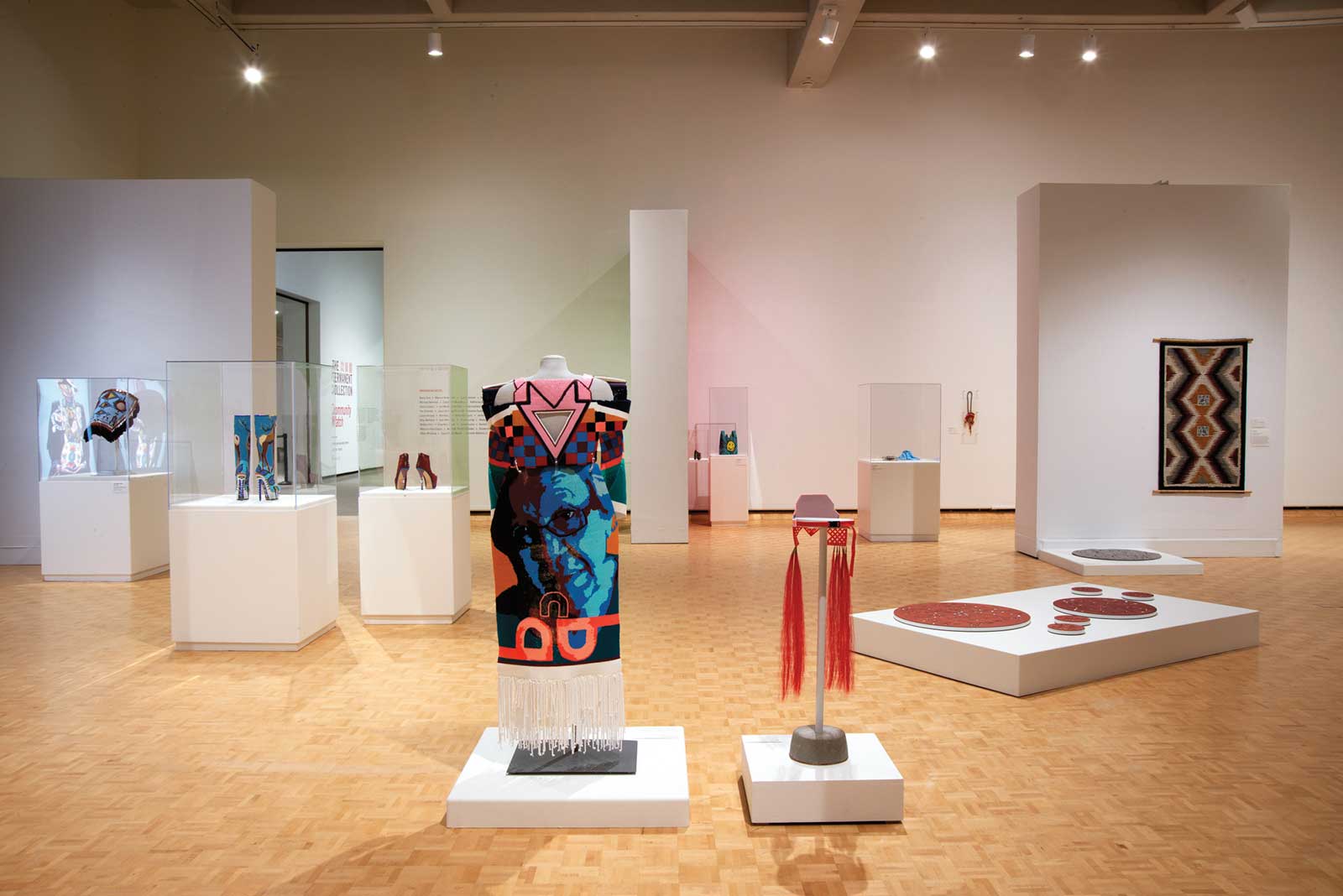 Installation view, Radical Stitch, Mackenzie Art Gallery, 2022. Photo by: Don Hall, courtesy of the MacKenzie Art Gallery.
Nico Williams, Anishinaabe and a member of Aamjiwnaang First Nation community, has created Aaniin, 2022, a tote bag with a smiley face design. He explains, “I choose to work with forms and objects that, like beadwork, have an overt—if often overlooked—relationship to gratitude, exchange and commerce, land, and the shaping, morphing ability of language. Sculptural geometries are a meeting point for technologies, stories and lineages of knowledge. Translating everyday, accessible objects into beadwork re-presents regular things from our daily lives to reattune us to their attraction and code-switching, overlapping, shifting resonances across cultural contexts and modes of identity. This deep layering of held meaning about the connectivity of the past and present, cross-cultural interweaving, and both the harshness and beauty of our current reality, shapes and motivates my practice.”
Through May 28, 2023
Radical Stitch
Art Gallery of Hamilton, 123 King Street West, Hamilton, ON, L8P 4S8, Canada
(905) 527-6610, www.artgalleryofhamilton.com
Powered by Froala Editor