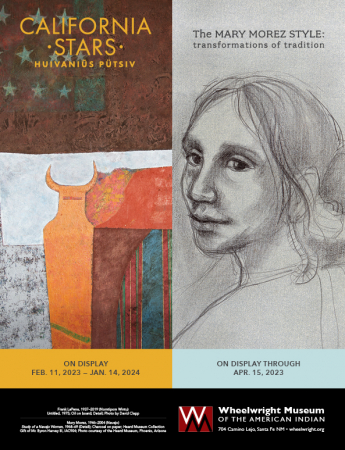
Currently on view at the Wheelwright Museum of the American Indian is a remarkable survey of the life and work of the renowned Navajo artist Mary Morez (1946-2004). She was not only a talented multidisciplinary creative, but is also recognized for her welcoming personality, adventurous spirit and above all, her strength. In the exhibition The Mary Morez Style: Transformations of Tradition, approximately 28 works of art spanning her career from 1969 to the late 1980s, highlights the “breadth and depth of Morez’s creative output, including her leadership in transforming Native art traditions into the global contemporary art canon,” describes chief curator Andrea R. Hanley.
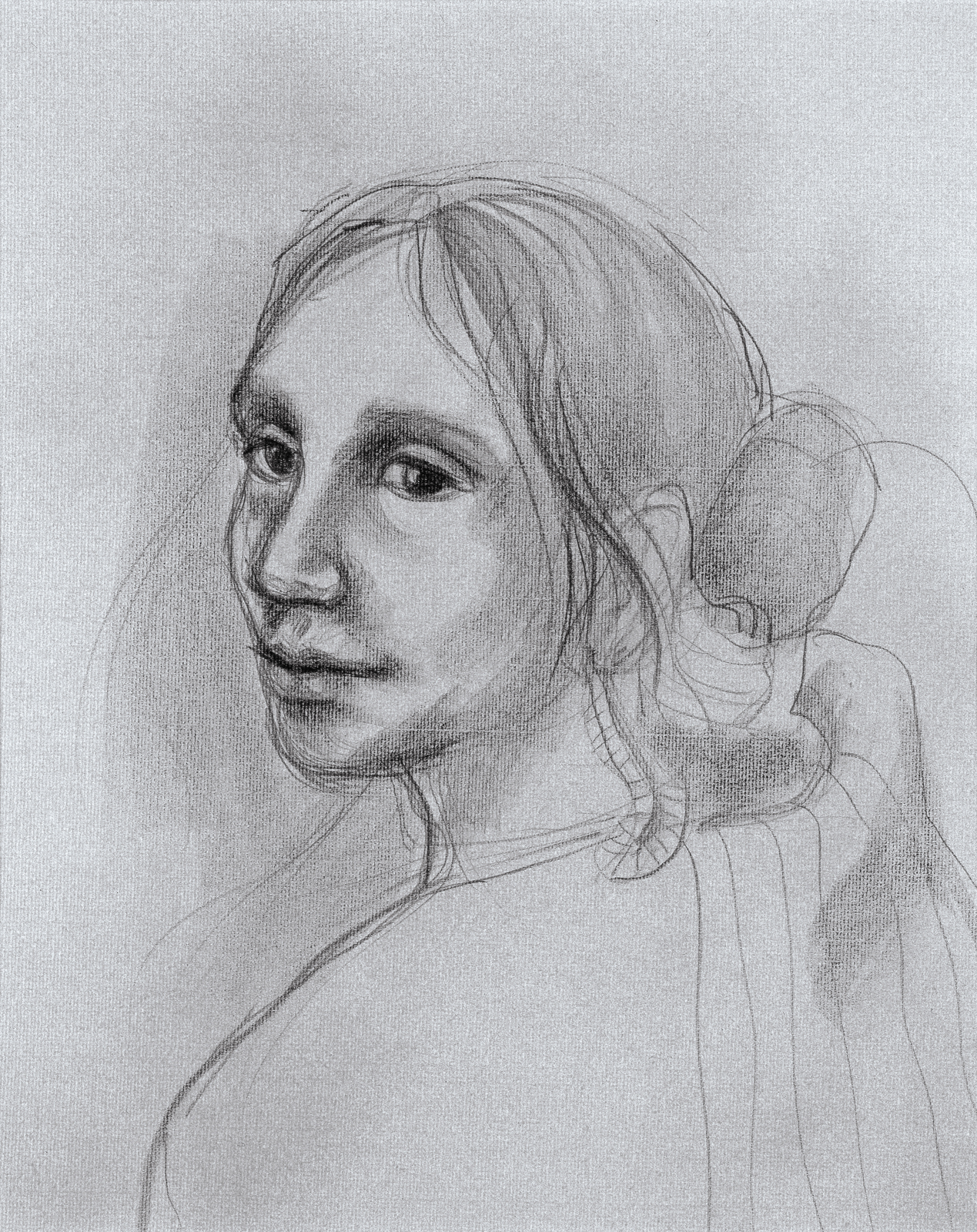 Mary Morez (Navajo, 1946-2004), Study of a Navajo Woman, 1968-69, charcoal on paper. From the collection of the Heard Museum, Gift of Mr. Byron Harvey III, IAC904. Photo courtesy the Heard Museum, Phoenix, AZ.
In her youth, Morez suffered several hardships, including the contraction of polio, rheumatic fever and losing both of her parents—which led to her adoption into a non-Native family. “A lot of things happened in the history of her life that made her a stronger person for it,” says Hanley. “It’s her strength that reveals itself in the exhibition.”
Despite Morez’s early adversity, she found herself succeeding in school, eventually earning a scholarship through the Southwestern Indian Art Project (SWIAP) in the early 1960s. “Directed by the University of Arizona Museum of Art and funded by the Rockefeller Foundation, SWIAP had an immense impact on the field, including the 1962 founding of the Institute of American Indian Arts in Santa Fe,” Hanley notes. “The project helped Morez establish her place, or rather her style, among other significant Native artists of the time. They were forging a new movement that expanded and merged traditional tribal art forms with international contemporary art aesthetics.”
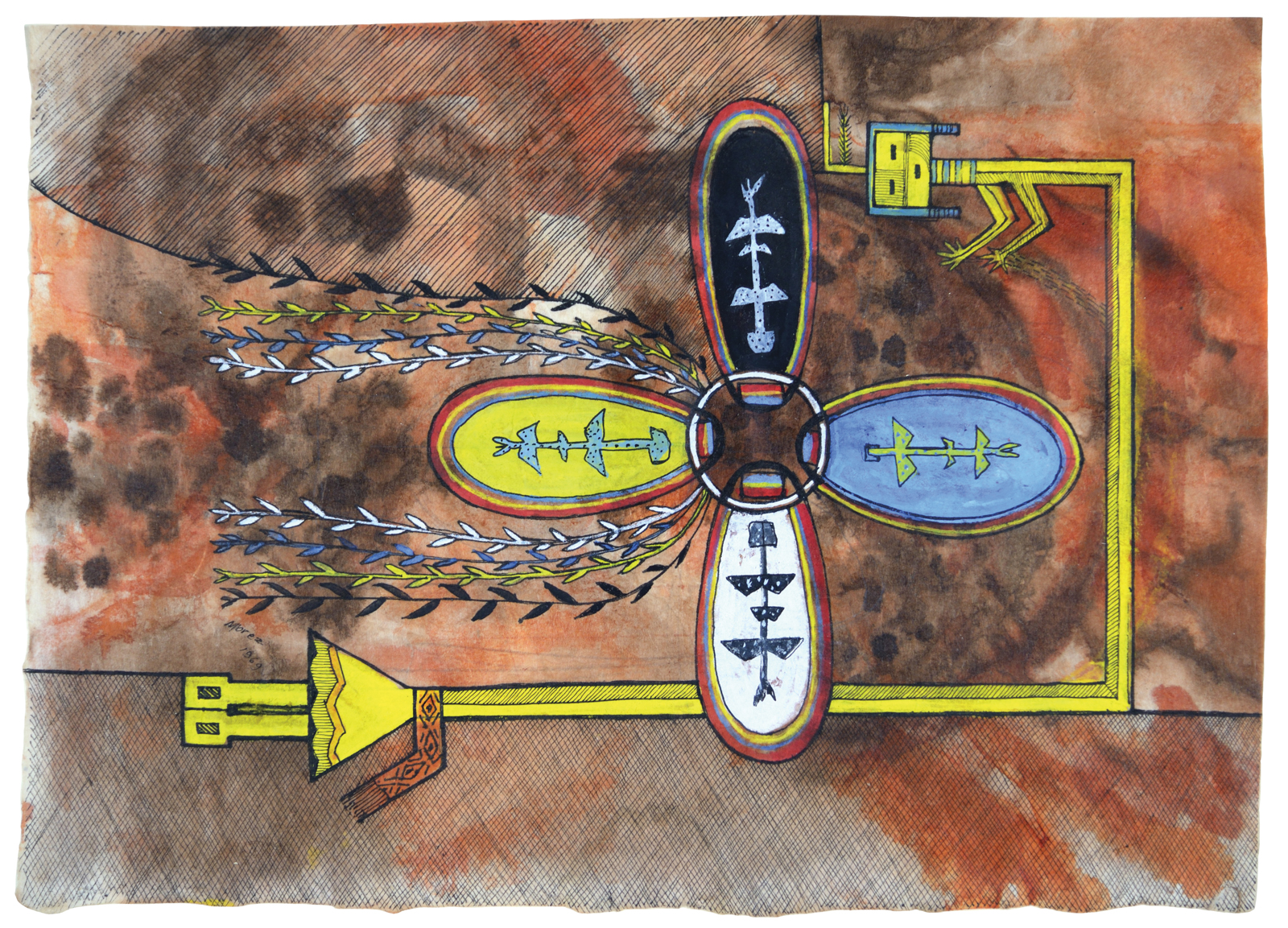 Mary Morez (Navajo, 1946-2004), Home of the Dragonfly, 1969, watercolor, pen and ink on paper. Photo by David Clapp, Wheelwright Museum.
The “Mary Morez Style” as it came to be known, was born out of this transitional time, and is “intertwined with an Indigenous feminist discourse and synthesizing Navajo artistic tradition with modernism and semi-abstraction,” Hanley continues. Morez’s work exudes emotional depth and celebrates her own experiences as a Navajo person while remaining fluid in her subject matter and choice of medium throughout her career—ranging from graphic design and illustration, to painting, drawing and textiles.
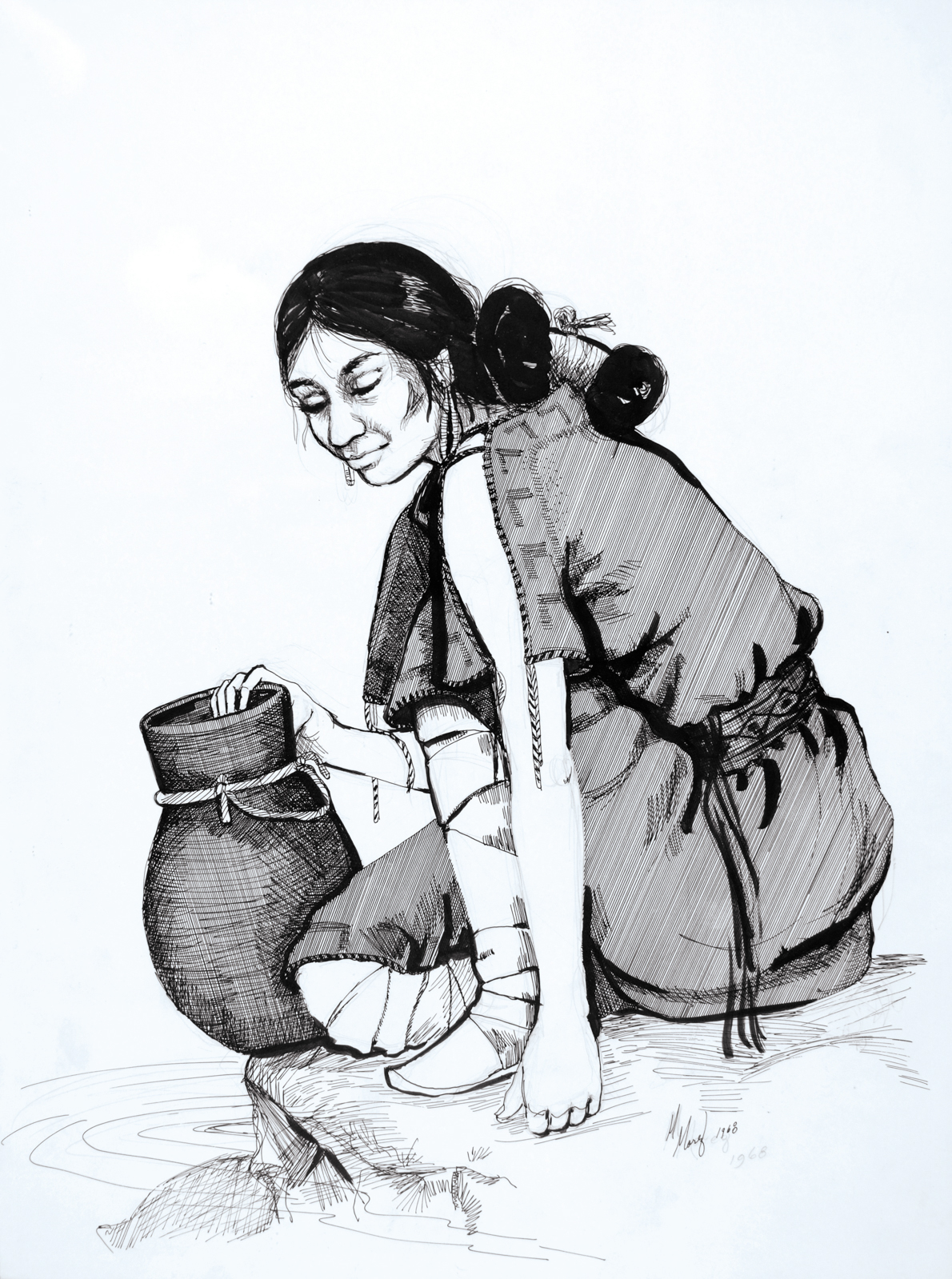 Mary Morez (Navajo, 1946-2004), Edgewater Clan Women, 1968, ink on paper. Photo by David Clapp, Wheelwright Museum.
One of the top highlights featured at the exhibition is Study of a Navajo Woman (1968-69), a charcoal on paper portrait on loan from the Heard Museum. “It’s just an iconic drawing of a Navajo woman,” Hanley says. “You can see her use of clean, bold lines—mastering these realistic depictions of everyday Navajo life. Her figures once started out realistic and then got more abstracted, but she never left figure drawings behind. Morez’s studies of Navajo women are especially poignant and reflective of the loss of her own mother as a child.”
Hanley notes that show pieces like Home of the Dragonfly, a watercolor, pen and ink piece depicting abundant color and symbolic imagery, “embodies the ‘Mary Morez Style.’ It feels like an undeniable modernist piece, but combines Navajo elements with contemporary abstraction. It transforms tribal and personal imagery.”
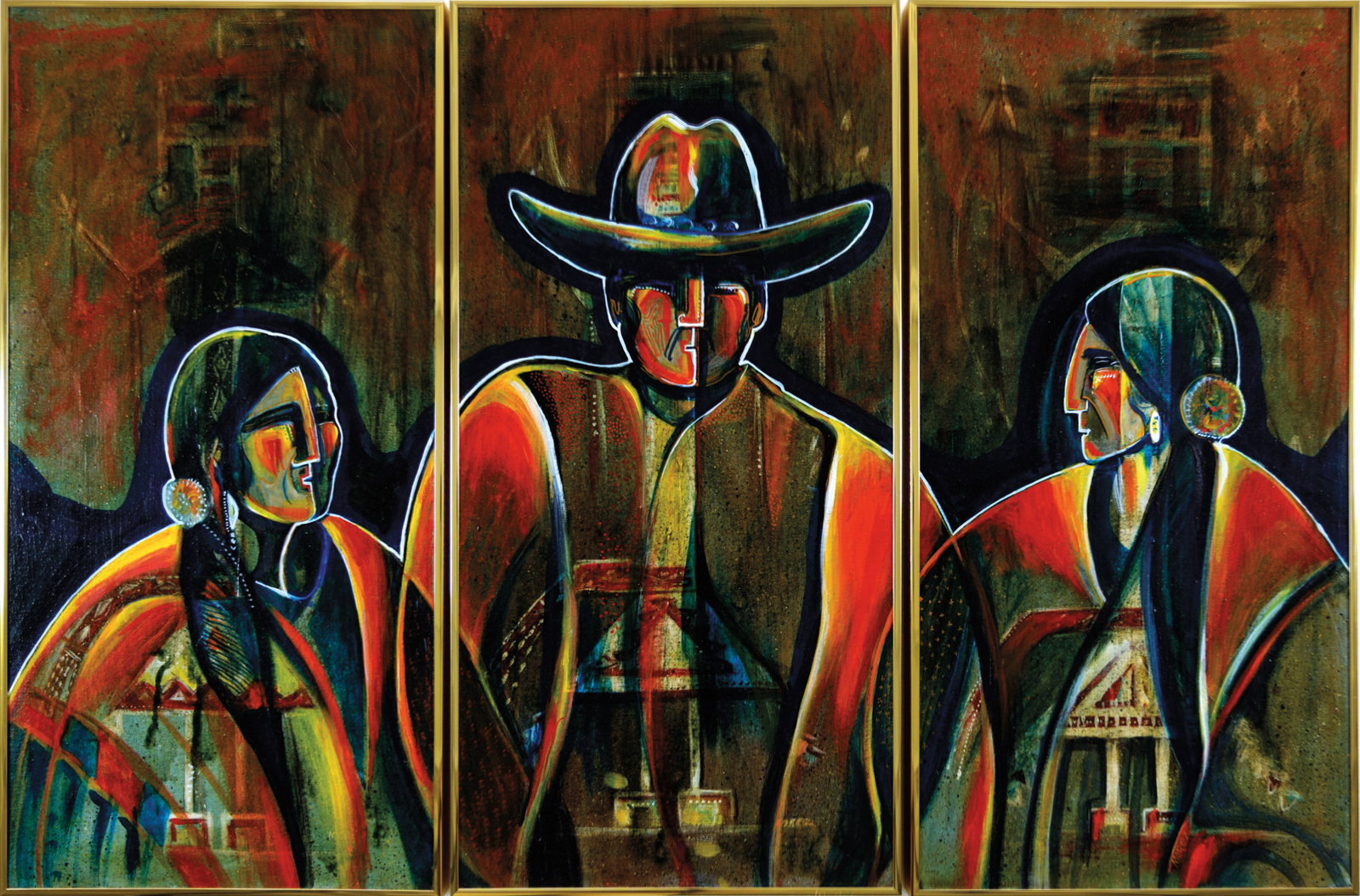 Mary Morez (Navajo, 1946-2004), Pow Wow Night, mixed media on canvas, triptych. Photo by David Clapp, Wheelwright Museum.
Morez also sustained a creative presence outside of her visual art career, serving as a curator at the Heard Museum in Phoenix, Arizona, where she lived most of her life, as well as an art consultant to the Wheelwright Museum of the American Indian, once called the Museum of Navajo Ceremonial Art, in Santa Fe, New Mexico.
The Mary Morez Style: Transformations of Tradition exhibition will remain on view at the New Mexico museum through April 15, 2023.
Through April 15, 2023
The Mary Morez Style: Transformations of Tradition
Wheelwright Museum of the American Indian
704 Camino Lejo, Santa Fe, NM 87505
(505) 982-4636, www.wheelwright.org
Powered by Froala Editor