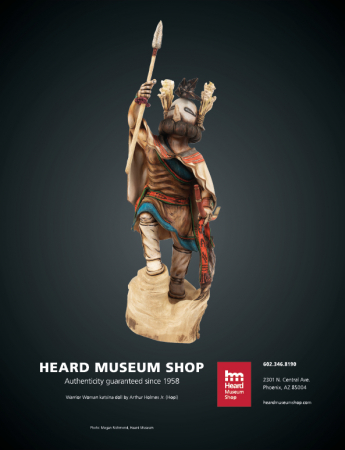
Every year during the Museum Guild Indian Fair & Market, event organizers invite a handful of artists to show their work outside of the regular market area. They don’t have booths, but they do have a world-class gift shop as the backdrop for their artwork as they set up in the Heard Museum Shop.
This year, six artists have been chosen to show in the shop: Denise Wallace, Ray Tracey, Andersen Kee, Boyd Tsosie, Tim Blueflint Ramel and Doug Hyde. They will exhibit their work alongside the other material on view in the shop. Although the setting will be somewhat more formal—and air conditioned with constant shade—the artists in the shop can still meet collectors, answer questions and have discussions about their artwork.
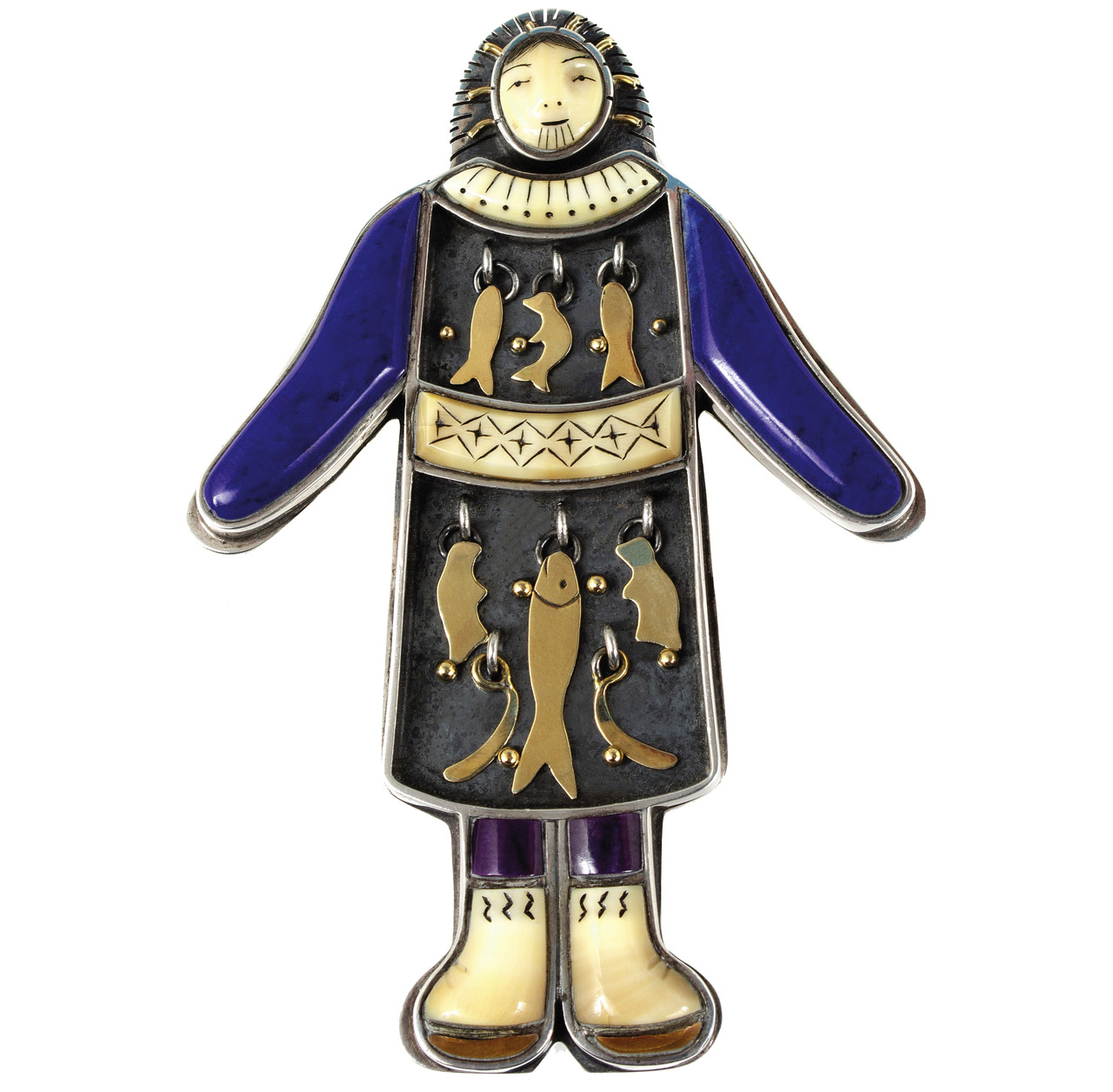 Denise Wallace (Chugach Sugpiaq/Alutiiq), Imam-Shua II, sterling silver pin/pendant inlaid with sugilite, lapis and fossilized ivory
Ramel, a Bad River Chippewa and Comanche artist from California, is looking forward to showing in the shop for this year’s market. He will not only be showing his award-winning flutemaking, but also his jewelry. “I’ve heard it said that, ‘All roads lead to the Heard.’ For me, all roads began at the Heard, since it was among the first juried Native American art markets that
I participated in and the first to recognize my work.
I am both proud and honored that the Heard Museum has played such a significant role in the support, development and advancement of my art career since early on,” he says. “I will be bringing both my flutes and my jewelry. I have been working this winter to acquire new tools, to refine existing and develop new skill sets that will be incorporated into new designs and ideas that I’m really excited to share.”
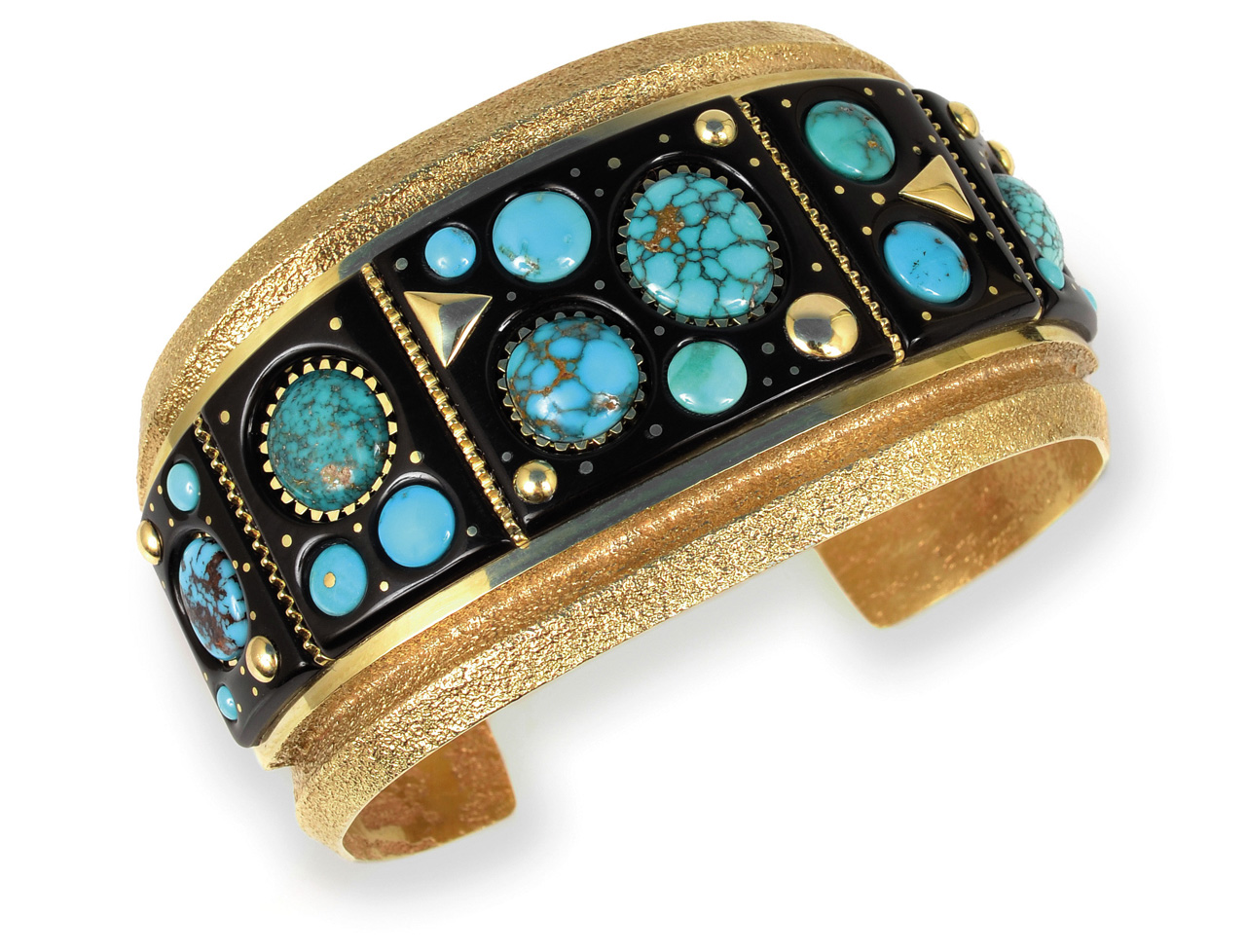 Boyd Tsosie (Navajo), 14k cuff bracelet inlaid with buffalo horn and turquoise (Lone Mountain, #8, Red Mountain and Indian Mountain)
Because his work can be very personal—things that are worn on the body and musical instruments—Ramel thinks of himself as a storyteller. “I have a lot of quiet time in my life, and I reflect, and I remember, and I dissect…So when I think about these special pieces I make, it all begins with a story. I ask myself, how do I tell this story? What’s the lesson contained within the story? How do I make someone feel the essence of the story just by looking at a piece? Many of these pieces, the designs evolve for years. As I am creating, I have to have confidence in the piece, the design and the message to allow it the space to evolve,” he says. “The materials I curate for my works can take years to find and acquire. I hand-pick all my exhibition-grade domestic and exotic woods, which can involve quite a bit of travel. While a specific wood may be known for its beauty, that doesn’t specifically mean that it will convey the tonal qualities that I demand. I want to be able to examine it closely and test for its vibrational qualities. The stones and corals are often curated in much the same manner. I only use natural or gem-quality materials in my jewelry, which means much of it is old stock, often from mines that are no longer operational or have been exhausted. Recently, I have invested in corals harvested in the 1930s through the 1960s that were acquired from an Art Deco collection. It’s exciting for me to envision how these rare and exotic materials will enhance the stories within my work.”
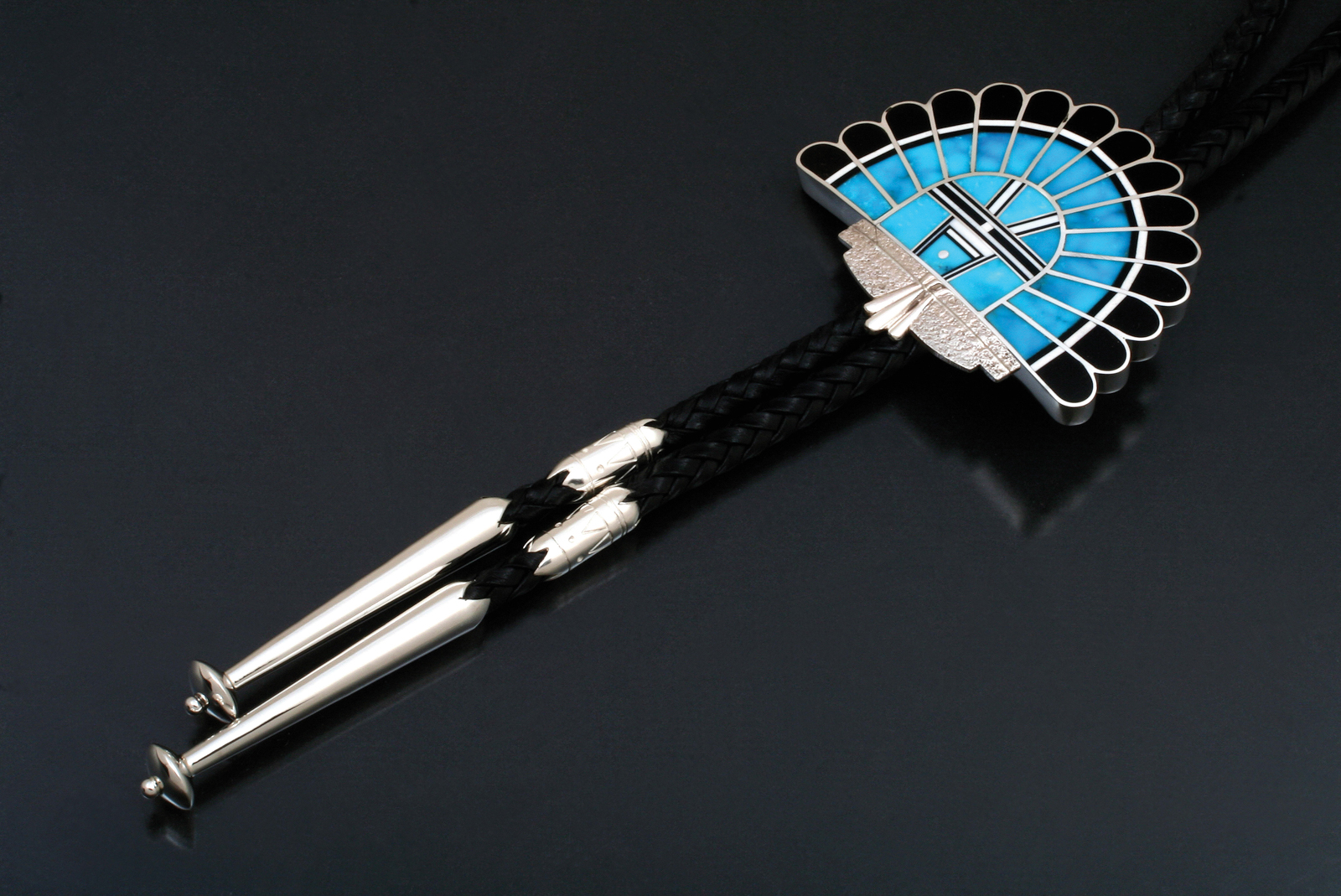 Ray Tracey (Navajo), Yei headdress inlay bolo tie
Tracey is another jeweler in the shop at the 2023 market. He, too, has had a long relationship with the Heard Museum. “I had my first showing at the Heard Museum 30 years ago. Life took me on a different path. I was trying my hand at producing movies. I came back to the Heard Market by invitation from Laura Cardinal eight years ago,” he says. “The work I do is Southwest traditional and contemporary jewelry. I incorporate Navajo styles from the early 1900s with turquoise as accents to my silverwork. I also do contemporary inlay work using different kinds of stones such as coral, sugilite, turquoise, lapis and shell. My inspiration comes from stories handed down from generation to generation. My grandfather and father told me stories of their childhood. In those stories there were legends of our ancestors. My grandfather held those stories sacred and told me to give them reverence.”
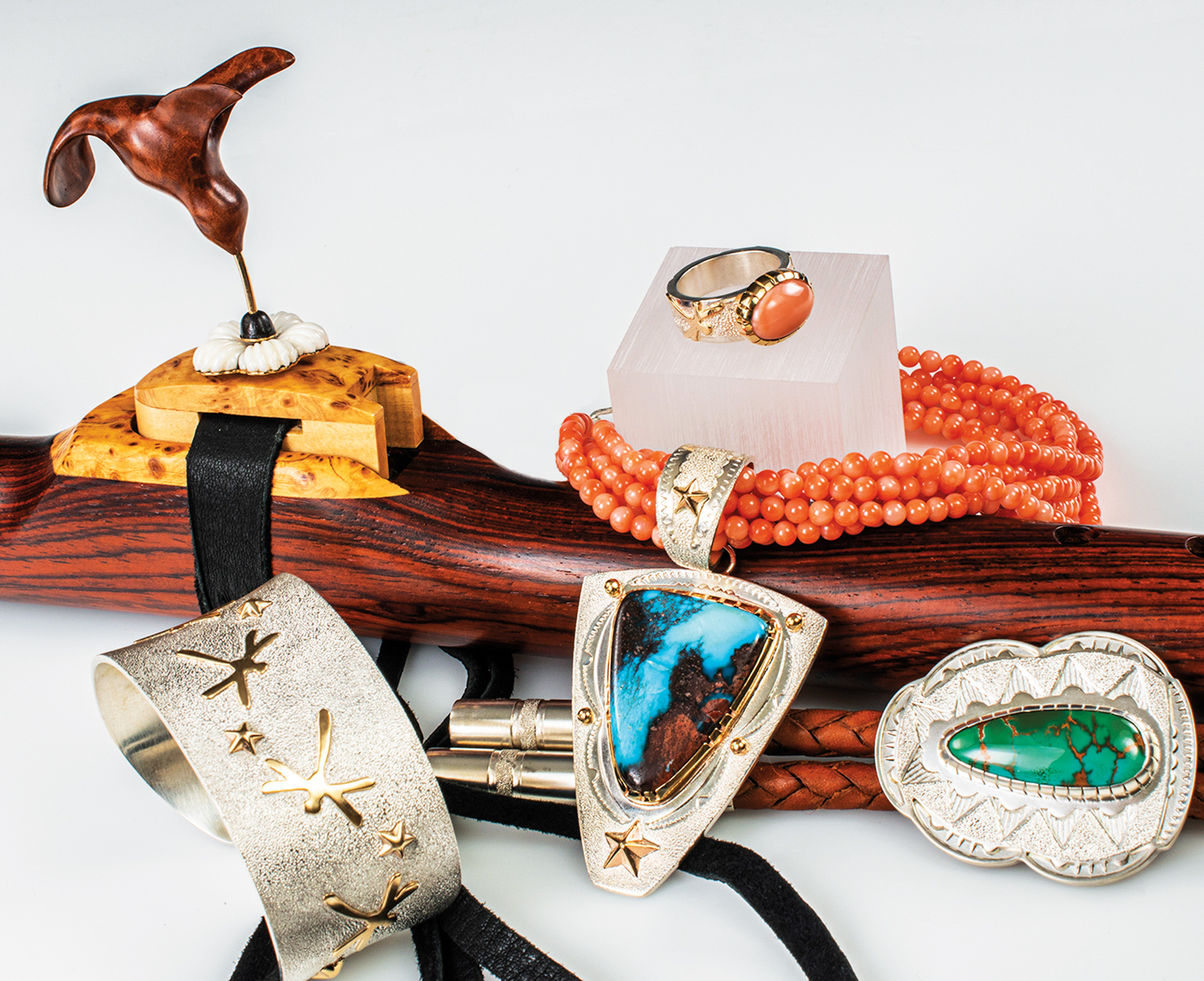 Tim Blueflint Ramel (Bad River Chippewa/Comanche), a carved flute and various pieces of jewelry
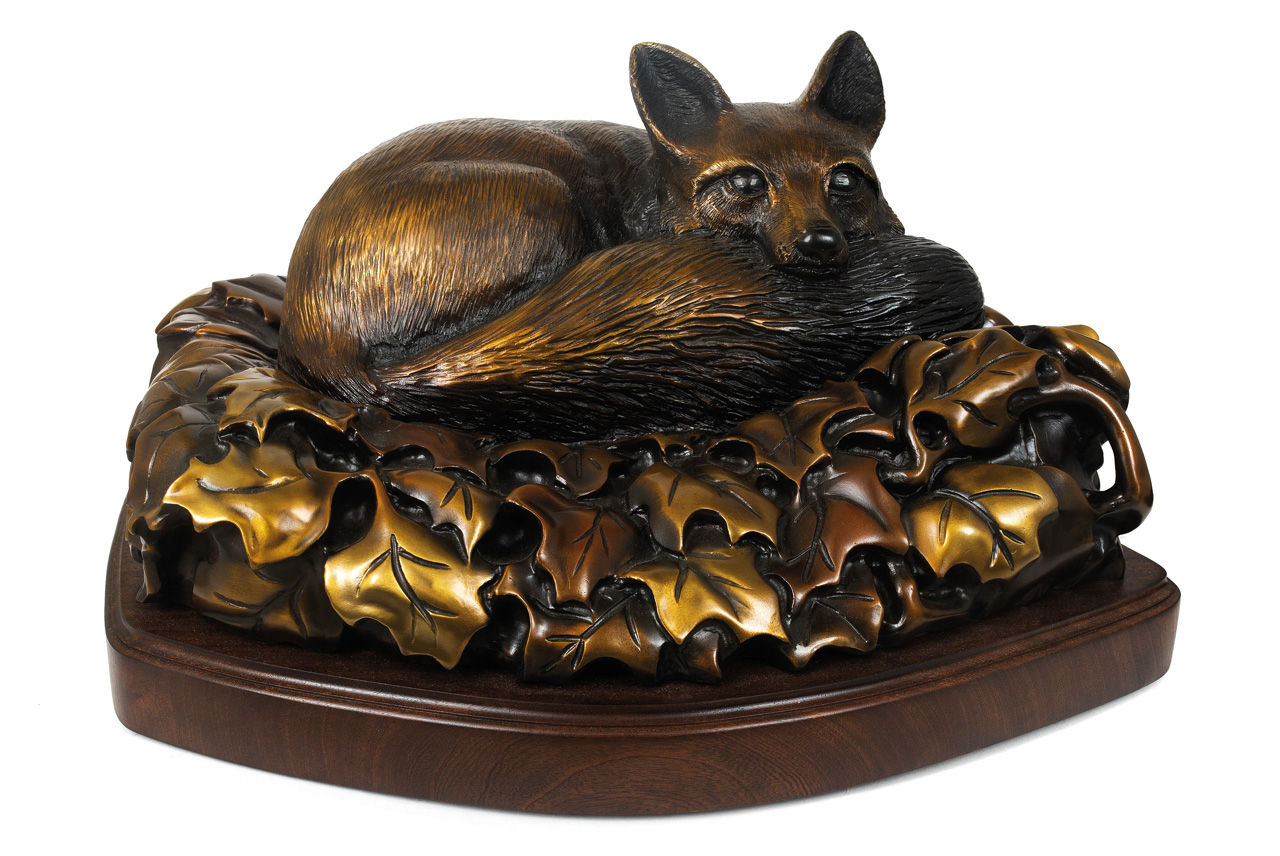 Doug Hyde (Nez Perce/Assiniboine/Chippewa), Lying Low, bronze
Tracey works primarily in silver using tufa and sand-casting methods. “This technique was brought to America by the Spaniards,” he adds. “The Navajo learned from the Spanish how to make silver jewelry. We refer to this technique as traditional style.”
Wallace will be showing her jewelry inspired by her Alaskan Native heritage. She has been showing with the Heard since the 1980s.
“I will be bringing a collection of jewelry that I have made recently…that tell stories about my Alaskan Native background and some of the current situations that we face as Native people,” she says. “We use sterling silver, 14k gold and fossilized walrus tusk, as well as many semi-precious stones. All the metal is hand-fabricated and the stones and tusk are hand-carved and fit to the pieces. We also scrimshaw tusks.”
Tsosie is another jeweler who will be showing in the shop. He’s been making Navajo jewelry for more than 50 years and was taught by the famous Kenneth Begaye, then a teacher at the Navajo Community College. Today, Tsosie’s work is collected at the highest levels. “Boyd Tsosie is a jeweler who draws inspiration from the rich heritage of his Navajo traditions,” notes Waddell Gallery, which represents Tsosie’s work in Phoenix. “Over the years, Boyd has developed a contemporary style of work primarily in 14k gold combined with turquoise, coral, lapis and sugilite. Boyd feels that he is creating ‘tomorrow’s tradition’ in Navajo jewelry by being given the rights and prayers by his elders to create his special pieces. He is featured in Navajo Indian Jewelry and Enduring Traditions by Jerry and Lois Jacka and North American Indian Jewelry and Adornment by Lois Dubin.”
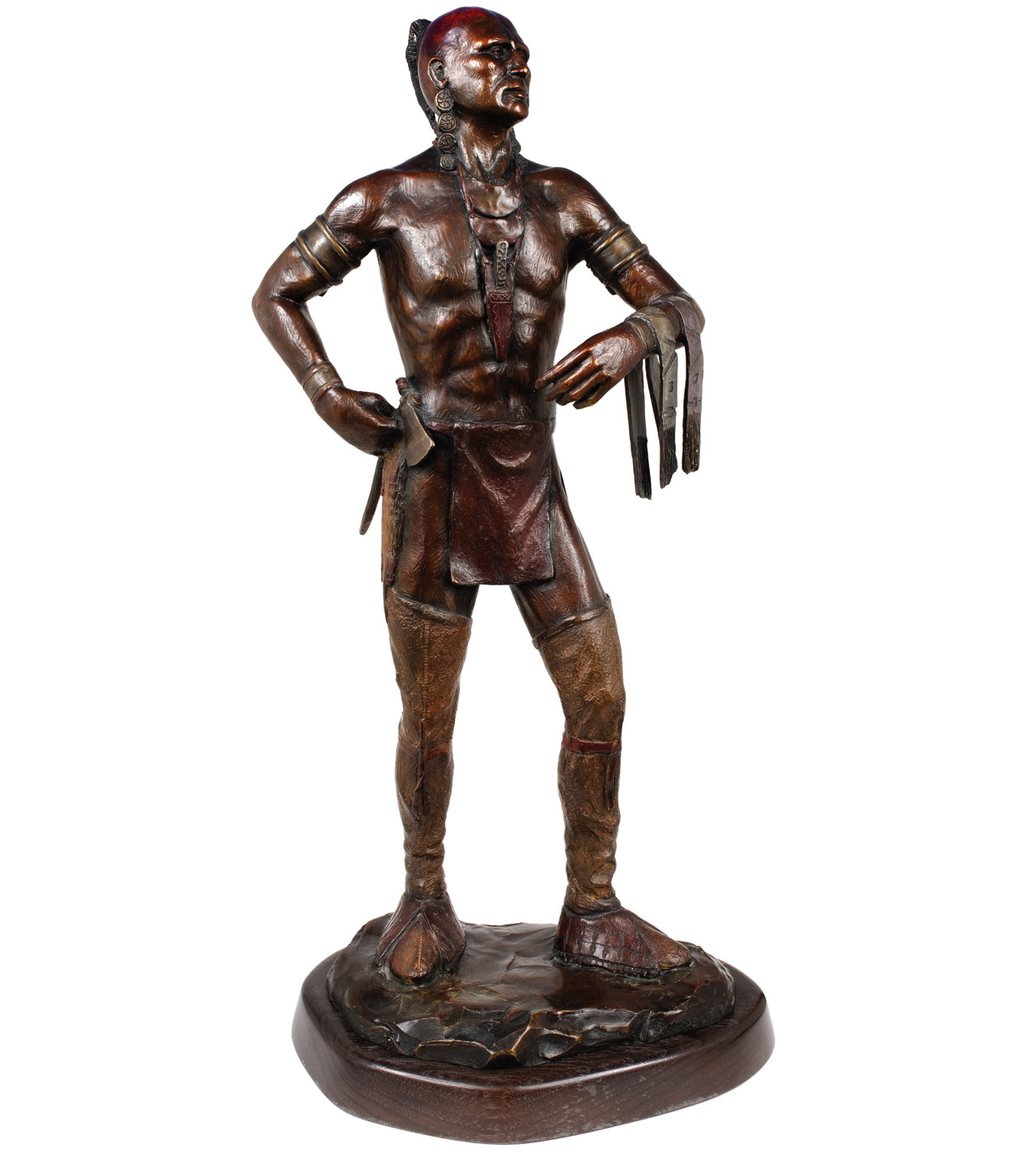 Doug Hyde (Nez Perce/Assiniboine/Chippewa), Chief Little Turtle, bronze
Kee will be showing both painted works and jewelry, both of which reflect his upbringing on the Navajo reservation in Northern Arizona. As True West, his gallery in Santa Fe, New Mexico, notes, Kee’s father worked on the railroad but supplemented his income as a silversmith, while his mother was a weaver when she wasn’t busy raising 14 kids. “Andersen was smack in the middle: lucky number seven,” the gallery notes. “But he liked hanging out with his older brothers, which is where he learned to ride.”
“My dad had a herd of mustangs: at the most 30 head, at the least 10, and a few we kept around the homeplace,” Kee says. “It was open range and it was the kids’ job to go check on the herd. Being the youngest, my brothers got all the saddles, so if I wanted to go along, which I always did, I had to ride bareback.”
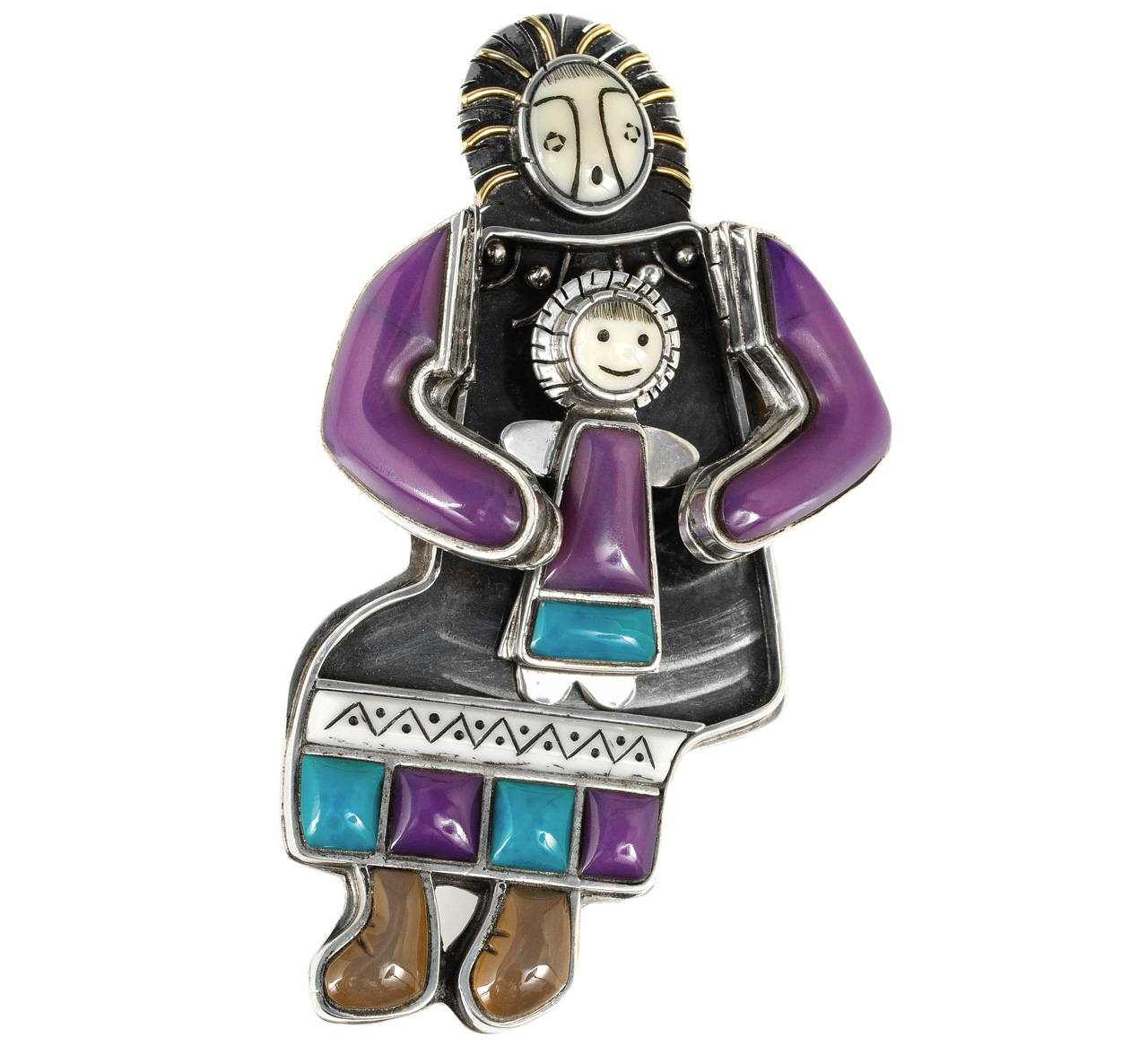 Denise Wallace (Chugach Sugpiaq/Alutiiq), Dollmaker II, sterling silver pin/pendant inlaid with fossilized ivory, sugilite and chrysacolla
Later, Kee went to the prestigious Institute of American Indian Arts in Santa Fe, then completed two years at the California College of Arts and Crafts. Finally, Hyde will also be showing at the shop. The Northern Arizona sculptor is no stranger to the museum—he has several major bronze works at the Heard Museum, including Intertribal Greeting, a monument in front of the Steele Auditorium right outside the shop entrance. The artist—Nez Perce, Assiniboine and Chippewa heritage—is another IAIA student, and he even worked for a time and became friends with the great Allan Houser before Hyde went to Vietnam with the U.S. Army.“When I returned from Vietnam and worked in a friend’s tombstone factory in Colorado, I got into modern tools like saws and grinders,” he says.
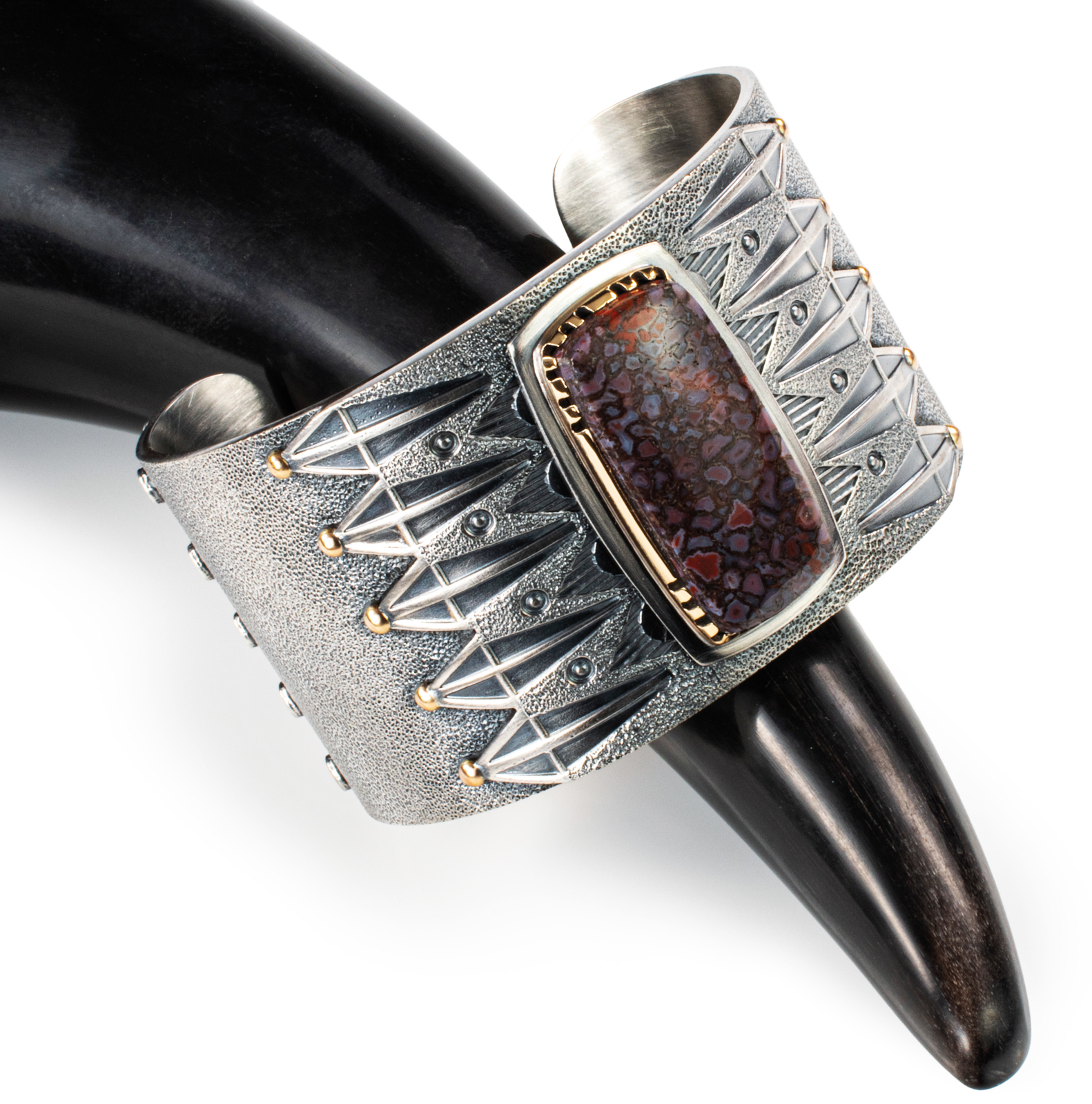 Tim Blueflint Ramel (Bad River Chippewa/Comanche), agatized dinosaur bone, stamped, overlay and textured sterling silver and gold cuff
“I returned to teach at IAIA and brought that technology into my classes, using air compressors, air hammers and sandblasters. I taught the students to work with the equipment and told them that if they were going to make a living at sculpture, they needed to carve things faster to meet the market while not ruiningthe quality.”
Today, Hyde’s work is collected all around the Southwest, in both Western and Native American art collections.
During the market, the Heard Museum Shop will also feature author and appraiser Terry DeWald, who is a recognized authority on numerous Native American subjects, including basketry.
The shop artists will be available throughout the market.
Powered by Froala Editor