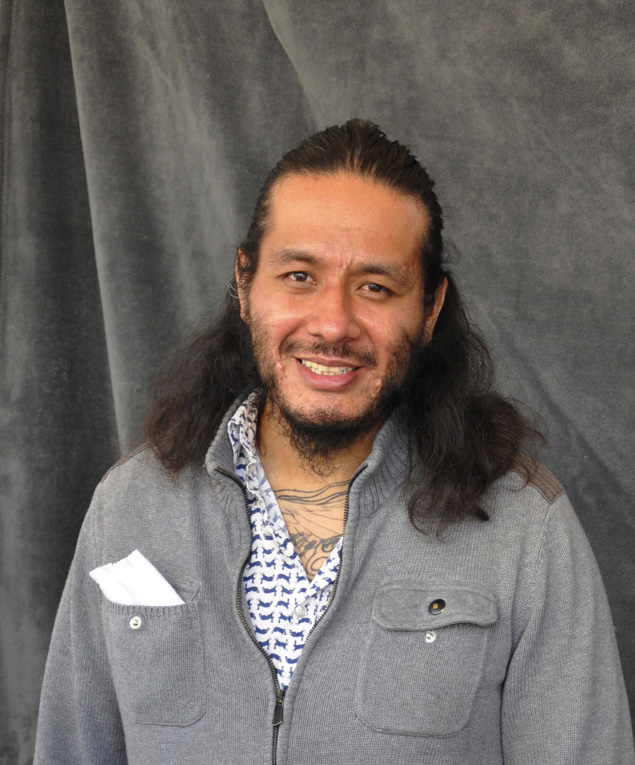
Talent arises from many sources, but sometimes a dual heritage sparks this emergence. A good example of this comes with the work of Keli’i Eli. He firmly believes that being half Zuni and half Hawaiian with a “smidge” of Irish gives him a unique background. “What a mix, right?” this tall, cheerful young man declares.
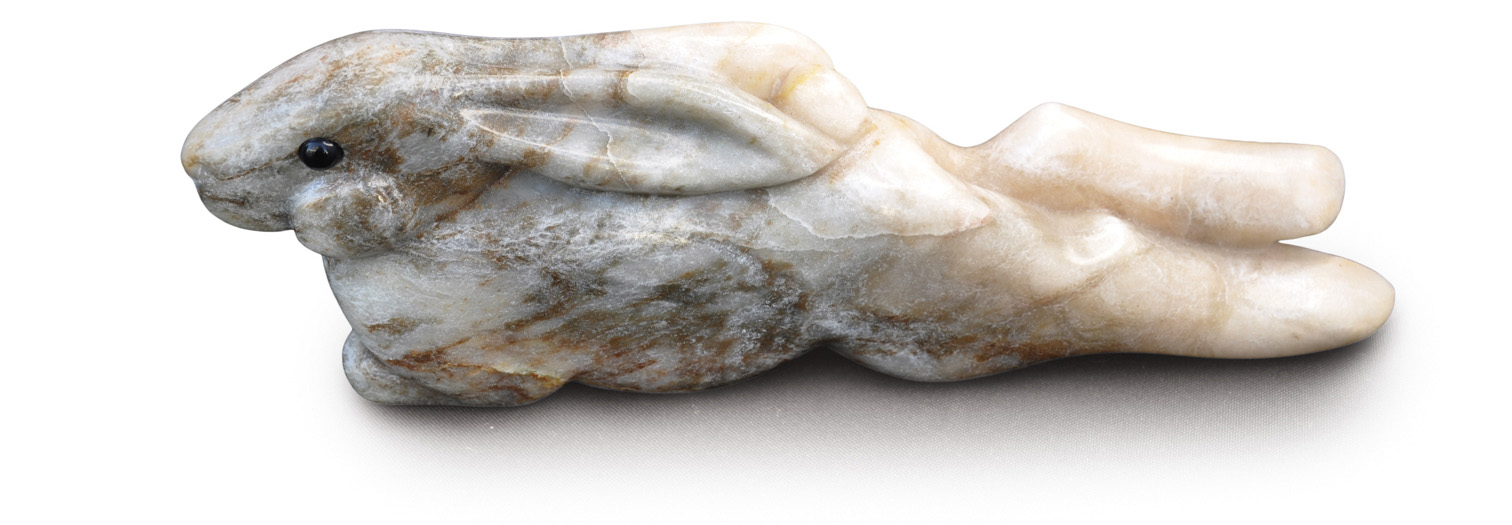 Racing Rabbit, New Mexico cream alabaster
His aptitude for carving has drawn many eyes since he began seriously sculpting in 2018. Eli credits his adeptness to guidance from Indigenous artists who showed him how to become expressive technically and aesthetically.
The story begins, naturally enough, with his birth in Gallup, New Mexico. The infant Eli started life with a rare childhood disease which affects those from newborn to age seven. His father, Damon Kaleihua Eli, and mother, Zuni Native ErmaLinda Pooacha-Lolepa Eli, were heartbroken but deeply relieved when their two-year old finally shook off the disease after a number of traumatic months. To this day, Eli feels this scary start to his existence taught him to “live my life purposefully.”
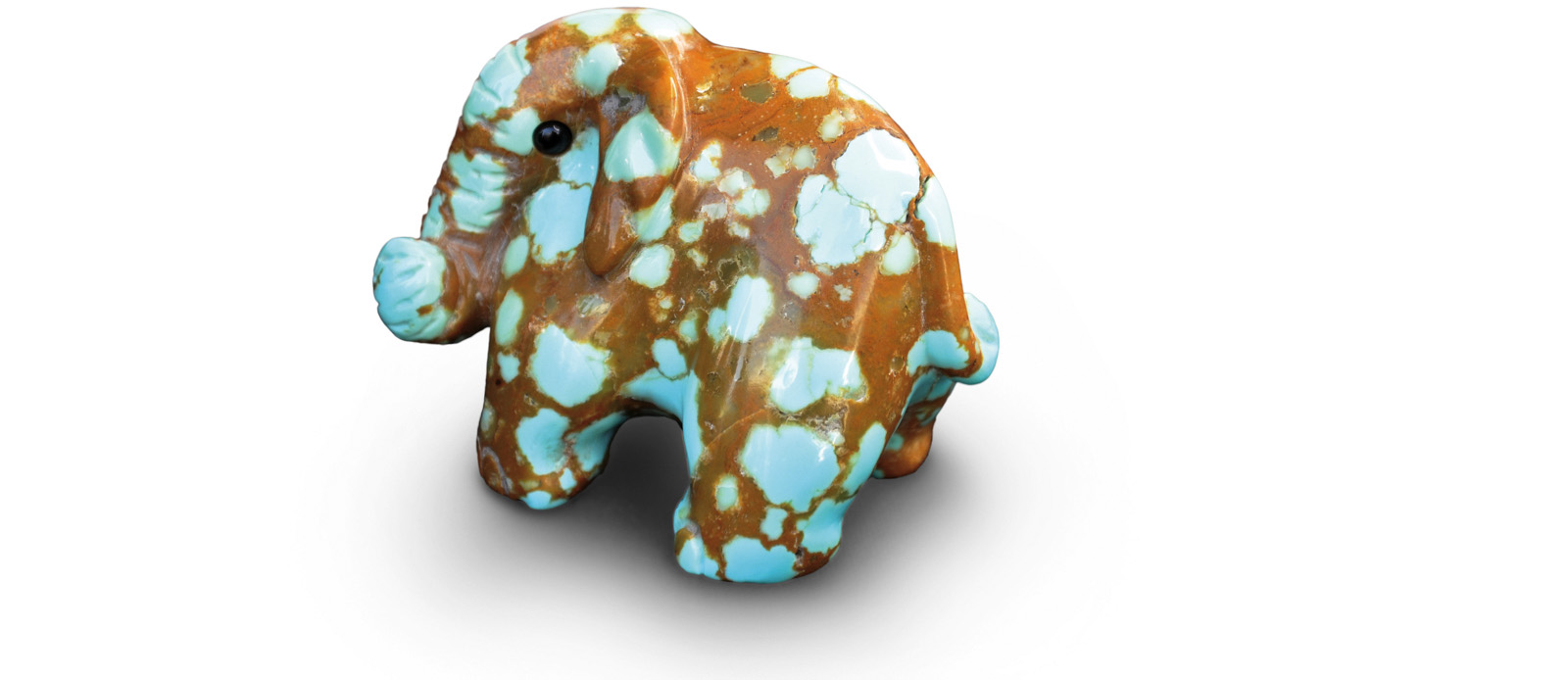 Elephant, Number 8 turquoise
Zuni was always considered home and frequently visited, but his father’s Navy career had them moving from California to Hawaii. Eli graduated from Waianae High School in 2003 and enlisted in the U.S. Navy in February of 2004, but didn’t undertake his first tour until 2007 during Operation Iraqi Freedom.
Eli returned to Zuni after he left the Navy in 2008. His maternal grandfather, Amos Pooacha, was a traditional silversmith, and his grandmother, Delphine, a talented seamstress. He learned from the artistic work of a cousin, and took advice from fetish carver and sculptor Gabe Sice, who said, “Get used to the equipment and have fun!” Their conversations led him to stone supplier Myles Schachter, owner of 2sculpt.com. As a result, Schachter became Eli’s mentor, along with other Native sculptors who shared their knowledge, expertise and friendship.
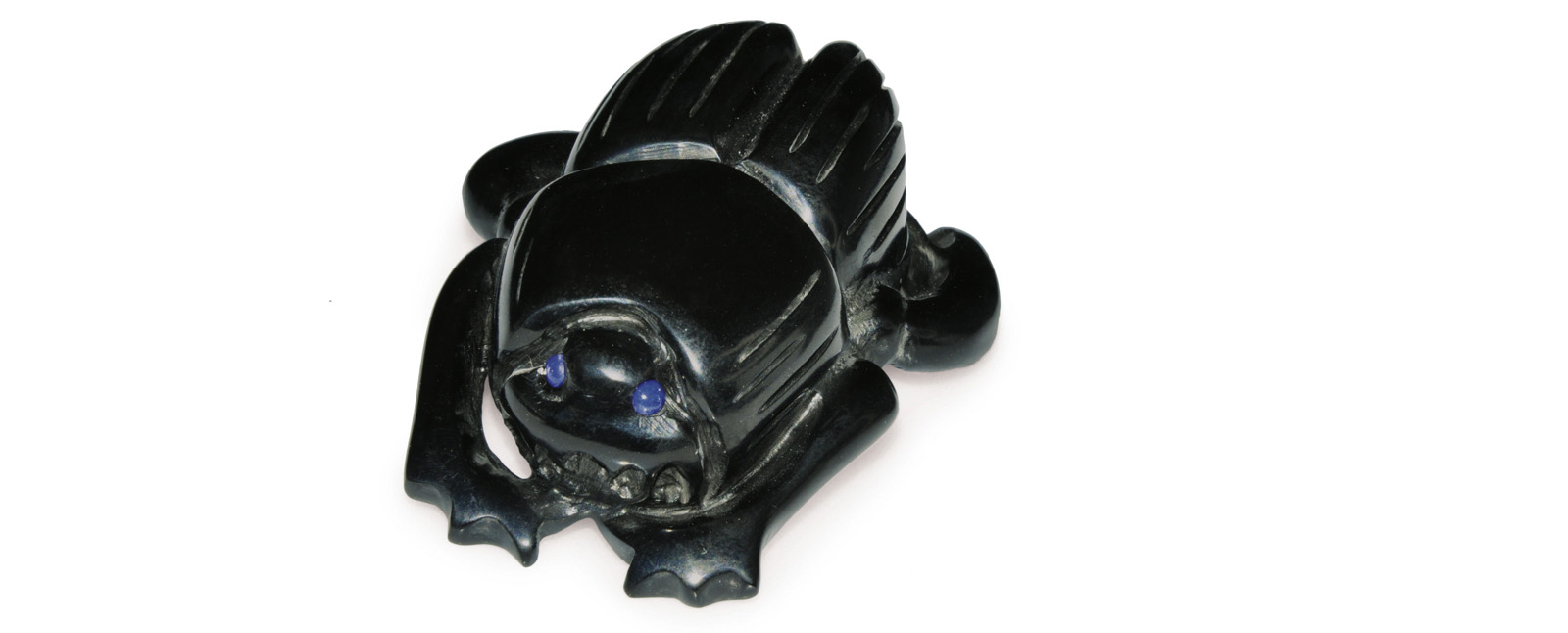 Beetle, Philadelphia jet
Since he began sculpting, Eli, who carves both small fetish-size and larger pieces, especially likes working with alabaster and calcite stones because of their transparency, natural veining and colorful hues. He is also mindful that these visual qualities reflect the fetish’s curative medicine and spiritual qualities for protection. He hopes to sculpt marble, limestone and granite in the future. He speaks with animation, moving from enthusiastic to reflective, and back.
Eli sees himself as a life-long learner and credits his mind as the most powerful tool of all. “Harness that, and you can do anything you set your mind to achieving. You’ll know when you’re ‘getting it right’ when everything comes together as it should, nothing forced.” There are no particular animals he most likes to carve, feeling his inspiration should be open to new possibilities.
He experiments with new methods regularly and immerses himself in diverse imagery. His cousin, a potter, showed Eli how pottery designs were a form of Indigenous communication; this helped him to commemorate “the time of both past and present into now.” Eli also discovered the sculptural power of tufa stone casting from master smith Darryl Dean Begay. Elements of his various adornment studies, including the concept of wearable art, came together in his first jewelry creations, which combined the textural elements of fetish carving with decorative animation. His pieces range from distinctive outlines of a whole animal or bird in depth to vignettes such as a buffalo head or bird design. He accepts commissions for such work from collectors drawn to specific types of imagery.
Equally mindful of marketplace demands, Eli sought training and education in healthcare. When the sudden destruction of the Covid-19 pandemic began in early 2020, Eli’s grandmother was the fourth Zuni tribal member to succumb to the virus. Eli was roused to take action. Greatly concerned by the lack of PPE supplies to be found in the Pueblo, he became an activist for locating, ordering and delivering these materials to those in need. He helped organize fundraisers and related activities, injuring himself in the process. Eli took this misfortune in stride, claiming it as “no good deed goes unpunished.”
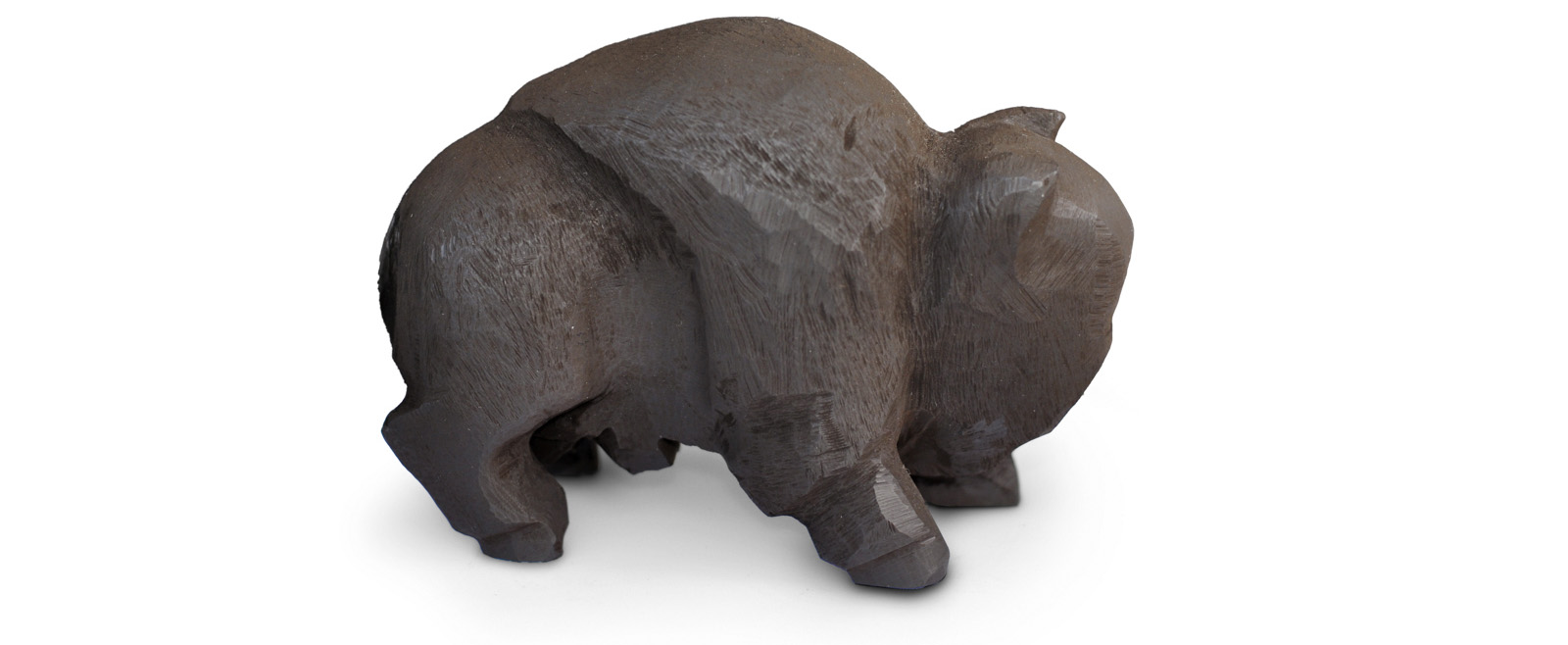 In-process buffalo, Pennsylvania jet, 2022
What makes this Indigenous man so remarkable in his three-dimensional work is the sheer imaginative range of his physical creations; he carves animals (exotic and domestic), birds, humans and fantastical figures. He brings out an aspect of every creature that speaks to its spirituality. Depending on the stone he uses, Eli’s pieces emerge with taut, smooth surfaces or are marked by strong physical definition. Musculature features are superb—the viewer feels the animal’s crouch or spring. Dignity also marks their delineation. This attribute can be seen whether in the great muscles of a bear or the spring of a rabbit ready to streak away to safety.
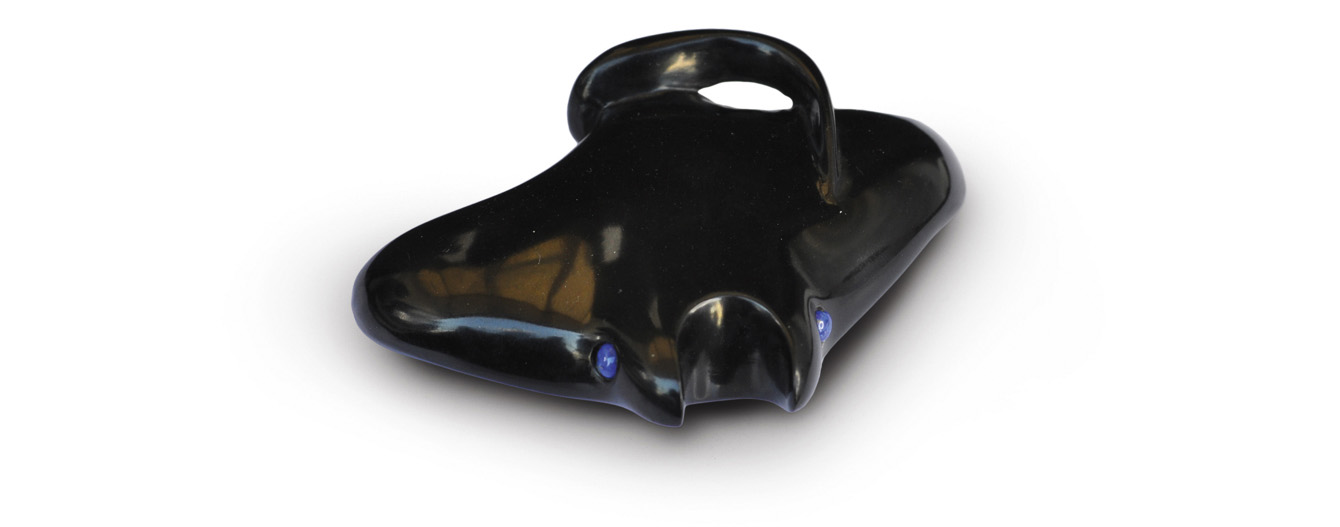 Stingray, Pennsylvania jet
At the recent 2022 Heard Museum Guild Fair & Indian Market, Eli offered pieces which reflected his unique style. A few were displayed in-process, permitting the viewer to see an animal emerge from the stone. The figures varied greatly but remained identical in charm, from a shy elephant to a startlingly exquisite stingray with piercing blue eyes. Humor was evident in Eli’s carved Sasquatch, the sole fantasy creature in the lineup.
Eli is in the sixth year of carving fetishes, a heritage passed on to him by his Zuni ancestors. He believes that his Native heritage helps him understand that stones have a spirit within. Stones speak to him, having a voice that conveys to him the way the stone wants to be in its new life. “Everything has a voice, just because they don’t talk like you and I do doesn’t mean they cannot communicate.” He feels that he must put his best effort into doing whatever it takes to bring the message in the stone to fruition.
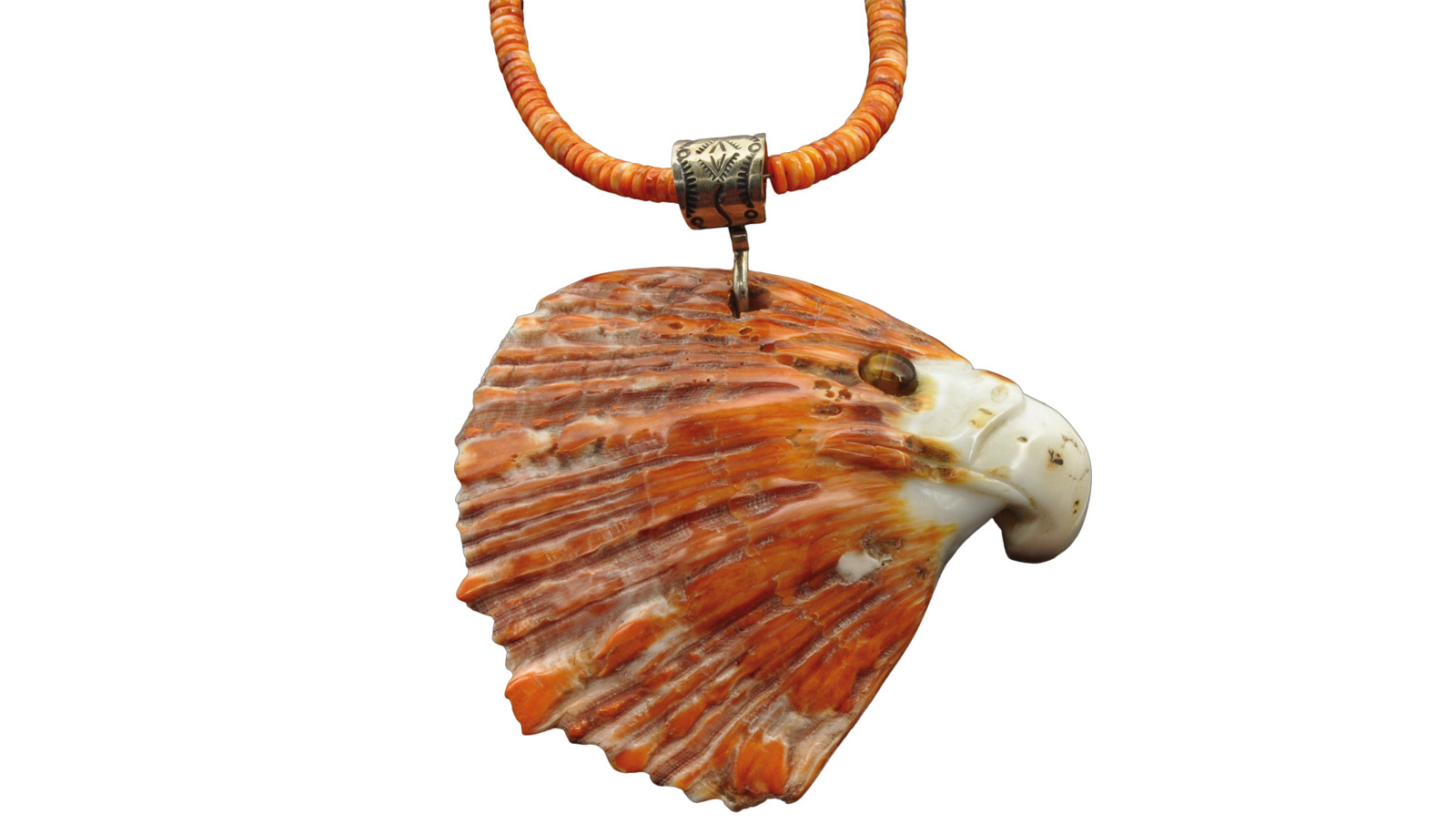 Eagle-head pendant, spiny oyster shell, 2020
He is grateful for the collectors who buy and commission his work. Like other Zuni artists, he has a special affection for Bronwyn Fox, a founder of the Keshi Foundation and manager of the Keshi Gallery in Santa Fe. She became a wholehearted supporter of Eli’s fetishes, sculpture and unique pendant jewelry. Collector attention has built rapidly for someone still relatively new to the Indian arts market. Eli exhibits at most of the Indian arts shows in the Southwest, large and small. He’s also paid attention to constructing social media and online website platforms to sell his work.
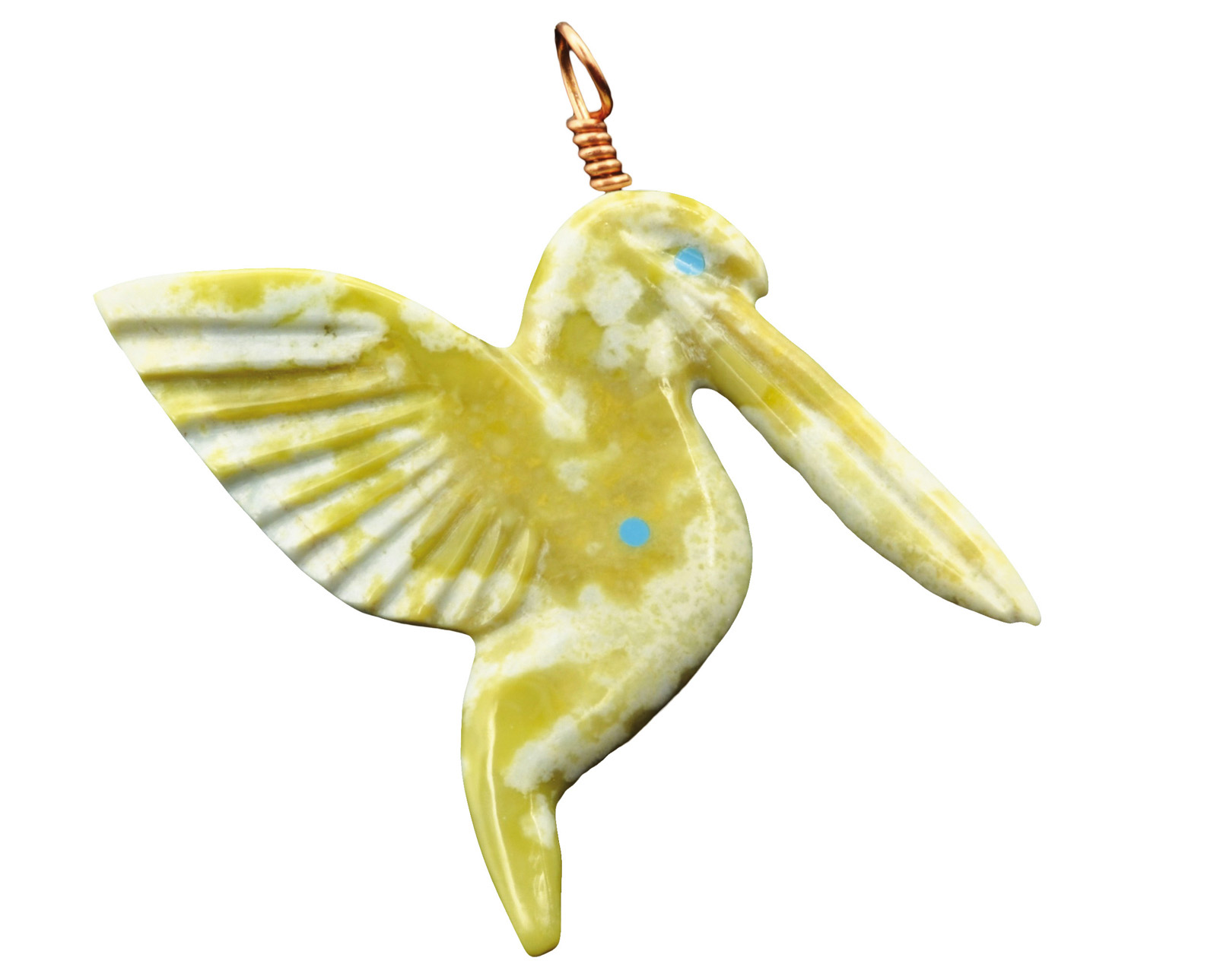 Transformational Pelican, 2019
Eli hopes to keep growing in ability as he works, while retaining a positive attitude. He’s appreciative of the notice he’s gathered, while attempting to be both spiritual and entrepreneurial in nature. When asked to describe what he wishes to achieve as an artist who happens to be an Indigenous man, his response is philosophical. “We are all given this life. We can either run from it or harness it. Being an Indigenous man and a Hawaiian Native is what I was born into. I was destined for this life as it was already chosen for me. I almost died coming into this world but the Creator had other plans. Whatever they are, I continue to give thanks through prayer and cornmeal each waking day and am truly grateful to share my journey with all of you. Life is simple. Live purposefully and with compassion—everything will come together when
you believe.”
Powered by Froala Editor