Jeweler Maria Samora chokes up talking about it. How the community of Native American artists has embraced her. Samora’s parents were a medicine man born and raised at Taos Pueblo, 69 years old at the time of her birth, and a white jeweler-seamstress 40 years his junior. They were never married. She grew up in Taos—still lives there—but not on the pueblo.
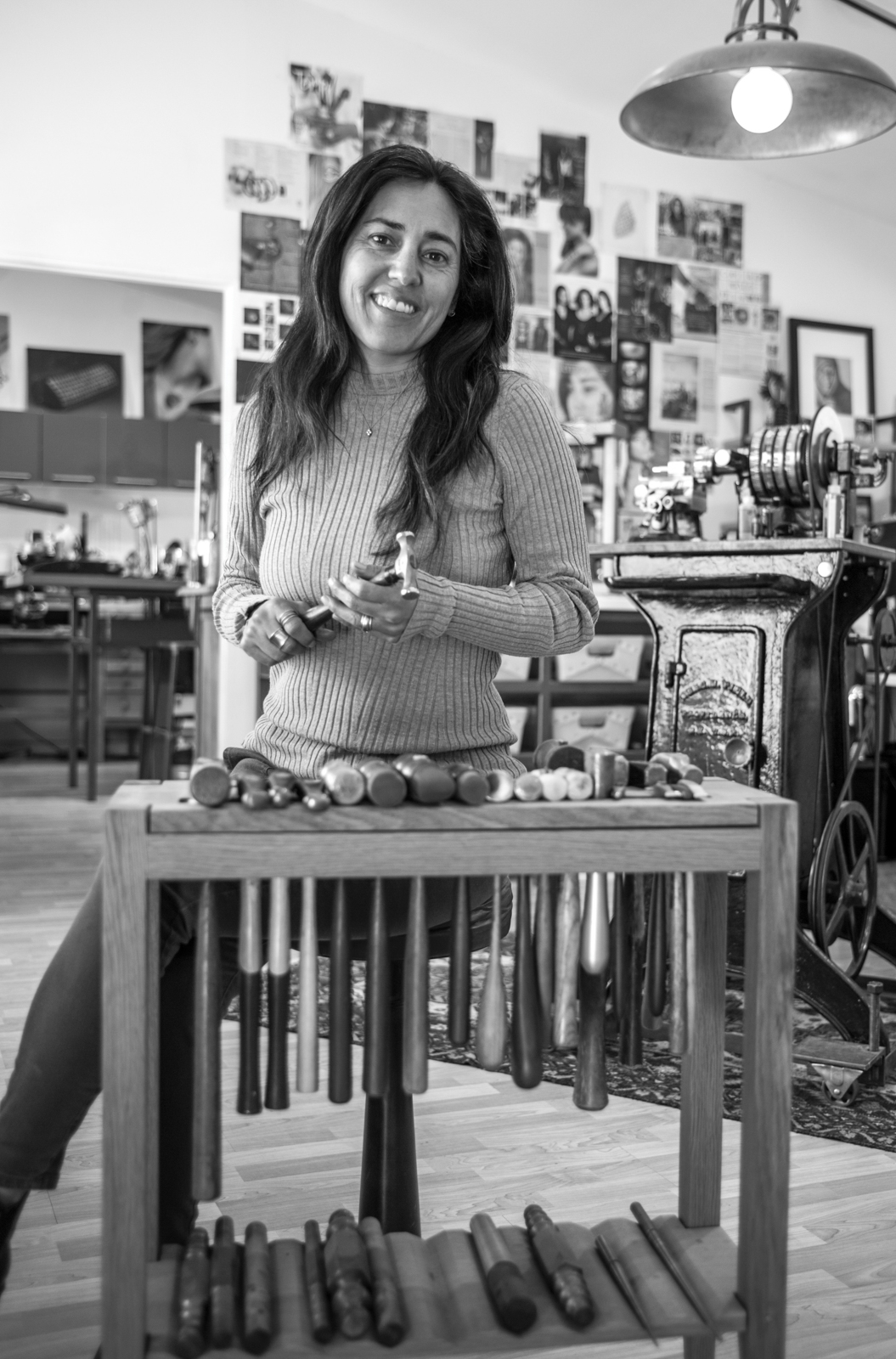 Maria Samora in her workshop.
“Because of my mother and father’s dynamic, it made it really difficult for me to have a relationship with my family out at the pueblo,” Samora says. “What was important and really special was when I did start doing the Native American shows. I felt like I finally had a place; I felt welcomed.”
None of which she expected. She never set out to be a “Native American artist.”
“In my mind, I was just designing what came to me, it was very contemporary, and I didn’t think about being put in the [Native] category,” she recalls of her origin in jewelry making 25 years ago. 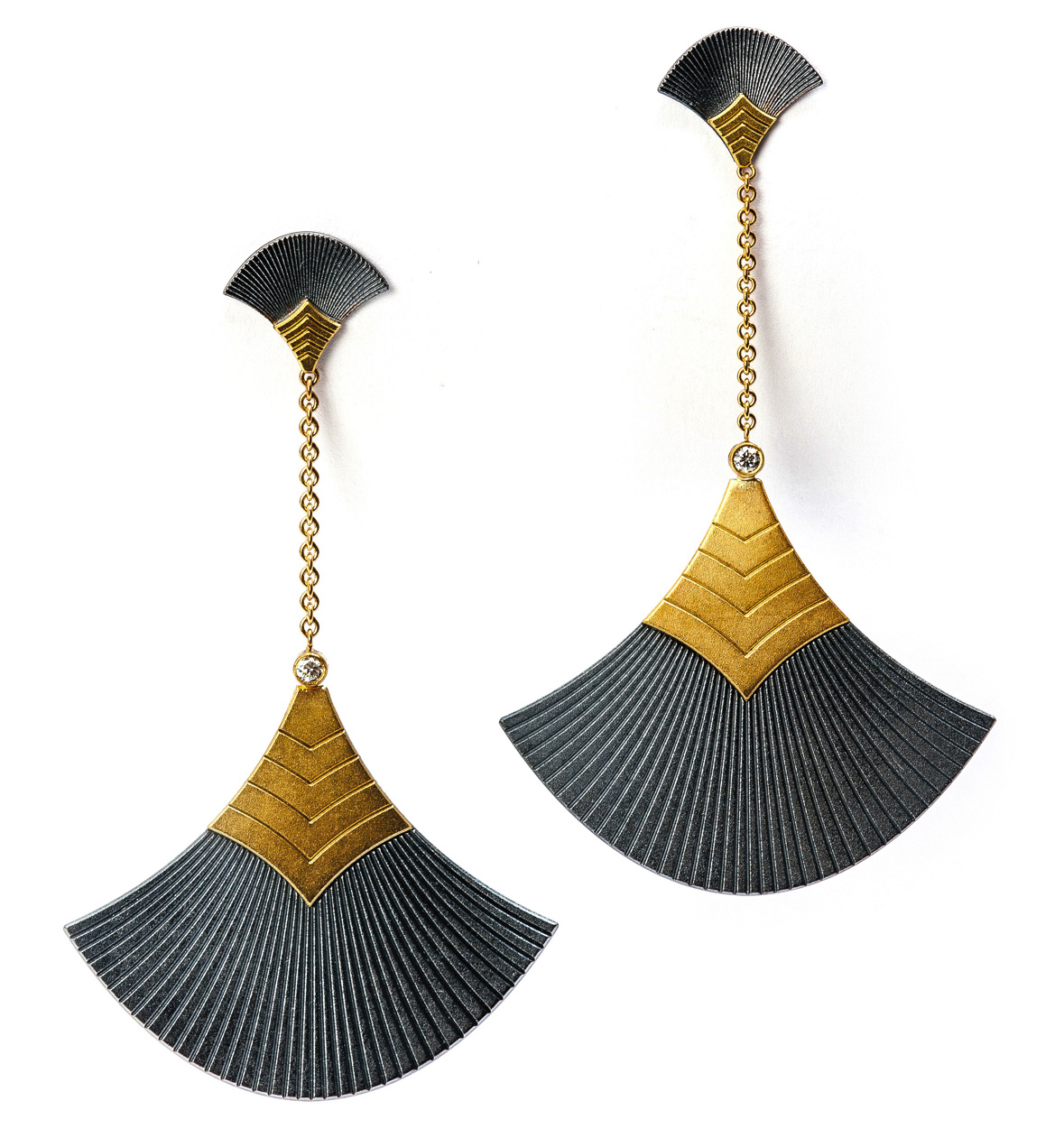 18k gold and Oxi silver fan earrings
Samora anxiously entered her first Santa Fe Indian Market in 2005—nine months pregnant. That was her first show of any kind, the first time she put herself out there through her work. She worried about how her uncustomary jewelry, most often described as “architectural and organic” or possessing “clean lines,” would be received at the most historic of markets in a genre steeped in tradition.
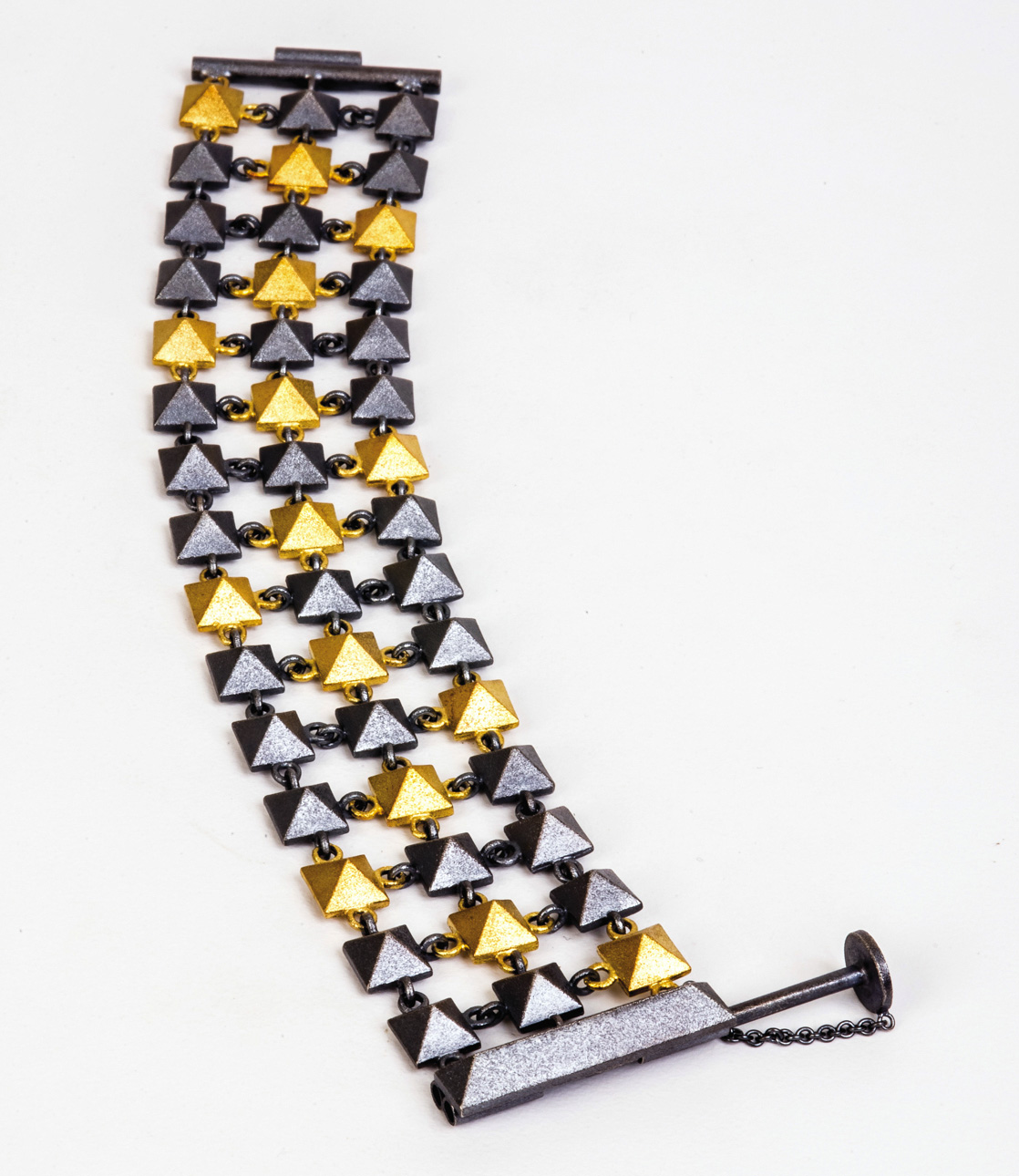 18k gold and Oxi silver pyramid link bracelet
“People were really, really excited about it, and the one comment I kept hearing over and over is that they were excited to see something refreshing and new,” she remembers.
The show was a success, allowing her to quit her waitressing job, take maternity leave and begin her career as a professional artist.
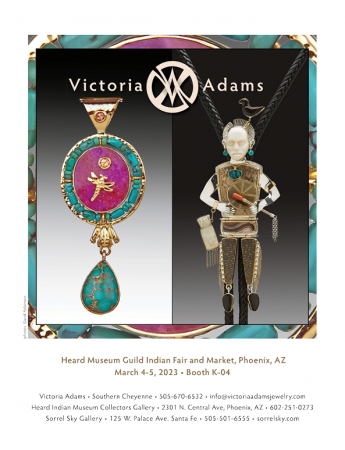
A career that would shortly see her take first place in 2007 at Indian Market in the jewelry category. Topping that, in 2009, her work was featured on the official Indian Market poster, the first jeweler and youngest artist ever to receive that honor. In 2011, she won the Best of Jewelry Award at the Heard Museum Guild Indian Fair & Market.
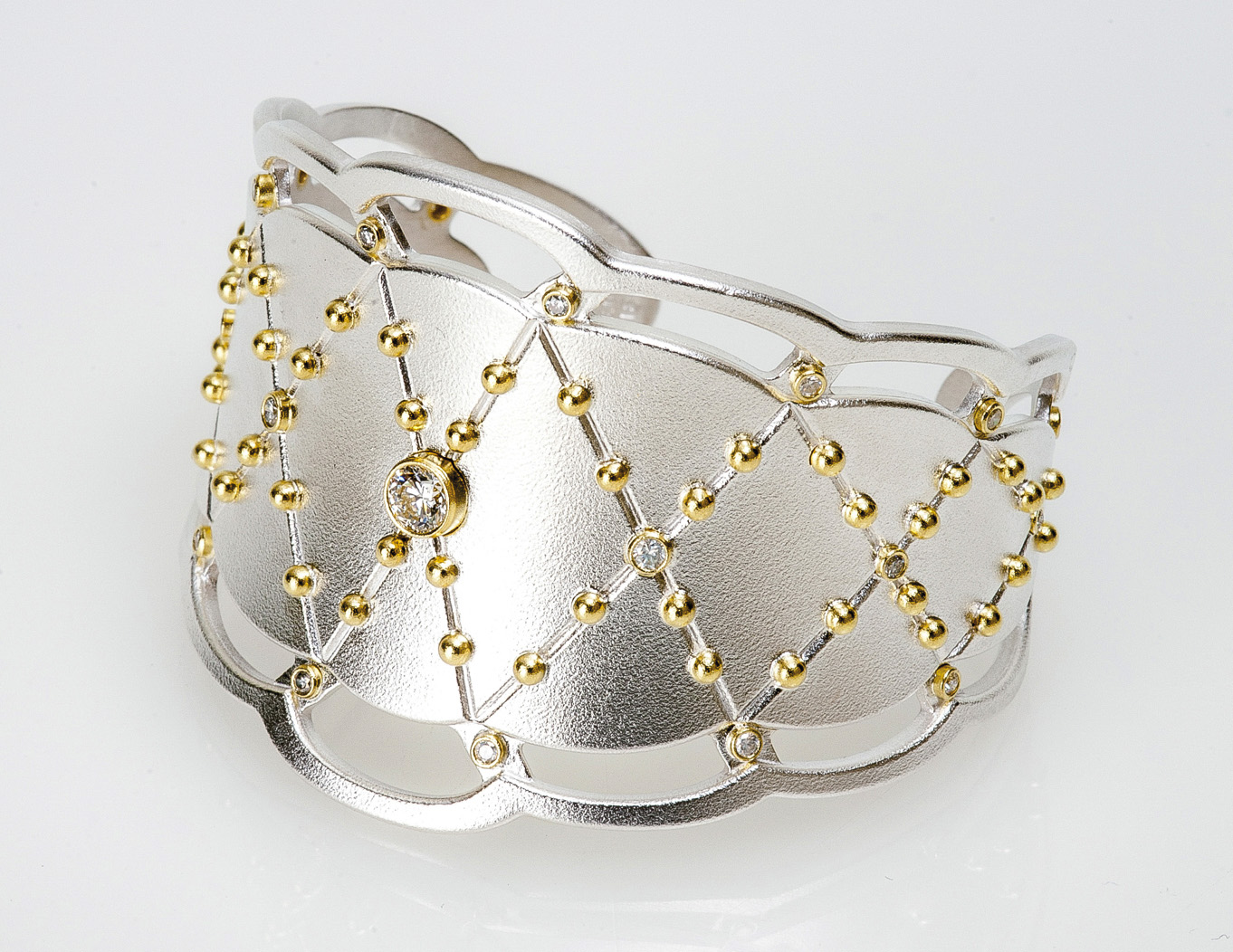 18k gold and silver lace cuff
Then, in 2018, she reached a pinnacle achievement being named the Museum of Indian Arts & Culture’s Living Treasure, joining the likes of Tony Abeyta (Navajo), Roxanne Swentzell (Santa Clara Pueblo), Dan Namingha (Tewa/Hopi) and Jody Naranjo (Santa Clara Pubelo). Her corresponding solo exhibition at the museum was titled Maria Samora: Master of Elegance.Samora returns to the 65th annual Heard Museum Guild Indian Fair & Market this March, as eager as a first-timer.
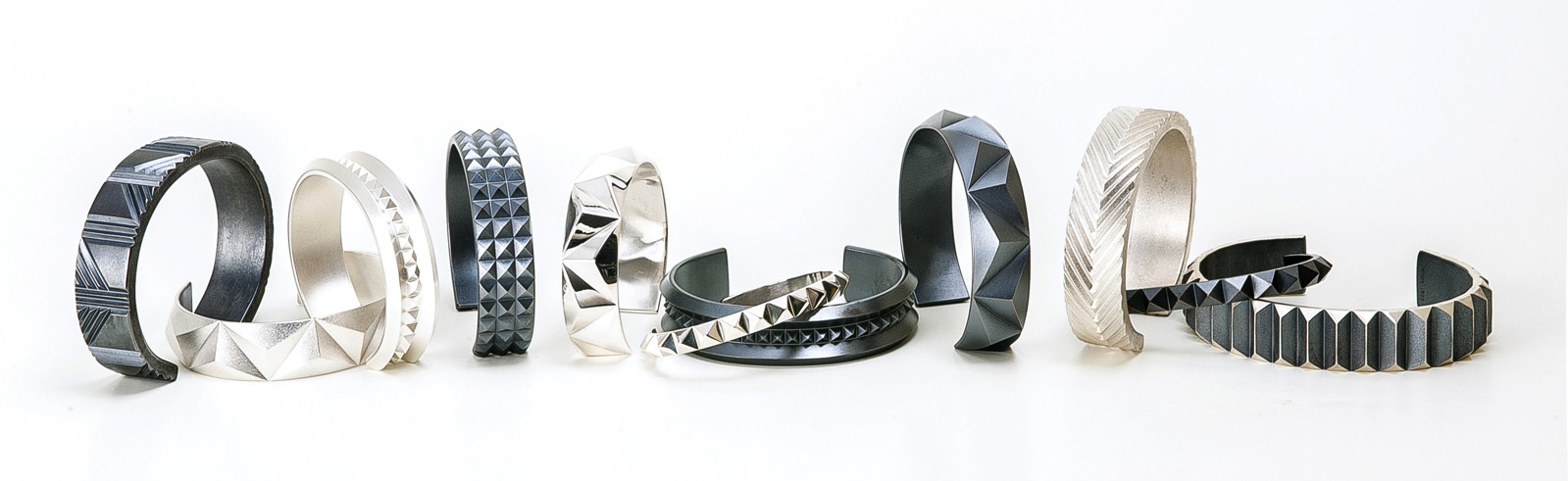 Mountainrange cuff collection
“Whenever it’s time for a show, [I’m thinking] what can I do next; what can be the next cool thing that nobody’s doing; what’s going to be the next big ‘wow’ factor,” Samora says, excitement evident in her voice. “That’s what makes it really fun, being able to get those creative juices going.”
Considering her tremendous success, complacency might seem natural. How could she be faulted for relying on the practices which have seen her rise to the top of her field, which support her family?
“There are designs that people absolutely love and they just want me to keep making them, and I do have a whole line of production pieces, but what’s really exciting is doing these shows, because every time I go to one, the collectors want to see new pieces, [and artists] up the ante because you know that your artist friend is going to be doing something just as cool,” Samora says. “There’s all these juried competitions, and it really does get you to this place where you push yourself, and that’s also what keeps keeps you motivated and wanting to keep creating and coming up with new ideas.”
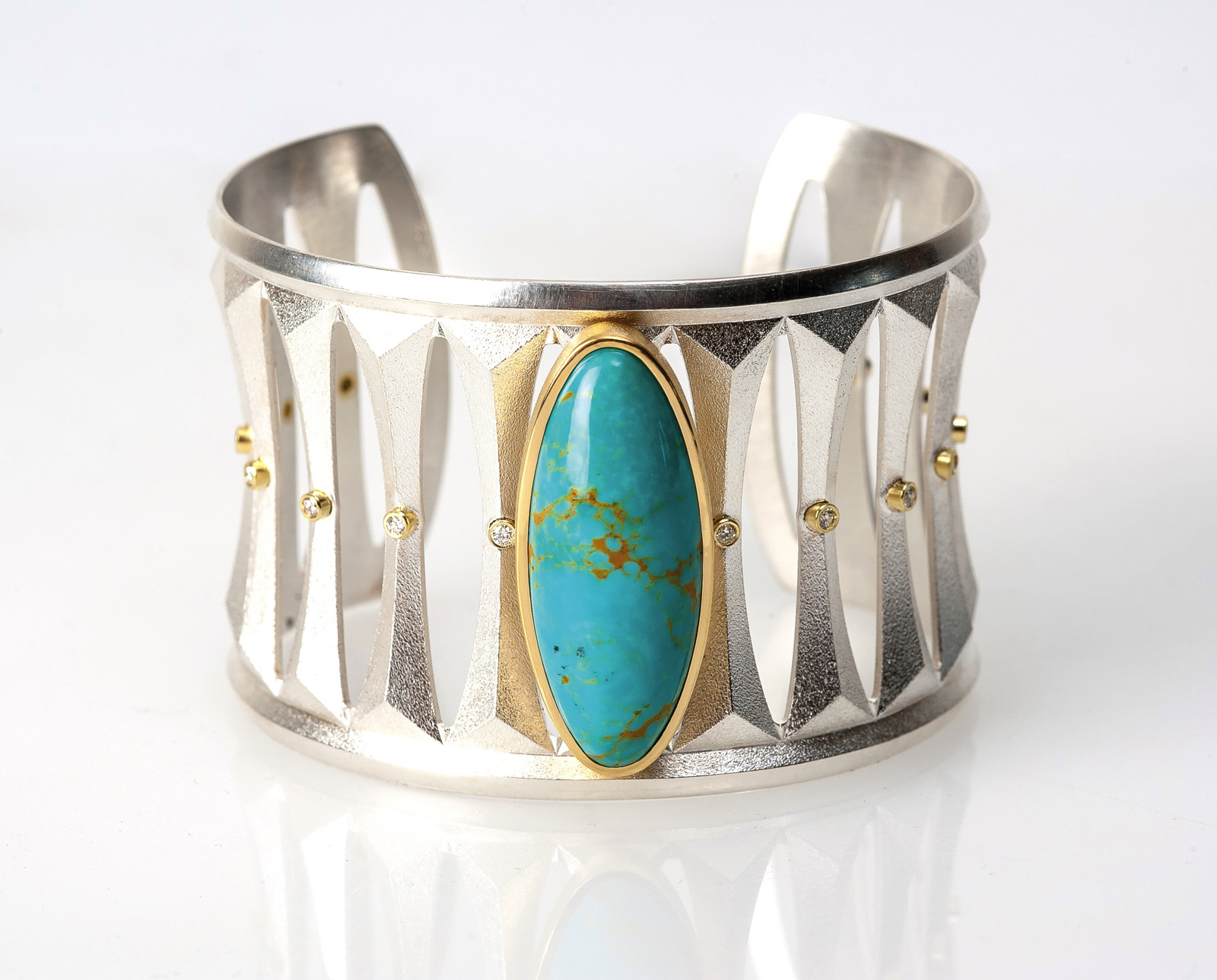 Silver hourglass cuff with turquoise
She’s always amazed by what her contemporaries come up with, and expects this year’s Heard fair to be no different.
“I am in a really select group of artists where the caliber of art is just over the top. I feel really honored to be able to do these shows with these artists because their work is absolutely gorgeous,” Samora says. “I create these pieces that I’m really excited about, and then I see other pieces that these artists have created and it just brings me to tears. It’s incredible the amount of beauty and the amount of work and craftsmanship that’s getting poured into making this jewelry.”
With her 50th birthday on the not-too-distant horizon, Samora is no longer the fresh-faced newcomer shaking up the genre. That doesn’t mean she’s not without a few new tricks up her sleeve for the competition.
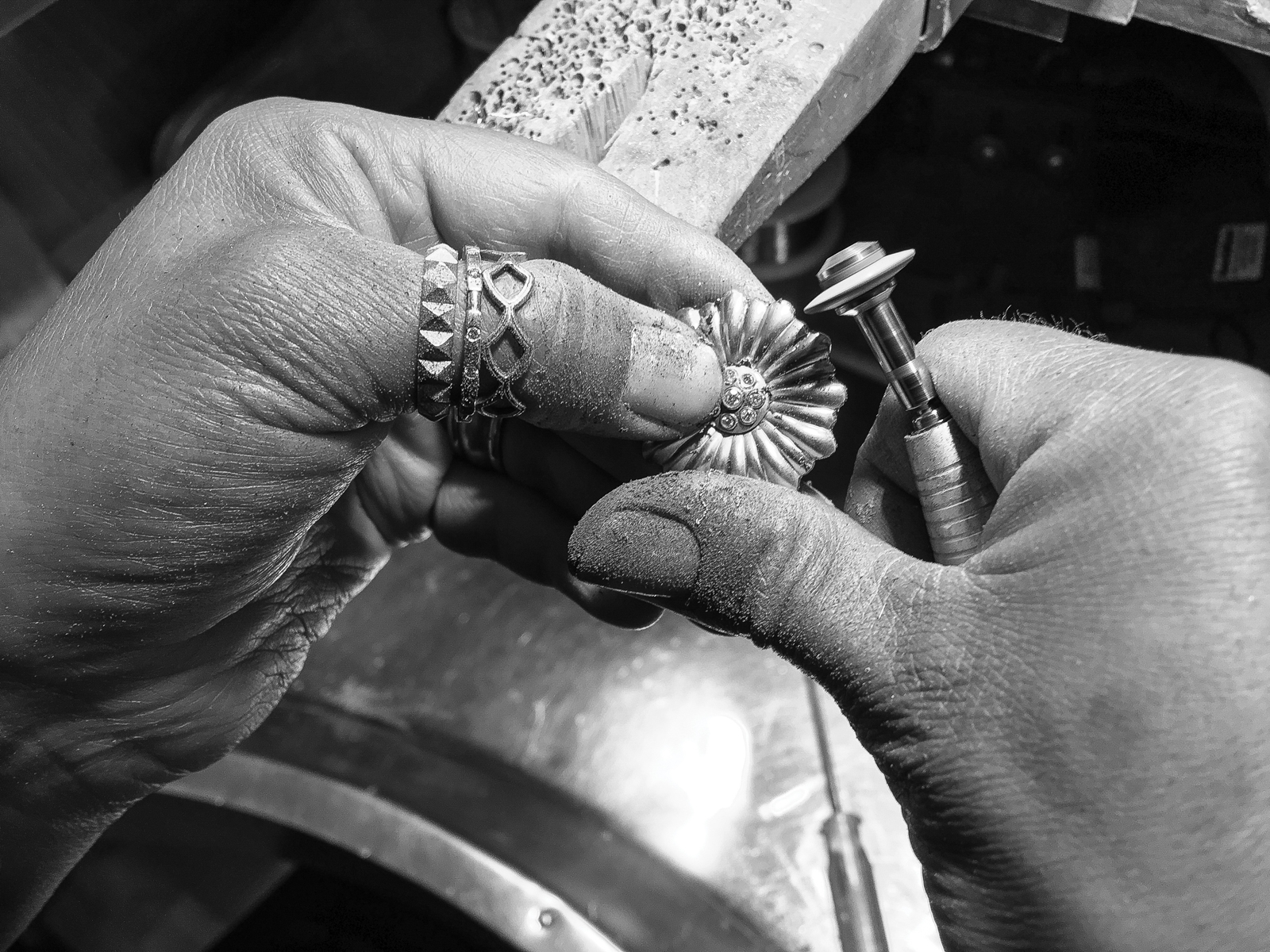 The artist works on a sunflower piece.
“I finally learned how to draw after 25 years of making jewelry,” she says proudly. “That was exciting because I never have created my jewelry in that manner. It’s always happened organically where I sit at the bench and play around with materials. I do try to constantly keep producing new ideas, working with new equipment and new tools.”
Those who have in the past described her work as “not looking Native American” forget that a hallmark of the tradition of all Native American art is innovation. She doesn’t hear that critique as much as she did starting out. What she hears mostly these days is collectors telling her about being stopped on the street and asked, “Is that Maria?” When wearing one of her pieces.
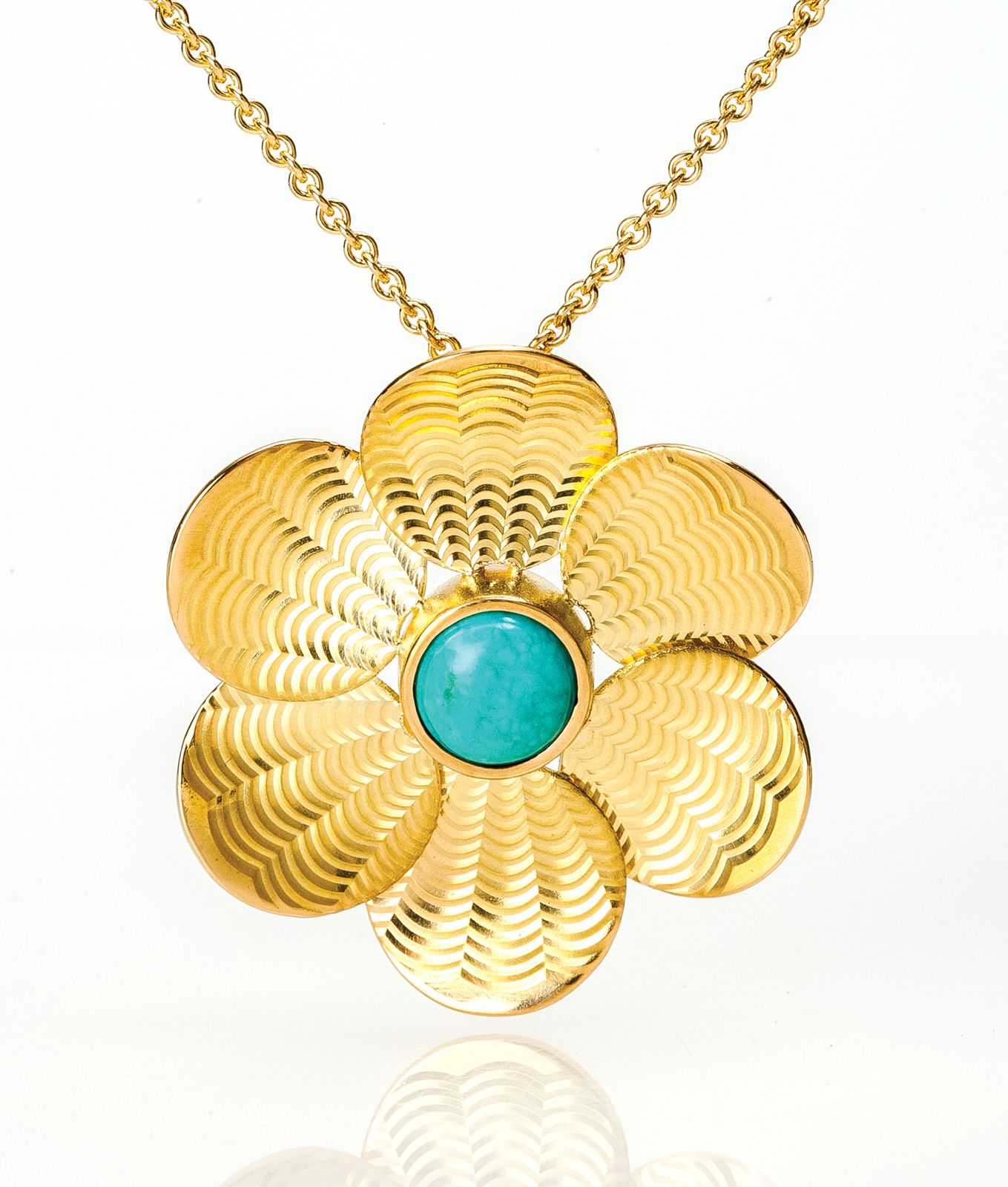 18k Guilloche pendant with turquoise
Samora has begun embracing what are considered more “traditional” Native American elements in her jewelry. She’s using more turquoise. But those pieces are still just as likely to include lapis, moonstone or African sapphire. Of course, her work has always been influenced by her Indigenous heritage and the people, culture and landscape she grew up with in Taos. Still, individual pieces routinely feature Etruscan, Greek, Egyptian, Syrian or Korean designs. Not that she consciously takes any of these influences into her studio.
“After 25 years, it’s become like second nature, a second skin of mine,” she explains of her process. “Everyone’s always like, ‘where do you get inspired?’ It just comes. It’s so hard to pinpoint. It’s such an organic, natural thing at this point.”
With age has come recognition of how this inherent creativity, the diversity evident in her production, stems from her unconventional upbringing.
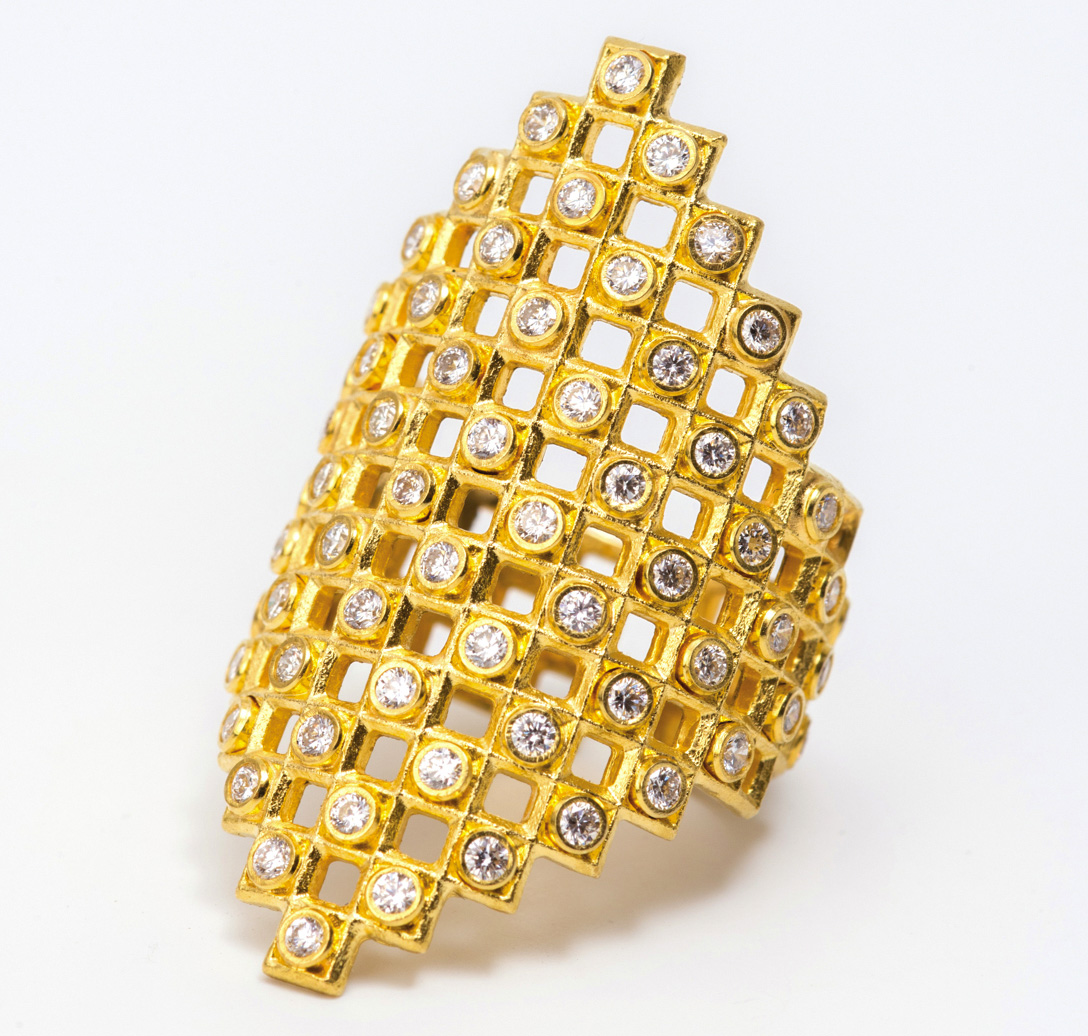 18k gold lattice ring with diamonds
“So much of my life is about my parents and who they were as people,” Samora says. “My father was 101 years old when he passed away so I grew up with a father who was an elder my whole life. That dynamic was really challenging because my mother was white and my father was from the Pueblo, [but] there’s so much importance to me about who my parents were and how they raised me and the opportunities that I had even coming from a really weird, poor family.”
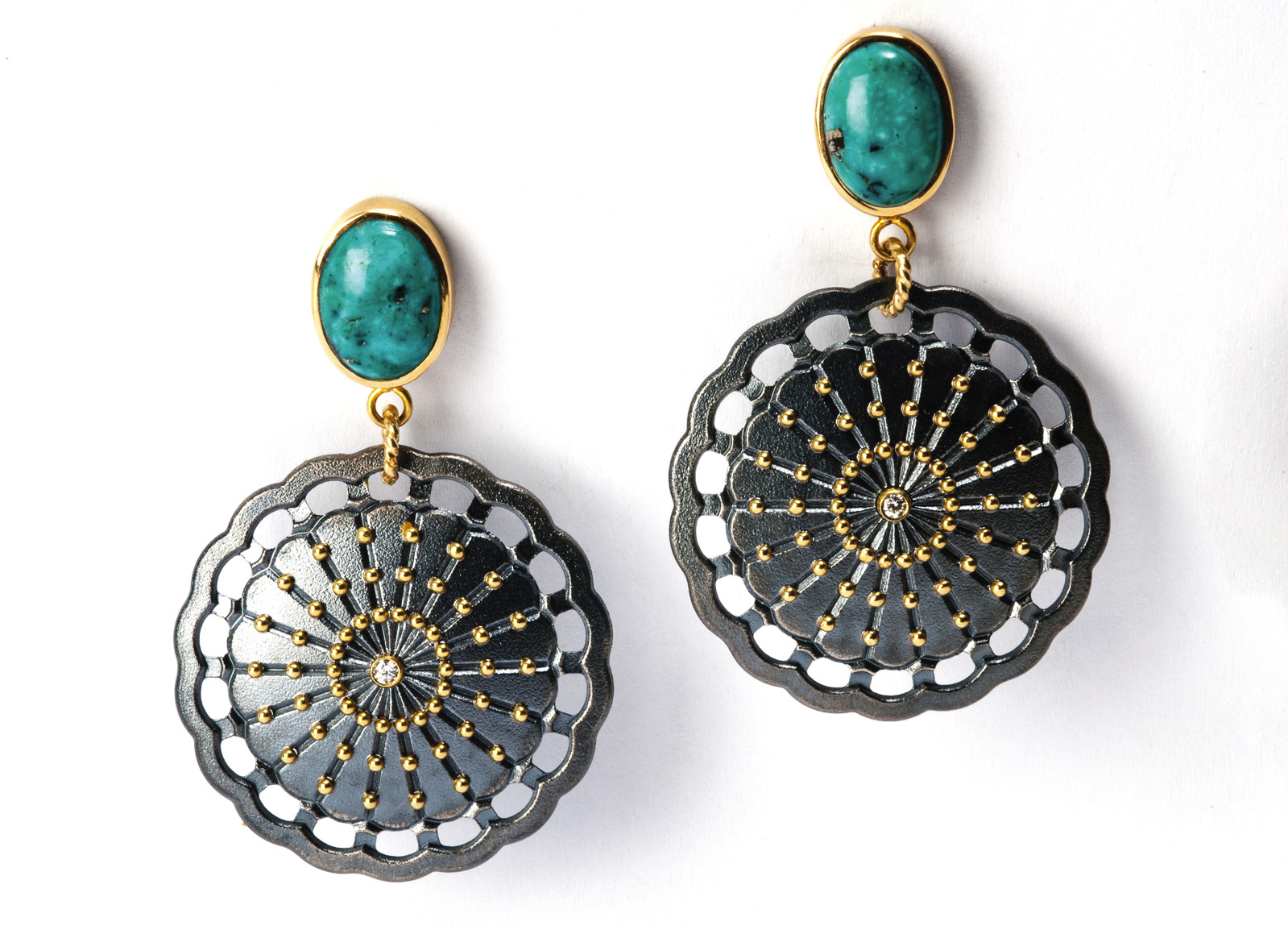 Lace earrings with turquoise
New opportunities continue presenting themselves to Samora. In 2019, she realized a long-held dream of opening her own family-run showroom—Samora Studio, in Taos. For 2023, she has been accepted into the Smithsonian Craft Show, the country’s premier show for fine American Contemporary Craft. Samora applied, unsuccessfully, three times previously. And she is now working with her own apprentices, passing along what she has learned the way her mentor, master goldsmith Phil Poirier, did for her.
“I’ve definitely put my time in and worked really, really hard and hustled, and I’ve done everything
I can to make ends meet to get to where I am. I’ve been very determined and motivated to create this whole environment, and it’s become a beautiful thing,” Samora says. “It’s still humbling though, because never in my wildest dreams did I think that I’d be able to support myself as an artist and in a lot of ways, even though
I have been doing it as long as I have, I feel like in a sense I’m just still scratching the surface.”
Powered by Froala Editor