Rose Simpson (Santa Clara Pueblo) views it as a gift. The ceramic figure. Since birth, she has been surrounded by them. Her mother, Roxanne Swentzell (Santa Clara Pueblo), was among the first to take pueblo pottery from the historic to the contemporary. Swentzell’s ceramic figures which were considered radical three decades ago are now prized by museums and collectors.
To Simpson, they were an everyday part of growing up. She didn’t need permission or innovation to explore the figure through her sculpture. With intimate access to the most cutting-edge figurative clay artwork being produced, radical was normal, and she started where many take years to reach.
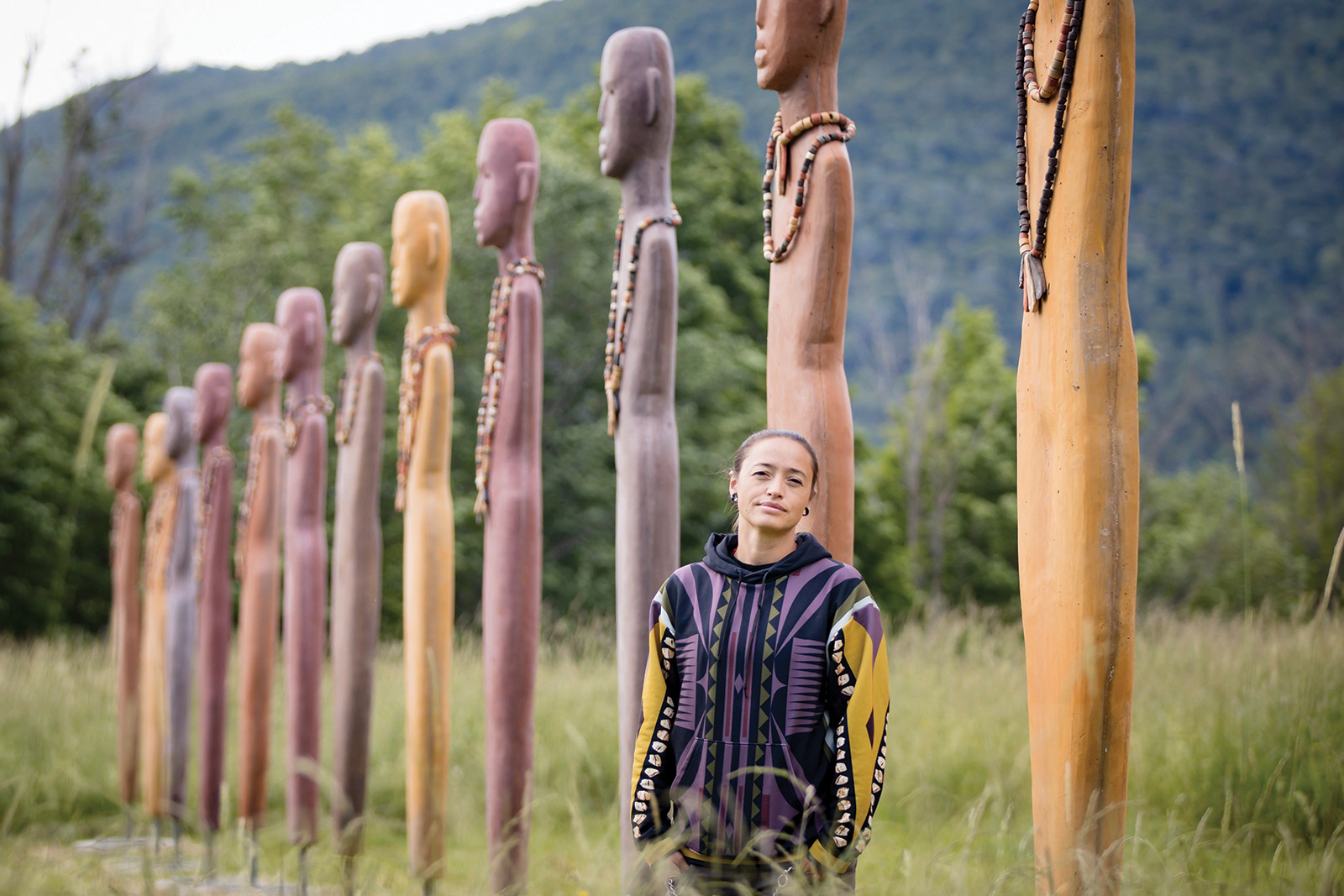 Rose B. Simpson with Counterculture, 2022, at Field Farm in Williamstown, Massachusetts. Photo by Stephanie Zollshan, courtesy of the Trustees.
That empowered Simpson to push her work even further. To expand beyond her mother’s practice and blaze trails no artist has before.
“I’m looking for healing; I’m frustrated by, and
I have the privilege to address, colonization, our current situation, I want to look at why we choose to hurt each other, our planet, to be disconnected, unaware,” Simpson said. “My work has a job to do and that might not always be pretty.”
That’s where Simpson sees her practice breaking from tradition: intention.
The intention of her work is not to be pleasing. Not to satisfy market demand.
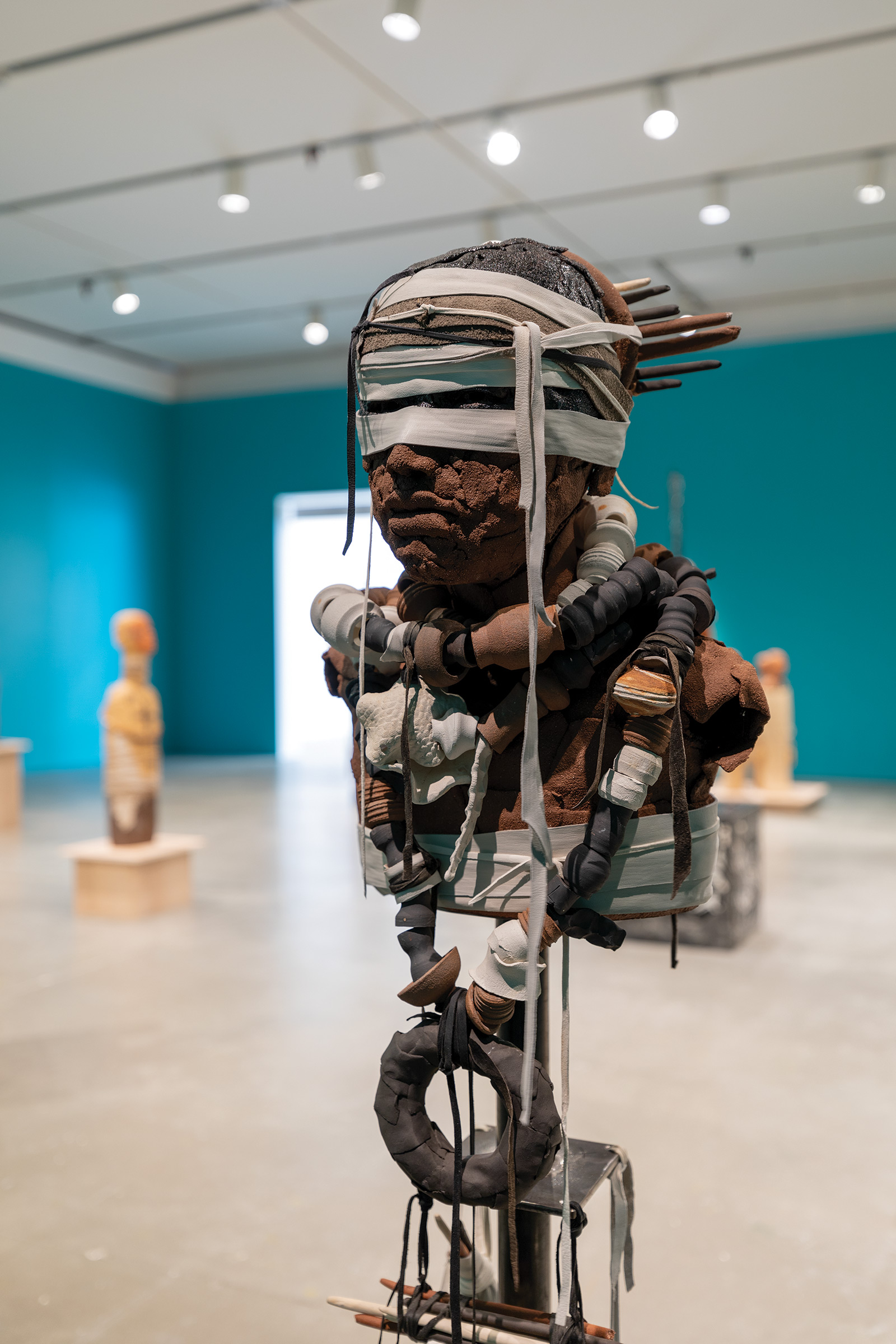
 Storyteller, 2021, ceramic, glaze, steel, leather and epoxy, 67 x 29 x 26”. Collection of Robert B. Feldman, Loudonville, New York. From Rose B. Simpson: Legacies, the Institute of Contemporary Art/Boston, 2022-2023. Photo by Mel Taing.
The surfaces of her sculptures aren’t smooth. The work is intentionally challenging, difficult, rough. More overtly political than her predecessors.
She strives to create artworks which purposely “get under people’s skin” and “make them uncomfortable” in her words.
That represents a major departure from her mother’s pottery which, despite its revolutionary forms, was still produced for a market economy to support her family. It had to be eye-catching and highly crafted. Appealing. Swentzell needed to sell artwork to tourists and collectors to feed Rose and her brother. Literally.
Simpson’s work is created to feed the mind.
Her career also had the benefit of a family steeped in art making. Aside from her legendary mother, her family tree also includes such luminaries as grandmother Rose Naranjo, “aunts” and “uncles” Jody Naranjo, Susan Folwell and Michael Naranjo. Her father is a sculptor in wood and metal.
 Directed South, 2014, ceramic, mixed and reclaimed media, 65 x 18 x 14”. Collection of William A. Miller, Santa Fe, NM. From Rose B. Simpson: Legacies, the Institute of Contemporary Art/Boston, 2022-2023. Photo by Mel Taing.
“When I was in graduate school, I realized that most of the students I was going to school with, their parents wanted them to be a lawyer or something more practical than an artist, especially a ceramicist,” Simpson recalls. “I had the neural pathway from day one that you can support yourself with your clay. When you have that neural pathway, then that’s what you manifest as true. (I know) if I’m struggling I can do this and I can put my energy into it and it’s a possibility to support myself.”
With that background, it may seem she was destined to be an artist. Maybe she was, but that’s not how Simpson saw her life playing out. She wanted to be a pilot. She was more interested in making model airplanes than clay pots as a kid.
After taking the Armed Services Vocational Aptitude Battery test in high school, recruiters for the Air Force began calling her home.
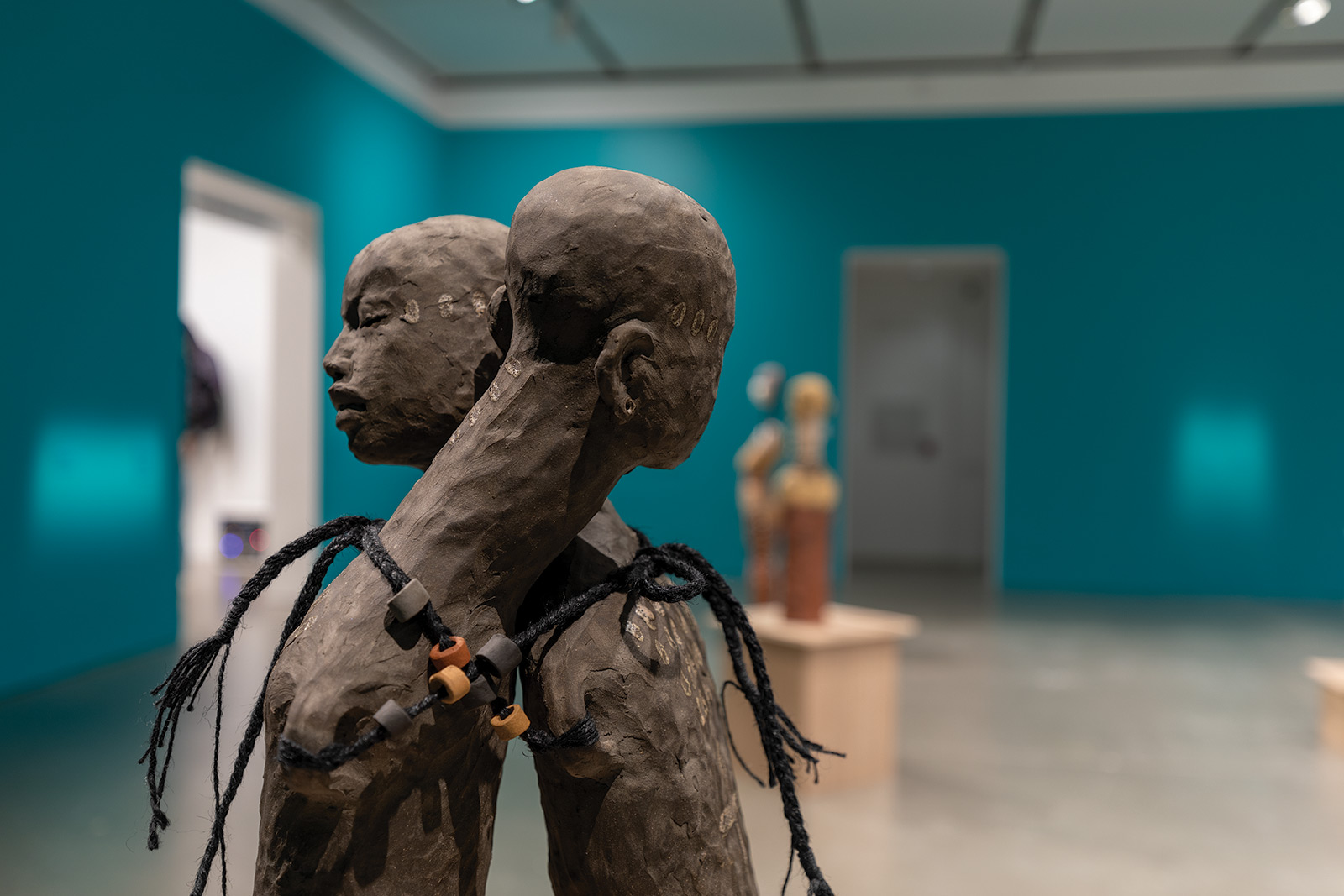 Brace, 2022, clay, glaze, steel and twine, 38½ x 28 x 14”. The John and Susan Horseman Collection, St. Louis. From Rose B. Simpson: Legacies, the Institute of Contemporary Art/Boston, 2022-2023. Photo by Mel Taing.
Swentzell hung up on them.
When asked by her mother if she wanted to go to the Air Force, Simpson recalls saying she badly wanted to fly their airplanes.
“Do you want to kill people,” was her mother’s reply.
Simpson said “no.”
“Well, there you have it,” Simpson remembers her mother telling her. “I’m glad I didn’t (join).”
Good decision.
Simpson has become not only one of the most in-demand Native American artists working today, but one of the most in-demand contemporary artists period. Solo exhibitions of her work in the past two years have taken place in locations far outside what is customary for Pueblo ceramics: the Savannah College of Art and Design Museum of Art, the Institute of Contemporary art in Boston and the Fabric Workshop and Museum in Philadelphia. Institutional group shows featuring her work during that same period are too numerous to mention.
Simpson has a theory for why this is the case.
“I’m noticing that a lot of the Indian art supporters who were sort of dated individuals still trying to capture an aesthetic of a dying culture, I feel like that’s starting to wane as those people age and I think the younger generations of collectors are interested in a different storyline,” she said. “We still see that exotification and exploitation of Indigenous culture and aesthetic, but I see more women in charge of institutional spaces and the old white man is fading, which I think is helping a lot of the voices that are more contemporary or hard to digest be heard.”
Simpson has long wrestled with the obstacles to being “heard” as a Native and female artist. During graduate school at the Rhode Island School of Design, she recognized Indigenous artists were speaking an entirely different aesthetic language from those adhering strictly to the American or Western traditions.
“I feel like as long as we’re stuck in a contemporary Western aesthetic where our value systems are rooted in the colonized perspective, we’re not going to be able to fully appreciate what (Indigenous) work is trying to say,” Simpson said. “We have to step out of our comfort zone and say, ‘I don’t know and I’m ready to listen.’”
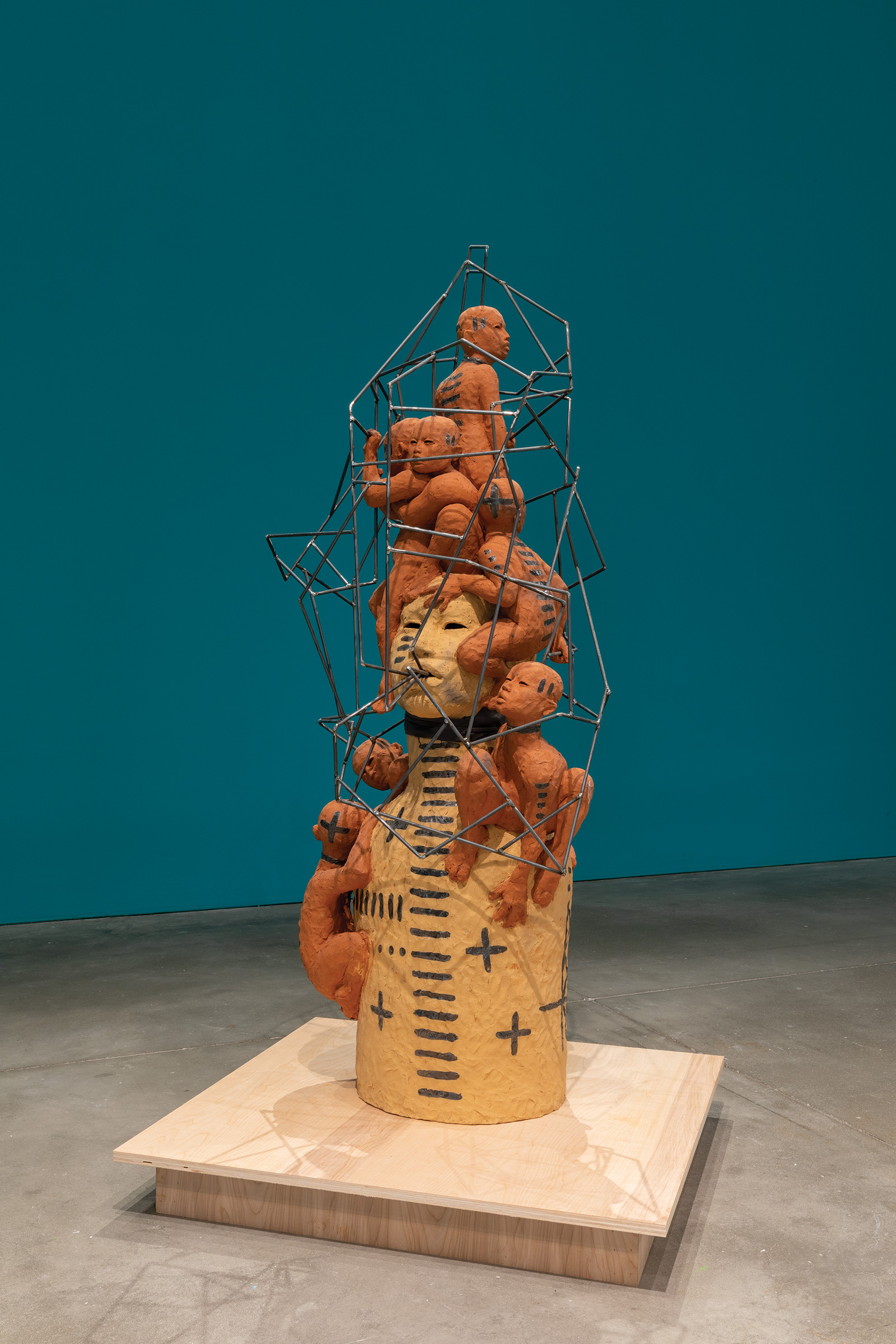
 Counterculture 2.a, 2021, ceramic, steel, grout and mixed media. Image courtesy of the artist and Jessica Silverman Gallery. Image Courtesy: Julia Featheringill.
She went so far as visiting Japan to experience what artmaking removed from the weight of colonial structures could feel like. She then returned to the Institute of American Indian Art, where she earned her undergraduate degree, to pursue a master’s degree in creative non-fiction writing to better equip herself to put into words the historic breakdowns between the messaging of Indigenous artwork and its reception by white audiences.
“I’m often caught by value systems and where museums, capitalistic interest, publications—validation by non-Native people—are the epitome of success,” she explained. “We’re not fully understanding the reason behind (Indigenous) work and what it’s trying to say and do in the world which is beyond the value systems of colonized Western mindset.”
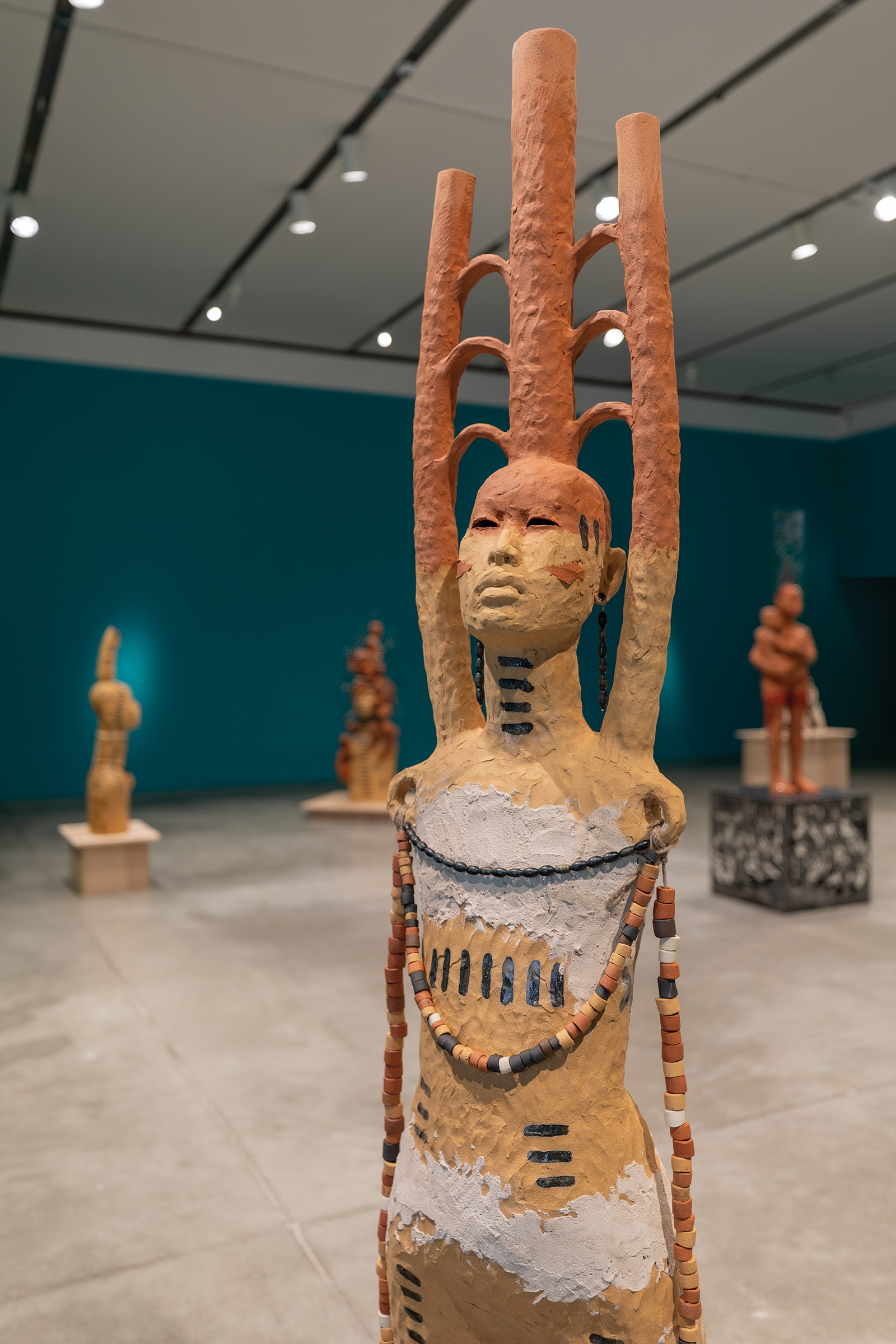 Installation view, Rose B. Simpson: Legacies, the Institute of Contemporary Art/Boston, 2022-2023. Photo by Mel Taing.
With this in mind, it’s easy understanding why Simpson, despite her wide travels and career success, which would allow her and her daughter to reside anywhere in the world, continues calling
New Mexico home.
“I live and work in my ancestral homeland, in a community that I’m involved in, invested in,” she said. “I’m surrounded by my family; I’m surrounded by the things that I love and cherish and I want to nurture (those things). Every day I’m reminded of why I do what I do.”
What she does, despite her 21st-century approaches, is carry on a generation’s old family tradition, a cultural tradition predating that. While standing on the shoulders of those who came before, Simpson extends their reach, advocating for Native people to new and wider audiences through her work. She acknowledges the weight of that responsibility.
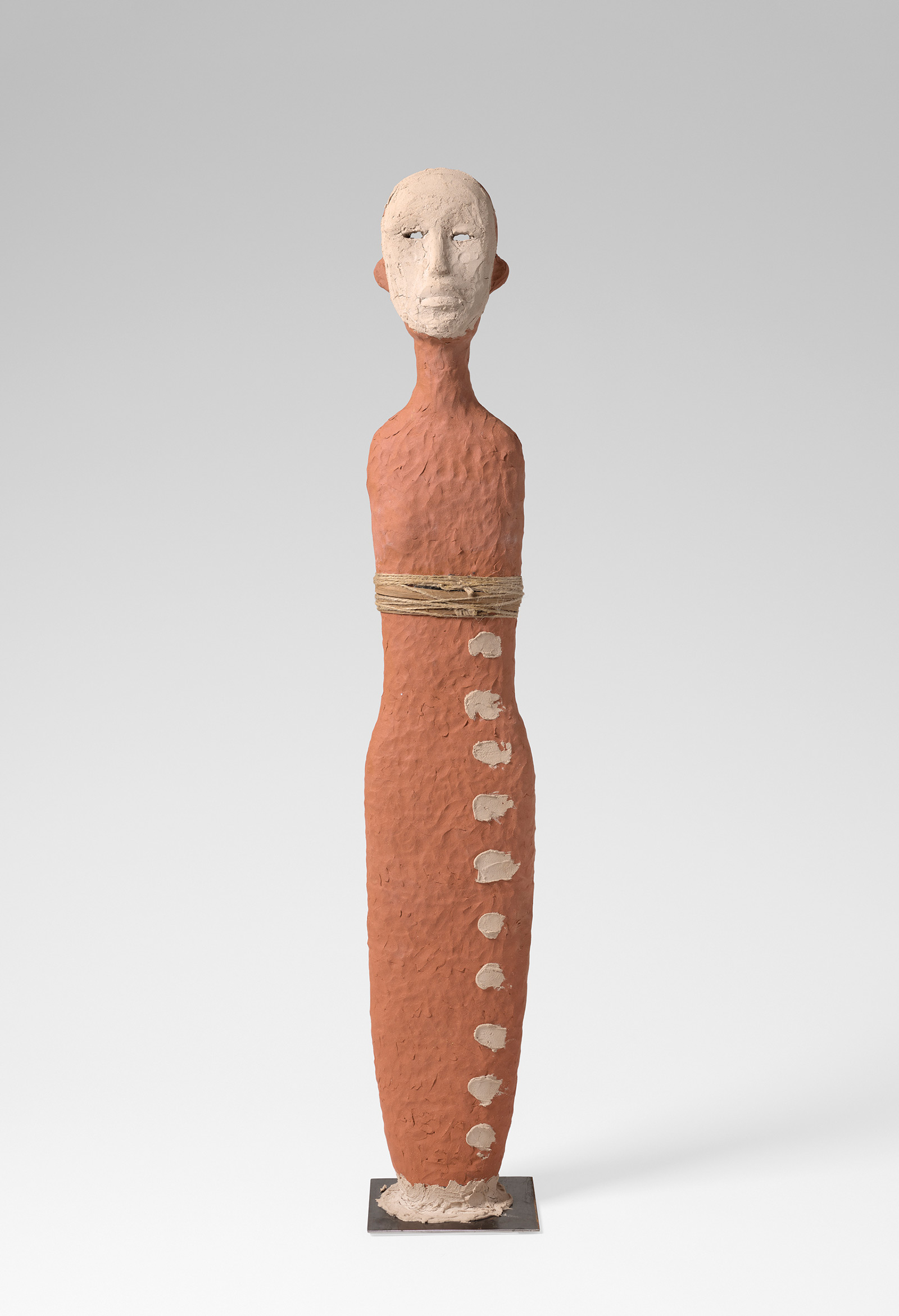
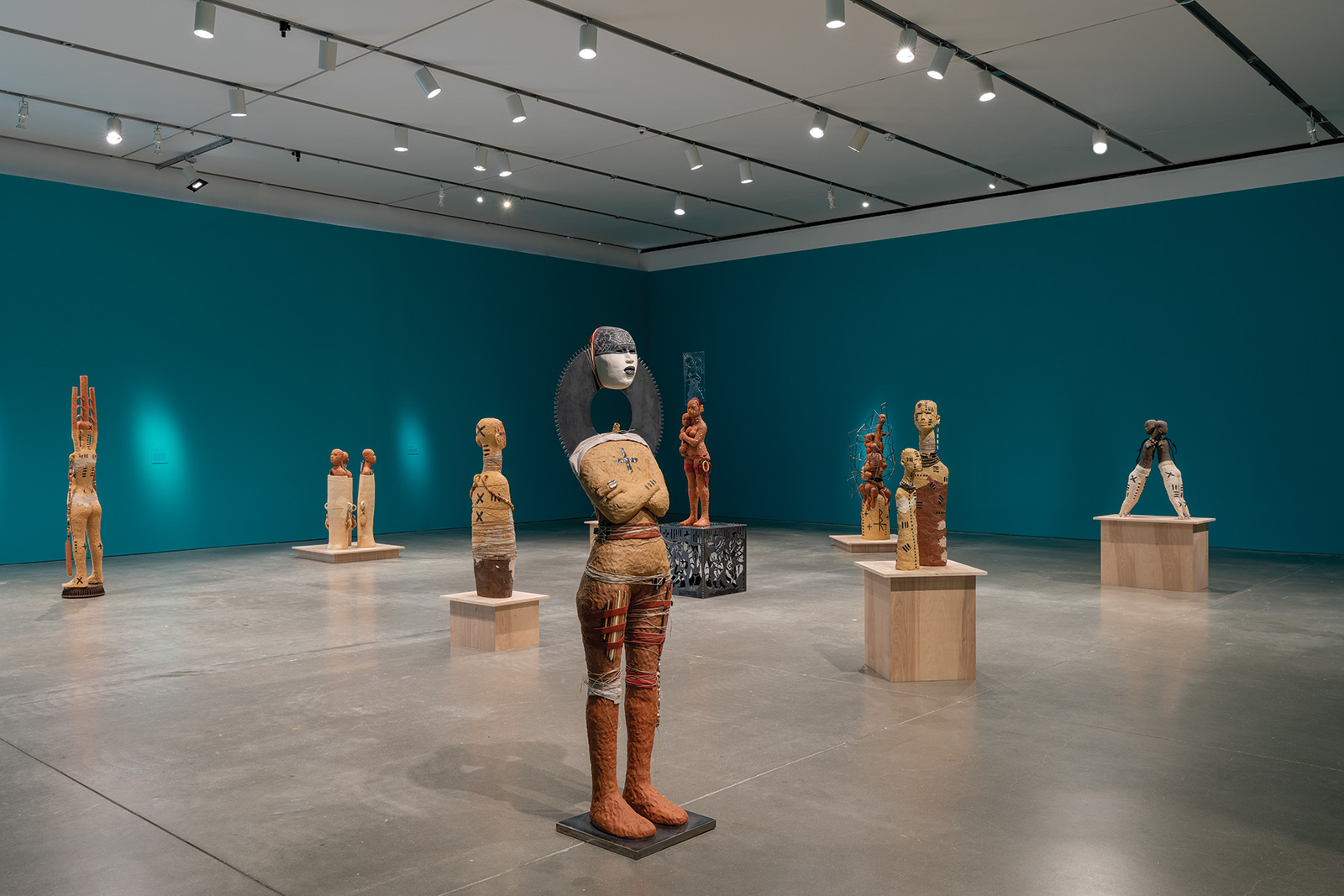 Root A, 2019, ceramic, glaze, linen, jute string, steel and leather, 71½ x 20½ x 16”. Rennie Collection, Vancouver. From Rose B. Simpson: Legacies, the Institute of Contemporary Art/Boston, 2022-2023. Photo by Mel Taing.
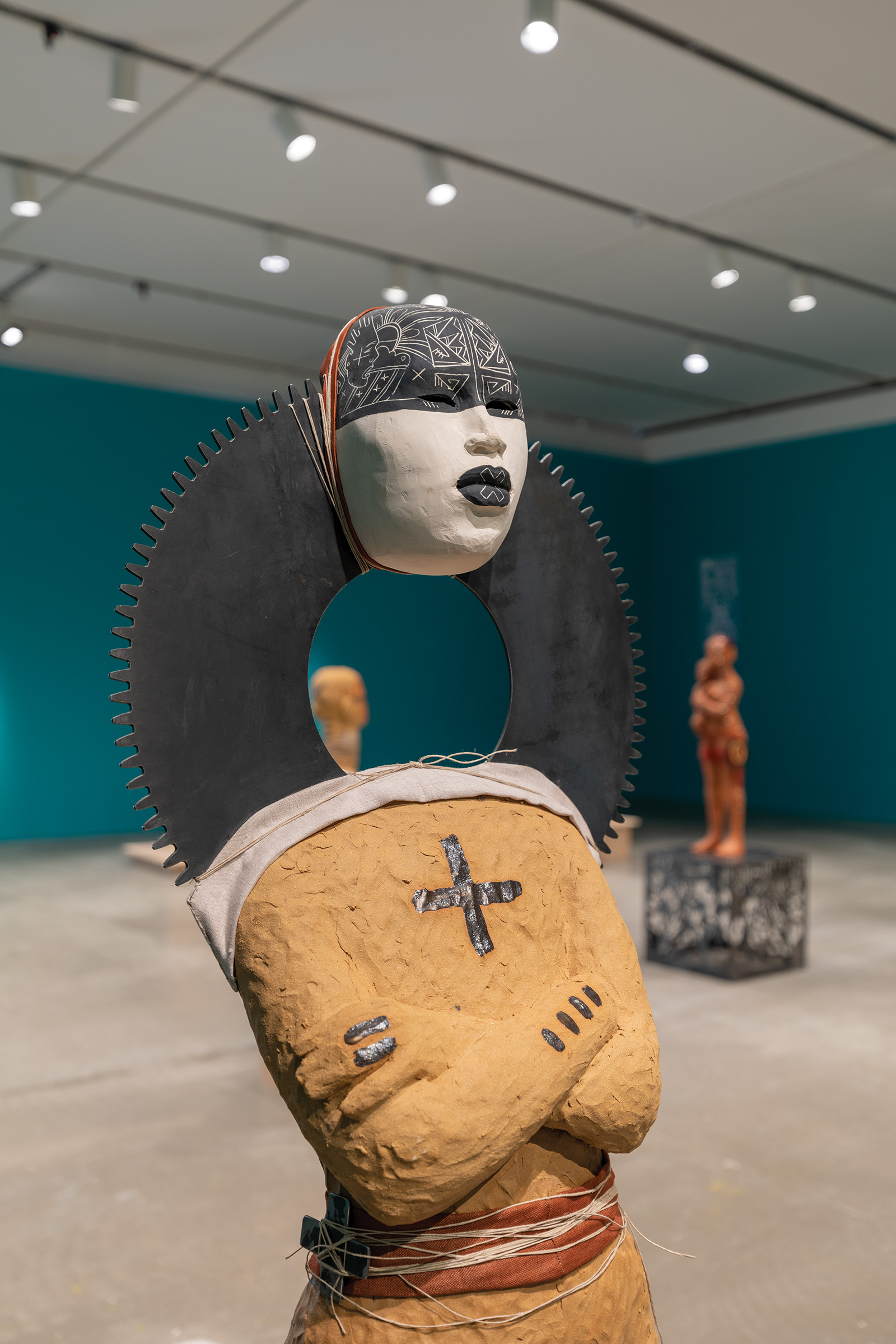 Installation view of Rose B. Simpson: Legacies, the Institute of Contemporary Art/Boston, 2022-2023. Photo by Mel Taing.
“I choose to do what I do because I enjoy it. I love to be in the studio. I love to make work, but I also know that there is a level of respect in the investment that you put into it,” Simpson said. “If I were just dabbling and not taking it seriously, I think that would be exploiting my ancestry. I hold myself to take this very seriously and push myself conceptually.”
Powered by Froala Editor