Gone are the bulky, dark, wooden display cases. Gone the dim lighting and cramped spaces. Gone the lengthy wall text.
The completely renovated Native American Galleries at the Eiteljorg Museum of American Indians and Western Art are now open and airy. Glass cases bring artworks closer to visitors. Digital label hubs house information about displayed items, freeing the rooms of didactic clutter.
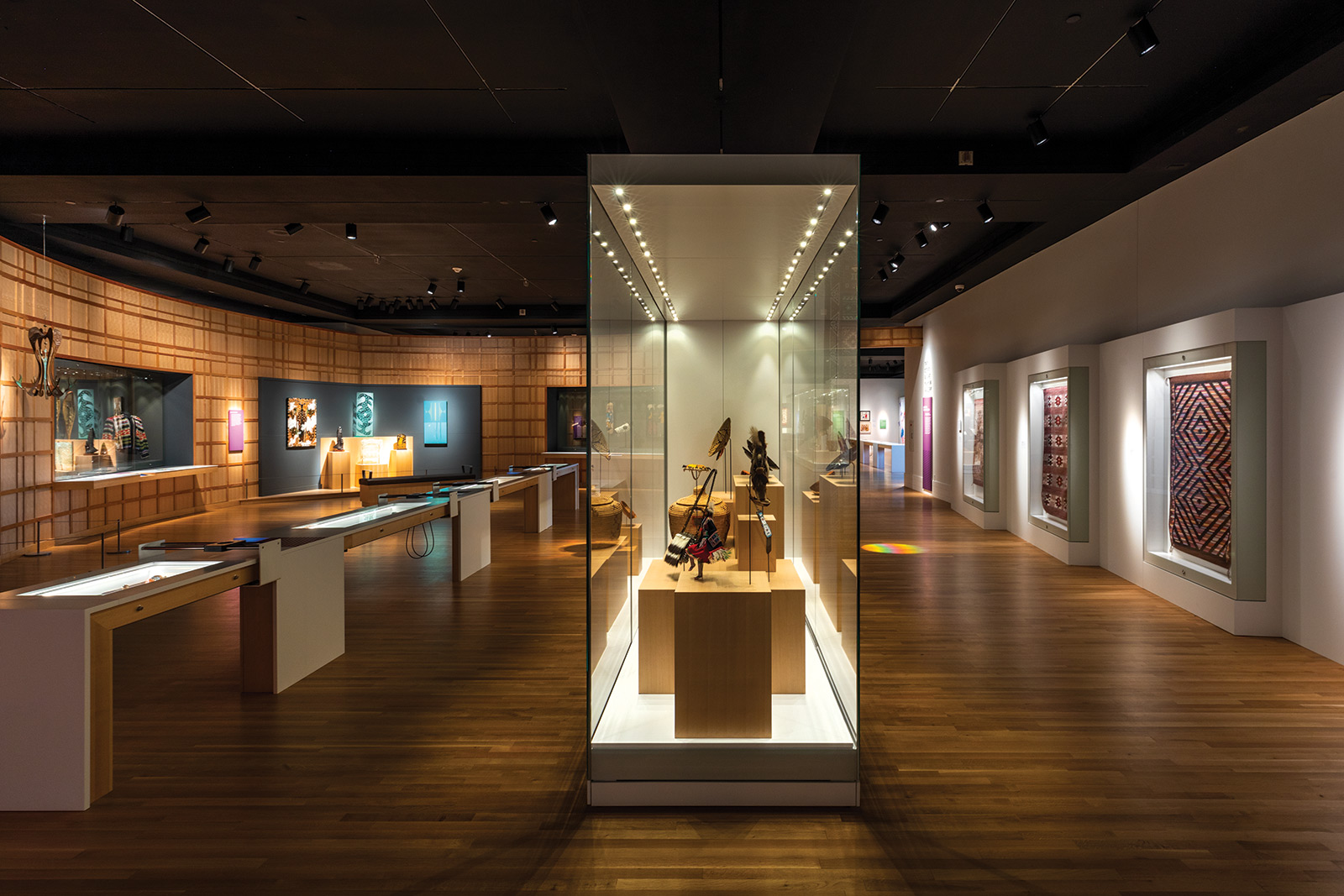 The Eiteljorg Museum’s new Native American galleries, featuring the exhibition Expressions of Life: Native Art in North America. Image courtesy of Hadley Fruits Photography and the Eiteljorg Museum.
Purposely, the feel is more contemporary art gallery, less history museum. More than $6 million went into overhauling the Eiteljorg’s Native American Galleries, the floorplan of which had gone mostly untouched since the museum opened in Indianapolis in 1989. The renovation, with a new exhibition, Expressions of Life: Native Art in North America, debuted on June 25.
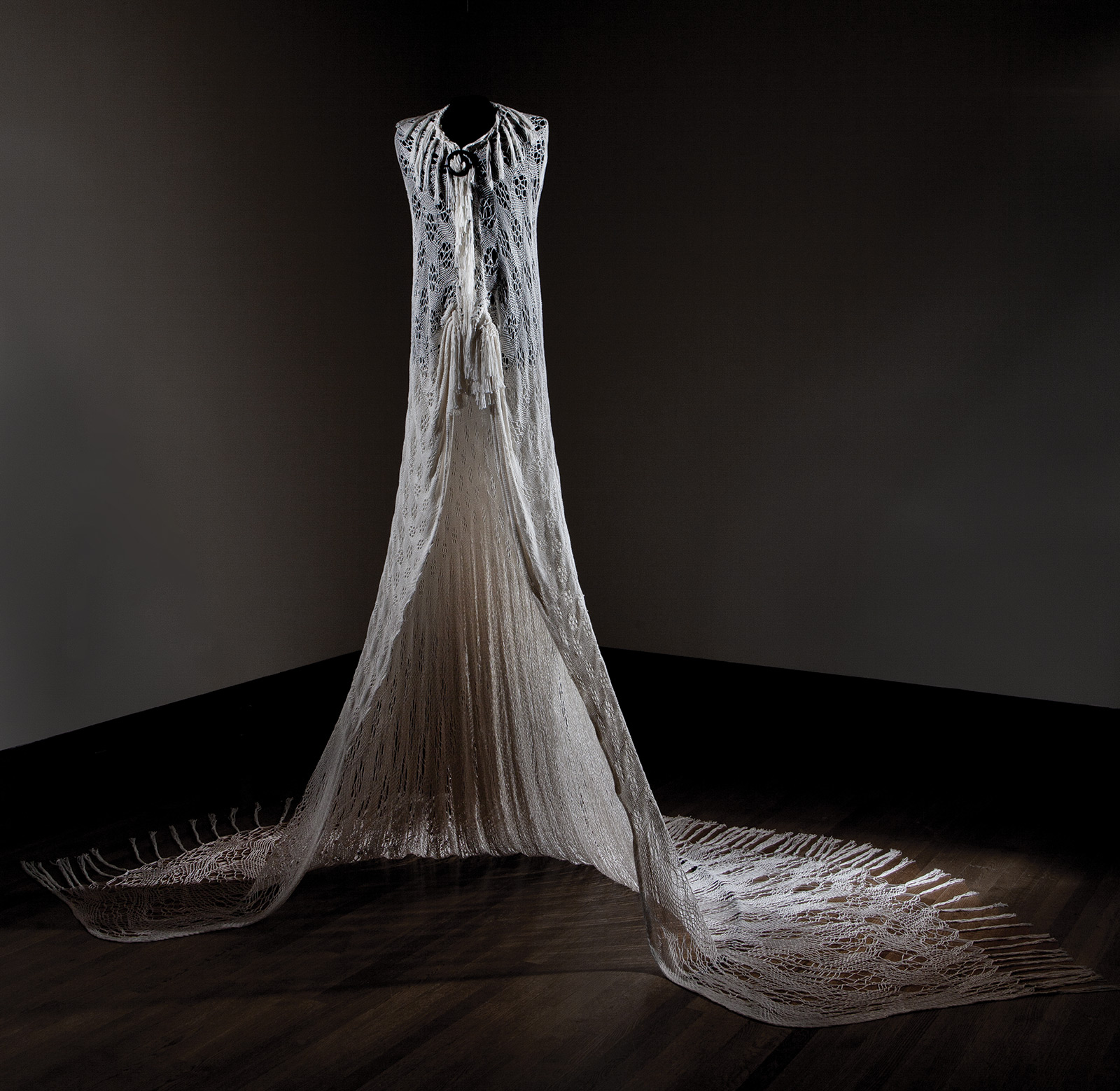 Tyra Shackleford (Chickasaw), The Lady, 2017, soy silk yarn woven with an interlinking sprang technique, commercial dyes, wood brooch and pin. Collection of Eiteljorg Museum, 2017. Eiteljorg Museum Indian Market and Festival Harrison Eiteljorg Purchase Award, 2017.6.1 A-C.
The physical changes in front of guests are the most immediately noticeable. The philosophical changes behind how the museum chose to present the artwork the most meaningful.
“Native peoples are the authorities of their own stories,” Dorene Red Cloud (Oglala Lakota), curator of Native American art at the Eiteljorg Museum, says of the project’s guiding mantra.
Eiteljorg staff consulted heavily with the museum’s Native American Advisory Council throughout. Its membership, consisting of individuals from local, regional and national tribes, guided the renovation’s “big ideas and implementation” according to
Red Cloud.
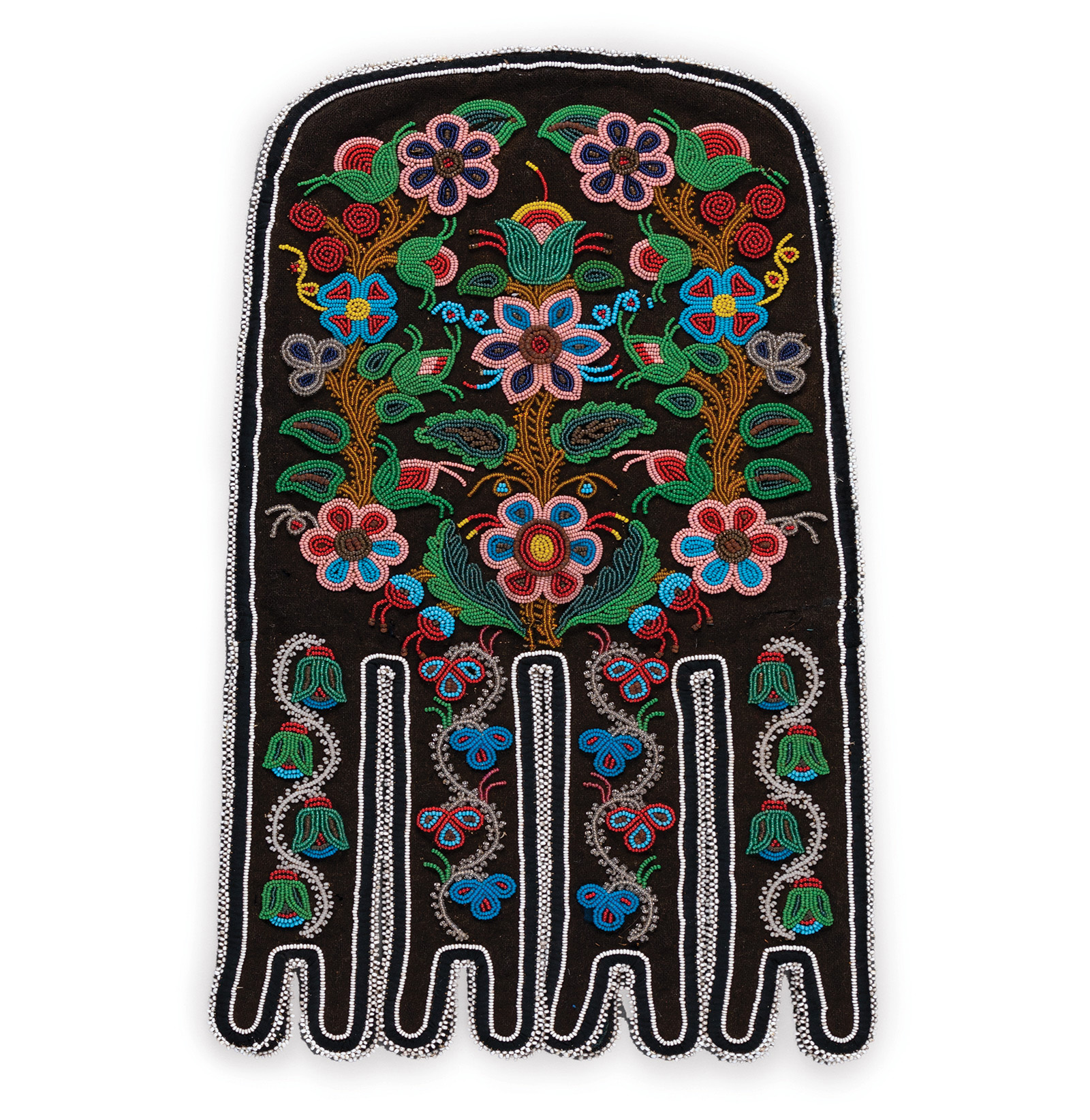 Unrecorded Cree Artist, Octopus bag, 1875-1900, wool and cotton cloth, glass seed beads, metallic beads, silk ribbon trim. Museum purchase with funds provided by a grant from Lilly Endowment Inc., 2019.2.256.
The biggest of the “big ideas” was to no longer present artwork and storytelling based on geography. Instead, a new thematic approach connects visitors with Native communities. The galleries are organized around three concepts shared by many Native cultures: relation, continuation and innovation.
“Relation” is the largest section, explaining how Native peoples view the world and each other, how Native peoples view their relations with plants and animals, and how relations among Native families are structured.
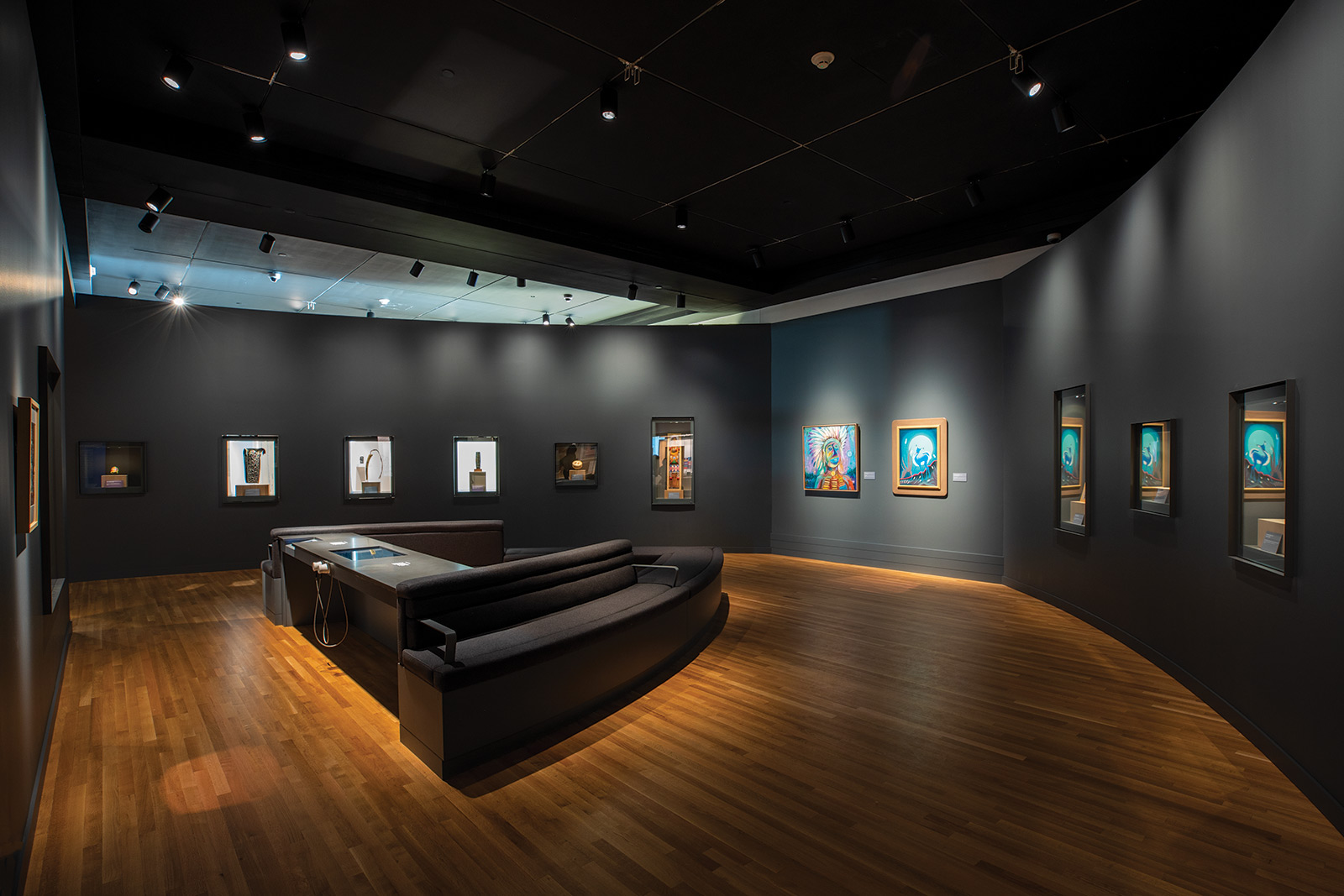 A recently renovated gallery at the Eiteljorg Museum in Indianapolis. Image courtesy of Hadley Fruits Photography and the Eiteljorg Museum.
You Are on Native Land
The exhibition welcomes visitors with a written land acknowledgment on an exterior wall. A shorter version projects onto the entryway requiring guests to walk over the text when entering, reinforcing that they—and the museum—are on Native land. This introductory space additionally features audio greetings in the Native languages of the original inhabitants of Indiana, including the Miami, Potawatomi, Delaware and Shawnee.
For the vast majority of visitors, it will be the first time these languages have ever reached their ears.
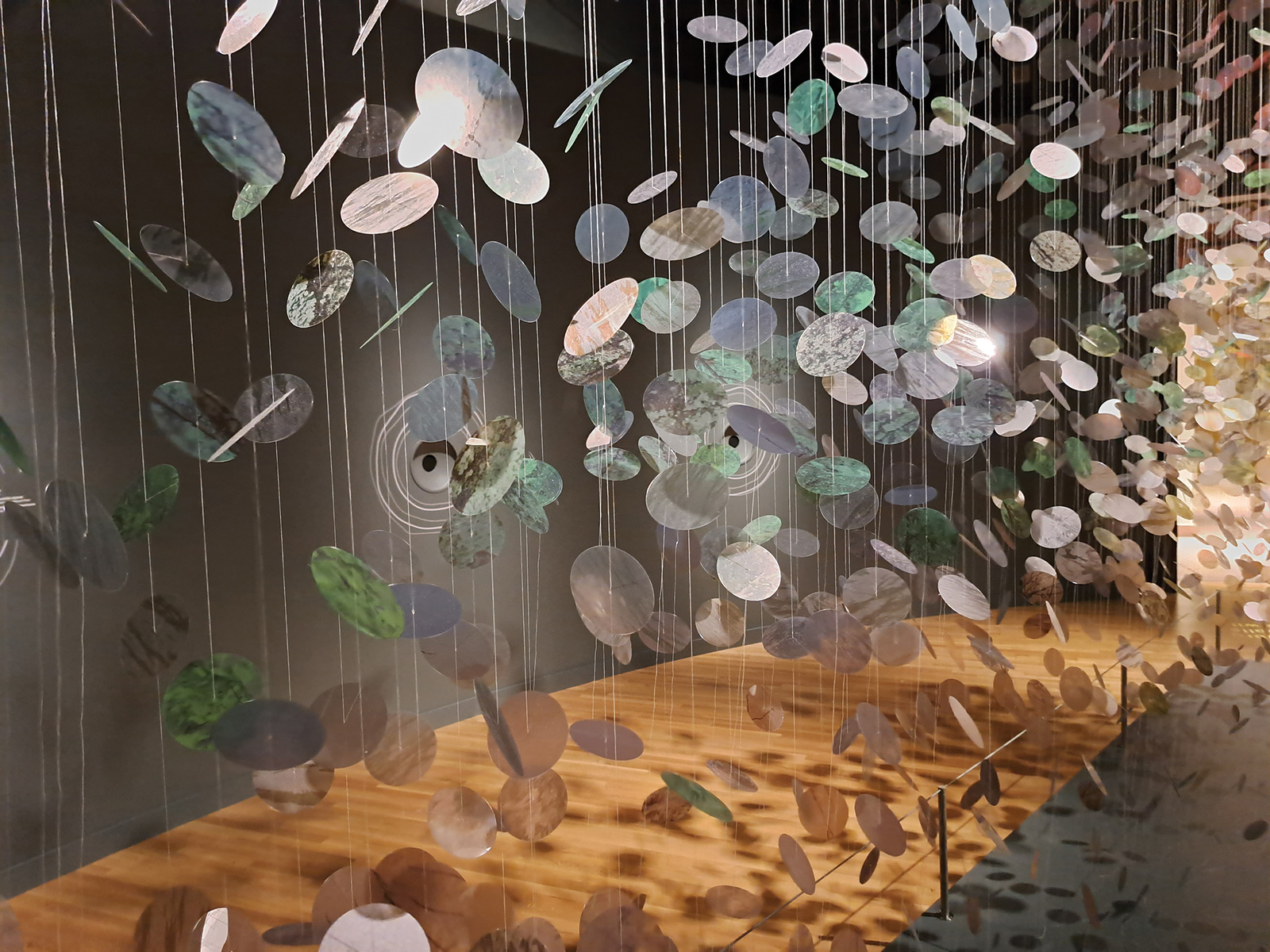 Hannah Claus (Bay of Quinte Mohawks), water song: peemitanaahkwahki sakaahkweelo, 2019, DuraChrome UV ink printed on JetView acetate film, Gütermann Scala 60 thread, PVA glue. 2019 Eiteljorg Fellow. Museum commission with funds provided by the Eiteljorg Contemporary Art Fellowship, 2019.9.1. Photo courtesy Eiteljorg Museum, 2022.
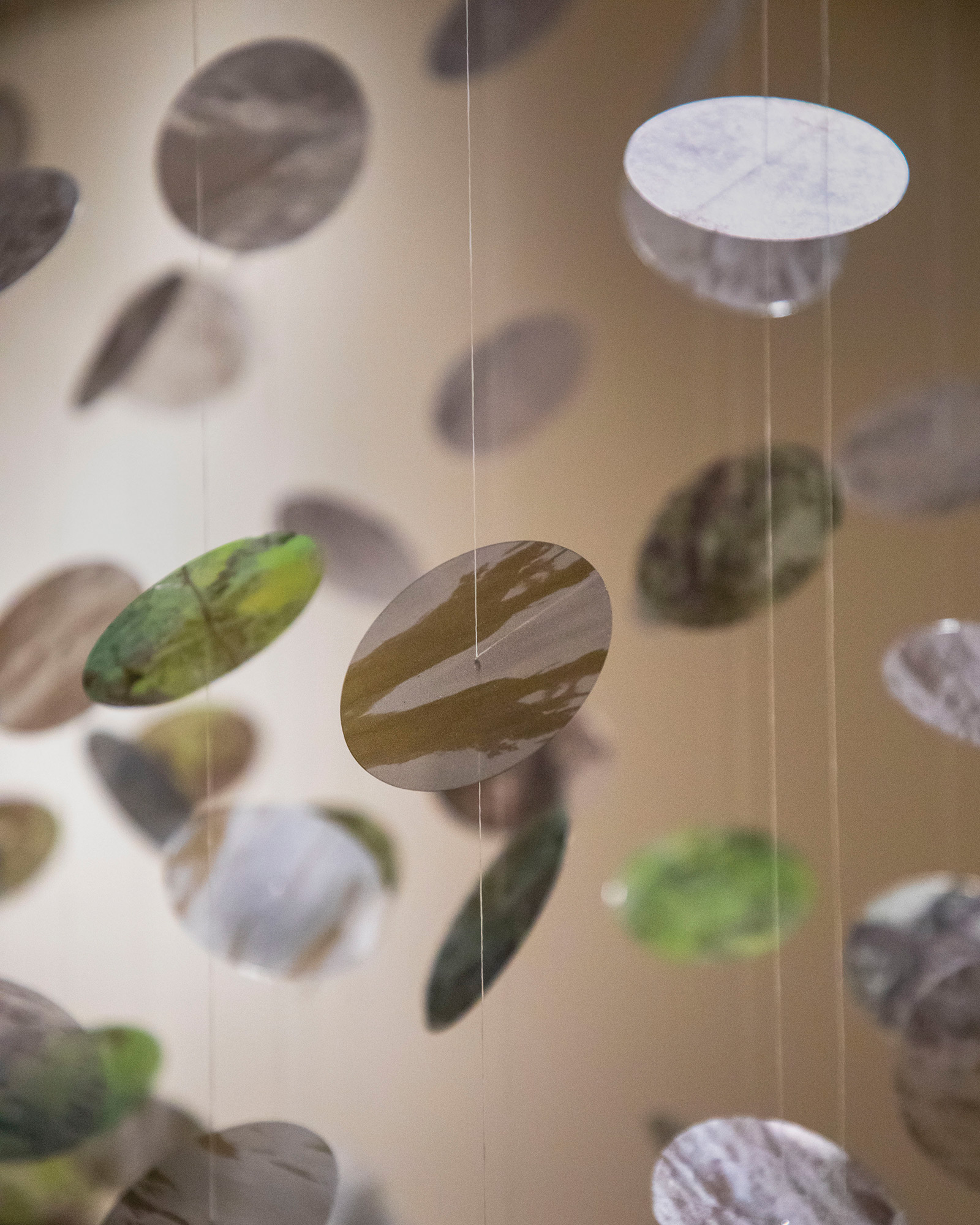 Hannah Claus (Bay of Quinte Mohawks), water song: peemitanaahkwahki sakaahkweelo, 2019, DuraChrome UV ink printed on JetView acetate film, Gütermann Scala 60 thread, PVA glue. 2019 Eiteljorg Fellow. Museum commission with funds provided by the Eiteljorg Contemporary Art Fellowship, 2019.9.1. Photo courtesy Eiteljorg Museum, 2022.
“A lot of people are under the impression that Native people don’t speak their languages anymore and that languages are dying off,” Red Cloud says. “[The speakers are] driving home the fact that this was once Miami, Potawatomi, Delaware, Shawnee, Kickapoo, Peoria lands; they still consider it home.”
Priority number one for the curators and advisory council was making guests undeniably aware that Native peoples and Native cultures survive and are contemporary.
A translucent, flowing installation piece using acetate film by 2019 Eiteljorg Fellow Hannah Claus (Bay of Quinte Mohawk) brings that point home in a dramatic way. Inspired by the Miami emergence story, Claus’ water song: peemitanaahkwahki sakaahkweelo (2019) fills an entry gallery. The installation would be equally at home in a white cube Chelsea gallery, thus making a fierce statement about Indigenous contemporaneity. This is not the “traditional” Native American art museum visitors have come to expect.
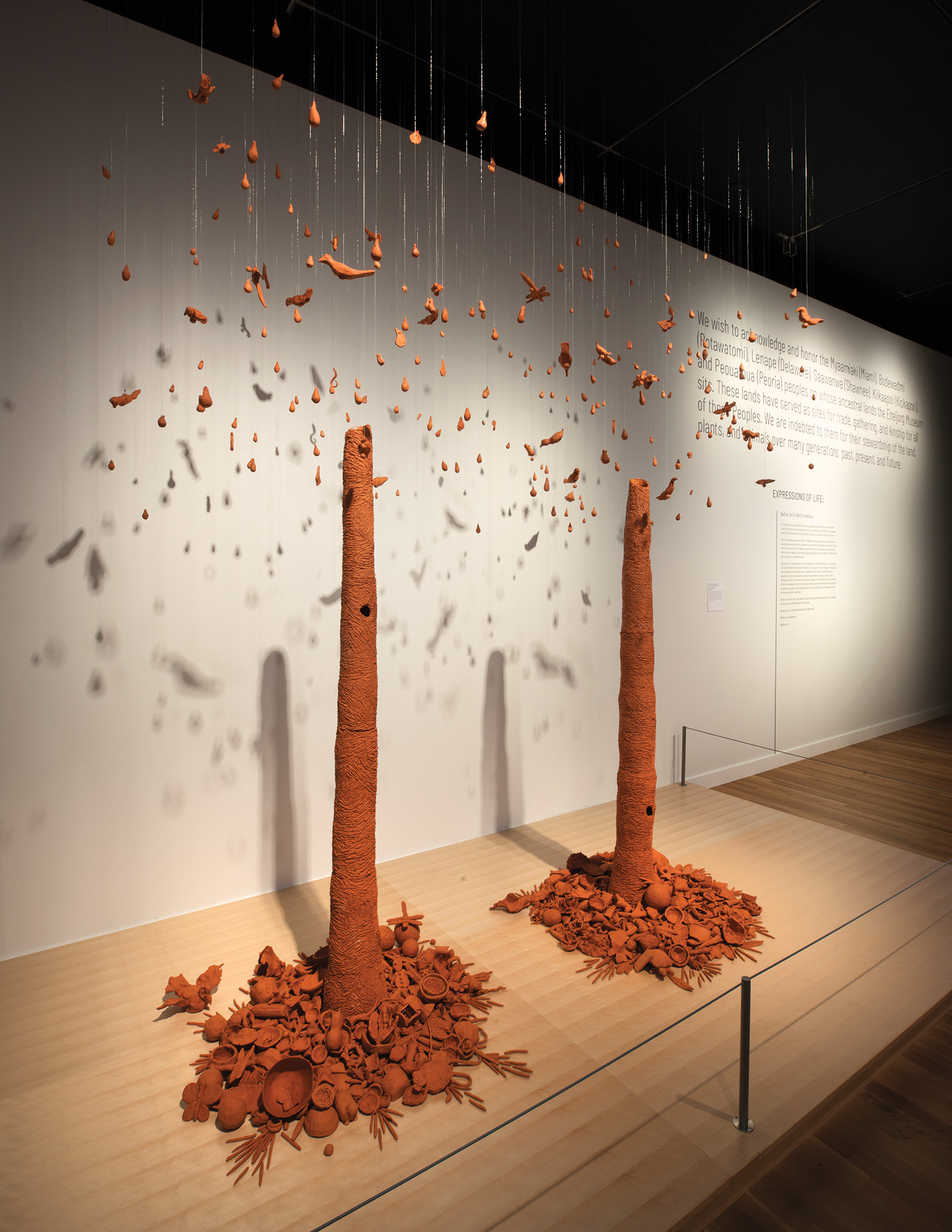 Anita Fields (Osage/Muscogee), Considering the Earth and Above, 2008, unglazed bisque-fired clay, metal. 2021 Eiteljorg Invited Fellow. Gift of the artist, 2009.8 A-T. Image courtesy of Hadley Fruits Photography and the Eiteljorg Museum.
That’s the point.
Native art is on a continuum.
“What is [now] hundreds of years old, at the time, was considered contemporary; things of the future will still have roots in tradition,” Red Cloud explains.
The first of the new galleries’ digital hubs features Claus describing the water song work. Audio descriptions for visitors with visual impairments, improved lighting, digital interactives and touch samples throughout the entire exhibition contribute to it being more accessible than before.
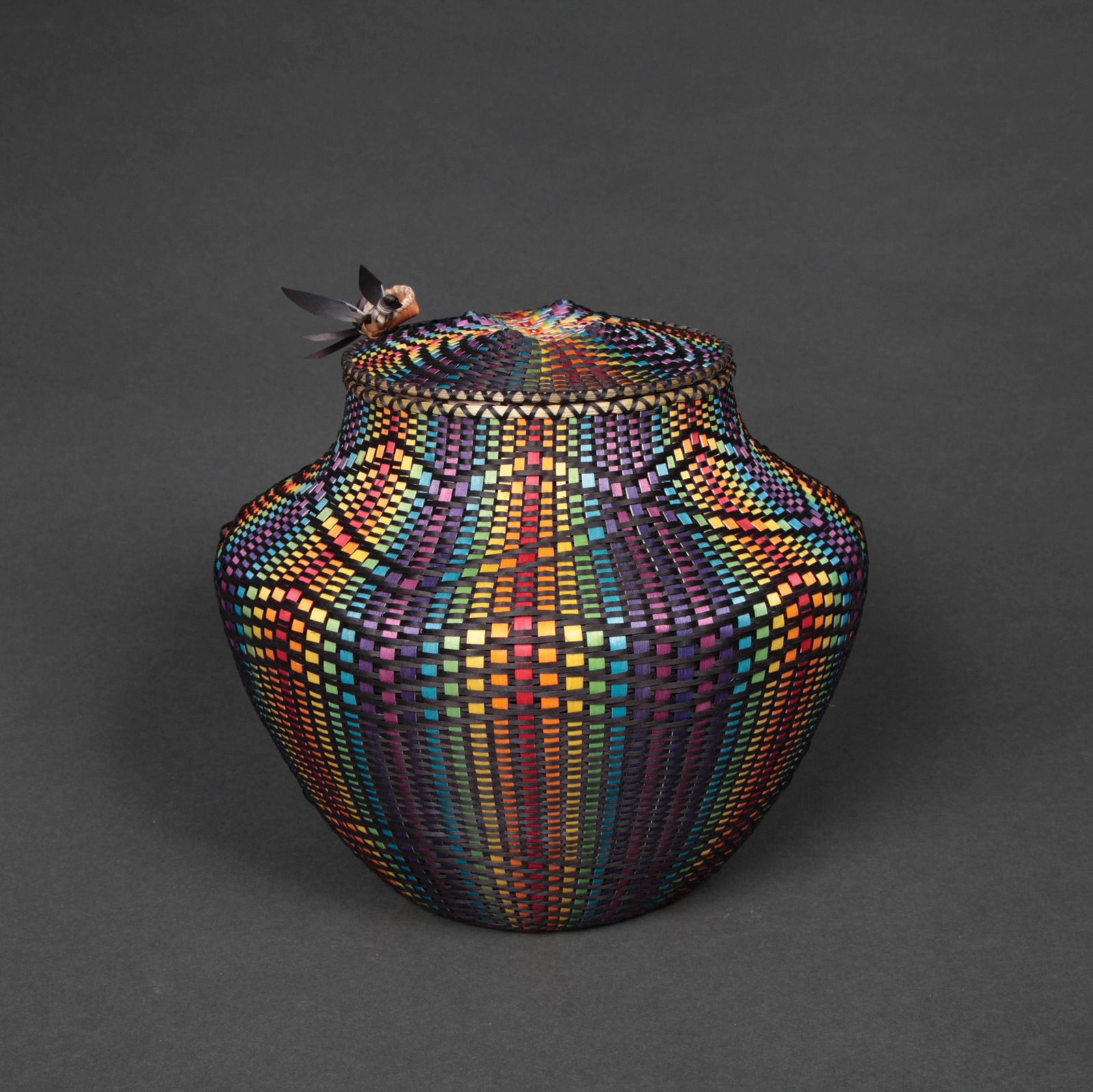 Geo Neptune (Passamaquoddy), Ceremony of the Singing Stars, June 2017, woven black ash, sweet grass, birch bark, commercial dyes. Collection of Eiteljorg Museum, 2017. Eiteljorg Museum Indian Market and Festival Harrison Eiteljorg Purchase Award, 2017.7.1 A-B.
Connected by Water
In 2019, the Eiteljorg, with the help of a Lilly Endowment grant, acquired an extraordinary personal collection of more than 400 items from Native nations of the Great Lakes including the Ho-Chunk, Meskwaki, Menominee, Ojibwe, Potawatomi and others. The Richard Pohrt Jr. Collection featured clothing and accessories such as shirts, blouses and vests; leggings, skirts and wearing blankets with intricate beadwork and ribbonwork; beaded bandolier bags, sashes, garters and moccasins. It contained significant examples of carved wooden bowls, ladles and war clubs as well as hand-woven bags.
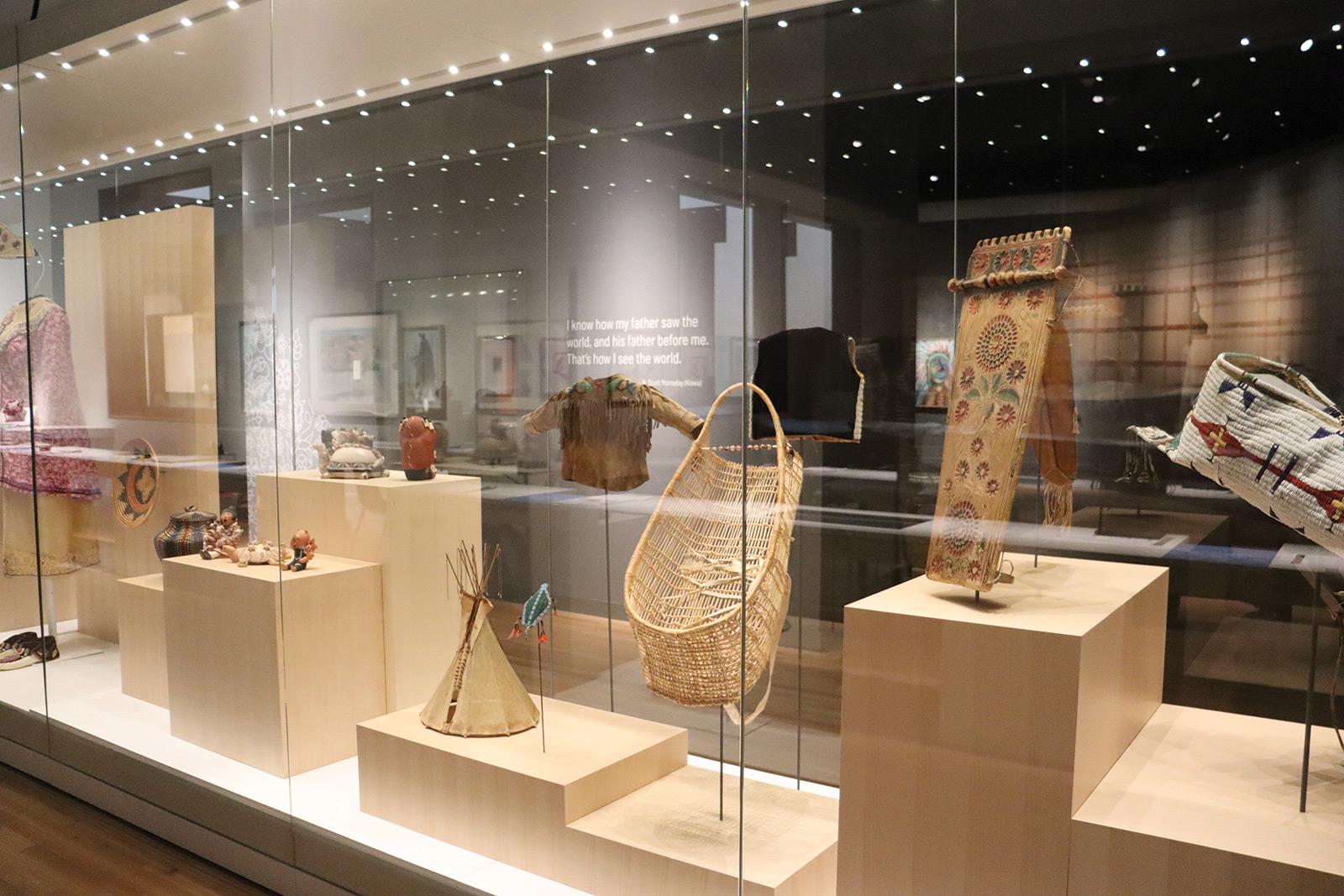 Artwork of all varieties on view in Indianapolis. Image courtesy of Hadley Fruits Photography and the Eiteljorg Museum.
Nationally significant, the items were also regionally relevant to the Eiteljorg considering Indiana’s Great Lakes location. The Pohrt Collection and other Great Lakes works acquired separately allowed the Eiteljorg’s renovated Native American Galleries to take a much deeper dive on artistic production from the region, leading to the “Connected by Water” section of the new exhibition.
“The Pohrt Collection allows us to not only feature the art in the exhibition, but we plan to develop more relations with Great Lakes tribes and have them visit [and] research the collection,” Red Cloud says.
As an example, just prior to the Covid pandemic, a group of beadwork and ribbon work artists from the Pokagon Band of Potawatomi visited the collection looking at items for inspiration.
Red Cloud adds, “Instead of having the collection just sit there, we want it to really represent our intent of goodwill and share it with the community.”
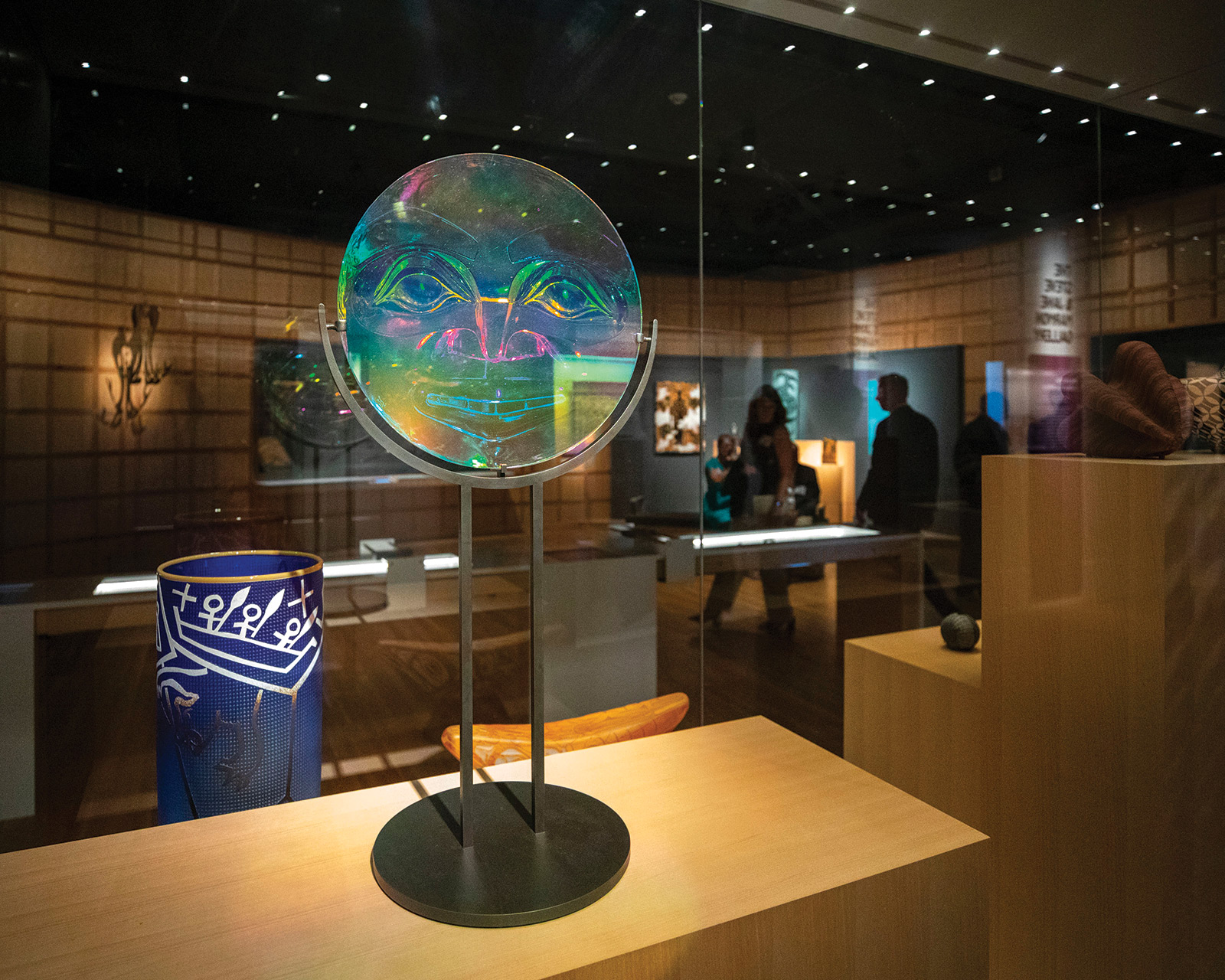 A new gallery in the $6 million renovation at the Eiteljorg Museum. Image courtesy of Hadley Fruits Photography and the Eiteljorg Museum.
The action speaks to a growing movement among museums possessing Indigenous material to be less static, to seek out Native people with ancestral connections to the items on display for help with the interpretation of those items.
“Museums are going to be involving communities more, instead of the museum acting like we’re the sole authority,” Red Cloud says. “We’re not the sole authority, our obligation is ongoing as a museum to involve our community, [to] service our community.”
Beyond the display of artwork, the Eiteljorg’s renovated galleries allow for opportunities to present more enriching programs including the possibility for storytelling, films, lectures and performances, for both Native and non-Native audiences, presented by Native people.
A learning space detailing how Native peoples have been interpreted over time follows Claus’ installation as visitors work their way through the exhibition. Here, guests see how earlier depictions of Native people by white artists such as Charles Bird King who strove for accuracy, gave way to later 19th- and early 20th-century artists who had other motivations.
“Frederic Remington, Joseph Sharp, Edward Curtis, they’re taking artistic license and projecting feelings and popular thoughts [of that time] that Native peoples were [either] savage or fading off into sunset,” Red Cloud says. “Those later projections are still influencing us today which we see in the mascots.”
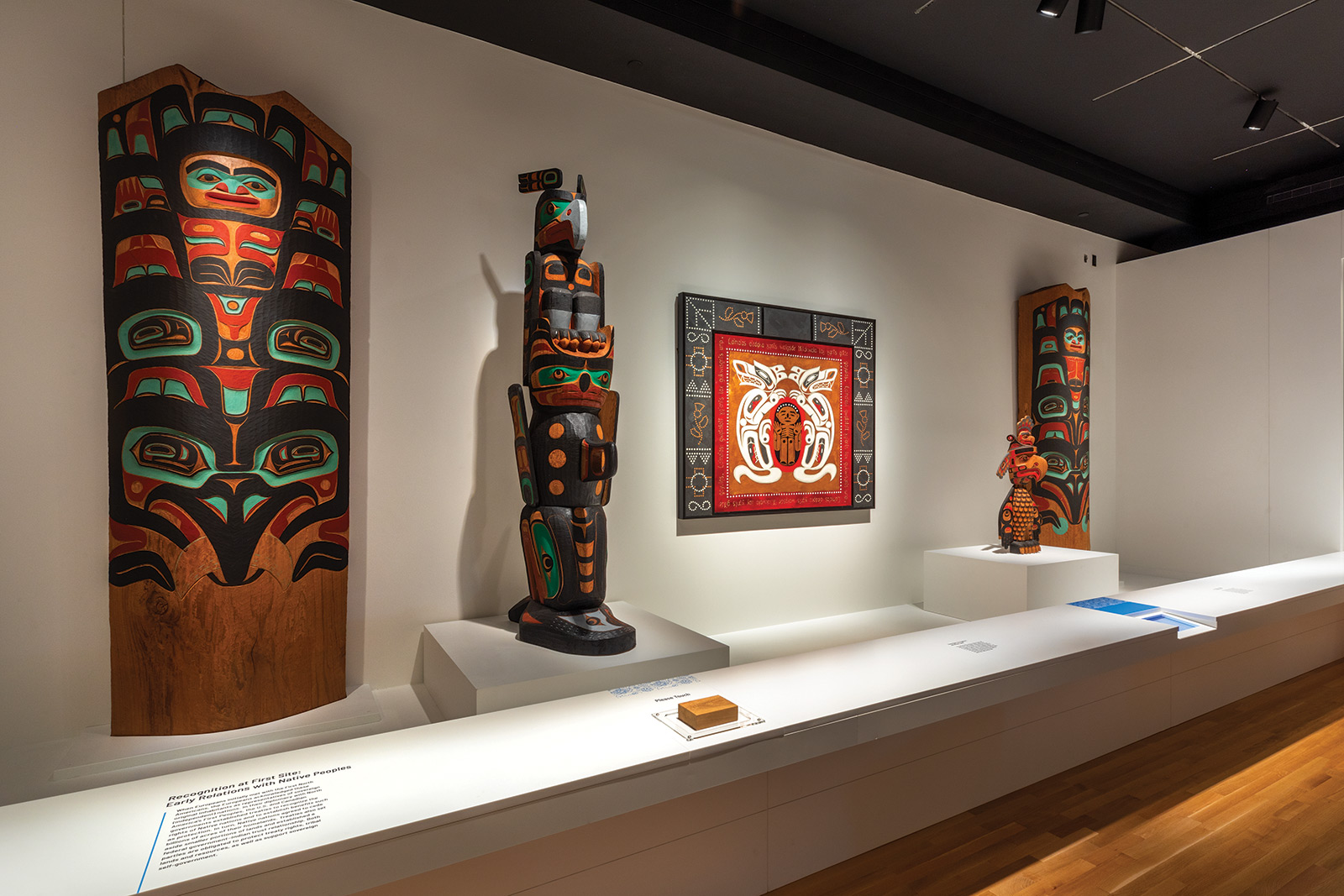 Large carvings on view at the Eiteljorg Museum. Image courtesy of Hadley Fruits Photography and the Eiteljorg Museum.
The learning space also does the important work of combating the “Cowboys and Indians” stereotype of Native America. After reinforcing that Native peoples are still living, the next most important goal for curators was communicating that Native peoples are diverse.
“Not everyone lived in a tipi, not everyone wore a headdress,” Red Cloud reminds us.
At the end of this section, a large picture collage shows a diversity of Native people from North around America engaged in a variety of activities from singing to surfing and playing drums, “to reiterate that Native peoples are very much alive and very contemporary like everybody else,” Red Cloud adds.
Testimonial
A raised beadwork piece by Karen Ann Hoffman (Oneida Nation of Wisconsin) appears in the renovated galleries. In describing the finished project, Hoffman beautifully summarized how the exhibition honors the work.
“Our art speaks—speaks of Life, Death, the proper ways to move between the two, and beyond. With strong Breath, our Art speaks the Voices of those who came before, through the Hands of those who are now, for the Ears of those who are yet to come,” she wrote. “This new exhibit is a rare and courageous celebration of those Voices. The curators, artists, mount-makers, curriculum-developers, all gathered in a communal and groundbreaking way to give full throat to those Voices first and foremost. This is what the Art deserves. It is what will fascinate the audiences. It is what the Eiteljorg had the courage to do. Come. Listen. Engage in the conversation. We are all welcome here.”
Powered by Froala Editor