You know Nighthawks even if you don’t recognize the name. Edward Hopper’s 1942 painting of three figures seated around the counter of a late-night diner with an employee waiting on them, comments on urban isolationism, the “aloneness” of city life amongst throngs of people as America was shifting from a rural and agrarian nation into an industrial one.
The image has been endlessly parodied to feature characters from The Simpsons, Disney princesses and, most famously, Gottfried Helnwein’s Boulevard of Broken Dreams, featuring Marilyn Monroe, Humphrey Bogart, James Dean and Elvis Presley. Nighthawks is so famous it has a famous imitation.
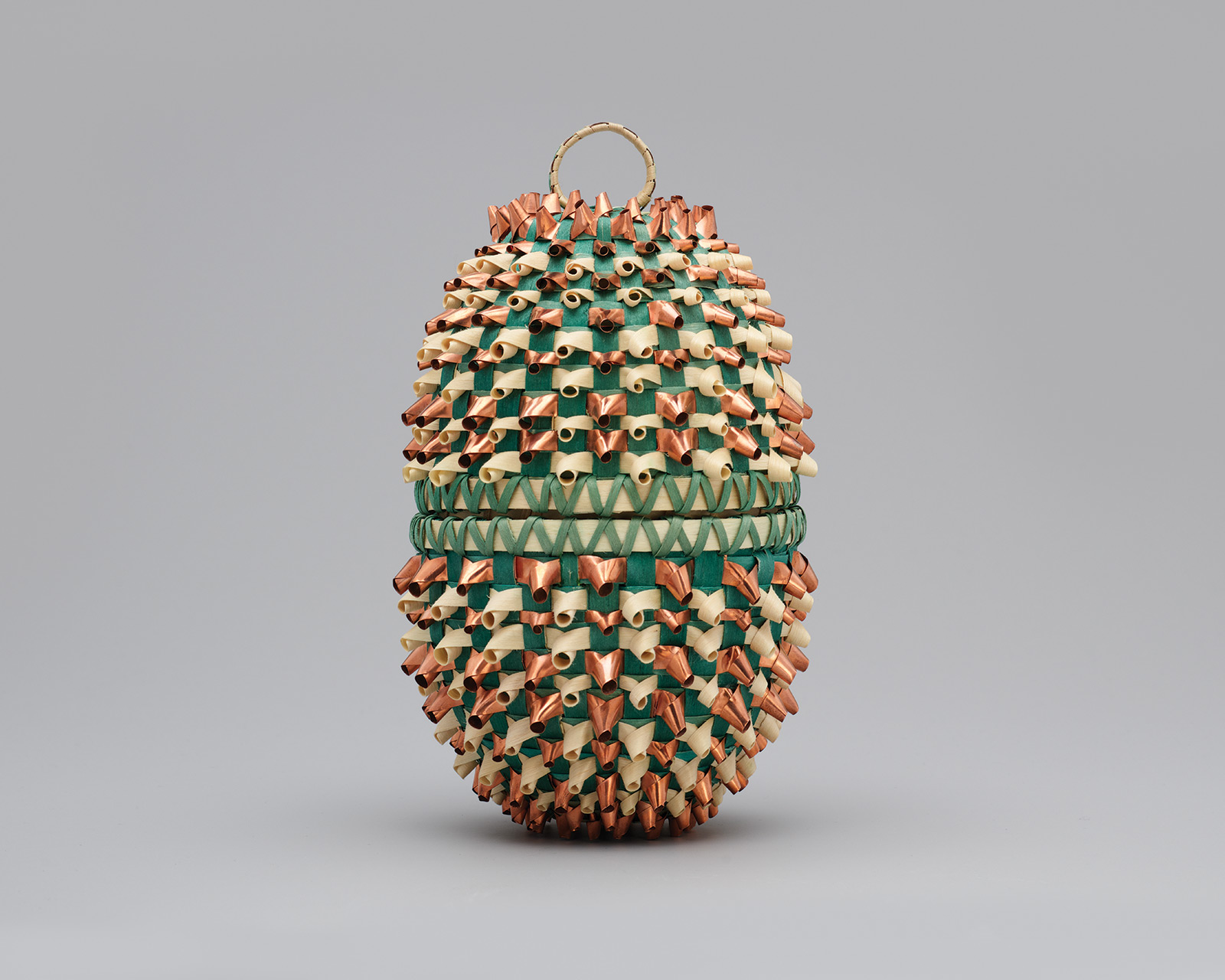 Kelly Church (Ottawa/Pottawatomi/Ojibwe), Sustaining Traditions—Digital Teachings, 2018, basket, black ash, sweetgrass, copper and Rit dye; medicine pouch containing sage, tobacco, sweetgrass and cedar; glass vial containing emerald ash borer and isopropyl alcohol; USB flash drive, 7¾ x 4”. Mrs. Leonard S. Florsheim Jr. Fund, 2020.389a-d.
The painting was acquired shortly after completion by the Art Institute of Chicago—among the small handful of the world’s elite art museums—and has been on view there ever since.
Arguably the most recognizable image in American art. Inarguably an icon of popular culture admired by millions annually.
In the spring of 2022, Nighthawks got a new neighbor: Sustaining Traditions—Digital Teachings, a 2018 black ash basket by Kelly Church (Ottawa/Pottawatomi/Ojibwe).
Church’s basket shares the story of the emerald ash borer, an invasive insect from Asia destroying the black ash trees used by Native People in Michigan to make baskets. Sustaining Traditions—Digital Teachings is green in color with copper woven in; the bug is green with a copper belly.
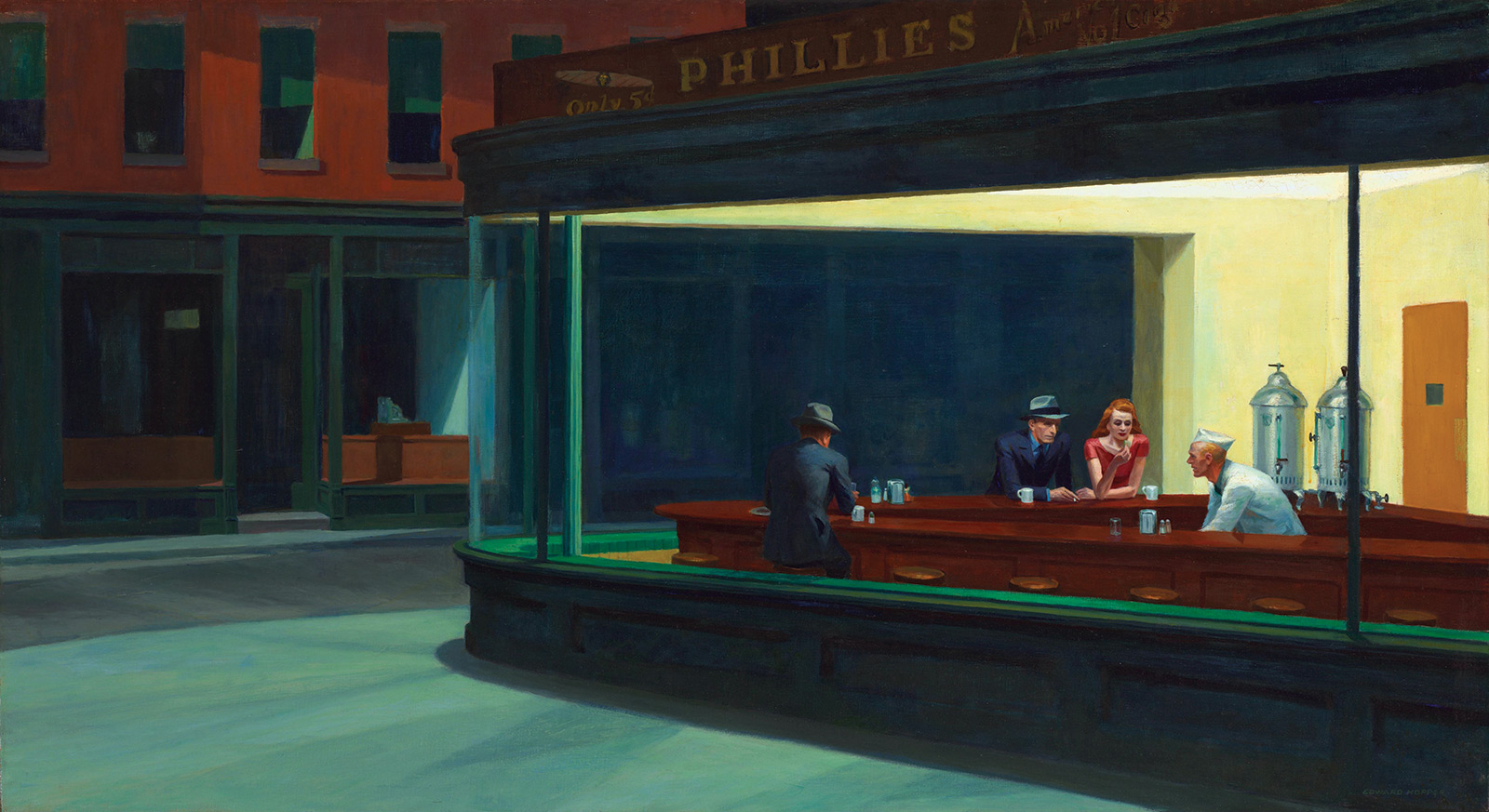 Edward Hopper (1882-1967), Nighthawks, 1942, oil on canvas, 331/8 x 60”. Friends of American Art Collection, 1942.51.
“The whole process was thinking about how to keep our memories and pass them on and share them, and continue to share them despite the emerald ash borer,” Church says.
The basket was purchased by Andrew Hamilton, associate curator of arts of the Americas at the Art Institute of Chicago, in the opening minutes of SWAIA Santa Fe Indian Market in 2019.
“Even when he purchased it, I never thought that it would actually be on display, because usually when museums purchase your work, it sits in the collection room,” Church remembers.
Hamilton emailed Church early in 2022 informing her that the museum’s American galleries were being reinstalled and that her basket would be positioned with Nighthawks.
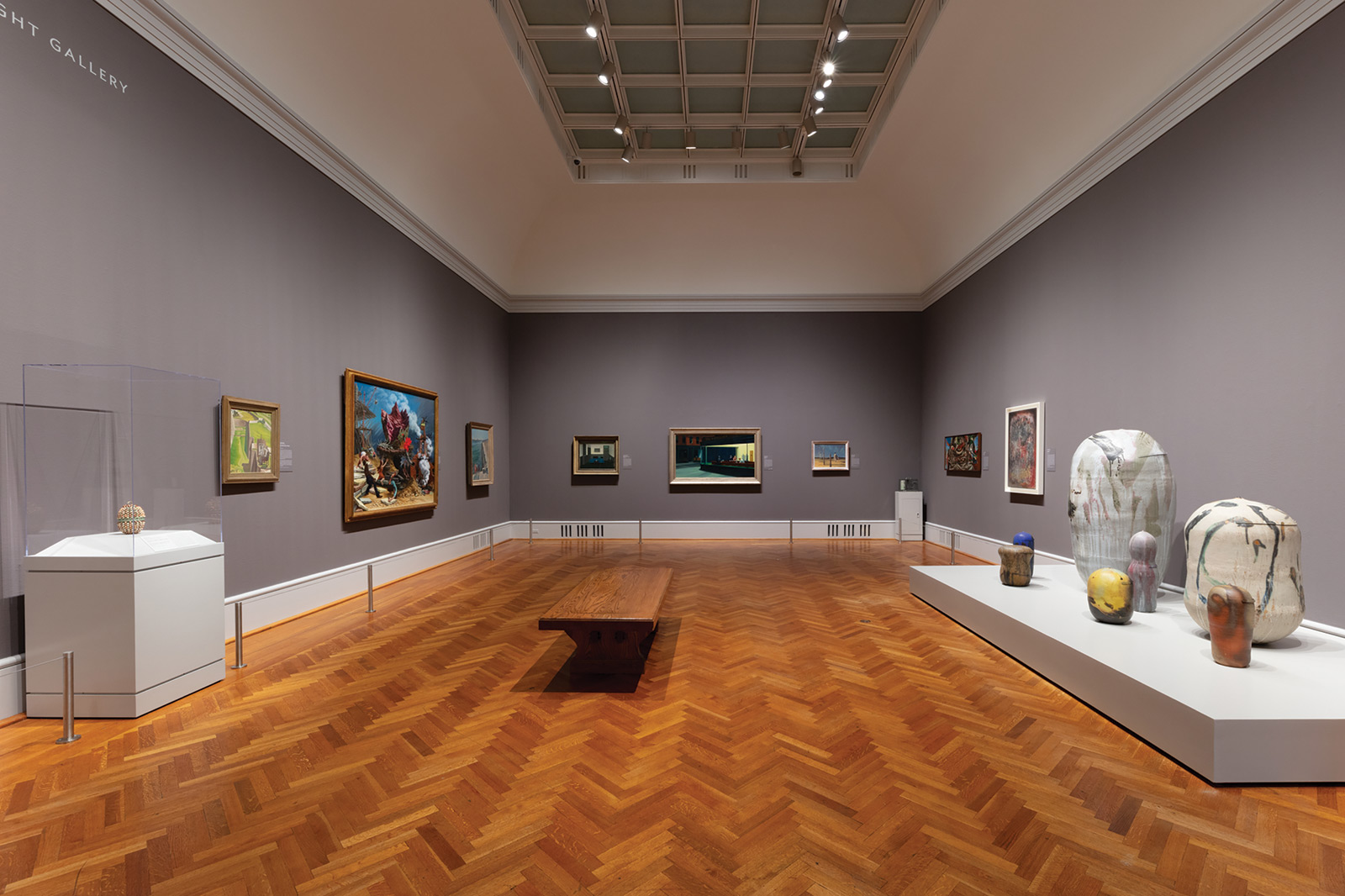 Kelly Church’s basket Sustaining Traditions—Digital Teachings on view in the same gallery as Edward Hopper’s Nighthawks.
“I have to admit, I know the painting, but I didn’t know the name, so I had to look it up and I was like, ‘Whoa, that’s a really famous painting,’” Church says. “The most exciting part is when I actually saw it. We thought we’d have to look for it—it’s a tiny egg, nine inches tall—and there’s these huge paintings in the room, but when you walk in the room and you walk around the corner, you don’t have to look for it at all.It’s centered [with] this is great light on it—it shines.
I know it’s mine, but I never saw it that way.”
Nighthawks previously hung on a wall by itself, dominating the center of the room. Museum curators made a conscious decision during the reinstallation to hang the painting shoulder-to-shoulder with works by a diverse array of artists.
“We hope that this presentation of Kelly Church’s basket emphasizes that Native American art is American art,” Hamilton says. “We also want to challenge audiences’ preconceptions about hierarchies of ‘art’ and ‘craft.’ The basket even may overturn assumptions about size: it is the smallest object in the gallery, but its glittering copper and bright green wood have a very powerful presence.”
The basket also has the distinction of being the most recently completed work on view in the gallery.
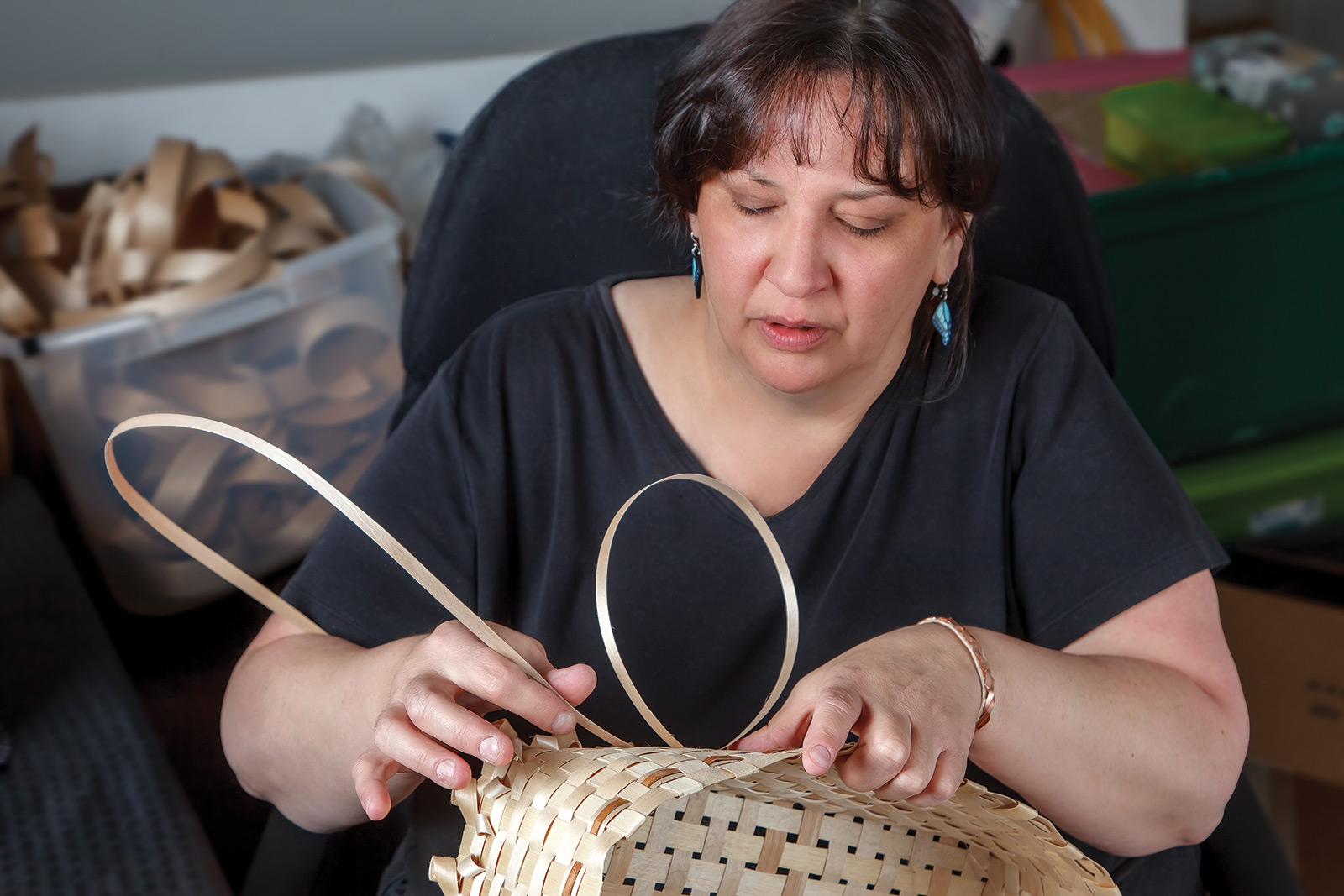 Kelly Church works on a basket in her studio. Image courtesy of the artist.
“One thing I hope [guests] realize is the placement of it because usually [Native Americans are] in natural history museums as people of the past; then, there’s always people thinking of Natives as ‘traditional.’ Well, [this basket is] not a traditional piece by a Native American,” Church says. “There’s always these places people expect us to be, so for this, I liked that we’re included in the American wing as we all live in America and, while we are all on Native land, we live in a world that is not dominated by our culture. It is dominated by a non-Native culture. So, recognizing that we are here, we are contemporary people [is important].
I still use the same traditional methods that we used thousands of years ago; I start with a tree, the same teachings that have been passed on orally, visually, and we’re taking that and using our voices to share who we are today.”
Church’s basket will be on view with Nighthawks for the foreseeable future. It has other famous neighbors as well: a Maria Martinez pot shares the gallery and Grant Wood’s American Gothic is just around the corner.
Powered by Froala Editor