Around 1000 B.C., the Cherokee occupied vast stretches of land among the Great Smokey Mountains and the southern Appalachians. They mined copper, which they hammered with stones into sheets that they formed into jewelry, arrow points and cooking utensils. Copper working gave way to the use of silver, iron and steel with the arrival of Europeans.
An elaborate 13th-century repoussé copper plate was discovered as part of the regalia of an Etowah chief in northwest Georgia. It is now in the collection of the National Museum of Natural History of the Smithsonian Institution which notes, “This plaque would have served as an emblem of office awarded a chieftain and would have accompanied him as a sign of his strength among the ancestral spirits.”
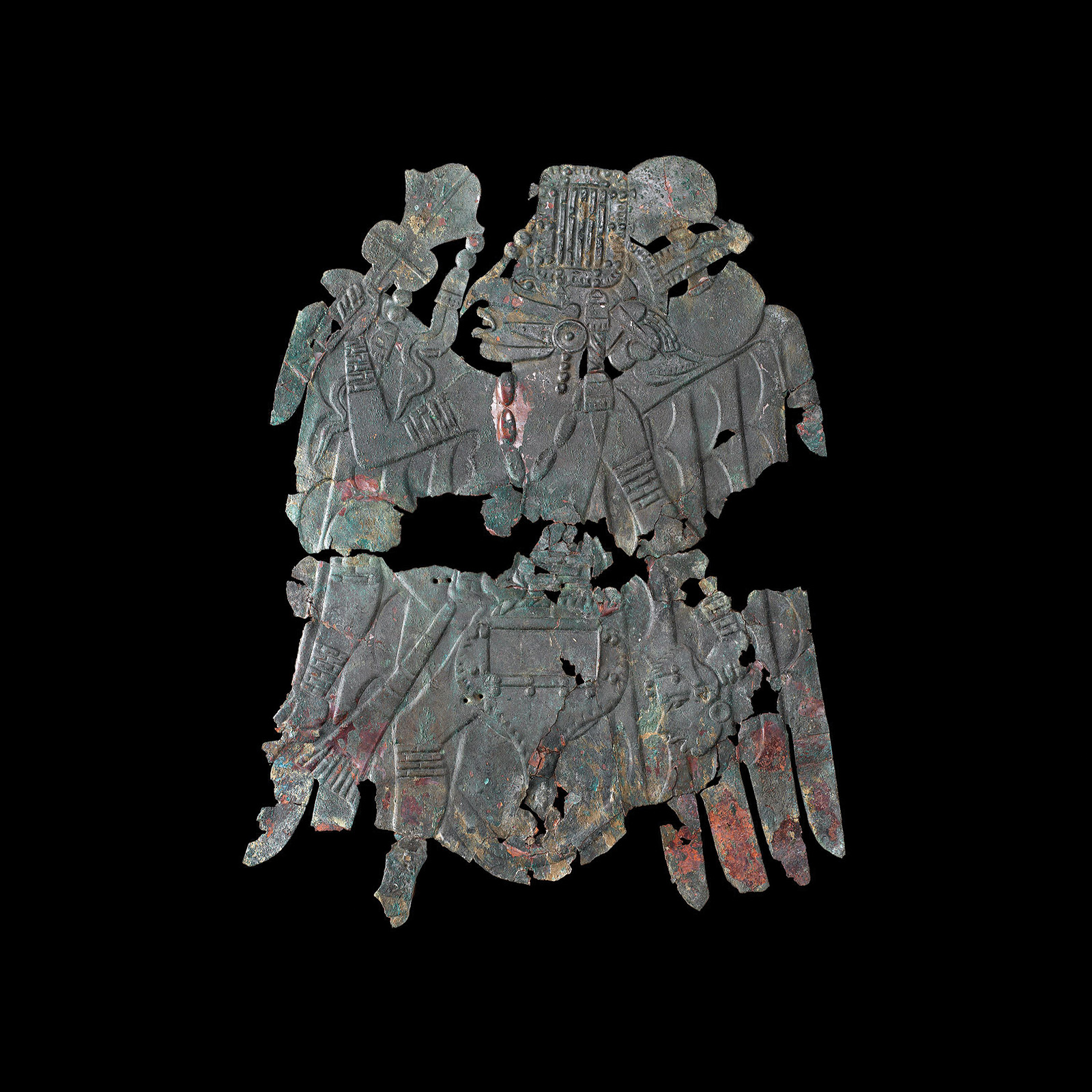 Copper Plate (Human Figure), 13th century, copper, 11”. The Rogan Plate is one of a collection of Mississippian copper plates discovered at the Etowah Indian Mounds in north Georgia. A number of these plates have been found in locations across the southeastern and midwestern United States. National Museum of Natural History, Smithsonian Institution, Washington, D.C.
The Qualla Arts and Crafts Mutual (QACM) was formed in 1946 by Eastern Band of Cherokee Indians’ artisans and craftspeople. At that time there was only one metalsmith among the members, Arch Miller (1912-2001), who made forged forks and hammered copper bowls. He was the only member of the co-op working in copper until his death.
The Qualla Boundary is territory held in trust by the United States government for the federally recognized Eastern Band of Cherokee Indians (EBCI), who reside in western North Carolina.
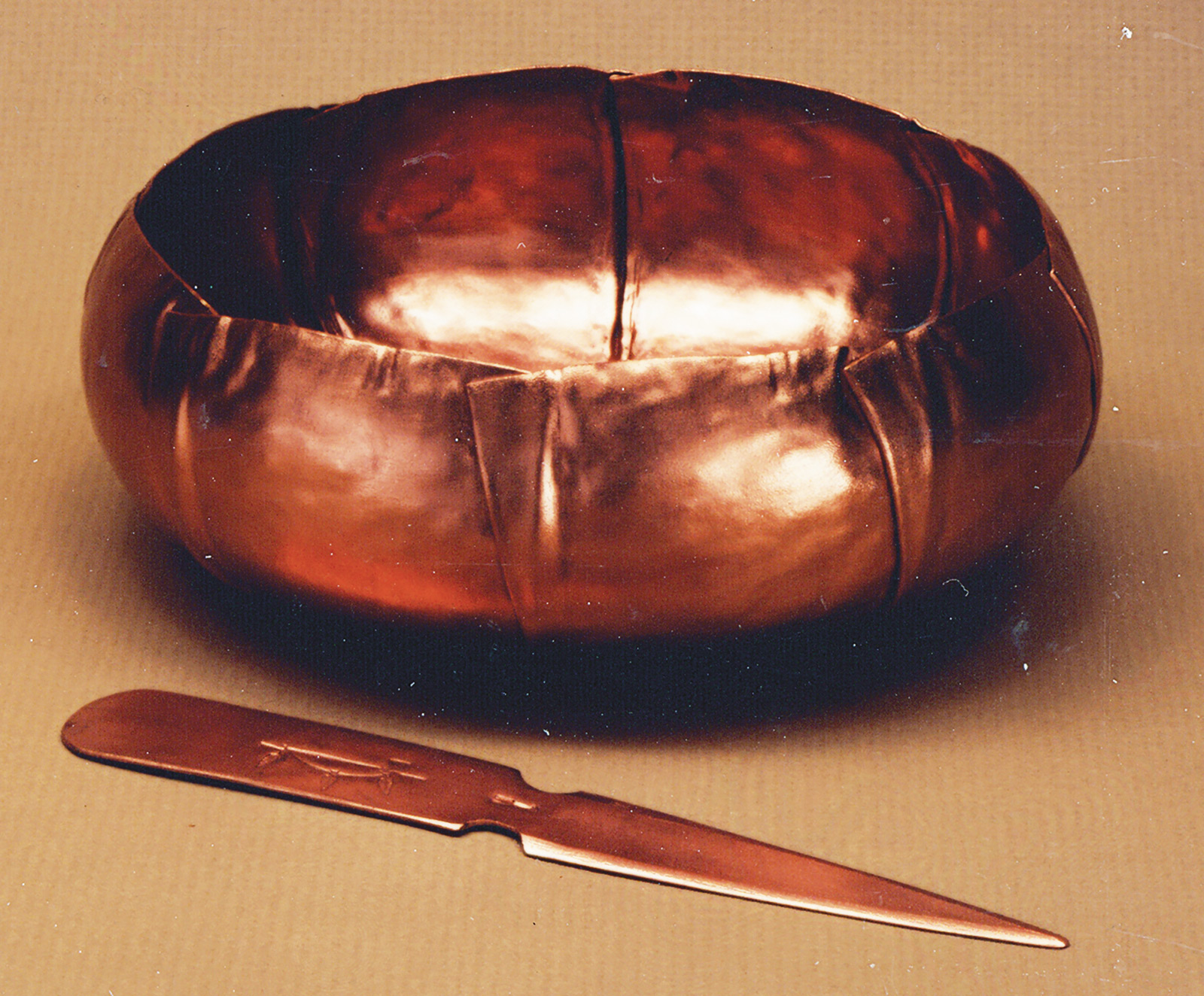 Arch Miller (Oklahoma Cherokee, 1912-2001), hammered copper bowl and letter opener
In 2008, the renowned metalsmith William Rogers was hired by QACM to document Arch Miller’s studio before it was sold and to teach metal workshops based on his findings. A grant from the Cherokee Preservation Foundation stated that the goal was to “share information on traditional metalworking among the Cherokee community with the idea of revitalizing the tradition of hammered copper.”
Further efforts brought classes in metalsmithing and hammered copper to local school children and to enrolled members in the EBCI. In one workshop at QACM, students made their own gorgets, hammered metal neck plates historically used as armor to protect the throat.
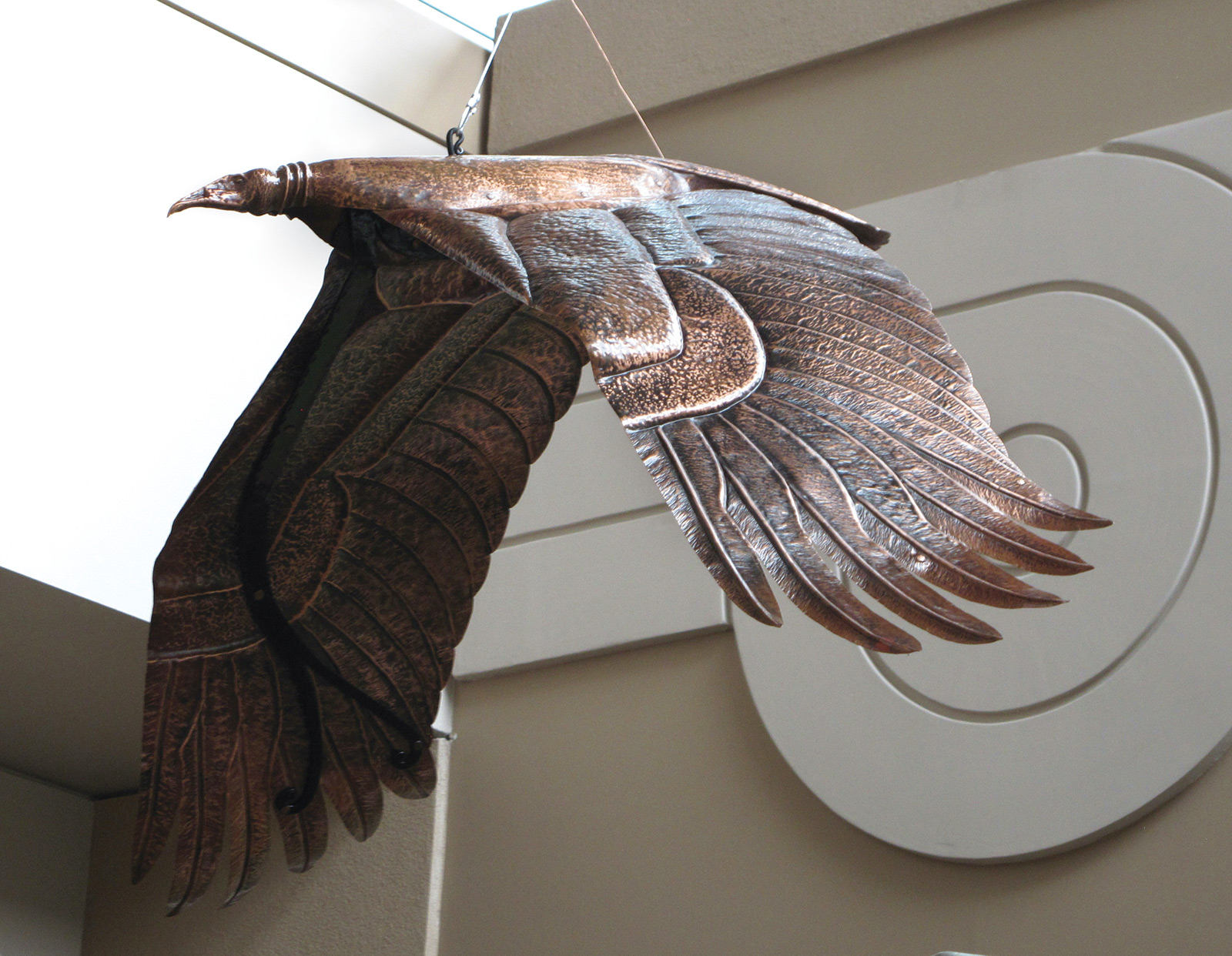 William Rogers, Nathan Bush (Cherokee) and James JR Wolfe (Cherokee), Grandfather Buzzard, 2020, hammered copper, 6’ wide. Cherokee Indian Hospital, Cherokee, NC.
Carmaleta Monteith was instrumental in a granted program at Cherokee High School that brought William Rogers together with students to teach the art of repoussé. The technique involves shaping sheets of copper into three dimensions using hammers and stakes. The students hammered their own culturally inspired designs onto copper disks that were incorporated as elements in two kinetic sculptures by Rogers that are now installed in the school’s atrium.
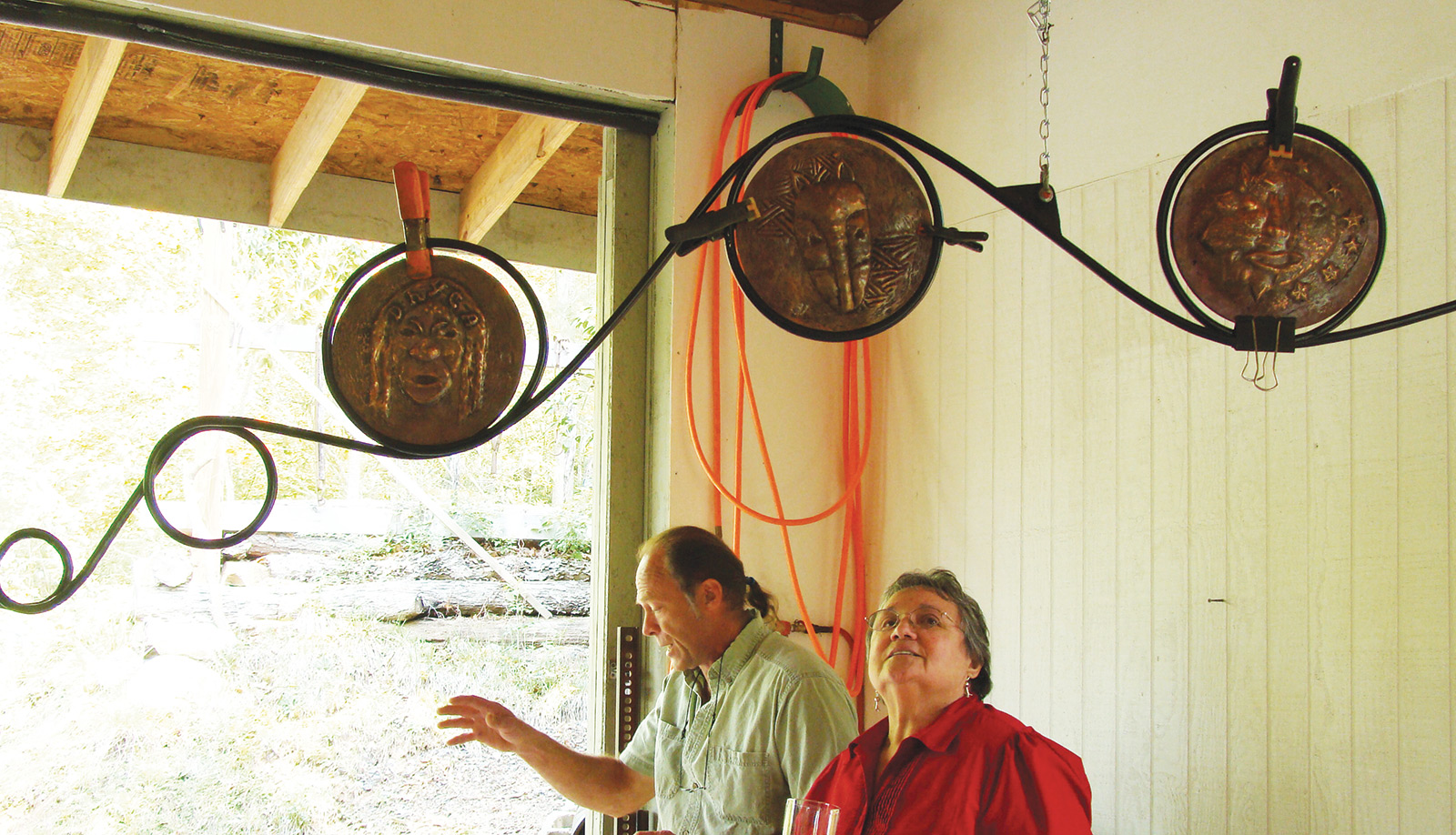 Metalsmith William Rogers and Carmaleta Monteith (Cherokee) inspect the construction of a mobile designed and crafted by Rogers and incorporating hammered copper disks made by students at Cherokee High School, North Carolina.
In 2021, the EBCI Tribal Council named Monteith a “Beloved Woman” recognizing her as “an outstanding member of the Yellowhill Community, [who] has dedicated her life to embodying the Cherokee Core Values and strongly exudes characteristics of a Beloved Woman.”
She was also influential in the creation of other hammered-copper pieces including the Grandfather Buzzard for a new wing of the Cherokee Indian Hospital (CIH). It was made possible with a 2019 grant from the Cherokee Preservation Foundation. As chair of the CIH Authority, Monteith stated, “The inclusion of the presence of the Grandfather Buzzard is critical to the completion of the depicted Cherokee creation story as presented in the artistic interpretation in the main mall area.” With a 6-foot wingspan and made of hammered copper, the sculpture is the work of Rogers and two apprentices, James (JR) Wolfe from the traditional community of Big Cove and Nathan Bush of the Snowbird community.
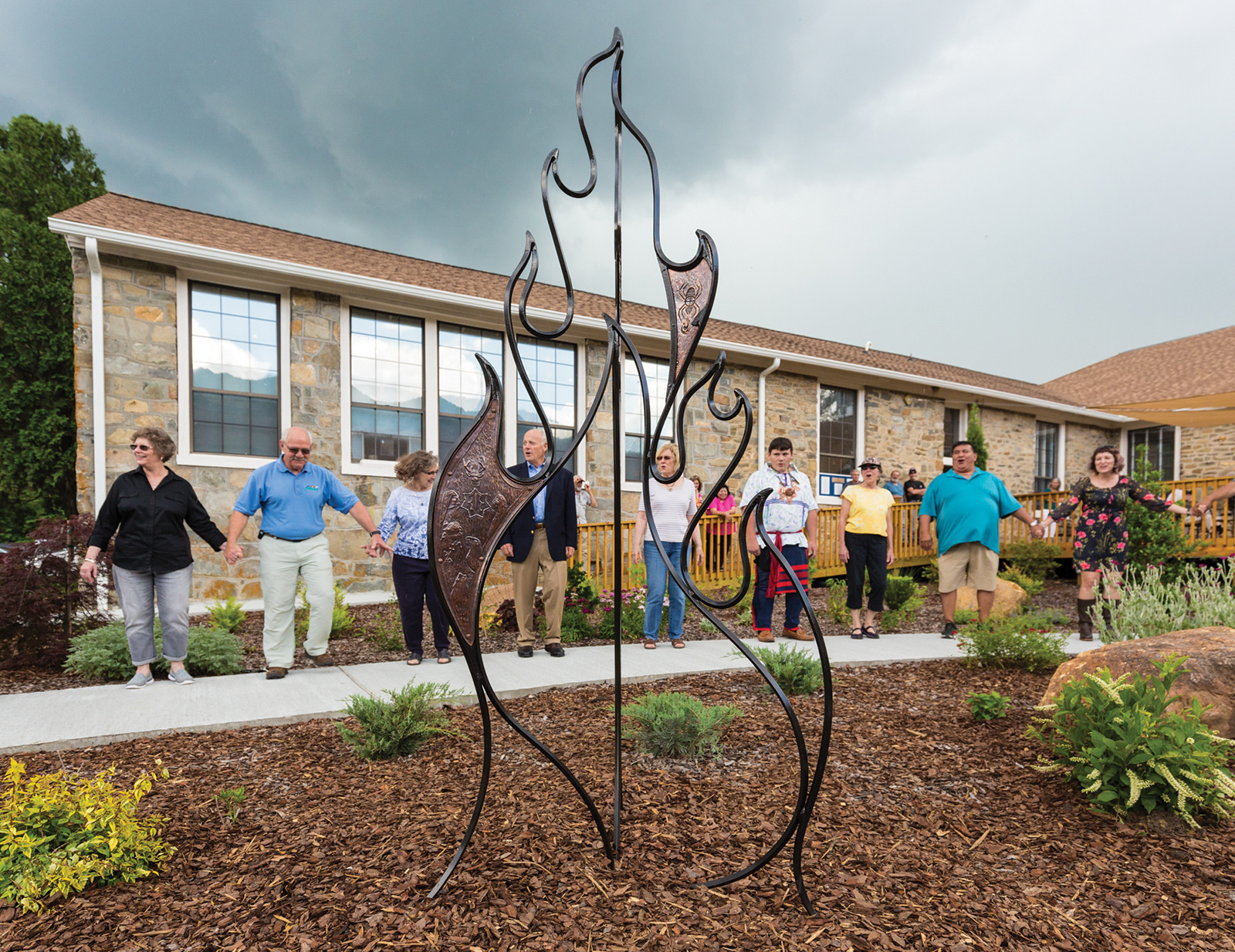 Dancers surround the Eternal Flame sculpture, a centerpiece of the Stecoah Cultural Arts Center’s Cherokee Courtyard. Credit: Chris Aluka Berry.
In the Cherokee creation story, the water beetle came to the watery earth, dove into the sea and brought mud to the surface. Dawn Arneach of the Museum of the Cherokee Indian relates the rest of the story. “When the waters started to recede and land could be seen, the great buzzard was sent out to find a place for the animals to live. When he reached Cherokee country he was tired from flying, when his wings swooped down, this created the valleys and when he brought them up, this created our mountains—this is the short version of how the Great Smoky Mountains were made.”
Rogers relates, “Nathan and JR have helped me learn more about Cherokee visual images and what part they play in telling Cherokee stories. Through working together on the Grandfather Buzzard, they have gained experience in professional metalworking and experience working with a contract and grant obligations.”
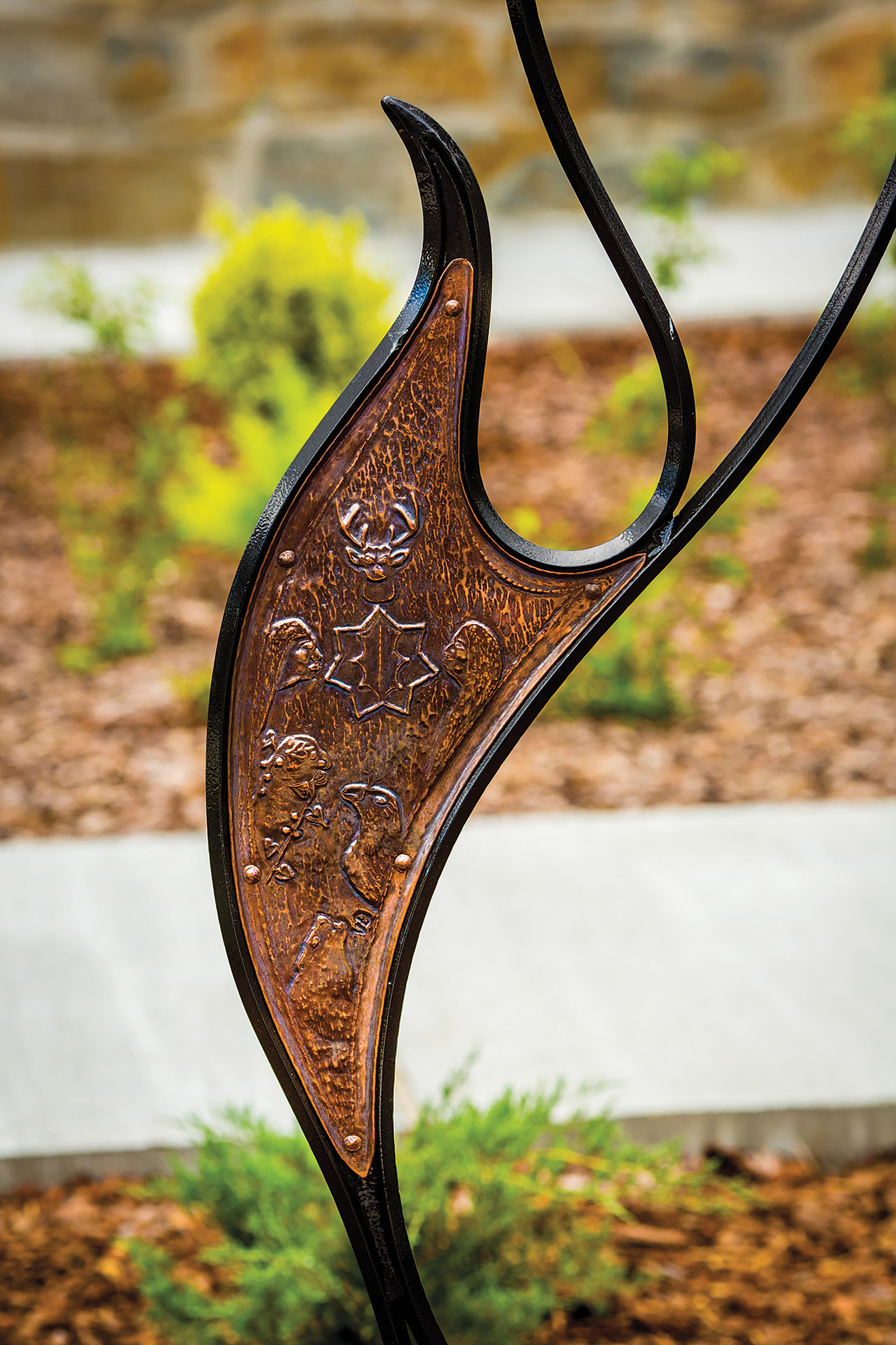 A hammered copper plaque incorporated into the Eternal Flame sculpture in the Stecoah Cultural Arts Center’s Cherokee Courtyard. Credit: Chris Aluka Berry.
Rogers met Bush and Wolfe at the Oconaluftee Indian Village, a living history museum operated by the Cherokee Historical Association. He was part of a project sponsored by the federal Institute of Museum and Library Services to design and build a metal studio at the village. Wolfe was a historical re-enactor at the village and Bush its program coordinator.
Bush received a 2021 Emerging Traditional Artist Grant from South Arts. Commenting on beginning his apprenticeship with Rogers in 2015, he said, “That’s when I first learned that my people worked with metal thousands of years before the first European landed ashore in America. William gave us a very clear history lesson of the relationship between the Cherokee and copper. I was amazed I had never learned this before about my own culture. Then we made our first tools in his blacksmith shop. I was hooked.”
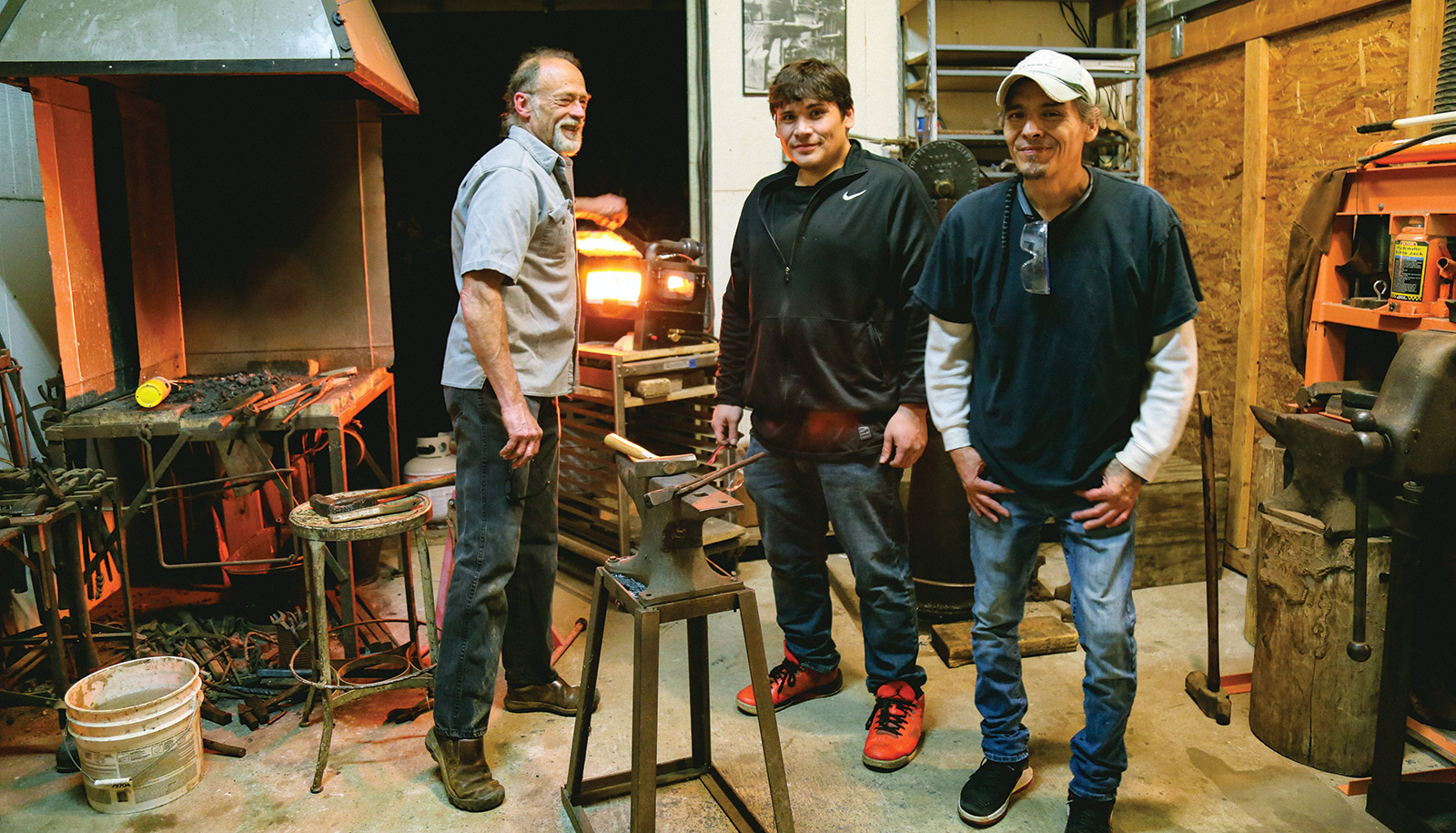 Nathan Bush, center, and James JR Wolfe, right, work with William Rogers learning to forge hot steel as part of their apprenticeship. Credit: North Carolina Arts Council.
Wolfe was an interpreter at OIV for more than 10 years and has since dedicated himself to being a full-time artist having mastered several media including pottery, basketry, carving and metal work. But, as he says, he’s been an artist all his life.
Independent curator Anna Fariello, who was Associate Research Professor at Western Carolina University, concentrating on the region’s material culture, comments, “While Rogers taught over a dozen EBCI artisans how to hammer copper, it was these two who took up the craft with serious pursuit. After several years of diligent practice, both Bush and Wolfe were accepted into the Qualla Arts and Crafts co-op, an accomplishment afforded only the best at their craft.”
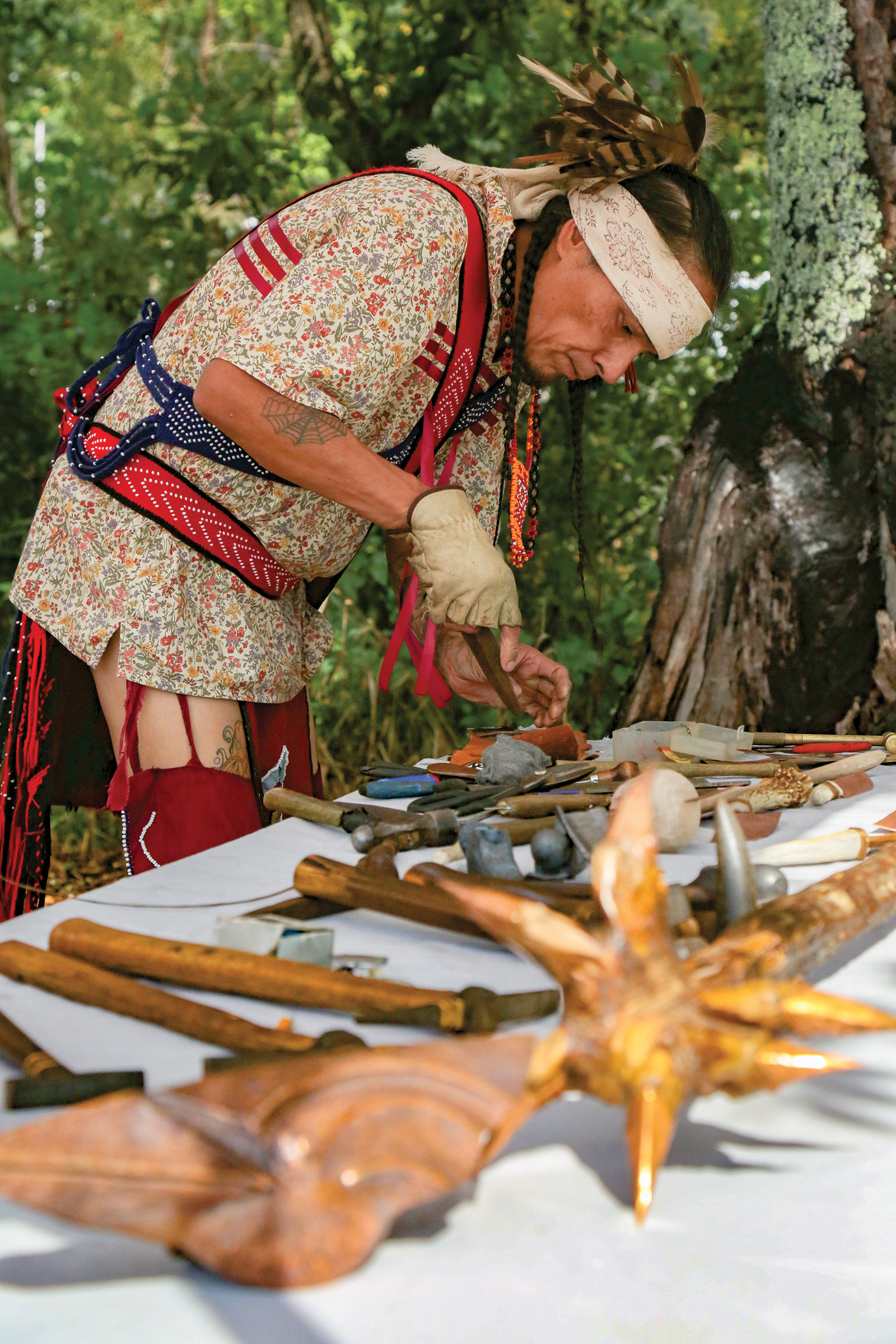 James JR Wolfe presents a demonstration at Mountain Heritage Day at Western Carolina University.
In 2018, the trio created an Eternal Flame sculpture for the Stecoah Valley Cultural Arts Center, which is installed in the center’s Courtyard of the Cherokee. Rogers designed and fabricated the 7-foot steel sculpture and incorporated original copper work by Wolfe and Bush.
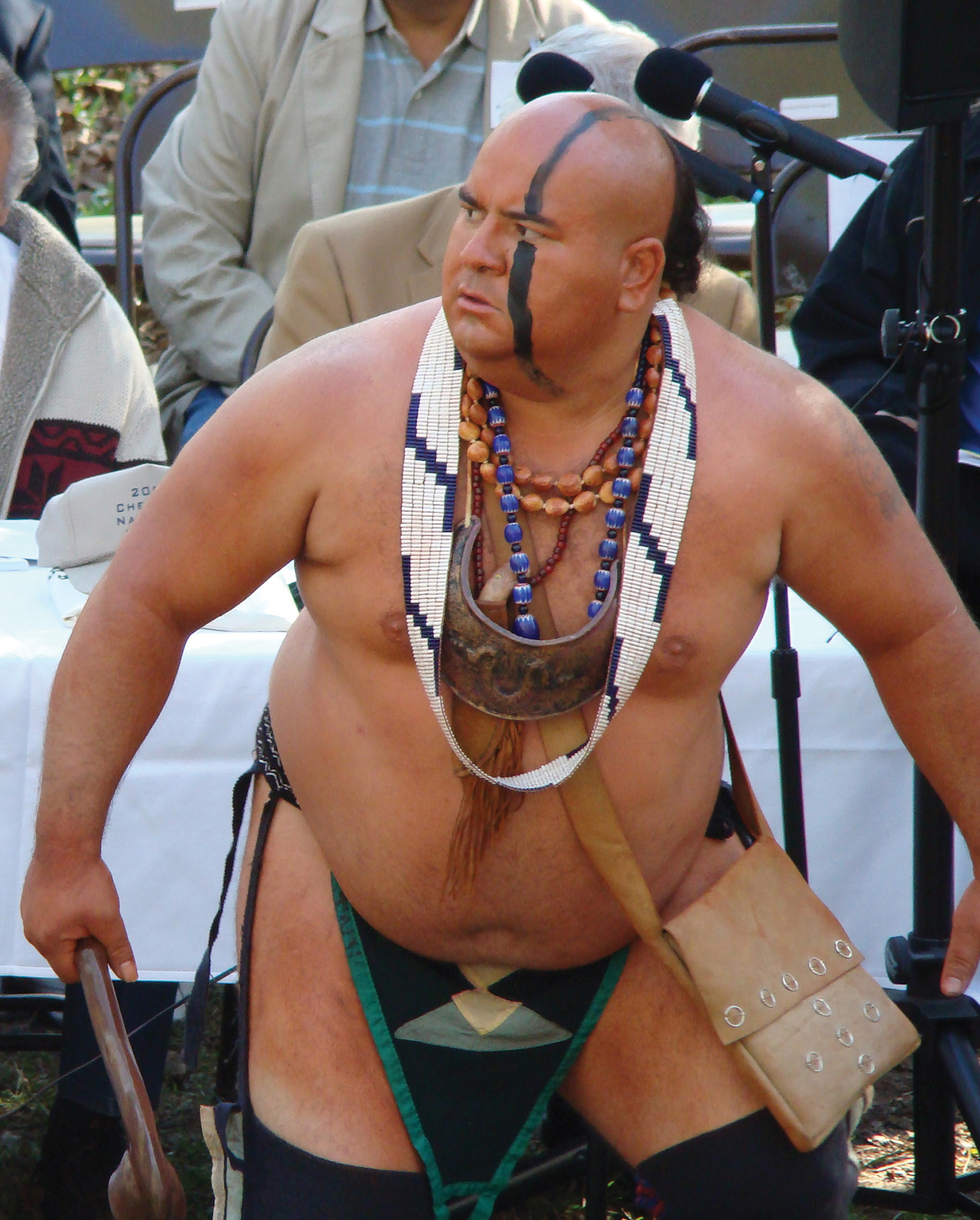 In workshops on tool making and copper forging at Qualla Arts and Crafts Mutual, each student made a copper gorget. Dancer John Toineeta wore his gorget in a performance at the 25th anniversary of Red Clay Joint Council in 2009. Credit: Anna Fariello.
Fariello explains, “Aside from their own work, a testimony to the revitalization of the hammered copper tradition is the fact that, in 2019, the Cherokee Indian Fair began including copper as a competitive category, for the first time in its 100-plus year history.”
Powered by Froala Editor