Every year the Museum of Northern Arizona in Flagstaff, Arizona, highlights one major, regional artist. This year, the honor goes to the prolific Navajo artist Baje Whitethorne Sr. In around 30 pieces including monoprints, watercolors and acrylic paintings, the exhibition titled Nááts,íilid/Rainbow Light chronicles Whitethorne’s career in expressing light and color found among the landscape of his home near Shonto, Arizona.
 New Beginnings, New Directions, 2018, acrylic on canvas, 36 x 24”“The thing I really love about him is the warmth of his personality but he’s also a great storyteller,” explains museum curator Alan Peterson. “They are honest, down to earth stories about being human and growing up and living on the Navajo reservation. Some are good stories and some are sad, but the paintings are very compelling glimpses into his life. There just so endearing—you get a sense that he’s sharing his spirit with you.”
Pieces in the exhibition range from the beginning of Whitethorn’s career through present day, in which the viewer might “sense the anxiety in them,” says Peterson. “I think it’s a really interesting perspective, because so much of his work is energetic, but in his recent works, you can sense the turbulence of the Covid pandemic, dealing with a very specific period of time in all our lives.”
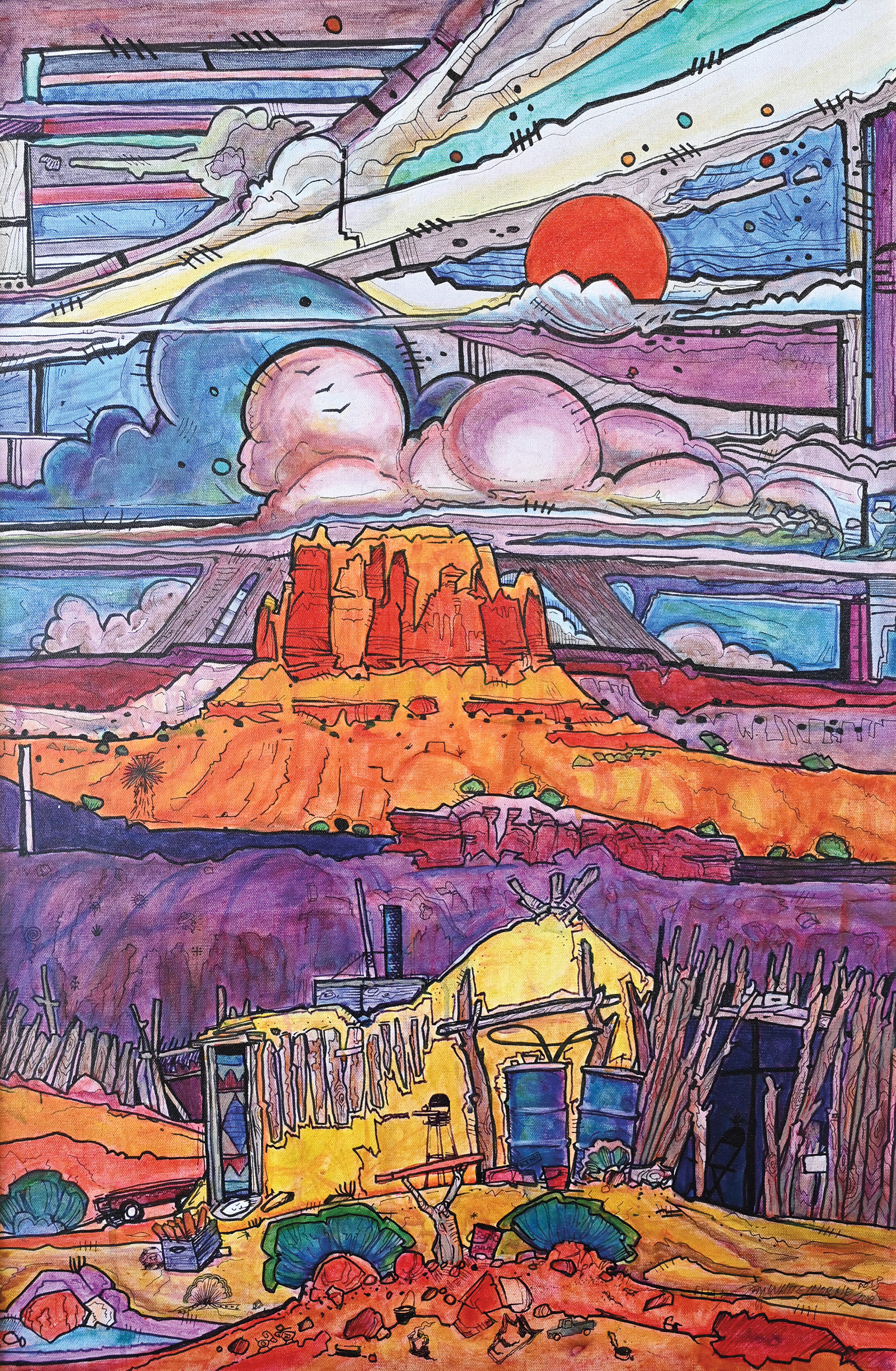
Two pieces that exemplify this mood of chaos are Iron Song, Star Relatives and Pixelated World, the latter pictured here, and appearing to be broken into fragmented sections, bordered with jagged lines, creating tension and commotion. While still colorful and lively, it has a much different feel than past works.
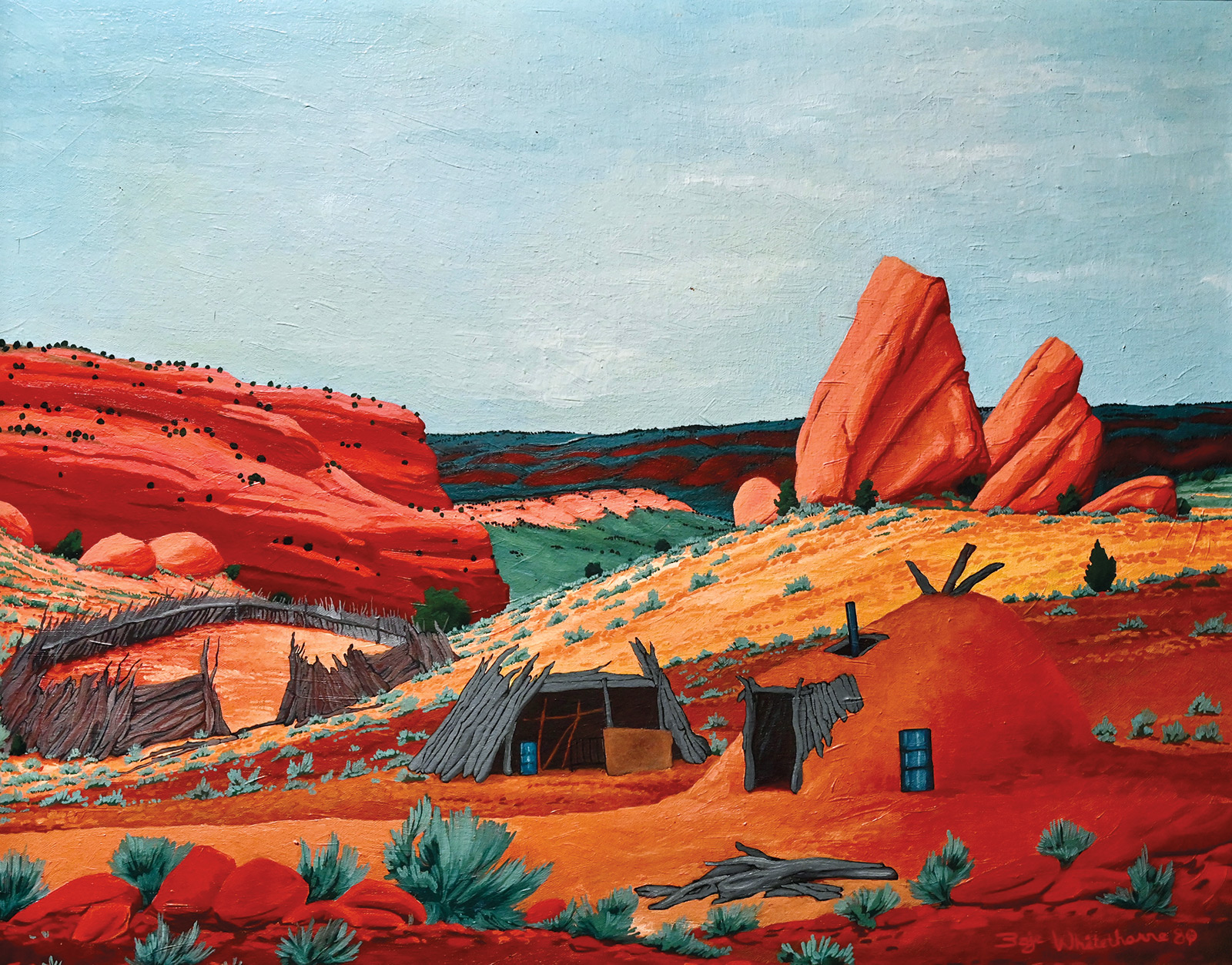 At Sitting Rocks, 1980, acrylic on canvas, 30 x 36”. Collection of Museum of Northern Arizona
Pieces like At Sitting Rocks, painted in 1980, depict a more tranquil, landscape scene of two shelters or dwellings, taken from a location on the Navajo Nation. Even later works like New Beginnings, New Directions, but still painted pre-Covid in 2018, features a very energetic, vibrant scene but carries a more serene, positive quality. “This is one of my favorite paintings in the exhibition,” Peterson remarks. “It’s so rich. It depicts his childhood home with many of the elements he includes that reference his youth—the two water barrels, toys and the ‘folding chair.’”
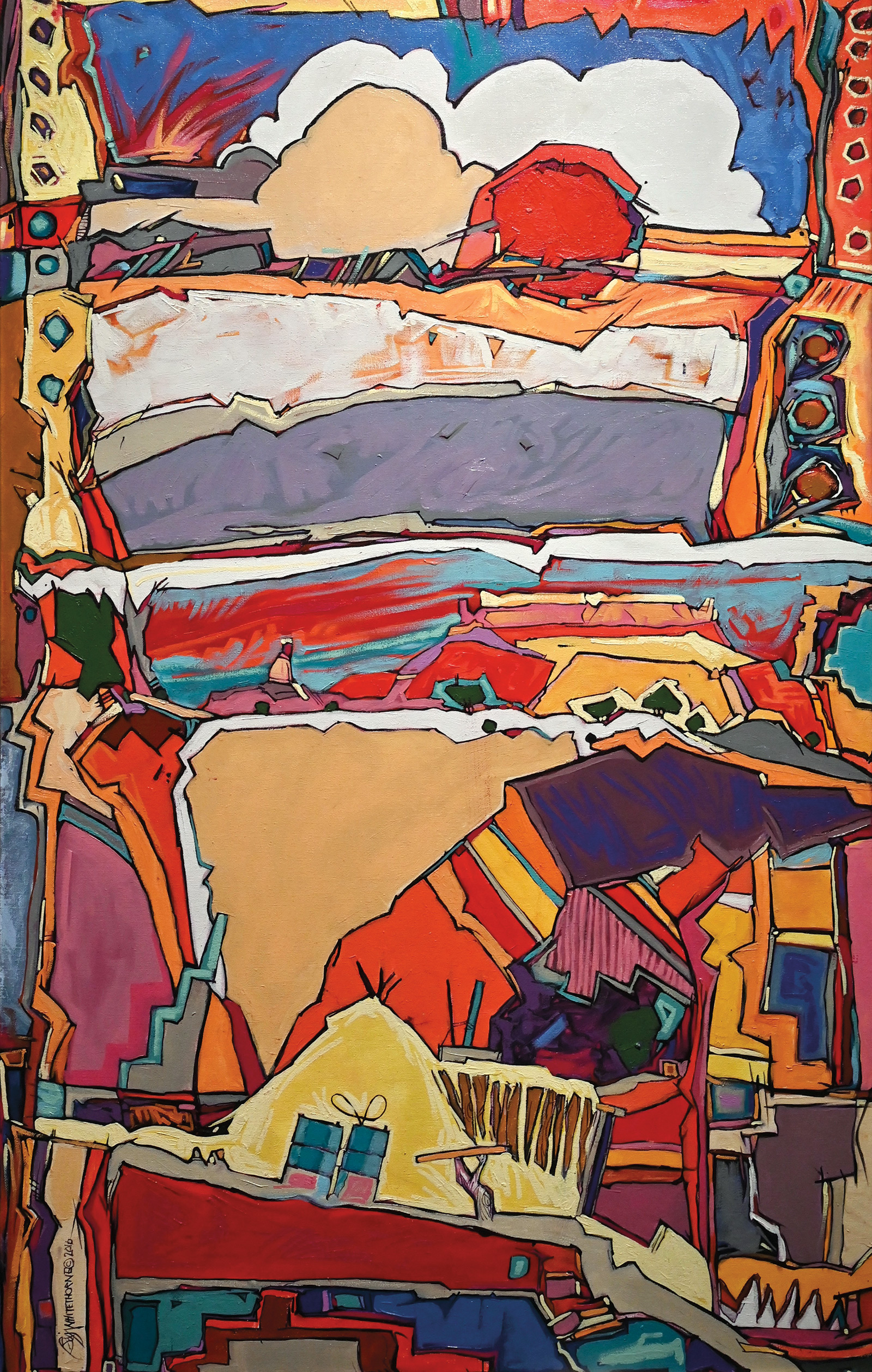 Pixelated World, 2022, acrylic on canvas, 48 x 28”
Peterson notes that most of Whitethorne’s paintings feature a small, blue folding chair—the artist's trademark—though sometimes the chair may be out of view or hidden. “When I was a boy,” says Whitethorne, “my parents and grandparents brought a new card table with six blue metal chairs home from Flagstaff. I was fascinated by how the sun hit the metallic blue. In the summer months, I would put my face against the cool seat of the chairs. Now I include the chair in my artwork because it reminds me of my boyhood and because it draws people into my artwork as they try to find it.”
Another fascination and important element to Whitethorne, has been the literal and symbolical use of light, and ultimately, color. When describing where the title of the show comes from, the artist says, “We’re taught to understand that in the beginning there was total darkness, and there were the Holy Ones who were responsible for what evolved on Earth. During this darkness, there was a crystal that came about and the Holy Ones saw a tiny light that came through it, giving off color. They all got excited and were so full of joy, that it was decided they’d make it bigger. Without really paying attention, they realized they made it too big—it was too hot and had to be moved away from the Earth. One minute it was so dark, but when they turned the light on, it beautified everything around them. It reflected all the color.”
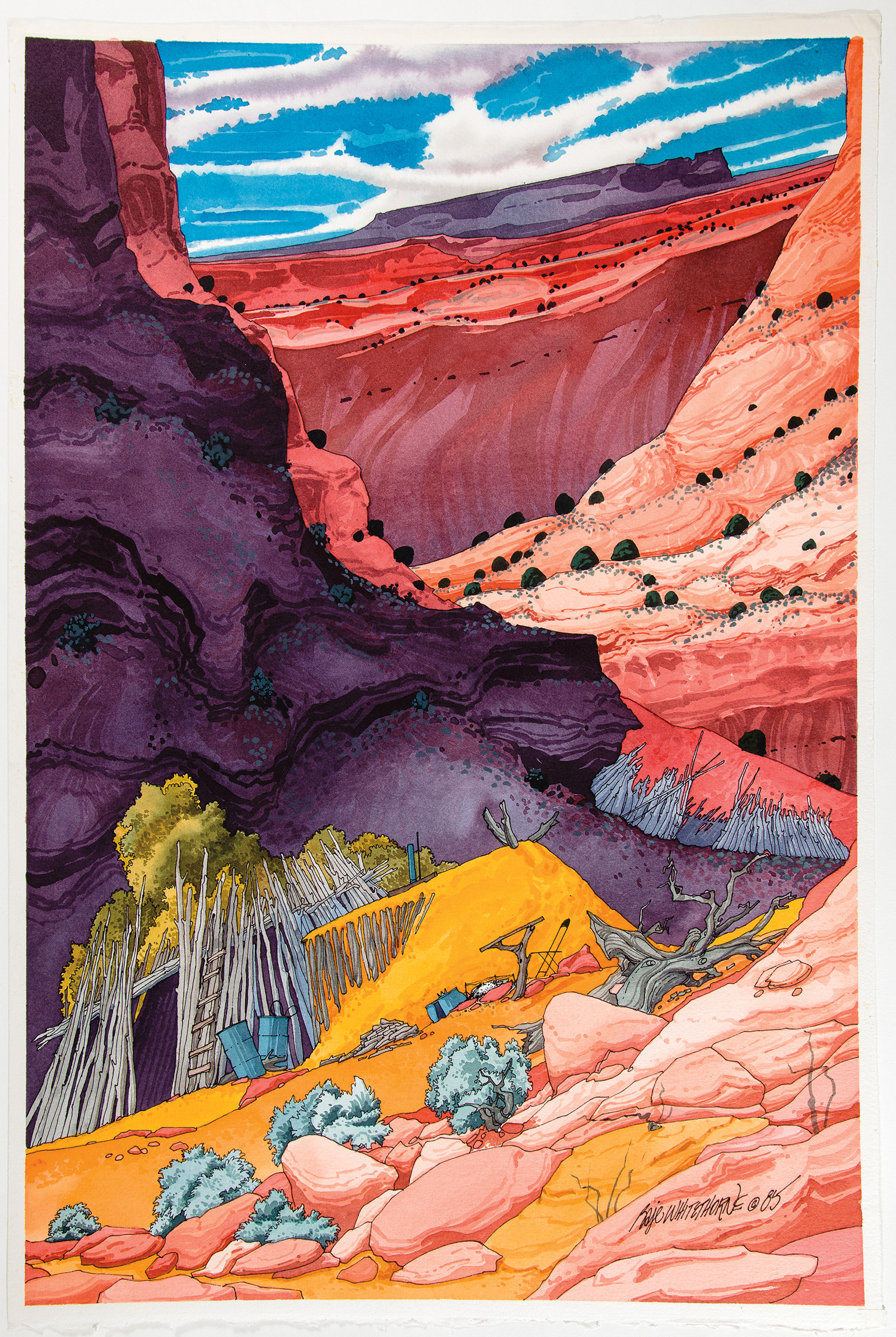 Sits in Shadow, 1985, watercolor, 22 x 15”. Collection of Museum of Northern Arizona.
Witness this celebration of light, color and story at the Museum of Northern Arizona through April 3, 2023.
On View Now
Baje Whitethorne Sr.: Nááts,íilid/Rainbow Light
Museum of Northern Arizona,
3101 N. Fort Valley Road, Flagstaff, AZ 86001
(928) 774-5213, www.musnaz.org
Powered by Froala Editor