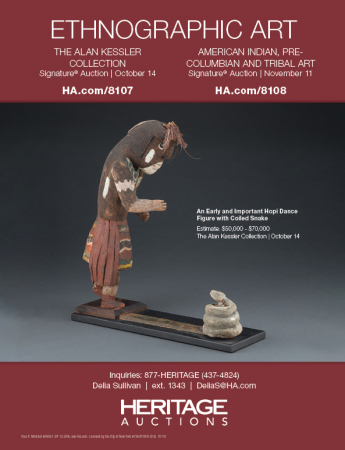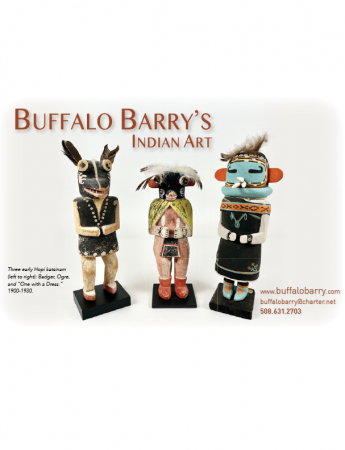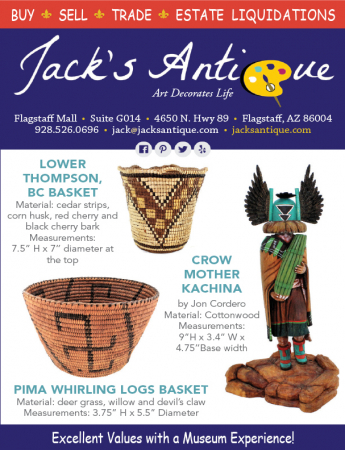

The carving of Hopi katsina dolls is a tradition goes back before the first Europeans entered what we call the Southwest. Each year the Hopi katsina dancers give out katsina dolls (katsintihu in Hopi) to the uninitiated young children so that they can begin to learn about the katsinas, their songs and Hopi religious life more generally. They dolls are carved only from the root of the cottonwood tree and for two important reasons: cottonwoods grow only in those rare places in the high arid lands of the Hopi where there is a reliable source of water and the trees are sustained by their roots which reach far down into the earth seeking the life-giving water.
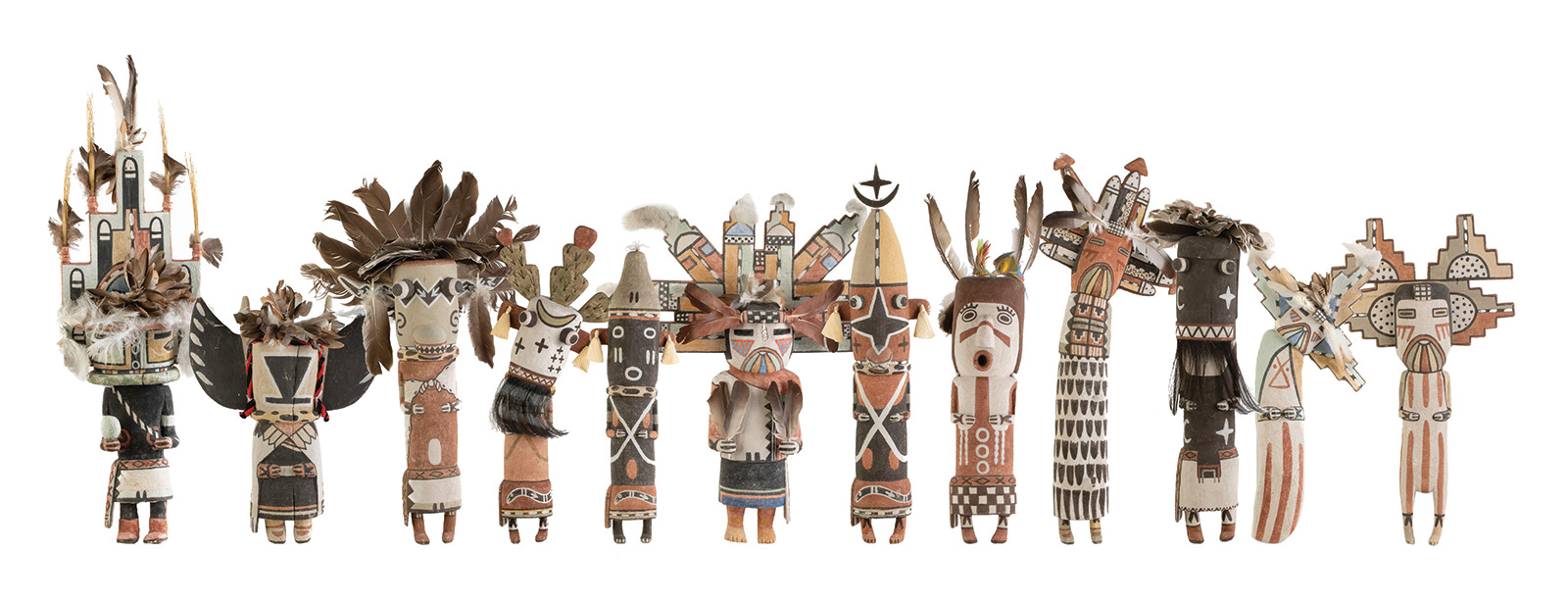 A collection Manfred Susunkewa katsina carvings from the Charles and Georgia Loloma Collection. The Santa Fe Art Auction recently offered dozens of Susunkewa works to bidders.
The katsina dolls and Hopi religious ceremonies (most notably the Snake Dance) have fascinated non-Hopis including American explorers, traders, ethnographers, tourists and museums since the late 1800s but the reactions varied: on one hand missionaries burned katsina dolls as idols while French surrealists like André Breton revered and collected them as art. They have been identified as idols, gods, dolls and sculpture, and described as idolatrous, surrealistic, simplistic, intricate, crude, sophisticated, primitive, garish and subtle.
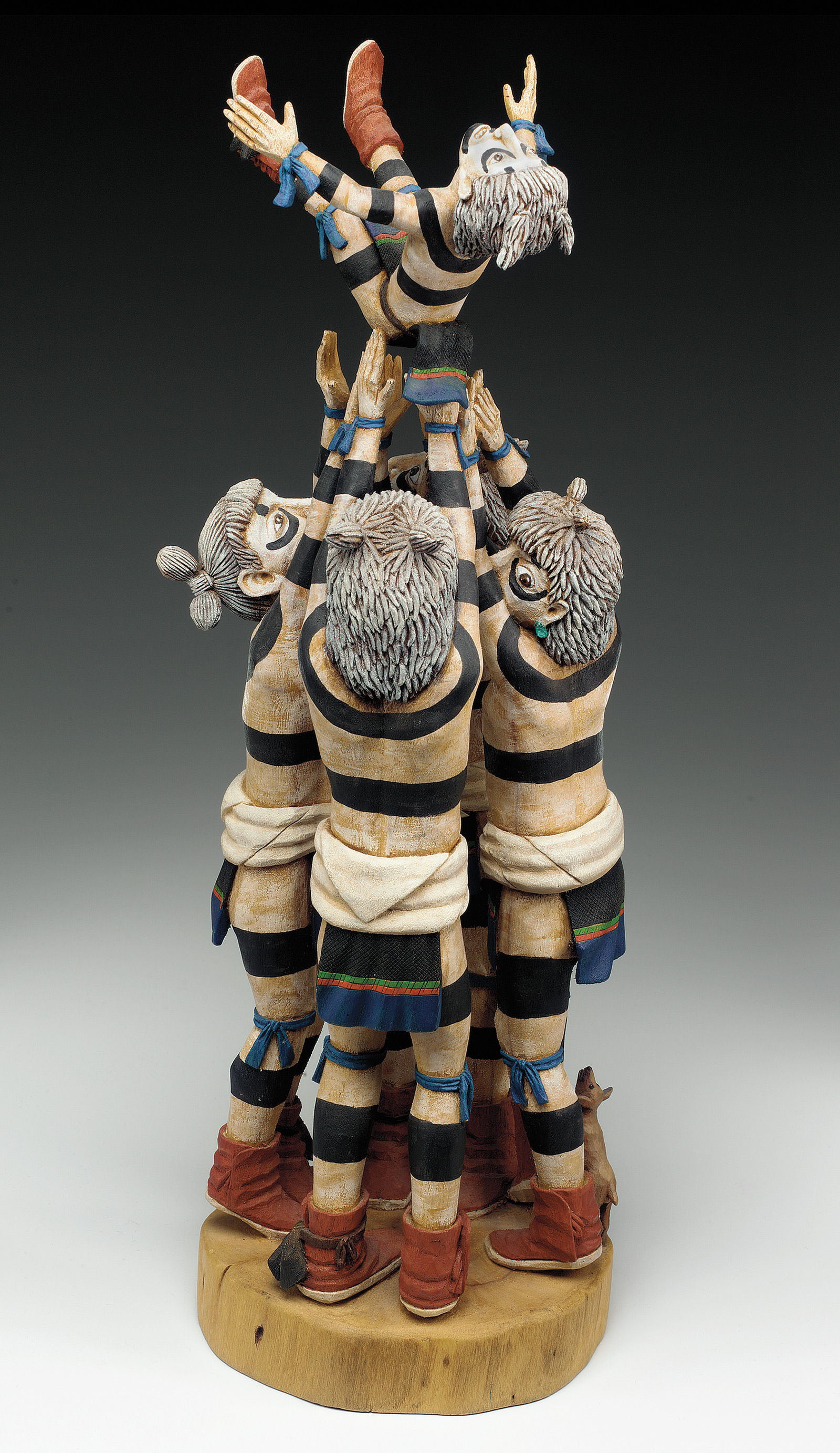 Robert S. Albert (Hopi), Tsuku Toss Third Mesa Clowns, 1998, carved and painted cottonwood, 18½ x 6”. National Museum of the American Indian. Donated to NMAI by Charles and Valerie Diker in 2004, 26/5126.
But in the late 1800s and early 1900s the government did not share an appreciation of traditional Indian culture generally. Efforts to suppress Indian religions, began in 1889 with the Code of Religious Offenses—a panicked response to the Ghost Dance movement of the 1880s. Among other strictures, it sought to prevent Indian children from attending, much less participate in traditional ceremonies. It continued on into the 1920s, with the religious ceremonies of the Hopi and other pueblo people being described variously as immoral, half-animal, obscene, sadistic and pagan. Attempts were made to complete suppress any aspect of traditional culture.
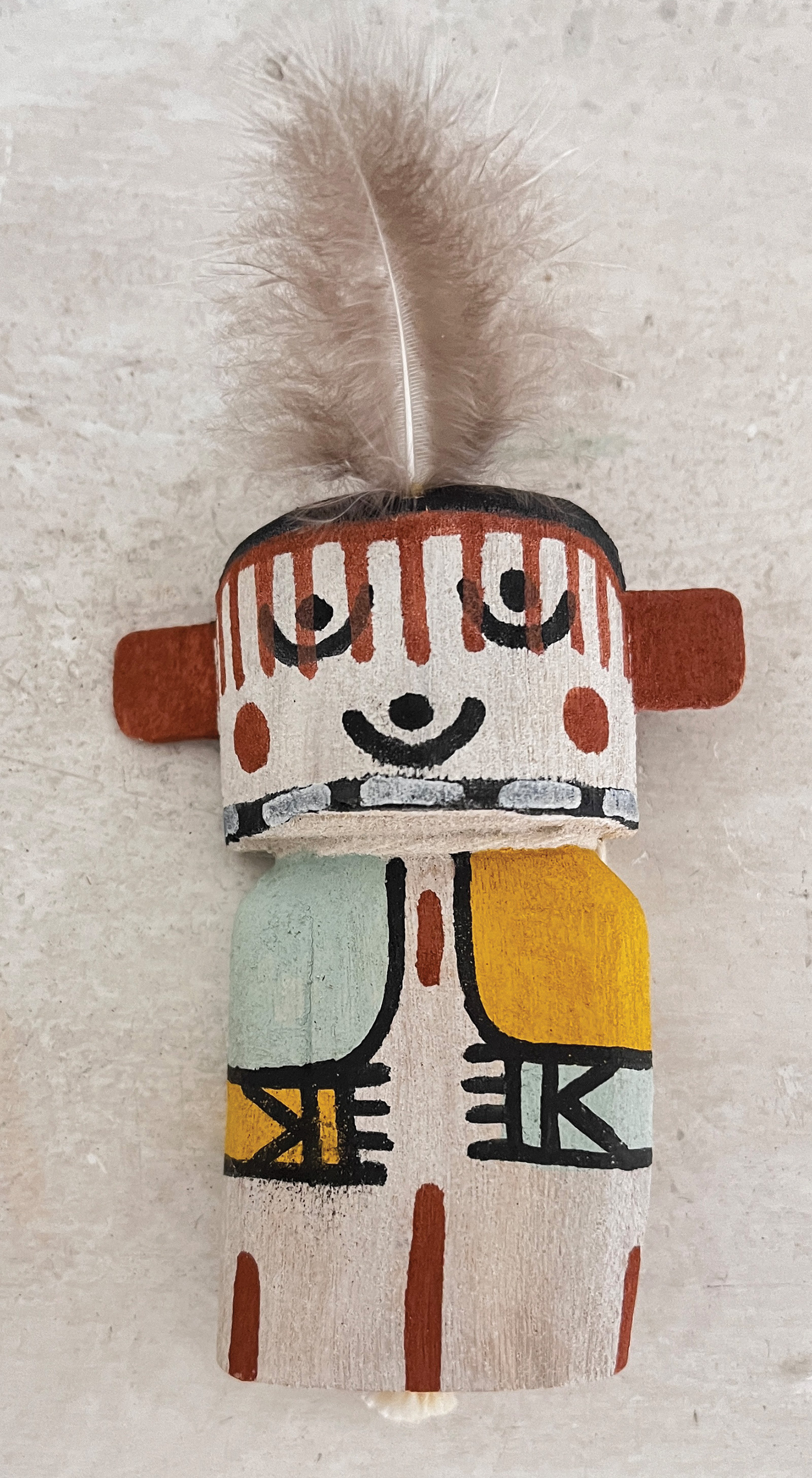 Qöyangnuvtu Mowa (Hopi), Hahay’i wuuhti, carved and painted cottonwood
The Hopi, far from American population centers, were literally better positioned to resist some of the pressure. Even so, they too paid a price for their efforts to keep their culture alive until John Collier, newly appointed by President Franklin Roosevelt, ended the policy and thereby formally extended freedom of religion to America’s original inhabitants.
Styles have changes over the years, in part due to better tools but also in response to the outside market. Though traditionally hung in Hopi homes, non-Hopi buyers often glued or nailed them to wooden bases so they could be displayed on a shelf. The Hopis adapted to this need, making it their own by often embellishing extending their artwork to the bases, with bas-reliefs of katsina faces or village scenes. Buyer complaints about traditional mineral paints rubbing off led to the adoption of poster paints and then acrylic paints. Collector fascination with highly detailed representations of the dancers led to some truly tour de force examples of intricate carving beginning in the mid-to-late 1970s. It was an economic boon for a number of talented carvers but an unfortunate side effect was the higher prices they commanded resulted in a market for inexpensive copies, generally made in Gallup workshops employing Navajos. (The Hopi have been very clear that those are copies and not true katsina dolls.)
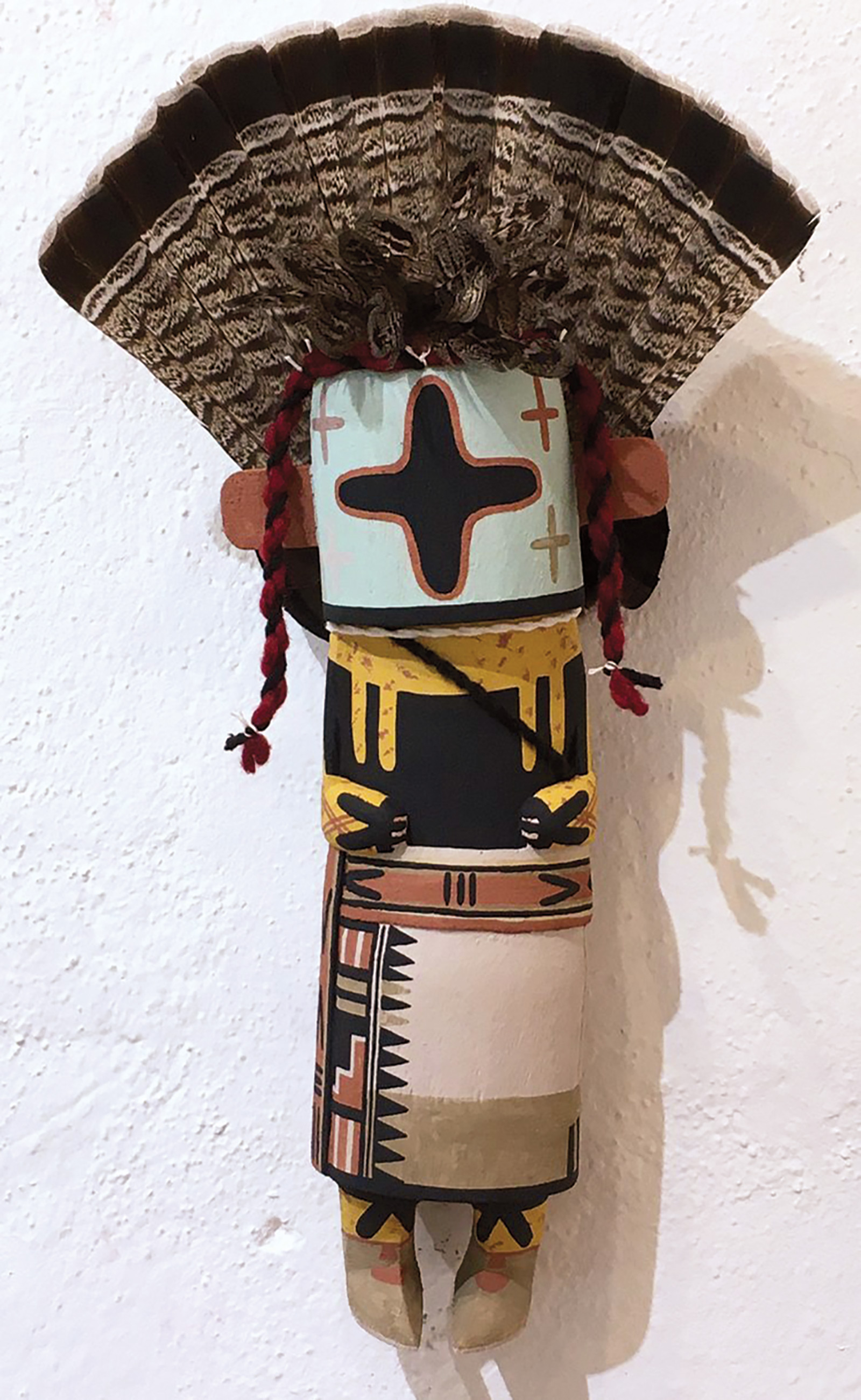 Randy Brokeshoulder (Hopi/Navajo/Shawnee), Sohu or Star Katsina, carved and painted cottonwood, 16¾”
One of the best-known current practitioners of the highly detailed style is Robert Albert (Sahkomenewa). In the past couple of decades he has focused his talents exclusively on Hopi clowns, bringing great humor to his technical virtuosity. Some of his most ambitious works have taken well over a year to complete.
During this time period there was only one carver who kept the older style alive and that was Manfred Susunkewa, a member of the Bear Strap Clan. While collectors may not have been appreciative of his effort, famed jeweler Charles Loloma was. He began collecting Manfred’s pieces early on, encouraging him and acquiring well over 100 examples of his work. Manfred continues to carve today with his work widely sought after.
Changes in style have always been mediated by the Hopi carvers themselves and in the last 20 years many have chosen to return to the oldest style— simply carved, painted with mineral paints and often embellished with feathers, horsehair, yarn or leather, as appropriate.
Brandon Kayquoptewa from the village of Hotvela on Third Mesa was one of the many accomplished carvers of detailed, so-called ‘action dolls’. He still carves in the style but also began carving in the revival style when it became popular. Others, like young carver Randy Brokeshoulder, started out in the traditional revival style. The trajectory of his work has been paying greater attention to detail. A katsina carrying gifts will have a small rattle, katsina, basket or bow, all carved separately and attached with string.
Manuel Chavarria from Sitsom’ovi village on First Mesa even weaves or stitches together key parts of the clothing of certain katsinas.
Raynard Lalo was initiated into the Katsina Society at age 9 but did not begin carving until age 13 because one has to be initiated before carving a katsina doll. Before then, the children are told that the katsinas themselves carve them. This means that most fathers and uncles who carve dolls to be given by the katsinas to the children must trade their work for that of carvers from another village, even another mesa, so that their child does not recognize the work as being by someone they know. The absence of a signature is the only difference between a doll destined for a child and one destined for a shop.
A member of the Spider Clan, Lalo started carving in the action doll style, so-named for the movement the artists tried to capture in their work. He began to carve the revival traditional style dolls about 15 years ago and has fully embraced it. While some carvers rely on buying their mineral paints from other carvers or one of the Hopi-run shops, Lalo is one who searches for and digs his own.
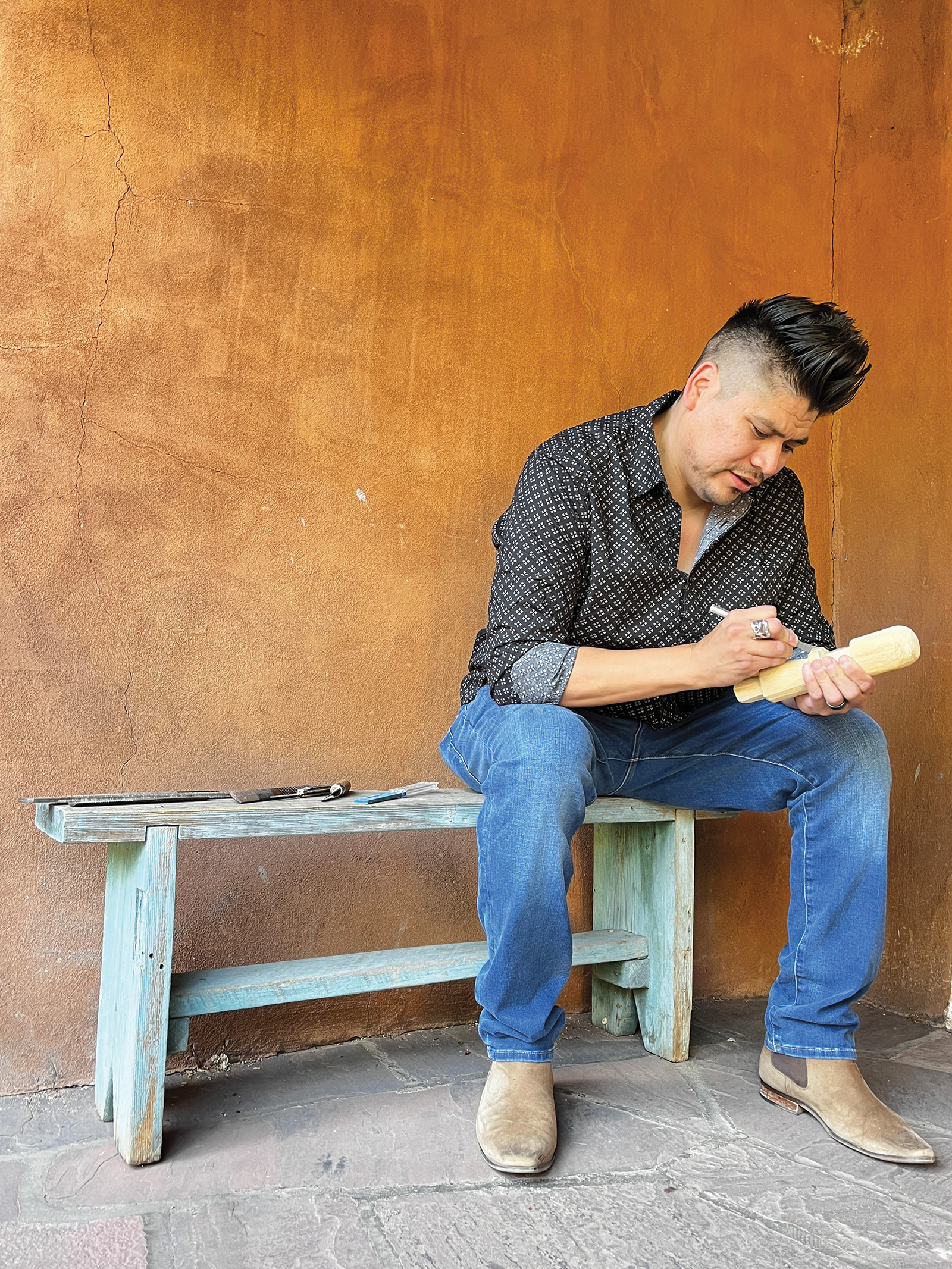 Randy Brokeshoulder carves one of his works.
Even more important than the mineral paints, cottonwood root, called paako in Hopi, is also a vital resource—arguably the most essential. Once the base of Grand Falls was the primary source as the Little Colorado drained a vast area and old cottonwood trees that fell into the river would get swept downstream and over a volcanic dike several hundred feet down into a pool of water that circled endlessly until the dry season. Now, with greater demand for their work, carvers buy cottonwood root from others—Colorado being a primary source. A network has developed for that important resource with finished dolls often being traded for root. One year a friend from Cochiti told me of a huge cottonwood that had been knocked over by a flood two days earlier. I told him he should let the Hopi know. He laughed and replied, “They’re already here!”
Access to feathers was never an issue until enforcement of the Migratory Bird Treaty of 1918 began, almost without warning, to be enforced on the katsina doll trade in the mid-1970s. The act exempted certain feathers for items such as sleeping bags and fly fishing lures but not if the same feathers appeared on Hopi katsina dolls that were for sale. Initially many carvers began to carve feathers (accelerating the trend towards highly detailed carvings) as distinguishing a ‘legal’ feather from an ‘illegal’ one is a daunting task. During peak enforcement, the U.S. Fish and Wildlife Service had to hire an outside expert because no one in their own department was qualified to do the task. Carvers and store owners alike found it vexing that birds like ducks and white wing doves could be legally hunted but their feathers could not be used on a katsina meant for sale. This has forced most carvers to rely on commercial sources for feathers, including grouse, turkey and pheasant.
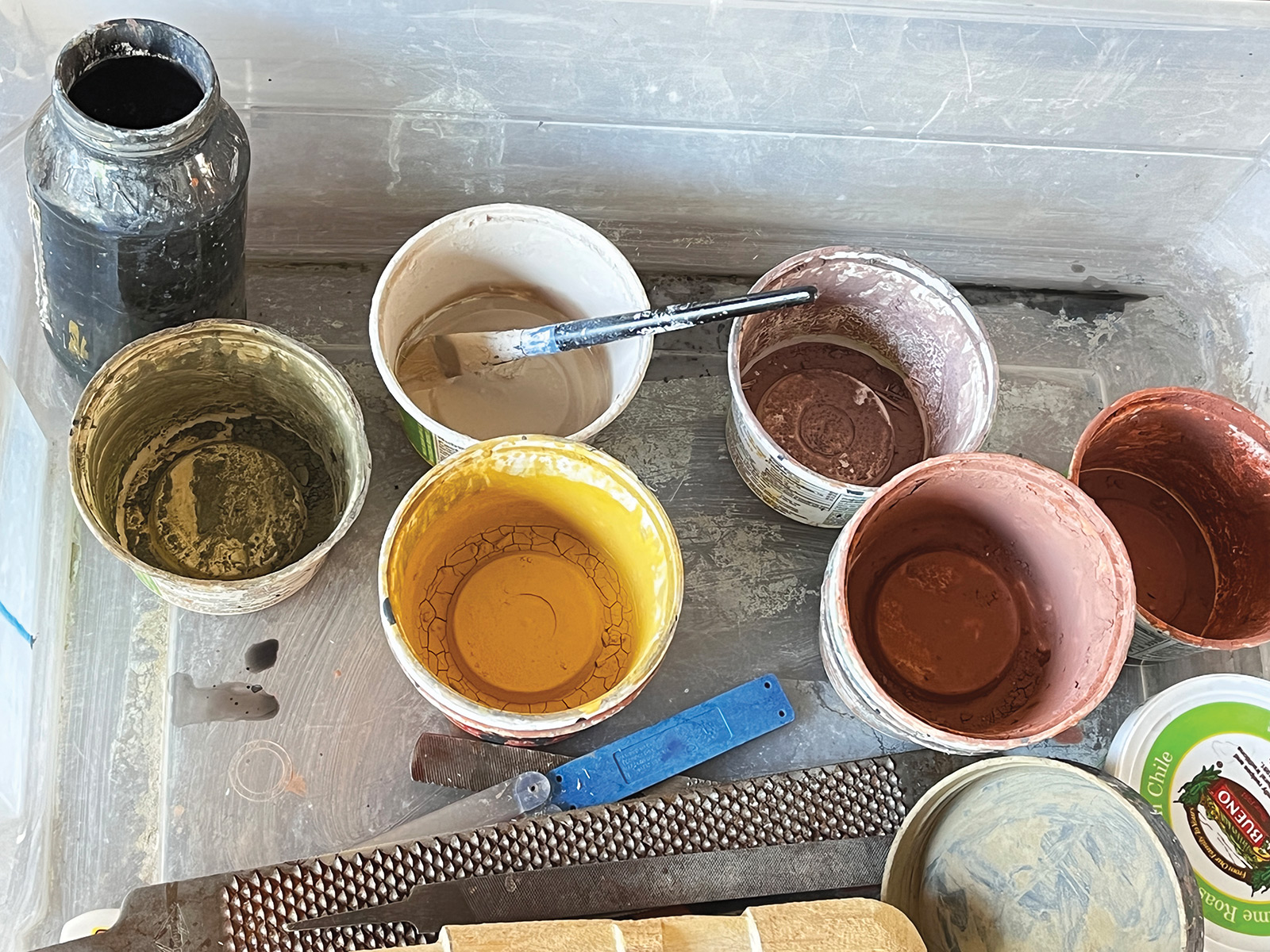 Mineral paints, which are commonly used in pueblo carvings.
Putskatihu (literally flat dolls) once were rarely seen for sale simply because collectors and casual buyers were not especially interested in them, but nonetheless they have been steadily produced by Hopi carvers to supply the need for these putsqatihu that traditionally are the only type given to infants and very young children. They are also the oldest style of katsina doll.
In the putskatihu style, Hahay’iwùuti, the Katsina Grandmother is the first katsina a Hopi receives, given when they are 20 days old and go through their naming ceremony. After that they may receive any type of katsina, and a few years later the child will begin to received fully carved katsina dolls.
The newest style, a sculptural style, is said by some carvers to represent more the katsina spirit than the dancer. Other carvers see the style as opening the door to greater personal, artistic expression. Tim Talwepi has begun to work in this vein, having recently begun a series of female katsinas in sculptural form that he calls his Female Empowerment Series.
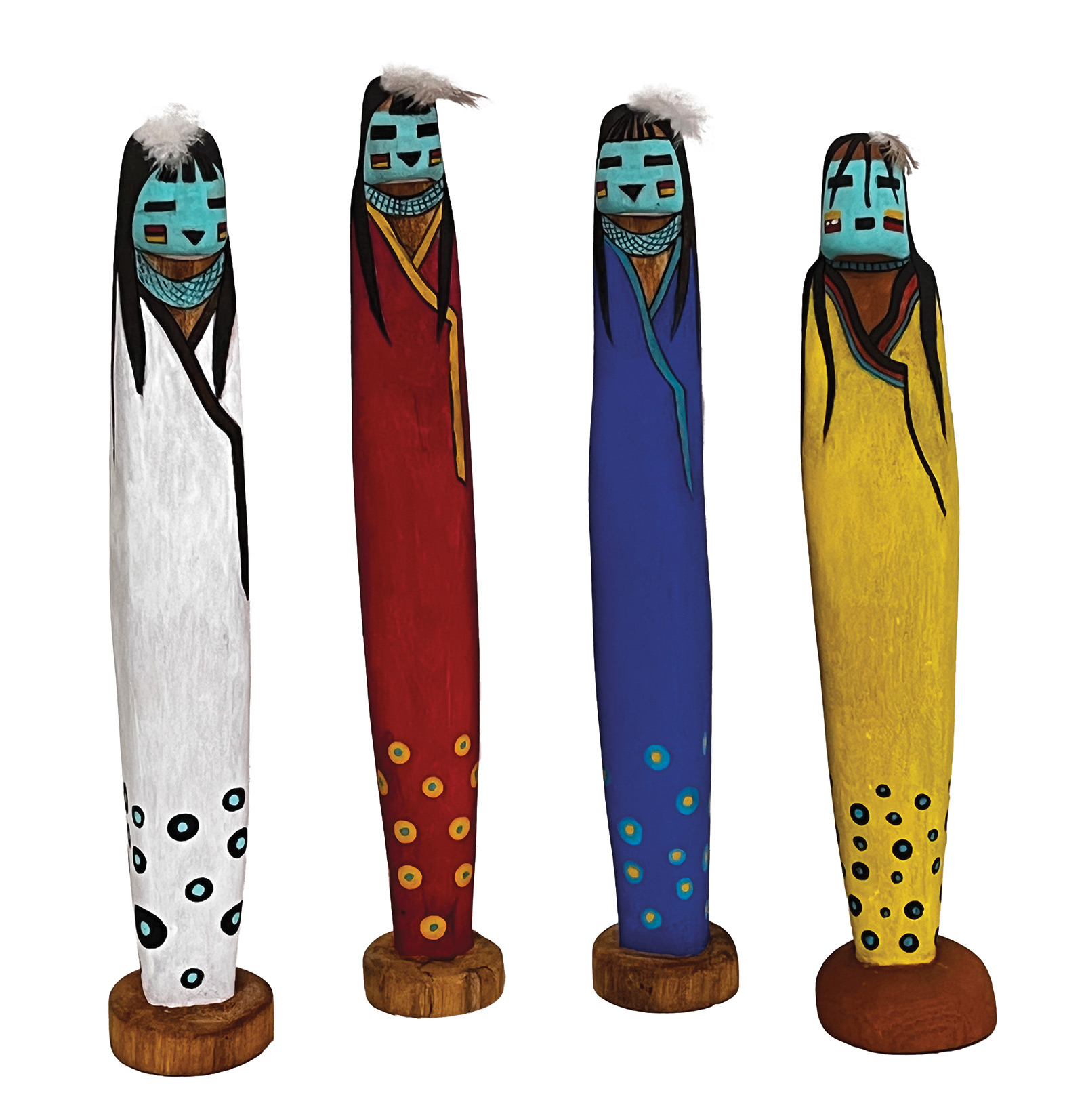 Tim Talawepi (Hopi), four Hano Maidens, carved and painted cottonwood, 8 and 9”
Gerry Quotskuyva is undoubtedly the most prominent current exponent of the sculptural style. He gives credit to earlier carvers for the inspiration, most notably the late Delbridge Honanie, a founding member of the avant garde Artist Hopid group. Gerry says it best: “My work transcends the traditional craft of Hopi katsina carving. When I became an artist, I chose to pursue the creation of a body of work interpreting the Katsinum as a fine art form…As my creations continue to evolve, more of the cultural way of life and my environmental concerns are being incorporated into my sculptures. As a result, I am feeling an even stronger desire to create with a message.”
Hopi katsina carving continues as both tradition and individual artistic expression, with both resting within the vessel of Hopi culture. And this Indian Market is best place to see the living, evolving tradition of Hopi katsina dolls and talk to the carvers who keep it alive and vital.
Notes From the Author: Catsina, kachina and katsina are among the various spellings (and pronunciation) used. In recent years the Hopi pronunciation (and spelling) “katsina” has become popular usage. From the viewpoint of most Hopi, either kachina or katsina is fine as the first is regarded as the English word for them and the latter the Hopi word. Additionally, for further information about this art form, the author recommends the book Following the Sun and Moon: Hopi Kachina Tradition, a book on katsinas, setting them within the context of Hopi religion and written
by Hopi author Alph Secakuku.
Powered by Froala Editor