John Potter remembers the cold. Even for Montana, this late March night illuminated by a full moon was remarkably cold. And remarkably historic.
This was the night in 1995 when wolves came back to Yellowstone.
Potter, a painter, and his brother, Scott Frazier, were there to welcome the return with ceremony. As the park celebrates its 150th anniversary this year, wolves remain Yellowstone’s most controversial inhabitants.
They were that night as well.
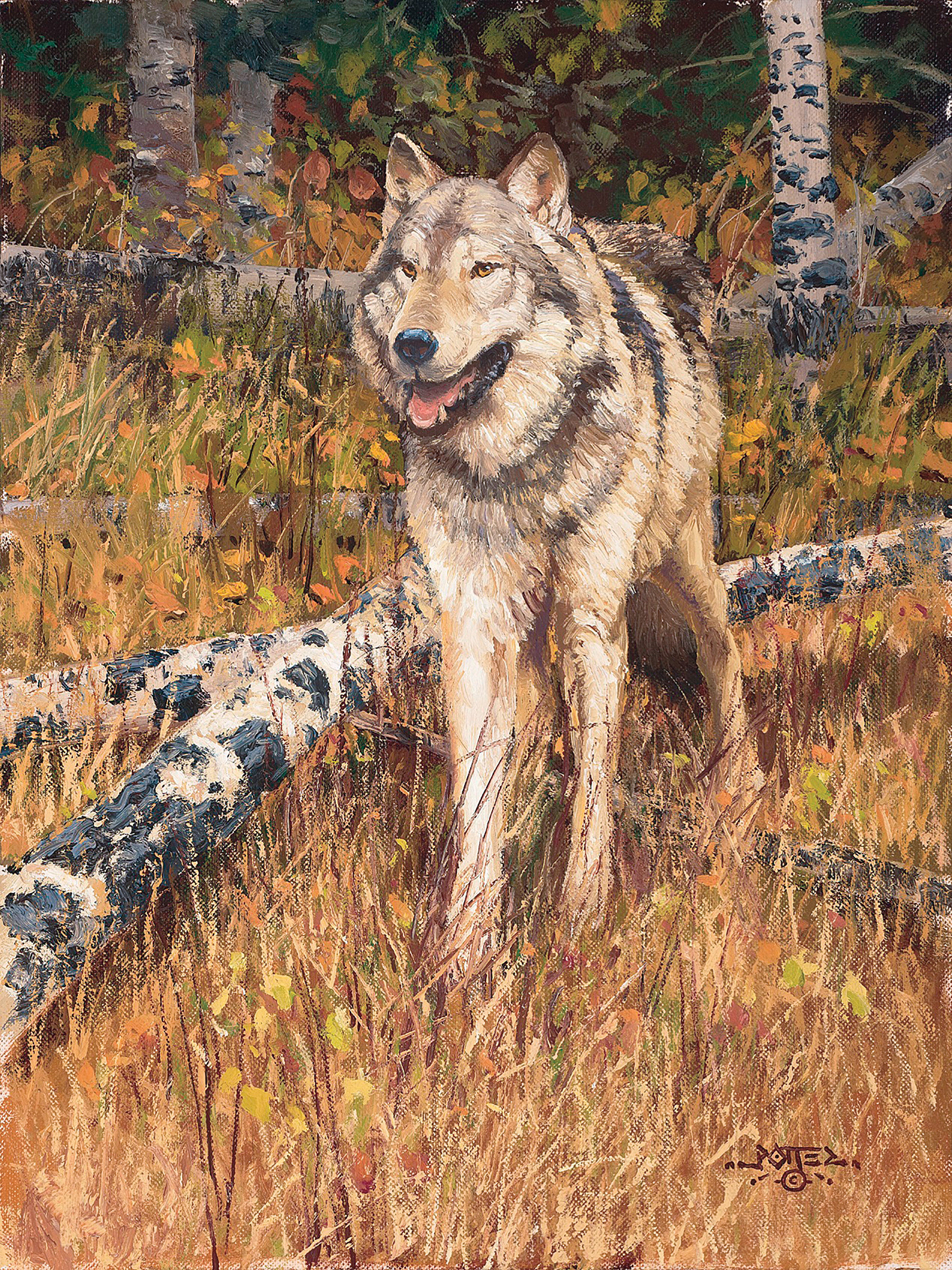 Into the Light, oil on linen, 12 x 9"
When Potter and Frazier met a park ranger in Gardiner, Montana, to drive into Yellowstone and perform their ceremony, the ranger informed them the reintroduction had been halted. Another injunction had been issued, the result of ongoing legal opposition from anti-wolf groups. That opposition continues to this day with no less furor.
The wolves were stuck up north in Great Falls.
Both had already driven hours to reach Gardiner, on the doorstep of the park, so Potter and Frazier decided to proceed and perform their ceremony, wolves or no wolves. The animal hadn’t been seen in Yellowstone National Park since 1926. That’s when the last pack was killed off. Powerful ranching interests across the United States had long been fearful of their toll on livestock and hunted, poisoned and lobbied the gray wolf nearly to extinction across the continent. Bison, grizzlies, cougars, beaver, eagles and other species in the Greater Yellowstone Ecosystem of northwest Wyoming, eastern Idaho and Southwestern Montana hung on by a thread, surviving the white man’s war on nature, but the wolf was gone.
Nearly 70 years later, the National Park Service acknowledged the mistake, recognized the ecological damage which had been wrought to the area by removing an apex predator and finally understood how incomplete the region that became Yellowstone National Park was without the wolves. This, of course, had been Indigenous homeland long before becoming the world’s first national park—still is. Upwards of 50 different tribal nations have historic associations to that land.
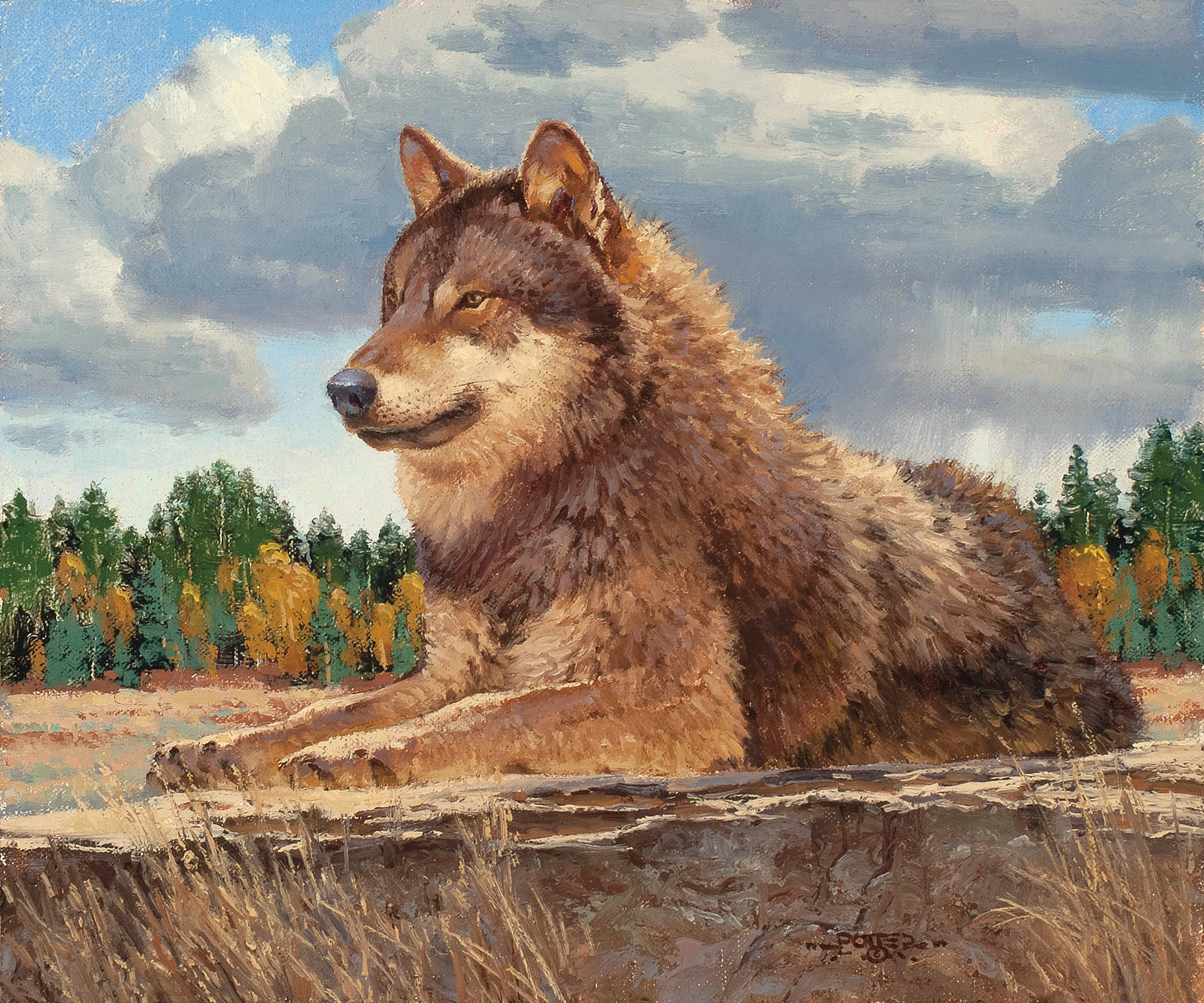 Reigning on High, oil, 11 x 14"
Wolves, however, survived in Yellowstone longer than its indigenous residents. Native people were removed from the park area by treaty during the Reservation Era in the latter half of the 1800s. “Removal” being a kind term. Others prefer “ethnic cleansing.”
By the time President Ulysses S. Grant signed the Yellowstone National Park Protection Act into law on March 1, 1872, creating the park, Native people had mostly been driven from inside its 2.2-million-acre boundary. Mostly. One band of Shoshone, the Tukudika, or Sheep Eaters, year-round residents, hung on in small numbers for more than 10 years after the park’s formation.
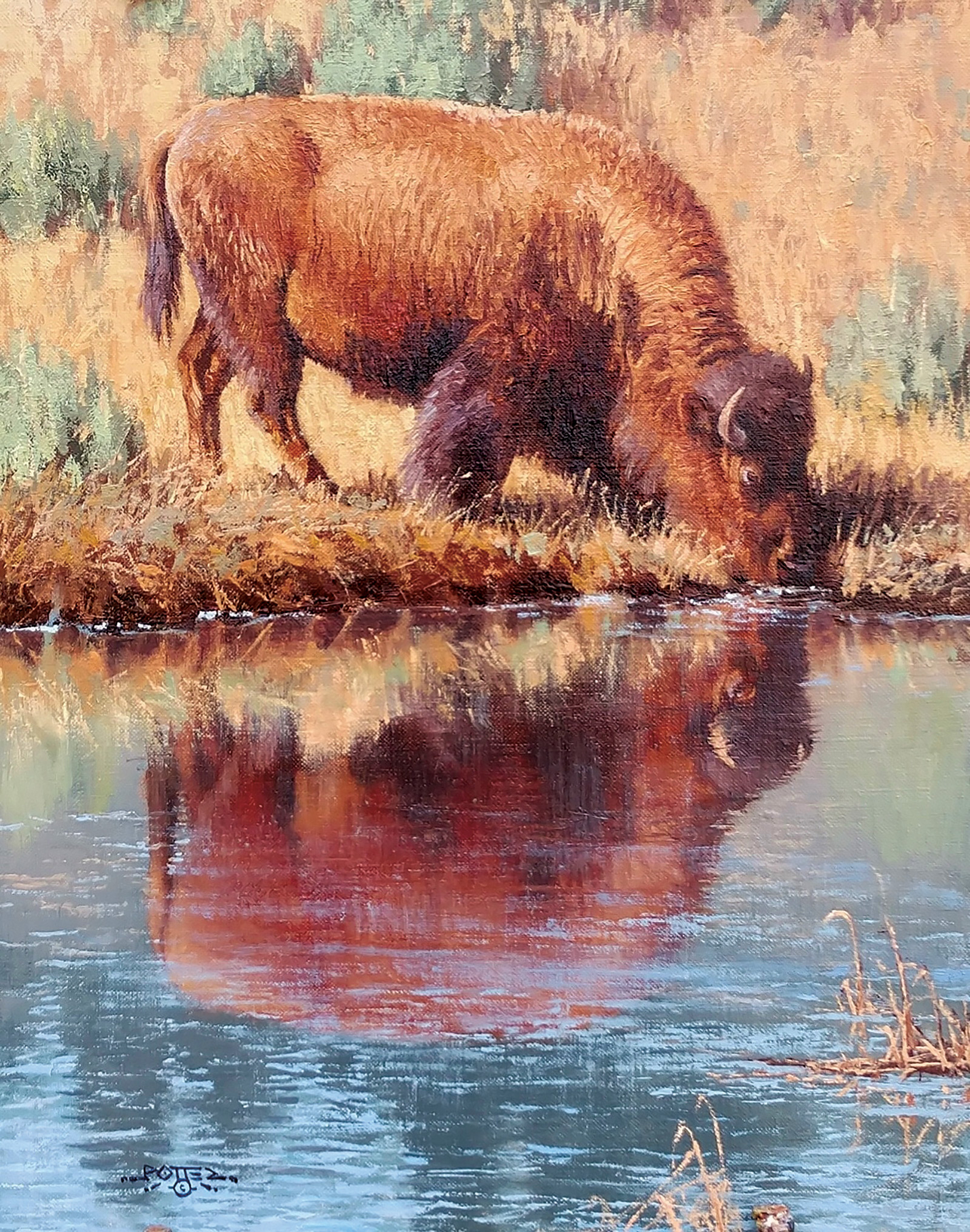 Water is Life, oil on canvas, 14 x 11"
Potter and Frazier made the right choice. By the time they arrived at the ceremony site, another ranger came along to tell them the injunction had been lifted and that the wolves were on their way.
“We did pipe ceremony and my job was to sing—teach them some of our songs,” Potter (b. 1957, Ojibwe) says. “When I started singing those songs, one of the wolves in the pen threw his head back and howled. They heard our songs and they were teaching us theirs in return.”
Potter wouldn’t have been there if not for Frazier, who was living in Bozeman at the time. Frazier regularly visited the park, gathering medicine and performing ceremony. He came to know several of the park rangers. When the National Park Service decided to bring wolves back to Yellowstone, they approached Frazier with tobacco asking him to perform a welcoming ceremony.
“In order to do ceremony, Scott needed someone to sing for him and so he in turn offered me tobacco, which is cultural protocol; [if] someone offers you tobacco, you can’t say ‘no,’” Potter explains. “It’s not something we were looking to do, but they approached us and asked us to do this.”
It’s also not something that was a one-time responsibility for Potter. More often than not in the 25-plus years since that freezing night in 1995, he has returned to Yellowstone’s Lamar Valley in October to sing and pray to the wolves there.
“Some of the songs were given to us by a Crow (Apsáalooke) Sun Dance Chief, some of the songs we received by going fasting in the mountains and were given to us by different four-leggeds and birds,” Potter recalls. “Songs are important between us and wolves. They teach us theirs as we teach them ours. It’s evidence of a long-standing relationship between us and wolves.”
That relationship is familial. Ancestral.
“What I’ve been told by my elders is that our relationship, our pact with wolves, goes so far back that back in the day, wolves would come into camp and share stories with our elders around campfires because we spoke the same language,” Potter says.
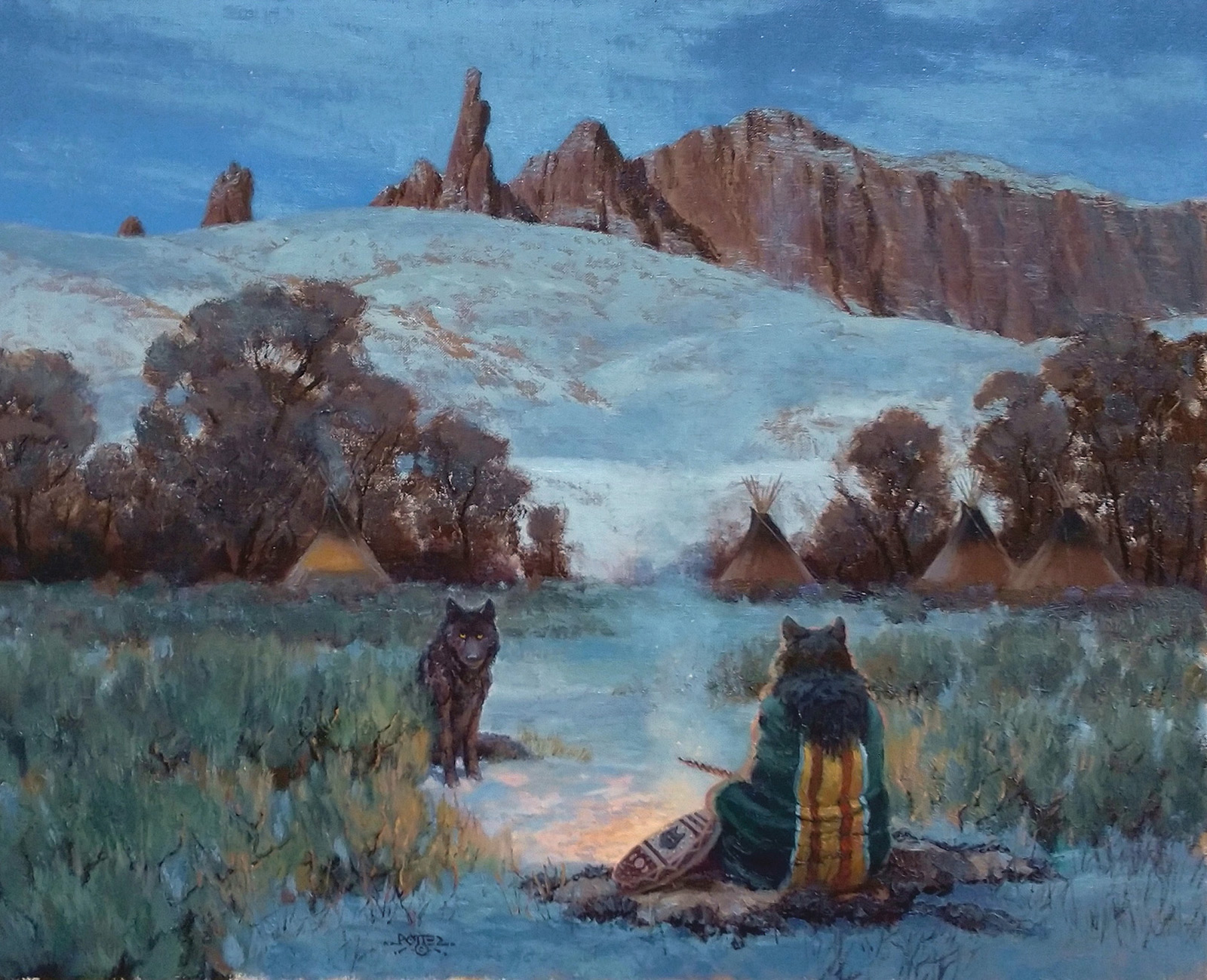 A Private Conversation, oil, 14 x 20"
Having been absent from these homelands for decades and transported hundreds of miles from Western Canada to repopulate the park, Potter and Frazier wanted to be sure the wolves felt at home.
“Among our people, there’s no such thing as orphans. Some of these wolves had been removed from their family units. The park service tried hard to keep them all together when they were capturing them, but they weren’t always successful,” Potter says. “When someone’s far away from home, far away from family, we adopt them. That happened to me when
I first came to Montana; I got adopted by a bunch of Native families in the area.”
“Someone,” not “something.”
Potter doesn’t refer to the wolves as animals, but as relatives. In his tribe’s language, there is no word for “animal.” Nothing translates specifically to that concept. Among the Anishinaabe people, of which Ojibwe are a part, the word for “animal” more closely translates as “other people.”
For Potter, who continues painting wolves regularly—at the time of this interview, he was working on four wolf paintings—that’s what wolves are, other people.
“For me, it’s like painting family members,” Potter says of his wolf pictures. “I’m not doing wildlife, I’m doing members of my family. I love [painting] them because every time I paint a wolf—or any other animal for that matter—I renew and I feel a sense of kinship with them.”
That kinship doesn’t extend to everyone. Ever since white men began colonizing North America, they have been attempting to eradicate the wolf. The effort continues amongst many.
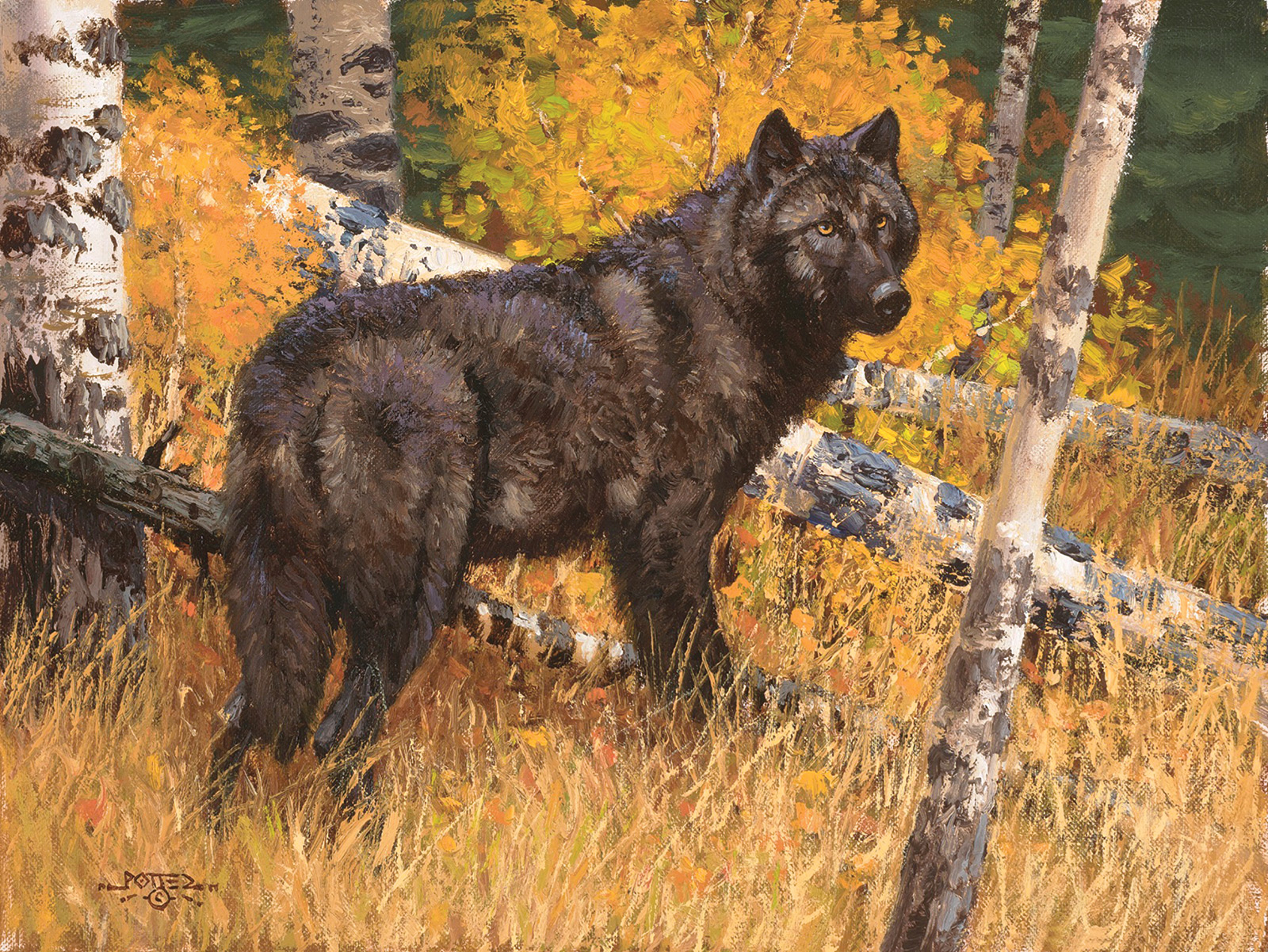 Intent, oil on linen, 9 x 12"
During the Trump Administration’s final weeks in office, gray wolves were removed from protection under the Endangered Species Act where they’d resided since the act’s founding in 1973. While a federal judge restored those protections in February 2022, state laws in Idaho and Montana signed in 2021 authorize the widespread killing of wolves. Wolves, of course, don’t recognize state or federal political boundaries nor can they understand they may be safe here, in grave danger there, despite those two places being just yards apart.
In Idaho, for example, sportsmen can now kill an unlimited number of wolves for the first time. The state legislature further opened trapping year-round on private property. The use of night-vision goggles, silencers, snowmobiles and ATVs are now legal when hunting wolves, methods and tools previously outlawed.
Wolf hunting, though, has always been barbaric. Wolves have been lassoed and dragged to death. Wolves caught in snares attempt to chew their paws off to escape. Industrializing the process, ranchers have been accused of lacing deer carcasses with strychnine, destroying entire families at once.
Today’s approaches share this historic inhumanity.
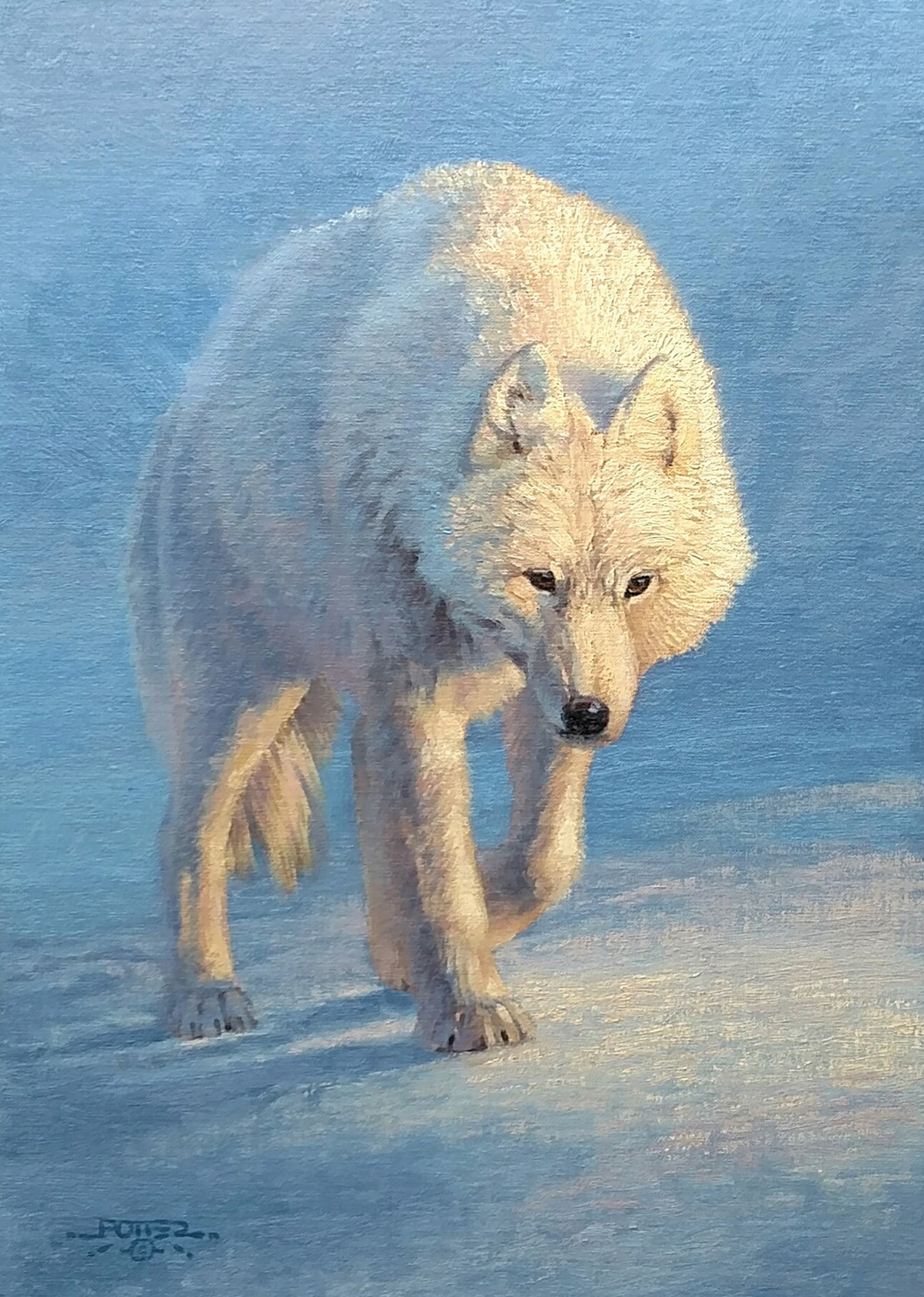 Out of the Blue, oil, 14 x 11"
“I know some [ranchers] and I’ve listened to them, and I understand what their concerns are and what their fears are,” Potter says. “Even though I’m not a rancher or farmer, I can empathize with that; they’re just trying to make a living. I don’t understand the anger and the hatred that comes along with opposition to the wolves and wolf reintroduction.”
Advocacy on both sides of the issue mirrors religion.
“[Ranchers] say that their anger and hatred is [based on] how wolves kill for sport or kill for fun or are indiscriminate, vicious, murderers—these are words that they use,” Potter explains. “Wolves don’t understand those words. Wolves don’t understand the concept of sport killing or killing for fun. They do what Creator tells them to do and if Creator has a reason for it, wolves do it because they’re suited for the job.”
Most of the nearly five million visitors expected at Yellowstone National Park during its sesquicentennial year will have little understanding of this history, the back-and-forth legislation, the continuing lawsuits, the overheated emotions which have made wolves one of the most acrimonious debates across the Western United States for 50-plus years. They will all come hoping to see a wolf.
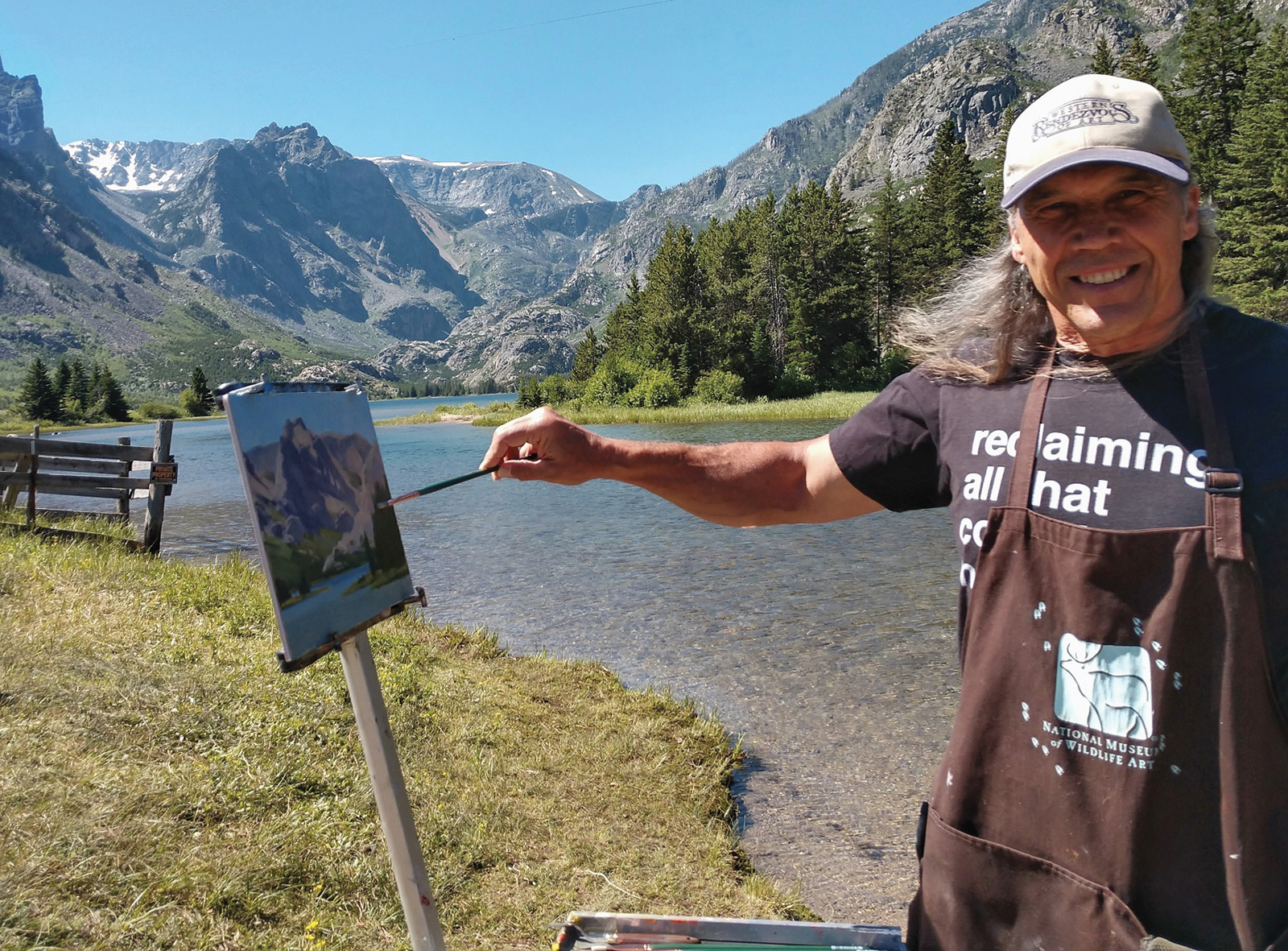 John Potter painting in Yellowstone National Park.
That sightings, while uncommon, remain possible at all is thanks to Frazier, his wife Marsha, devoted Yellowstone wolf researcher and author, Rick McIntyre, and countless others. Potter doesn’t place himself on that list.
“Ultimately, the story is about the wolves. It’s about giving back to them for everything they’ve given us for tens of thousands of years and if there is ever anything that I can do for them, I try to do it because I wouldn’t be here if not for them. None of us would be because wolves shaped us as human beings in our relationship with them,” Potter says, choking up. “I think every person has—if they look into their hearts—their own connection with wolves if they can be quiet enough to listen for it.”
Powered by Froala Editor