A welcome. A warning.
A wooden figure with arms raised skyward standing over 10 feet tall offers both when greeting visitors entering the Denver Art Museum’s collection of Northwest Coast art.
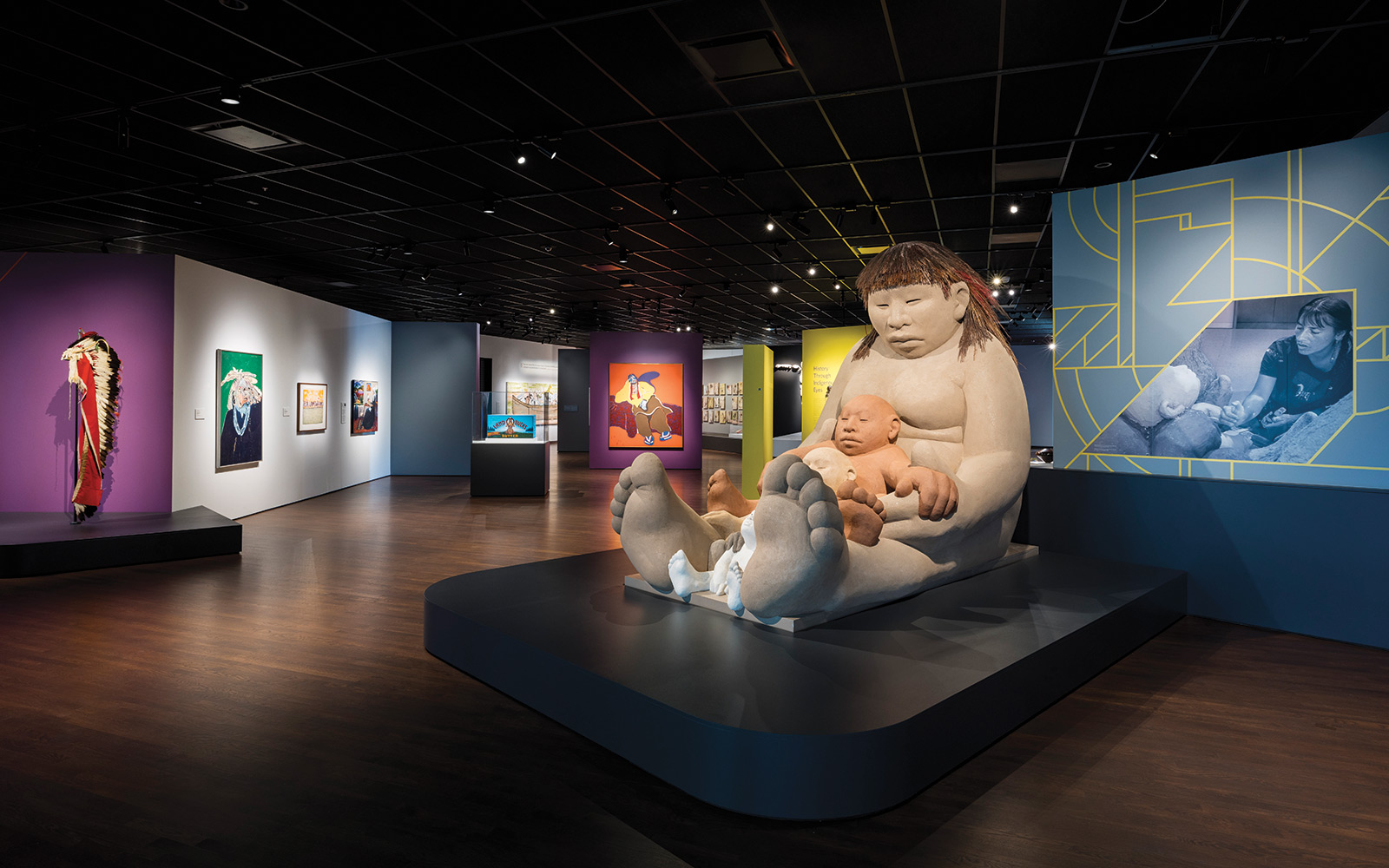 Mud Woman Rolls On by Roxanne Swentzell (Santa Clara Pueblo) sits in the third-floor gallery at recently renovated Martin Building at the Denver Art Museum.
The Kwakwaka’wakw welcome figure was commissioned around 1914 by Johnny Scow, chief of the Kwikwasut’inuxw band. Historically, welcome figures marked territorial boundaries and greeted visitors arriving for feasts or ceremonies.
It was presented as a gift—of sorts—to settlers occupying his people’s traditional territory along British Columbia’s central coast. The artwork’s true meaning subversively served as a protest against the Canadian government’s theft of Kwakwaka’wakw land.
At one point, the figure was holding a broken copper overhead. Broken copper represents a disagreement between peoples in the tribe’s tradition. When one person was perpetuating an offense against another, copper would be broken publicly with the broken piece given to the offending party.
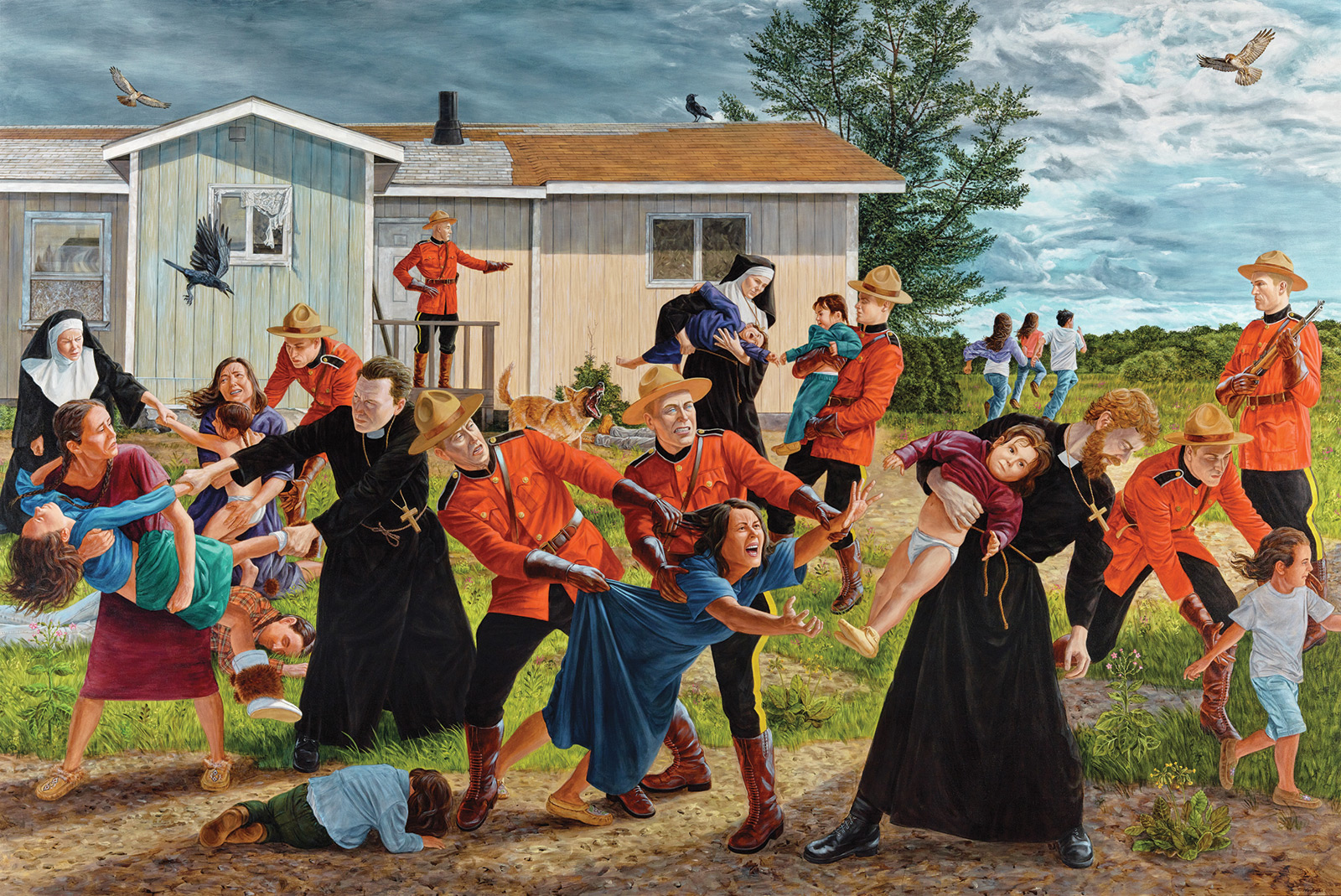 Kent Monkman (Fisher River Band Cree), The Scream, 2017, acrylic paint on canvas, 84 x 132”. Denver Art Museum: Native Arts acquisition funds and funds from Loren G. Lipson, M.D, 2017.93. © Kent Monkman.
Broken copper was presented to the settlers along with the carving.
The colonial intruders who were given Indigenous land for farming happily received the offering, oblivious to its meaning, displaying it for a half century.
The original copper has been lost through time.
A different example can be found on display nearby.
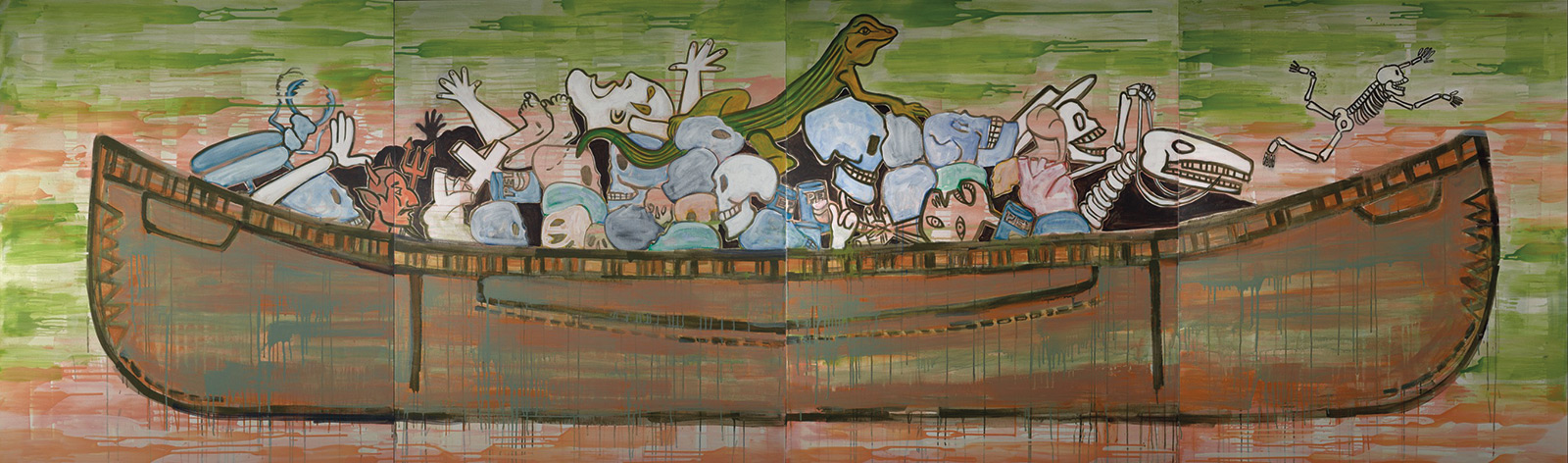 Jaune Quick-to-See Smith (Confederated Salish and Kootenai Nation), Trade Canoe for Don Quixote, 2004, acrylic, pencil, charcoal and oil on canvas, 200 x 60”. Denver Art Museum Collection: William Sr. and Dorothy Harmsen Collection, by exchange, 2005.62A-D. © Jaune Quick-to-See-Smith and courtesy Garth Greenan Gallery, New York.
The figure sets a tone for DAM’s broader Indigenous Arts of North America galleries which received a complete overhaul in October of 2021. Among the thousands of items—articles filling every category of creativity from masks and totems to paintings, pottery, textiles, baskets, jewelry, functional objects, decorative objects and a suit of police riot gear—everything is complex. Each piece shares a story. All of them inspire questioning. All of them possess a deeper significance waiting to be uncovered.
Every one is also the very best of its kind. A farsighted strategy which saw the museum begin collecting contemporary Indigenous artwork nearly 100 years ago has paid off in a stunningly rich, diverse and thorough collection.
“In the 1920s, the Denver Art Museum, as it was morphing into what it was to become, took a long, hard look at ourselves and said, ‘We’re never going to have collections (of) Roman sculpture,’” John Lukavic, Denver Art Museum Andrew W. Mellon Curator of Native Arts, says.
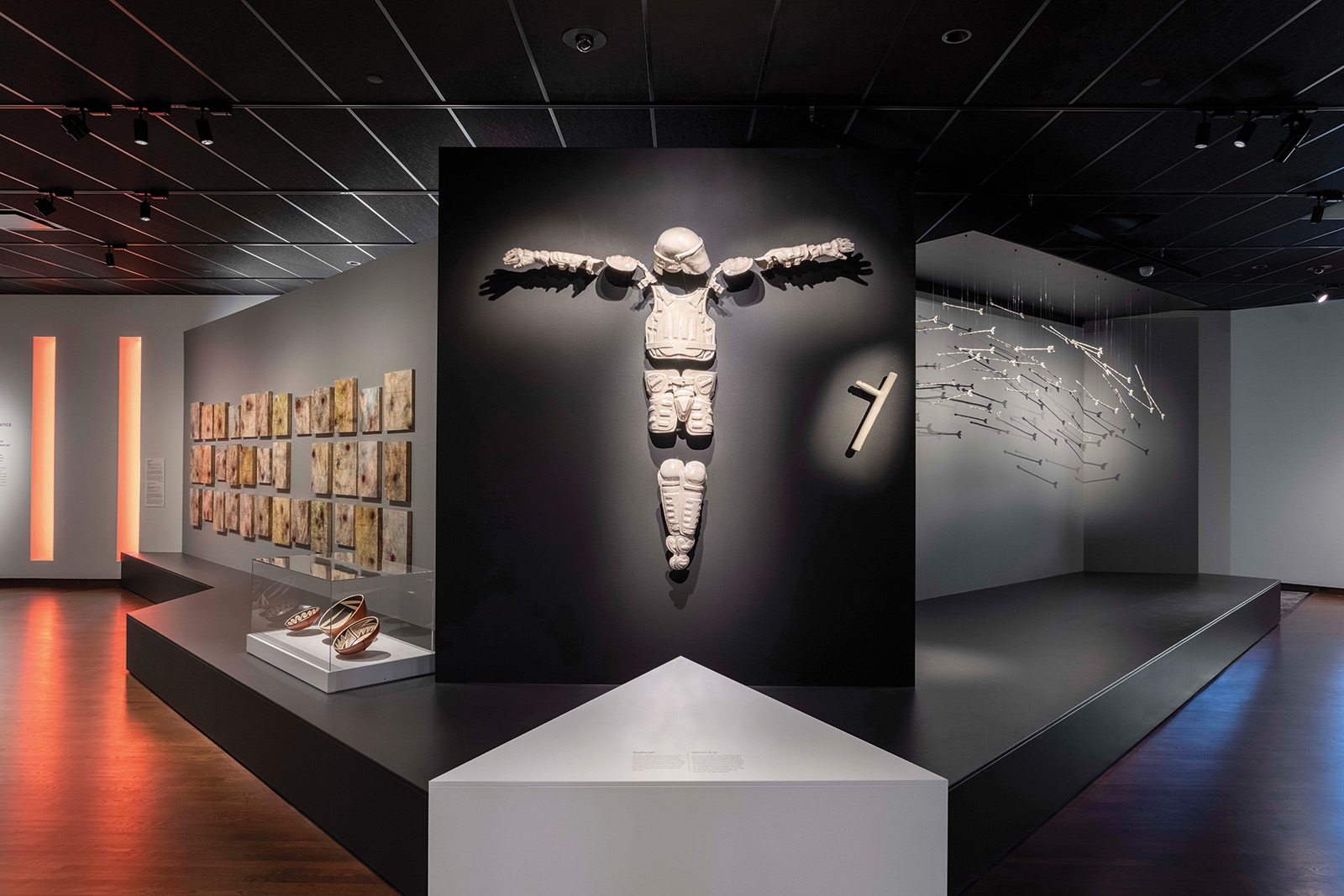 God Complex by Nicholas Galanin (Tlingit/Aleut) on display at the Denver Art Museum.
Denver lacked in collectors possessing the troves of material traditionally filling art museums. That stuff was all held back East. Egyptian and Greek antiquities. Objects from the Far East. Renaissance and Baroque paintings and statues.
Searching for how to distinguish itself, DAM leadership identified Indigenous arts. With Denver’s central location to a vast half-continent’s Indigenous population and area collectors possessing the treasures produced by those cultures, DAM prioritized the acquisition, study and display of Native artwork with a vigor unseen at the time.
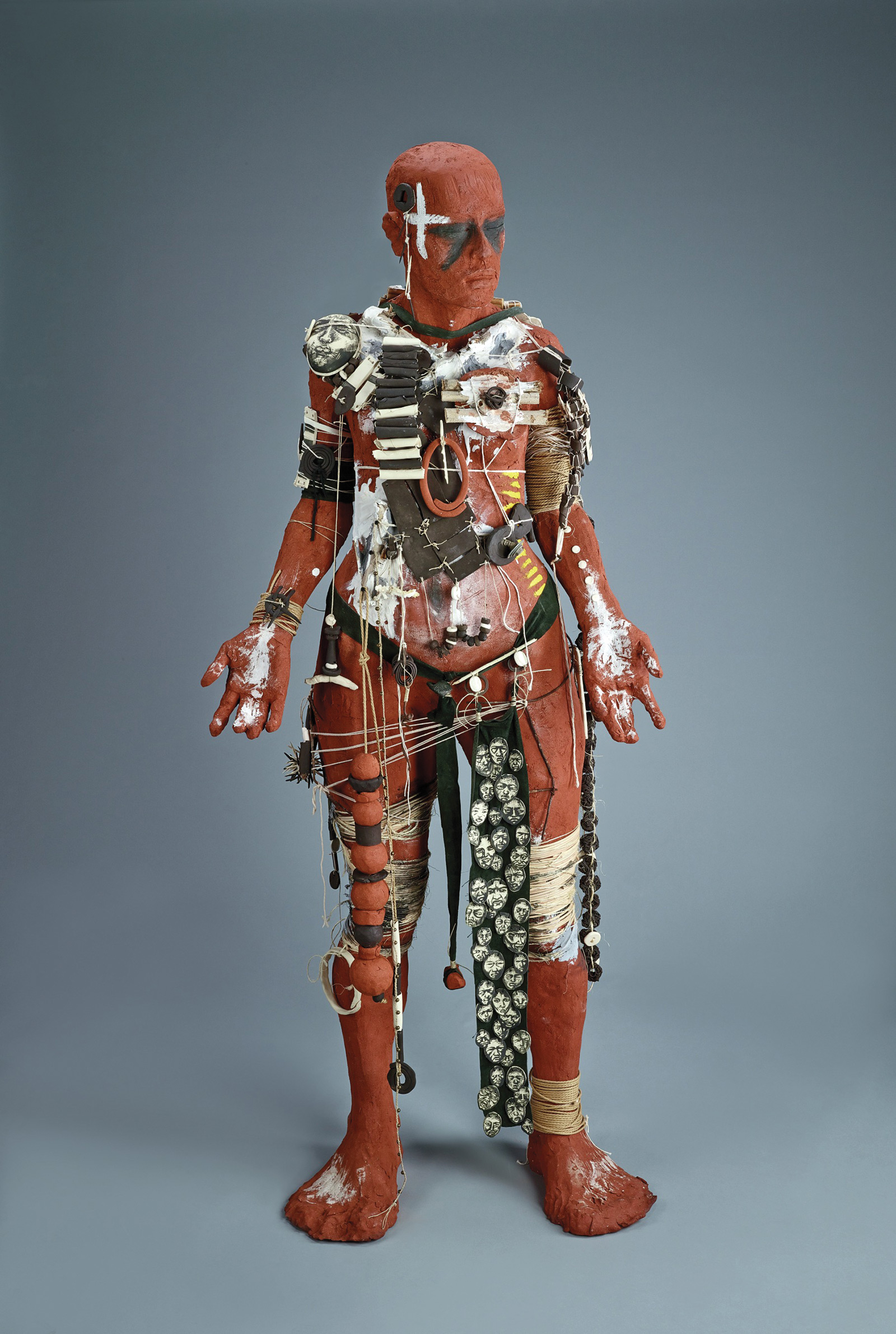 Rose Simpson (Santa Clara), Warrior, 2012, clay and mixed media, 67 x 27 x 18". Gift from Vicki and Kent Logan to the Collection of the Denver Art Museum, 2014.221A-E. © Rose B. Simpson.
“For decades, we were the only major museum in the world collecting Indigenous arts as an art,” Lukavic explains of the long-held Western practice of denying Indigenous creativity the label of “art,” relegating it to “ethnography” and natural history museums. “We’re a global art museum, and the intention was to show the great diversity of arts being created all across North America.”
While artwork from the entire continent can be seen at DAM—more than 250 Indigenous nations are represented—the Northwest Coast and Southwest Plains are strengths.
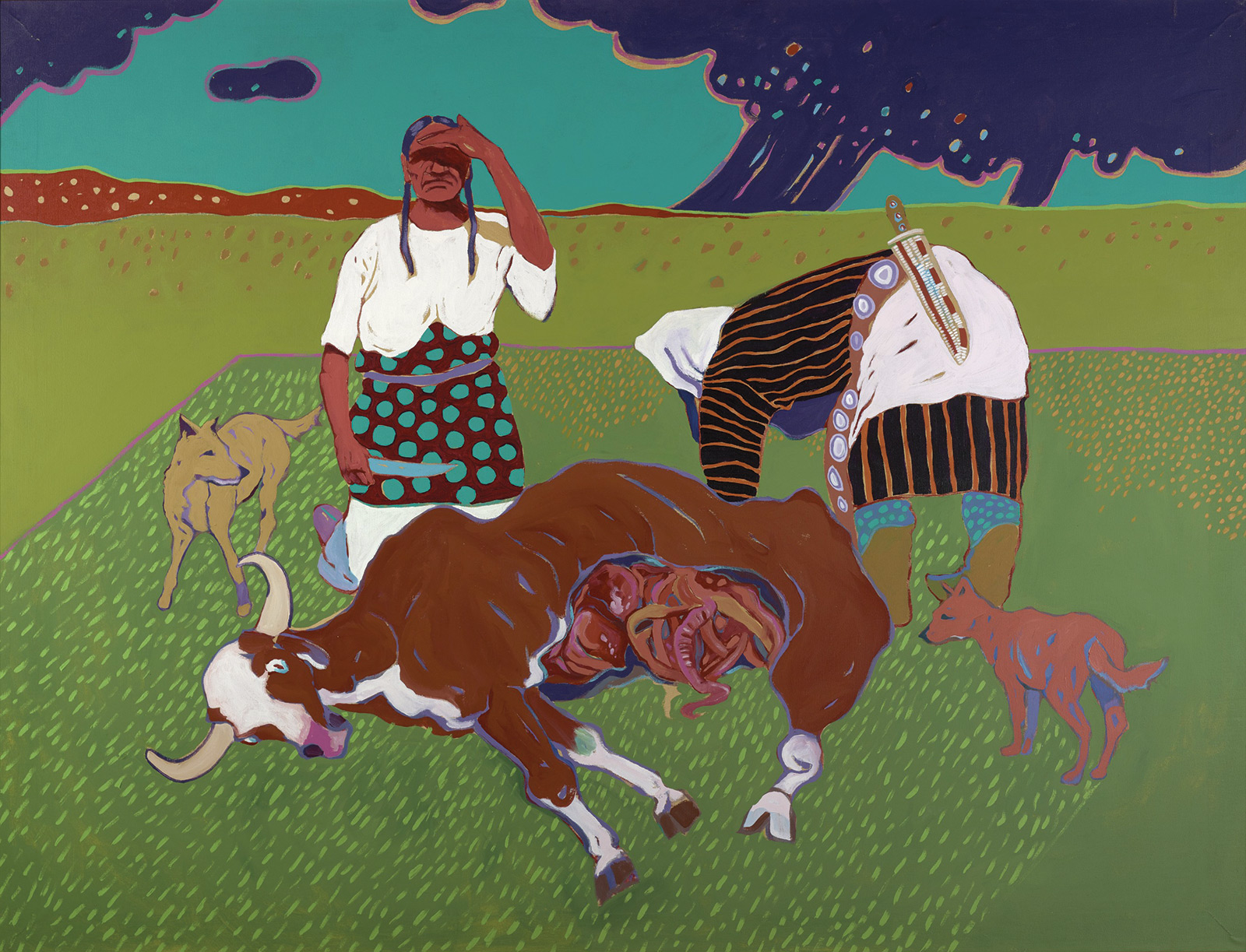 T.C. Cannon (Kiowa/Caddo, 1946-1978), Beef Issue at Fort Sill, 1973, acrylic paint on canvas, 71½ x 55¾”. Denver Art Museum: Native Arts acquisition funds, 2017.94
Recognizing and filling a hole among global cultural institutions for Indigenous artwork wasn’t the only way in which DAM’s early collecting strategy proved inspired.
“Unlike a lot of other institutions when they started, they started looking back and wanted ‘authentic’ objects from the 19th (century); (DAM) always focused on what was being created at that moment in time,” Lukavic says. “We were collecting pottery by Pueblo artists in the 1920s that were made in the 1920s.
So, we have an incredible collection of 20th-century Indigenous arts here that most institutions do not have because they’d never collected it.”
As another example, DAM started acquiring Native American church art in the 1930s. Most other institutions didn’t even acknowledge it as art at the time.
“This is something that we have always done and continue to do,” Lukavic says of the museum’s strategy, which spreads across all departments. “Collecting contemporary art has always been a priority and it remains so today. We’re always looking forward, we’re always looking at who’s doing what now, but that doesn’t necessarily mean just cutting-edge contemporary art. It also means artists today who are working in customary media, beadwork and quillwork and weaving, pottery. There’s incredible art that continues to be made and we’re constantly paying attention and working in those areas.”
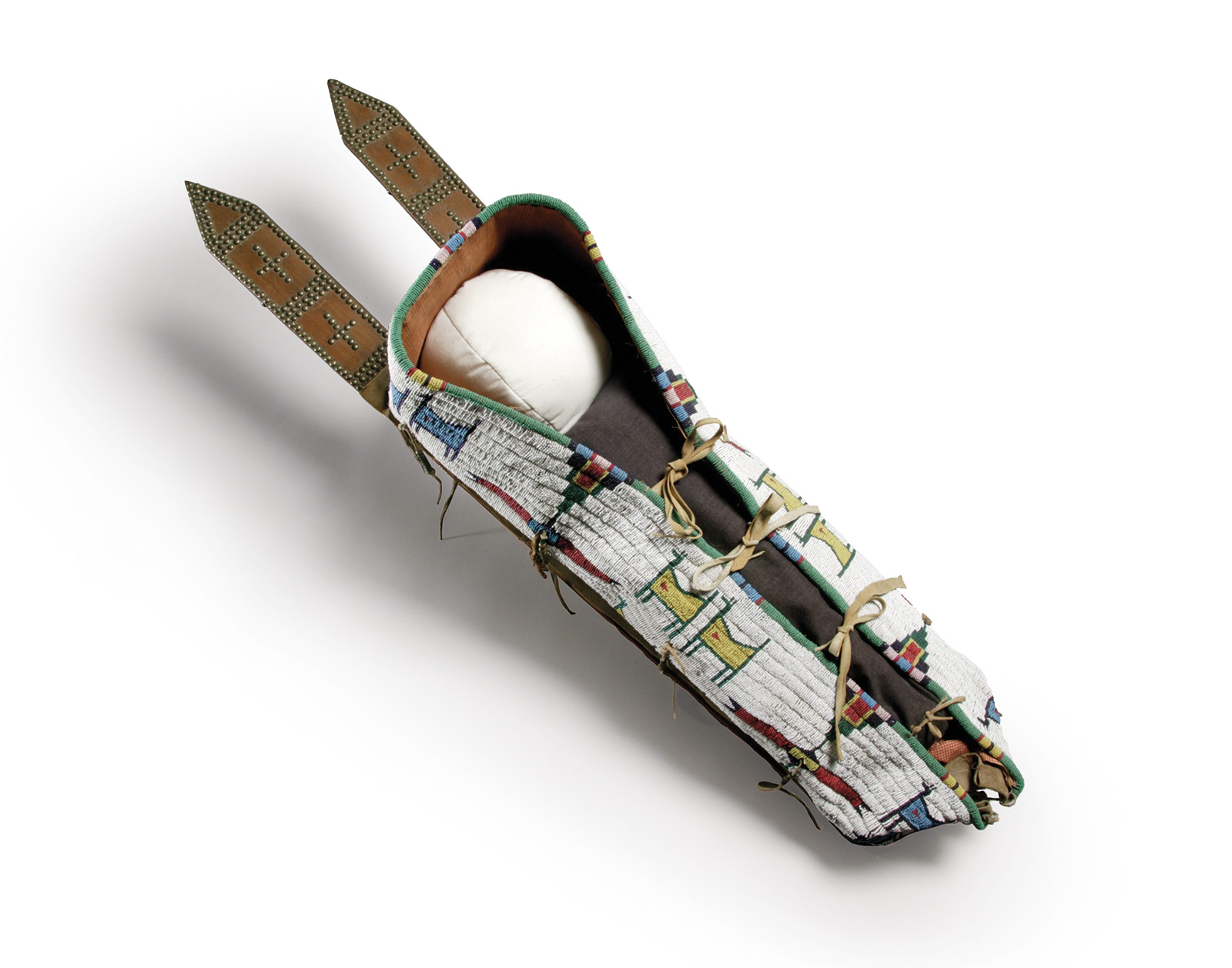 Cheyenne artist, cradleboard, ca. 1880, hide, rawhide, beads, wood, brass and cloth, 415⁄8 x 10 x 9½”. Denver Art Museum: Native Arts acquisition funds, 1949.61.
Inside the galleries DAM’s Northwest Coast galleries soar. Totem poles dramatically stretch upward, inches separating their tops from the 27-foot light tracks attached to the building’s ceiling customed designed to house them. The gallery’s verticality and darkened light simulates the region’s majestic forests. The presentation evokes awe and quietude.
Contrasting this is a searing, screaming, roiling display of politically provocative paintings produced more recently by a who’s who of the genre: T.C. Cannon (Kiowa/Caddo), Fritz Scholder (Luiseño), Jaune Quick-to-See Smith (Salish/Kootenai/Cree/Shoshone), Julie Buffalohead (Ponca), Kent Monkman (Fisher River Band Cree). Manifest Destiny, reservations, boarding schools, massacre, genocide, ecocide—the impact of European colonization on Indigenous people—is confronted head on through a battery of large-scale paintings, any one of which could serve as a crown jewel for a Native art collection at even the country’s best museums. Seeing them together in one place is staggering. To highlight any one would demand highlighting them all, each being fiercely singular and affecting.
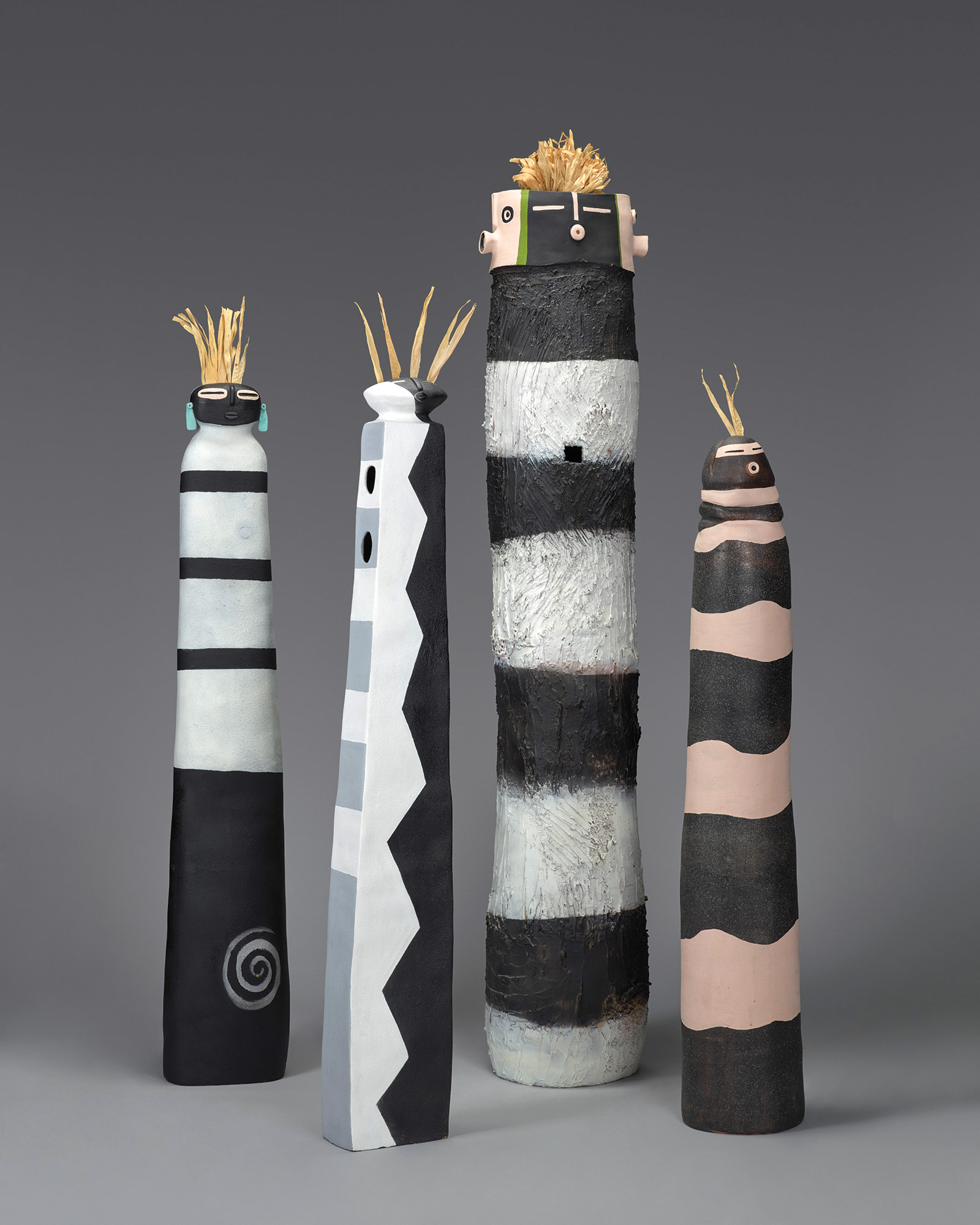 Nora Naranjo-Morse (Santa Clara Pueblo), Four Figures, 1996, clay, paint and plant fiber. Denver Art Museum: Gift of Nancy and Hamilton Harris, 2015.675.1-4. © Nora Naranjo-Morse.
Throughout, DAM doesn’t overwhelm visitors to its Indigenous arts galleries with the number of items on display, it does so with their size, quality and impact.
The material shown here is charged. Highly. DAM recognized this during planning for the reinstallation and has incorporated means to help visitors process the experience.
“Museums have a responsibility that if we are going to potentially trigger someone and open up emotions, we have a responsibility to be part of the healing process as well,” Lukavic says.
For Monkman’s The Scream (2017), a violent, penetrating scene portraying Royal Canadian Mounted Police, priests and nuns tearing Indigenous children from the arms of their parents to send them to residential schools, a second wall label underneath the main description of the work provides a telephone helpline number for people who have experienced trauma from residential or boarding schools. Similar resources are offered to coincide with Sonya Kelliher-Combs’ (Inupiaq/Athabascan), Credible (2019) which uses maps to highlight 35 Indigenous communities in Alaska that experienced instances of abuse by Catholic clergy and laypeople throughout the 1900s.
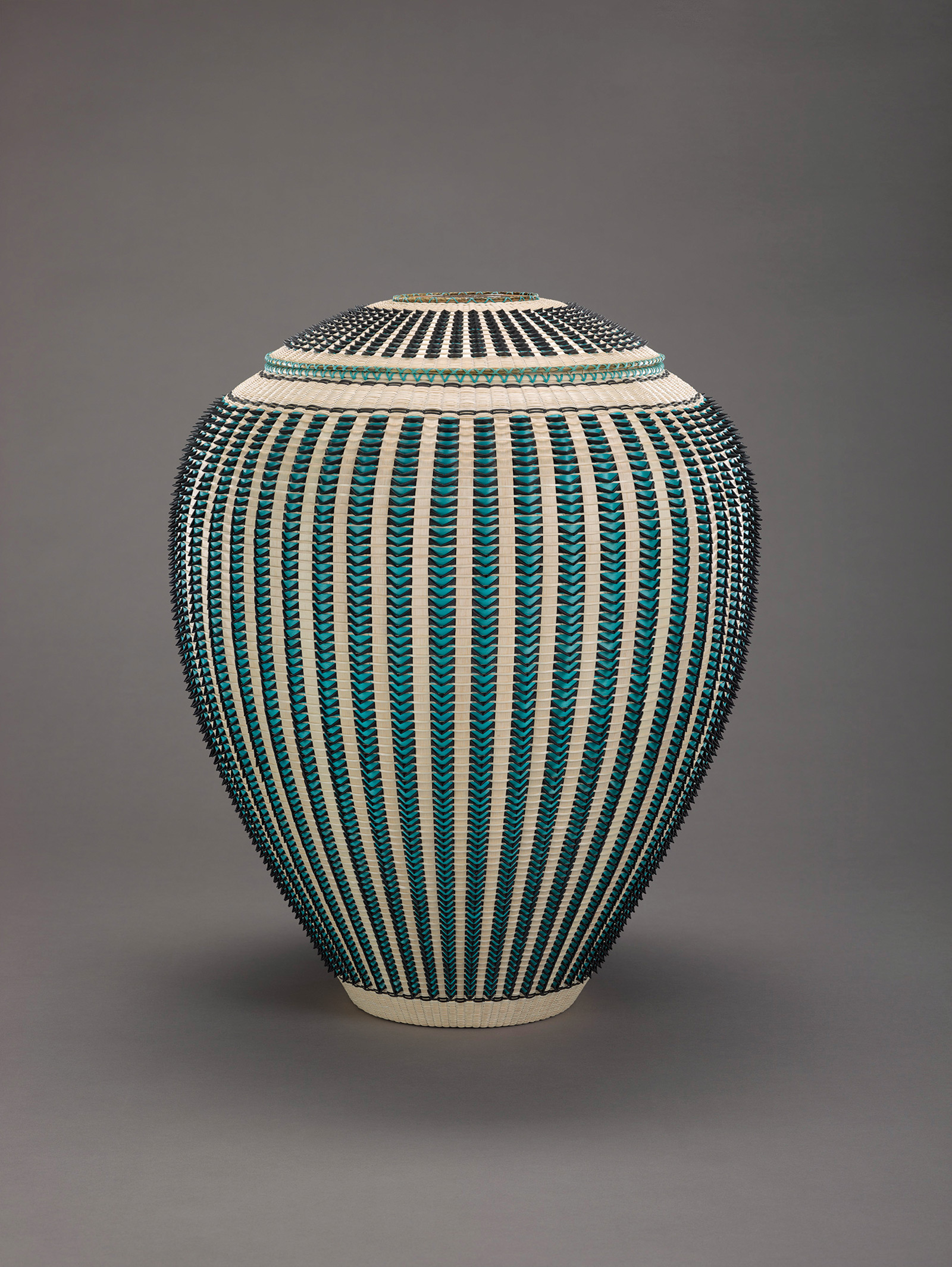 Jeremy Frey (Passamaquoddy), Watchful Spirit, 2022, ash tree fibers, 273/8 x 22¼”. Denver Art Museum: Purchased with the Nancy Blomberg Acquisitions Fund for Native American Art, 2022.51A-B. © Jeremy Frey.
A peaceful reflection space was attached to the galleries. The museum worked with United States Poet Laureate Joy Harjo (Muscogee), using one of her poems in the space to help guests in need center themselves.
It is important to remember, and DAM achieves this, that while what’s on view here is art, what’s on view here is also history. Millions of people experienced these traumas and continue to today.
“For so long Indigenous people have been outside of American consciousness, or world consciousness,” Lukavic says. “You constantly hear the story of Native people saying that people don’t even know that they exist. Clearly, by what we’re showing here, Indigenous artists have never stopped creating amazing art. The stories are relevant, they’re about issues that we should all take seriously and find important.”
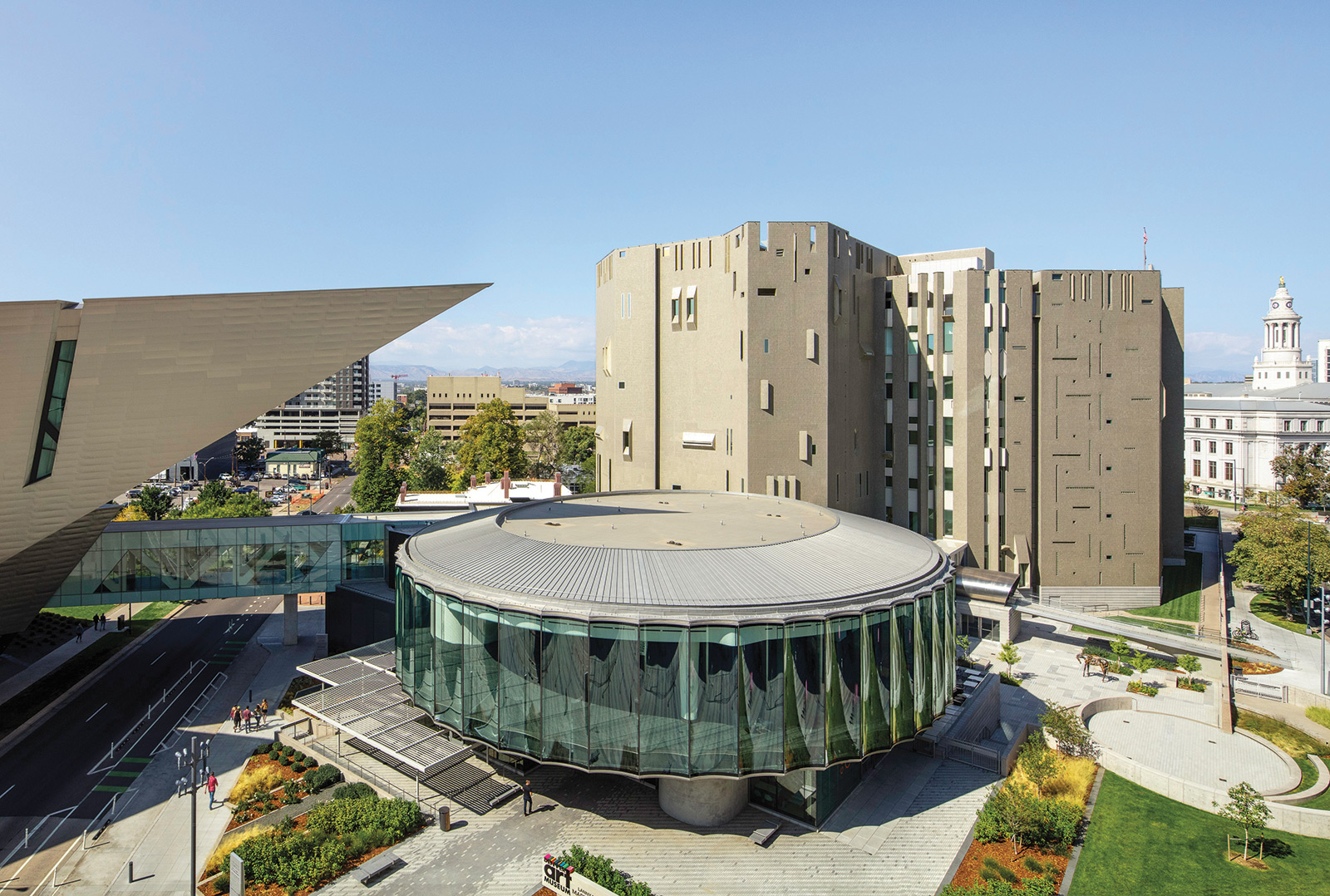 Denver Art Museum Campus. Photo by James Florio Photography. Courtesy of the Denver Art Museum.
The Denver Art Museum has paced the institutional world in the collection and display of Indigenous artwork for a century. It continues doing so with thankfully, no end in sight.
“Indigenous arts are integral to the identity of the Denver Art Museum,” Lukavic says. “This is something we will always put a priority on and will always be front and center in our programming and the experiences people have here.”
Powered by Froala Editor