In 2018, I attended my first Indigenous Comic Con at Isleta Resort & Casino in Albuquerque, New Mexico. I walked up and down the rows of artist booths and was fascinated by the widespread incorporation of Star Wars imagery within so many different types of art. Ever since, I have been intrigued by the Indigenous connection to these stories about a galaxy far, far away, and while I have my own understanding of why we relate as Indigenous people, every artist I speak to about it maintains a unique personal connection.
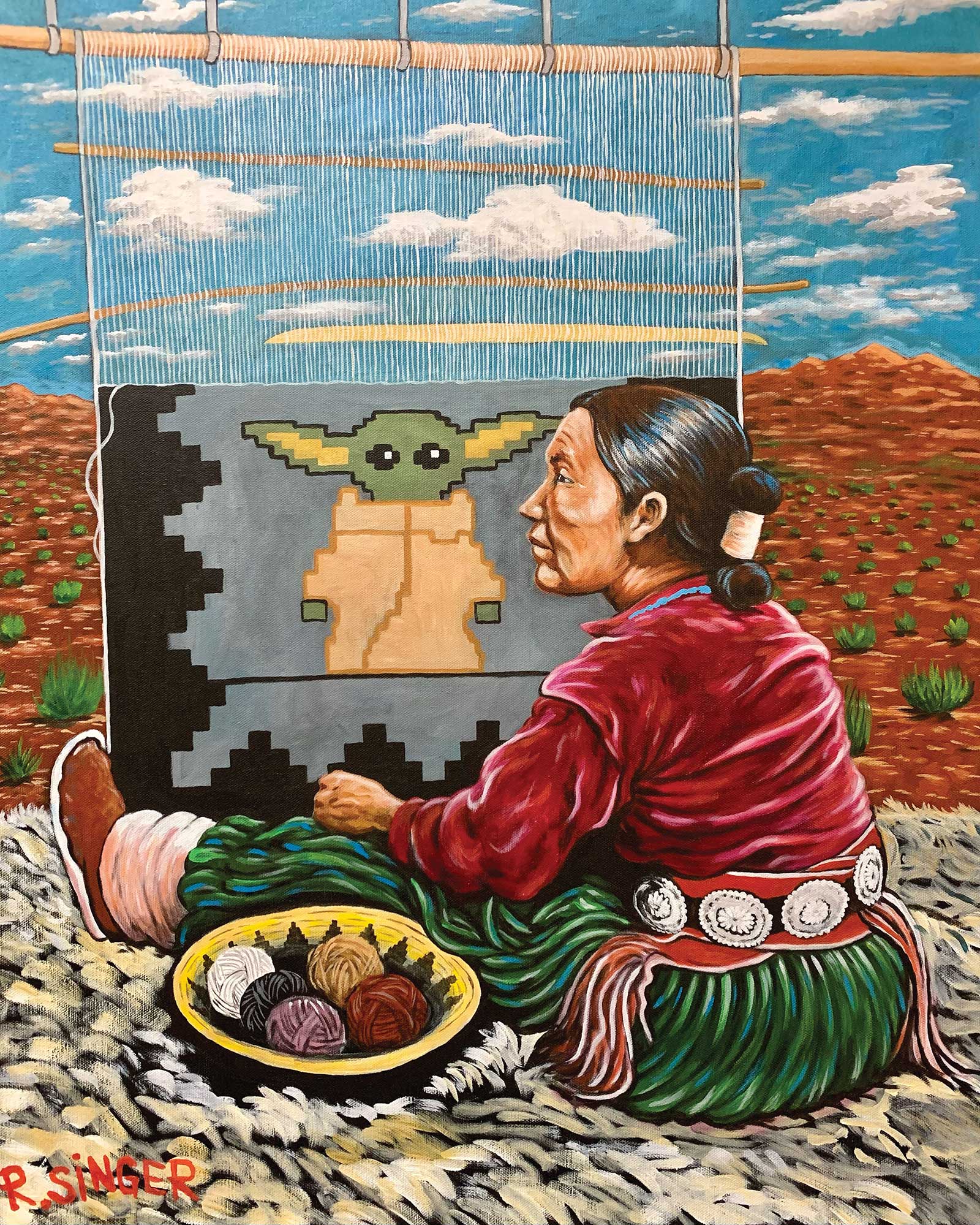 Shi’ Awéé’ (My Baby), acrylic on canvas, 30 x 24”
Star Wars played a pivotal role in Diné painter Ryan Singer’s trajectory as an artist. He grew up in Tuba City, Arizona, on the Western edge of the Navajo Reservation, and moved to the reservation around age 4 or 5. Singer describes his affinity for art beginning at a young age: “Always drawing with whatever I could make a mark with.” And then in 1977, the first Star Wars movie came out. He described a school field trip that he went on to see the movie’s premiere in Phoenix. As his class entered the theater, Singer was amazed by all of the cardboard cutouts, the branded cups, the decorations all around the space—everything was Star Wars-themed. Singer vividly recounted the feeling of sitting in the dark theater and the excitement he experienced with the start of the film. He felt an instant connection as the desert scenes and landscapes reminded him of home—he could see the familiar dry arroyos of Tuba City in the desert planet of Tatooine. Even as a young child, he was impressed by the film’s attention to detail, such as the aged and rusted appearance of the Jawa Sandcrawler. When he visited his grandmother for sheep camp, he would bring his Star Wars toys with him and play in the area surrounding her home. Ever since he first saw the movie, Singer has been incorporating Star Wars imagery into his work, gaining a lot of artistic experience through his early drawings of the film’s vehicles and characters.
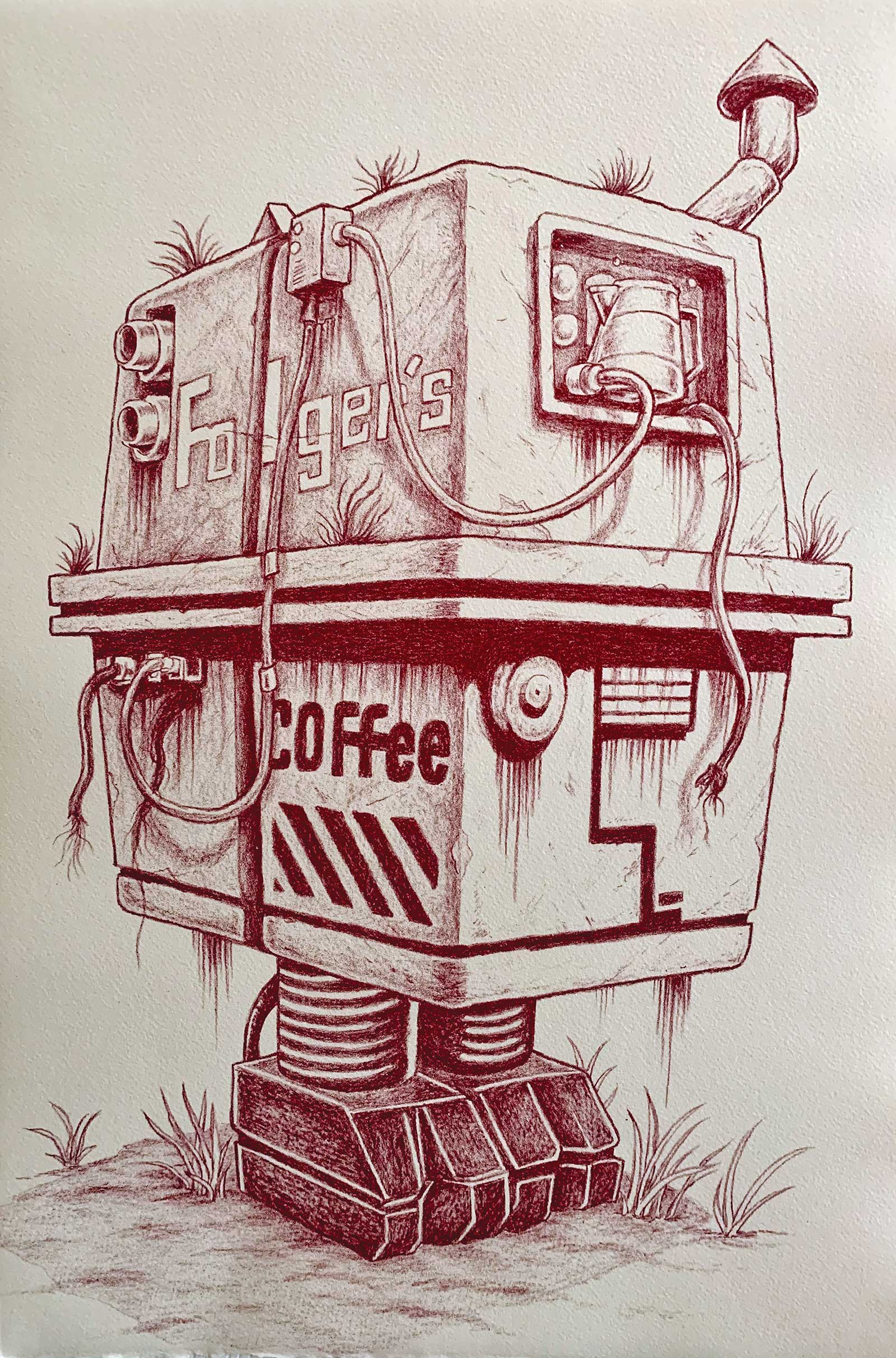 Coffee Droid, one-run color lithograph on Arches Cream Buff, 22 x 15”
Beyond Star Wars imagery, Singer describes a deeper connection to the story: “It’s a universal story of good and bad that anyone can relate to—the Force can be anything,” he explains. Singer also emphasizes the lack of racial tension within the storylines. In the movies we see humans and various alien civilizations interacting, but their difference isn’t the focus of the story. “It wasn’t a big deal,” he adds. “It was just accepted.” His use of Star Wars imagery was employed to address important topics like the ones that resonated with him from these films. Through the vivid colors and playful imagery of his art, Singer speaks to issues that are significant to contemporary Indigenous people. Early on in our discussion, he brought up his interest in addressing stereotypes about Native people through his art and the tension he has experienced as a Native artist whose work has been judged by non-Natives as either “too Native” or “not Native enough.”
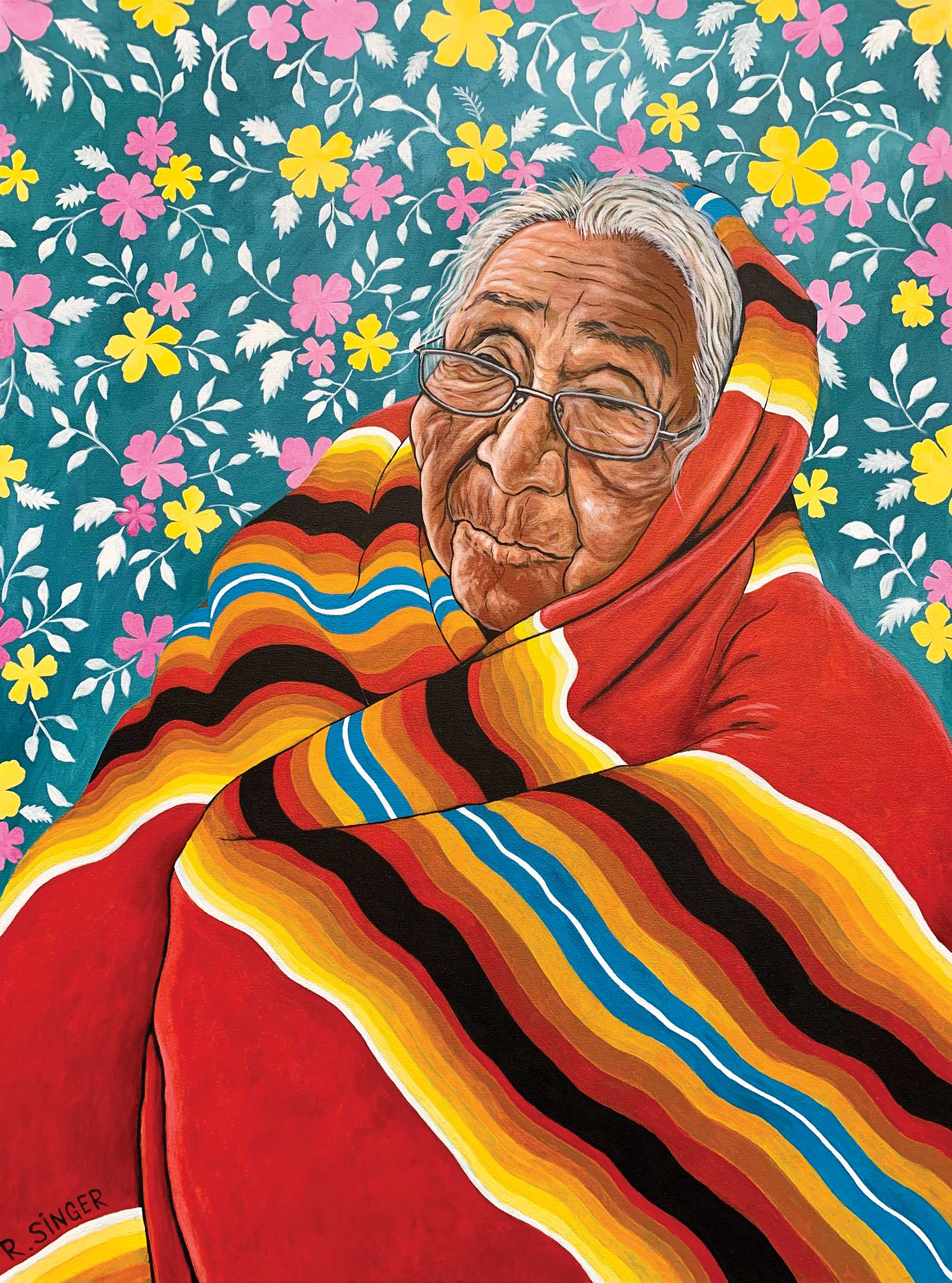 Beauty All Around Me, acrylic on canvas, 40 x 30"
Singer describes some of the other major influences in his work, including his interest in surrealism at a young age, and how it was greatly inspired by the work of Salvador Dalí. Other interests, including skateboarding and music, have been intertwined into his world and played a major role in his life. One of my favorite references from our conversation was the 1976 Kiss album Destroyer and the inspiration that Singer drew from the cover art. As he grew older, he looked to prominent Native artists, such as T.C. Cannon, as he really began to focus on painting. During this time, he was extremely dedicated to self-improvement. “Every time I sat down at my easel, I was trying to get better at painting,” he says. All of these diverse influences are evident in his work, but Singer seamlessly pulls all of his inspiration together to create a style completely unique.
To me, Singer’s artistic style makes the meaning behind his work that much more impactful because it catches the viewer off guard. First you notice the colors, maybe a pop culture reference, and then the deeper meaning behind the work starts to set in. It makes viewers really stop and think in a way that art with a much more obvious message might not. As
I was looking through images of Singer’s work online, one piece that stopped me in my tracks was his 2021 painting, Kill the Indian, Save the Toys. The painting depicts an Indian boarding school using Fisher Price toys—a school house with “1ND1AN 80ARD1n9 SCH00L” written on the roof in magnets—and all of the figurines within the school and outside wear frowns on their faces. When I saw this piece, I was reminded of a story my grandmother would often tell about how she and her boarding school classmates were only allowed to play with one toy on one day each year. This was on Christmas, and at the end of the day, the toys were taken away until the next year. Singer’s juxtaposition of familiar children’s toys to tell a story of our relatives who were never allowed to be children really struck a chord with me, as I’m sure it has done for so many other Native people.
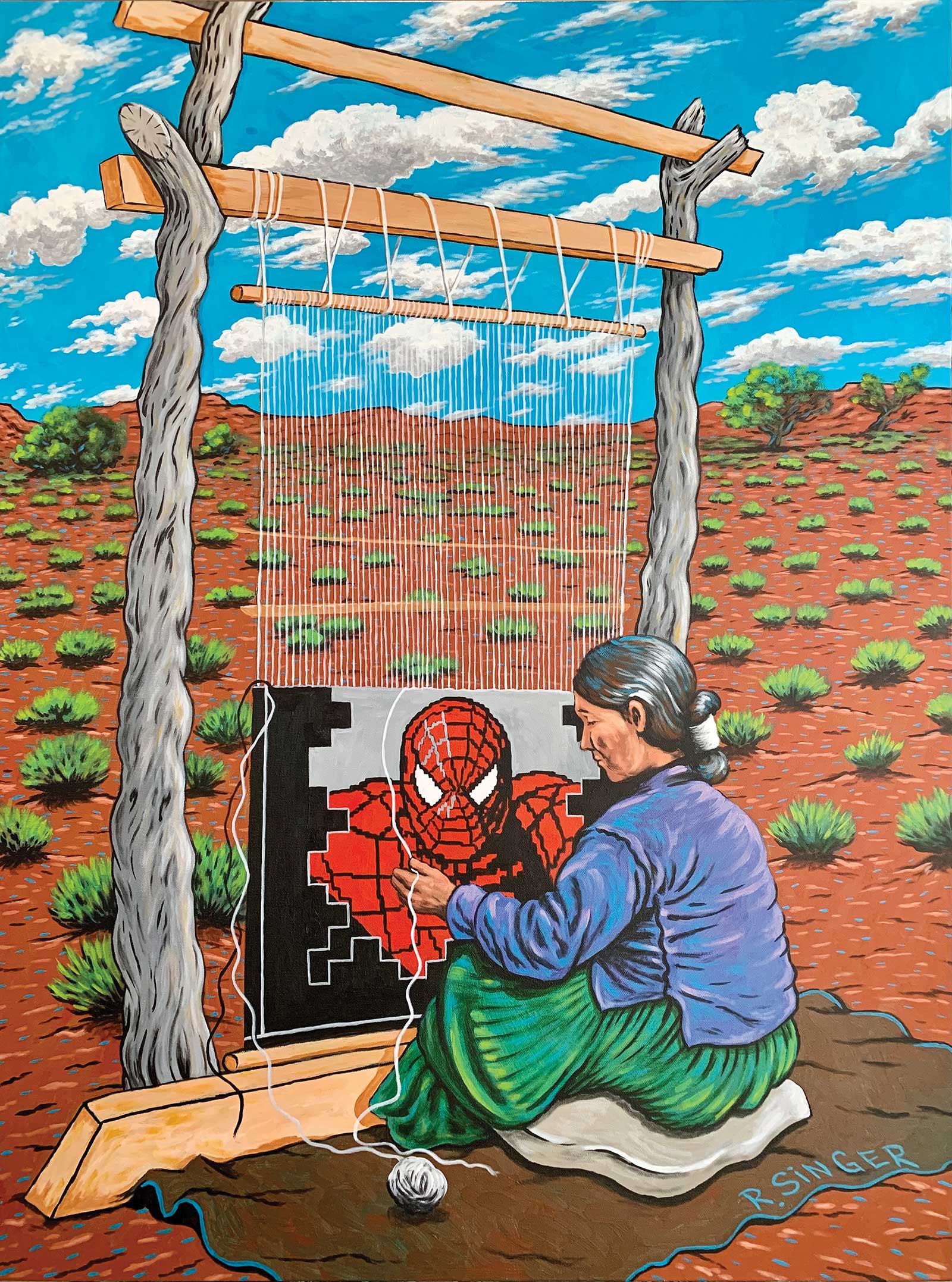 Opposite page: Spider-Man Meets Spider-Woman, acrylic on canvas, 40 x 30”
Another work that similarly presents a striking dichotomy between the subject and the imagery used to depict the subject is LEGO Long Walk. Also completed in 2021, this piece depicts the Long Walk using LEGO figurines. U.S. soldiers sit on plastic LEGO horses amidst a long trail of Diné LEGO figurines—some lay on the ground while others carry small LEGO babies as they walk in the direction of a billboard that reads “Hwéeldi (Bosque Redondo).” Both of these works were recently acquired by the Eiteljorg Museum in Indianapolis and will be on display in an upcoming exhibition.
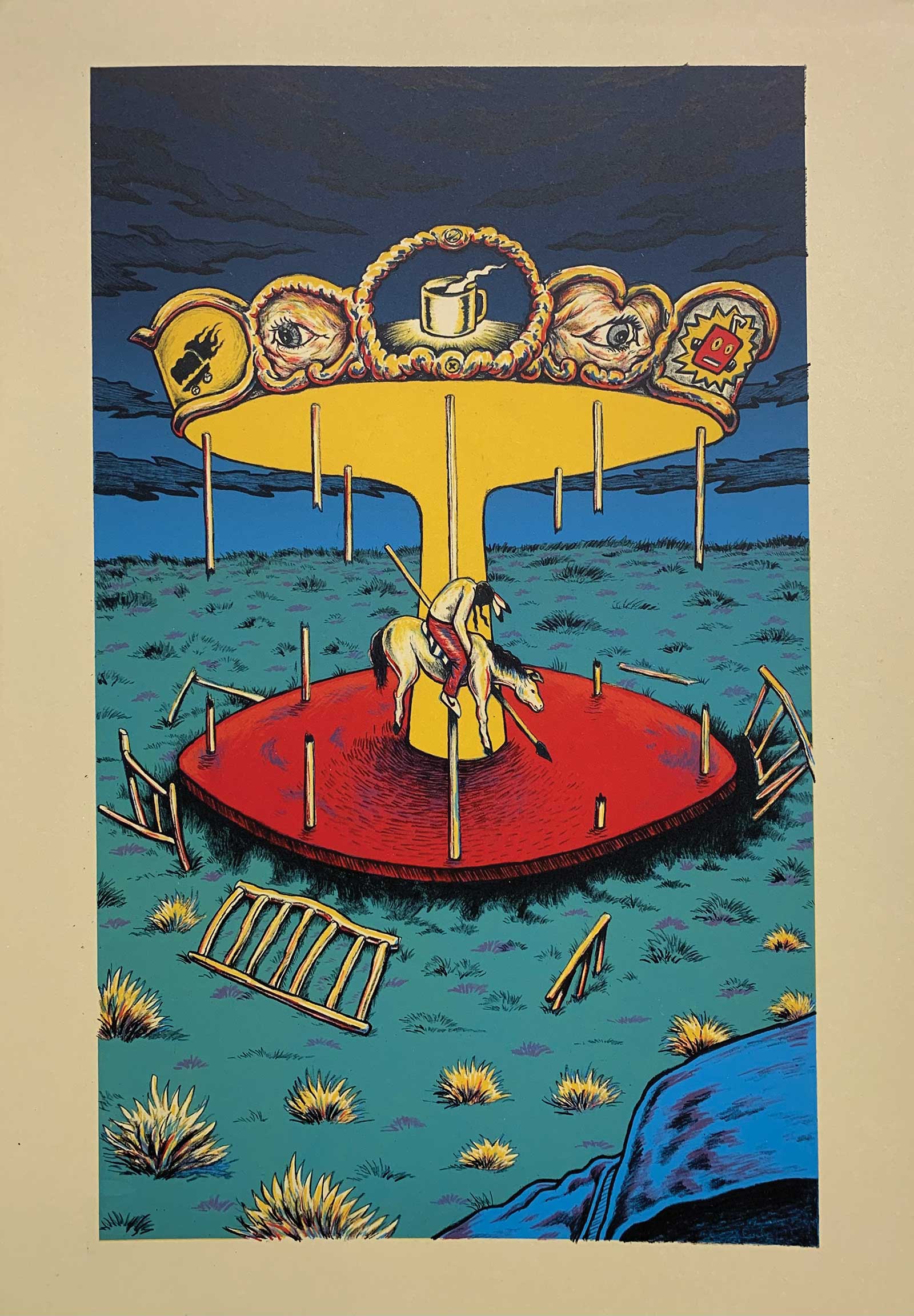 A Storm is Brewing, four-color run lithograph on newsprint gray somerset, 22 x 15”
Singer explains that his artwork is deeply personal, and often creating the work is very cathartic for him. However, he also hopes that his work can reach others—that other Native people might look at his work and see themselves, their family and their history. For non-Native people, maybe his work can be educational or at least inspire them to do their own research about what is depicted in his work. Ultimately, it could change their mindset about Native peoples and lead them to teach their kids or teach others. Singer explains, “Art can do so many things—it could be humorous, could make someone happy or angry, could make someone think about who they are and where they come from.”
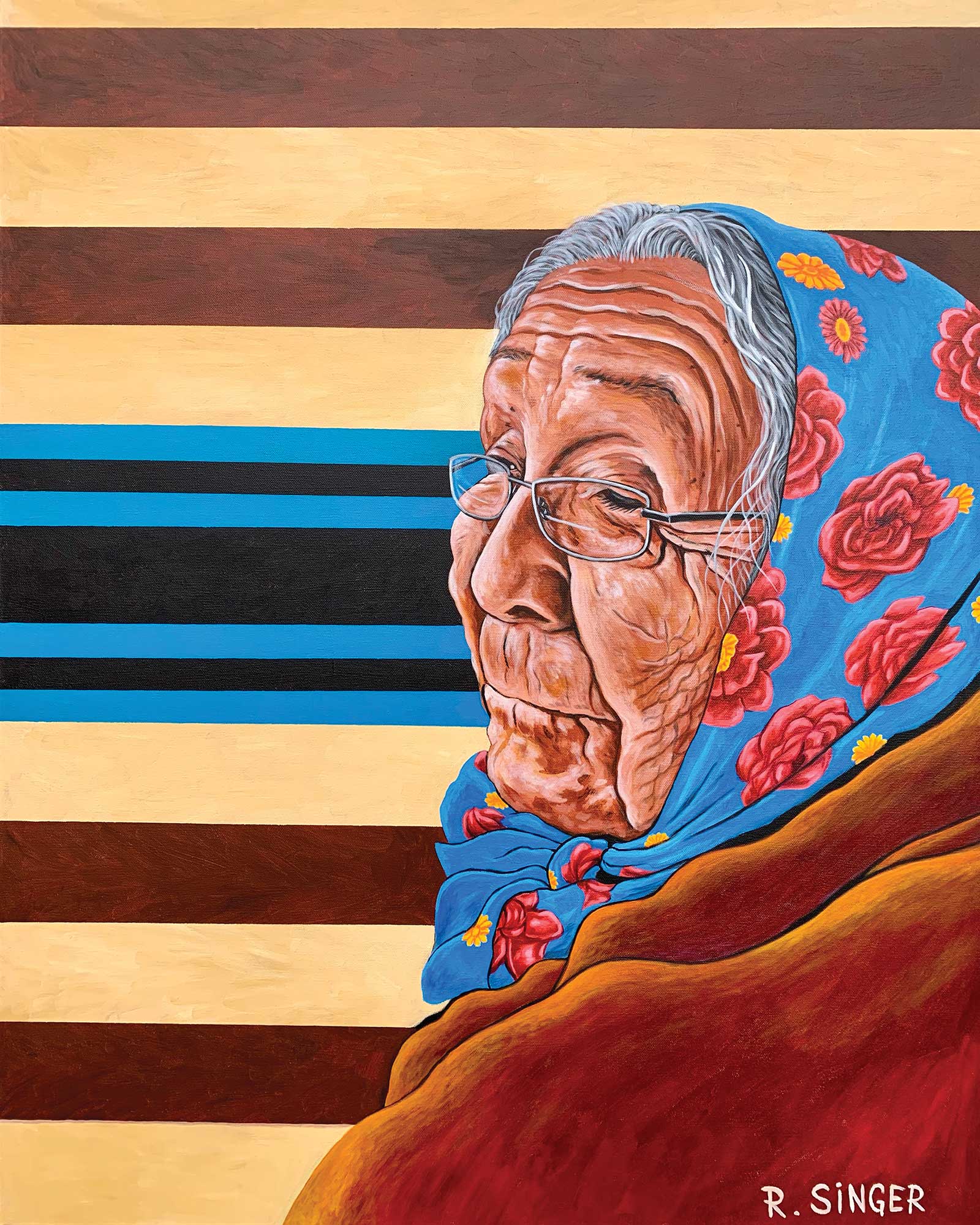 Looking Into the Future, acrylic on canvas, 40 x 30”
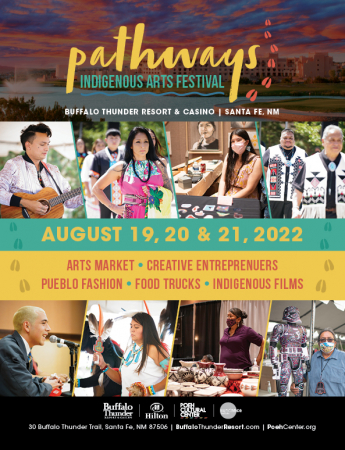
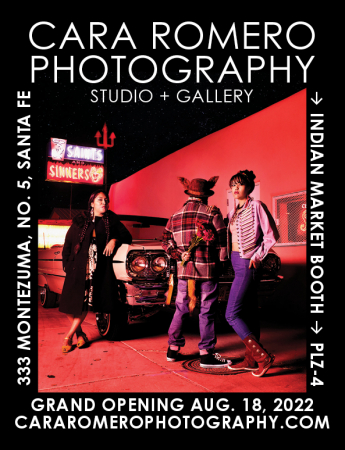
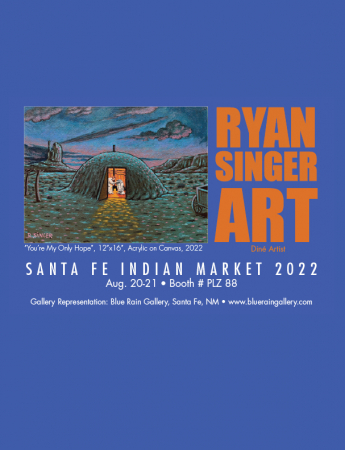
Santa Fe Indian Market attendees can expect to see many familiar themes and images within the work that he brings this year, including Star Wars, dinosaurs, Cthulhu, Spider-Man and Godzilla. Singer is also particularly excited about a collaboration with Diné fashion designer Orlando Dugi that he has been working on since January. The work will make its debut on the runway at the SWAIA Indigenous Fashion Show on Sunday, August 21. Singer couldn’t divulge too many details, but he shared that the piece is a men’s coat that will feature embroidery by Dugi and painting by Singer to depict an image related to the Navajo creation story. Beyond the fashion show, visitors can see Singer and his work at booth PLZ 88 within the Santa Fe Plaza.
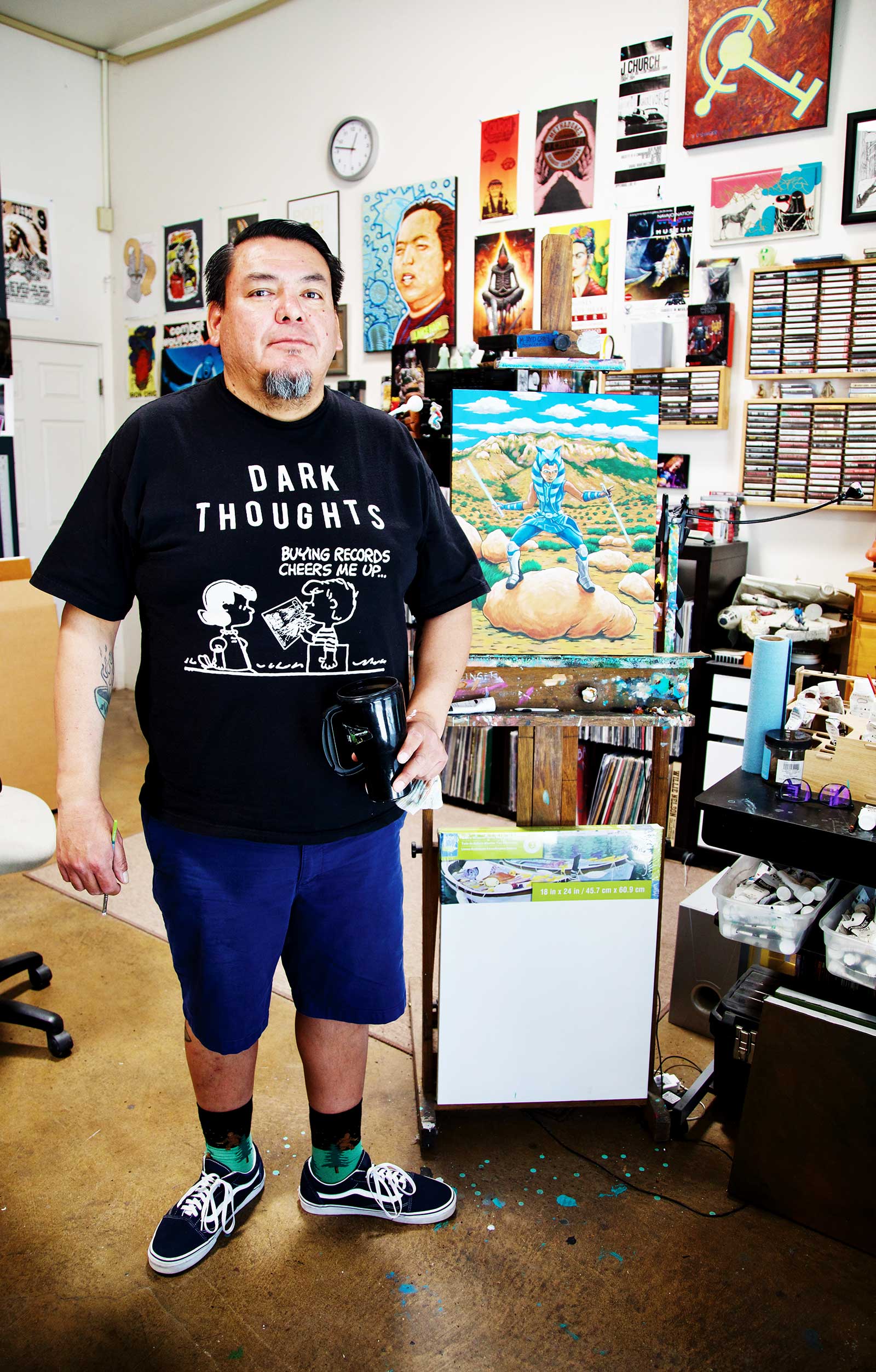 Ryan Singer in his studio with Ahsoka in the Foothills on his easel.
Singer also recently began showing with Blue Rain Gallery in Santa Fe. In the spring his work was featured in an exhibition at the gallery alongside the work of Frank Buffalo Hyde and Starr Hardridge. Singer is currently finishing up his Bachelor of Fine Art degree at University of New Mexico, and plans to put some work into the gallery before Indian Market, so be sure to stop by Blue Rain while in town for the weekend.
Powered by Froala Editor