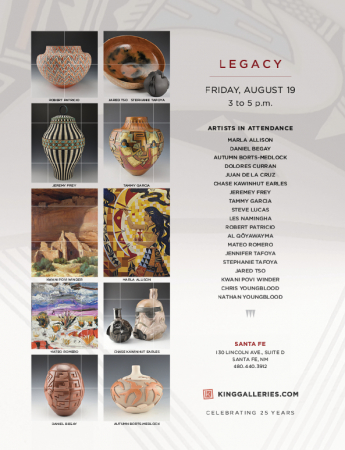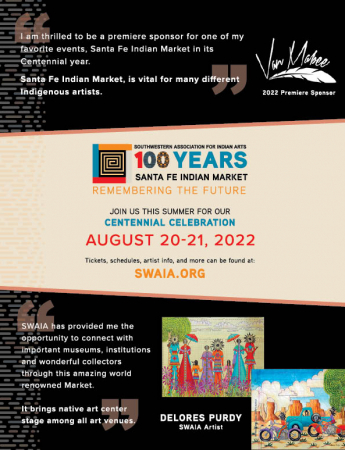
This year marks the 100th anniversary of SWAIA’s Santa Fe Indian Market! Though it is a time for celebration, many of this year’s participants are reflecting on the impact this event has had on their families, lives and legacies. This is particularly true for sisters Tammy Garcia and Autumn Borts-Medlock, both world-renowned pottery makers from the Santa Clara Pueblo. Though they always create pots that honor the teachings passed on to them by their ancestors, this year’s market entries are specifically dedicated to the women potters who came before them, many of whom also shared their creations through Indian Market. Autumn and Tammy’s relationship to this time-honored event exemplifies how it is truly a family affair filled with history, love, excitement and creativity.
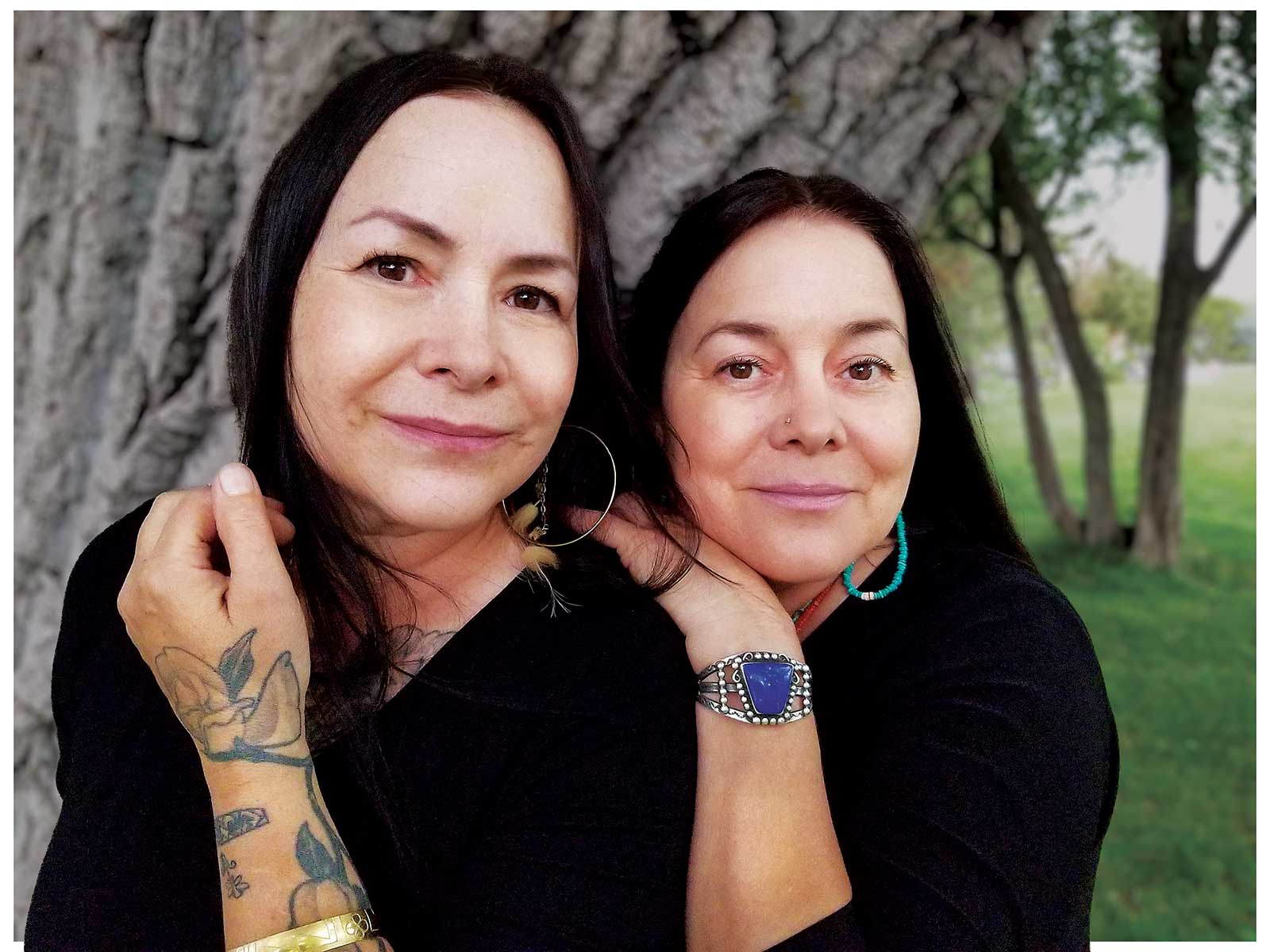
Growing up in the early 1970s in Santa Clara Pueblo, Tammy and Autumn’s mother, Linda Cain, would often take them up the road to visit their grandmother, Mary Cain (1915-2010). During the warmer months, the family would travel to the foothills of the Santa Clara mountains to harvest the clay that Mary and Linda needed to make their pots. From the very beginning, Linda and Mary taught Autumn and Tammy that clay was not something that should be wasted or disregarded as inanimate, for it is a material that has always been an integral part of pueblo life. They then learned how to create pottery using the traditional style of coil building, where you form a dish and build its walls up one coil at a time until the desired shape is formed. Their initial creations included small bowls and animal figurines. However, in time, Mary and Linda began to teach them the different designs they could incorporate into their work. On Autumn’s website, she recalls how her teachers drew inspiration “from the spiritual symbolism and nature-oriented design aesthetics of Tewa culture” and carved “kiva steps, bear paws, feathers, rain clouds, water serpents, and lightning bolts into the surface of the vessels.” She also remembers waiting for calm, “wind-free mornings to fire [the vessels] outdoors in flames kindled by thin fragrant stacks of red cedar.”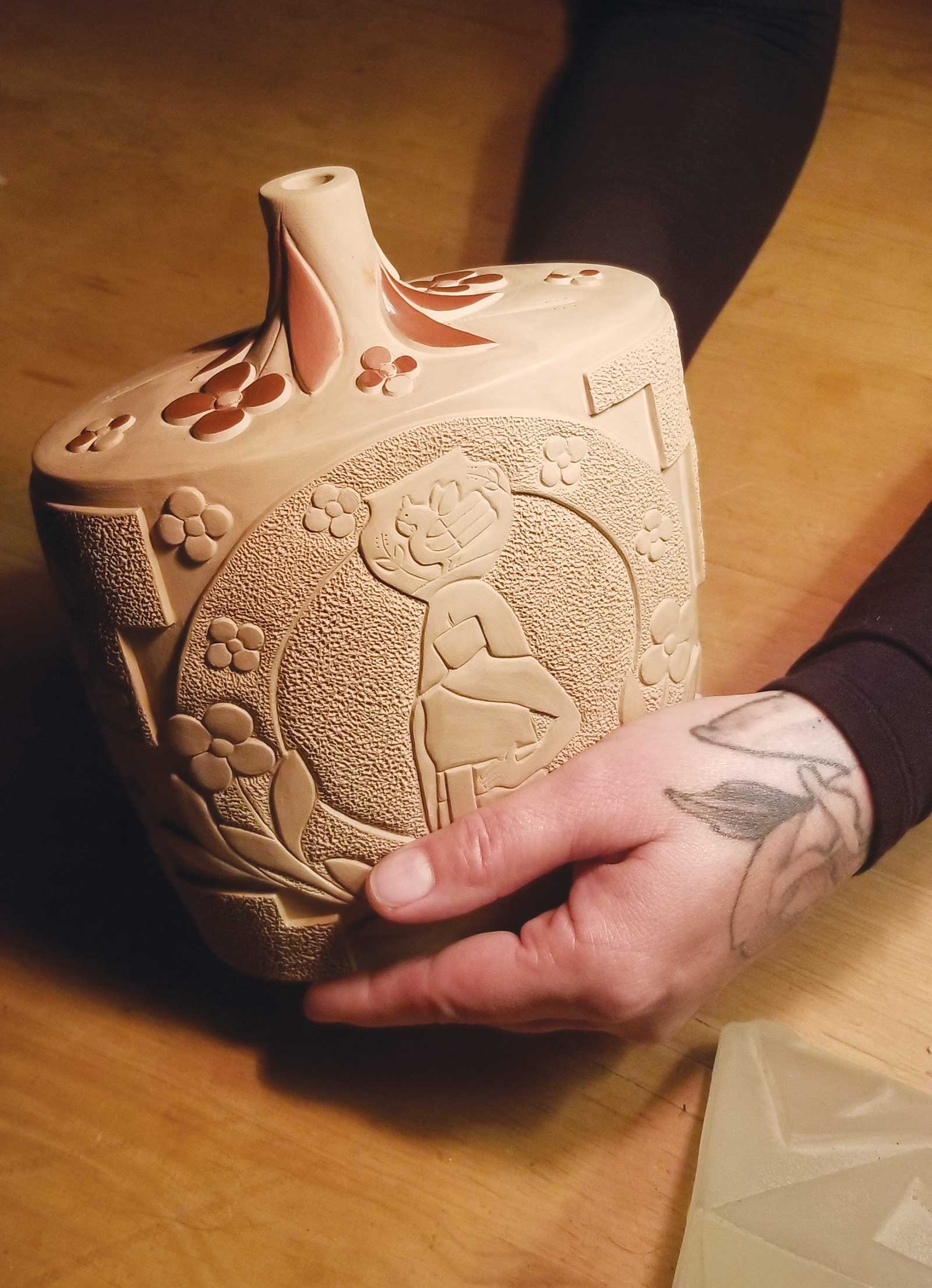 The finished design on a pot. Photo by Wiz Allred.
When Tammy and Autumn reached adolescence, their mother began to encourage them to make pieces that were distinctly their own. Though intimidated at first, Tammy and Autumn drew on the strength of their matriarchs to accomplish such a task. According to Tammy, “[Our] grandmother and mother seemed fearless when it came to clay, and it was that confidence that inspired us both to have the courage to evolve and trust our instincts.” Eventually, they began to sell their work in Santa Fe’s Plaza, including the gift shop at La Fonda Hotel and Kiva Gallery. Occasionally, wholesale buyers would go straight to their grandparents’ home in the pueblo to buy pots from their grandmother. These same buyers would also purchase what Tammy and Autumn had available. During these encounters, Tammy and Autumn learned the importance of building a rapport with those interested in their art, lessons which came in handy when they began to show at Indian Market later in life.
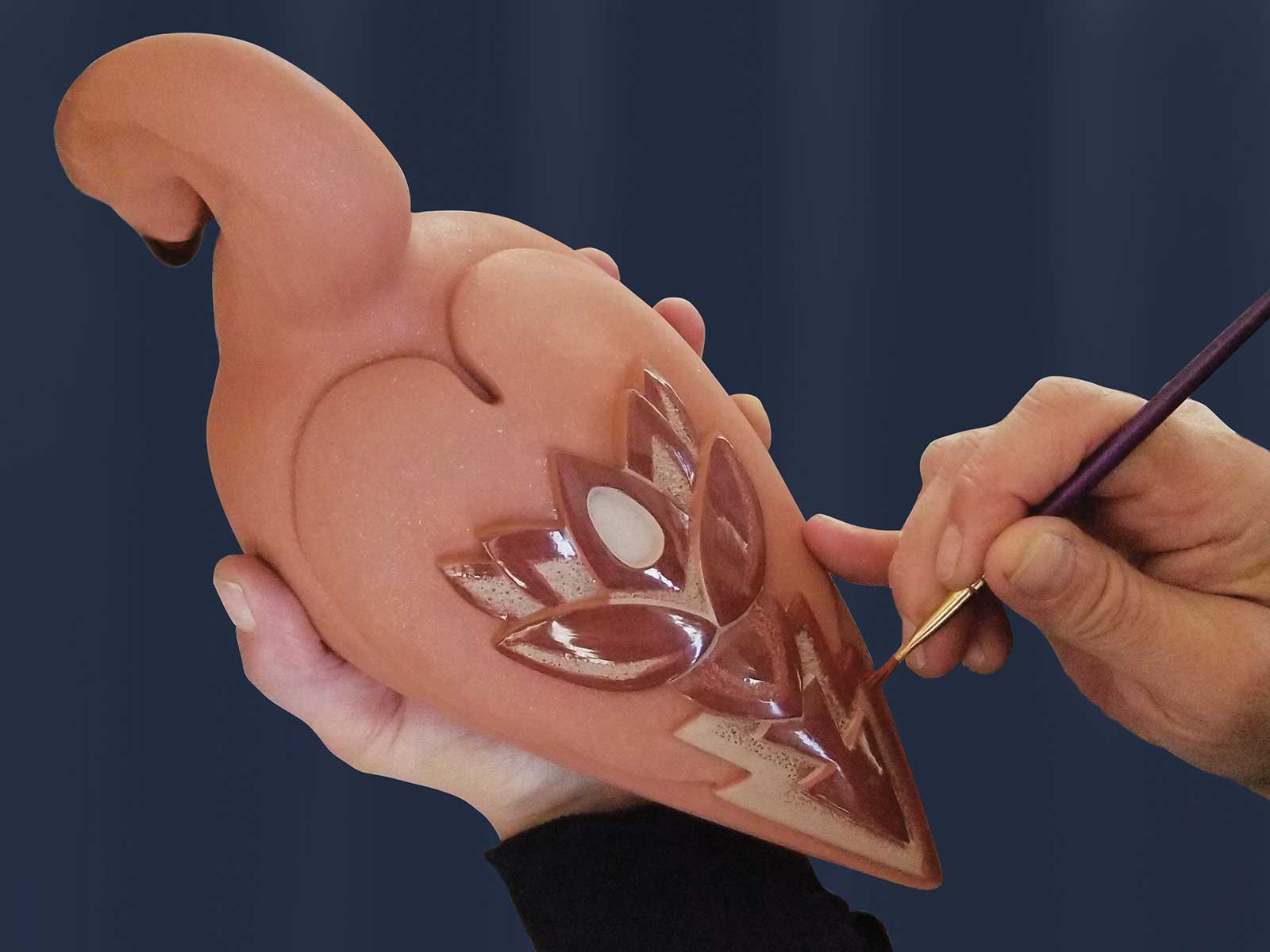 Autumn Borts-Medlock paints a design on the back of Black Swan. Photo by Wiz Allred.
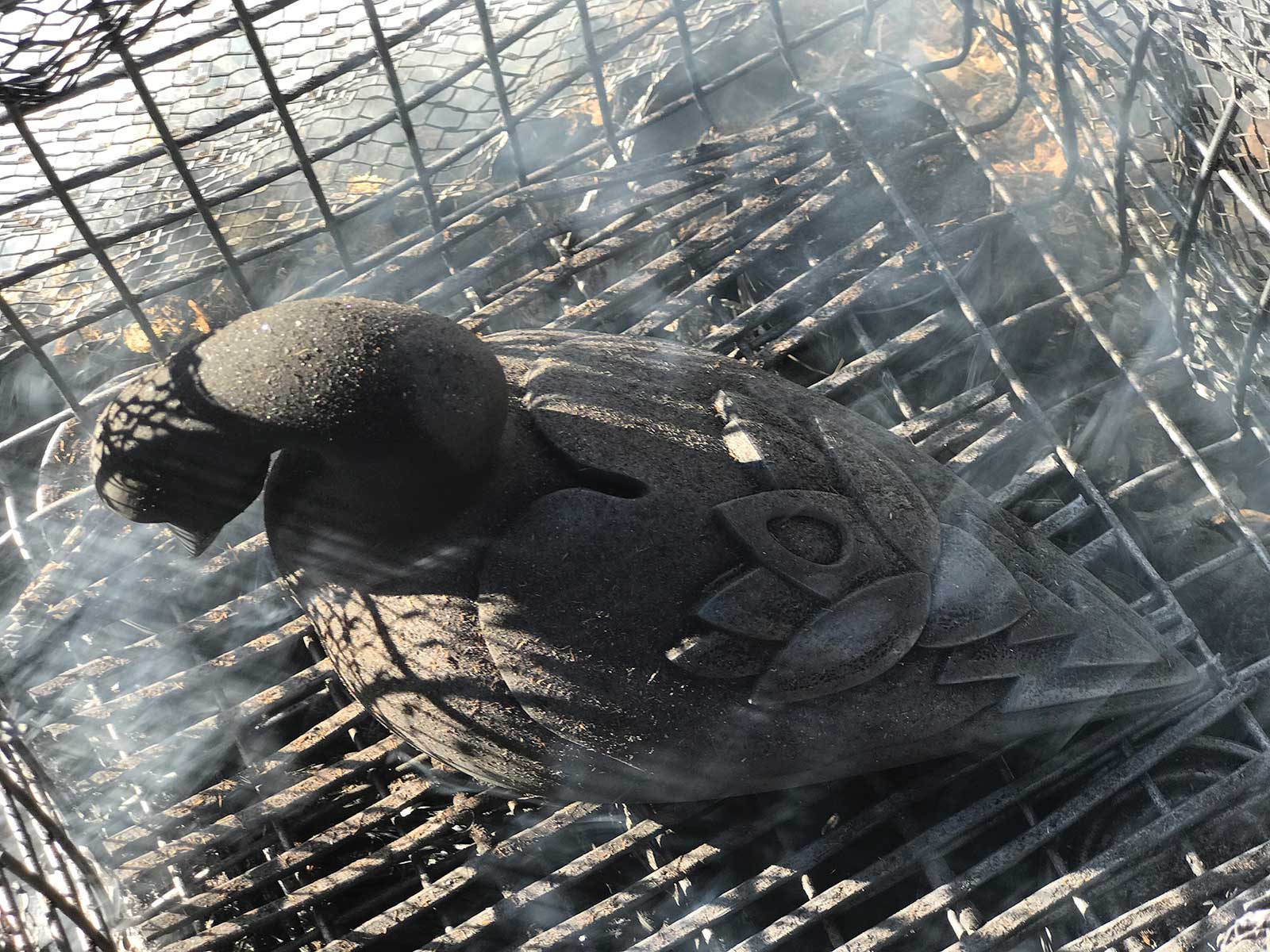 Black Swan after the firing process, which gives the work its black finish. Photo courtesy the artist.
Their great grandmother, Christiana Naranjo (1891-1980), was the first in their family to participate in Indian Market. Christina shared a booth with her daughter Mary and later Mary’s daughter Joy. When Christina retired from showing at market, Linda began to share a booth with Joy and Mary. On market days, Tammy and Autumn would help unload boxes of pottery early in the morning and then repack anything left over in the evening. Throughout the day, they would hang out at the plaza and admire all the other works of art on display. They dreamed of the day they could show their work as their mother and grandmother did.
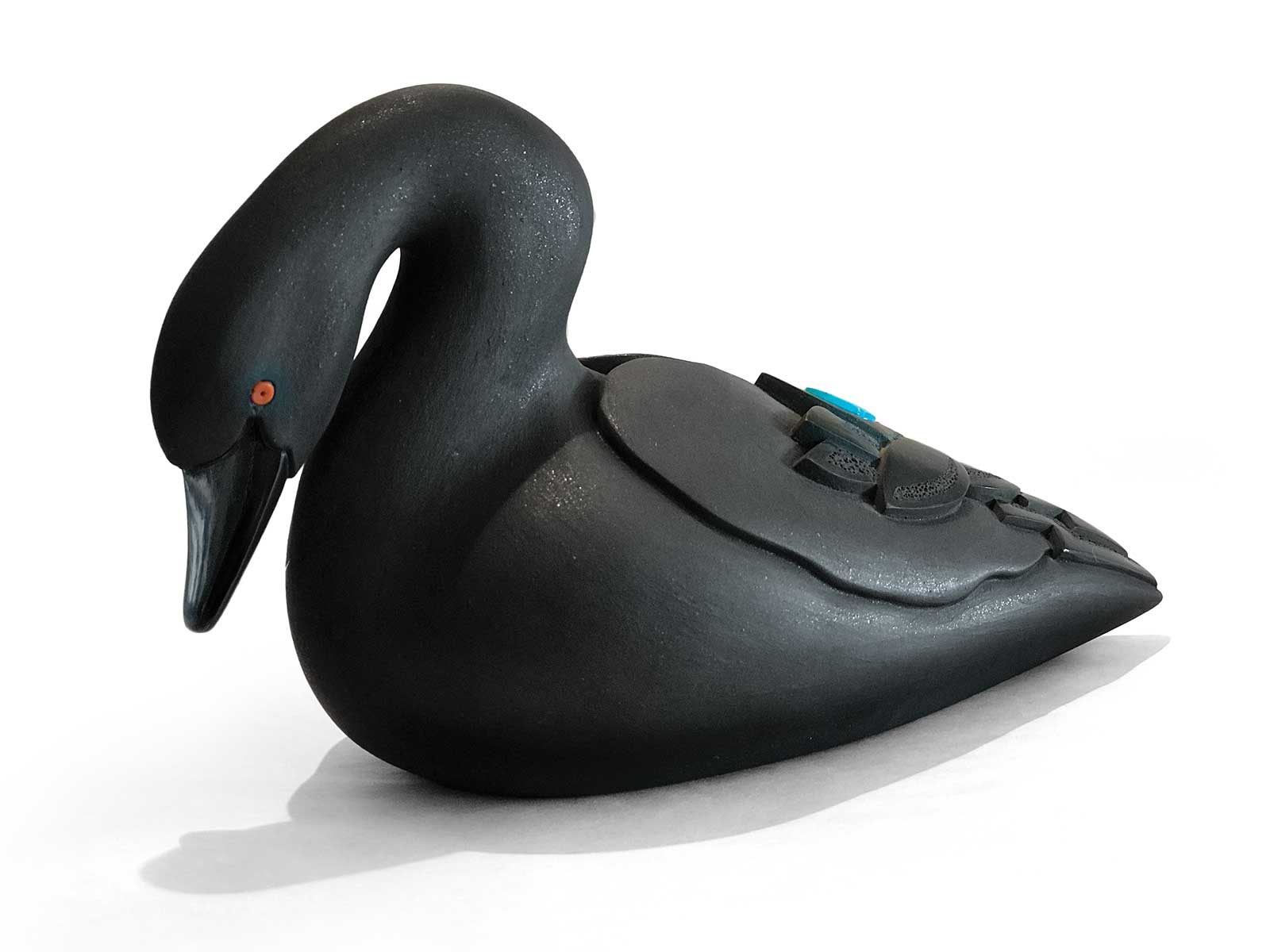 Autumn Borts-Medlock (Santa Clara Pueblo), Black Swan, excised and pit-fired traditional clay with red coral bead eye and Robin Egg turquoise stone on back, 5¾ x 4¾ x 9¾”. Photo by Wiz Allred.
That dream became a reality in 1993 when Tammy won a fellowship from SWAIA that provided her with a booth and award money, most of which she spent on purchasing books about Southwest pottery. In 1994, she entered Indian Market again, but this time won a large pottery award for a fired black vessel with a Kokopelli design. When Autumn began to show her work at SWAIA in 2001, she did so independently. However, after their grandmother Mary and aunt Joy retired, she started sharing a booth with her mom. It was not until 2017 that the sisters, along with Autumn’s daughter Rochelle, began sharing space. This year, at the centennial celebration, visitors can find all three artists at booth PLZ 22 in the Santa Fe Plaza. All together their work represents five generations of family members who have participated in this highly coveted event. For Autumn, this year feels like she is coming full circle with her sister: “We learned our craft together at the pueblo, went on to do our own thing for a few decades, then here we are working alongside one another again and having a great time at it.”
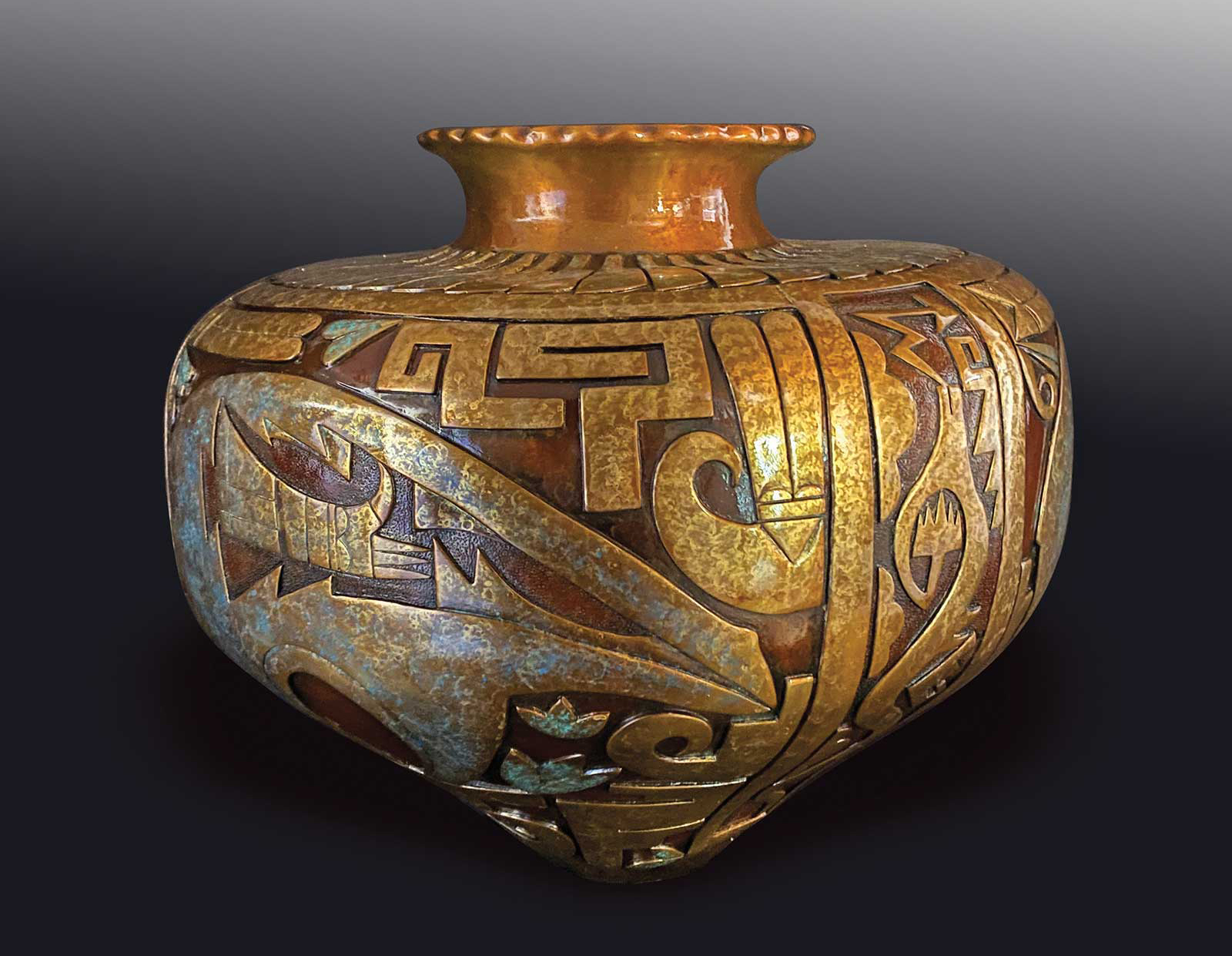 Tammy Garcia (Santa Clara Pueblo), How the West Was One, bronze and hand patina, ed. of 9, 16½ x 14½”. Photo by Wiz Allred.
Tammy echoes her sister’s sentiments, saying, “Being able to share a booth with my sister and her daughter Rochelle is an incredibly rare opportunity. And we can assist one another. A show like this is a lot of work, but we have the best time together.”
Tammy’s most recent clay works involve layers of stacked designs that are separated by stippling the surface with a pointed wood tool. Over the last several years, she has featured Native women carrying pottery with surrounding floral frames. Tammy has also worked with other materials, like bronze and glass. “Each medium offers something different, like color choices, being opaque or transparent. Bronze has the strength and durability to push boundaries,” Tammy says.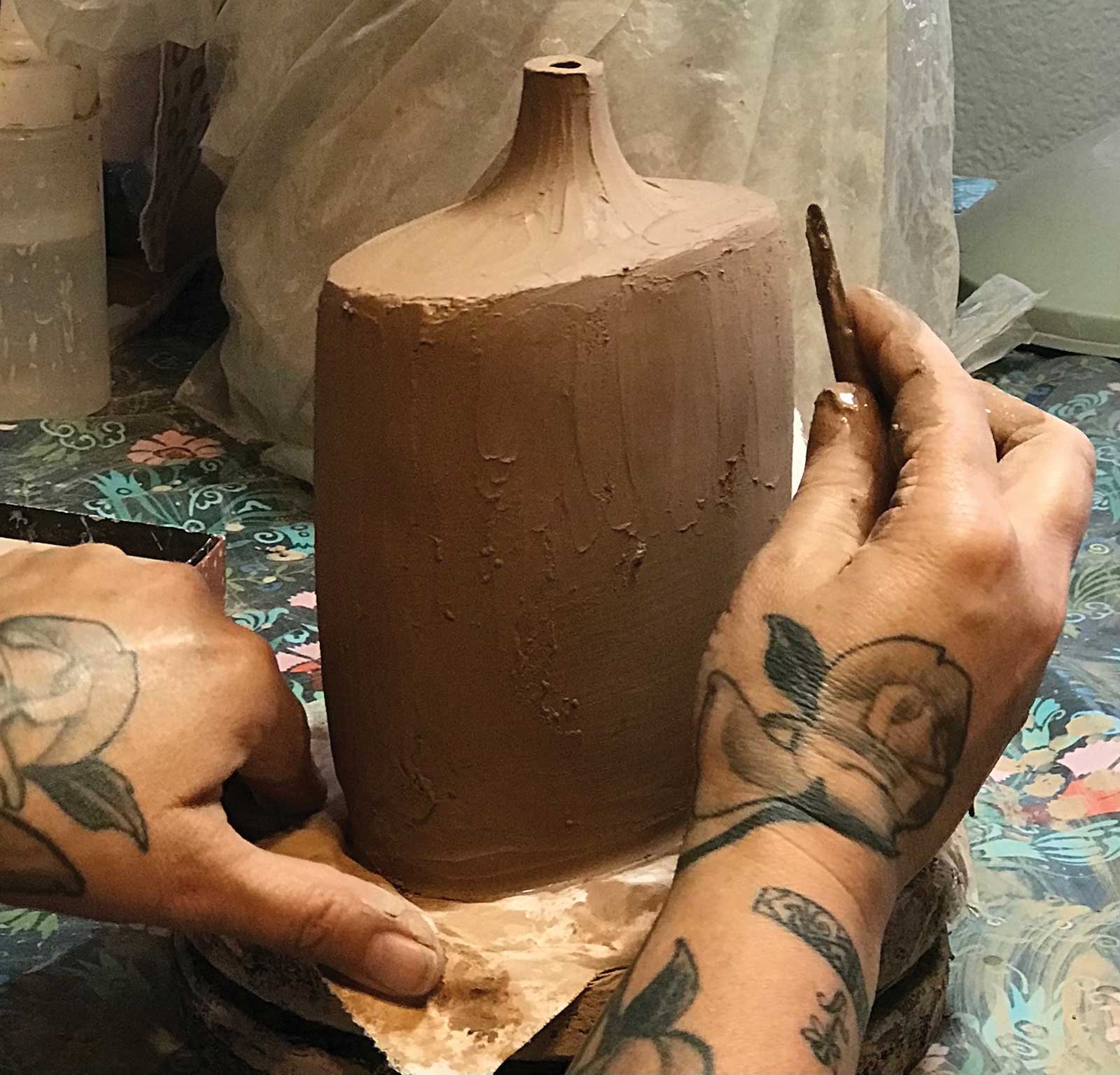 Tammy Garcia creates the shape of a new pot. Photo by Autumn Borts-Medlock.
For similar reasons, Autumn has found herself using bronze in some of her most recent works. But she is more concerned with moving away from perfectly symmetrical vessels. “This year and last, I have been making work that is a bit more sculptural,” she says. “Although I have done this kind of work in the past, I am now elaborating on it.”
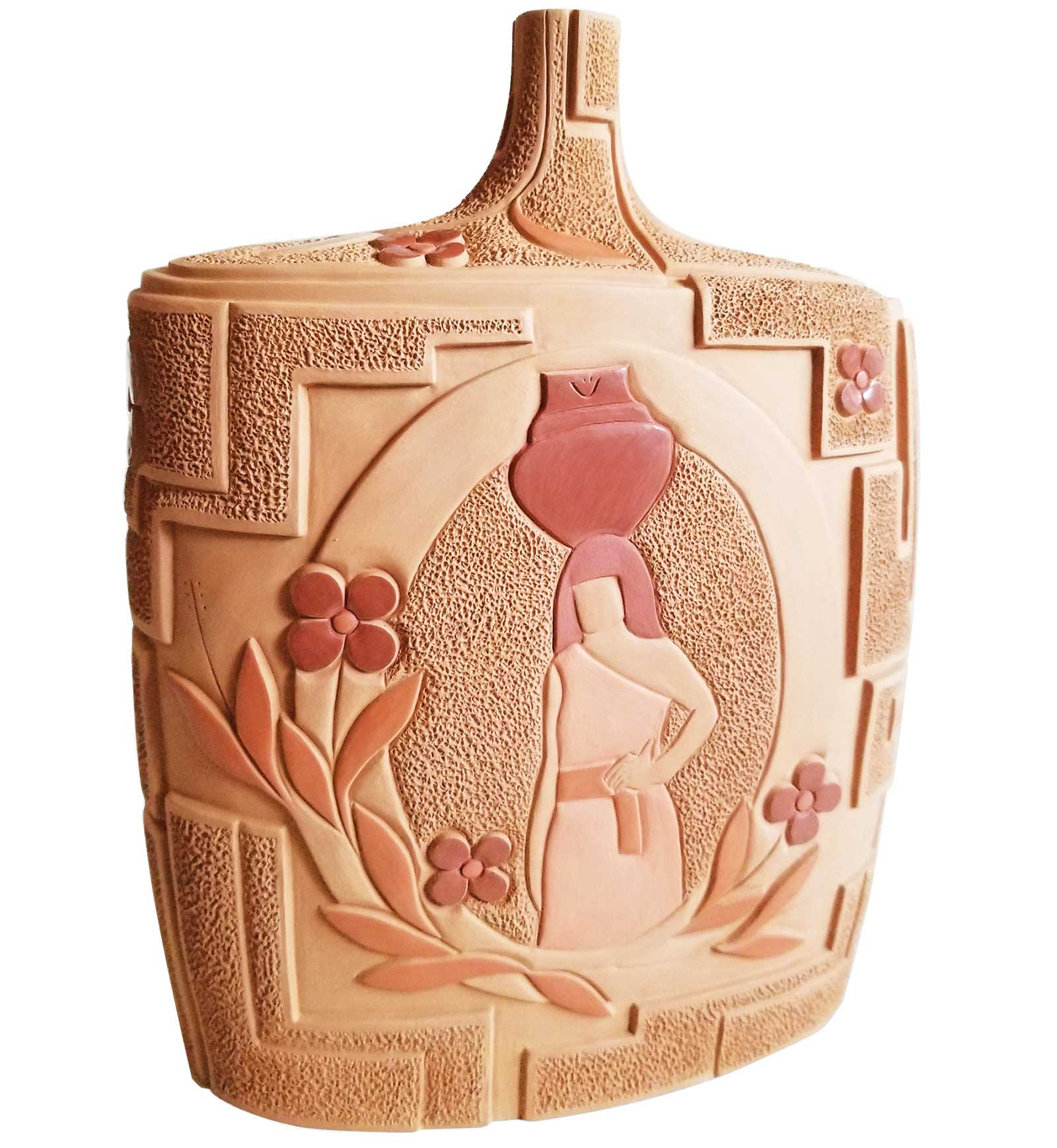 Tammy Garcia (Santa Clara Pueblo), Untitled, excised and pit-fired traditional clay, 9 x 7 x 3". Photo by Wiz Allred.
No matter what direction Tammy or Autumn take their artwork, it is apparent that they continue to use the lessons bestowed to them by their ancestors, mother and grandmother. Autumn often reflects on how pottery ties her to ancient traditions when she says pottery “connects me to my ancestors. Knowing that a thousand grandmothers did this before me is amazing…to have been born into this heritage is a gift.” Tammy agrees. “We do not do art just for the sake of doing art,” she says. “We do this to honor our pueblo women, ancestors and the culture that we come from.”
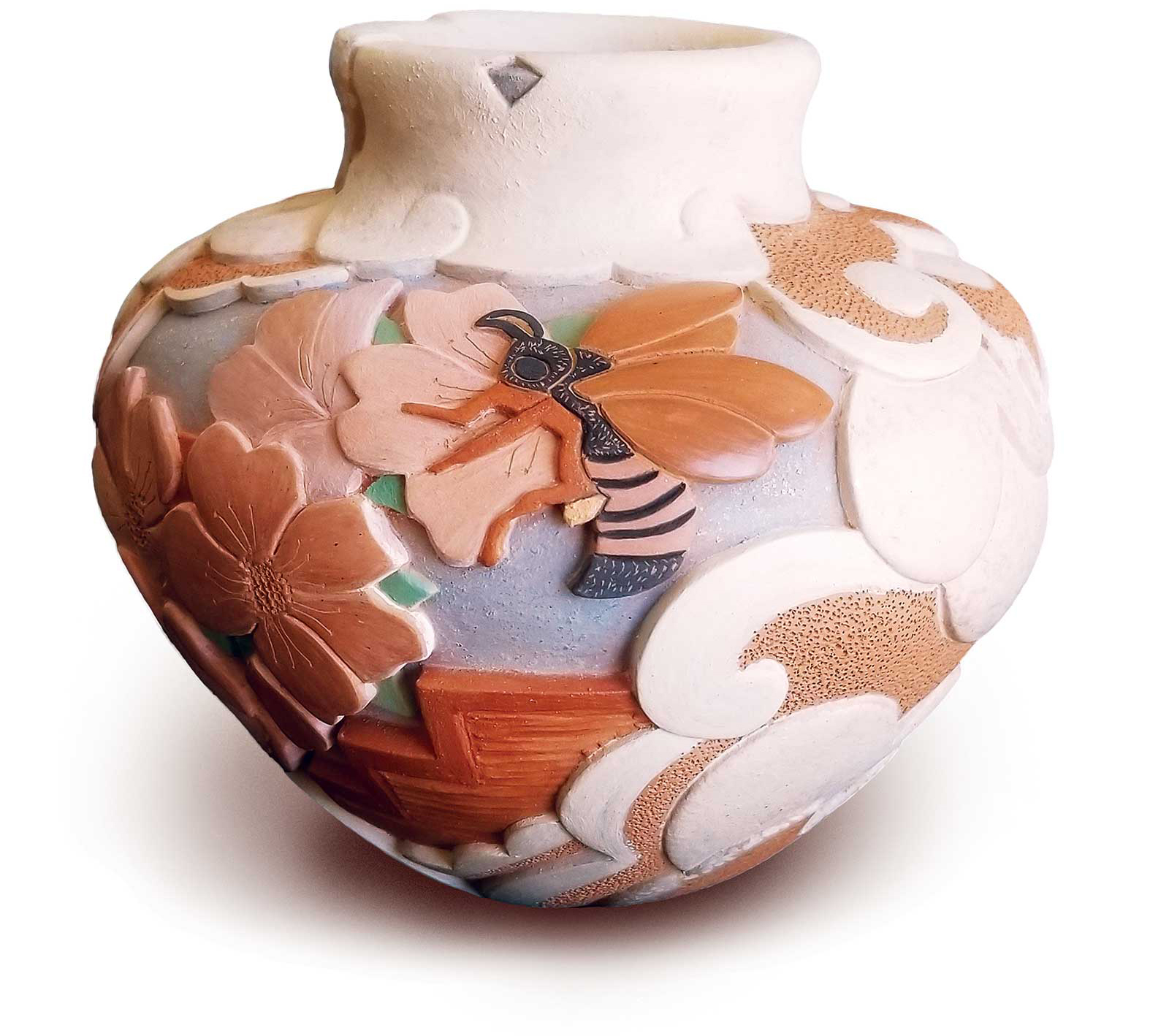 Autumn Borts-Medlock (Santa Clara Pueblo), Bee and Flowers, excised and pit-fired traditional clay, 6¾ x 8”. Photo by Wiz Allred.
So, if you happen to cross paths with Autumn and Tammy at this year’s Indian Market and are maybe even lucky enough to own one of their spectacular pieces, know that you are in the presence of resiliency and prominence. Their work is not only beautiful to look at but is also adorned with the kind of love that transcends time and place.
Powered by Froala Editor