A favorite quote of mine comes from the end of E.M. Forster’s novel, Howards End. It is “Only connect…” Lambert Wilson and his partner Jenny Holland follow that advice in their lives and in their collecting.
Visiting Santa Fe Indian Market for the first time in 2012, they met Alvina Yepa, a potter from Jemez Pueblo. Through her they met her family and other artists at Jemez. “Getting to know the artists is a very important part of my collecting,” Lambert explains. “It makes everything more real. I like to have that connection.”
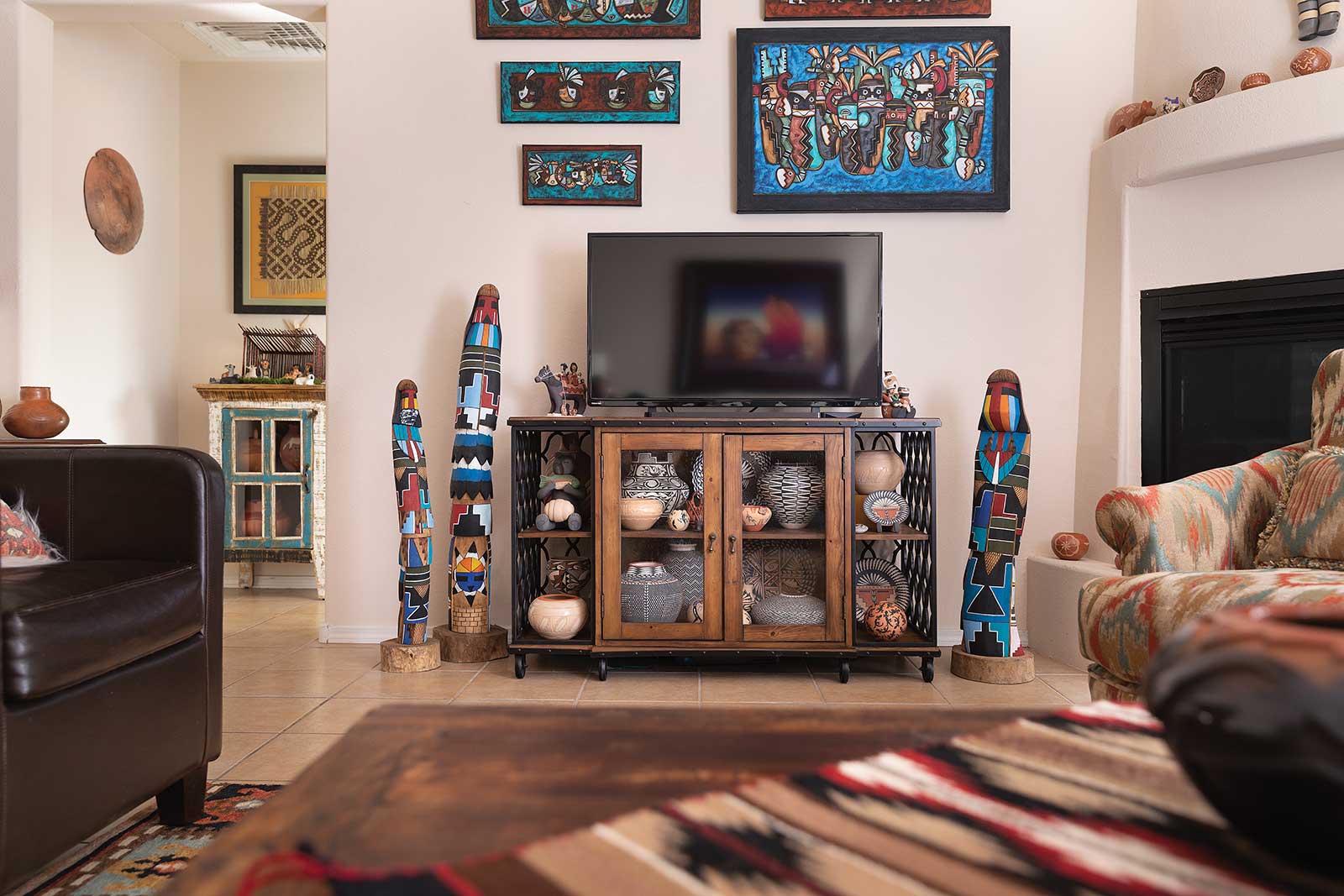 The paintings are by Kevin Horace-Quannie (Hopi, Navajo). On either side of the cabinet are totems by Jerry Guy (Hopi).
They had come to Santa Fe from their home in North Carolina with friends and stayed at a hotel. On subsequent visits they came with more friends and rented a house. Wanting to come to town more often, they decided to buy their own home.
They had bought a bronze sculpture, Indian Dancer, by Joe Cajero (Jemez) at the market. “When we were looking for a house in Santa Fe,” he says, “I called Joe to ask who I should have as a realtor. He recommended his sister, Joetta, who is a real estate agent…and we found our house. When we needed work done on the house, Joetta’s husband did the work.”
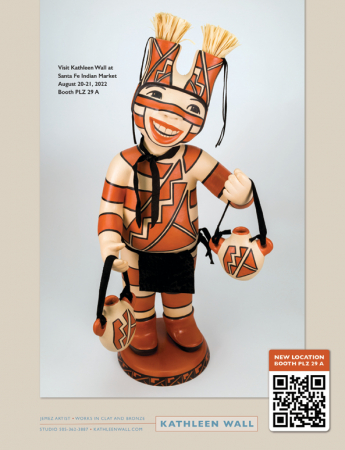
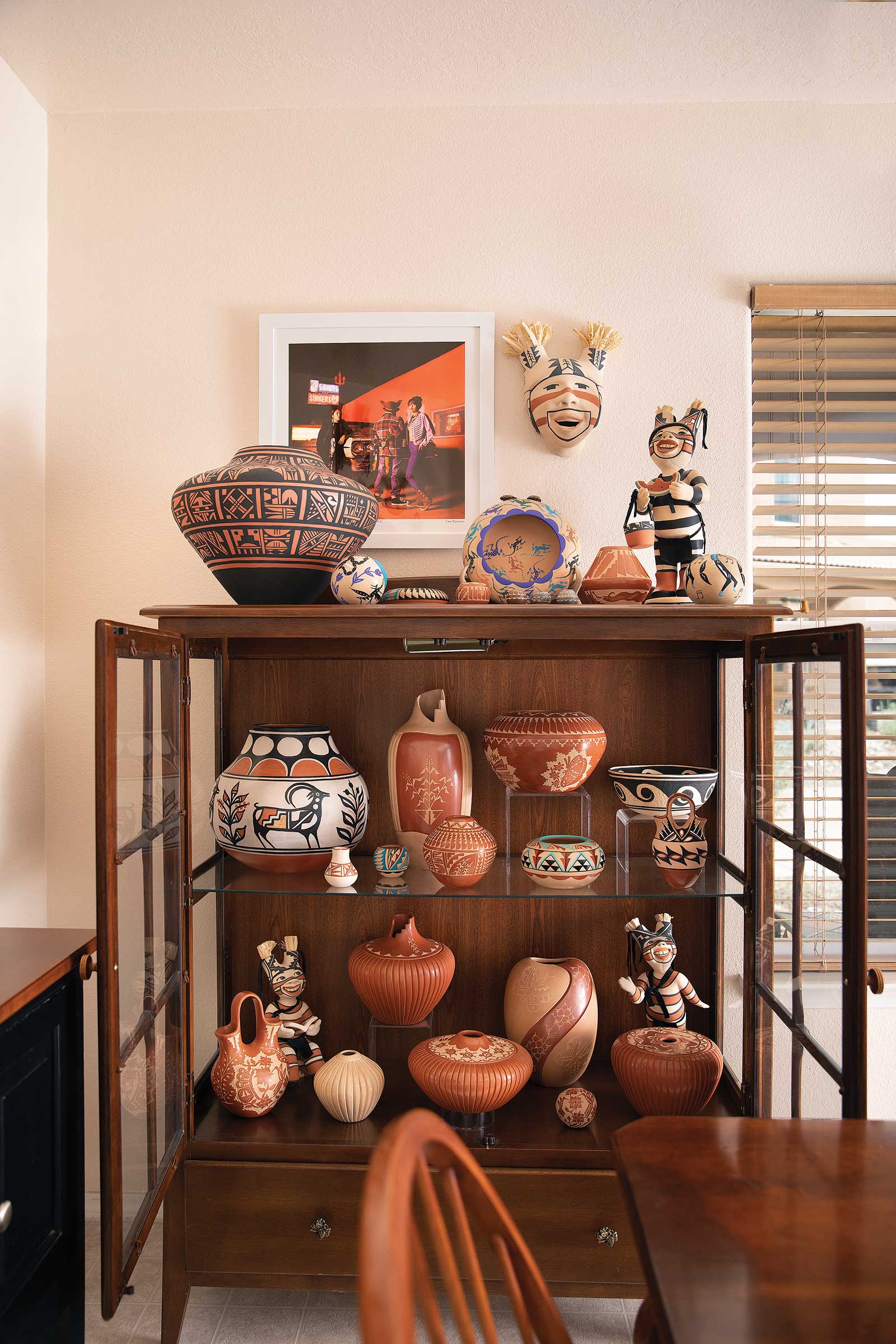 Coyote Tales No. 1 by Cara Romero (Chemehuevi) hangs above the cabinet next to a Koshare Mask by Marcus Wall (Jemez). The large pot is by Joseph and Nona Latoma (San Felipe/Zuni). The three Koshares are by Kathleen Wall (Jemez). On the top shelf in the cabinet are, left to right, a deer pot by Robert Tenorio (Kewa), a tall pot by Marcella Yepa (Jemez/Chickasaw), an etched red pot and small pots by Lawrence Yepa (Jemez) and a black-and-white wave pot by Thomas Tenorio (Santo Domingo). On the bottom shelf are pieces by Alvina Yepa (Jemez) and a tall pot by Marcella Yepa (Jemez).
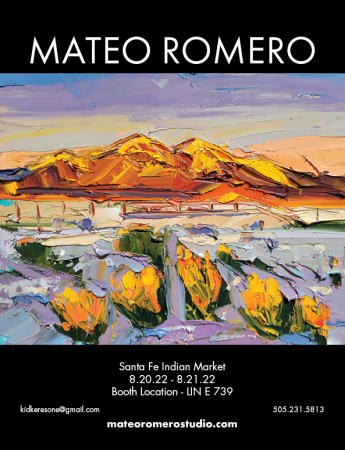
They also bought a painting of an Indian dancer by Mateo Romero (Cochiti) because they thought it went well with Joe Cajero’s sculpture.
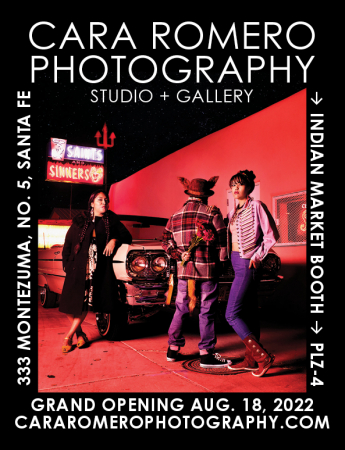
Much later they saw photographs by Cara Romero (Chemehuevi) in Native American Art magazine and, captivated by them, bought several including one titled Naomi—which was his grandmother’s name. Cara, it turns out, is married to Diego Romero, Mateo’s brother.
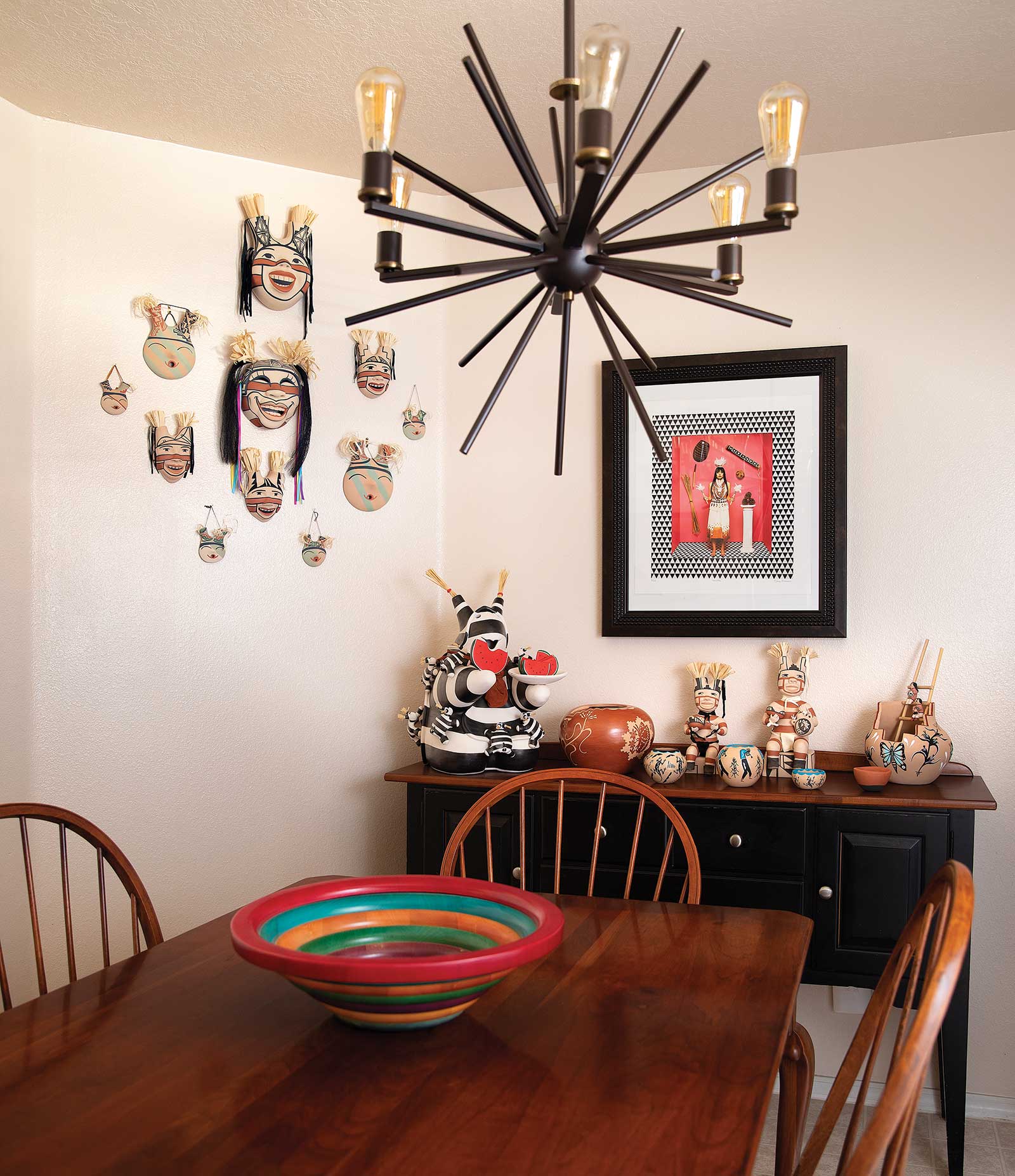 Naomi, a photograph by Cara Romero (Chemehuevi) hangs above the sideboard. The large clay figure on the sideboard is by Randy Chitto (Mississippi Choctaw). The large red pot is by Lawrence Yepa (Jemez). The two Koshares are by Marcus Wall, Jemez. The kiva pot with ladder is by Ester Cajero (Jemez). The large masks are by Kathleen Wall and Fannie Lucero.
Southwest Native art was new to Lambert when he came to Indian Market. His collecting interest had been piqued by Rodney L. Leftwich’s book Arts and Crafts of the Cherokee. “My interest in Native American art came from my fear that the Eastern Band of Cherokee Indians was going to lose their art. People don’t have to rely on their art like they used to. It’s said that if you lose your language you lose your culture. I think if you lose your art you lose your culture.”
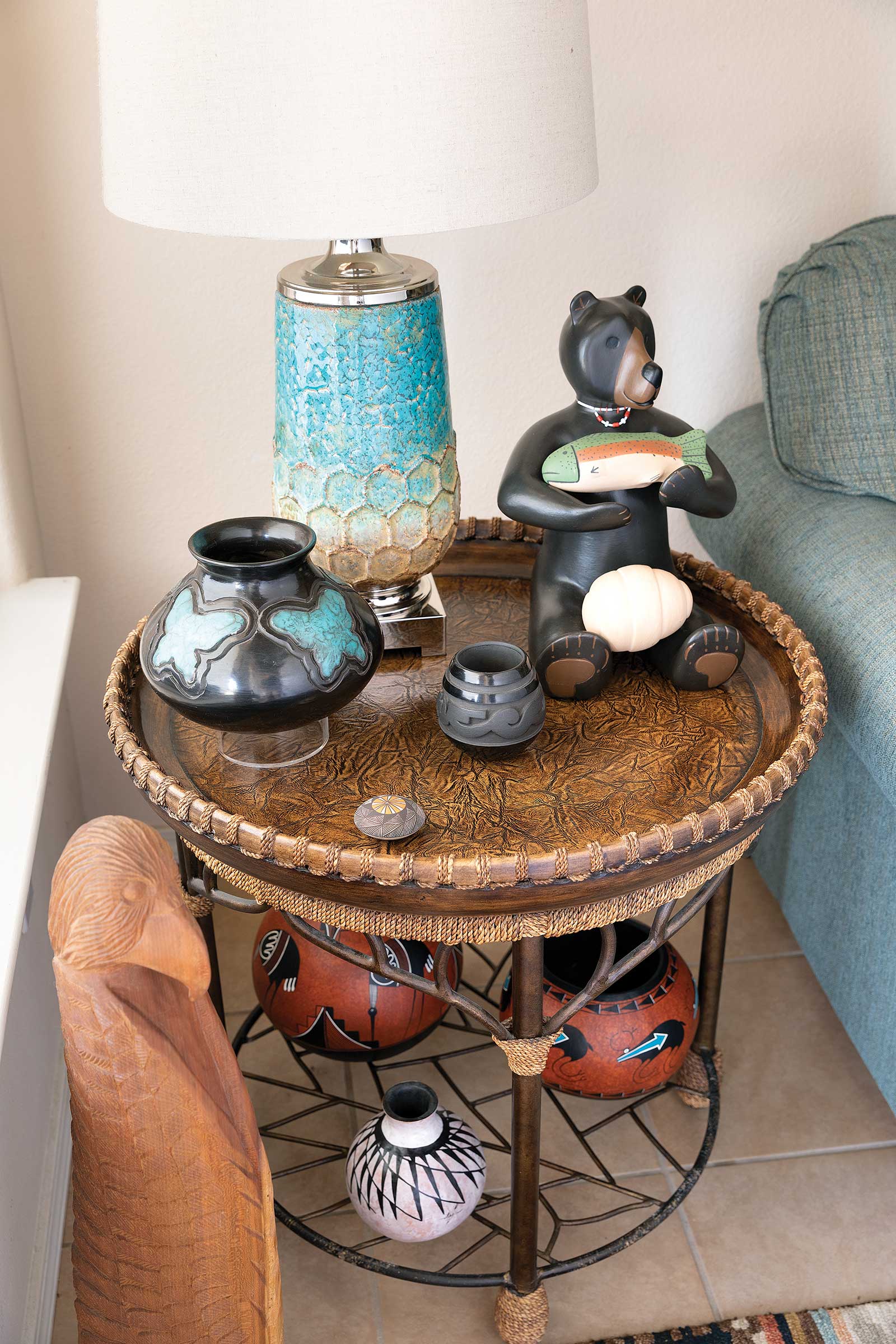 The butterfly pot on the side table is by Joel Queen (Eastern Band of Cherokee Indians). The bear is by Marcus Wall (Jemez). The small black pot is by Marvin Moquino (Santa Clara).
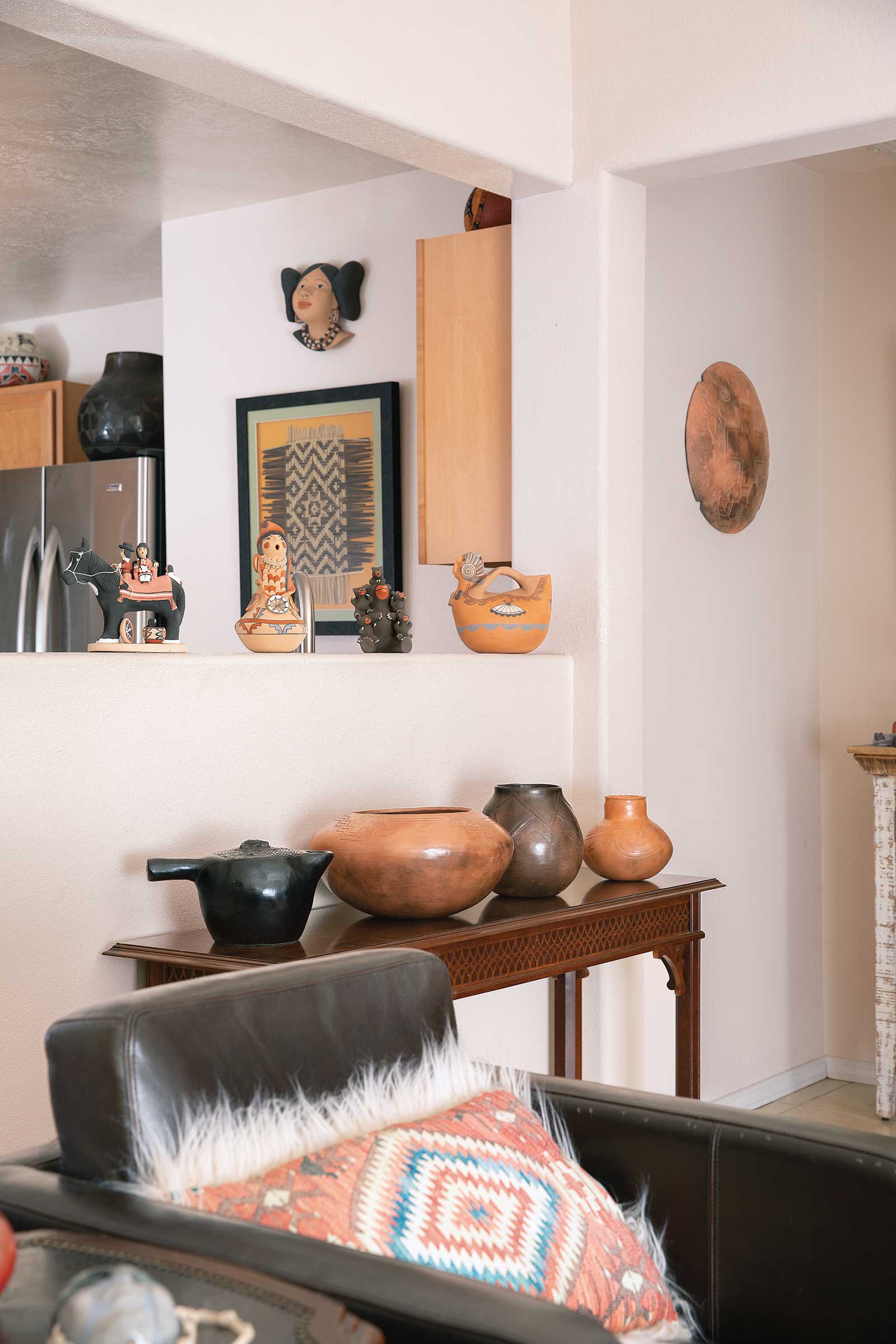 The framed river cane mat is by Joely Queen (Eastern Band of Cherokee Indians). The mask above it is by Kathleen Wall (Jemez). A pottery shield by Jane Osti (Cherokee) hangs on the far wall. On the table are a black pottery water pipe by Paulette Smart (Eastern Band of Cherokee Indians) next to two pots by Lily Vann (Cherokee Nation).
Lambert received degrees in education and administration and served as principal of a school just off the Cherokee reservation. Children could choose to attend either the Cherokee school or a state school. A federal grant provided to state schools with Native students enabled him to bring in Emma Squirrel Taylor (1920-2002) who “taught basketry, pottery and a little beadwork,” he says.
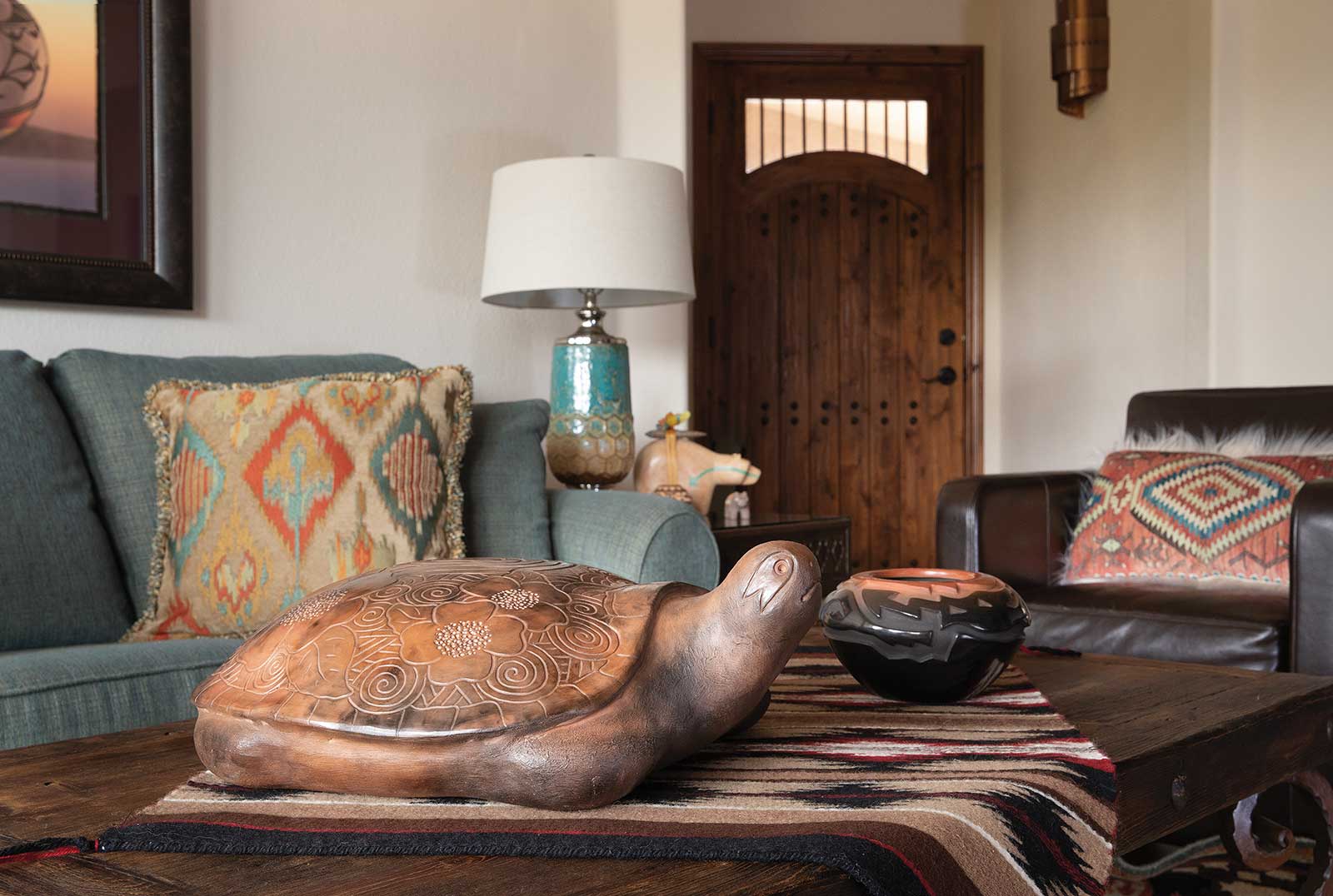 The pottery turtle is by Jane Osti (Cherokee Nation). The pot is by Gwen Tafoya (Santa Clara).
He wants to share his art and lends pieces to exhibitions as well as to the U.S. Department of State’s Art in Embassies program. When a friend who was ambassador to Tanzania wanted some pieces from his collection for the embassy, Lambert included a river cane mat by Joely Queen (Eastern Band of the Cherokee Indians). She was a student in a school where Lambert was the principal. She made the mat to enter in a student art competition. Disappointed that she didn’t win a prize, she gave the mat to Lambert. Jenny had commissioned additional mats for use as place mats but decided they were too beautiful and they had them framed. “I wanted Joely to know that even though her mat didn’t win a prize, it didn’t mean it wasn’t a nice piece of art.” Joely has since gone on to win prizes at the Cherokee Art Market in Tulsa, Oklahoma, and the Cherokee Fall Festival in Cherokee, North Carolina.
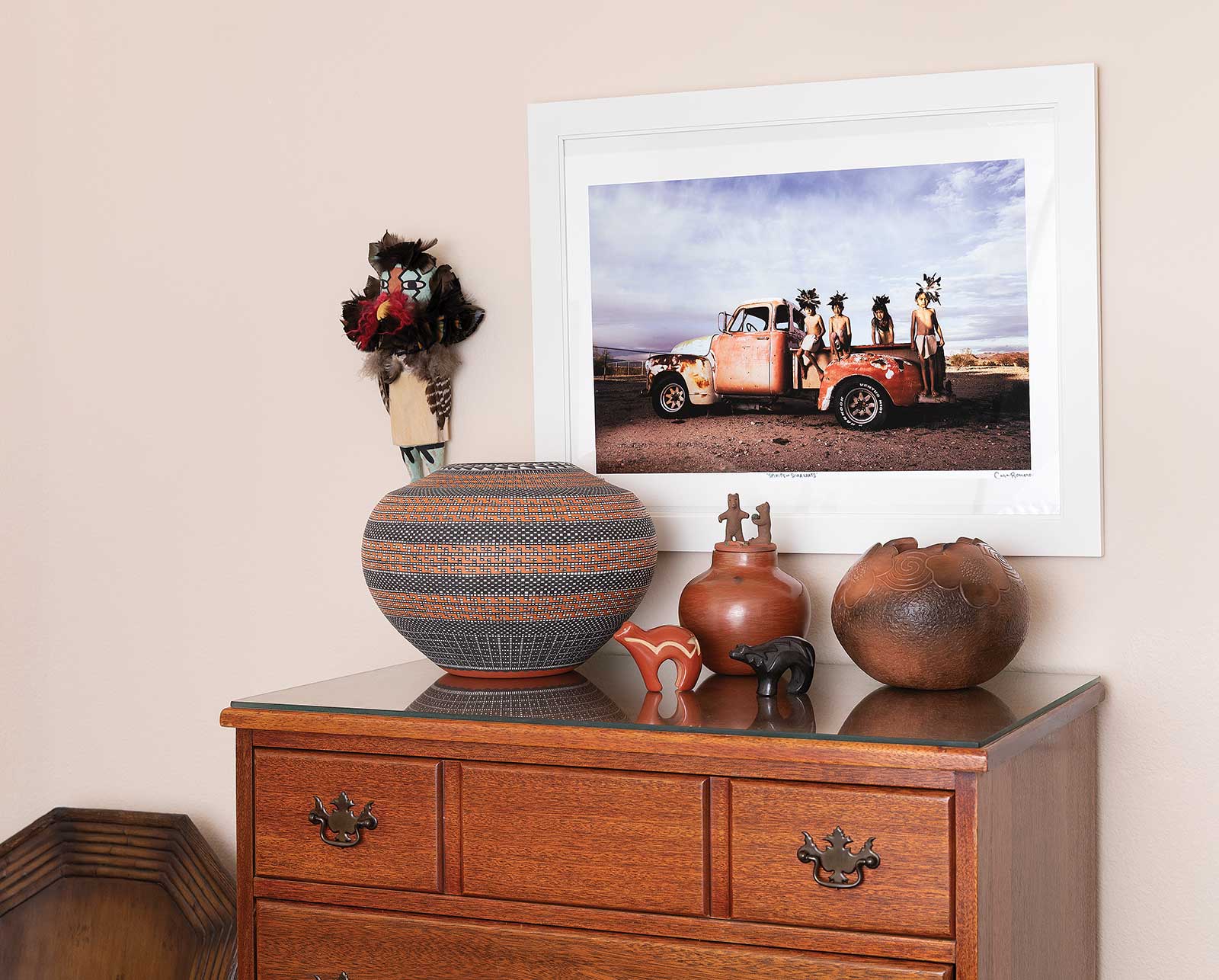 The photograph is Spirits of Siwavaats by Cara Romero (Chemehuevi). Next to it is a katsina by Randy Brokeshoulder (Hopi/Navajo/Shawnee). On top of the dresser are, left to right, a large pot by M.C. Antonio (Acoma), a covered pot by Marcus Wall (Jemez) and a pot by Jane Osti (Cherokee Nation).
His interest extends beyond individual artists. He is a member of the board of the Museum of the Cherokee Indian where his nephew, Evan Mathis, is director of collections and exhibitions. His has also opened the Queen House Gallery in Cherokee, primarily to support younger Cherokee artists as well as artists from tribes across the country.
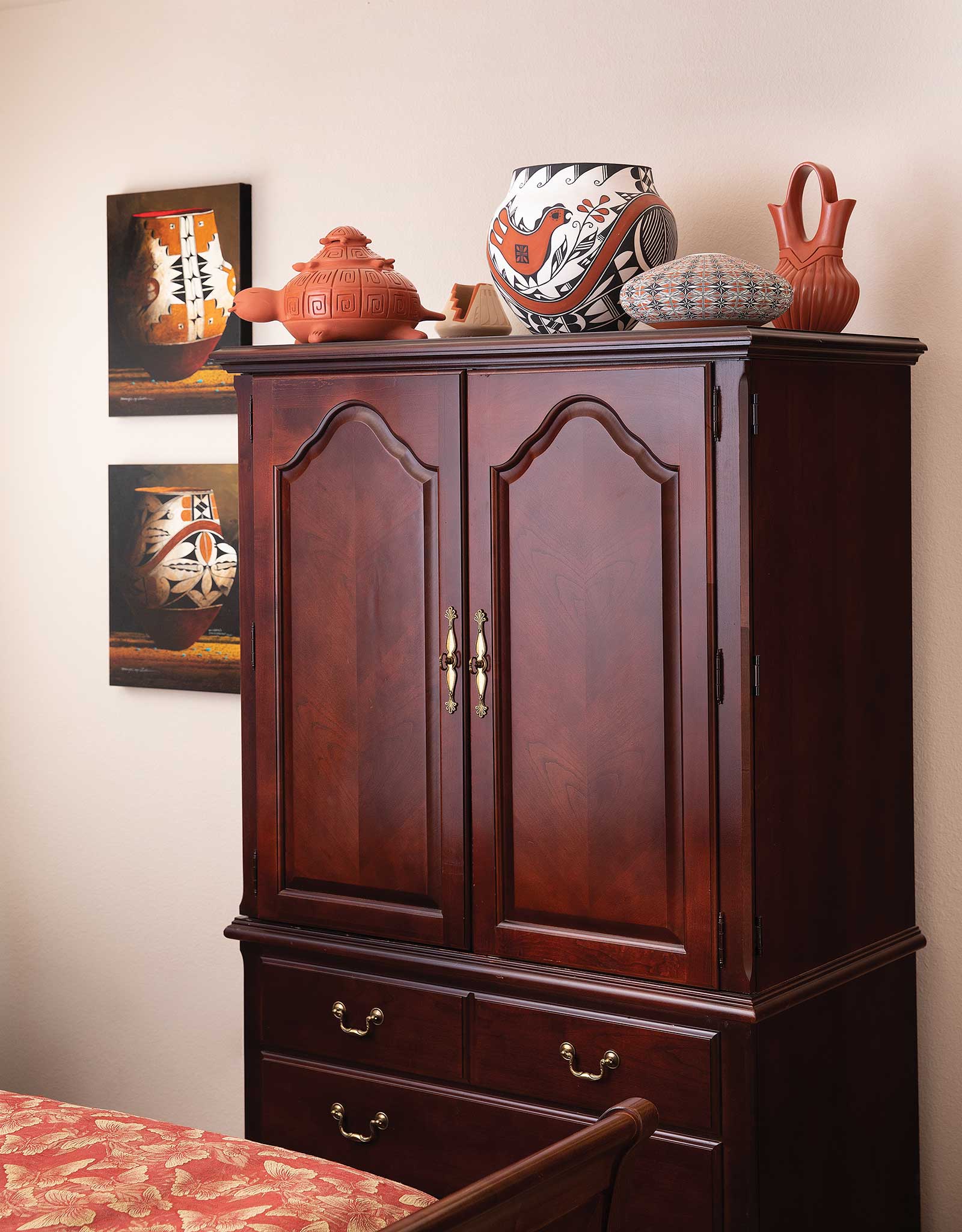 Above left: The pueblo pottery paintings are by Michael McCullough (Choctaw). On top of the cabinet are, left to right, a turtle pot by Marcella Yepa (Jemez/Chickasaw), a small unsigned fine line Acoma pot, a large Acoma bird pot by Antonio and a wedding vase by Marcella Yepa.
His interest in youth also extends to collecting paintings with children in them and collecting art created by children. At Santa Fe Indian Market he has bought paintings by Nocona Burgess (Comanche) as well as by Nocona’s 13-year-old son Quahada who goes by Q. “It’s thrilling that those kids are carrying on that tradition,” Lambert comments.
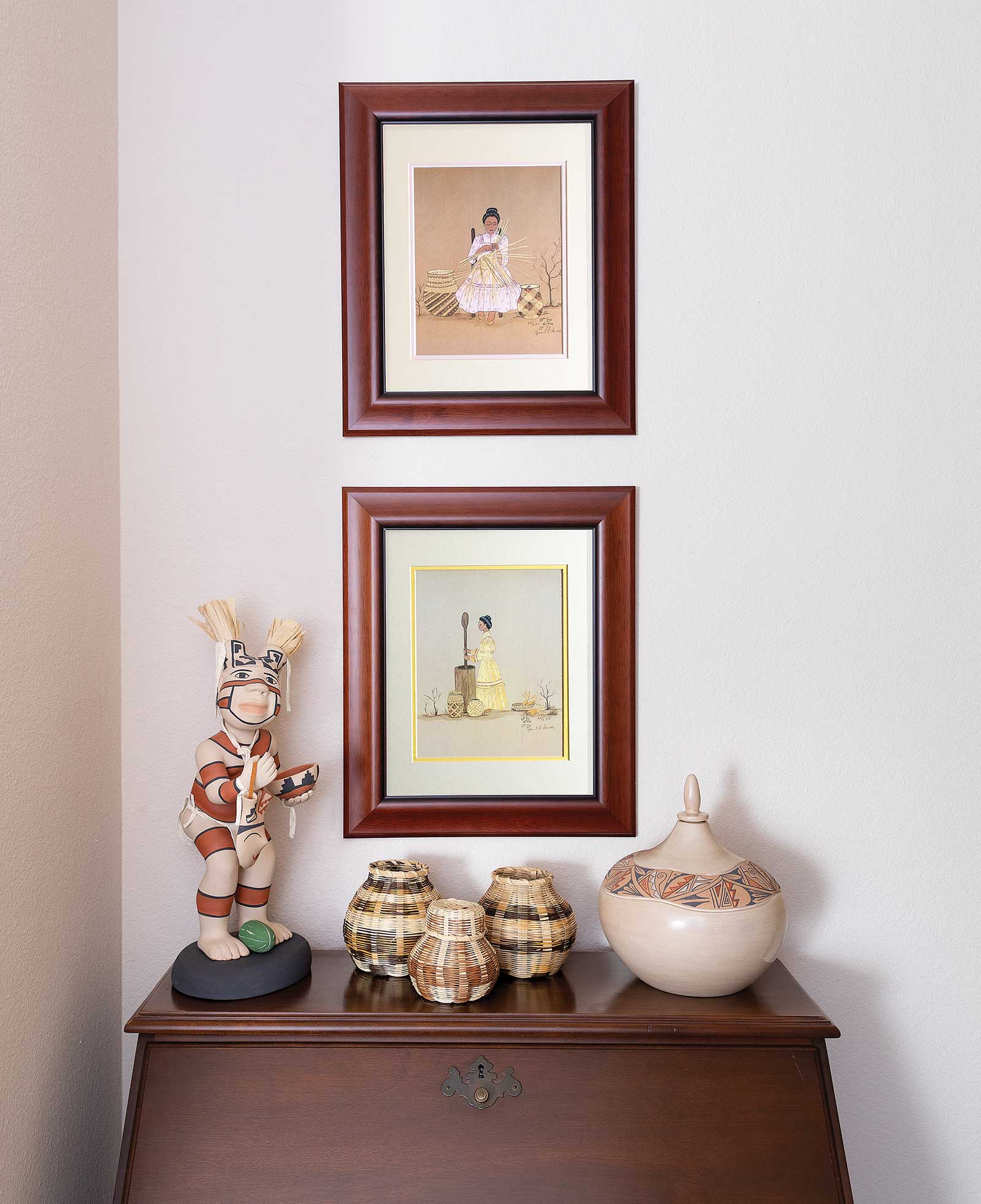 Above right: The Cherokee Maiden prints are by Janet Smith (Cherokee Nation). On the desk are, left to right, a Koshare by Marcus Wall (Jemez), three honeysuckle baskets by Megan Wachacha (Eastern Band of Cherokee Indians) and a covered pot by Marcella Yepa (Jemez/Chickasaw).
Another theme seems to be turtles. “Jane Osti (Cherokee) is a friend and we became interested in her turtles. We have five of them and knew we needed to have one of them, Matilda, in Santa Fe. Turtles are a sign of longevity. We also bought a turtle pot by Marcella Yepa at the Cherokee Art Market. Although we had already bought it, Marcella wanted to enter it in a competition—and she won a prize.
“I just can’t imagine living without art,”
he comments.
Powered by Froala Editor