Mined from earth and animals, carved, cast, chipped and polished, Native American jewelry has a history and a story to tell as rich as the ages. Crafted by Indigenous artists for thousands of years, jewelry has served many purposes. Influenced by the very land itself, spiritual beliefs, legends, and cultures, it has been crafted since the earliest days of the Inca, Aztecs, Maya and Anasazi.
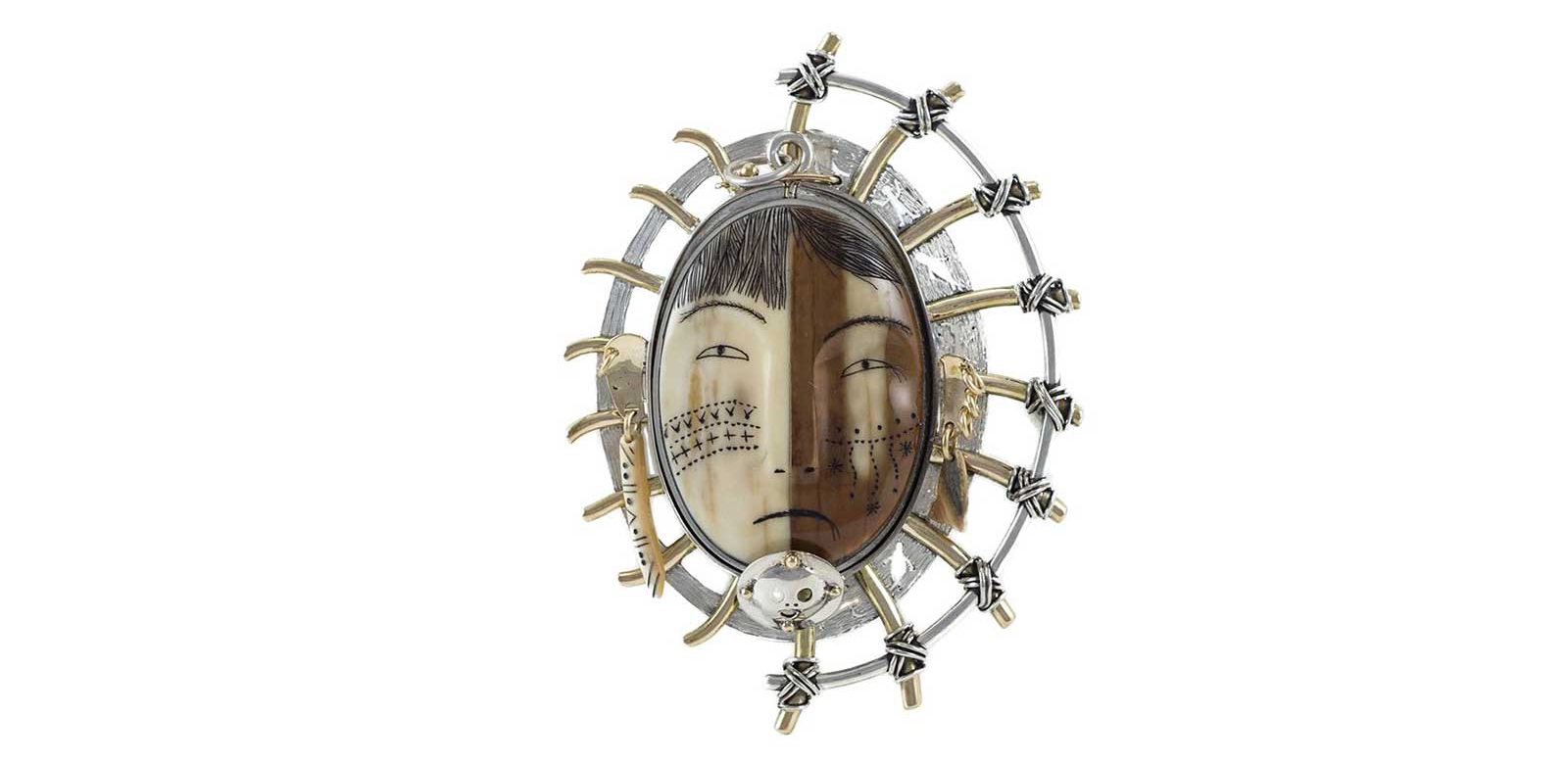 Denise Wallace (Native Village of Tatitlek), Woman of Ages, pin pendant, sterling silver, 14k gold and fossil walrus ivory
As early as 10,000 B.C. people used antlers, bones, porcupine quills, shells, stones and feathers in their creations. As nations progressed, jewelry became more complex with animal teeth, mined turquoise and silver, smelted copper, semi-precious stones, carved local wood, animal claws, pearls and abalone shells. For nomadic tribes wealth had to be portable, so jewelry became a wearable bank, depicting rank and social class.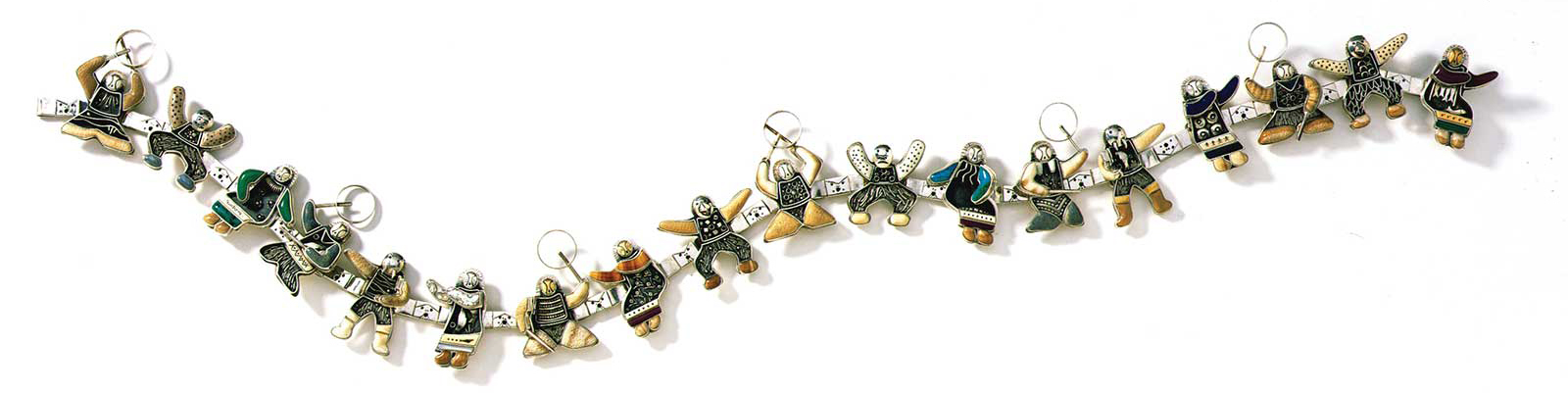 Denise Wallace (Native Village of Tatitlek), King Island Dancer, sterling, fossil ivory, silicated chrysacolla, chrysoprase, lace agate, moonstone, bruneau jasper, lapis lazuli, spectralite and sugilite, 2½ x 40 x 1½”
The Zuni were the first to incorporate silver in the 1870s, having learned the technique in the 1850s from the Spanish. Soon it was used by the Hopi, Navajo and Apache, making the Southwest the center of advanced jewelry design that tells stories and carries traditions in something as small as a ring or as large as a breastplate. Consistently the most popular art form at Santa Fe Indian Market, the authentic jewelry sold by the artists themselves each has its own unique story, connected to significance and deep cultural meaning.
Some of the top artists at Indian Market bring all of this to their booths.
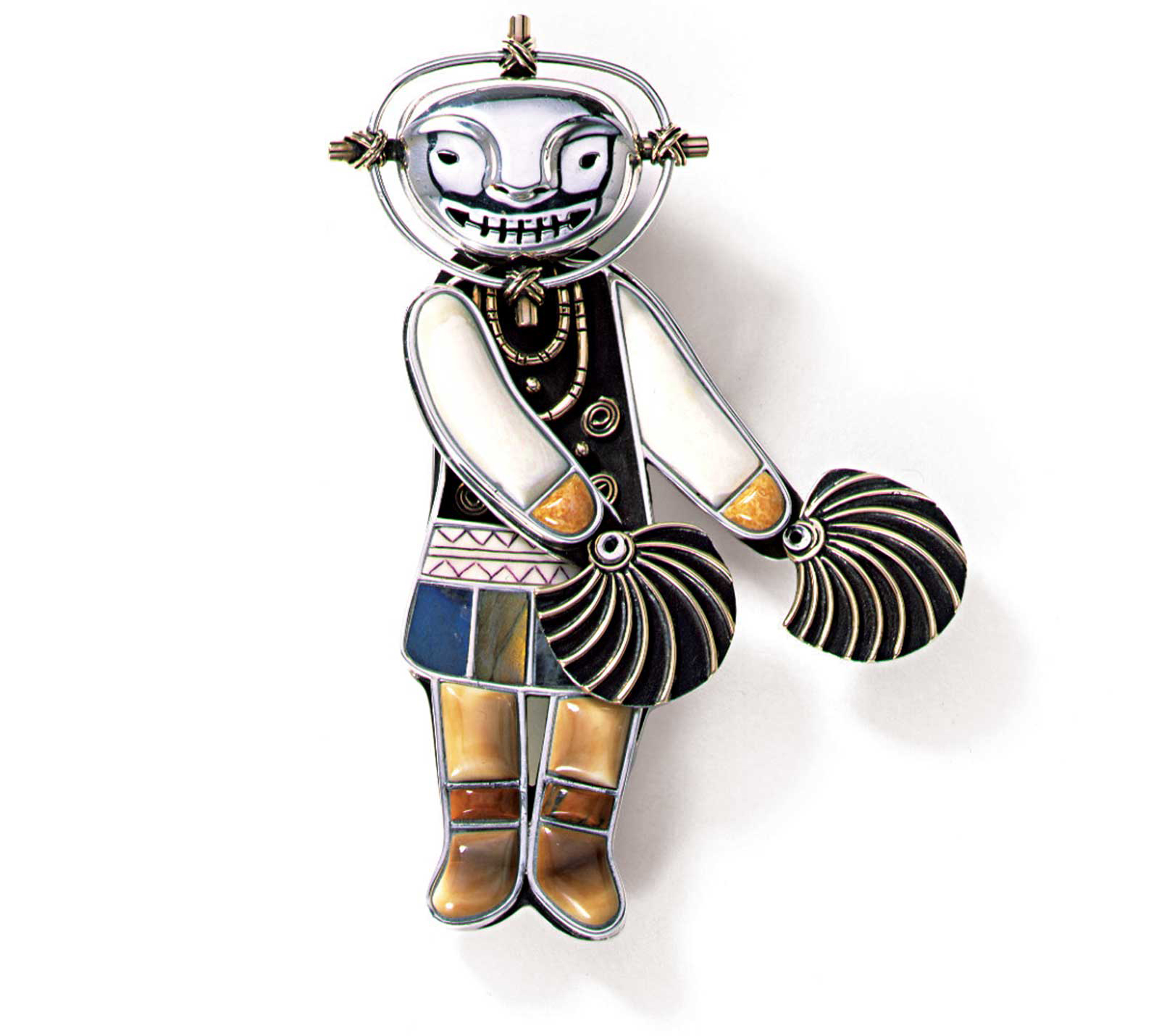 Denise Wallace (Native Village of Tatitlek), Yup’ik Dancer with Large Mask, sterling, 14k gold, fossil ivory, turquoise, petrified whale bone, sugilite, bruneau jasper, moonstone, fire agate, spectralite, petrified palm wood, chrysoprase and silicated chrysacolla,
3½ x 1½”
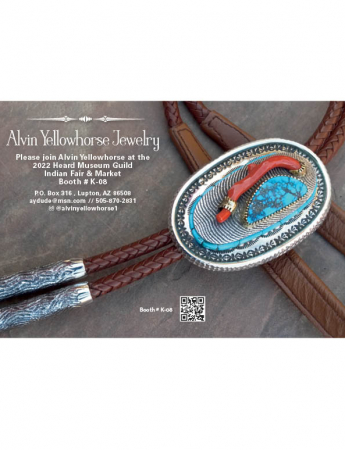
Alvin Yellowhorse describes himself as “a friendly Navajo doing his own thing on the Navajo reservation.” He continues, “I was raised by my father and mother next to Route 66 here in Lupton, Arizona. My dad sold jewelry and rugs for a living along the highway with an old, covered wagon and a few spotted donkeys. It was enough to get the attention of a few that stopped for gas.”
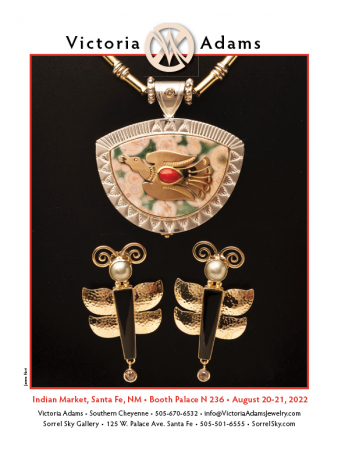
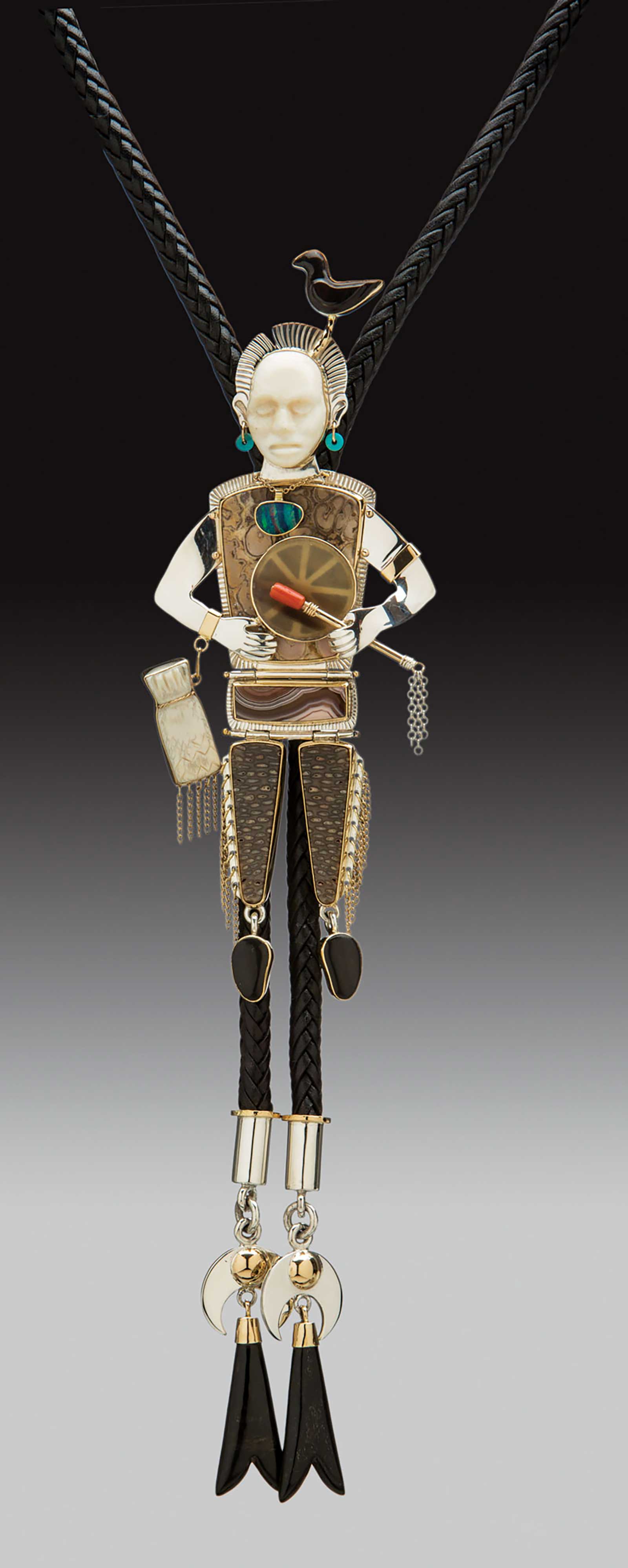 Victoria Adams (Cheyenne/Arapaho), pendant
Yellowhorse’s job was to “help customers up on the old wagon for a few pictures. If there ever was a tour bus pulling off the freeway my dad would yell, ‘Put your headdress on boys and get out there and wave!’ That usually did the trick!”
Yellowhorse has been making jewelry and honing his craft for 35 years.
“Bracelets, bolo ties, belt buckles, pendants and rings seem to be the best sellers,” he says. “Meeting new collectors at different art shows is always the best part. I’m known best for building one-of-a-kind pieces, always pushing myself to create new things. I love the customers reactions when they see something not done before and trying to figure out how it’s made.”
Alaskan jeweler Denise Wallace stands out as she is inspired by her Chugach Aleut ancestors, though she started her training in Santa Fe in the late 1970s.
“I started making jewelry when I was a young adult and continued learning my skills at the Institute of American Indian Arts in the late 1970s to [the] early 1980s,” she says. “My husband was a big inspiration to start making jewelry, as he had a passion for working with stones.”
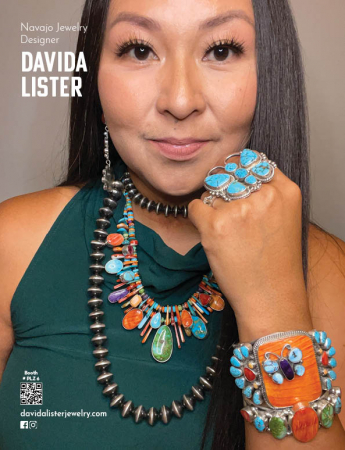
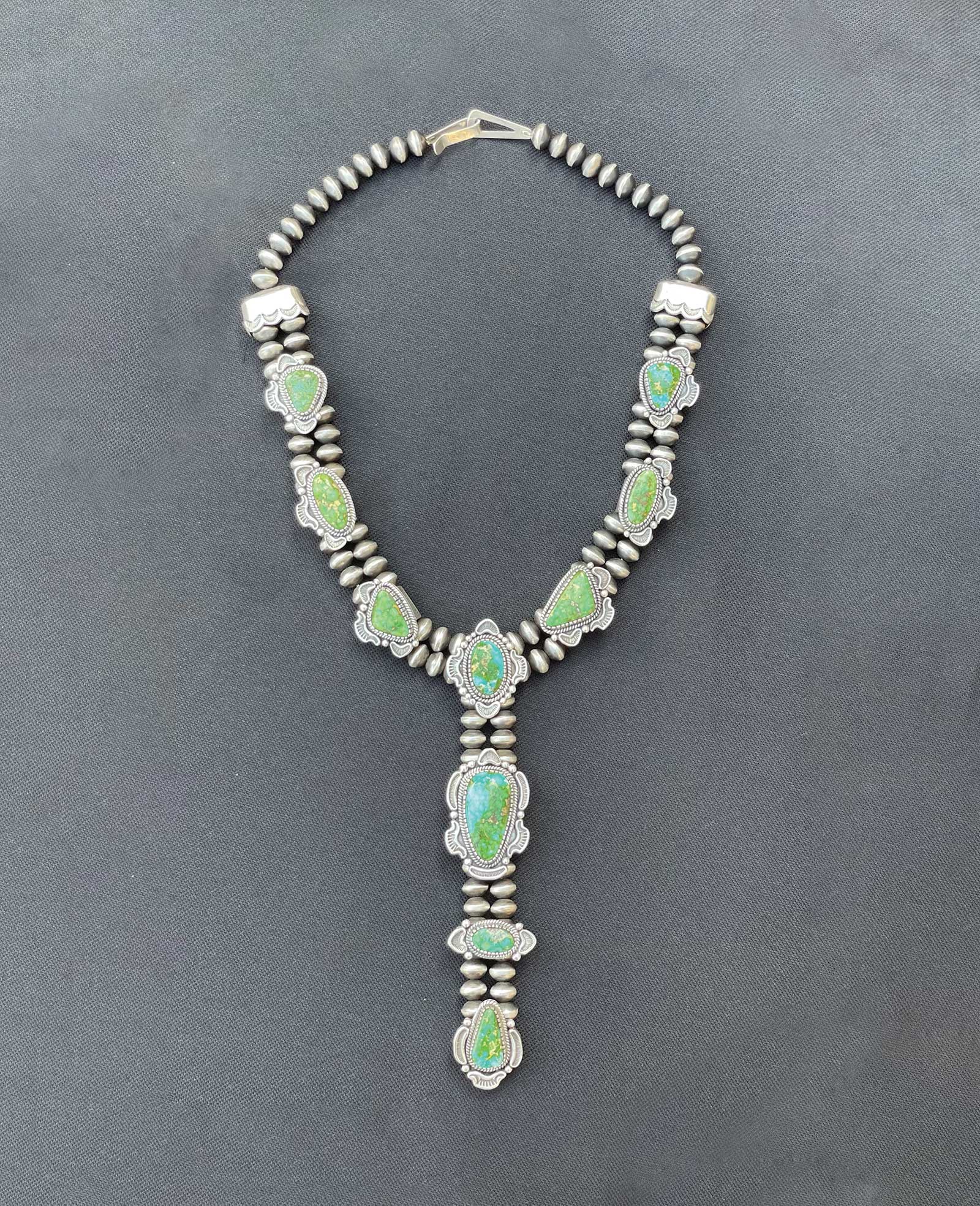 Davida Lister (Navajo (Diné)), silver and turquoise necklace
Swimming seals, toothy walrus and schools of fish figure prominently in her pieces that tell rich tales and share the customs of the Native people of arctic Alaska, stories of healing, growth, nature and transformation. Intricate and playful, she often has tiny locks in her work that open to reveal more secrets. “The transformation aspect is what inspired the doors and hinges on my work,” Wallace says.
Wallace utilizes silver, gold, semiprecious stones and a unique Alaska material—scrimshawed, fossilized ivory—to create belts, earrings, pendants and lockets.
“I think jewelry is definitely one of the items that you can never have enough of. No one ever said, ‘I have too many earrings!’ I am always happy to see my collectors walk up wearing their pieces,” she says. “It’s like seeing my family.
I also like to create pieces that have stories connected to my culture, ancestors and current events. Jewelry connects me with the world because people wear the work and share it all over the world.”
Davida Lister says she began making jewelry when she moved back in with her parents, David and Alice Lister, about 10 years ago. “I was going through some life changes and it brought harmony, love and patience back into to my life,” she says. She creates strong feminine designs with rainbows of coral and multi-colored stones. Butterflies are a recurrent motif, and she uses 14-karat gold and Kingman turquoise.
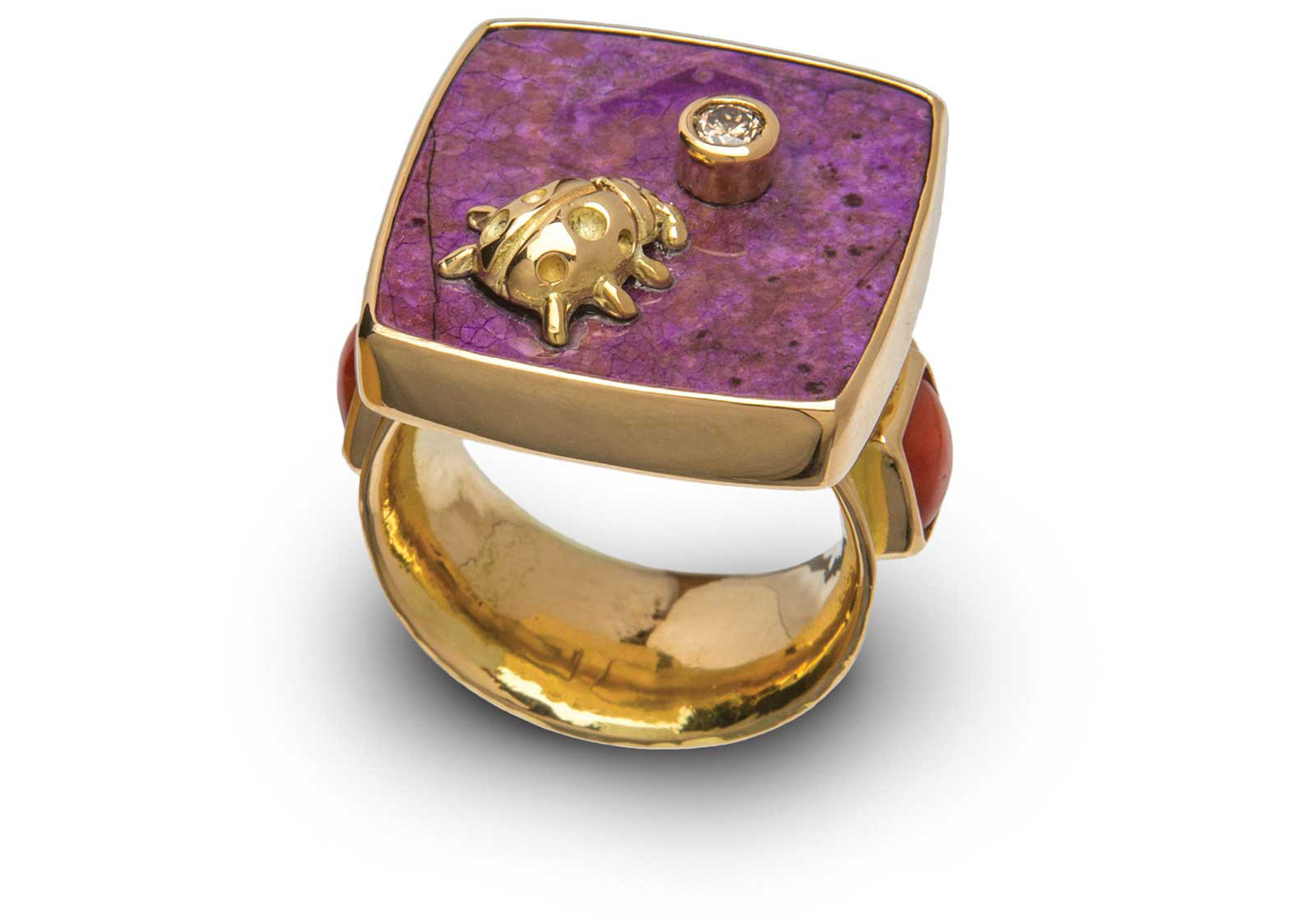 Victoria Adams (Cheyenne/Arapaho), ladybug ring, gold, diamond and stone
“It’s glorious to be able to wake up and be creative with materials that were supplied by Mother Earth,” she says. “Creating jewelry that will soon become sentimental to one of my customers means the world to me.”
Lister believes jewelry becomes sentimental as it becomes associated with special events. “I believe jewelry is the most popular at art shows because you can wear it with you in the most memorable times in your life,” she says.
A rock star jeweler, Navajo Cody Sanderson was raised in Window Rock, Arizona, and now works from his studio in Santa Fe. He started out making jewelry in 1999, learning by experimenting, asking questions about other jewelers’ techniques, and taking classes to learn tufa casting.
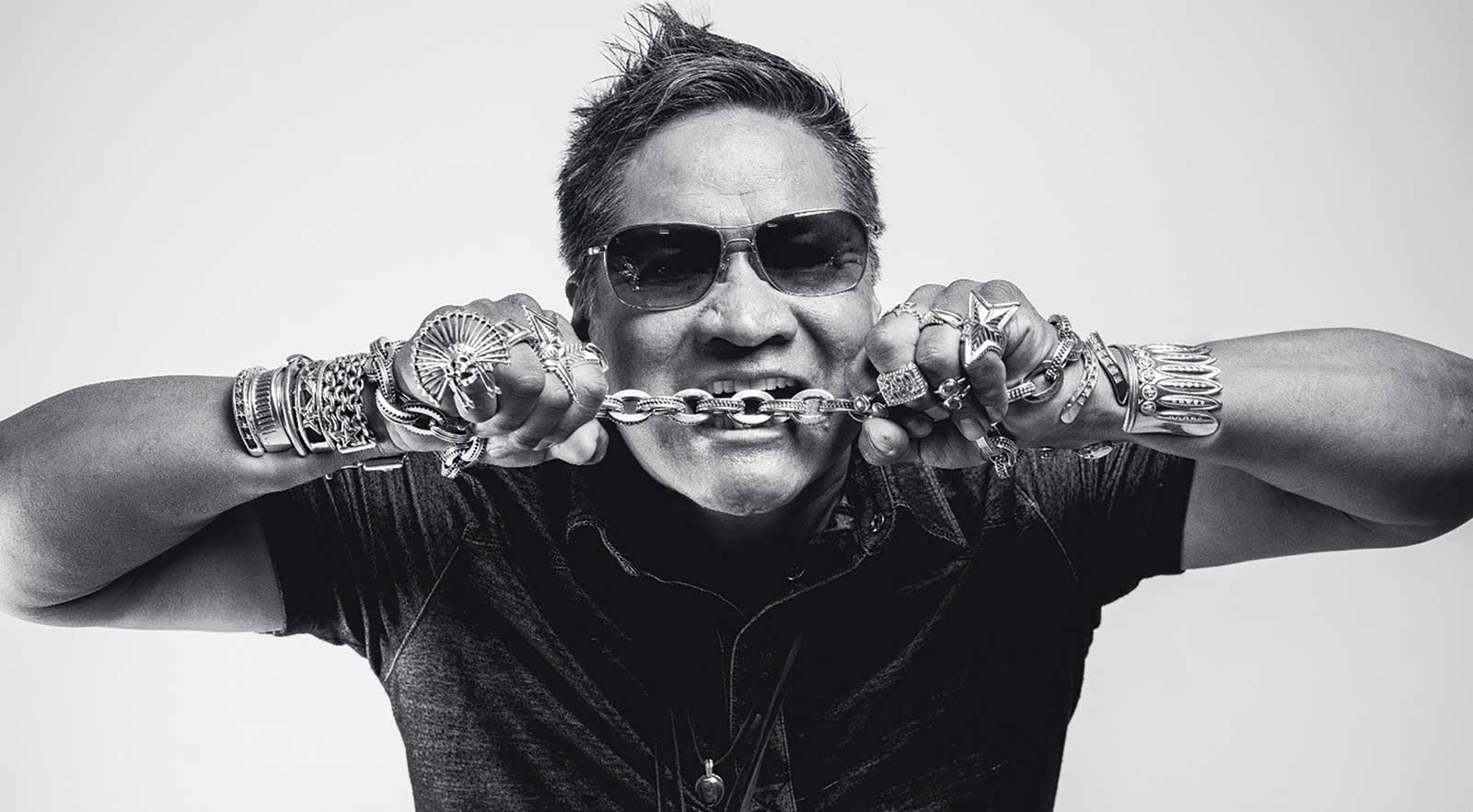 Sanderson is known for his imaginative, often playful style. He has won numerous awards, including Best in Show at the Heard Museum. Bold and imaginative, he hand-fabricates, bends, forges, casts and stamps his silver designs and uses new tools like 3D and CAD printing. Stars appear in most of his designs. To him, stars are recognized in every country and appear on flags, and symbolize the heavens, brightness, and good fortune. “I did a lot of my learning by asking other jewelers, ‘Hey, how’d you make that ring? How’d you make that bracelet? How did you shape that?’”
“I started out in Asia selling,” he says of his unusual route with stores and sales reps in Tapei and Tokyo. “There are artists that insist on doing only traditional. They have this romanticized notion that you have to mine your own silver, dig the stones outta the ground, shape them, all these things. But to me 21st-century tools are a continual evolution in jewelry and jewelry making, so I use them.”
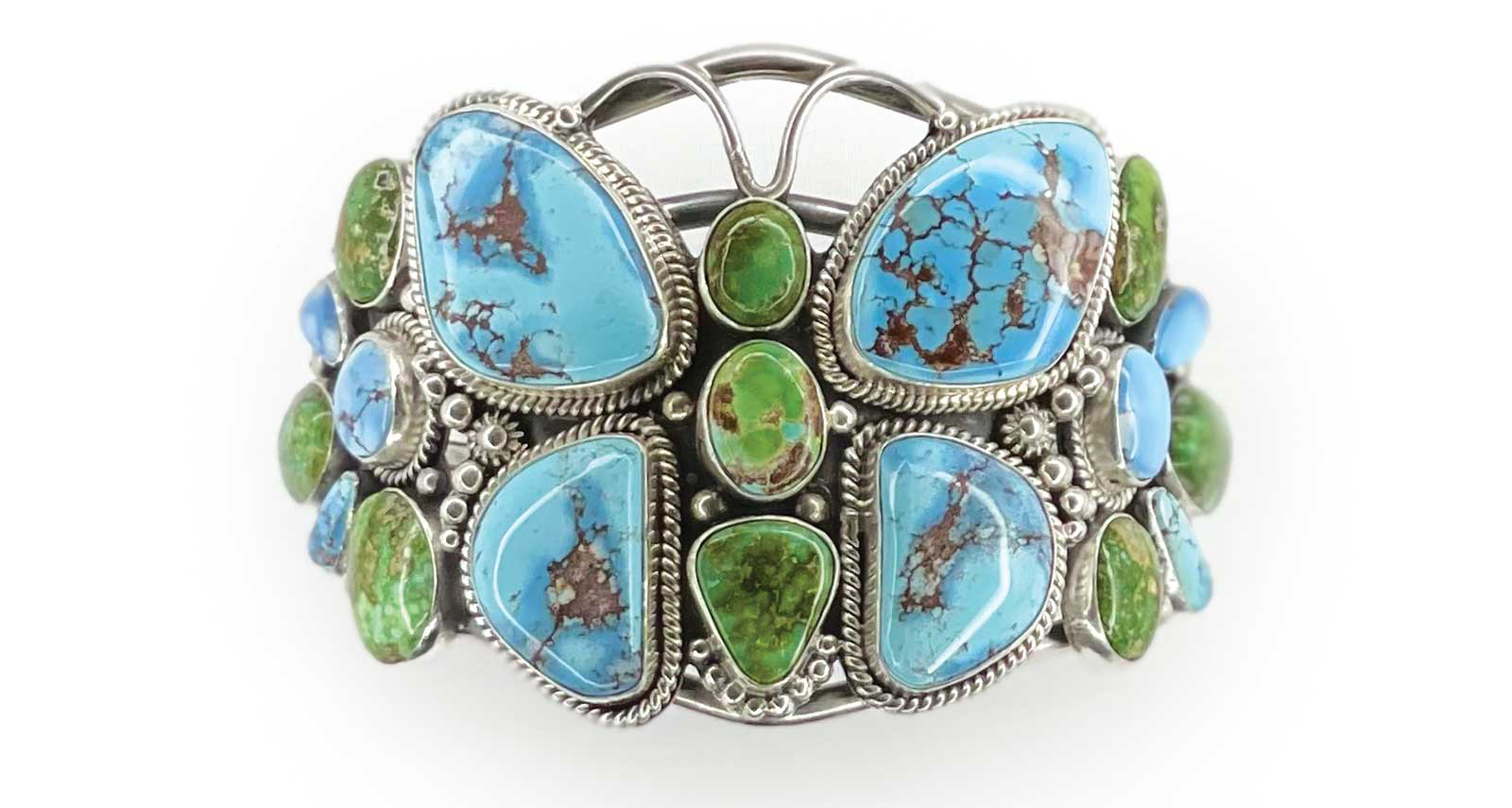 Davida Lister (Navajo (Diné)), butterfly ring, silver and turquoise
The cutting edge, contemporary work has a rock-and-roll aesthetic that he claims to be “some of the hardest stuff I’ve made—the sharpest, the pointiest, the most dangerous looking pieces have gone to women in their 60s to their 80s.”
As for its enduring popularity, he says, “Everyone likes jewelry. It’s easy to travel with. It’s easy to pack. Even in a depressed economy it’s something that feels necessary.”
Victoria Adams (enrolled Southern Cheyenne, Oklahoma), whose traditional name is He On E Va (Woman Who Lights the Pipe), makes work that lets the materials tell their story. “My jewelry creations are predominantly one-of-a-kind designs, many pieces are built using unusual gemstones, stones which are not easily obtained,” she says. “I search out materials which speak to me, often they tell me what they want to become, I can follow their story, or add it to my own narrative. The pieces I create are keepers of history, they carry accounts of animals, plants, ceremonies, stories of family and the sun, moon and stars. Without knowledge of our history, and where we come from, our world will become a void.”
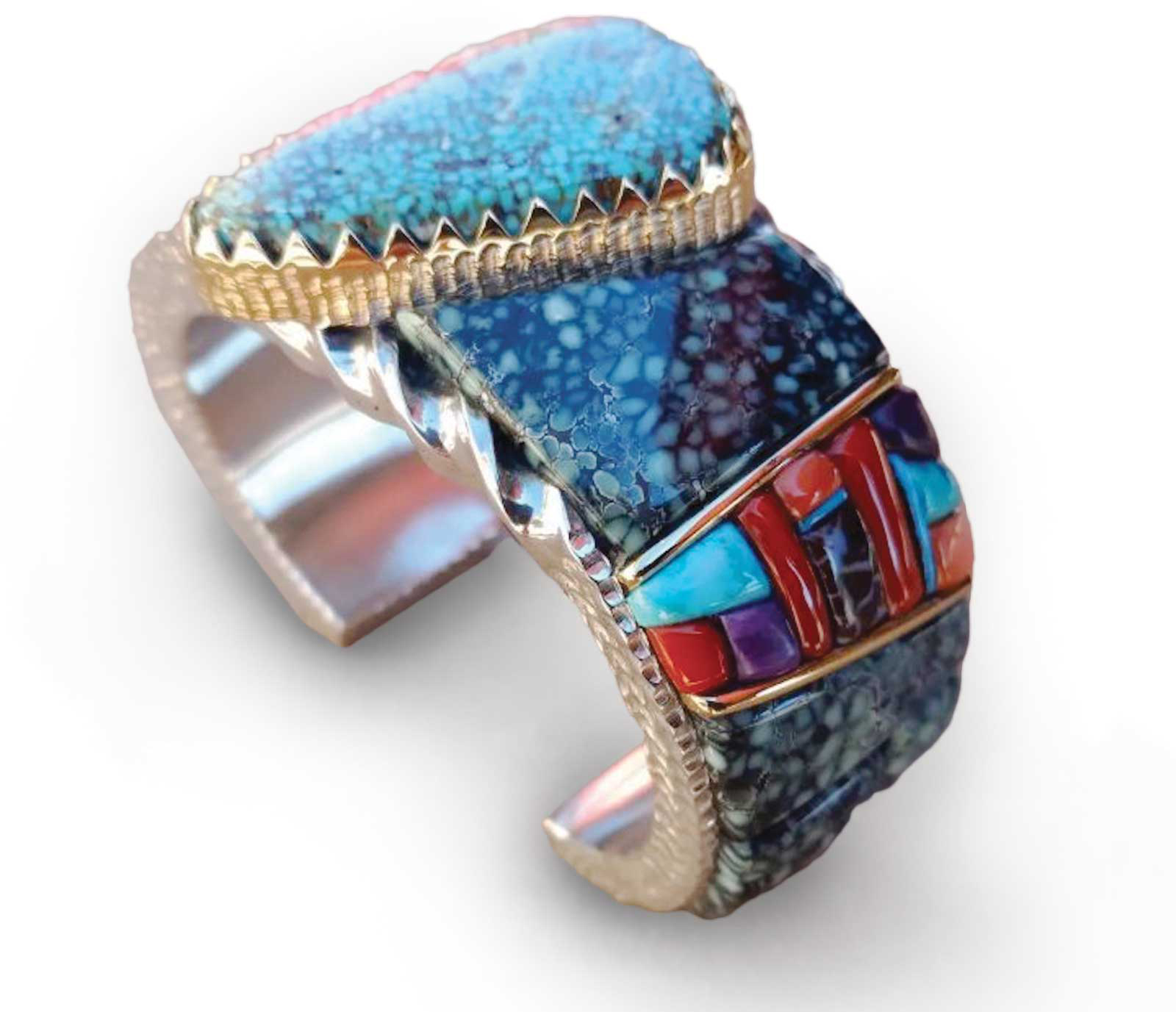 Alvin Yellowhorse (Navajo (Diné)), turquoise, silver, gold and multi-stone ring
She learned to make jewelry from a friend in her early 20s. “I was having a difficult time trying to find my way in the world; mainstream American life was not to my liking. I’d been raised in a family of engineers and artists, hence creating something from materials at hand was in my blood. The right instruction at the right time set me on a path that I’m still on. When
I walk into my jewelry studio, my knowledge of tools, and materials keeps me totally engaged—each day is a creative adventure.”
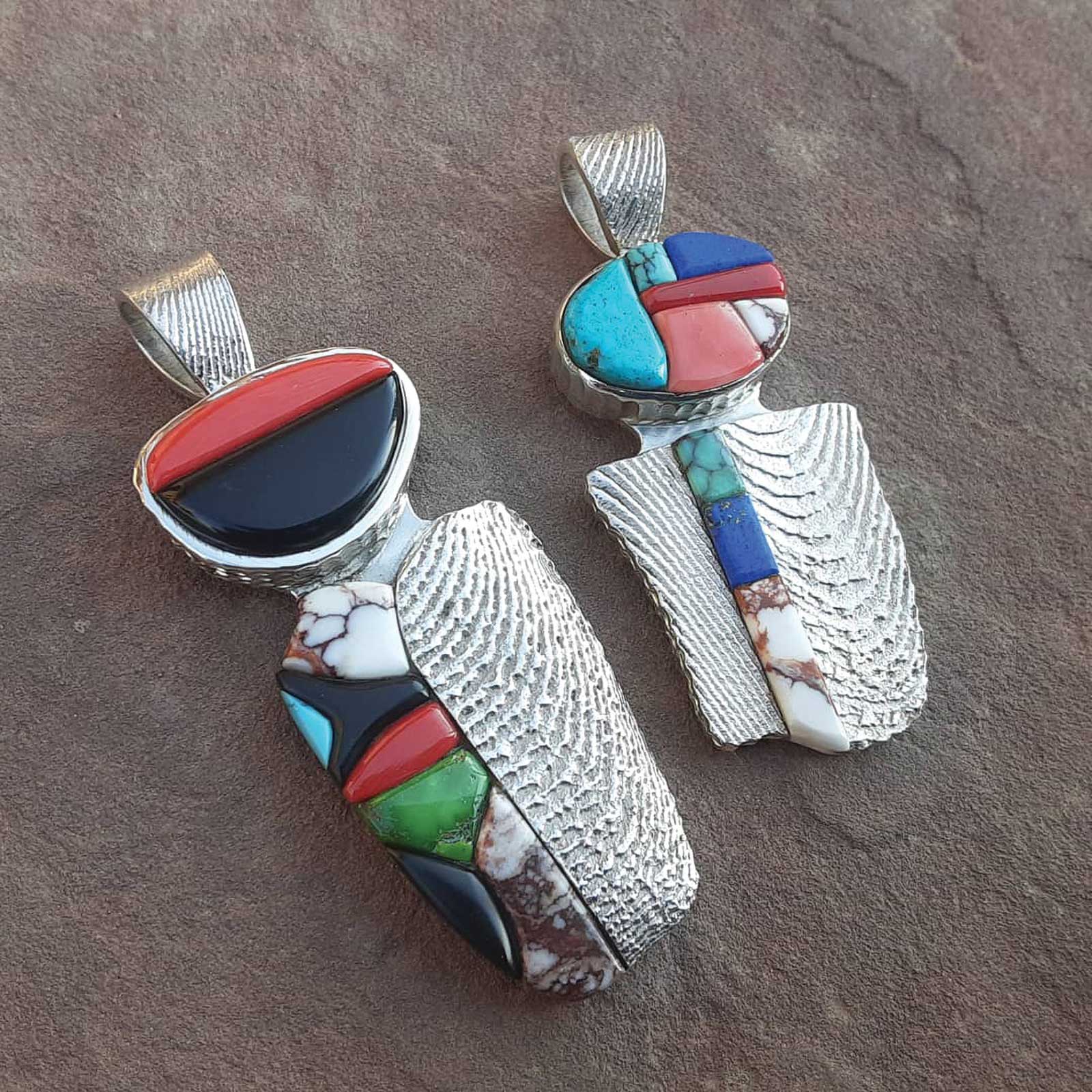 Alvin Yellowhorse (Navajo (Diné)), multi-stone silver necklaces
Adams says that jewelry is so popular for one main reason: “Jewelry, unlike many other art forms offered for sale at Santa Fe Indian Market, is wearable art, and the human body becomes an exhibit space. A person’s choice of jewelry and the way they wear it immediately conveys information to an observer. But more importantly; when you adorn yourself with an item you highly value, either monetarily or spiritually, you can feel empowered and connected, connected to the maker of the jewelry. The maker’s spirit, creative processes and narrative are embodied in their jewelry; the buyer’s responsibility is to carry this power forward, and to be strengthened by it.”
These artists and dozens more will be at their booths at Santa Fe Indian Market, carrying on a centuries-old craft with stories told in stones.
Powered by Froala Editor