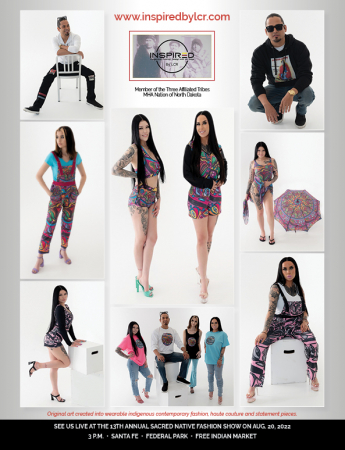
As someone who works in the museum field, I have grown accustomed to months and even years of advanced planning for programs and exhibitions. SWAIA’s Indigenous Fashion Show is an interesting paradox of an event because it requires a year of planning, yet fashion show director Amber-Dawn Bear Robe (Siksika Nation) often has no idea what the designers will bring to the runway until their creations arrive backstage. For this reason, the fashion show is one of the most anticipated events of Indian Market weekend, and with the centennial celebration, this year is no exception. Market attendees can look forward to two days of fashion events on both Saturday and Sunday, featuring an exciting roster of designers and models.
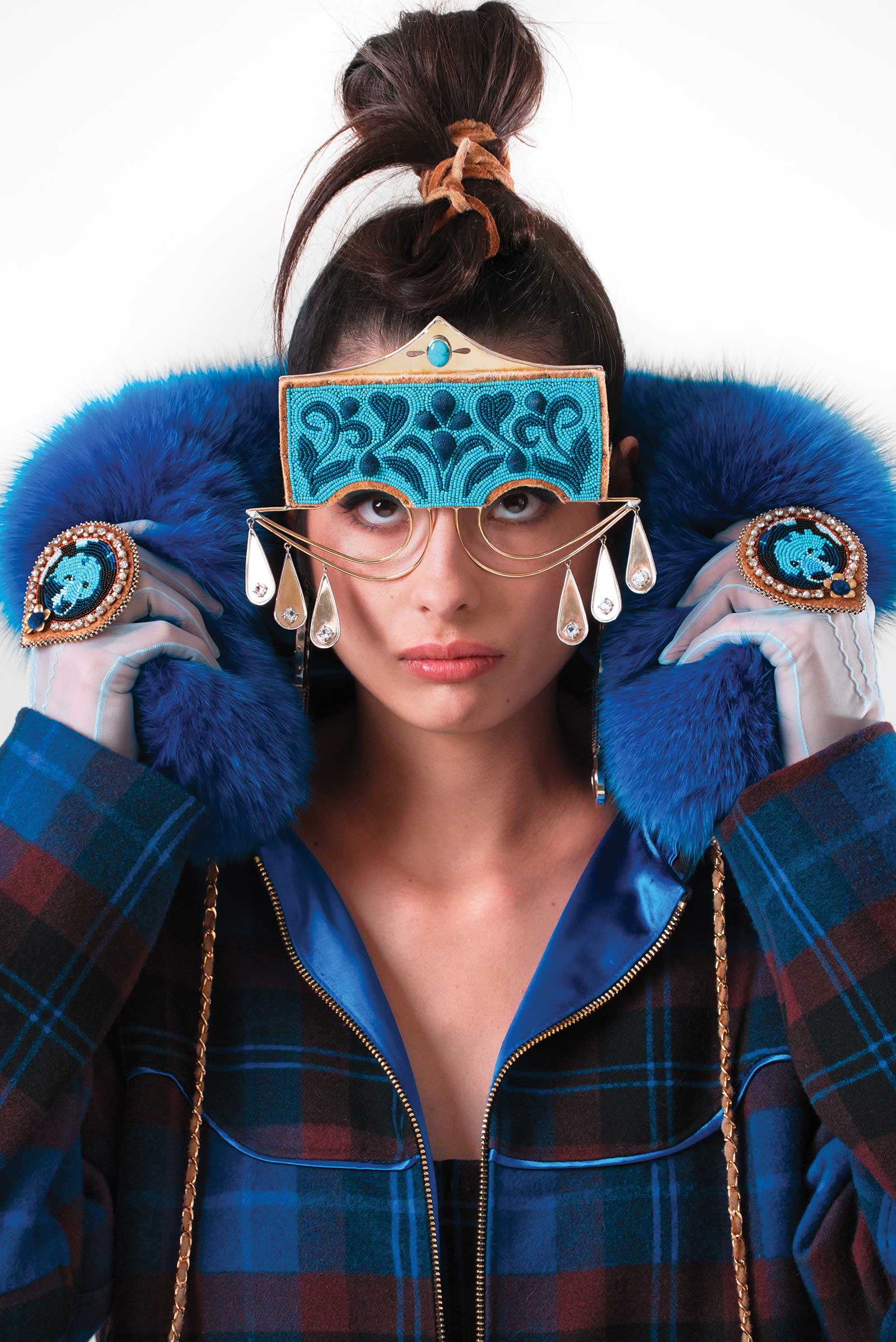 Photo: Patrick Shannon
Model: Alicia (SuperNaturals)
Coat: Melanie LeBlanc
Accessories: Catherine Blackburn x Rykelle ‘Ahlazua’ Kemp
I sat down with Amber-Dawn Bear Robe to learn more about what goes into the organization of this two-day event, as well as what we can expect from this year’s program. The first SWAIA show took place outdoors at Cathedral Park in 2014 and has only grown every year since. Prior to this initial event, Bear Robe had also organized two fashion shows for the Museum of Contemporary Native American Art (MoCNA). She credits the founder of Beyond Buckskin, Dr. Jessica Metcalfe (Turtle Mountain Chippewa), for really exposing her to the world of Indigenous fashion and with much of the initial momentum for the fashion show. Since the inaugural show nearly 10 years ago, the event has evolved and flourished more and more each year.
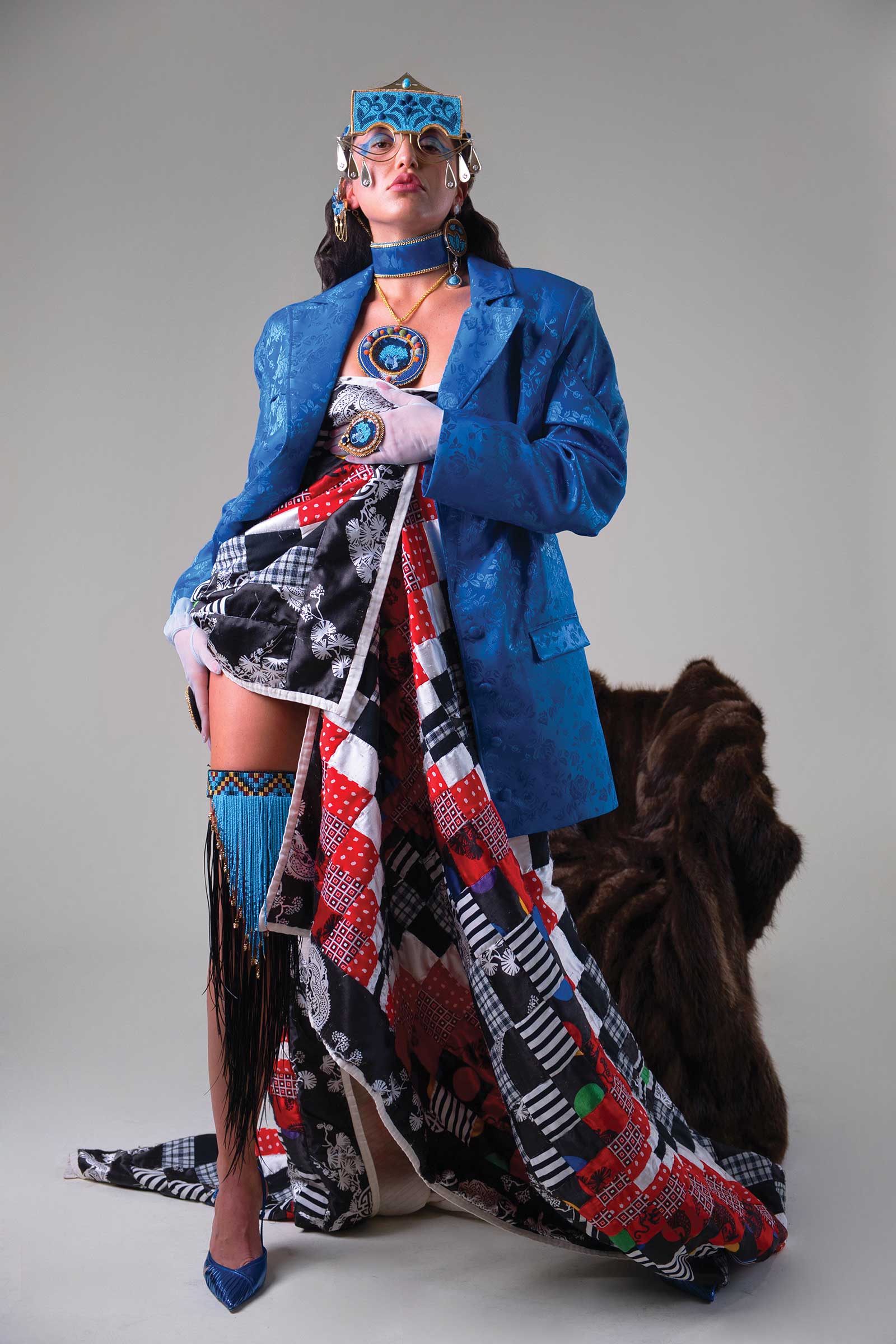 Photo: Patrick Shannon
Model: Talaysay (SuperNaturals)
Blazer dress: Melanie Leblanc
Accessories: Catherine Blackburn x Rykelle ‘Ahlazua’ Kemp
I attended my first SWAIA fashion show last year and was absolutely blown away by the splendor of the event. The lights, the music, the timing and the innovation of the designers’ work absolutely stunned me and everyone around me in the audience. I asked Bear Robe about the selection process for the show since the designs cannot be shared in advance. Designers are both invited and selected via an application process to participate in the show. Bear Robe explained that the selection process is extremely difficult because the goal is to showcase the range of Indigenous fashion—from designers whose work might be considered more “traditional” to others who would be viewed as more “contemporary.” Eventually the selection committee will adapt a strict jurying process as the event continues to evolve. Bear Robe commented that the show has outgrown the Santa Fe Convention Center because there are just so many talented designers that should be highlighted, and eventually, she would like to see the weekend-long event scale up into an entire Indigenous fashion week—similar to those happening in Toronto and Vancouver. However, for now, the show has expanded into a two-day event. Bear Robe emphasized the excitement around both shows—in previous years there may have been a misconception that the event on Sunday is a “main” or “finale” event, but attendees can expect the same level of excitement from both shows.
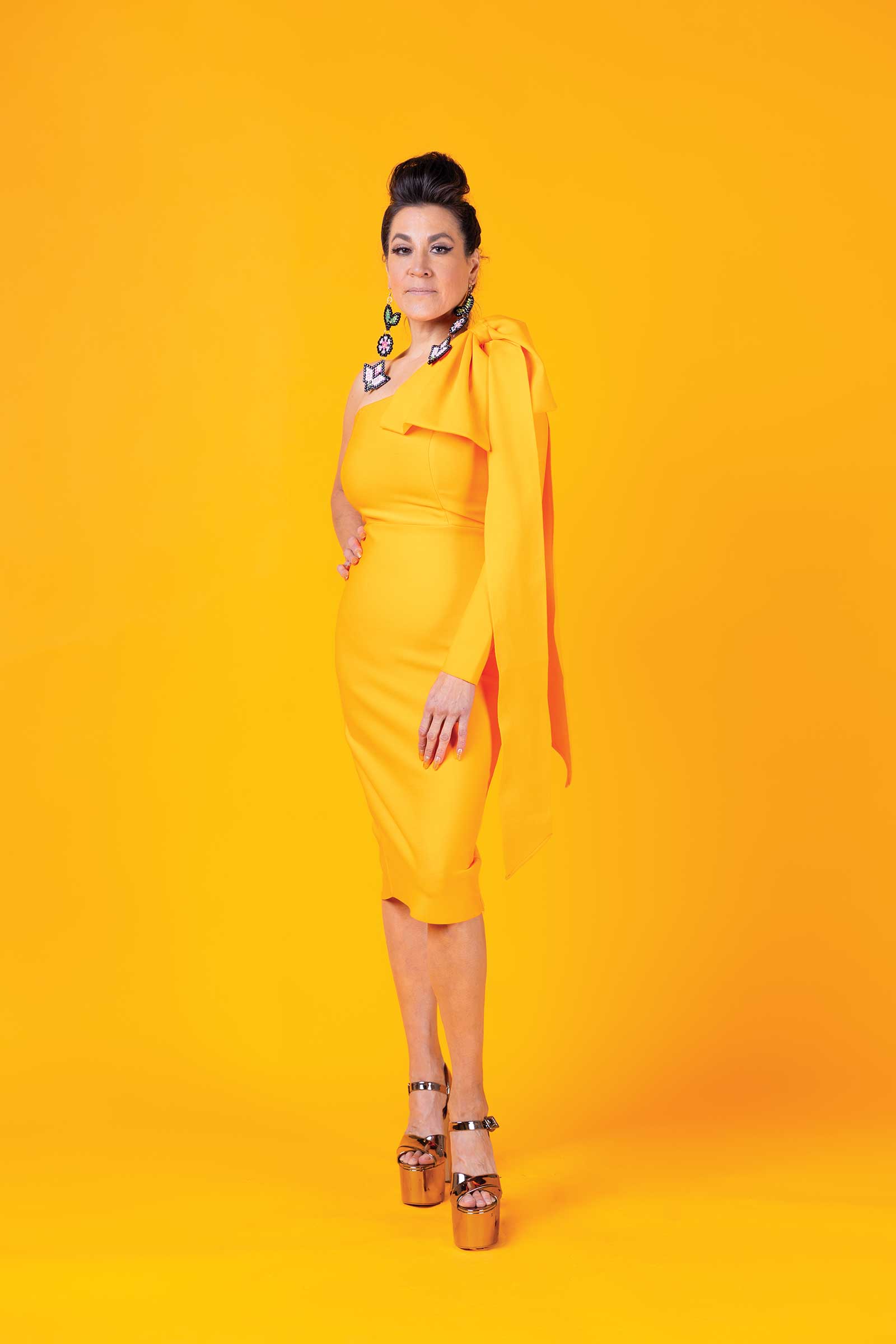 Amber-Dawn Bear Robe (Siksika Nation) photographed at the 2021 Indigenous Fashion Show. Photo by Tira Howard.
This year, 16 designers will share their creations across the two events. Eight designers will be featured in the show on Saturday and eight will be featured on Sunday. When I asked Bear Robe what she had learned from last year’s fashion show, which was unique in that SWAIA was grappling with Covid safety precautions (just as they are this year), she recounts the uncertainty and explained that she wasn’t sure if they would be able to host a fashion show at all. When the show was confirmed, organizers sought to make the indoor event as safe as possible, which resulted in a limited runway. This meant that with less designers, each one could show more looks, and there was no shortage of designs on the runway. Bear Robe explained that because of this, she realized the importance of more runway time for each designer, but two days is simply not enough, which really points to “the need for an entire Indigenous fashion week and the need for more platforms for Indigenous fashion designers,” she says.
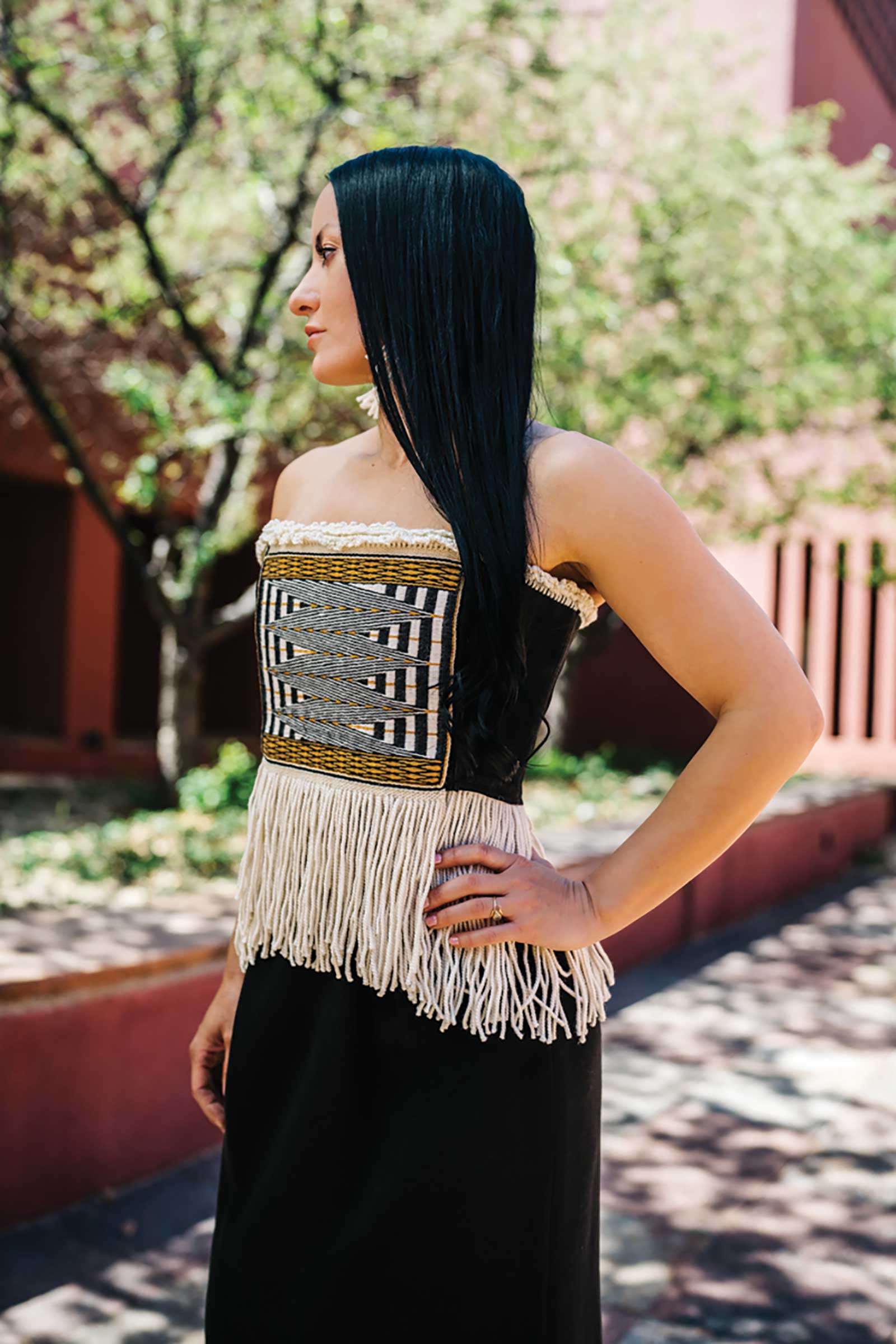 Design by Ursala Hudson (Tlingit)
Photos by Kahlil Hudson
Model: Julene White
All photos courtesy Amber-Dawn Bear Robe.
This year’s roster includes: Orlando Dugi, Jamie Okuma, Patricia Michaels, Korina Emmerich, Lesley Hampton, Catherine Blackburn and Melanie LeBlanc, Jason Baerg, Dorothy Grant, Skawennati, Sho Sho Esquiro, Lauren Good Day, Yolonda Skelton, Pamela Baker, Adrian Standing Elk Pinnecoose and Ursula Hudson.
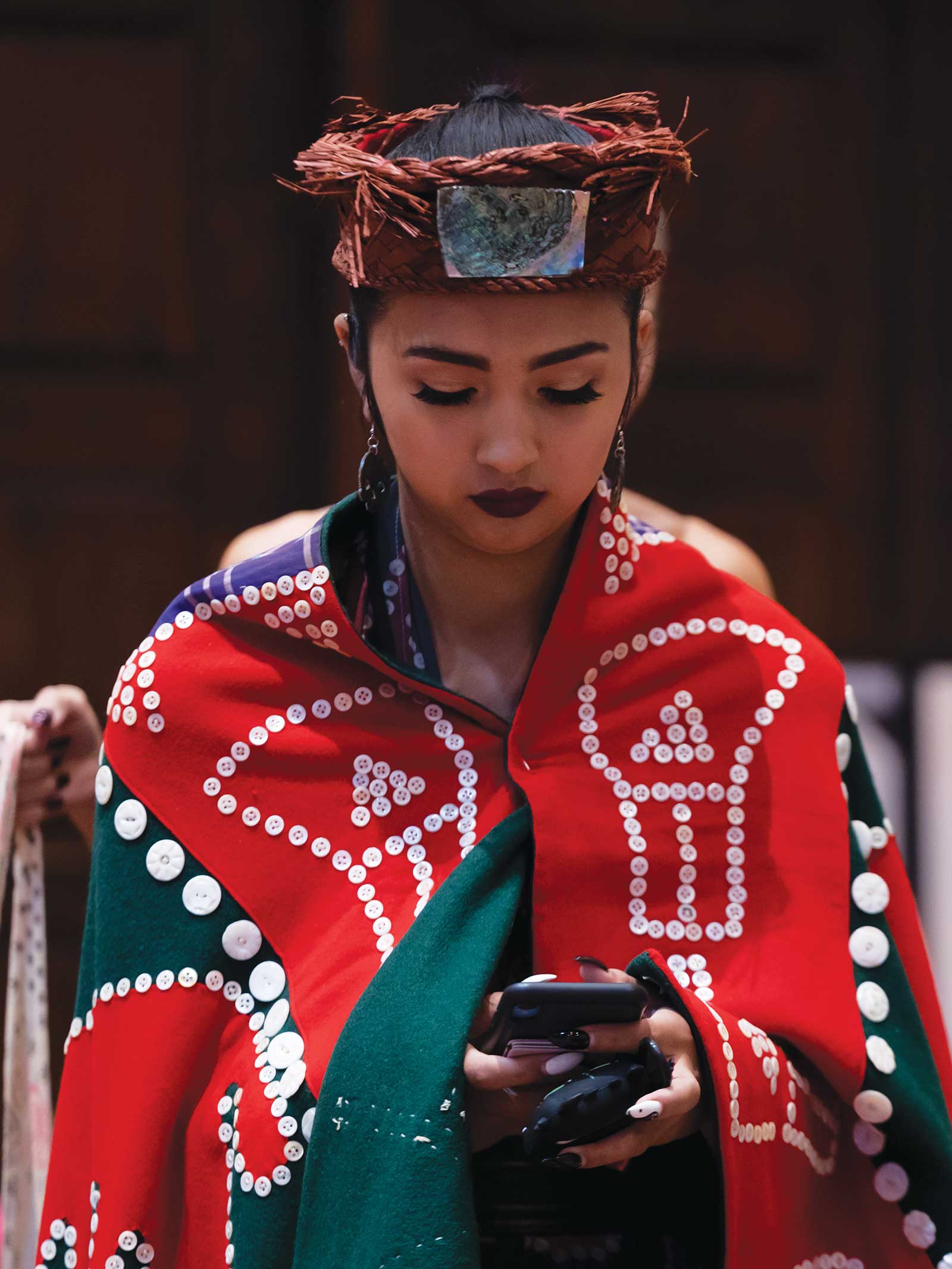 A model waits patiently backstage at the 2021 fashion show. Photo by Tira Howard.
The designers aren’t the only talent that will be highlighted at this year’s fashion shows. The combined program will feature about 80 to 100 models. Attendees can expect to see Supernaturals models, other professional models such as Ashley Callingbull, as well as emerging models. The SWAIA Indigenous Fashion Show has been an important point of entry for Indigenous people who are interested in modeling careers. Well-known models who now work in New York City, such as Phillip Bread, started their careers on the SWAIA runway.
Looking at the fashion show through the lens of a museum professional, I assumed that Bear Robe saw herself as a curator of sorts, but this is not the case. I asked if there was a specific theme for either or both of this year’s shows, but Bear Robe explained that she doesn’t want to force the artists under the umbrella of a specific theme, because, since the beginning, the fashion show has been a space where artists have the opportunity to creatively explore, express and create something that they themselves have been inspired to do. Bear Robe explains, “The thrilling thing about the fashion show is the mixture and the diversity—you can’t identify a theme or what will transpire on the runaway.” She elaborates that her main goal is for everyone involved to have a good time—designers, models and the audience. Rather than asking the designers to work to communicate her message, which would fall in line with the typical role of a curator, she sees responsibility as supporting the designers to execute their own messages. Bear Robe continues: “The message is important, but I don’t bring that—the designers do.” She further explains that the fashion shows do not present the full story of Indigenous fashion. These events represent just a small fraction of a much larger story, and the story that they do tell is very much grounded in the Southwest and the individual worldviews of those involved—further emphasizing the need for broader representation of Indigenous fashion beyond SWAIA.
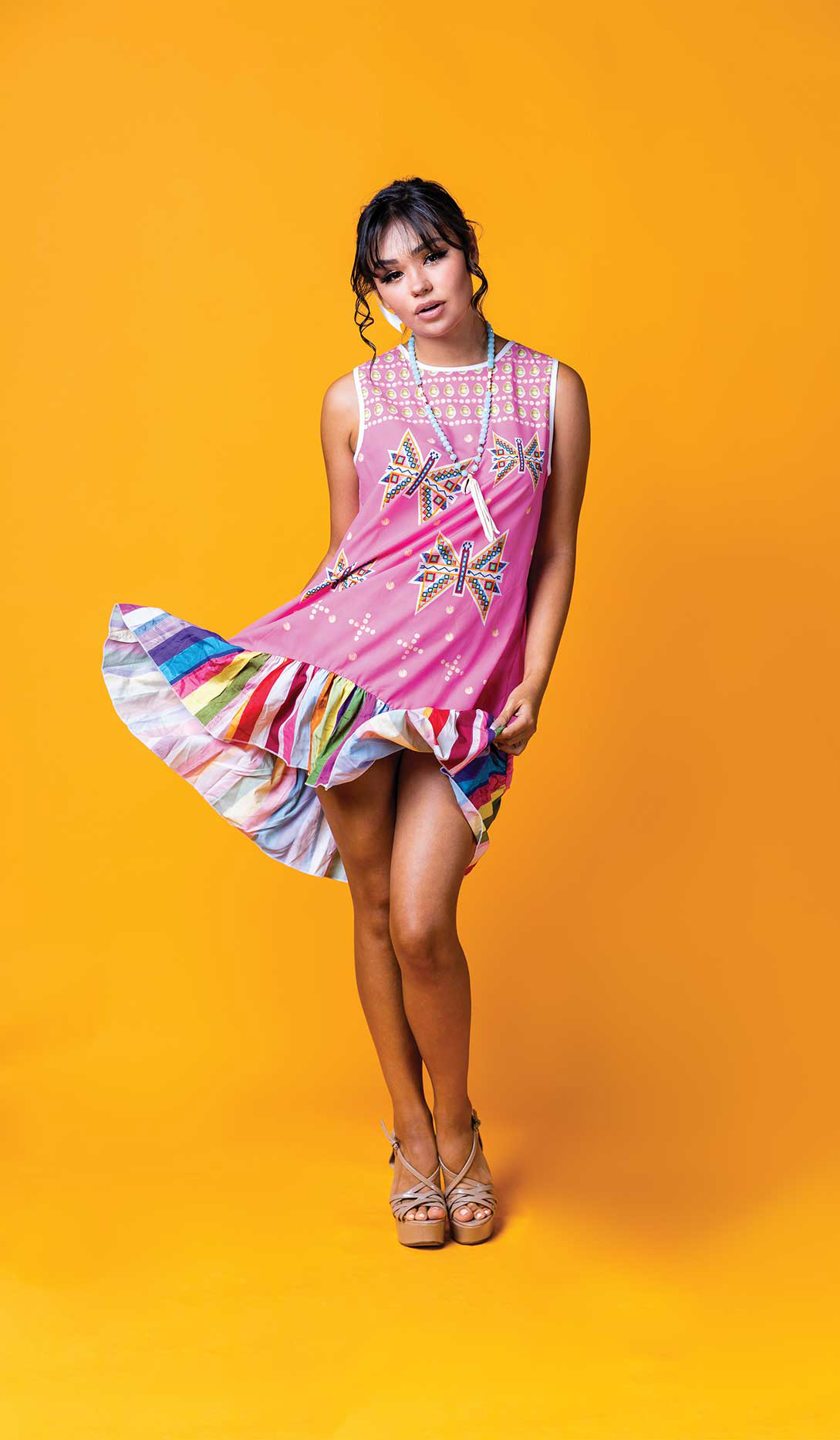 Clothing by Lauren Good Day (Mandan/Hidatsa/Arikara Nation) from the 2021 Indigenous Fashion Show. Photo by Tira Howard.
When asked what she is most looking forward to at this year’s event, Bear Robe responds that she is excited to “[see] new creations on runway” and “thrilled to see what designers are bringing this year.” I asked about the significance of this year’s fashion show within the context of SWAIA’s centennial, and Bear Robe explains, “The fashion show is a landmark of breaking the rules.” These rules were set 100 years from an anthropological lens when the organization was first formed. She further elaborates that breaking the rules through this event “can be fun and can be exciting, because we can include younger and older generations—there is room for both traditional and cutting-edge contemporary artists.” Bear Robe described the opportunity as a means to appeal to all generations of collectors and artists: “Everyone wears clothing.”
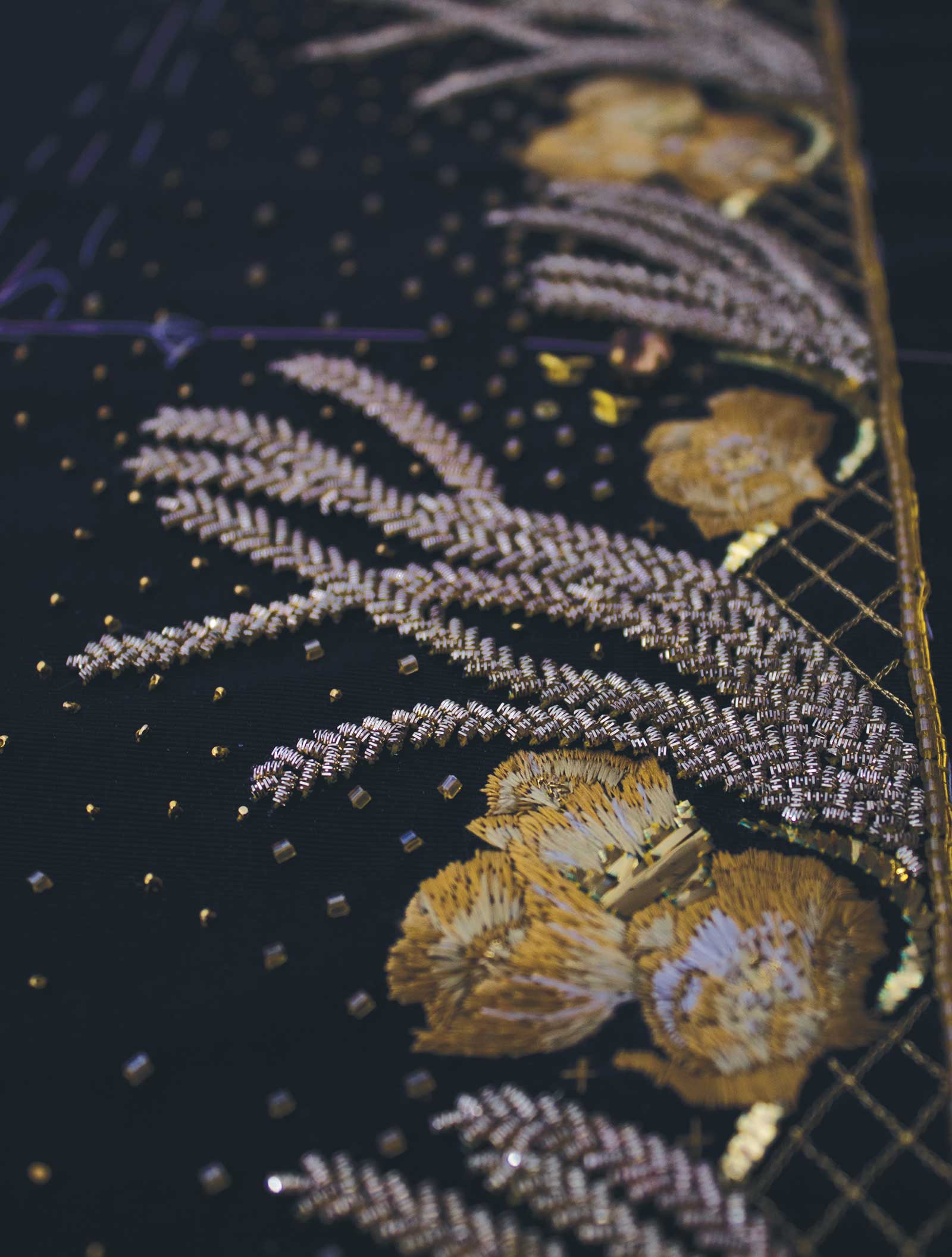 New textures and materials from Orlando Dugi (Navajo [Diné]).
I asked Bear Robe what she hopes for the next 100 years of Native fashion. She envisions a future where Indigenous designers are not relegated to a particular niche, but rightfully celebrated within the larger global fashion world. “We are making a mold of our own and encouraging discourse that is from the perspective of Native designers and benefitting our communities—something inclusive not exclusive.” She also hopes for recognition of the influence of Native material culture within the broader history of what is considered American fashion and design. “Indigenous fashion has always been around. Native designers are the original couturists of this land despite the colonial assimilationist agenda in which Native dress was forbidden.”
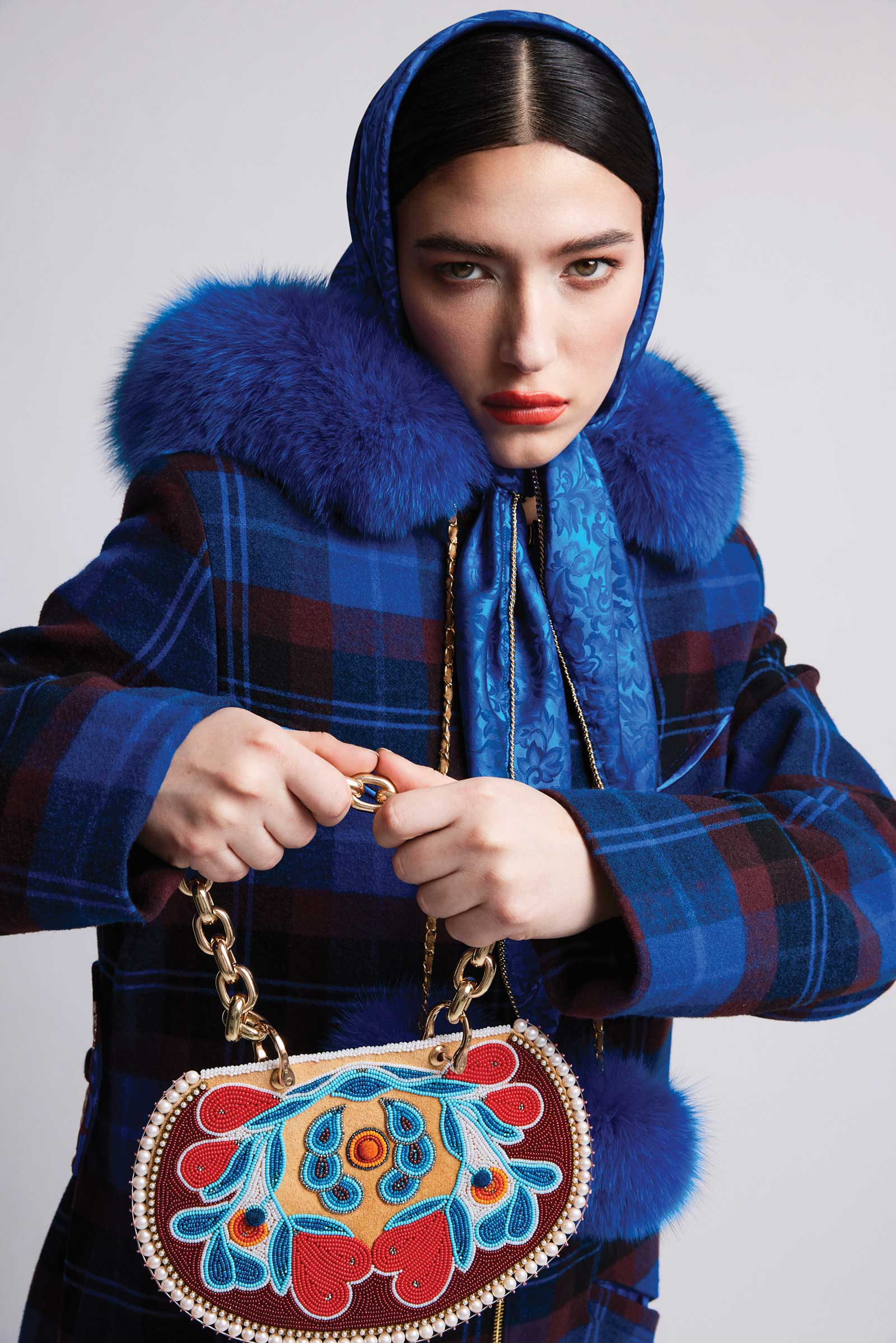 Photo: Nicole Romanoff
Model: Hope Davies (STRAY Mgmt)
Coat: Melanie LeBlanc
Accessories/medicine Bag: Catherine Blackburn (Dene)
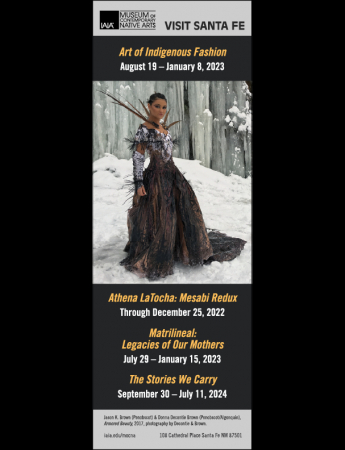
Beyond the SWAIA Indigenous Fashion Show runway, Amber-Dawn Bear Robe is also curating a Native fashion exhibition for the Museum of Contemporary Native American Art that opens on August 19. Bear Robe explains that there is a connection between the exhibition and the fashion show because many, if not most, of the designers who are in exhibition have been or will be on the SWAIA runway. “[The fashion show] is an important opportunity to see work on a moving body walking, versus just on a form never to be worn again,” she says. Further, many of the pieces in the exhibition, including a dentalium shell dress made by Jamie Okuma, made their debut at the SWAIA Indigenous Fashion Show. As the conversation wound down, Bear Robe emphasizes the fact that there are so many stories out there to be told, and that both of these projects are grounded in her unique perspective and based on the personal relationships that she has built with Native artists over the years.
After Indian Market weekend, Bear Robe is organizing a fashion show at Bishops Lodge that will feature the work of Lloyd Kiva New and Kay Bennett. This will be an exciting and rare opportunity to see some of these artists’ works on a dynamic runway instead of a museum or private collection.
August 20, 2022, 6-9 p.m.
SWAIA Gala: “Shiny Drop” Centennial Party, Fashion Show and Auctions
Santa Fe Community Convention Center
201 W. Marcy Street, Santa Fe, NM 87501
Tickets required | www.swaia.org
August 21, 2022, 3 p.m.
Indigenous Fashion Show
Santa Fe Community Convention Center
201 W. Marcy Street, Santa Fe, NM 87501
Tickets required | www.swaia.org
Powered by Froala Editor