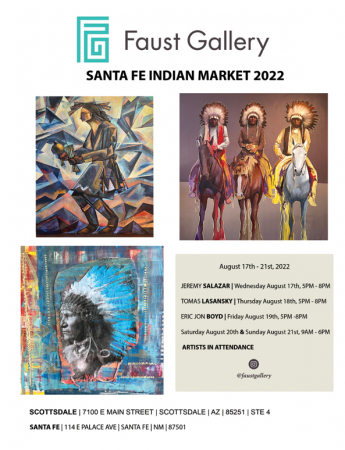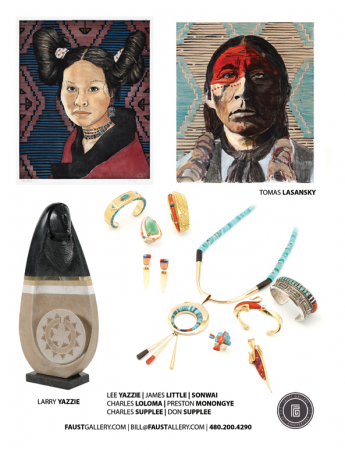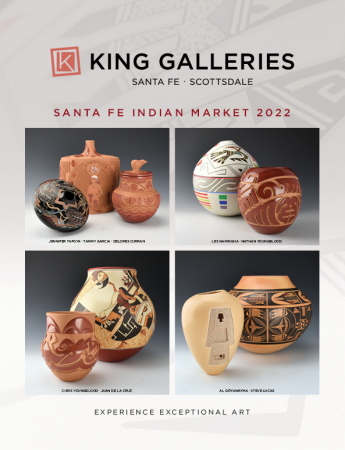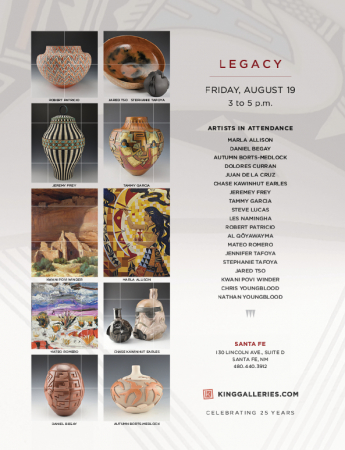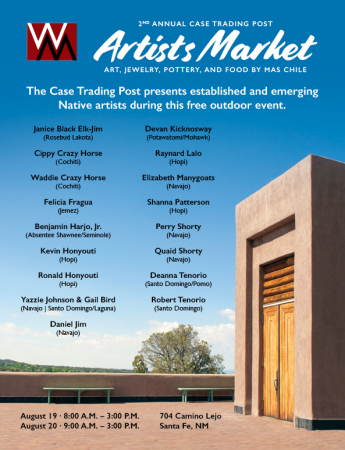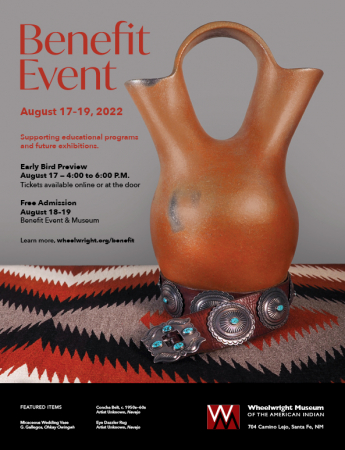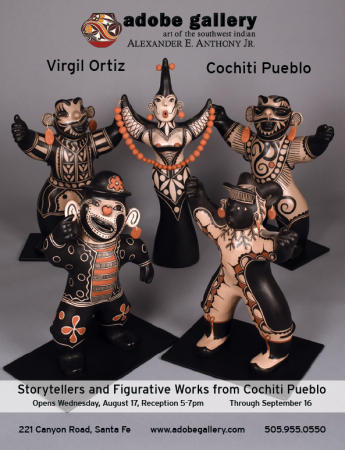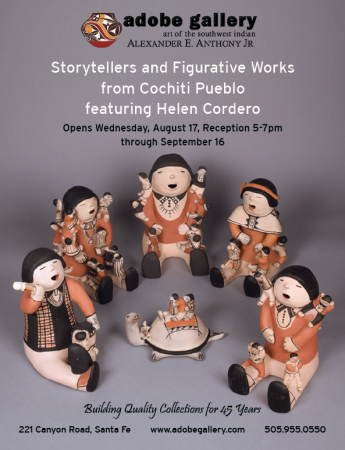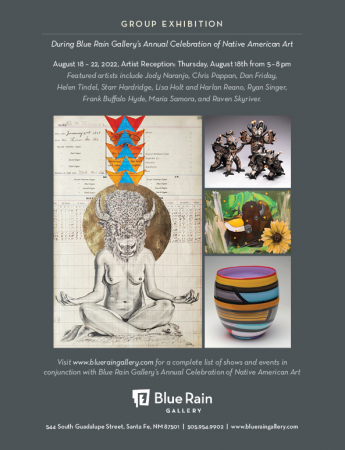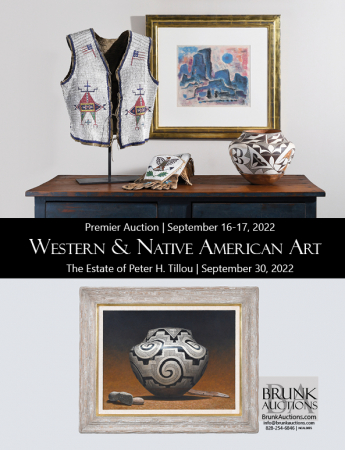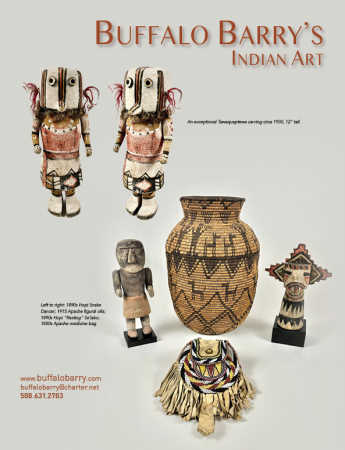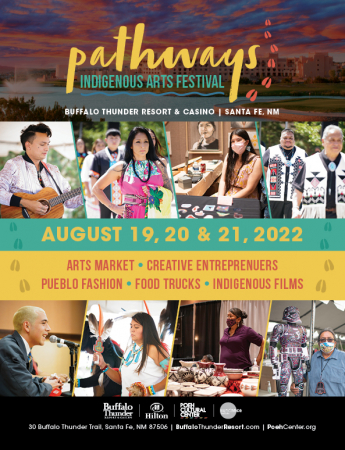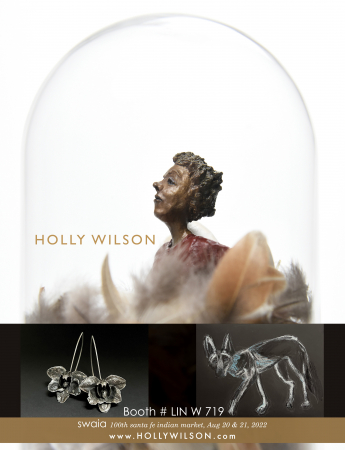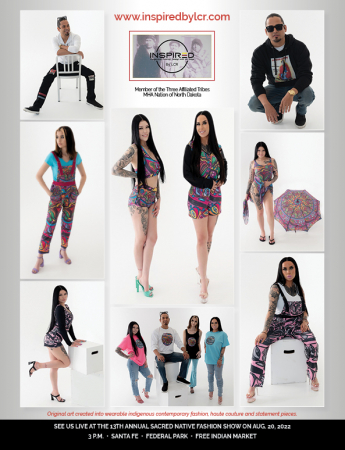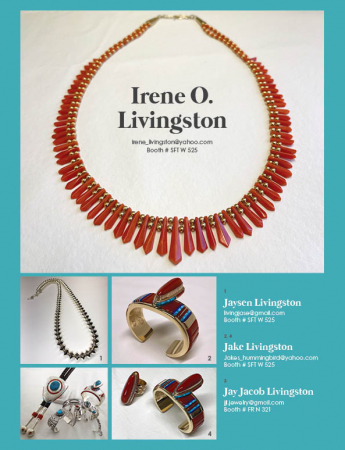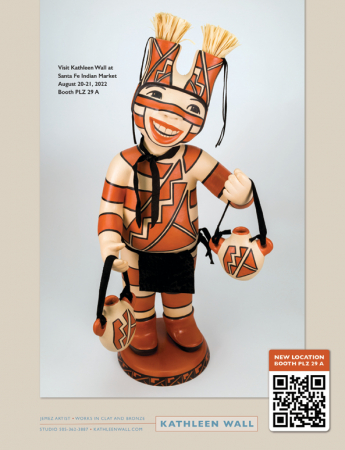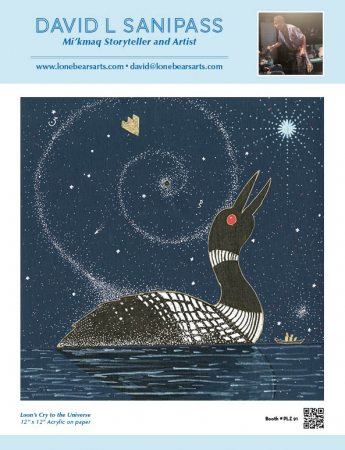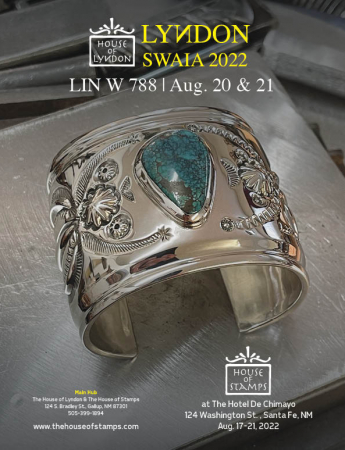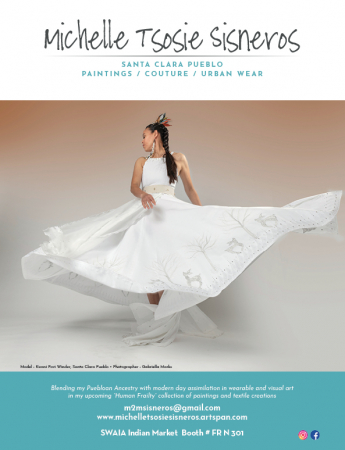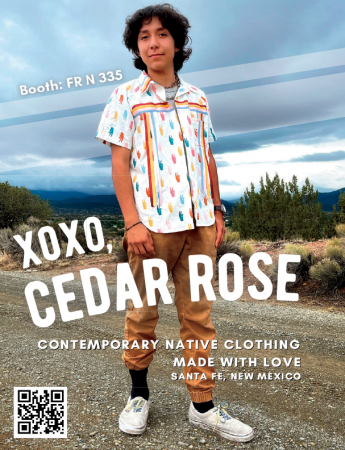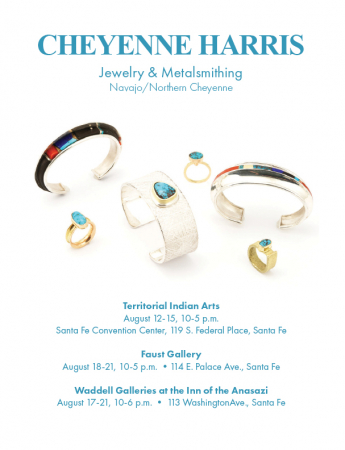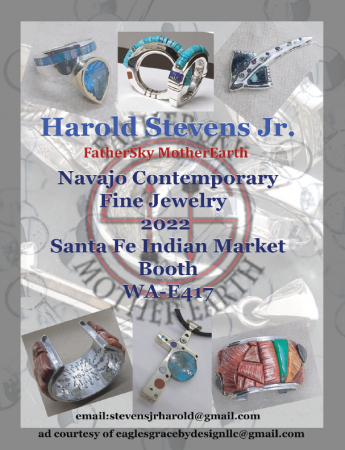
All roads lead to Santa Fe on the third weekend of August. This year’s annual celebration marks the centenary of the Santa Fe Indian Market. This city became a tri-cultural crossroads for Indigenous dwellers, Hispano conquerors and settlers, and then, more recently, incoming Anglo residents in the 19th century. When the fortunes of the region’s Indians were at a low ebb in the early-20th century, prominent non-Native individuals sought ways to make things better for them. These early philanthropists strongly believed in nurturing and developing Native talent and artistry. Santa Fe was the perfect setting for such an endeavor.
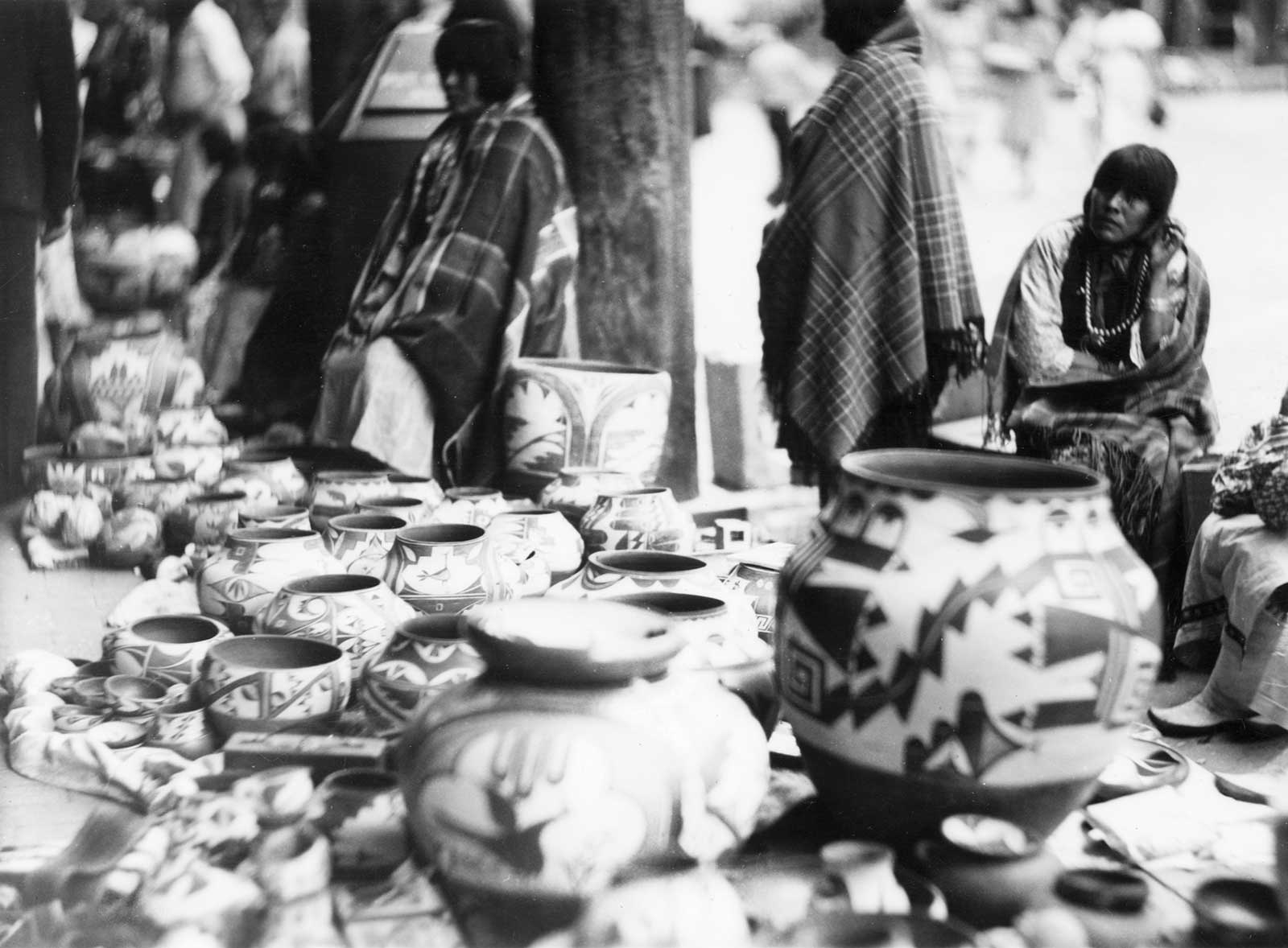 Pottery vendors on Palace of the Governors portal, Indian Market, Santa Fe, New Mexico, 1938. Courtesy of the Palace of the Governors Photo Archives (NMHM/DCA), 135047.
“The hour has arrived” was Museum of New Mexico director Edgar Lee Hewett’s opening words at the first Indian Fair. The time was 1922, and the fair was an offshoot of the traditional Santa Fe Fiesta. Hewett, the first director of the Museum of New Mexico, was one of a number of leading Santa Fe figures who felt that this fair was a necessary first step. Their objectives were ambitious. Hewett and others wanted to revive and preserve Native American arts and establish a market whereby these creations could be exhibited and authenticated, and their makers receive fair prices.
Up through 1926, the fair was shown at the National Guard Armory in downtown Santa Fe. The last fair was held in 1931, and it was newly located on the portal of the Palace of the Governors; artists were now allowed to handle their sales personally. During the worst of the Great Depression, no fairs were held from 1932 to 1935 and the sponsors went instead to various pueblos and other regional shows, like the Gallup Inter-Tribal Ceremonial, to judge works and award prizes. In 1934 management of the Indian Fair was transferred to the New Mexico Association on Indian Affairs (NMAIA) and, by 1936, the format of the Indian Market changed to an outdoor setting; non-Native judges noted pieces they considered “good” but there remained a somewhat chaotic presentation of arts, although makers still did the selling.
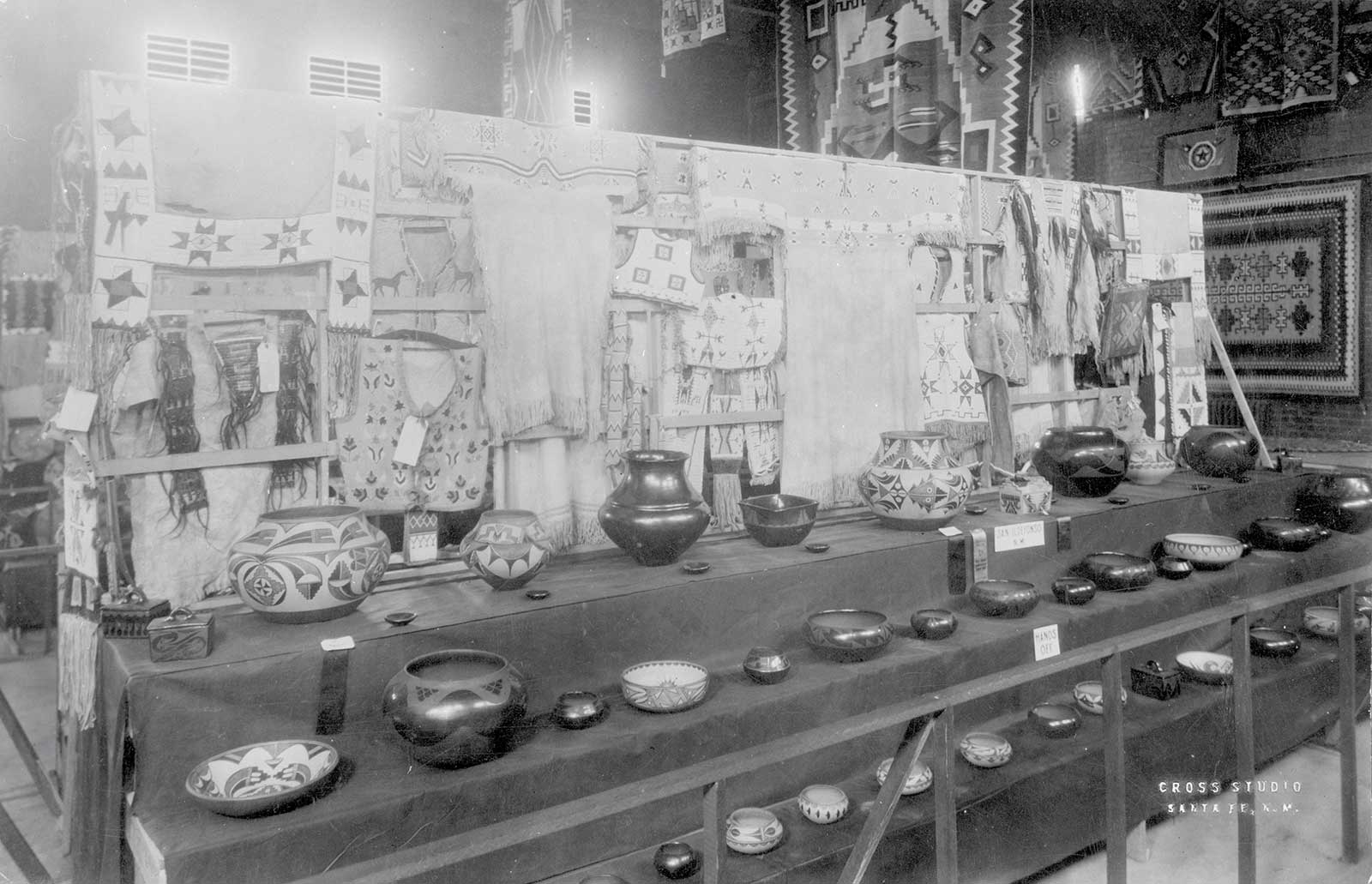 A display at the first Indian Fair, National Guard Armory on Washington Avenue, Santa Fe, New Mexico, 1922. Photographer: Guy Cross. Courtesy of the Palace of the Governors Photo Archives (NMHM/DCA), 001500.
In 1959, the NMAIA transformed into the Southwestern Association on Indian Affairs (SWAIA). Booths were added in 1965 and 1966. Indian Market now expanded well past the portal and plaza, extending onto neighboring streets. Native artists were growing stronger in their self-determination. The establishment of the Institute of American Indian Arts in 1962 inaugurated an educational system less governed by non-Native tenets and more focused on inter-tribal visual expression.
Attendance rose steadily through the 1970s as Indian Market grew and became one of Santa Fe’s biggest attractions. The 1980s, marked by a swell of remarkable Native talent, proved to be a boom in terms of collector attendance. And, in a reversal of its beginnings, SWAIA made sure Native individuals sat on its governing board and served as staff. SWAIA changed its name to Southwestern Association for Indian Arts in 1993. The organization’s mission statement says it all: “Bringing Native arts to the world by inspiring artistic excellence, fostering education, and creating meaningful partnerships.”
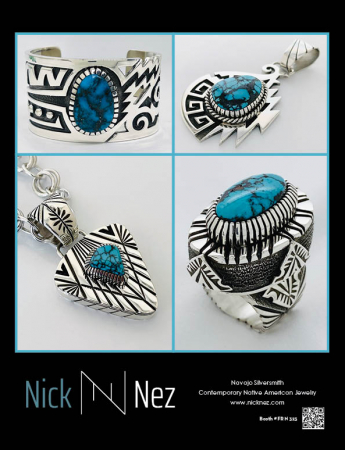
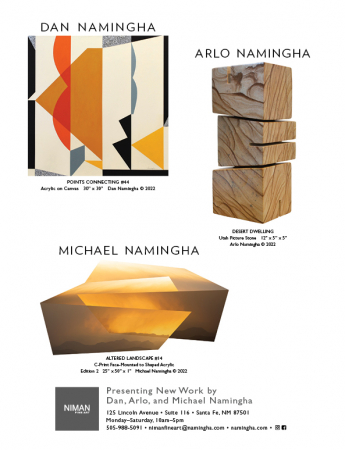
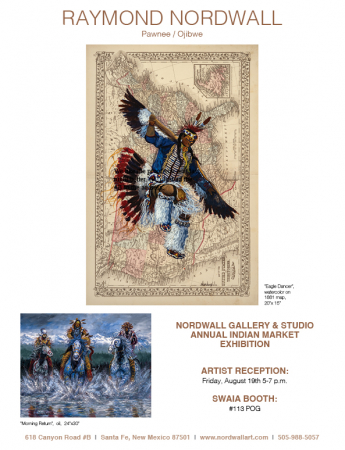
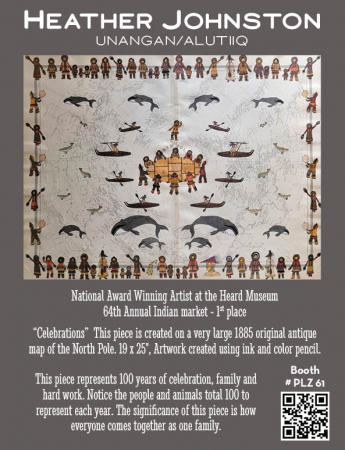
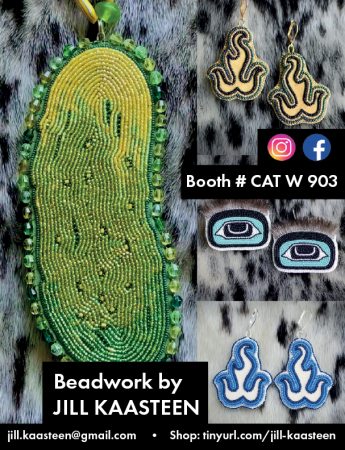
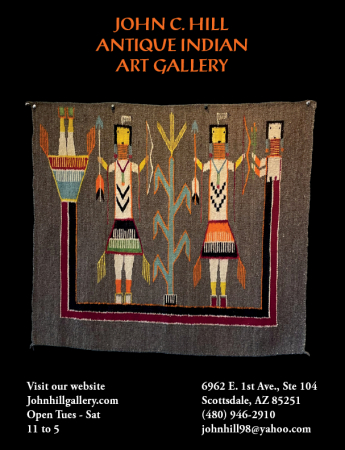
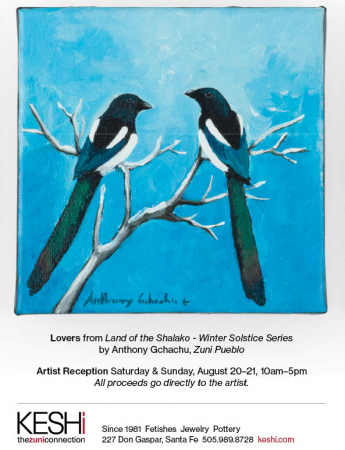
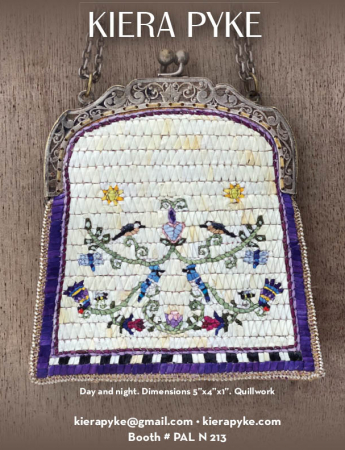
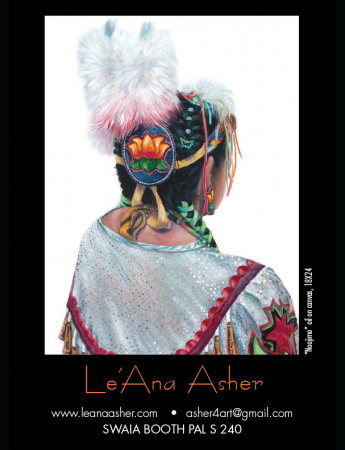
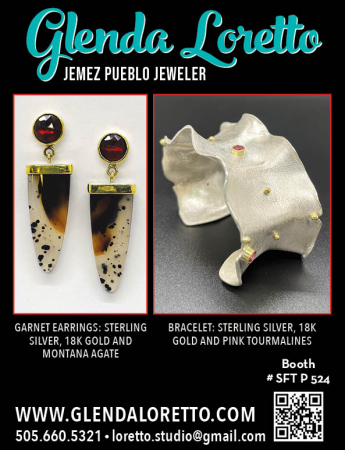
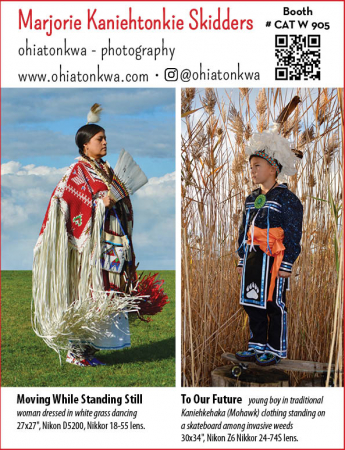
Market, the nickname for this distinctive event, had become the place for viewing and purchasing high-quality Indian art. Now a venerable destination, its setting in Santa Fe—a unique cultural center—has given the American Southwest an additional luster. Few annual art fairs have such name recognition. Today, the SWAIA Santa Fe Indian Market still serves as the leading art exposition for contemporary Indian artists in North America. Other major markets exist but none have had the ability to take over a historic city’s famed downtown Plaza and adjacent streets and generate a colorful weekend occasion dominated by Indigenous artists working in multiple media. While pottery had been the chief focus of the earlier fairs, market now gleams with fine jewelry, unique paintings, sculpture, and prints, hand-woven textiles and carved katsinim. Artistic careers are launched, made and secured here.
Artists come “home” to Indian Market for several specific reasons. The most important one, of course, is to sell. Many elect to devise new unique designs as a means of boosting their reputation and sales potential. Claiming a prized show ribbon is another goal. Individuals with big names hold court in Santa Fe’s superb gallery openings. But Indian Market is also a long-awaited social event for artists and their families. The city’s restaurants are full and the partying is extensive. Friends reunite and Native pride prevails.
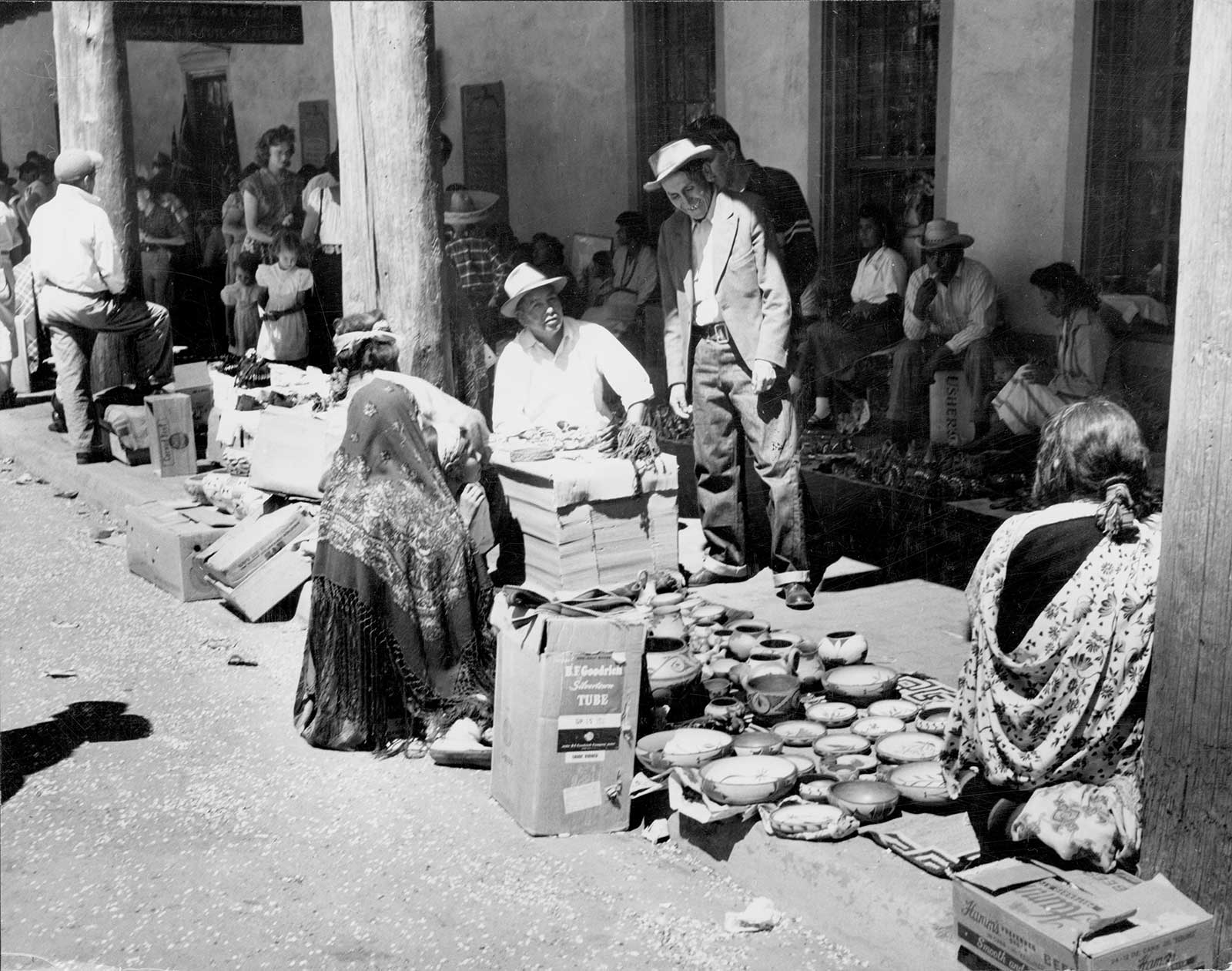 Vendors under the portal of the Palace of the Governors during Indian Market, Santa Fe, New Mexico, 1952. Photographer: Alice Bullock. Courtesy of the Palace of the Governors Photo Archives (NMHM/DCA), 183510.
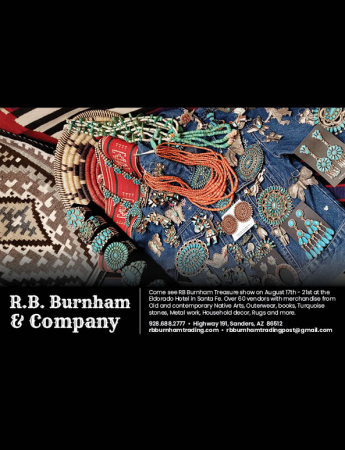
The week leading up to the fair hums with anticipation. Hotel rooms are fully booked months in advance. Antique and vintage Native arts are sold at several specialty shows. The galleries and hotels surrounding or near the plaza host art dealers and artists who are featured in small exhibitions. Thursday acts as a kick-off of sorts with local market-related events. A popular four-day show, Native Treasures, featuring a mix of artists, dealers and Indian traders takes over the Eldorado Hotel’s spacious lobby rooms.
Mood and atmosphere help make Indian Market a powerful experience. Friday brings excitement when pieces winning ribbons go on display at the convention center; collectors eagerly note the frontrunners. Meanwhile, workers install booths and tents on the plaza and the main streets leading into the grassy square, which are now blocked off from traffic. Early Saturday morning is filled with a palpable buzz of energy and professional calculation. Devoted collectors come early (even before the artists arrive) to line up at individuals’ booths for a first chance at award-winning and new pieces.
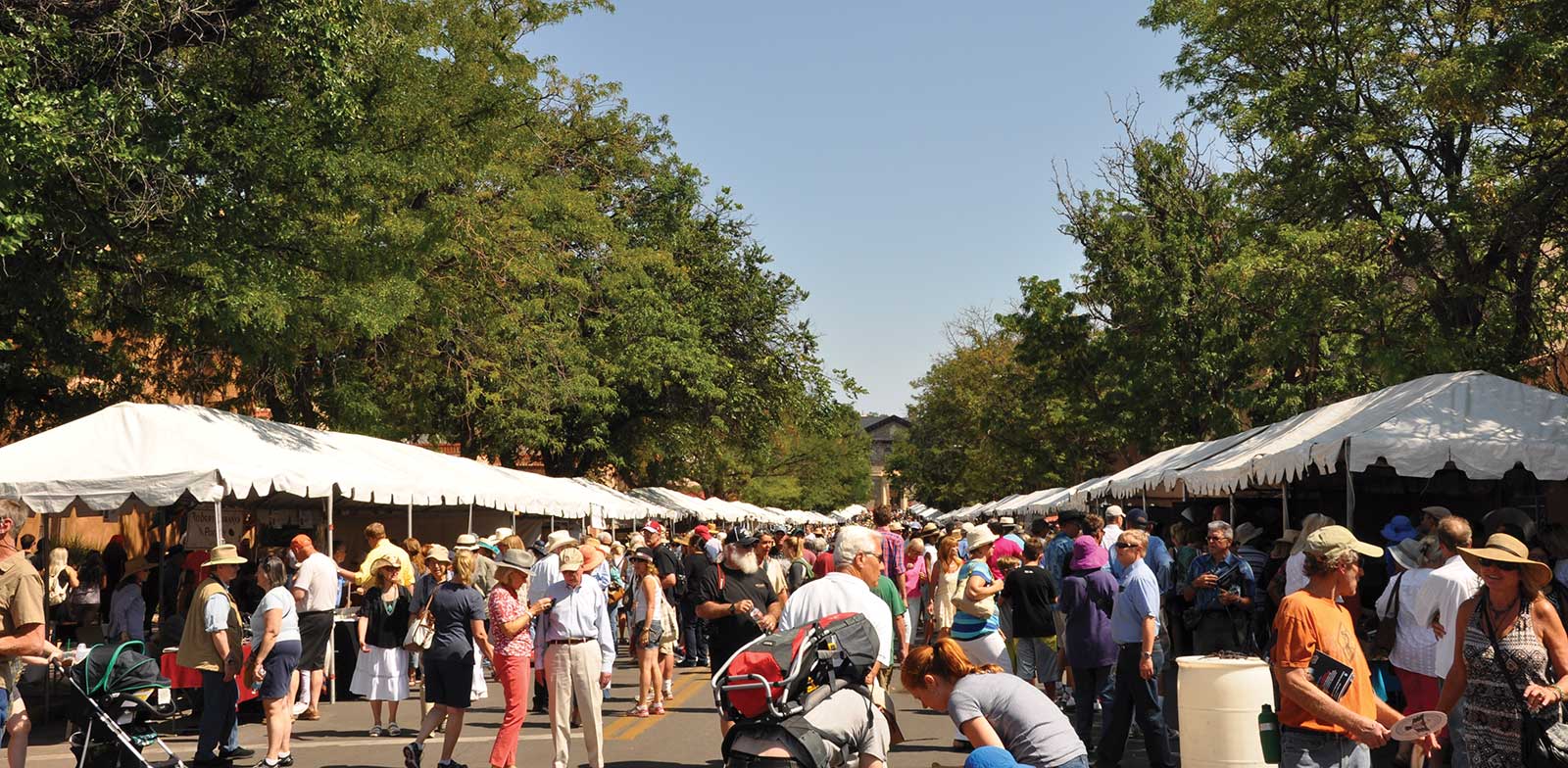 Santa Fe Indian Market in full swing on leafy Lincoln Avenue, 2015. Courtesy the author.
Tension marks the first three or four hours of market. Most of the early attendees are seriously intent on acquisition. Sales for artists are critical during this morning phase. Some artists are so much in demand that they sell out before noon. Early birds gather the worms here. A different group of visitors don’t have specific pieces or artists in mind, but they comb the booths for works that speak to them personally. Market is a full-fledged treasure hunt.
By noon the atmosphere changes. Laughter floats on the air. Serious selling has been done and now the event feels more like a festival. Indian Market, however, is not a craft fair. There may be some handmade items sold at modest prices, but the goods here make Indian Market an art show. Traditional fine arts are sold, including drawings, paintings, photography, sculpture and photography. Western culture usually labels jewelry, basketry, pottery, textiles and carvings as decorative arts. For Indigenous makers, however, these works are fine art and priced accordingly. Most of the objects on offer at booths are one of a kind. SWAIA also dictates that those selling operate under specific guidelines to ensure quality in materials and technique.
As Saturday progresses, a more relaxed and merry mood takes over. Many attendees are still hunting for treasures, but the general tension felt in the morning is replaced by a cheery flurry of activity. The tented platform on the plaza with its rows of chairs now serves as a focus for performances, music, and one of the market’s happiest events—the children’s dress contest. Bright-eyed little ones appear in full tribal regalia and compete for awards. Some years there’s even a protest march or two. By the end of the day vendors and visitors alike are worn out, but mostly with a happy exhaustion.
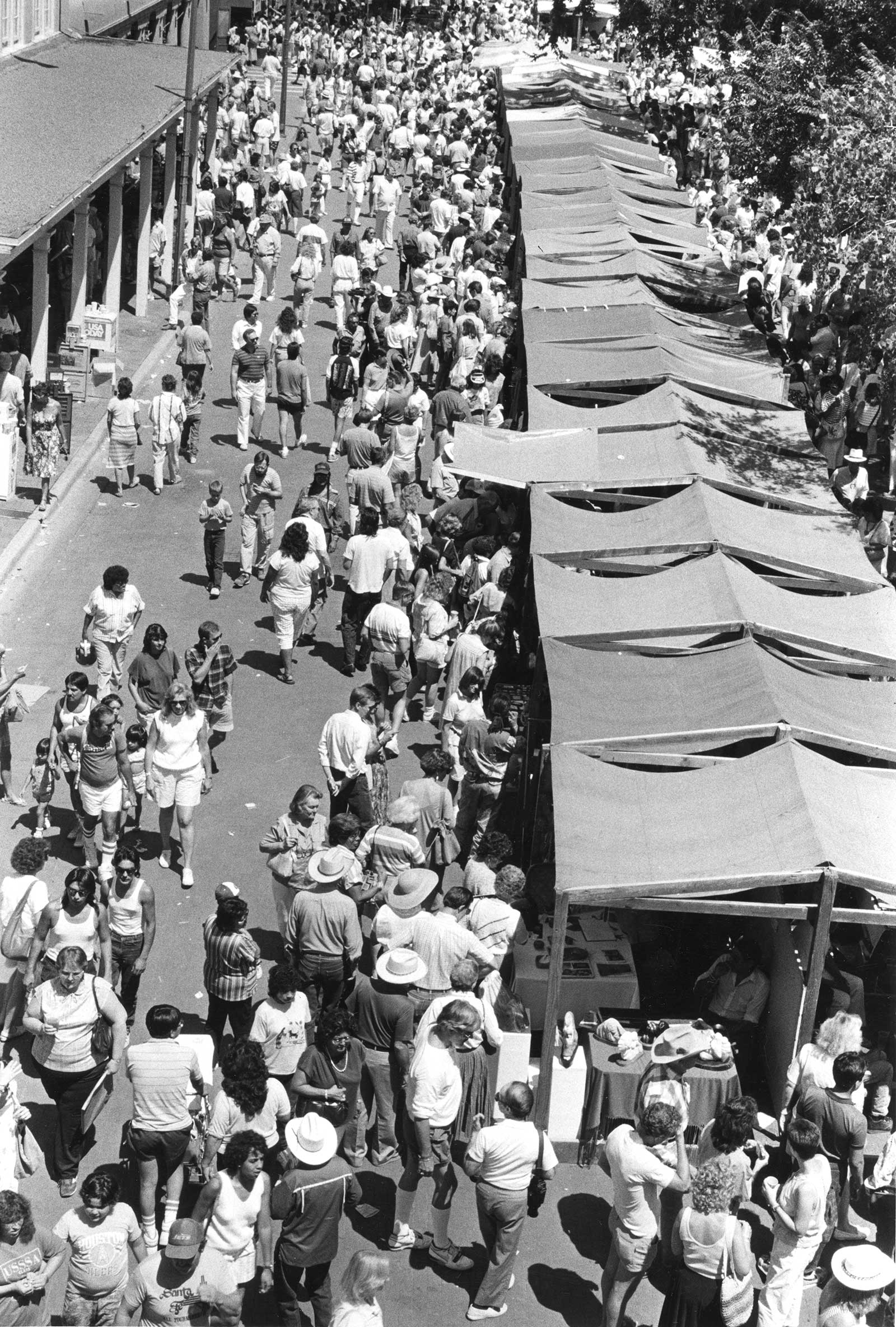 Crowds along Lincoln Avenue during Indian Market, Santa Fe, New Mexico, 1988. Photographer: Larry Beckner. Courtesy of the Palace of the Governors Photo Archives (NMHM/DCA), HP.2014.14.681. The Santa Fe New Mexican Collection.
Sunday’s mood is even more easygoing. Indian Market now feels like a mellow street fair. Nevertheless, selling remains the primary purpose for this setting. Many of the artists depend on the weekend’s sales as critical annual income. SWAIA itself over the years has experienced various highs and lows. Change and challenges have proved inevitable. In recent years there have been breakaway shows and general controversy over various rules, such as the artists selection process. Market now has competition as a result of these frictions.
When we look at the history of Santa Fe Indian Market, however, its historical significance outweighs any dissonance. Here the finest Native artists in North America compete for awards, while nearly 1,000 entrants show their wares to a multitude of eager collectors and enthusiasts. This uplifting pageant of beauty, talent, and pride makes sure that visitors will unfailingly be educated, entertained, and eager to carry away skillfully designed, original artwork. Mission accomplished.
Powered by Froala Editor