Distinctive in their fractured, compositionally complex designs, the Northern Northwest Coast figurative ceremonial “Chilkat” dance blanket, known as Naaxéin (nahk-HAYN) by the Tlingit (translating to “fringe about the body”),1 are not only visually striking, but expressions of cultural identity, ingenuity, adaptability and technical prowess. Unlike the way by which many of us encounter the Chilkat blanket today, spread flat and hanging in a museum case, the robes were conceived to be royal objects in motion, the fringe swirling and swaying as the noble wearer danced at a potlatch and other special events, the blanket draped over his or her shoulders, dipping and turning to a drumbeat and breathing life into crest figures represented within the weavings.
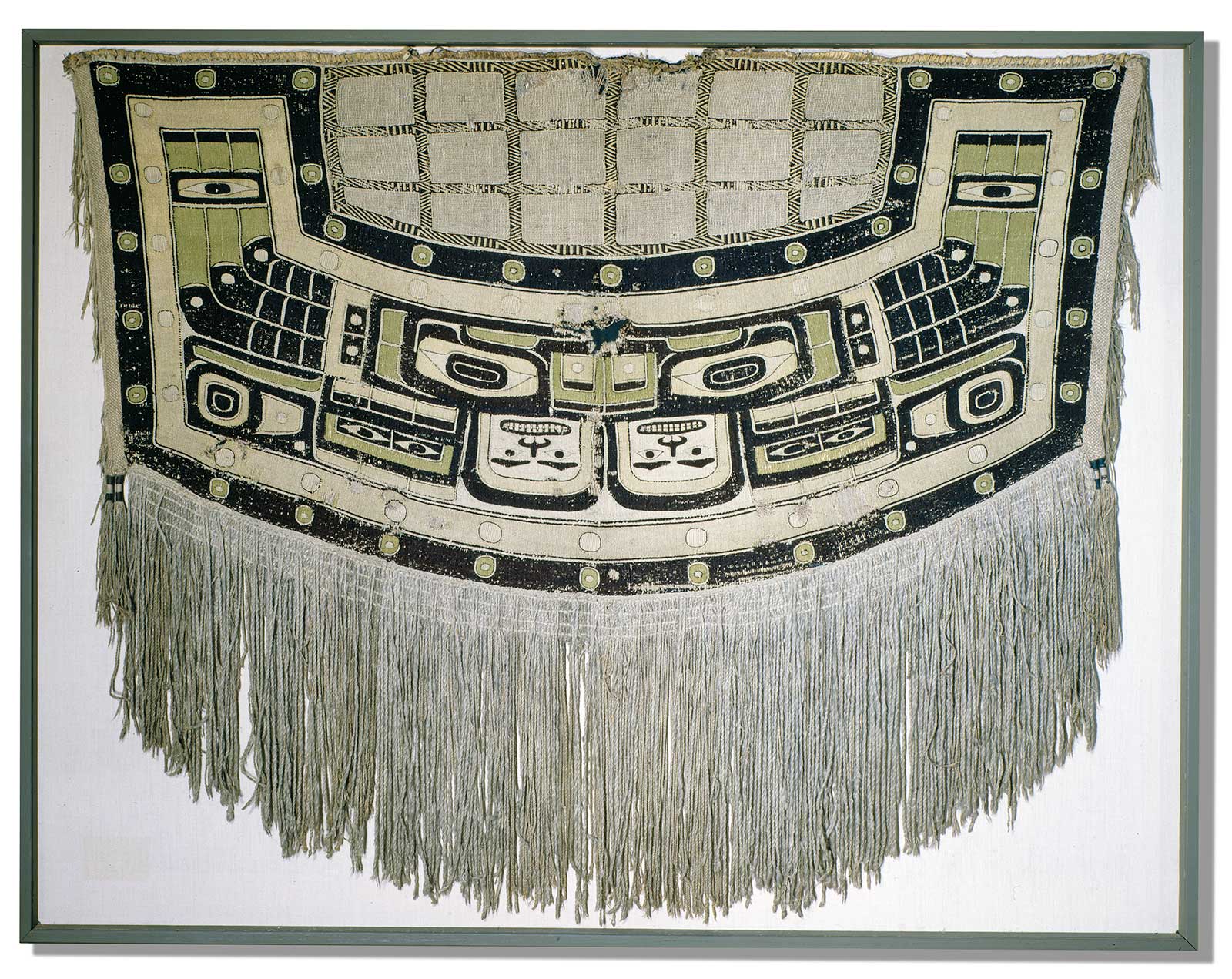 Reportedly collected in Tsimshian territory in 1880, this very finely woven transitional Ravenstail/Chilkat blanket exhibits a pronounced border, fringed sides and footing, and hints at the to-be standardized five-sided form with wrapped tie offs that we associate with the “classic” Chilkat design. The textile shares with the earliest Chilkat blankets a color palette of black, white, yellow and yellow-green. (Tsimshian artist, Ravenstail/Chilkat Robe, ca. 1800/1820, mountain goat wool and cedar bark, 33 x 613⁄16”. Museum Purchase: Indian Collection Subscription Fund, Rasmussen Collection of Northwest Coast Indian Art. Portland Art Museum, Portland, Oregon, 48.3.546.)
The general styling and weaving technique of the Chilkat blanket is said by Native oral histories to have sprung from the creativity of the Coast Tsimshians and has since become closely linked with the weavers of the Chilkat tribe of the Tlingit at the north end of Southeast Alaska. Just before warfare erupted between the 13 American Colonies and the British, the Spanish ship Santiago approached the north end of the Haida Gwaii archipelago (Queen Charlotte Islands) at Graham Island in [the summer of] 1774. Written accounts by priests of the woven fringed shoulder robes worn by Haida chiefs align with the sophisticated, purely geometric twined blankets in black on a white ground with yellow accents that pre-date European and Russian contact, now commonly referred to as “Ravenstail,” and not the later figurative “Chilkat” blanket with undulating black formlines. The earliest preserved proto-Chilkat blanket that utilizes Northern formline design principles in combination with geometric motifs was collected in 1778 on British Captain James Cook’s third voyage amongst the Nuu-chah-nulth at Nootka Sound, though it is argued to have been woven by a Northern culture.2 Another exceptional transitional robe now resides at the Portland Art Museum, which reportedly was collected in Tsimshian territory in 1880. A gridded panel with convex lower edge at the top center of the blanket preserves the Ravenstail geometric zigzag design, and a fully-developed twined formline crest figure hugs the gridded bib on the lower body of the blanket.
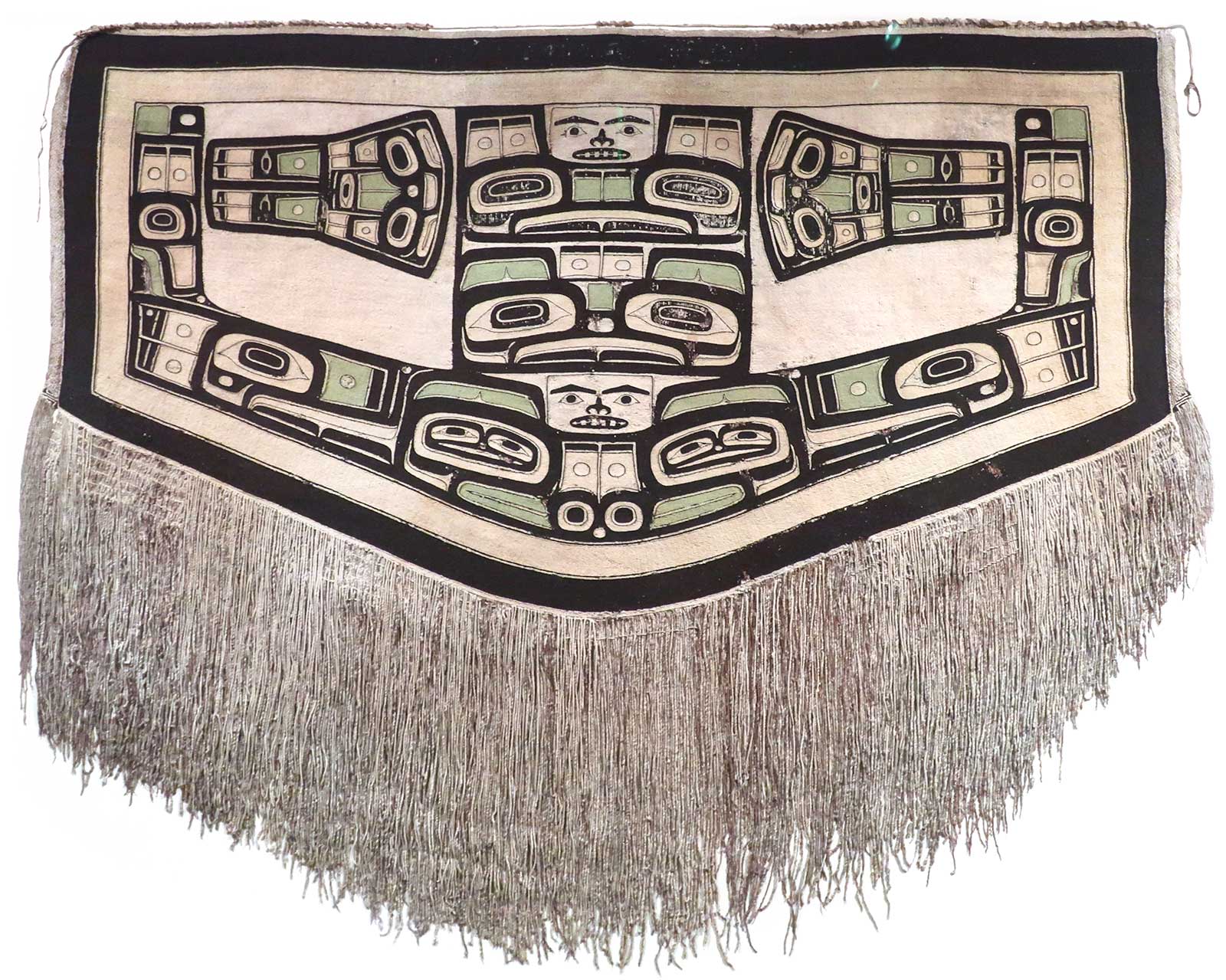 Attributed to the Tlingit, the “Coppers Robe” was donated in 1832 to the Peabody Essex Museum. A pattern board resembling the Coppers Robe has been passed down within a noted family of Chilkat weavers in Klukwan to contemporary weaver Lani Hotch, whose maternal great-great grandmother was Saantaas’ and maternal grandmother was Aklé (Mary Willard) (1867-1959). (Tlingit artist, Chilkat blanket, early 19th century. Mountain goat wool, cedar bark, leather. 53 x 63¾”. Peabody Essex Museum, Gift of Captain Robert Bennet Forbes, 1832. E3648.)
The earliest extant documented fringed “classic” Chilkat robe displaying purely figurative designs within the characteristic pentagonal format with double black and yellow border, rendered in the visual vocabulary of the northern Northwest Coast with black primary formlines, is believed to have been collected around 1825 by fur trader Robert Bennet Forbes at Fort Ross, the Russian-American Company’s trading post in present-day northern California. Attributed to the Tlingit, the “Coppers Robe” was donated in 1832 to the Peabody Essex Museum, and while lacking the typical three-part arrangement consisting of a confined primary design field and flanking lateral panels that mirror one another, the bilaterally symmetrical design is foretelling of the most prevalent design used in Chilkat weavings: a diving whale’s head appears at the center bottom, his lateral fins containing depictions of whale heads in profile and spreading outwards along the bottom borders. Two shield-form coppers—symbols of prestige and wealth along the Northwest Coast—are rendered sideways, floating freely within the white ground.
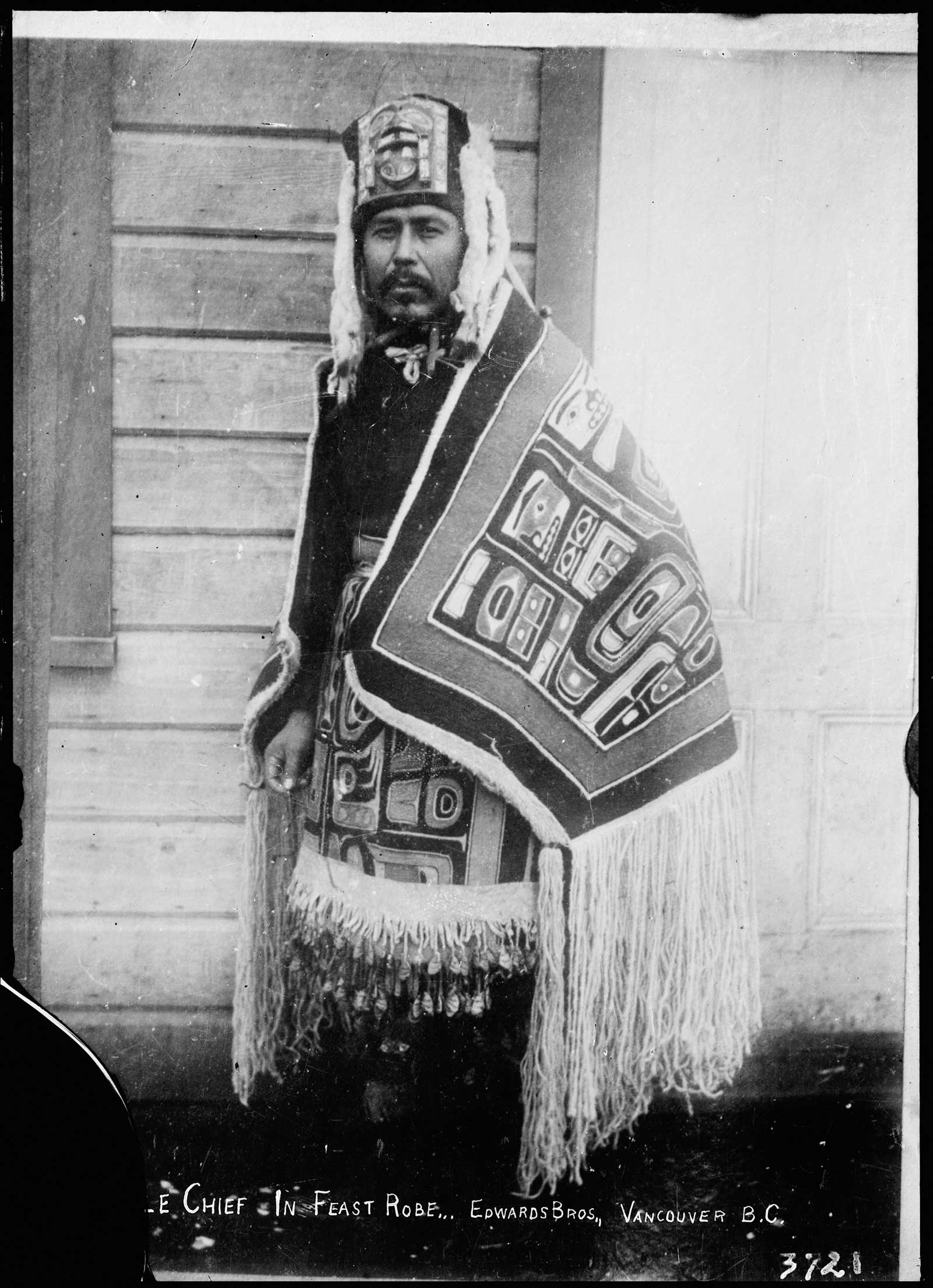 A Nisga’a chief of the Nass River Valley in Northwestern British Columbia stands in full ceremonial regalia constructed almost entirely of Chilkat weavings, 1902. His dancing blanket, worn high over his shoulders, represents a Thunderbird catching two Whales. (Nass Chief with Chilkat Blanket, Edwards Brothers, 1902. Vancouver Public Library, Accession No. 2675.)
The collection of the “Coppers Robe” around the mid-1820s coincides with the emergence of the recognizable three-part, bilaterally-symmetrical Chilkat blanket style,3 discernible by the highly-developed and representational Northern Northwest Coast design principles in which a crest animal(s) or creature—which visually communicated the original wearer’s house or clan identity—is dissected into a multitude of flat body facets and spread out amongst the design field so as no space is left uncovered. These faceted body parts, outlined in flowing curvilinear and interconnected black or dark brown lines known as formlines over the natural ivory ground, were rendered with minimal diversion in a specific color palette of yellow and yellow-green (early Chilkat blankets) or blue-green (last quarter of the 19th century onwards) in the tertiary areas.
The Art of Chilkat Weaving
Many believe the Chilkat weave to be one of the most complex textile styles in the world. Historically, women bore sole responsibility for the labor-intensive preparation of materials and weaving the blankets following the spring-time harvesting of yellow cedar bark and mountain goat wool. Reciprocal trade between Northwest Coast and further inland tribes was vital for blanket weavers to acquire the necessary materials; cedar did not thrive in the Northern Tlingit region; mountain goats did not inhabit the mountains of Haida Gwaii, and the wolf lichen ancestrally used to produce the yellow dye flourished in the interior regions of the Pacific Northwest.
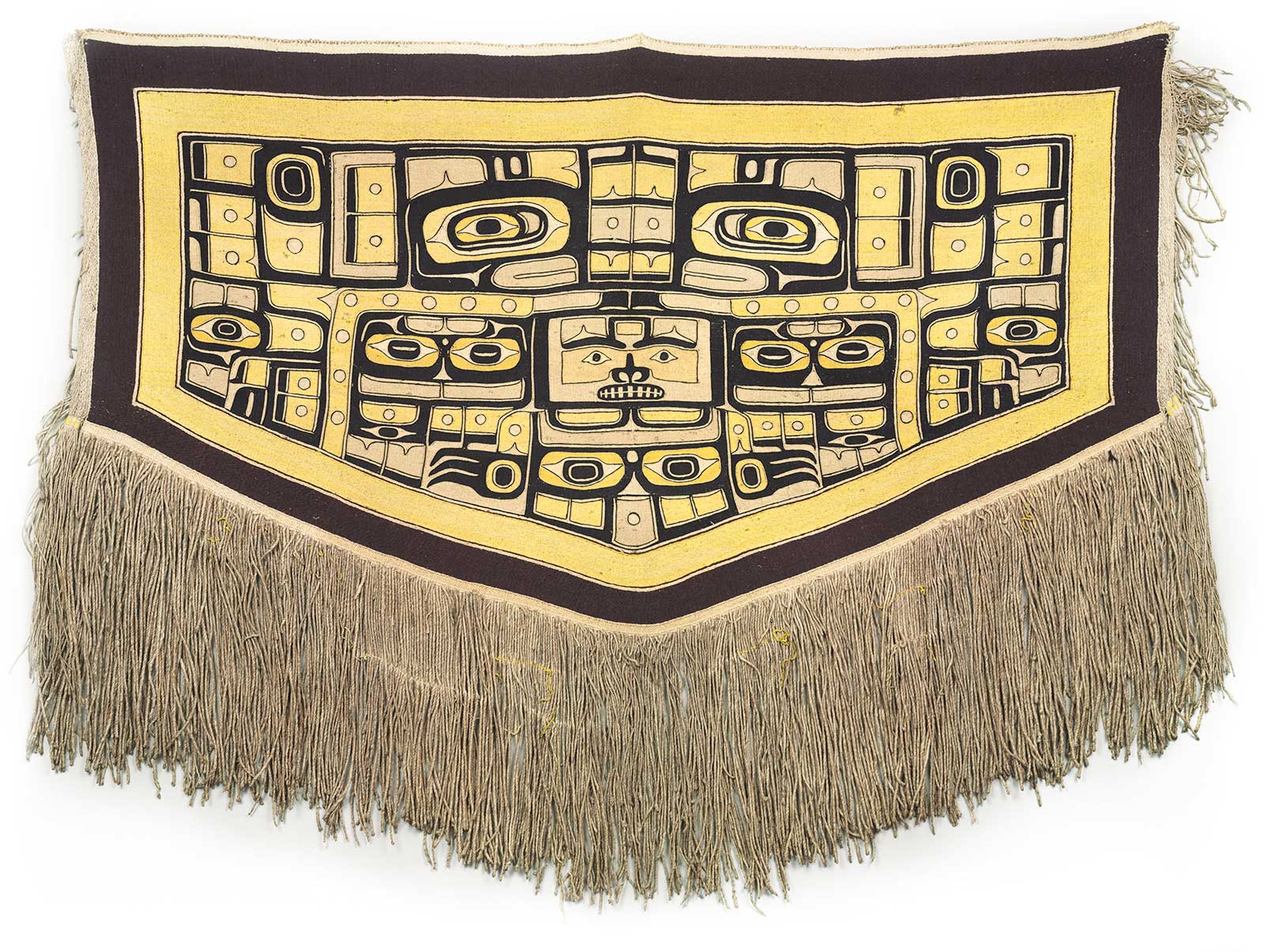 Perhaps a nod to the earliest “Coppers Blanket,” several blankets were created at the end of the 19th century in which crest figures are depicted configuratively without the continuous formline nor delineated three-part division of the design field, often with floating elements against the ivory ground. This circa 1880s example originating from the Frog House of the Chilkat Tlingit at Klukwan depicts the “frog emerging from its winter hibernation” at center. (Courtesy of the Brant Mackley Gallery, Santa Fe, New Mexico. Collected by Henry C. Gibson (1830-1891), a noted Philadelphia philanthropist.)
Chilkat blankets are finger woven on a single-bar upright loom without the aid of any instruments with similar twined weaving techniques as utilized in the cultures’ baskets. Yarn constructed by spinning together two strands of cord made from the plucked wool of mountain goat was utilized for the strands to be visible on the surface of the blanket (known as the wefts), and was woven horizontally from left to right over passive vertical strands comprised of a hearty core of shredded and twisted yellow cedar bark encased in a layer of mountain goat wool (known as the warps, and concealed in totality by the weft strands).
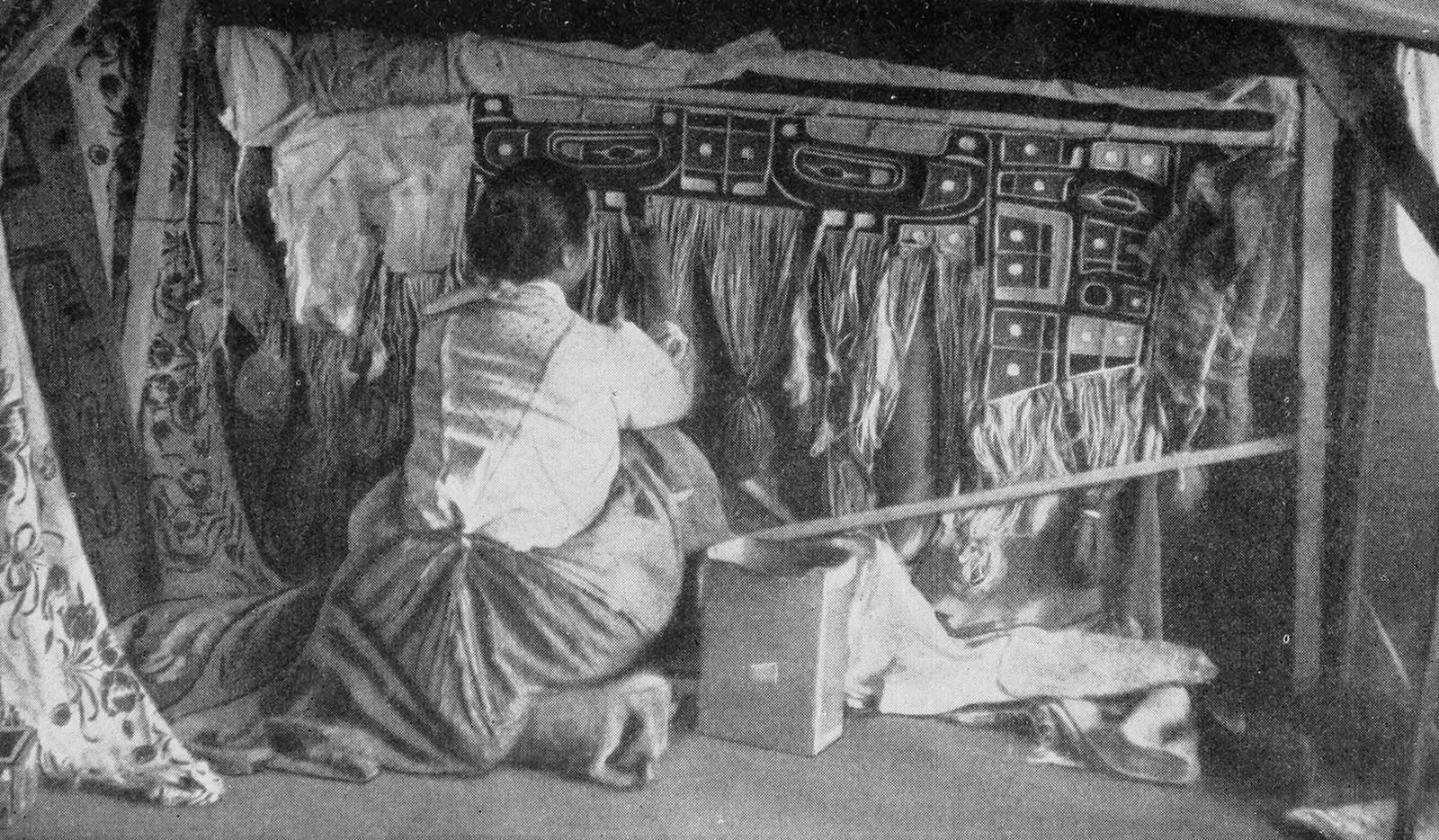 A historic early-20th-century photograph of a Tlingit woman of the Chilkat tribe in the act of weaving demonstrates how, worked from top to bottom, the abstracted body fragments of the Chilkat robe design were woven in one small section at a time before being united together. The weaving is wound up on the loom beam, the warp ends gathered in bundles and tethered within animal bladder “gut bags” to keep them untangled and clean. (Chilcat Woman Weaving a Blanket, illustrated in Samuel Hall Young, Alaska Days with John Muir (Fleming H. Revell Company, 1915), illustration facing p. 82.)
This unique ability to translate the curvilinear formline designs derived from painted wooden pattern boards (furnished by a male of tribe) that could travel without confinement over the woven surface, as well as complete circles, was the result of the weavers’ distinguished invention of a weaving technique known as braided twining: three strands of spun mountain goat wool are braided kindred to how a woman would braid her hair. This braided cord is then secured to either a weft strand (if the weaver desired to travel vertically) or a warp strand (if the weaver desired to travel horizontally) to form a beautiful raised twisted line that outlines shapes within the design.
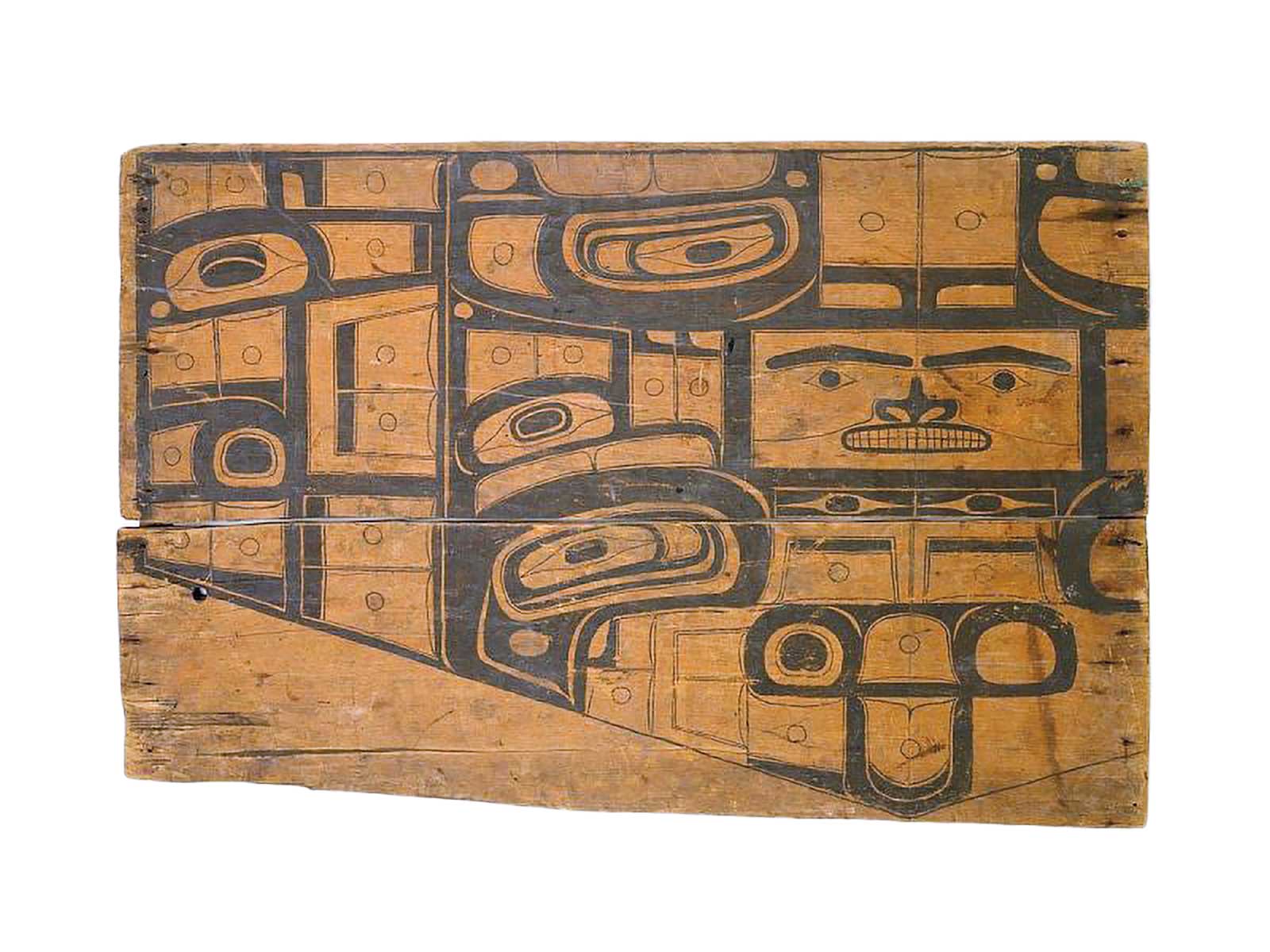 This Chilkat blanket pattern board was collected in 1900 by Lieutenant G. T. Emmons among the Tlingit. Crafted from two wide, handmade boards of western red cedar, the black painted Northern Northwest Coast formline depiction displays a little more than half of the “Diving Whale” blanket pattern—the most prevalent in Chilkat weaving—excluding the black and yellow borders, as the bilaterally symmetrical nature of the design necessitates just enough of the repeat be illustrated. “Placement of yellow and blue was so nearly fixed that skilled weavers knew just where those colors were to be.”8 (Tlingit, Chilkat Blanket Pattern-Board, collected 1900 (Southeastern Alaska), Lt. George T. Emmons. Collection of the Smithsonian National Museum of Natural History, Cat. No. E209581-0, Accession No. 037750, March 28, 1901.)
Innovation, Adaptability, and Continuity of the Art Form
The mid-1800s were marked by a myriad of external influences that socially altered northern Northwest Native cultures, including the land-based fur trade that particularly benefited the Chilkat Tlingit, Tsimshian and Kwakwaka’wakw who resided in the regions where river otter, bear, marten and mink thrived. The Chilkat weaving techniques diffused along the Northern Coast, and with the increased wealth came an increased necessity to commission such ceremonial regalia as the Chilkat blanket to be worn and gifted at feasts. Intercultural transactions and responses to external forces are evident in the transition from using purely natural dyes to incorporating aniline dyes (primarily black) beginning in the 1860s, commercial colored wools, and the sourcing of blue or blue-green from boiling indigo trade blankets or military jackets.4 By the last quarter of the 19th century, when many Chilkat robes were collected by natural history museums, missionaries and tourists alike, the vibrant robin’s egg blue color predominated and these distinct blankets were christened “Chilkat blankets” by white traders due to the majority materializing from the Chilkat Tlingit located at Klukwan.
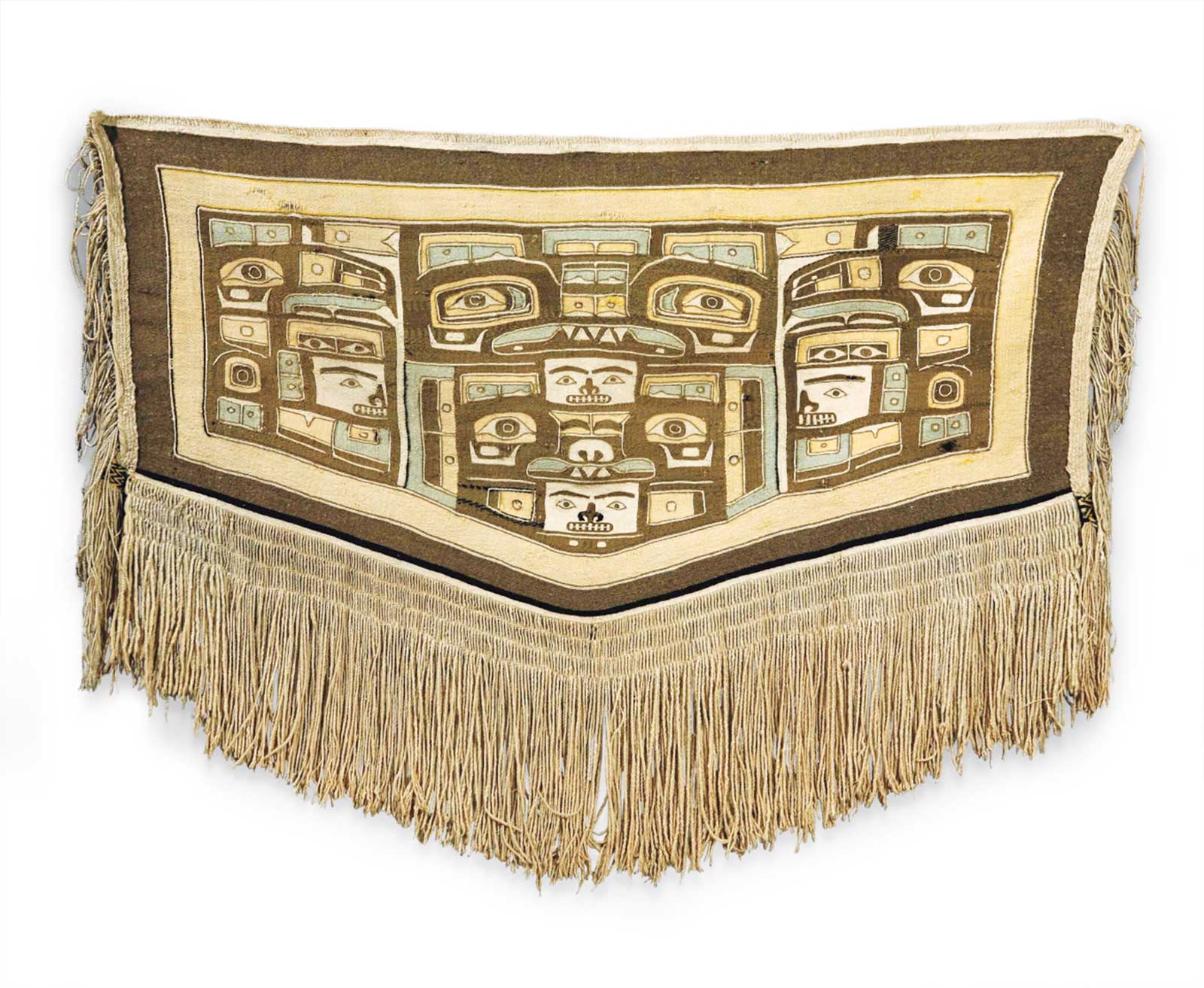 The Chilkat blanket’s abstracted design principle, with the crest animal or creature’s body parts dissected and distributed across the design field, can make for complicated interpretation. This blanket, in the collection of the Cleveland Museum of Art, is said to represent either a Sea Bear or standing Eagle with outspread wings. (Tlingit, Ceremonial Garment (Naaxein) (Chilkat Blanket), late 1800s. Weft twining: cedar bark wrapped with mountain goat. 54¼ x 69”. Cleveland Museum of Art, Gift of Mrs. A. Dean Perry, 1981.69.)
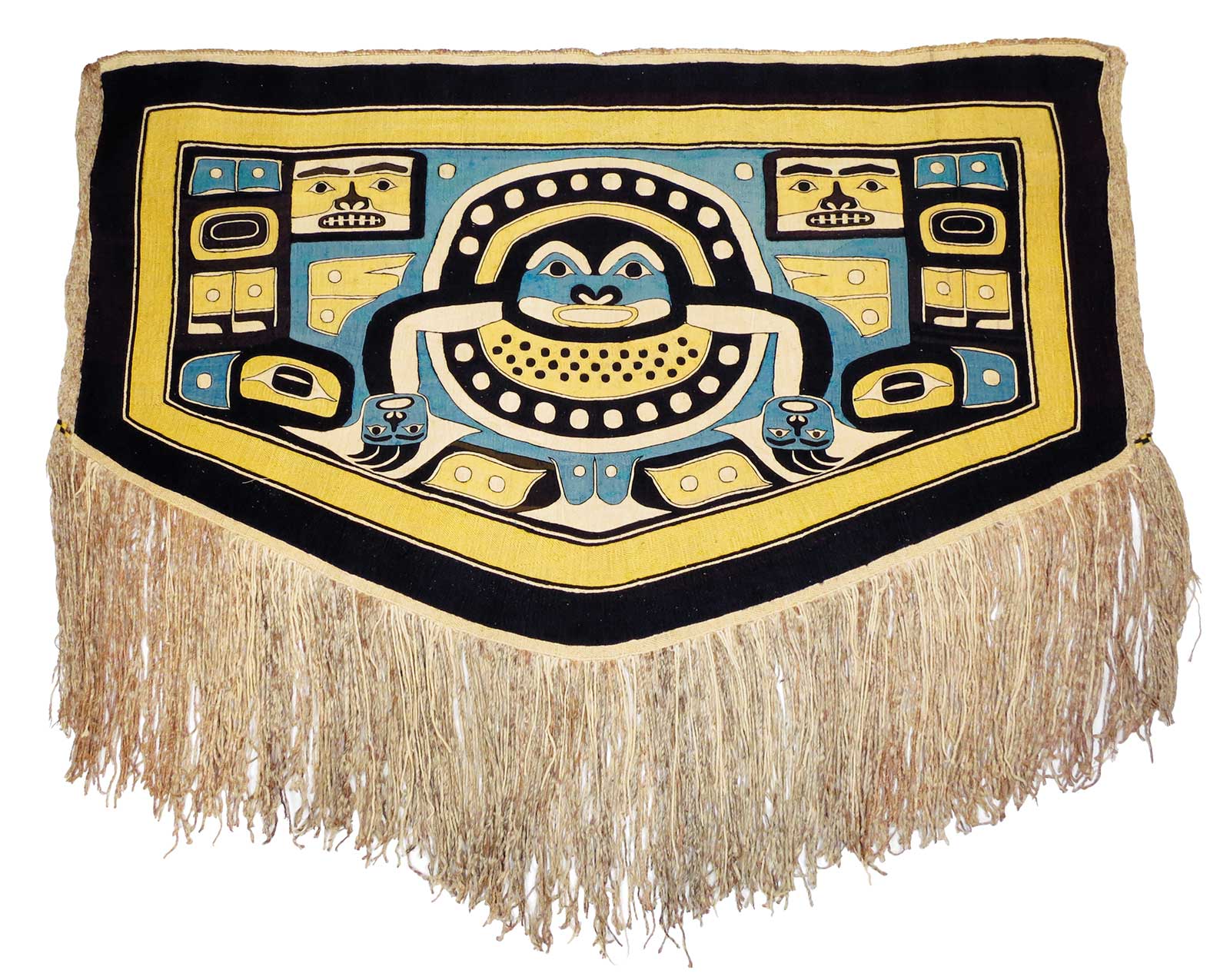 Perhaps a nod to the earliest “Coppers Blanket,” several blankets were created at the end of the 19th century in which crest figures are depicted configuratively without the continuous formline nor delineated three-part division of the design field, often with floating elements against the ivory ground. This circa 1880s example originating from the Frog House of the Chilkat Tlingit at Klukwan depicts the “frog emerging from its winter hibernation” at center. (Courtesy of the Brant Mackley Gallery, Santa Fe, New Mexico. Collected by Henry C. Gibson (1830-1891), a noted Philadelphia philanthropist.)
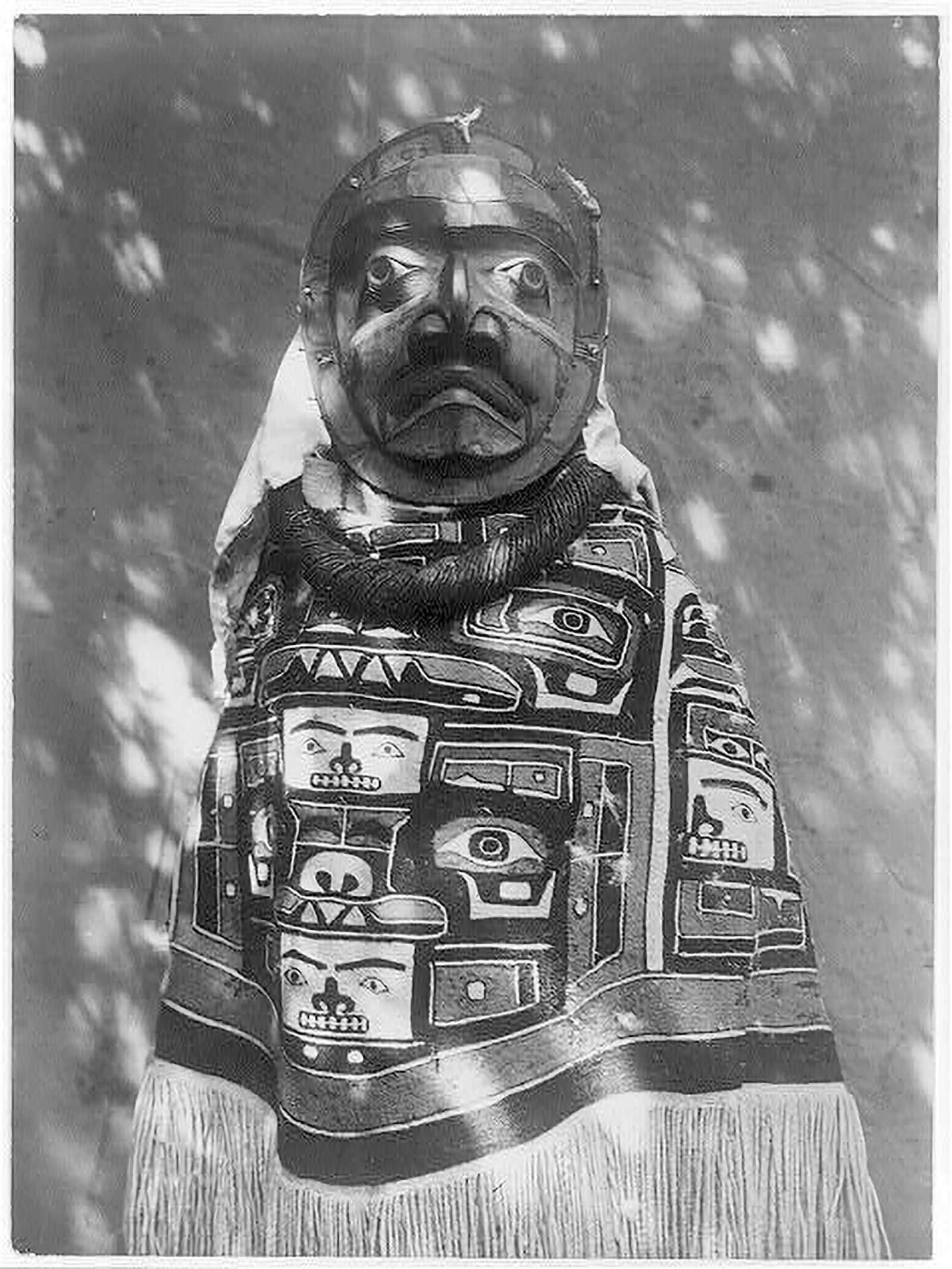
Anisalaga (Mary Ebbetts Hunt) (1823-1919), a high-ranking woman of the Gaanax.ádi (Frog) clan of the Taant’á Kwáan (Tongass) Tlingit, is credited with having introduced Chilkat weaving techniques to Kwakwaka’wakw territory by means of marriage to a Hudson Bay Company factor Robert Hunt (English, 1828-1893). Primarily living at Tsaxis (Fort Rupert), Anisalaga’s Chilkat weavings are visual expressions of adaptation and innovation, including progressive experimentation with the content of the warp (lightly twisted cotton, twine, plain sheep’s wool, and lastly a core of cedar bark). This Chilkat robe is one of 13 known blankets woven by Anisalaga at Tsaxis, ca. 1865-1871, depicting a variation of her common pattern design, which includes Ravens in profile within the side panels. Photographed in ca. 1910-1914 by Edward S. Curtis—to whom Anisalaga’s first-born son, George Hunt (1854-1933), who served as translator and consultant—the blanket went on to be purchased from the Paris branch of Christie’s auction house in 2014 by the U’mista Cultural Centre of Alert Bay. Pictured right: Chilkat blanket attributed to Mary Ebbetts Hunt (Anisalaga, 1823-1919), Fort Rupert, Vancouver, British Columbia. Pictured above: Edward S. Curtis (1868-1952), A Tluwulahu Costume – Qagyuhl, Curtis No. 3565, ca. November 13, 1914. Library of Congress Prints and Photographs Division, Washington, D.C.. Call No. LOT 12328-A.)
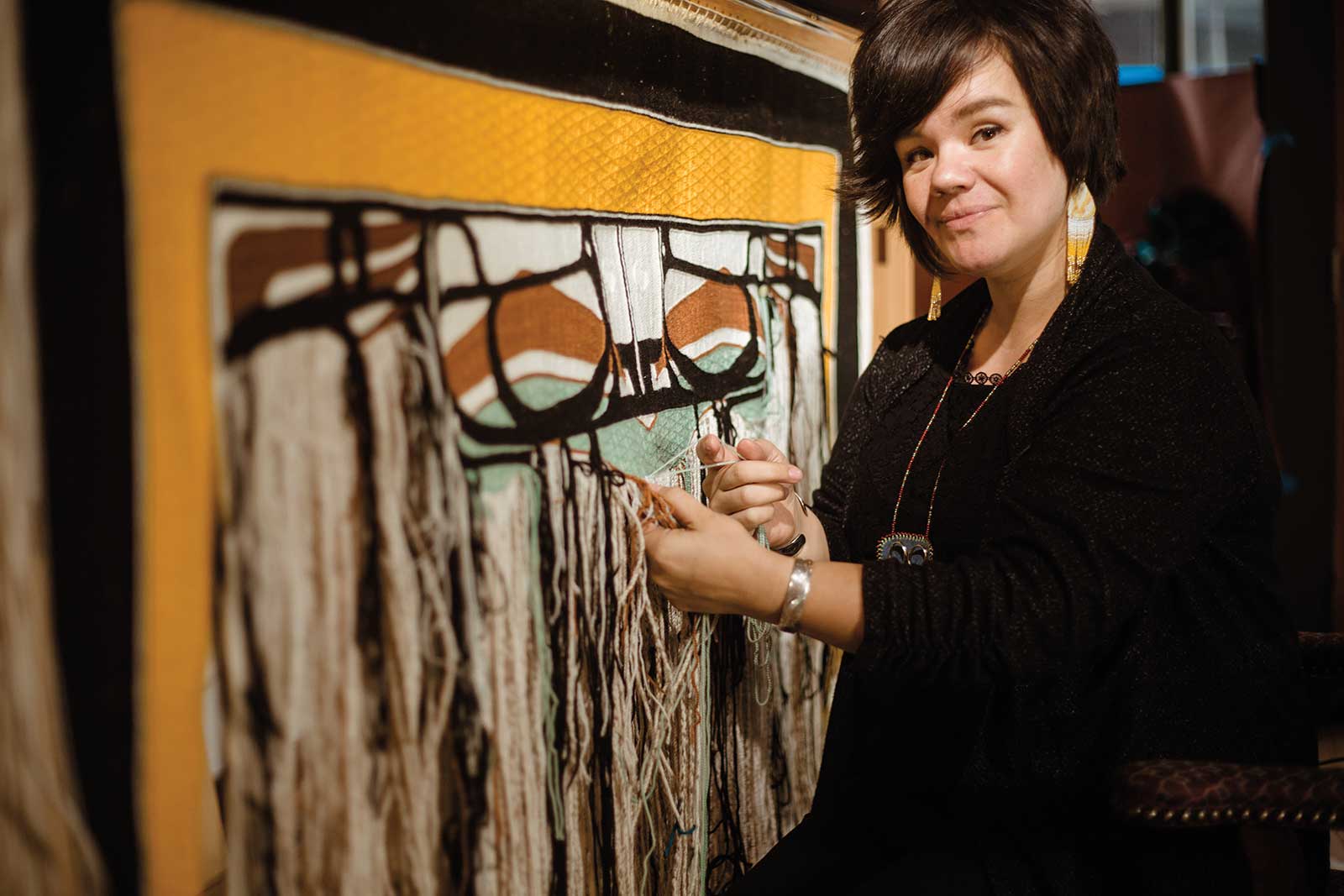 Wooshkhindeinda.aat Lily Hope (Tlingit/Filipina) (Raven T’akdeintaan Clan, Snail House out of Hoonah, Alaska) of Juneau is currently working on her third full-size Chilkat robe, titled “Aantlenx’Xh’aak: Between Worlds,” a commissioned work for the Houston Museum of Natural Sciences. “Between Worlds” is a merging of two different beings: The bones of a Diving Whale pattern are executed in black commercial acid-dyed merino wool wefts as an expression of present-day weaving traditions; through the back of this design emerges a spirit being, with hands and face pressed against the veil between two worlds, woven with merino weft yarns hand dyed in burnt sienna brown, sea foam green, and pale yellow using historical recipes for natural dyes to honor ancestral weavers. The weaving is Hope’s most ambitious to date, requiring 1,500–2,500 hours at her loom, with an anticipated completion this June. (Wooshkhindeinda.aat Lily Hope (Tlingit/Flipina), Aantlenx’Xh’aak: Between Worlds, 2021-2022 (in process). Thigh-spun merino wool and cedar bark warp, hand dyed merino weft yarns—using both commercial acid dyes and ethnographic recipes for natural dyes. 74 x 49”, including dance fringe. Photo by @Sydneyakagiphoto, Tléináxh Shaawát Sydney Akagi.)
Unlike the geometric Ravenstail robe, the Chilkat blanket has an unbroken history of creation since its inception two centuries ago. By 1907, it is believed that only fifteen Tlingit weavers of Chilkat blankets remained, and Jennie Thlunaut (Shax’saani Keek’) (Kaagwaantaan clan, Chilkat Tlingit, 1892 – 1986), the “last of the traditional Chilkat weavers,” is recognized as having invigorated the modern production of the robes in 1985 with a workshop in Haines, AK, at the age of 93. Social and cultural preservation and transformations continue to reveal themselves in the Chilkat weavings of contemporary artisans, both female and male. Wooshkhindeinda.aat Lily Hope (Tlingit/Filipina) (Raven T’akdeintaan Clan), a celebrated weaver who creates ceremonial, museum and art-collectible Chilkat dancing blankets out of her studio in Juneau, AK, speaks to the layered meanings embedded in the weave of Naaxéin: “Chilkat is not about the individual. It is about community. It is about healing. It is about collective memory, ancestry, and history. It is about sharing who we are right now. Who we’ve always been, and where we go from here.”
FOOTNOTES
1. From the Tsimshian accounting for the origin of the Chilkat blanket, as recorded by George T. Emmons, “IV. The Chilkat Blanket,” Memoirs of the American Museum of Natural History, Volume III, Part IV., December 1907, p. 329.
2. This blanket is in the collection of the Museum für Völkerkunde, Vienna, Austria, Cat. No. 218. Ex-Leverian Museum (1790, sold in 1806 at Leverain Sale, #2817), ex-Cook Collection.
3. Russian artist Pavel Nikolaevich Mikhailov’s Sitka portfolio from the Russian M. N. Staniukovich around-the-world expedition of 1826 to 1829 illustrates a “classic” Chilkat in 1828, the yellow-green, yellow, black and white color palette captured (see William W. Fitzhugh and Aron Crowell, Crossroads of Continents: Cultures of Siberia and Alaska (Washington, D.C.: Smithsonian Institution Press, 1988), Fig. 63, p. 61).
4. Hemlock bark was used for reddish brown to dark brownish-black (the latter requiring a subsequent overdye in a copper/ammonia bath), wolf moss (a traded material) for yellow, and blue remains enigmatic, possibly was derived from indigo or a copper/ammonia (urine) solution. See Mary W. Ballard, G. Asher Newsome, and Susan Heald, “An Ongoing Mystery: Copper Kettles and Chilkat Blue.” The Textile Specialty Group Postprints. 29 (2019): pp. 99-113.
Powered by Froala Editor