Northwest Coast Indigenous art has always been receptive to cultural and social aesthetic trends. When argillite sculpture from the archipelago of Haida Gwaii caught the attention of visitors and collectors during the mid-1800s, Haida artists began creating Western objects like pipes and mugs from this slate-like rock. After chainsaws became widely available in the 1960s, artists in the Pacific Northwest jumped at the opportunity to own a tool that could help them both fell trees and rough-out large-scale sculptures. Advancements in three-dimensional printing and laser technology have now inspired some Northwest Coast Indigenous artists to experiment with new techniques and materials. While there are traditionalists in every field, many Northwest Coast artists have historically embraced technological advancements to help push the art form forward and to innovate.
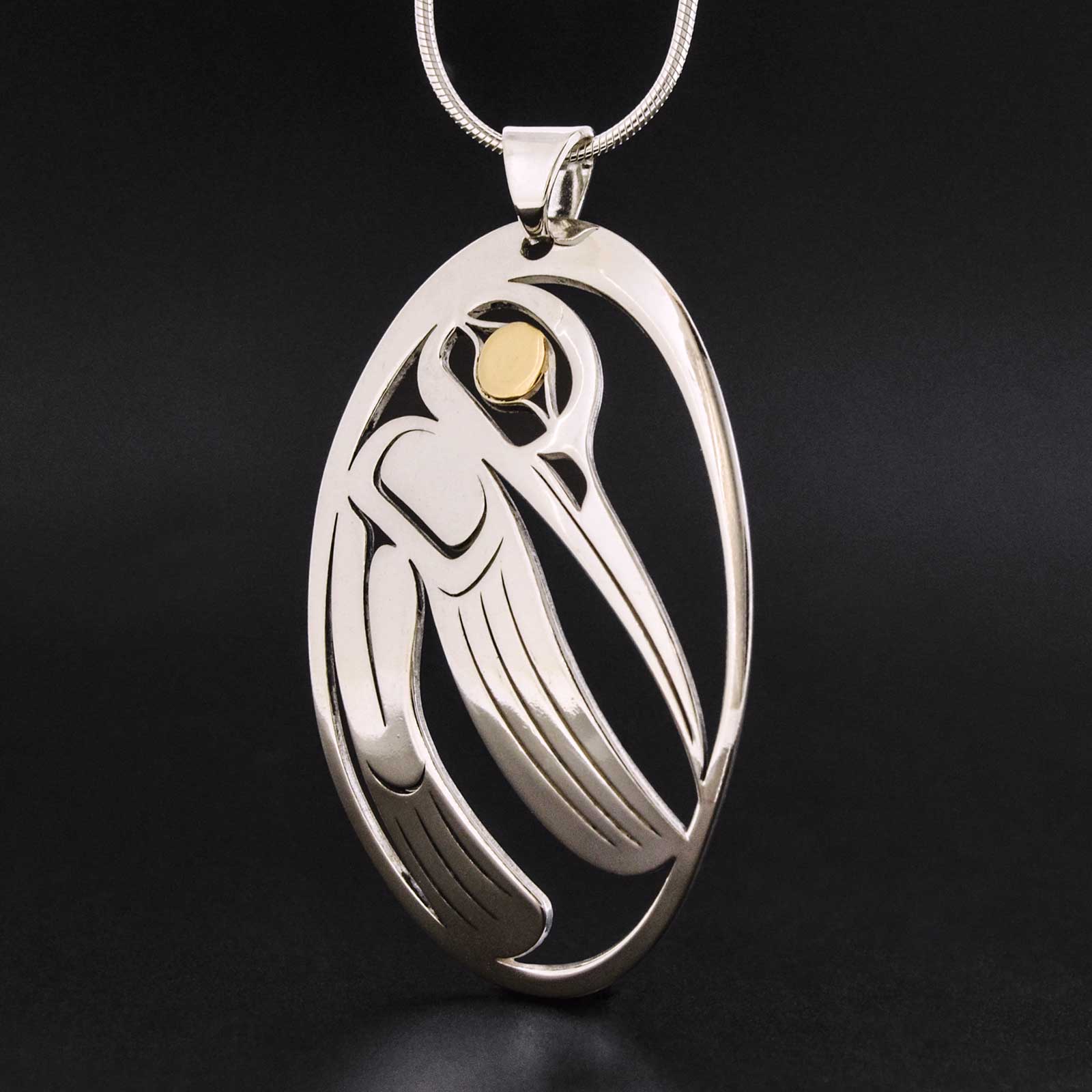 Grant Pauls (Tahltan), Hummingbird, sterling silver and 18k gold pendant. Photo Credit: Lattimer Gallery.
Some galleries in the Pacific Northwest have started carrying lines of jewelry created with assistance from Computer Numerical Control (CNC) machining, which is a manufacturing process that involves pre-programmed computer software dictating the movement of laser or water jet cutting tools. While all jewelry produced using this method still requires hand-finishing, filing and polishing, it results in pieces that are sleek and refined. Another benefit of laser-cut jewelry is that it enables artists unversed in hand-engraving and soldering to create wearable artwork. For example, a printmaker who creates popular designs through serigraphy—but has never attempted to hand-engrave metal—could have one of their designs vectorized, inputted into a CNC machine, and transformed into a piece of sterling silver or gold jewelry. The creative process behind generating a piece of unique jewelry is essentially the same when comparing hand-engraving and laser-cutting, but artists who employ the latter are embracing modern modes of production.
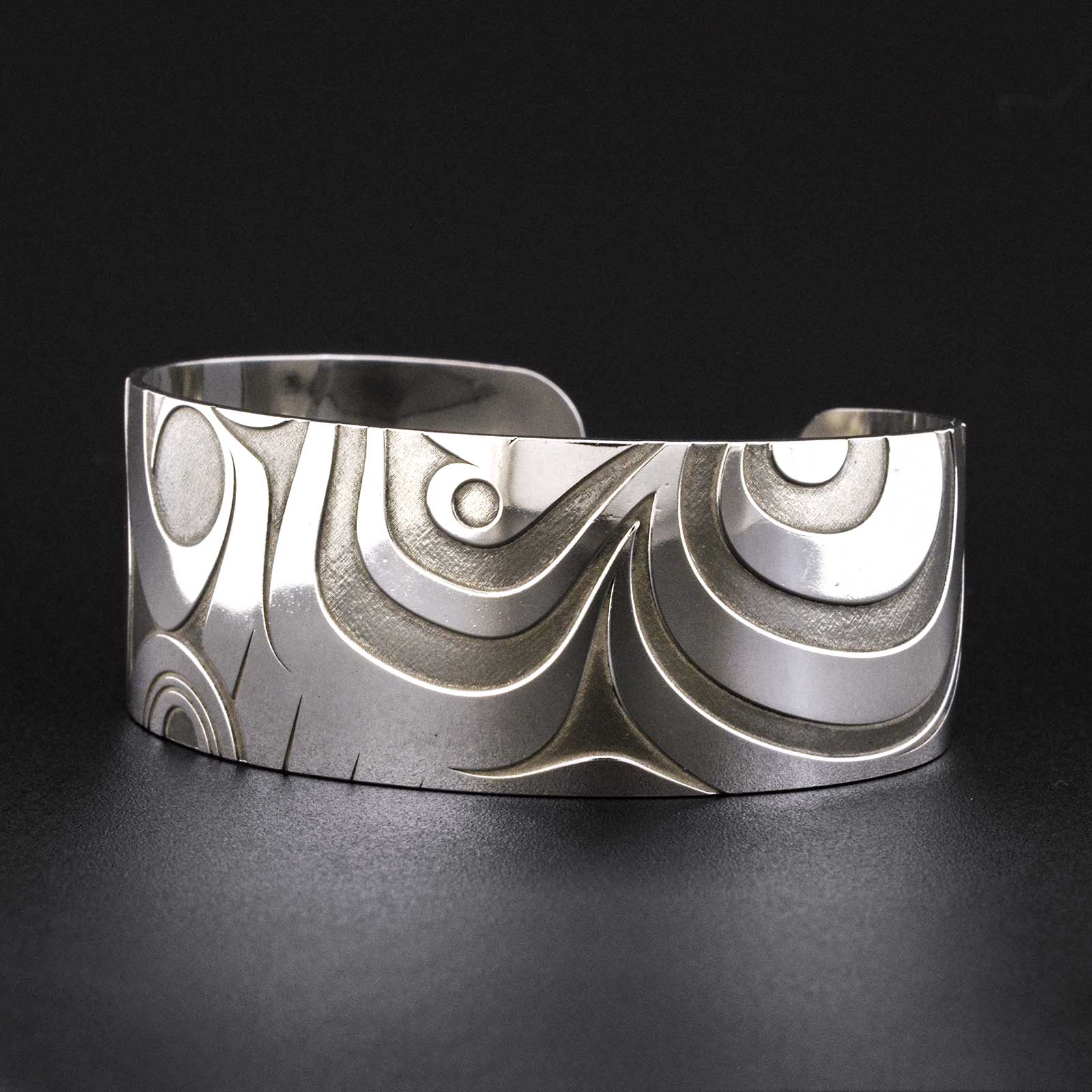 John Velten (Dené), Abstract Thunderbird, sterling silver bracelet. Photo Credit: Lattimer Gallery.
Two artists who have adopted this new method are Grant Pauls (Tahltan) and John Velten (Dené). Pauls primarily creates earrings and pendants that display figurative and bold animal crest symbols. His designs are clear, crisp and classic. He also sets his pieces apart by embellishing many of them with 18-karat yellow gold overlays. Velten is a young artist who is finding his own creative voice by adding stylized elements to conventional symbols. He recently created a laser-cut sterling silver bracelet titled Abstract Thunderbird that was made by cropping a portion of a larger, cohesive design to produce a work that looks modern and conceptual.
Many associate the art of Pacific Northwest Indigenous cultures with woodcarving and sculpture born of the massive evergreens that line the coast. From Longhouses to Welcome Poles, many cultures in the region have taken advantage of these abundant, carvable conifers to create monumental and highly detailed works. Regarding hand-carved sculpture created for purchase, most pieces in the market are relatively expensive. Clear timber must be sourced, original designs must be conceived, adequate tools must be obtained, and then artists must laboriously carve and knife-finish their pieces by hand. All fans of Northwest Coast art would love to adorn their homes and workspaces with one-of-a-kind panels and masks, but at current price points this is just not attainable for many. Recognizing this gap in the market, Chris Gaston, University of British Columbia forestry professor and university liaison at FPInnovations, and Brenda Crabtree, Director of Aboriginal Programs at Emily Carr University of Art and Design, developed the B.C. Aboriginal Doors program. The initiative launched in 2016 with 10 Indigenous artists from across the province each hand-carving a cedar door, with assistance from several established artists. After the doors were completed, they were transported to UBC where they were replicated using large CNC machines. It only took about three hours for the digital routers of the CNC machines to replicate each hand-carved door. Although each reproduction had to be touched up, they could retail for around $5,000, while the hand-carved doors would retail for around $20,000. “Aboriginal art is an estimated $2 billion market worldwide, but only for a few select, high-end artists,” says Gaston. “We hope that the training and application of computer-assisted machining technologies will lead to added wealth for the artists and First Nations communities.”
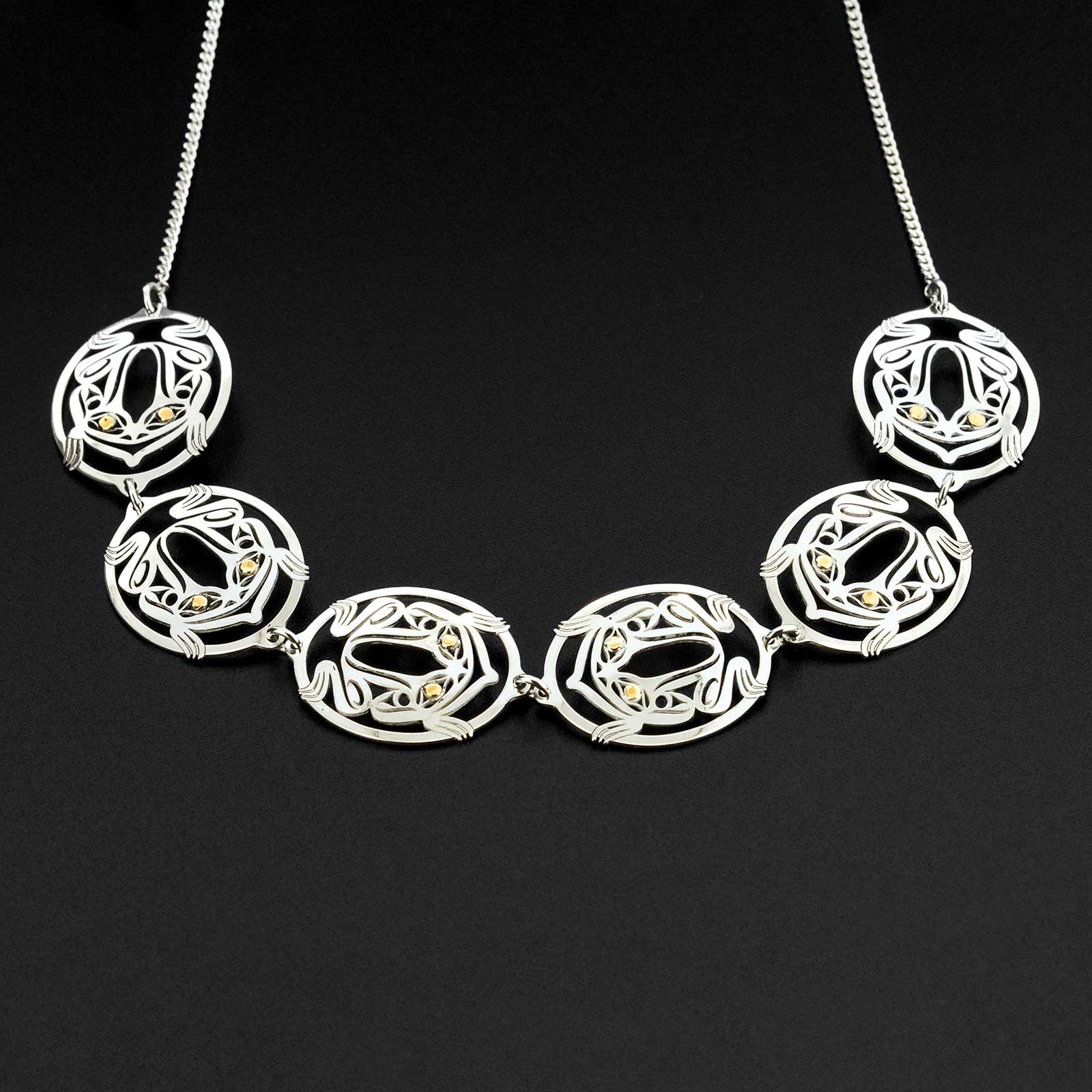 Grant Pauls (Tahltan), Frogs, sterling silver and 18k gold necklace. Photo Credit: Lattimer Gallery.
Recently, a handful of artists have developed an alternative process to produce artworks that are both crafted from local cedar and affordable. Deeply carved, sleek wall panels can be created through sandblasting, in addition to CNC processing. To create works using the sandblasting technique, artists draw an original sketch and then transfer this sketch to thin rubber matting. The negative spaces of the design are then cut away by hand, and the rubber mask is applied to the substrate. Then, the negative spaces are removed by a spray of sand, blasted at high pressure against the wood. The resulting works are original, graphically bold, and usually half the price of hand-carved artworks due to the time saved from the sandblasting process. In some cases, this process is able to highlight the idiosyncratic design sense of each artist and the characteristics of the wood better than a hand-carved piece, due to the way the blasting emphasizes the natural grain and color of the wood. In 2015, Jazmine McCrimmon-Cook—a young Kwakwaka’wakw artist from Vancouver Island—was one of the first artists to employ this technique in the production of Northwest Coast fine art.
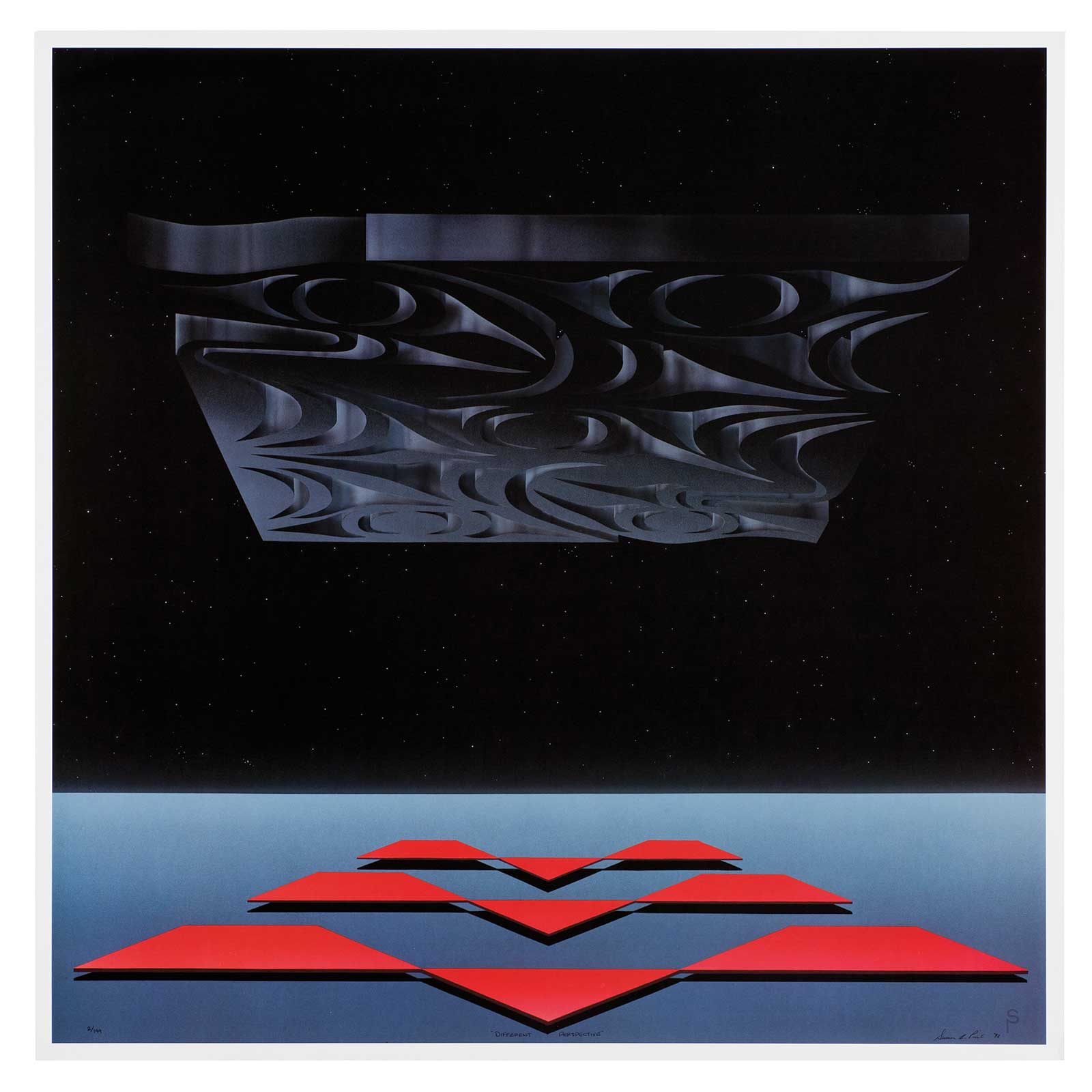 Susan Point (Coast Salish), Different Perspective, limited-edition print. Photo Credit: Lattimer Gallery.
After personal computers became ubiquitous in the 1990s, some Northwest Coast designers and printmakers began using software to create digital forms of their artwork and producing giclée inkjet prints rather than silkscreens. Many Northwest Coast Indigenous artists started to experiment with producing representations of crest symbols on silkscreen prints and lithographs in the 1970s, as these materials became more accessible and affordable. Printmaking was a way to create art for art’s sake. Free from the obligation of tailoring designs to the specific spatial requirements of bentwood boxes, drums, or dance screens, artists began creating prints to produce unconventional works that reflected their unique personalities and distinct cultures. It was also a method of production that was quick and efficient, and prints became the predominant form of two-dimensional art in the market. To this day, original paintings—which still drive the conventional art market—have not been a popular medium within the context of Northwest Coast artwork. Computer programs that allow users to create and edit images interactively on their computer screens, and then easily save them in raster or vector graphic file formats, began to emerge in the early 1990s. Graphics editing programs like Adobe Photoshop and CorelDRAW allow artists to not only create works from start to finish in a digital medium, they also make it easy for artists to add effects like shading, gradation and perspective to their compositions. These are effects that had very rarely, if ever, appeared in the world of Northwest Coast Indigenous art before.
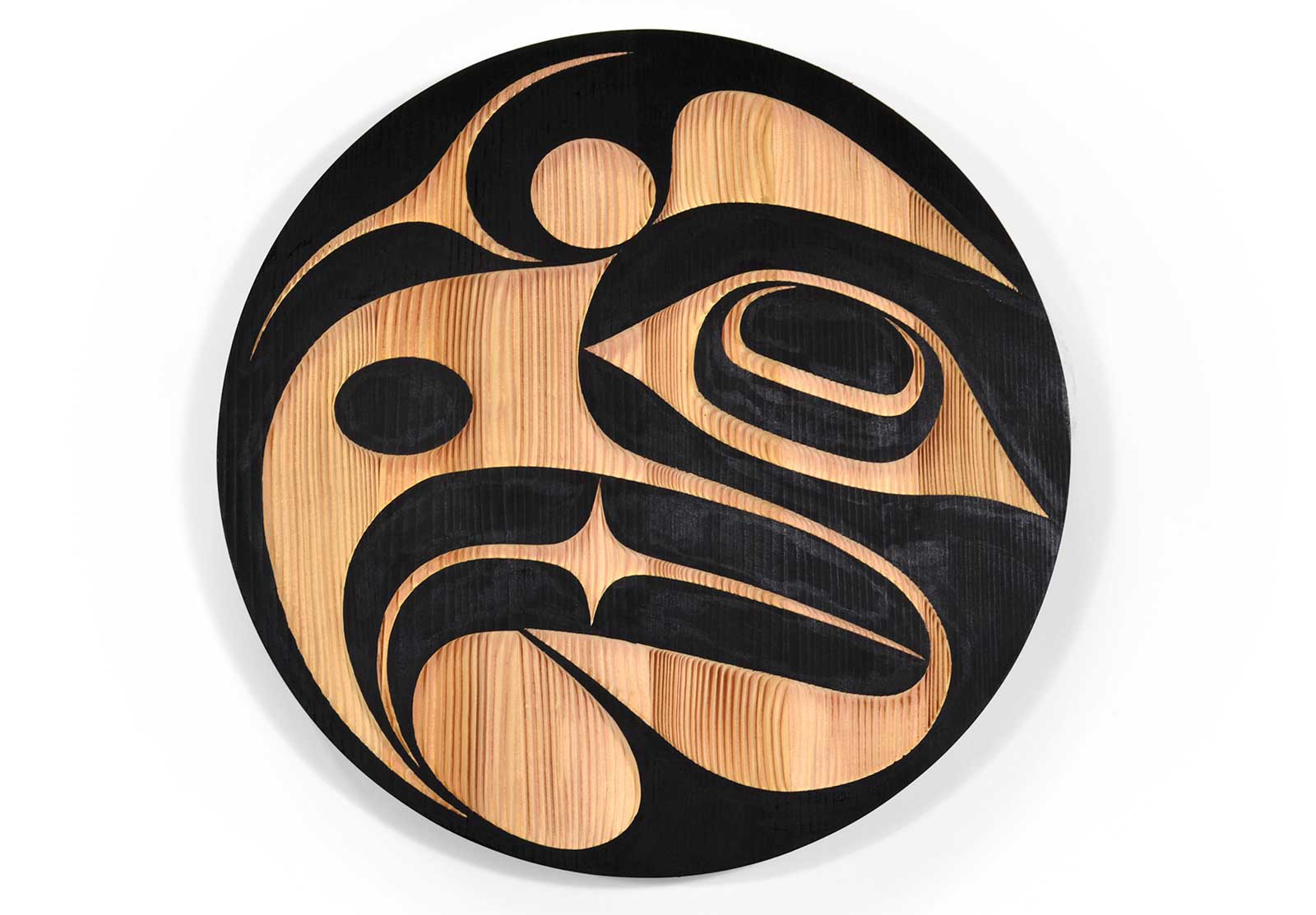 Jazmine McCrimmon-Cook (Kwakwaka’wakw), Thunder, red cedar sandblasted panel. Photo Credit: Lattimer Gallery.
Among the artists who applied these new tools to their trade early on were Susan Point (Musqueam) and Andy Everson (K’ómoks and Kwakwaka’wakw). In her Different Perspective limited-edition giclée print from 1992, Point portrays a giant Coast Salish monolith floating in space and hovering futuristically above a digital landscape that resembles a Musqueam weaving pattern. One of Everson’s earliest digital prints is titled Ancestral Steps and starkly depicts four cascading Chilkat-style faces. Everson writes of this piece, “I conceived of Ancestral Steps after finishing my master’s degree. I envisioned the legacy of knowledge left to me from my ancestors and wished to acknowledge that mine was not a solitary effort, but part of something much bigger.” In both of these pieces, personal and cultural visions have been applied to a new creative technology and produced works that are both timeless and innovative.
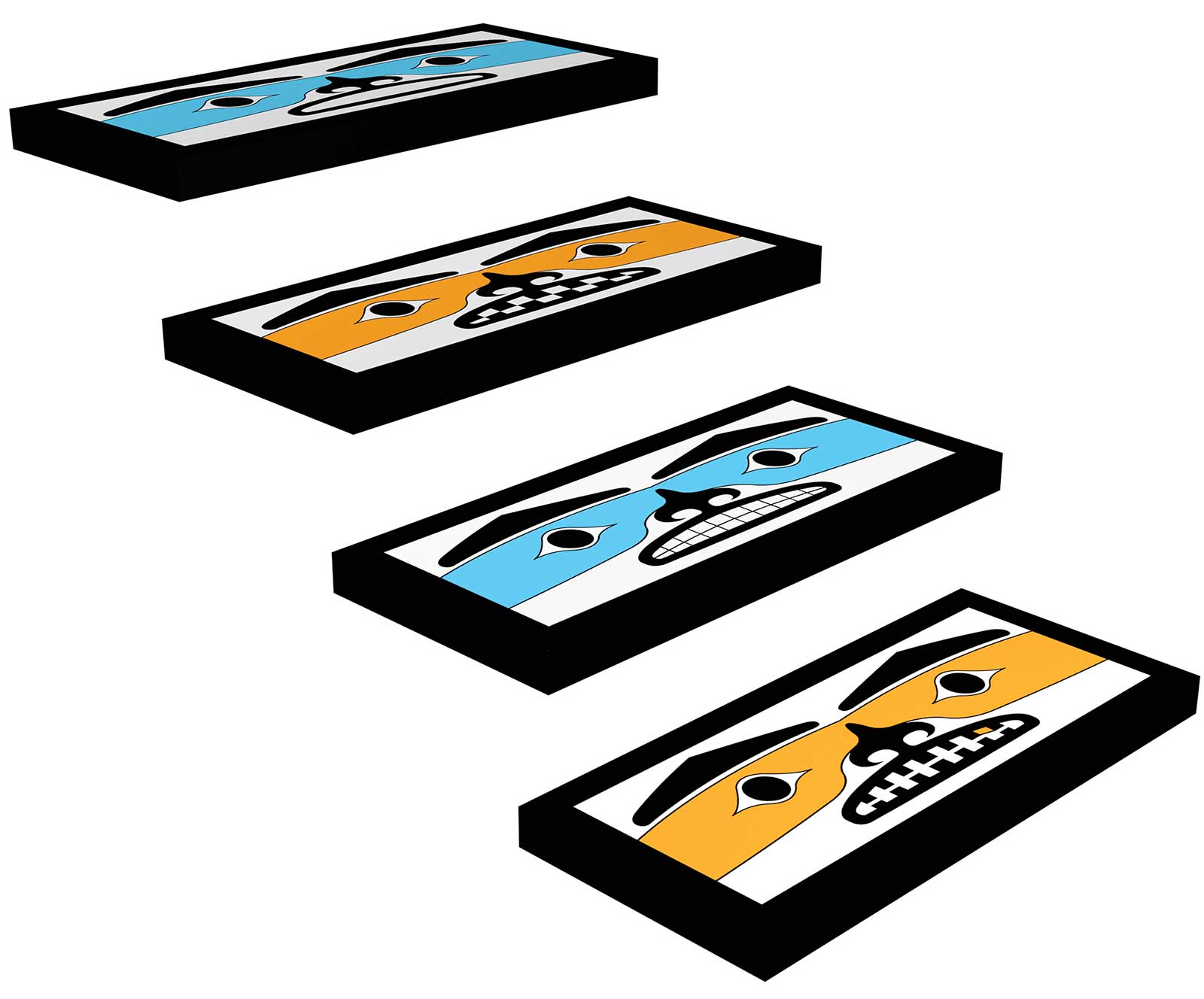 Andy Everson (Comox/Kwakwaka’wakw), Ancestral Steps, limited-edition print. Photo Credit: Andy Everson
There are individuals—artists and collectors alike—who feel that the application of emerging technologies and methodologies to ancient art forms can result in work that is somehow inauthentic. While there is nothing wrong with the appreciation of classical artwork based on convention, it is naïve to believe that there was ever a period in time when Northwest Coast art was immutable. Works created using modern technologies still carry significant intention and still rely on the tenets of this rich aesthetic system, they just look different from pieces that were being created one hundred years ago. Computer-based technologies have been a boon to Northwest Coast artists, and it will benefit admirers of this art form to learn about these advancements taking place and to look forward, rather than back.
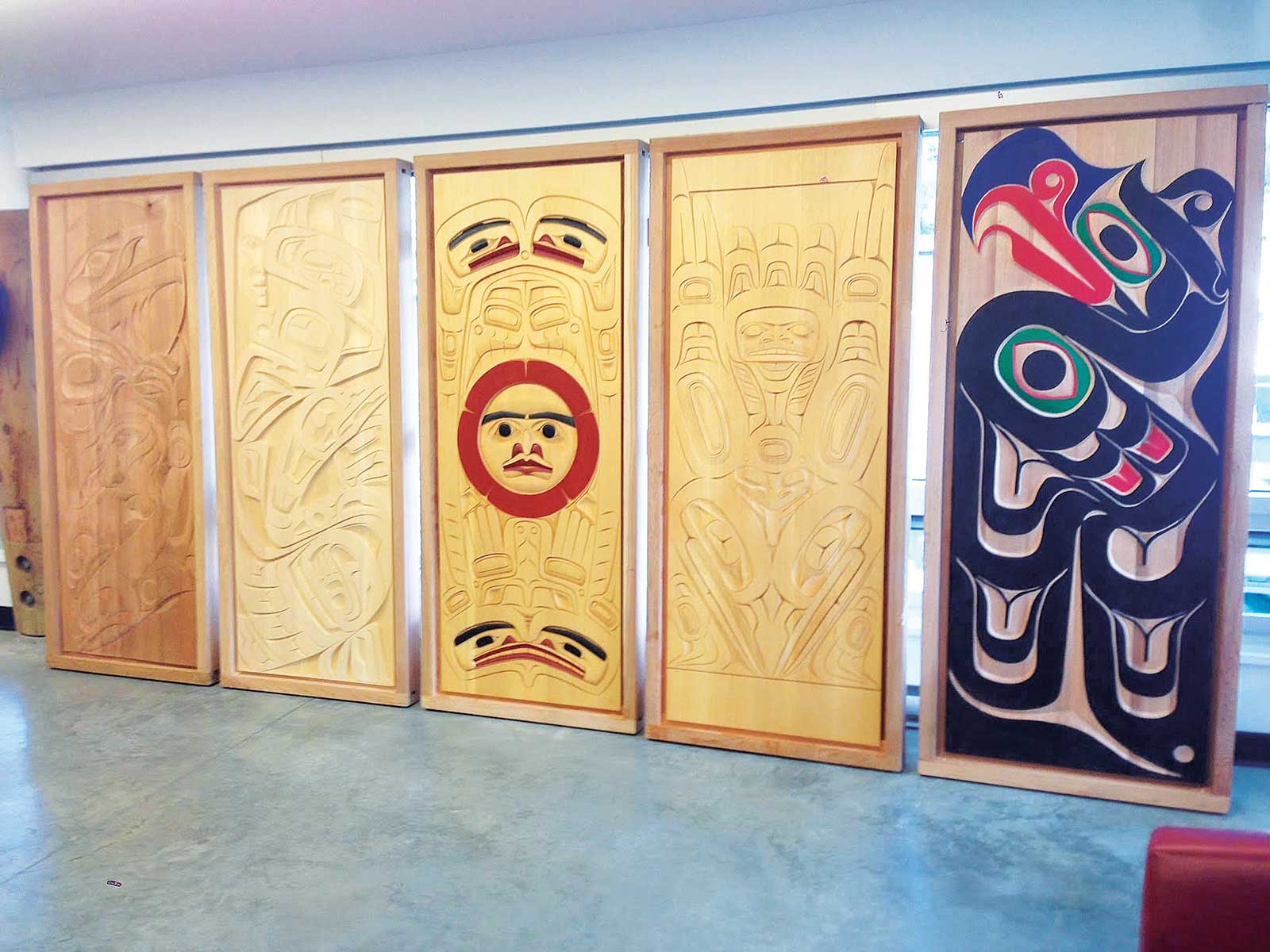 Emily Carr University of Art and Design and University of British Columbia’s Opening Doors exhibition. Photo Credit: Chris Gaston.
Powered by Froala Editor