“From this day forward all war between the parties to this agreement shall for ever cease.” So reads the first sentence of the first article of the 1868 Fort Laramie Treaty signed between the Sioux Nation and the United States government.
“The government of the United States desires peace, and its honor is hereby pledged to keep it.” So reads the next sentence.
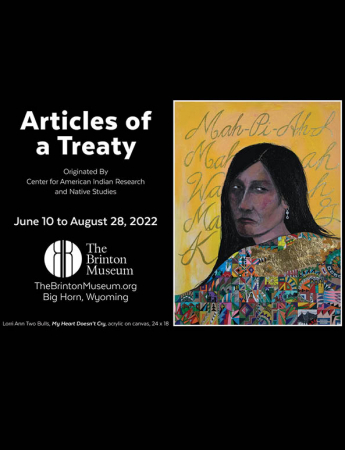
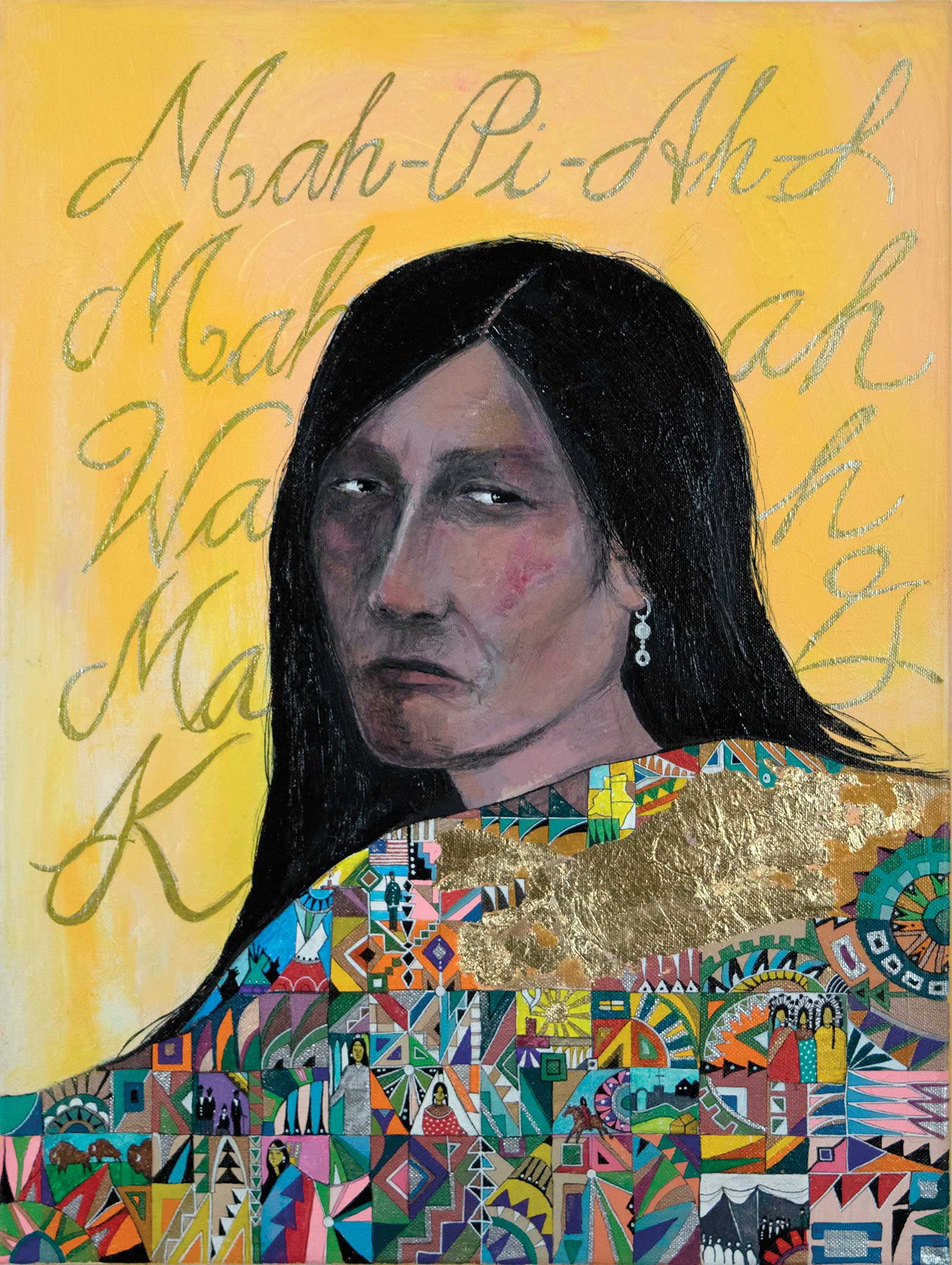 Lorri Ann Two Bulls (Oglala Sioux), My Heart Doesn’t Cry, acrylic, 24 x 18”
Fewer than 10 years later, George Custer was leading a military force against the Sioux and other tribes in what would become the Battle of the Greasy Grass or the Battle of Little Bighorn. Gold had been discovered in the Black Hills, land negotiated by treaty to belong to the Sioux—the Oceti Sakowin (Seven Council Fires) Confederacy—in perpetuity.
Miners trespassing in the area wanted Army protection to extract the gold. The Army was happy to provide it despite the treaty’s stipulations. This treaty and its legacy are the subject of an exhibition, Articles of a Treaty, opening June 10 and continuing through August 28 at the Brinton Museum in Big Horn, Wyoming.
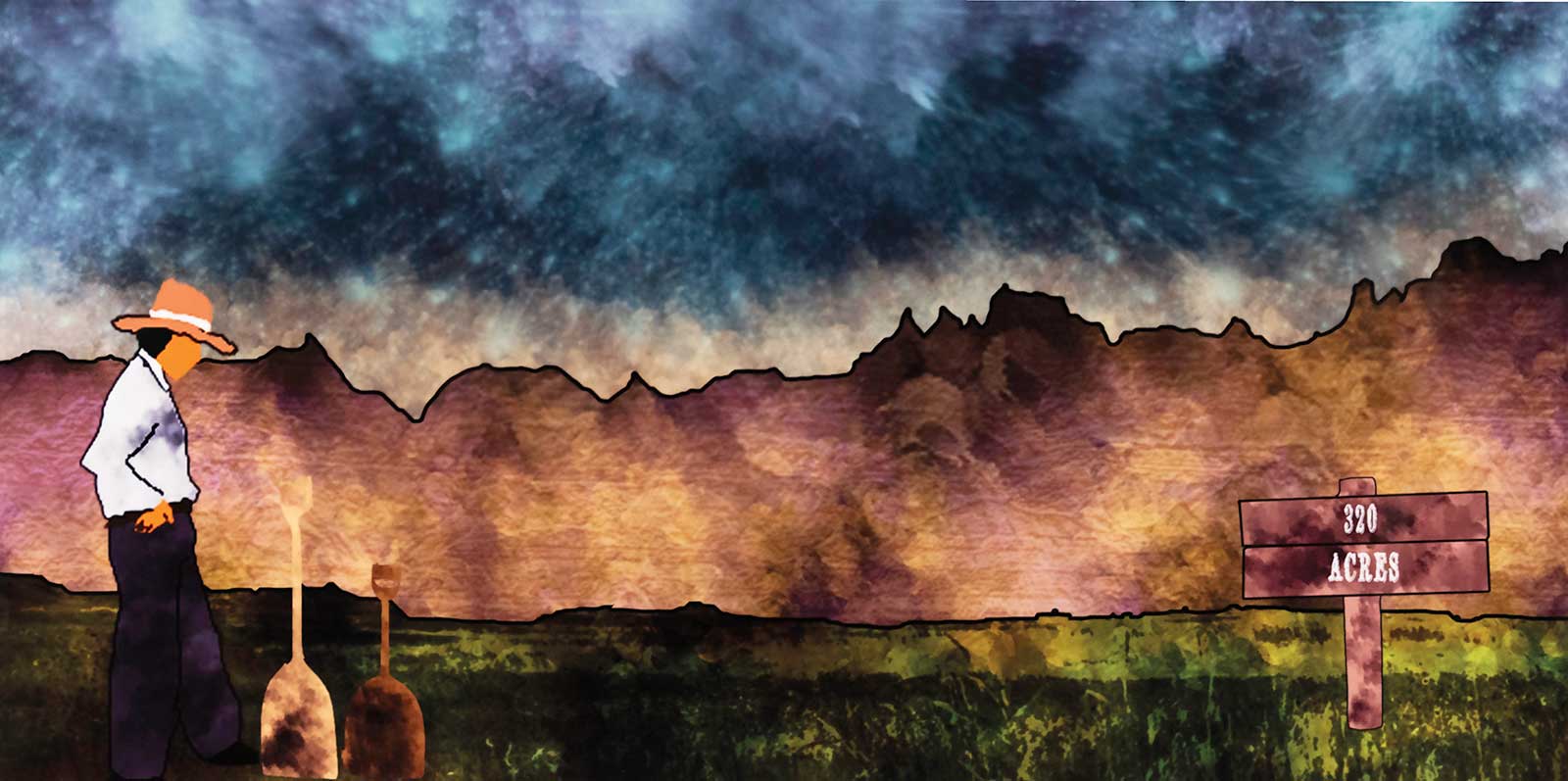 Tom Swift Bird (Oglala Sioux), Salvage & Adapt, sheet metal print, 12 x 24”
“The treaty is mentioned over and over and over again when issues come up. We all talk about it, but hardly any of us have read it,” exhibition curator Craig Howe, an enrolled citizen of the Oglala Sioux Tribe, says.
Thirty-two contemporary Oceti Sakowin artists created work for the exhibit along with 17 Oceti Sakowin writers who crafted poems or prose and 17 Oceti Sakowin and Northern Plains musicians who created songs. There were 17 articles in the treaty.
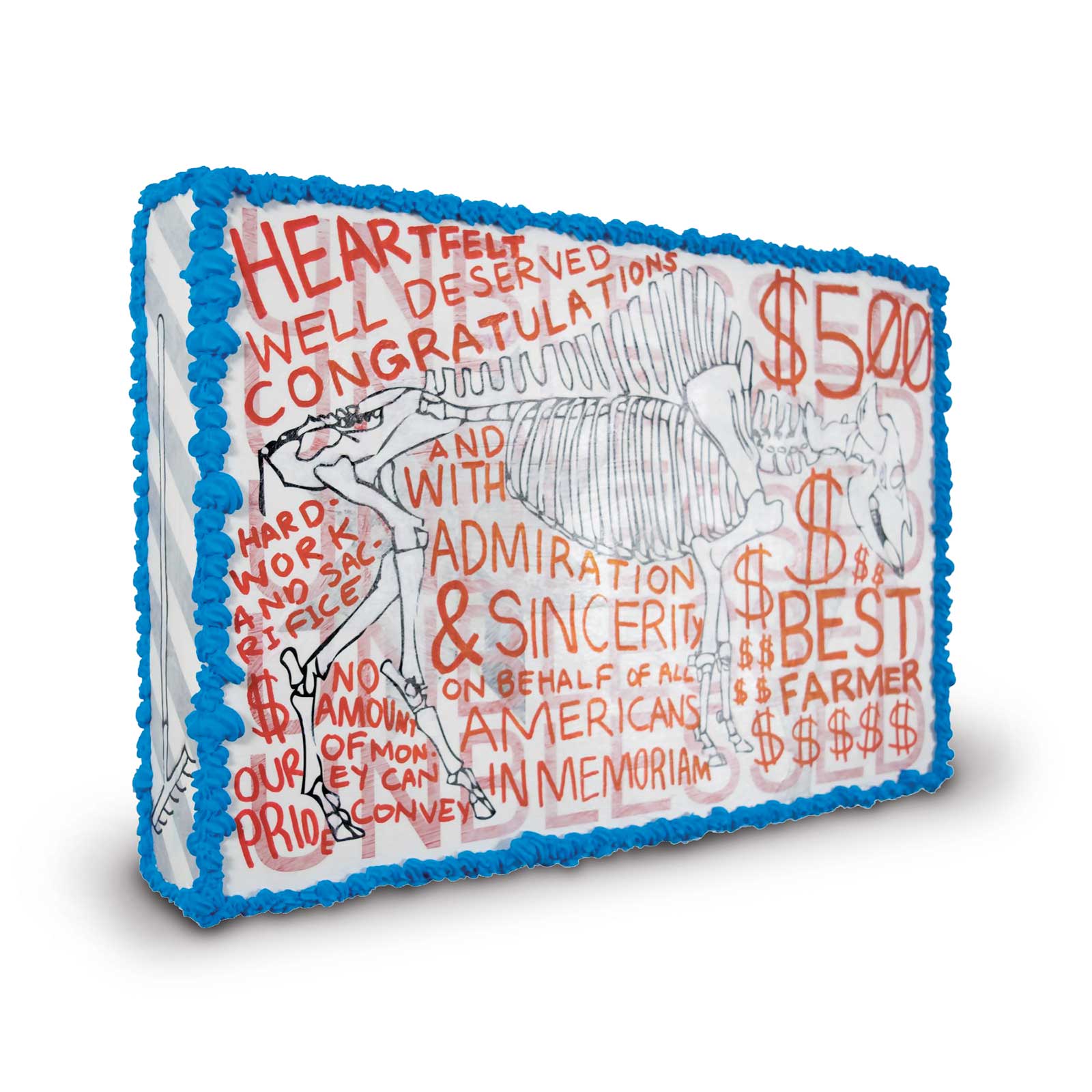 Marty Two Bulls Jr. (Oglala Sioux), Honor Cake (Best Farmer), mixed media, 17 x 24 x 5”
“We want to show the creative breadth of Oceti Sakowins [and] that there is no one way to be Indian, broadly speaking, or Lakota, narrowly speaking,” adds Howe, who is also the founder and director of the Center for American Indian Research and Native Studies.
In Howe’s experience, it’s the poetry that makes the greatest impression on visitors.
“The artwork engages people—they will talk about and look at it—but it’s the poetry that will move people to tears. Right there,” he said.
Had the United States honored the treaty, an area of more than 190,000 square miles—almost the size of Spain—covering parts of South Dakota, North Dakota, Nebraska, Kansas, Colorado, Wyoming and Montana would now make up the Oceti Sakowin nation. Included would be the 10th richest gold mine in the world and all of the Missouri River in South Dakota.
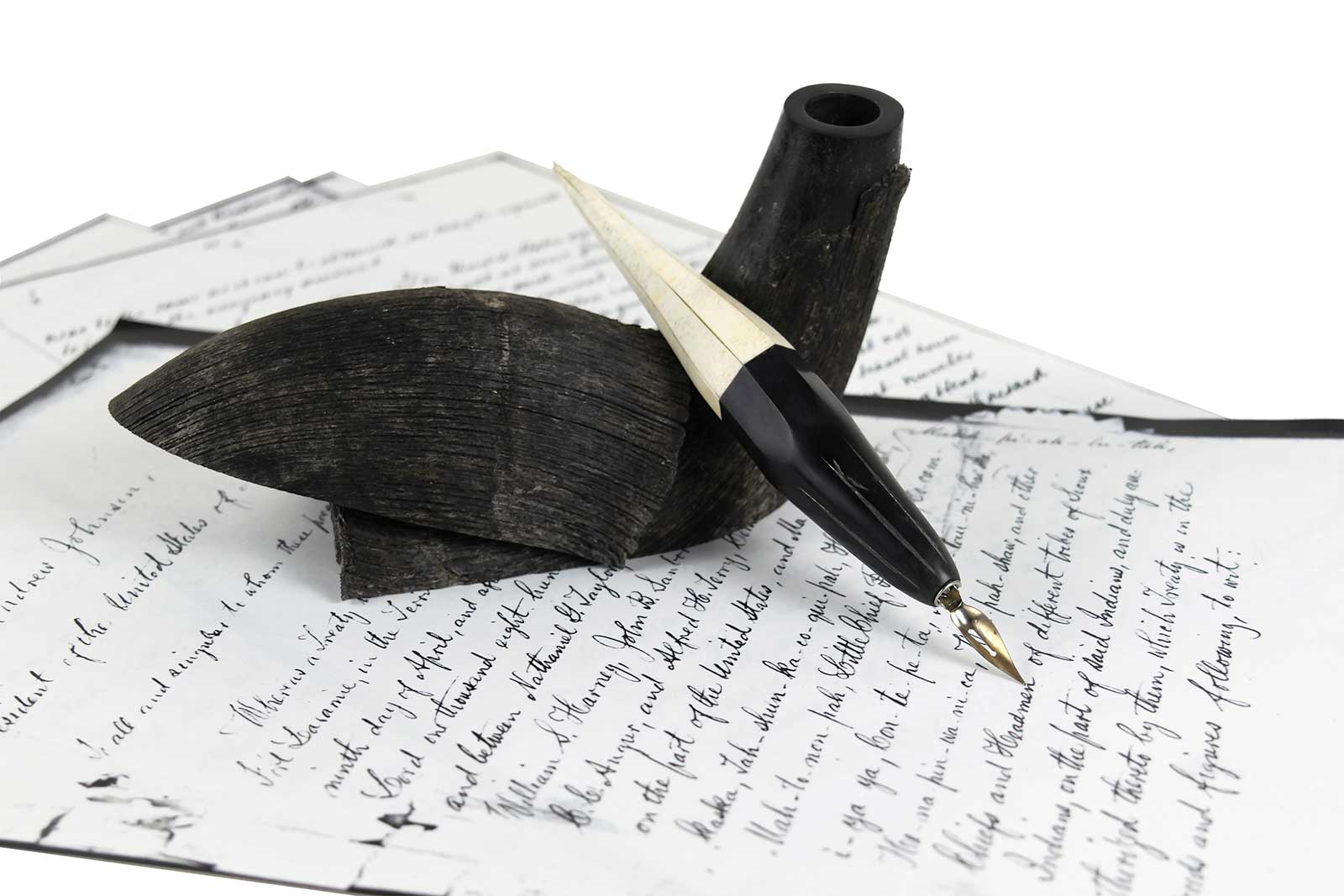 Brian Szabo (Rosebud Sioux), Touching the Pen, buffalo horn, antler and metal, 9 x 8 x 2½”
“The United States now solemnly agrees that no persons, except those herein designated and authorized so to do…shall ever be permitted to pass over, settle upon, or reside in the territory described in this article.”
That passage comes from the surprisingly succinct document’s first sentence in Article Two.
“It’s amazing to contemplate what could have been if the United States had kept its side of the agreement,” Howe says. So brief, however, was the period during which the United States upheld its end of the Treaty that Lakotas never even gave a name to the territory.
June 10-August 28, 2022
Articles of a Treaty
The Brinton Museum,
239 Brinton Road, Big Horn, WY 82833
(307) 672-3173, www.thebrintonmuseum.org
Powered by Froala Editor