Bill and Sheryl Sloup discovered their passion for Native American art through friends in their hometown of Omaha, Nebraska, who are avid collectors. Gary and Micki had begun collecting primarily Native beadwork on family trips and, in 1976, convinced Bill and Sheryl to form a little caravan and follow them to northern New Mexico. Gary and Micki had met Paul Speckled Rock (1952-2017) at Santa Clara Pueblo. They introduced Bill and Sheryl to Paul and his family, an introduction that marked the beginning of a long friendship.
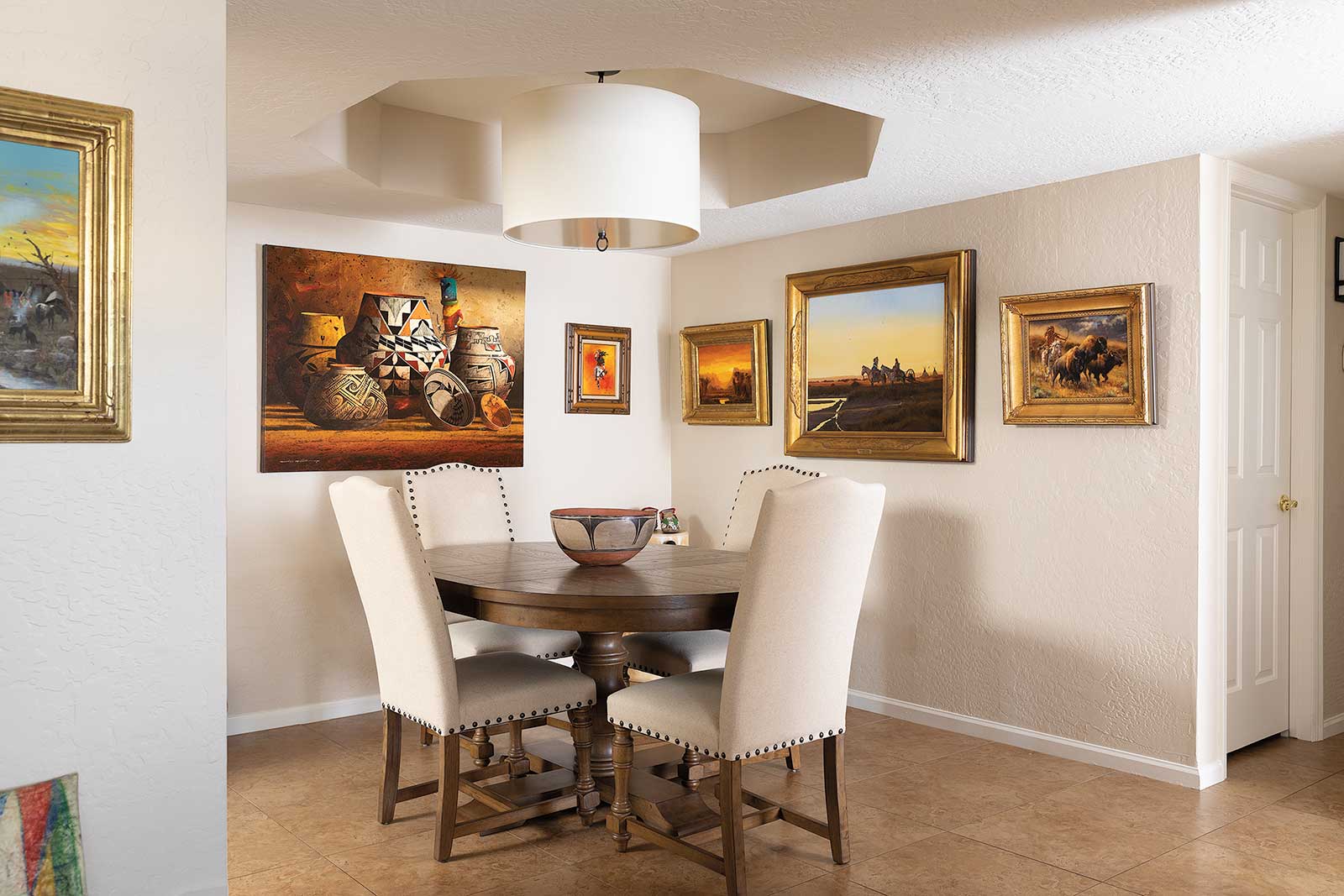 On the left in the dining room is an acrylic painting, ca 1990s, by Michael McCullough. Next to it is the first Native American piece bought by the couple, Corn Dancer, Santa Clara Pueblo, ca. 1977, acrylic, by Paul Speckled Rock (Santa Clara, 1952-2017). On the adjoining wall are, left to right, Valley Sunset, ca. 1980s, oil, by Michael Coleman; Moving Camp, ca. 2013, oil, by Nicholas Coleman; and Prairie Thunder, ca. 2020, oil, by Don Oelze. On the table is a Santo Domingo dough bowl, ca. 1910.
“We didn’t know much at the time,” Bill admits, “but we fell in love with the beauty of Native American paintings, pottery, beadwork and more. In the days before the Internet, we went to the library to learn about the tribes and their art. When we returned to Santa Clara the following year to visit Paul, his first wife, the potter Rosemary 'Apple Blossom' Lonewolf, and their young son Adam, we bought our first piece of Native American art—Paul’s painting, Corn Dancer, Santa Clara Pueblo.
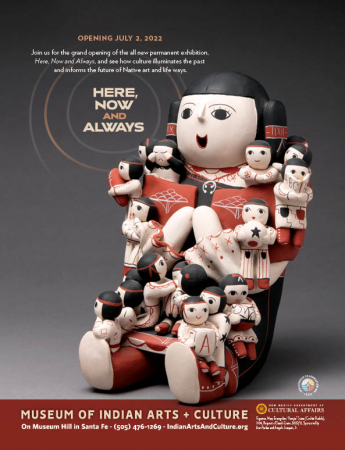
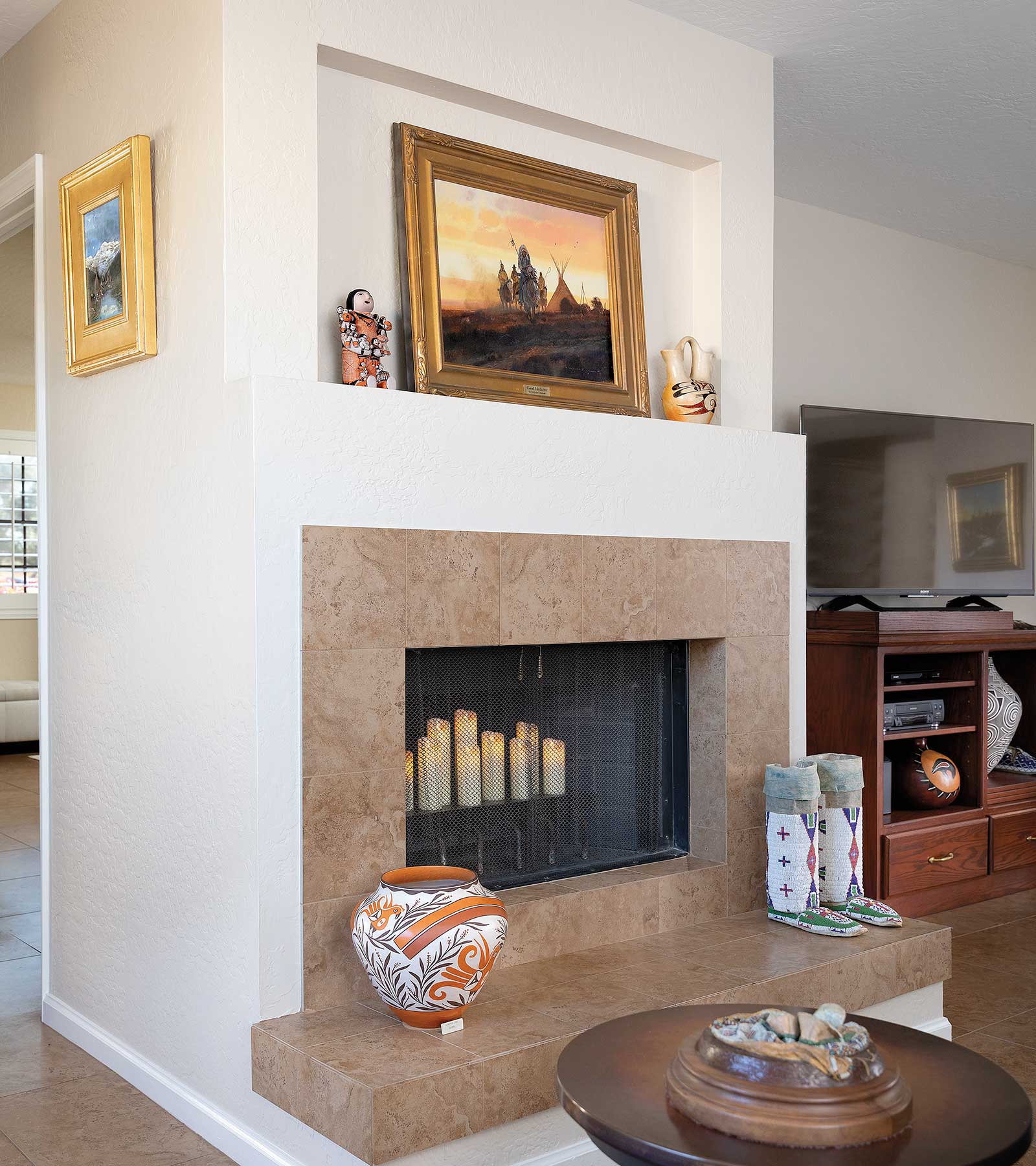 Above the fireplace is Good Medicine, ca. 2018, oil, by Nicholas Coleman. On the left is Storyteller with Ten Children, ca. 1980s by Louise E. Suina (Cochiti, 1939 -1992). On the right is a wedding vase, ca. 1950s by Nettie Ami (Hopi, 1901-1992.) To the left on the hearth is a pot, ca. 1990 by Loretta Joe (Acoma) a 25th anniversary present from the couple’s children. On the right are Sioux beaded leggings with mocs, ca. late 1880s. On the table in the foreground is Stars and Stripes, ca. 2003, bronze, by Dave McGary (1958-2013).
"Paul was also a dancer," Bill continues."We would find a beautiful stream and have a picnic and had a good time with everybody. We bought that first painting and we were hooked!”
Paul Speckled Rock was the grandson of the Santa Clara pottery matriarch Severa Tafoya (1890-1973). He made small paintings before working in bronze and, in 1983, following in his grandmother’s footsteps, making pottery. The couple owns pottery by him from the 1990s.
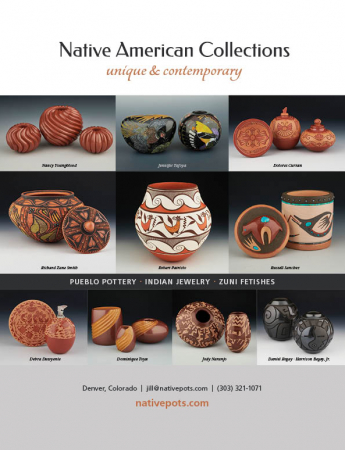
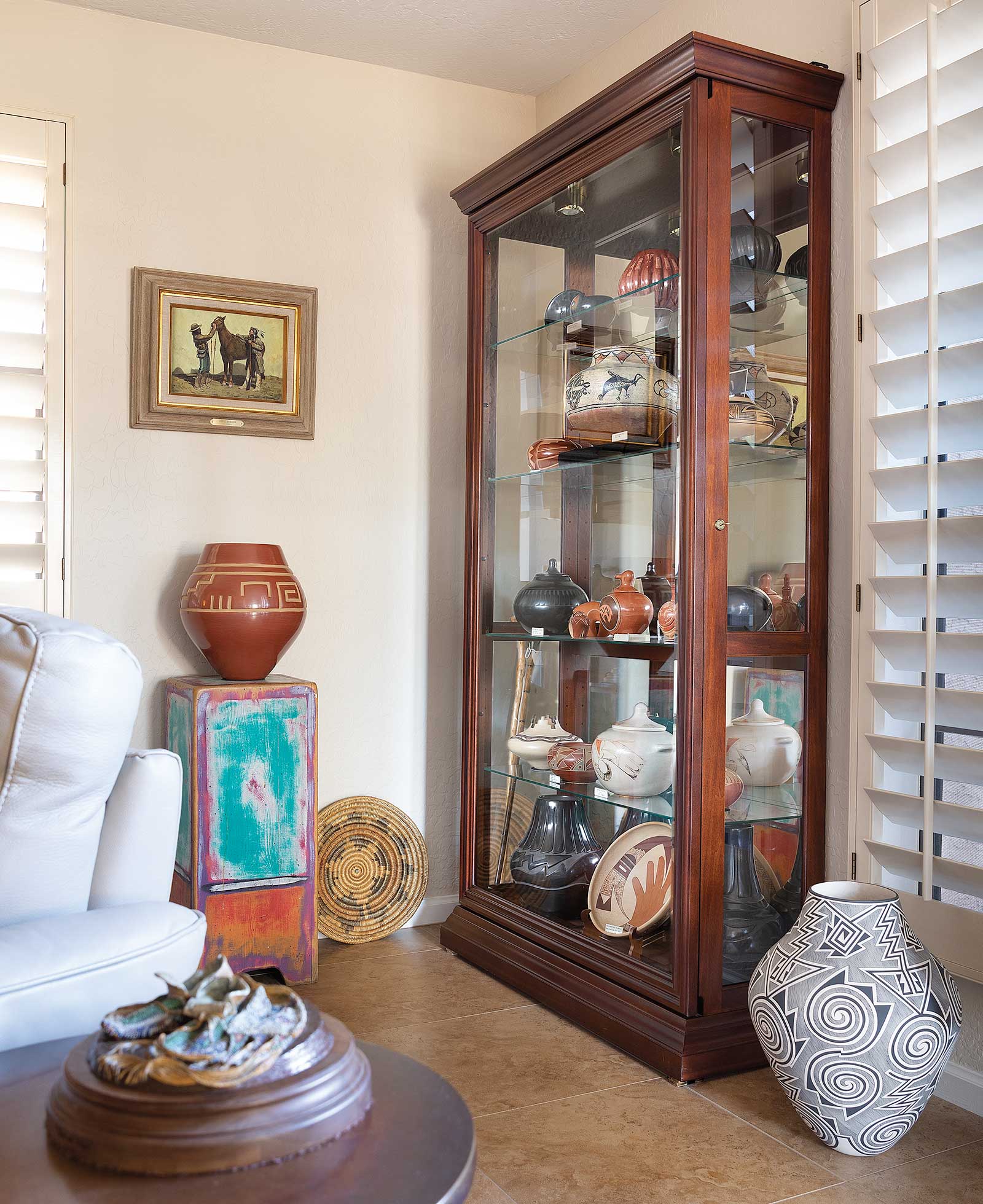 On the pedestal is a large red bowl, ca. 2006, by Luann Tafoya (Santa Clara). Hanging above it is Horse Trading, ca. 1980s, oil, by Roy Grinnell (1933-2019). Next to the pedestal is a Navajo wedding basket, ca. 1930s. The large olla, ca. 1992, on the right, is by Myron Sarracino (Laguna). In the foreground is Stars and Stripes, ca. 2003, bronze, by Dave McGary (1958-2013). The glass case contains contemporary pottery from the 1950s to 2021. On the top shelf are pieces by Severa Tafoya (Santa Clara, 1890-1973), Dora Tse-Pé (San Ildefonso), Helen Shupla (Santa Clara, 1928-1985) and Alton Komalestewa (Santa Clara). Beneath them are pieces by Russell Sanchez (San Ildefonso) and Fannie Nampeyo (Hopi, 1900-1987) and a large San Ildefonso Jar, ca. 1880s. Next are pieces by Juan Tafoya (San Ildefonso, 1949-2006), Luann Tafoya (Santa Clara) and Grace Medicine Flower (Santa Clara). On the next shelf are pieces by B.J. Fragua (Jemez, 1962-2022), Teresita Naranjo (Santa Clara, 1919-1999), Emogene Lomakema (Hopi, 1901-1999) and Denny Gutierrez (Santa Clara, 1942-2013). On the bottom shelf are pieces by Vickie Martinez (Santa Clara), Jean Sahmie (Hopi-Tewa) and Pablita Chavarria (Santa Clara, 1914-1979).
The Sloups began collecting on a tight budget—Sheryl was an administrative assistant for 39 years, and Bill, a blue-collar worker for 44 years often working 72-hour weeks to earn overtime pay. Since that first purchase, they have amassed an impressive collection of paintings, pottery, beadwork and sculpture. In 2019, they moved from Omaha to Scottsdale, Arizona, selling 60 pieces of their collection as they downsized. “The art we have,” Bill says, “is a real love of our life. We buy what grabs our eye and when we look more closely, grabs our heart.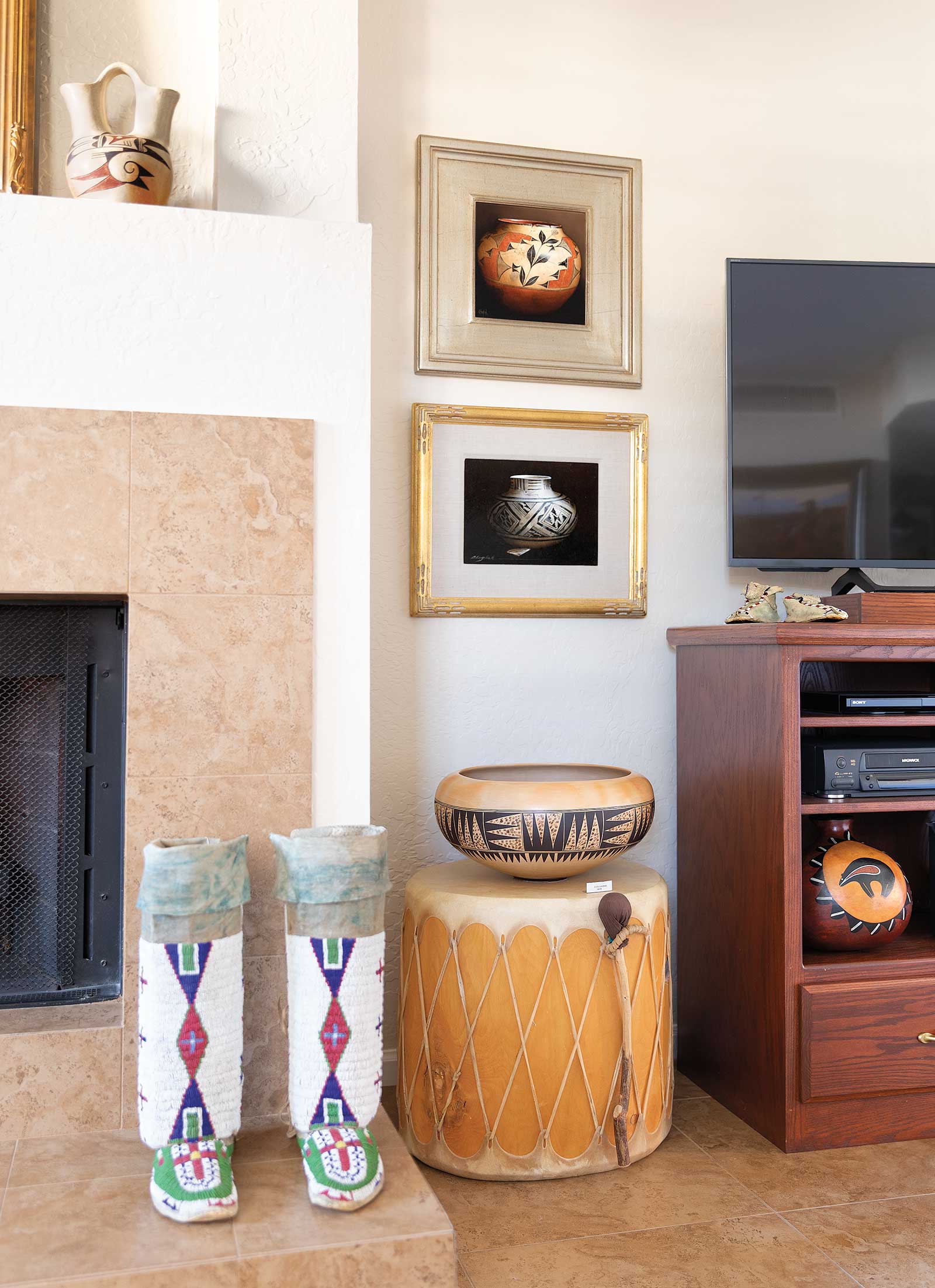 On the mantel is a wedding vase, ca. 1950s by Nettie Ami (Hopi, 1901-1992.) On the hearth are Sioux beaded leggings with mocs, ca. late 1880s. On the right are, top to bottom, a painting, ca. 2020, by Greg English and a painting, ca. 1996, by Greg’s mother, Cheryl English (1945-2018). On the Taos drum, ca. 1976, is a large Bowl with a stylized parrot motif, 2000, by Jean Shamie (Hopi). On the bottom shelf of the TV cabinet is a gourd, ca. 1990s, by Robert Rivera.
“We bought our first pottery at Sam King’s Serendipity Trading in Estes Park, Colorado. Charles King was a 15-year-old boy working in his parents’ gallery. He now owns King Galleries in Santa Fe and Scottsdale. He’s a friend and has been a great source for much of our collection.”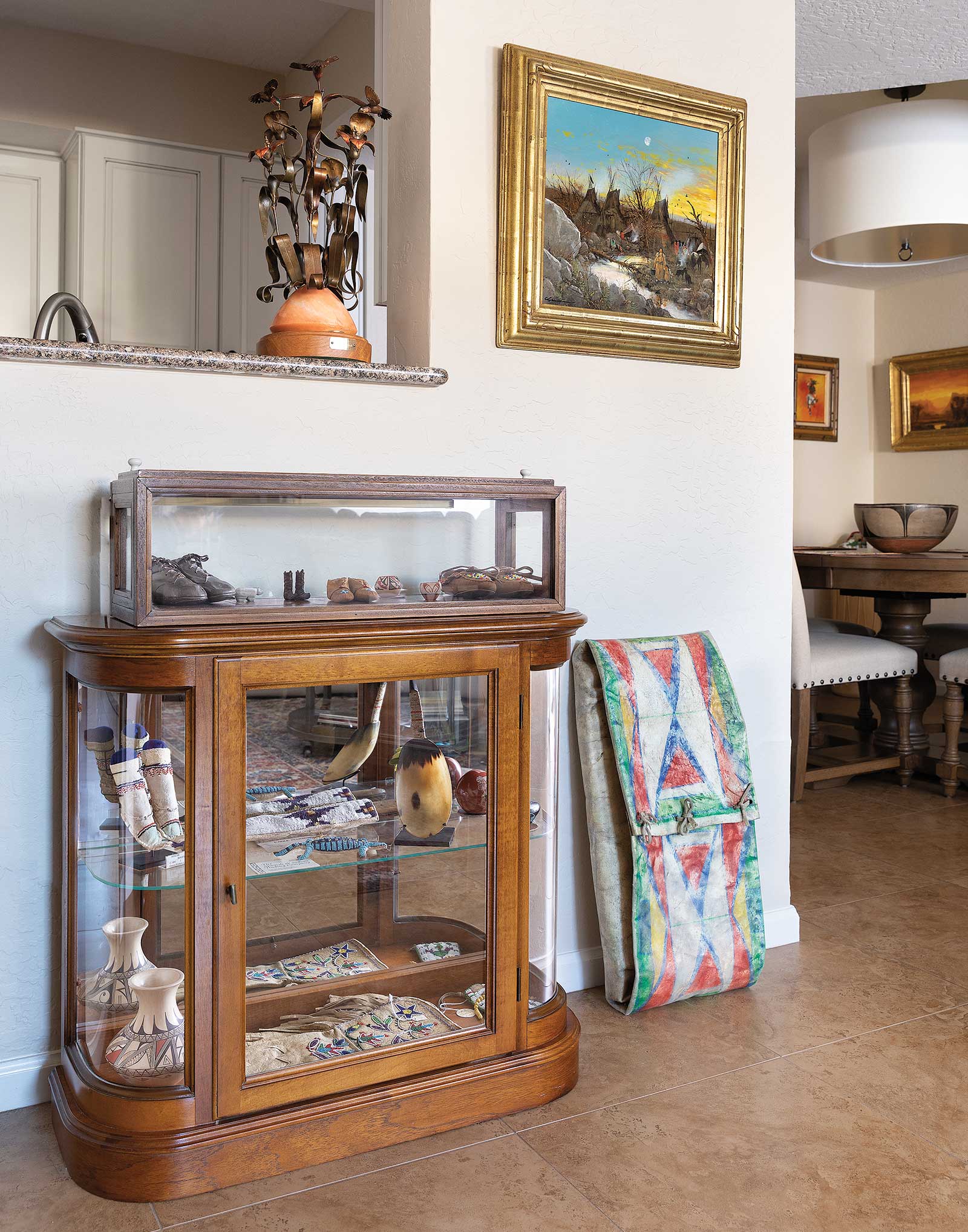 On the shelf is Stealing Sugar, ca. 1992, bronze, by Charles Pratt. On the wall is the painting Native Encampment, ca. 2005, by Gregory Sumida. Beneath it, on the floor, is a Crow parfleche, ca. 1870s. In the display cases are pottery, ca. 1990s, by Paul Speckled Rock (Santa Clara, 1952-2017) and a Hopi Vase, ca. 1990, by Roberta Silas (Hopi, 1939-2009). Other pieces include a Plains horn spoon with quilted handle, ca. 1870s; a Sioux strike-a-light bag, ca. 1890s; a Sioux beaded lizard fetish, ca.1880; Northern Plains beaded gauntlets, ca. 1880; Apache doll cactus boots, ca. 1890s; and Sioux baby moccasins, ca. 1890s.
Getting to know the artists has been a big part of Bill and Sheryl’s collecting. They had seen work by Stan Natchez at Feathers Gallery in Scottsdale and fell in love with it. They picked up his card and, on their next trip, they set up a visit to his house in Tempe where he had some work in progress. Natchez had purchased uncut sheets of dollar bills from the Bureau of Engraving and Printing and painted ledger artwork on them. In the 19th century when there were no longer buffalo hides to paint on, Native artists used whatever paper they could find, including used pages from company ledger books. Natchez's Capturing Horses, painted on dollar bills, is in the Sloup's collection, as is his Cheyenne Wedding Ceremony, 2005. The background of the latter is a reproduction of a rare $5 bill produced in the 1890s that features the portrait of a Lakota Sioux chief. Natchez has painted the figures in ledger style and has used beadwork in the clothing of the wedding couple and the priest.
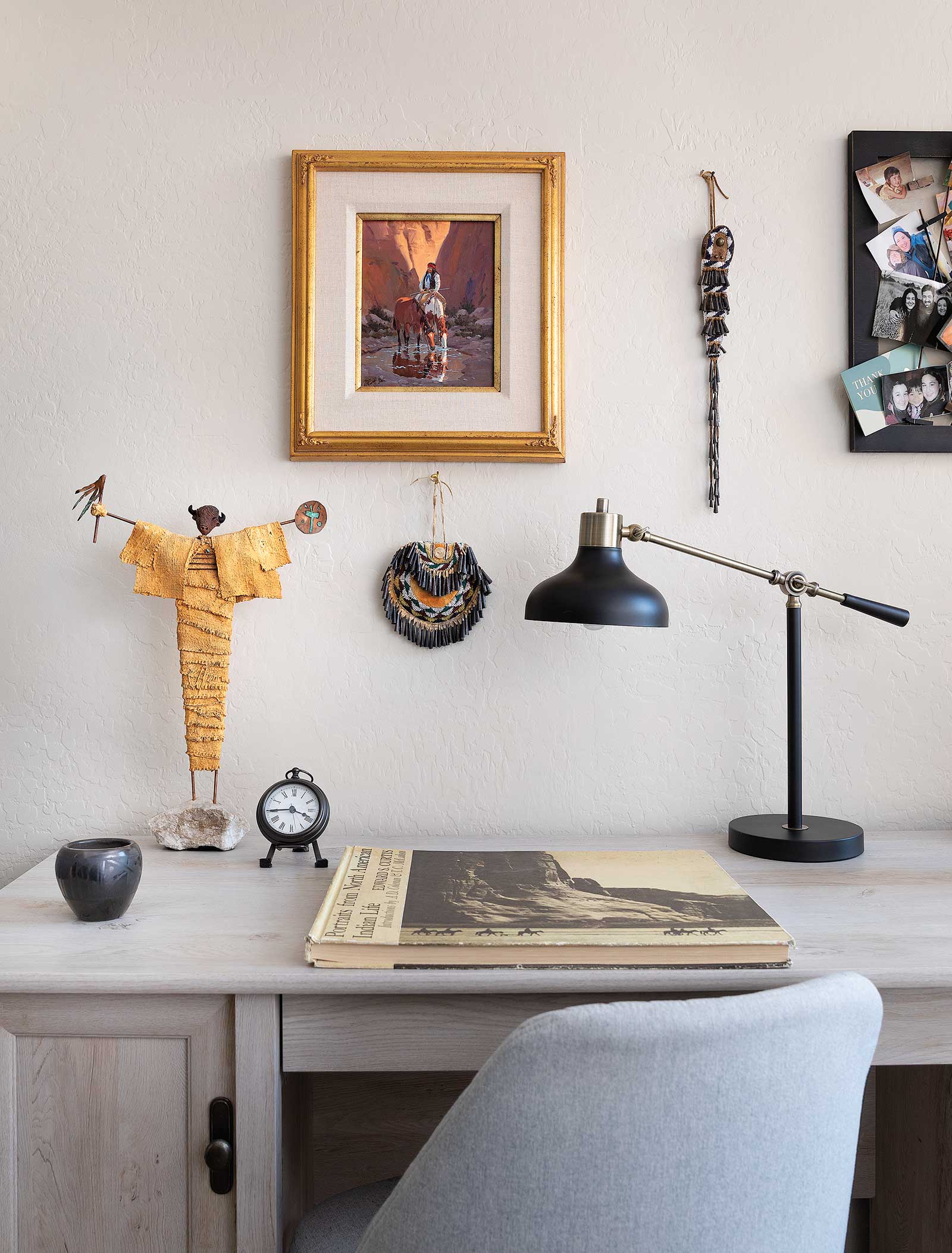 The painting above the desk is Hidden Pool (Apache), ca. 2007, oil, by Ron Stewart. Next to it is an Apache awl case, ca. 1905, and beneath it is an Apache medicine bag, ca. 1900. On the desk is a Plains shaman by an unknown artist; a pot, ca. 1980s, by P. Tafoya (Santa Clara); and a copy of Edward S. Curtis’s Portraits from North American Indian Life, ca. 1972.
“Since we grew up in Omaha,” Bill says, "we were looking for a beaded Sioux pipe bag. We bought one from John Molloy when he was with The Spanish & Indian Trading Company in Santa Fe. He now has his own gallery in New York. I rely on him for all our beadwork information and have always trusted him for his knowledge and honesty in dealing with Native antiquities.”
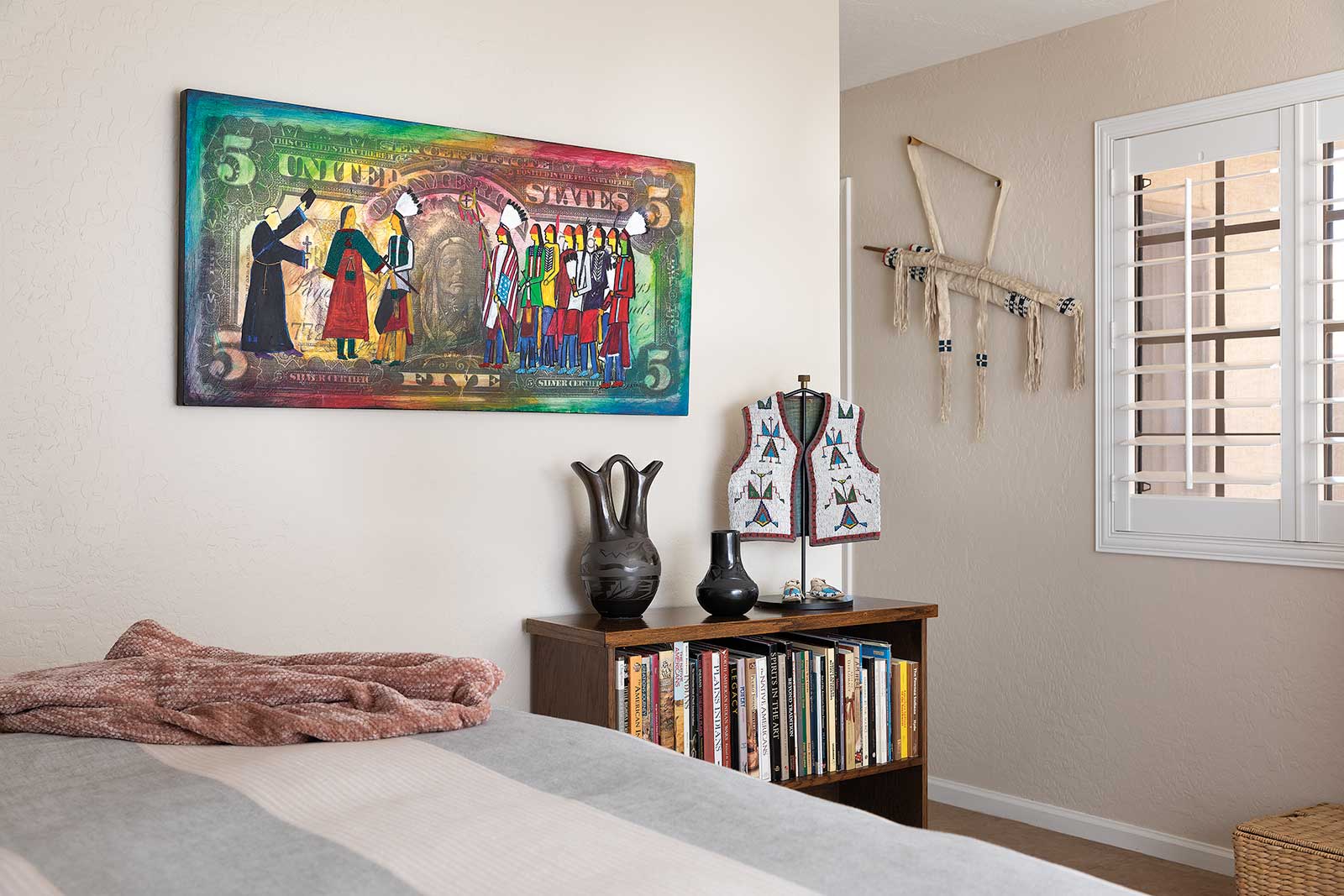 The painting in the bedroom is Cheyenne Wedding Ceremony, 2008, acrylic, by Stan Natchez (Shoshoni/Paiute). On the bookcase are, left to right, Black wedding vase, 1985, by Nicolasa Naranjo (Santa Clara, 1907-2002); black jar, ca. 1960s by Blue Corn (San Ildefonso, 1921-1999); and a Sioux beaded child’s vest and child’s moccasins, ca. 1890s. By the window is a Sioux quiver, bowcase outfit with four arrows and pony beads, ca. last half of the 20th century. The bookcase containing books on Native American culture was made by Bill Sloup’s brother in 1975.
The quality of their collection is such that it has been included in four books on Native pipe bags and weapons by John Baldwin, who they met in Santa Fe at the Whitehawk Antique Show.
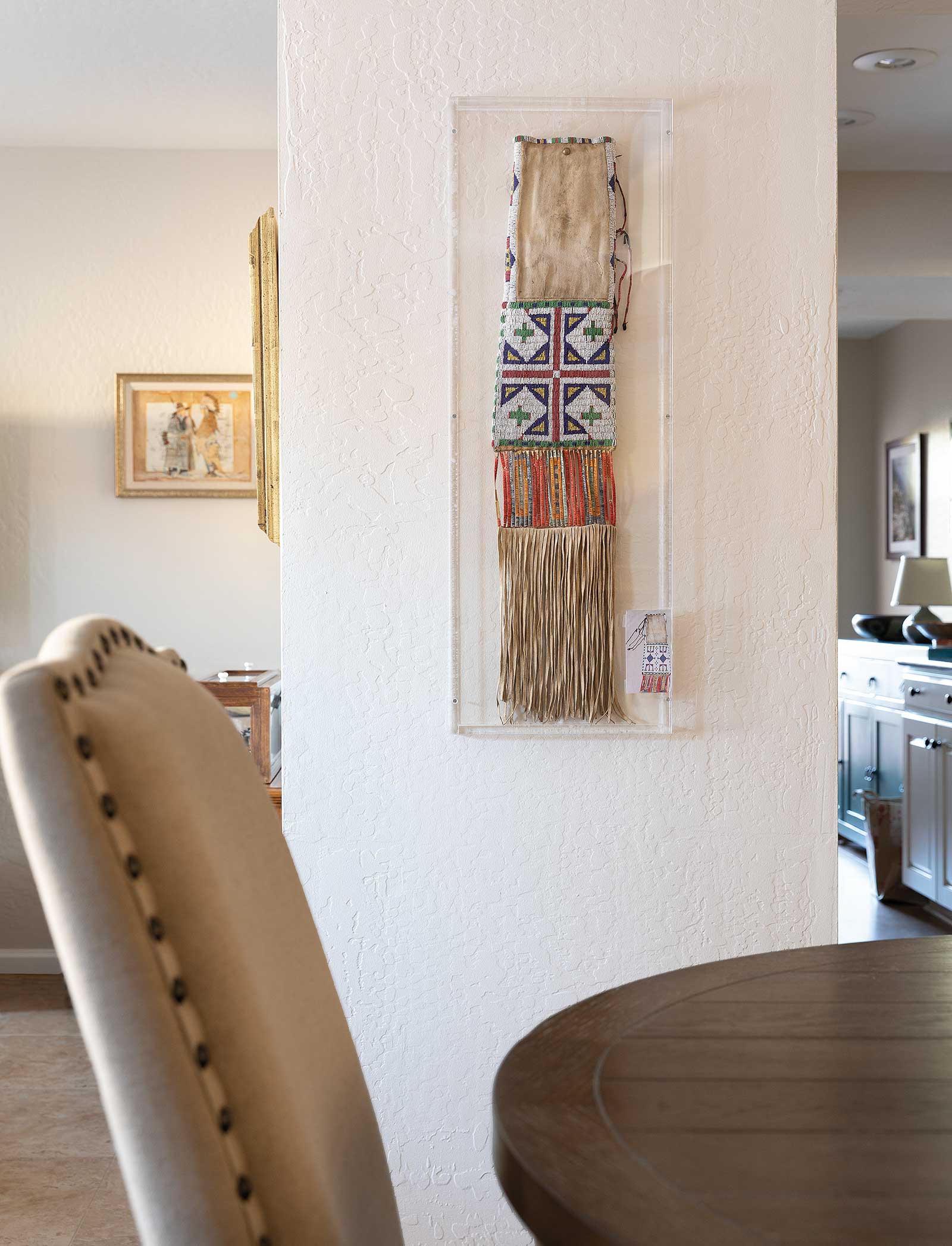 On the far wall is Snowy Mountain Council Chiefs, 2021, acrylic, by Oreland Joe (Navajo/Ute). In the case is a Sioux pipe bag, ca. 1880.
“The collection makes my day,” Bill comments. “My wife says, ‘You’re like a kid. You go to the cases, light them up and you look and look.”
Powered by Froala Editor