1945—in Susanville, California, an hour and a half northwest of Reno, Nevada—marked the beginnings of renowned Native American artist and activist Jean LaMarr. Her northern Paiute/Pit River ancestry, with ties to both northern Nevada and California, greatly inspired her artistic career, along with her experiences with racism, assimilation and bias. She channeled these obstacles and love for her heritage into paintings, sculpture and prints, now displayed as a retrospective at the Nevada Museum of Art.
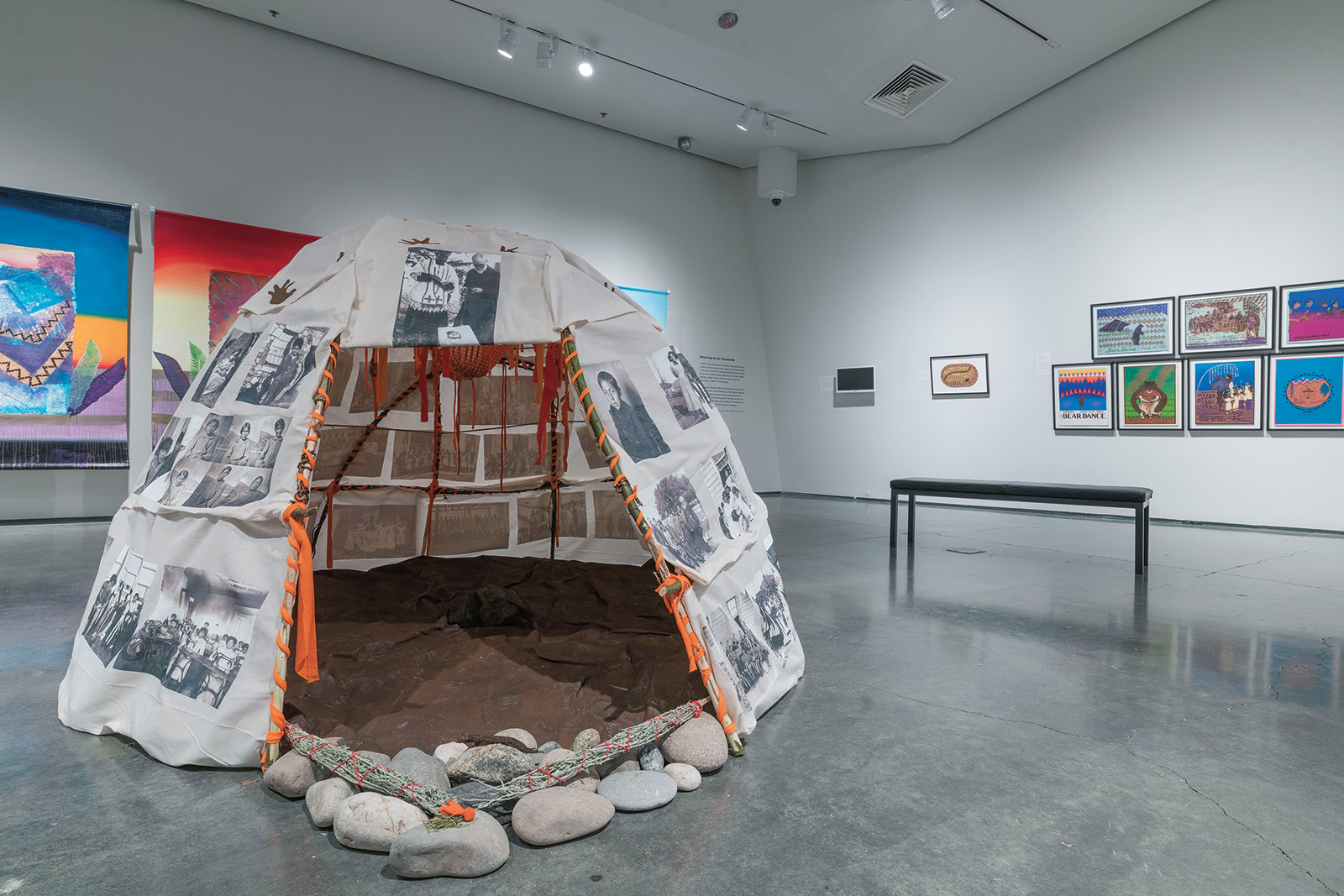 Jean LaMarr, Bringing Our Ancestors Home, 2022, mixed media. Collection of the artist.
The exhibition titled The Art of Jean LaMarr, spans 50 years of LaMarr’s production in more than 100 pieces of work, including newly made installations. “The museum has been working with artists of the Great Basin for over a decade,” says chief curator and associate director Ann Wolfe. “LaMarr has been recognized by our region for a long time as a professional artist, and it was time to acknowledge her lifetime of work.”
The museum is also known for their Greater West Collection that includes “transhistorical and contemporary Indigenous works that focuses on a super region stretching from Alaska to Patagonia, and from the Inner Mountain West to Australia,” explains Wolfe. This collection allowed the museum to dive deep into collecting works from these areas, which included LaMarr’s pieces. “LaMarr is relevant to the region, along with contemporary dialogues and conversations across the U.S. and the globe,” says Wolfe.
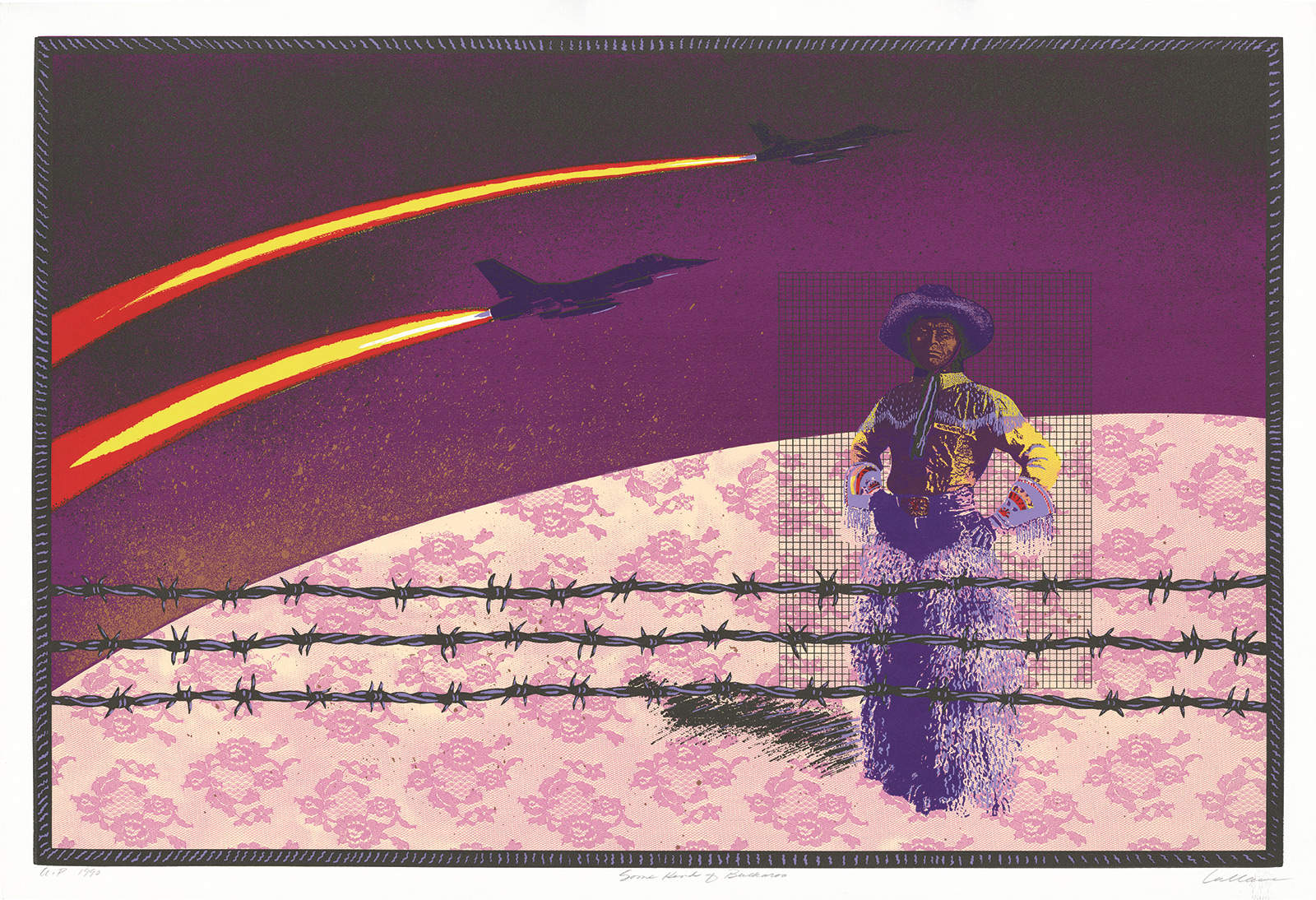 Jean LaMarr, Some Kind of Buckaroo, 1990, screen print, 26 x 38”. Collection of the Nevada Museum of Art, The Robert S. and Dorothy J. Keyser Foundation Art of the Greater West Collection Fund © Jean LaMarr.
LaMarr has explored many important themes relating to the Native American community throughout her career. “Overall, LaMarr has been committed to subverting or undoing the vanished American Indian,” Wolfe says. “She speaks often of wanting to remind the broader community that Native Americans are here and they are a living and vibrant culture. There are a lot of works that look at the representation of women historically, and LaMarr very often will attempt to return dignity to these women. She does this by using historical material with popular representations of Native women like in magazines and calendars.”
Another large theme is rethinking the colonial narrative and tackling political issues of American expansion, along with historical ones as well, like Christopher Columbus’ discovery of the Americas. One of LaMarr’s newest works in the exhibition, the installation piece Bringing Our Ancestors Home, deals with an even bigger theme of assimilation boarding schools.
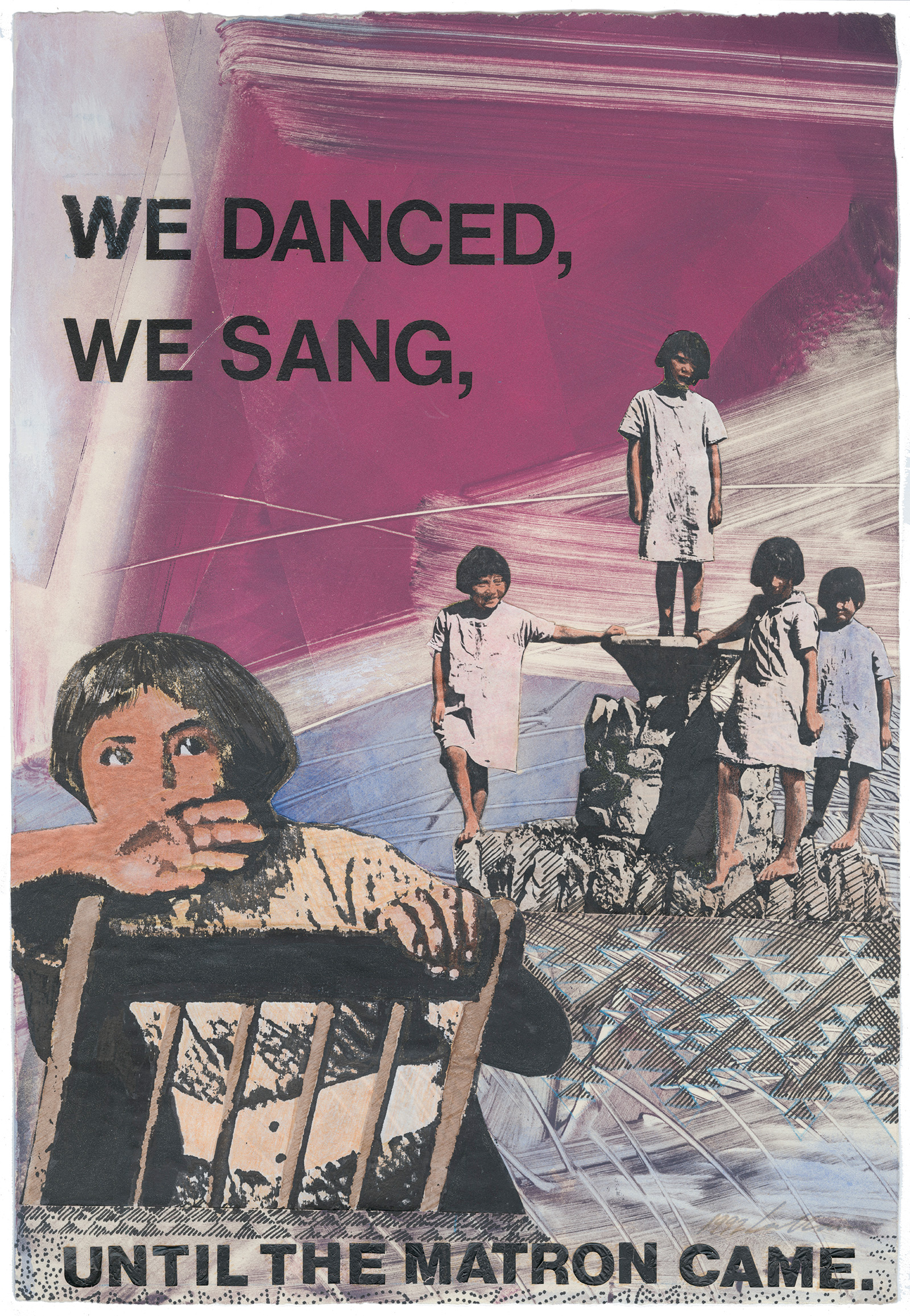 Jean LaMarr, We Danced We Sang, Until the Matron Came, 1992, monoprint, 16 x 11.” Collection of Zandra Bietz © Jean LaMarr.
“LaMarr’s mother and four aunts were taken from their family in 1924 and sent to Stewart Indian Boarding School,” says Wolfe. “LaMarr created this new sculpture—a traditional willow sweat—as a place to begin the process of cleansing and healing from this trauma. The sweat is covered with photos of children at boarding schools throughout North America and tied with orange fabric.”
Another exhibition piece, the monoprint We Danced, We Sang, Until the Matron Came, “is an artwork based on a historic photograph of the Webster sisters at Stewart,” Wolfe notes. “The title refers to a story told by LaMarr’s mother about how the girls were forced to clean the lavatories but would dance and sing together to pass the time—until they saw the strict matron approaching.” LaMarr will be debuting a performance at the museum of the same title.
Also featured in the retrospective is one of LaMarr’s most iconic pieces Some Kind of Buckaroo, a painting depicting a Native cowboy with lace as the earth and barbed wire at the top. “Basically, she’s subverting the ‘myth’ of cowboys and Indians of the American West,” says Wolfe. “If you think of this popular stereotype, the Native American figure is always inferior. The figure in this piece stands proudly but the barbed wire calls into question whether the Native cowboy is caged in or caged out.” LaMarr calls them “new warriors.”
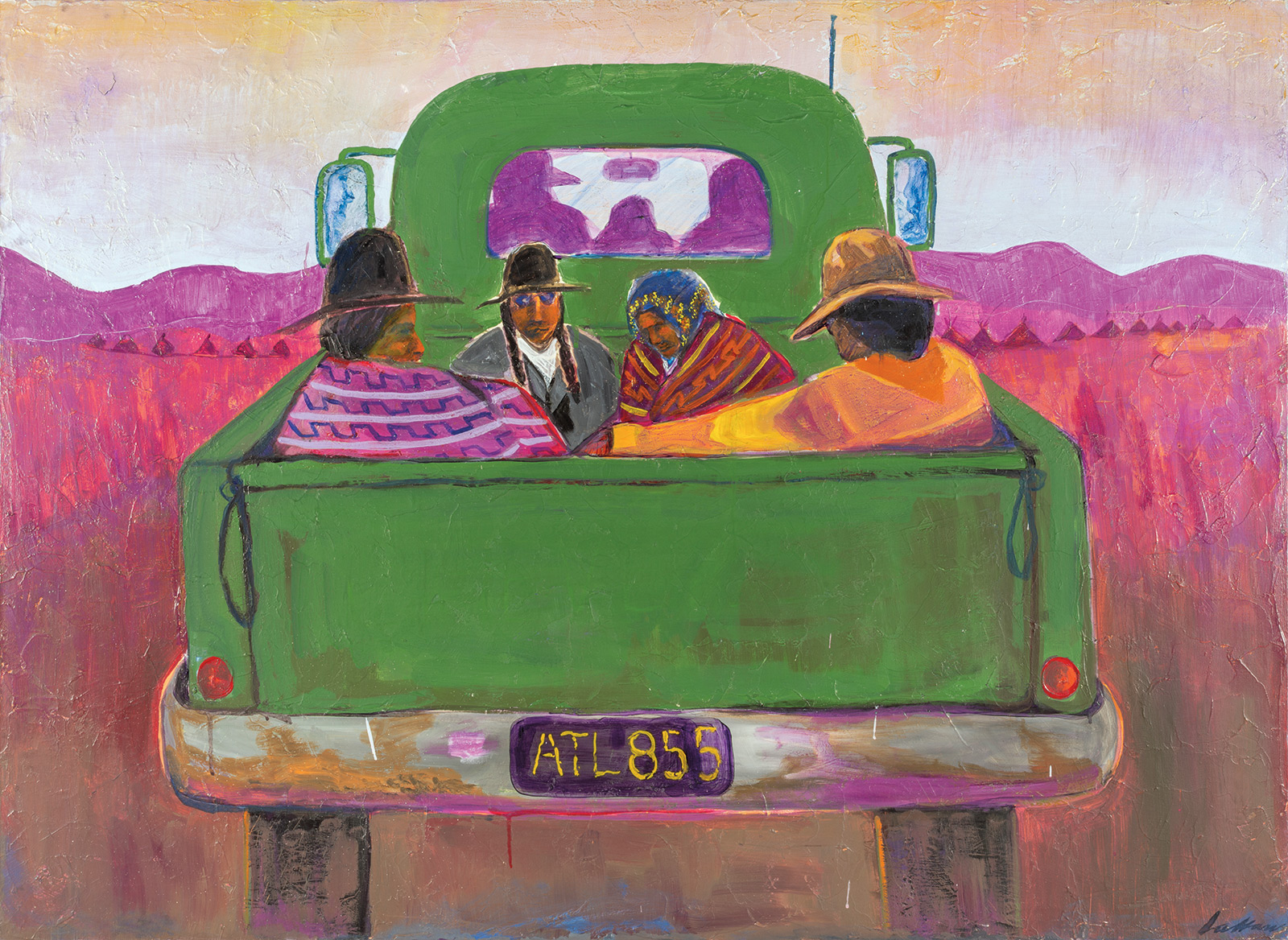
Jean LaMarr, Going Back to the Rez, 1974, oil on canvas, 36 x 49½”. Collection of the Nevada Museum of Art, purchased with funds from deaccessioning © Jean LaMarr.
One of LaMarr’s significant early pieces to be displayed is the oil painting Going Back to the Rez, 1974. “As a student at U.C. Berkeley, she was frequently told by her instructors to not refer to her Native American culture in her paintings,” Wolfe says. “The painting is a metaphor for the artist’s personal journey and transformation. In the background you can see two different shades of purple. She would often paint these color field paintings that her instructors wanted to see, and when they were returned to her, she would paint in what she called ‘the real stuff.’ In this case, she depicts her relatives piled into the back of an old, green pickup truck headed to a family gathering, known as a ‘Big Time,’ not far from her home in Susanville.”
The exhibition, running through May 29, goes hand-in-hand with the museum’s other programs such as their Community Forum: Reckoning with Nevada’s Boarding School Past on March 31, that will also include LaMarr’s performance mentioned above.
Through May 29, 2022
The Art of Jean LaMarr
Nevada Museum of Art 160 W. Liberty Street, Reno, NV 89501
(775) 329-3333, www.nevadaart.org
Powered by Froala Editor