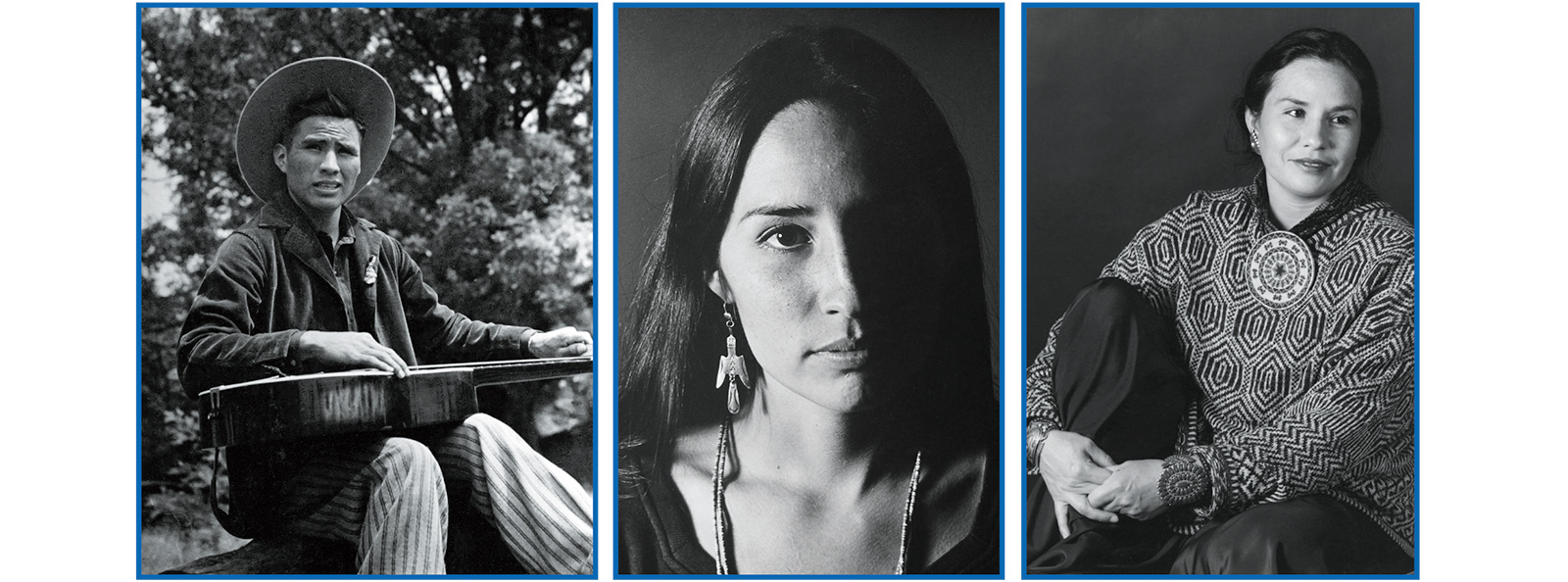
 Left: Postwar, Narciso Abeyta strumming a guitar at a dude ranch in Cottonwood Gulch, Arizona, 1952. Photo courtesy Shaun Conway. Middle: Pablita Abeyta, 1974. Photo courtesy Shaun Conway Right: Elizabeth Abeyta, 1980. Photo courtesy Shaun Conway.
Note: This is an excerpt of an essay from the Abeyta | To’Hajiilee K’é catalog published by the Wheelwright Museum.
I grew up in a home where projects were always at hand. There were clay vessels being worked on across the kitchen table; there was the smell of casein paint emanating from my father’s bedroom studio, there were woodworking tools, belt sanders, beads ready to be strung and books falling off of every shelf and wool ready to be carded, spun and woven on looms.
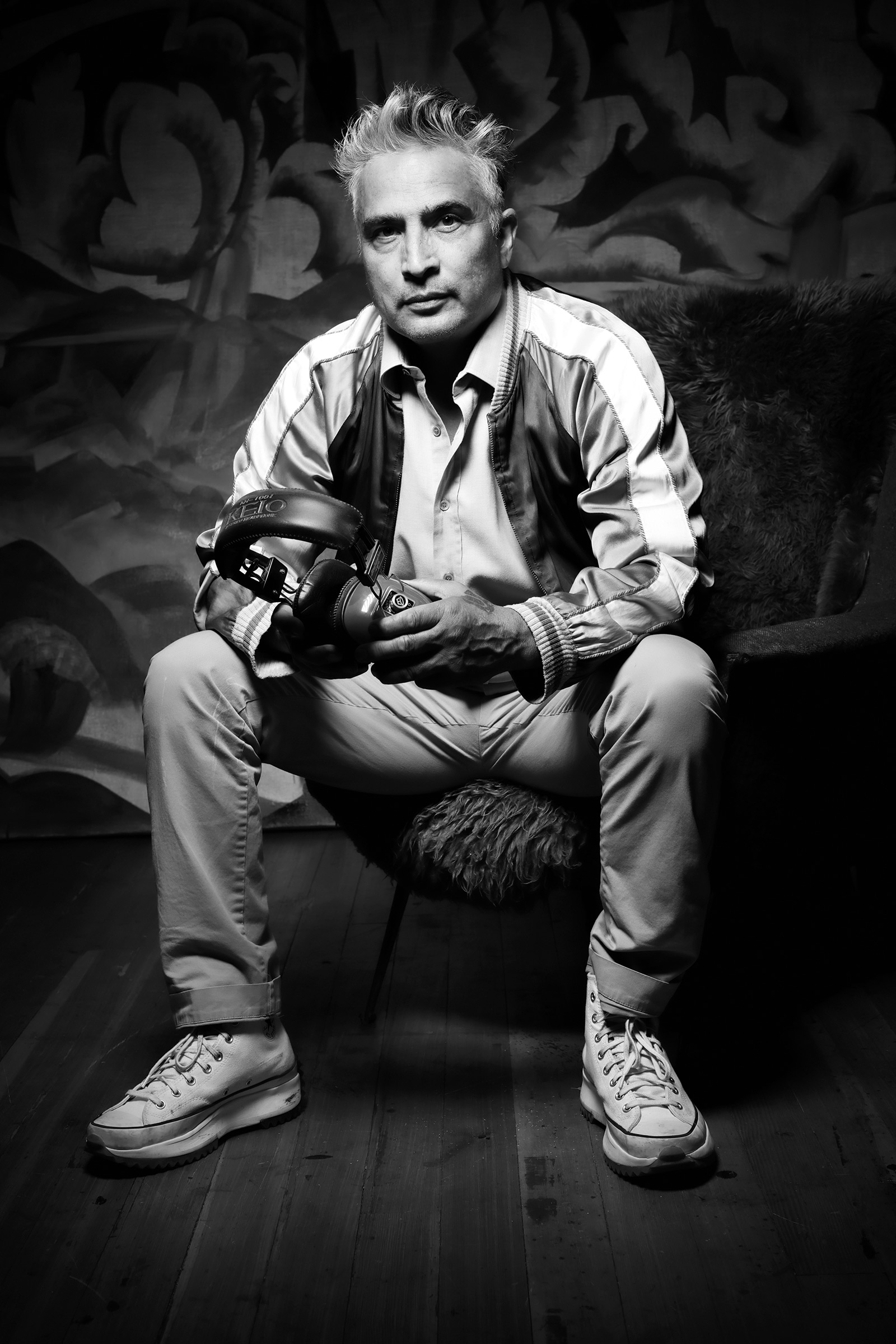 Tony Abeyta, 2021. Photo by Larry Price.
I chose instead to be outdoors constructing club houses and tree dwellings where I could spend time with friends devising skylights and elevator systems and kicking it on salvaged carpeting from a recently renovated hotel.
The home I grew up in was a creative place where art was familiar, and everyone was engaged in a creative project. In fact, everyone in my family was an artist and there was no escaping this legacy for me.
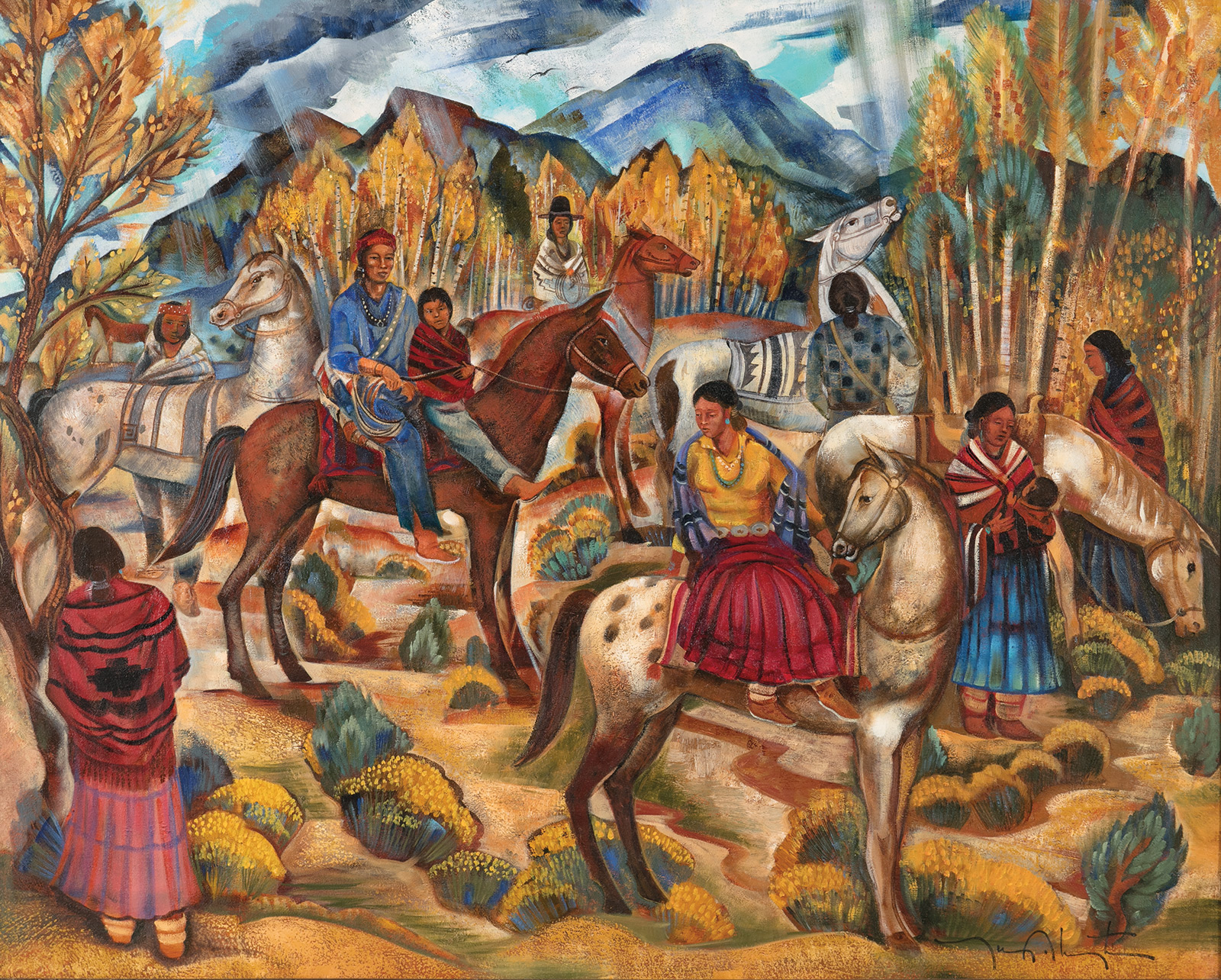 Tony Abeyta (Navajo), Moving Camp to the North, ca. 2004, oil on canvas. Photography by Addison Doty.
From the origins of a treehouse architect, I segued into working my teenage years as a projectionist and tearing tickets in movie theaters throughout Gallup, New Mexico, in places like the El Morro, the Aztec and the Rio West twin theaters. I wasn’t a painter yet, as this happened much later in my life.
My father Narciso was already an established painter whose work was in many museum collections, and collectors showed up at our house on the weekends to purchase unfinished paintings from him. Collectors, curators, and dealers all the way from Oklahoma were sometimes lucky enough to catch him on one of his prolifically inspired sprees and they could choose from a selection of works to add to a collection.
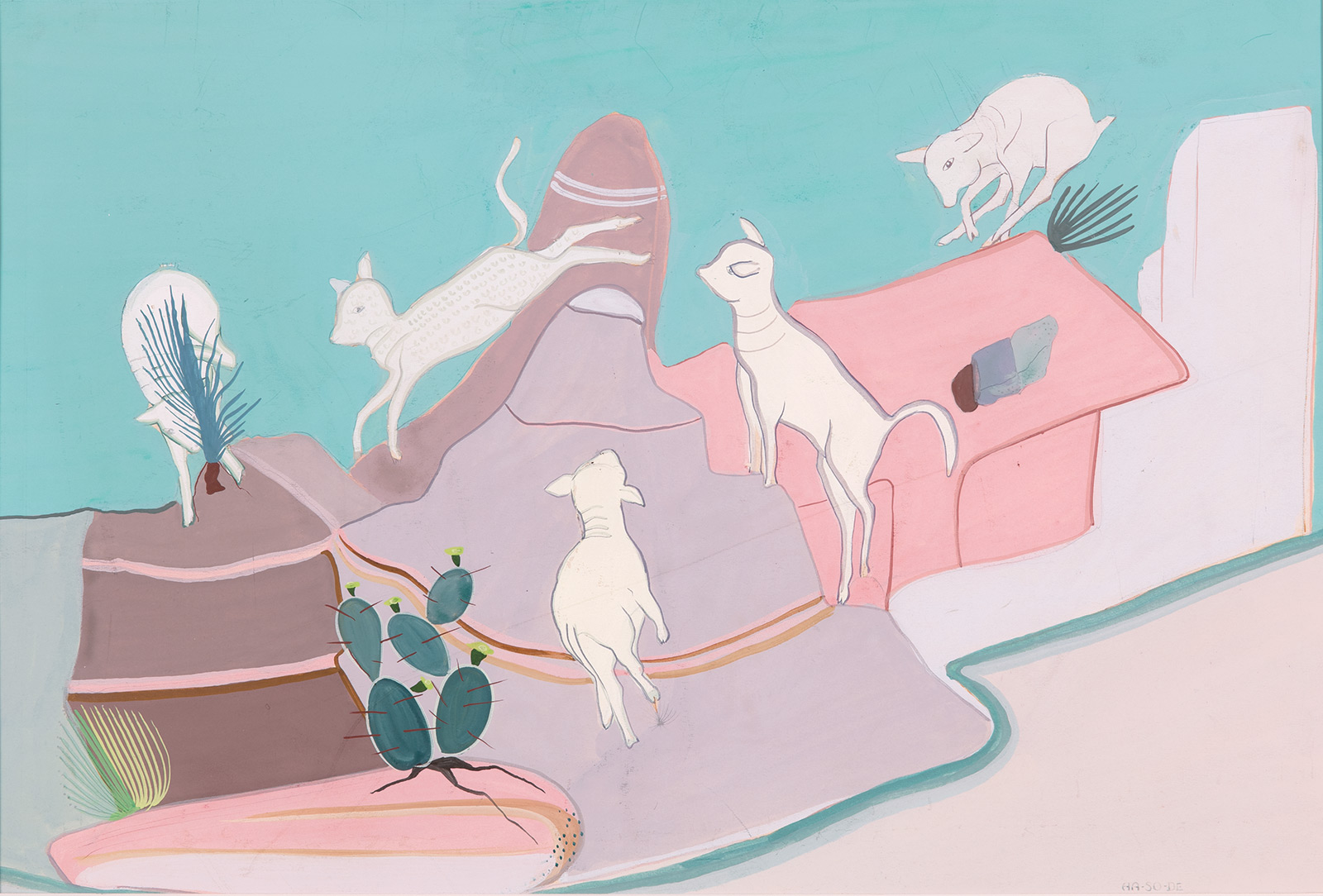 Narciso Abeyta (Navajo), Navajo Fawn Hunt, 1937, gouache on paper. Photography by Addison Doty.
In those days, most paintings of his sold for a few hundred dollars but the money went far in a small town for a small family. Along with the art being created, there was also storytelling at hand for those who took the time to listen; stories of boarding schools, the war, reservation life, the Navajo long walk to the Bosque Redondo. These epic and often colorful stories were very visual in my mind. Even to this day,
I attach my own visuals to people’s stories and because of the stories of my father every book I’ve ever read has such a specific vernacular that I can traverse the streets of Macondo in the book A Hundred Years of Solitude and know the taste of the clay upon the town’s adobe walls.
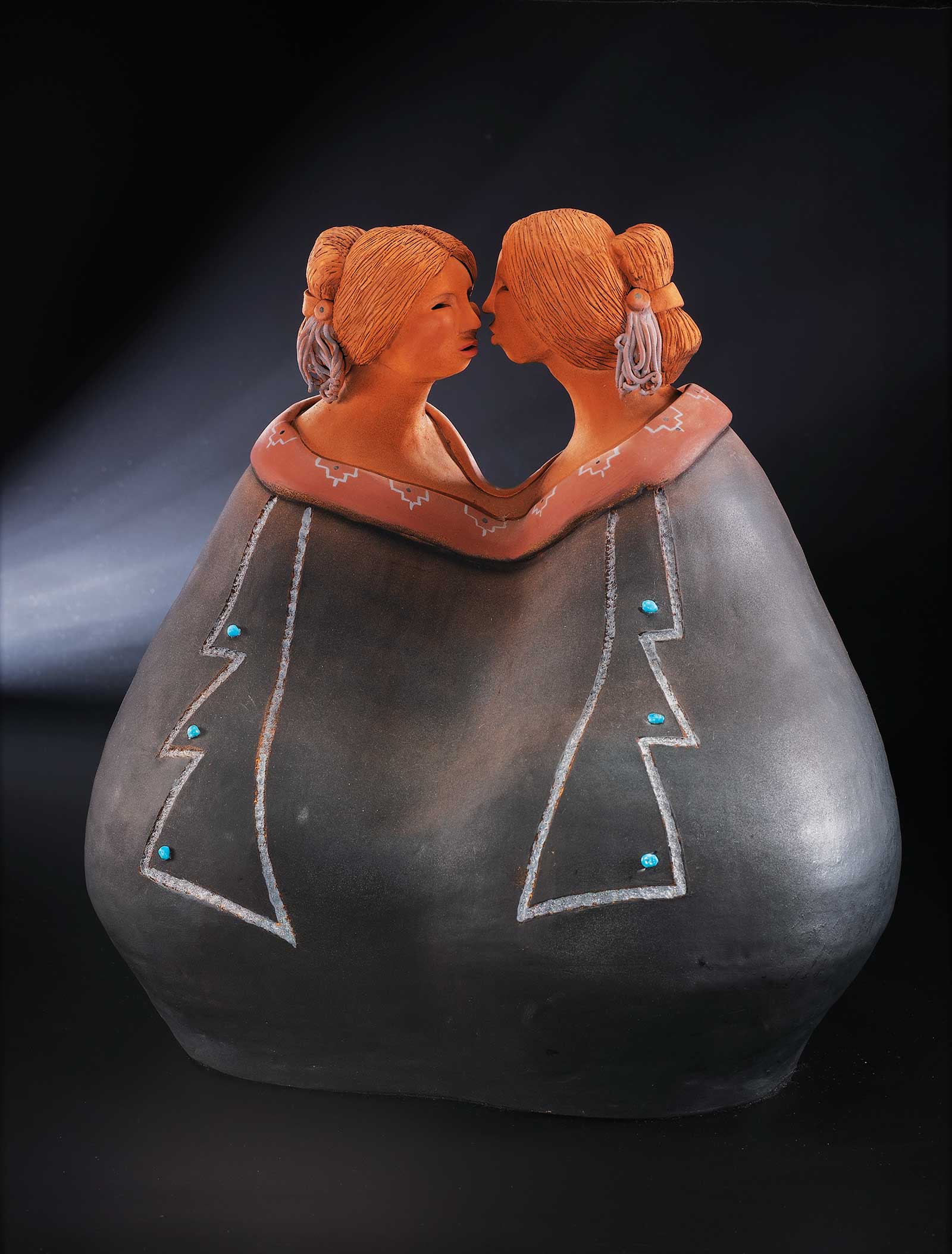 Pablita Abeyta (Navajo), Navajo Sisters–a Secret, ca. 1990-1991, clay, paint, turquoise. Photo by NMAI Photo Services.
For me, this was an experiential childhood, and all the tools were in place to make something happen. There was even a ceramic kiln there for a short while for my sister Elizabeth and a potter’s wheel on the porch to eat lunch upon, like a lazy susan.
At the apex of this creative foundation, I could be found carving rocks, my father would be painting expressive hunt scenes, my mother would be busy with carded, dyed and spun wool for local weavers, and my sister Elizabeth was off at the IAIA working on filigree clay sculptures as a student of Otellie Loloma. Pablita was working in Washington DC for the Navajo nation and my sister Rose was studying creative writing and raising her children. My other siblings were also creative magnates: Alice was always a storyteller with paint, Benita was refurbishing brownstones on the East Coast and my brother Tom was working as a potter and teacher. We were all creative forces to reckon with, each influencing the other and manifesting careers in creativity that started in a small home in Gallup, New Mexico. Everyone was unique and independent in their own right and it was important for everyone to be the artists that they all became.
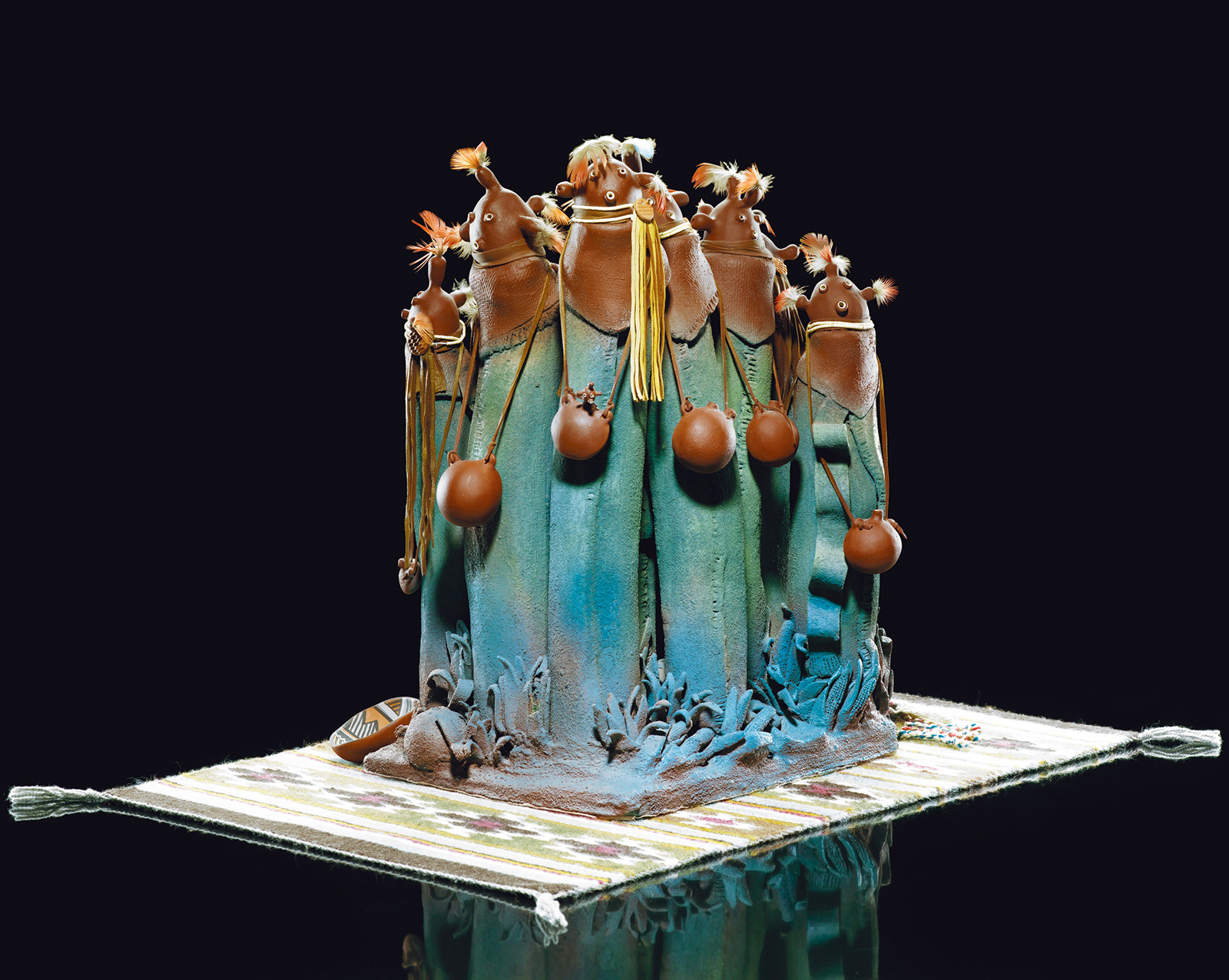 Elizabeth Abeyta (Navajo), Rain Watch–Cloud Gathering, 1995, clay, paint, leather, shells. National Museum of the American Indian, Smithsonian Institution (27/97). Photo by NMAI Photo Services.
It was said that my father’s career began by drawing horses on the canyon walls of Tohaajiili’. I have a few early paintings that he did when he was 16, so I have come to believe that he always did art. One story that is told is when my father was a young boy, he slipped away in a wagon with his best friend Tony Jose Chavez (who I was named after) and left in the fall for the Santa Fe Indian School. Hs family didn’t know where he disappeared to and thought that he had frozen in that cold winter’s snow. However, in the spring he returned in new clothes as if he had come back to life. They were elated but most likely angry that he didn’t ask to go in the first place. He was too young to begin school, but an allowance was made for him to enter the school and there he began painting in the studio of Dorothy Dunn.
In the afternoon of October of 1974, my father returned to his community of Cañoncito to visit with family and escape for a weekend. It was on this day that a violent tornado touched down on his tribal lands, killing a child and wounding residents and several sheep near his family’s homestead. It was traumatizing for him, and he returned home to us that Sunday, obviously shaken. I remember the story well as a child and personally felt the impact that it had upon my father as he returned home and began to sketch it upon watercolor paper that wrinkled and bucked with thick washes of grey and blue casein paint. He did two variants of this event, and this painting has what appears to be the roof of the trailer that was ripped off of the trailer house and a toy truck belonging to a small child in the tempest.
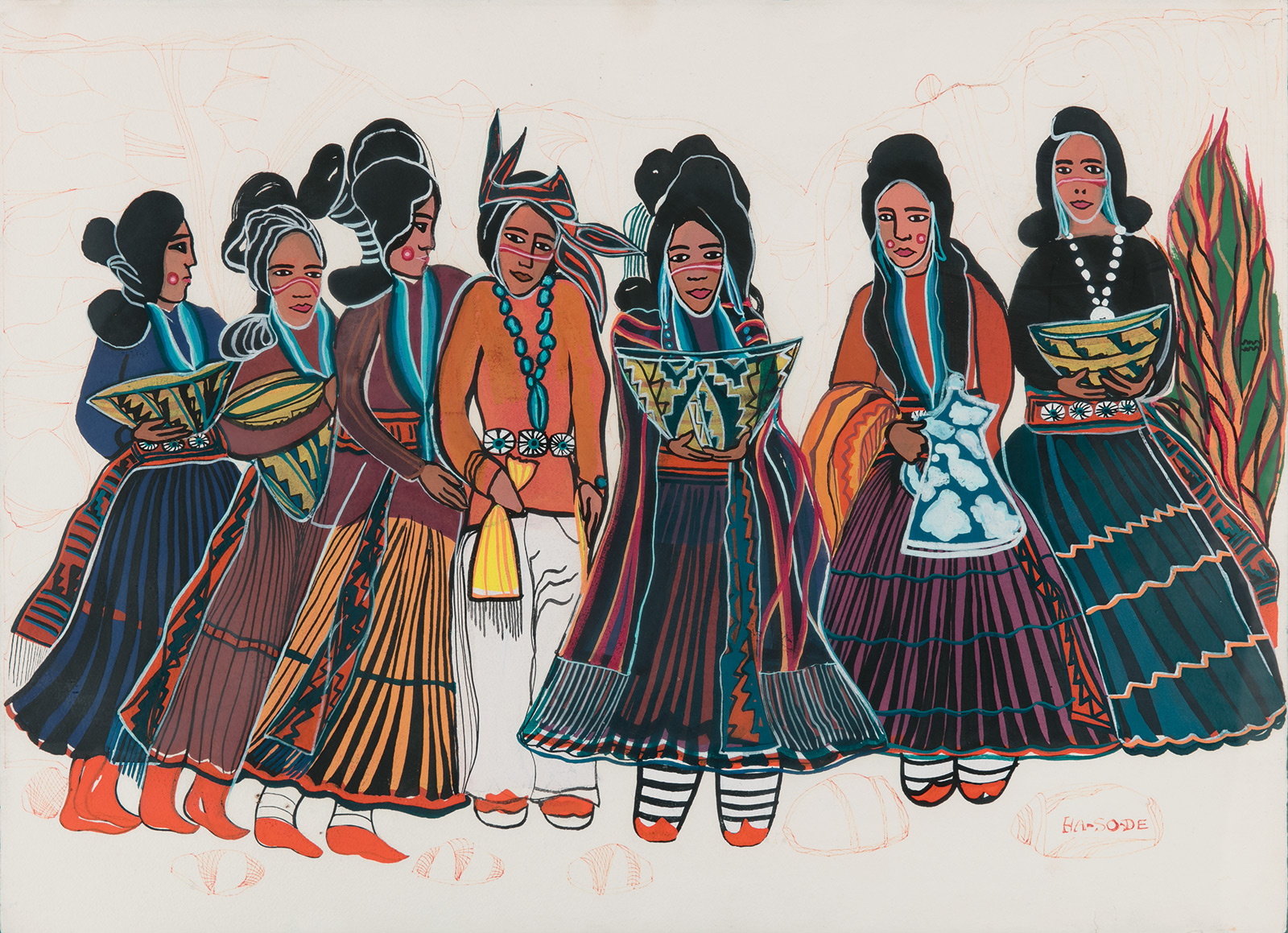 Narciso Abeyta (Navajo), Navajo Wedding at Canyoncito, NMex (Elizabebeth Abeyta’s Wedding), ca. 1970, gouache on paper. Photography by Addison Doty.
The colors within this torrential force are cold in palette and entangled with an expressionistic and emotional documentation of how he must have felt. The paper was almost torn in places and the large white hail spots were said to be the size of golf balls, the lightening forceful and he had made an obvious attempt to create the very sound that he heard.
Remaining authentic to his artistic inspirations, he wanted to document this event, as it represented the immense impact of nature and the ominous consequences of the great unknown. The painting is expressive and handled very differently from many of his other works, which were more lyrical, buoyant and composed, all to calmly direct the eye throughout his paintings.
His recollections of what he learned from his painting instructor at UNM, artist and transcendentalist painter Raymond Jonson are apparent, and this painting deviated more than any other work of his. There remains a sense of tragedy and futility in reckoning with these forces of nature. This painting was lost for many years until a collector in Colorado contacted me and gifted it back to my family, returning a memory of its creation along with a powerful experience.
As the only son of my father’s and the last child after five daughters, I grew up in a family surrounded by strong and creative women. They were certainly a force to reckon with. Pablita was named after my father’s mother, who came from the small town of Corraro, New Mexico, and she was part of a local modern dance group that emerged out of the unlikely Red Rocks of Ramah, New Mexico. She was very creative but was driven by the very life force of making social change and, early in my life, she headed off to Washington, D.C., to make things happen.
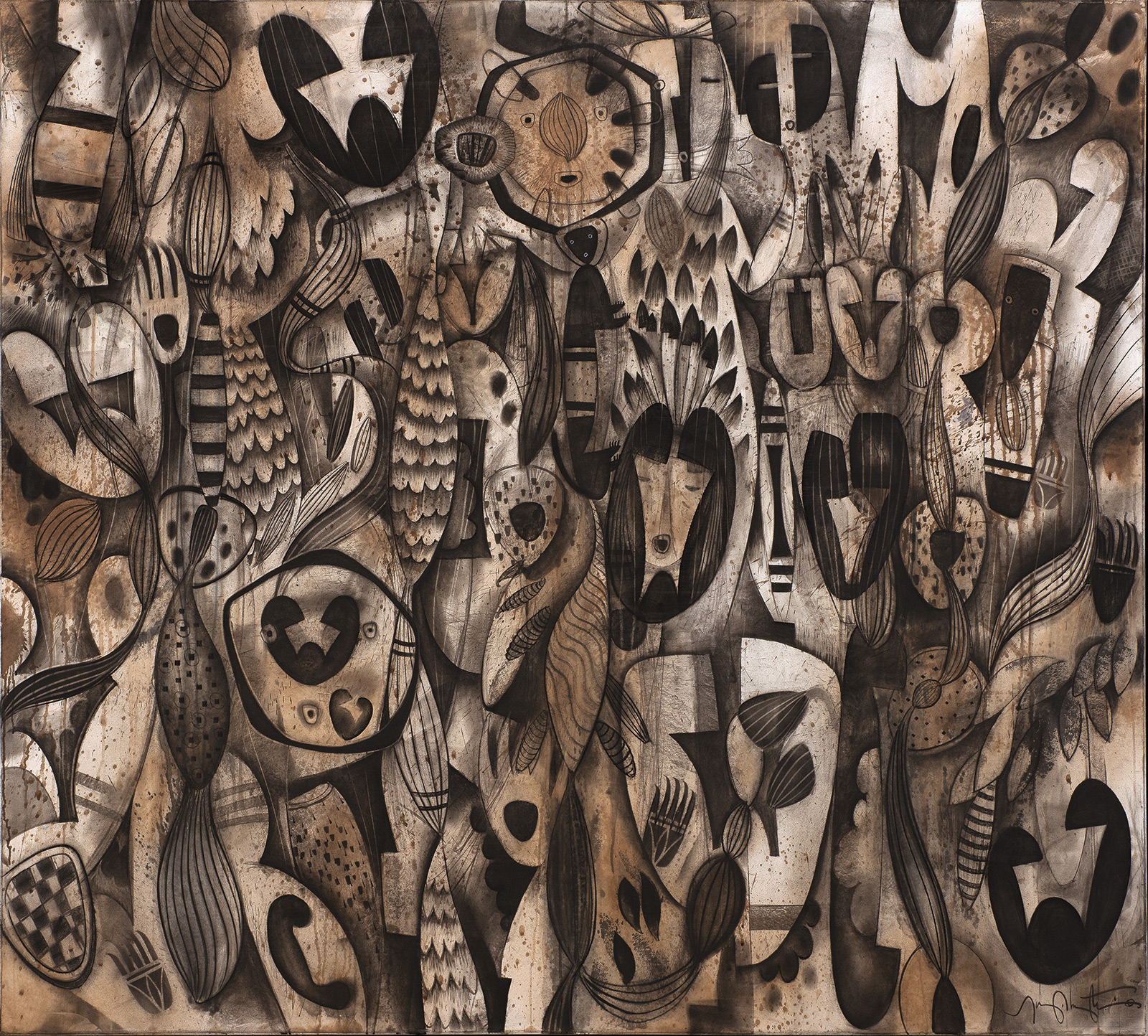 Tony Abeyta (Navajo), Songs Emerging from Darkness, 2018, charcoal and ink wash on Hiromi paper mounted on canvas. Photo courtesy of Laura Widmar and Sergio Tapia Collection.
Pablita worked on Capitol Hill for senators and the Navajo Nation, and would come home on occasion to check in on my developments as an artist. We were very close in the later years of her life. She loved art and supported me unconditionally. She arranged for many of her friends to purchase my artwork early on and built a small market on the East Coast for my work. Eventually, my very first gallery was in Dupont Circle in downtown D.C., and this helped finance my studies in Baltimore at the Maryland institute, College of Art. I was there on scholarship but had a savings account of about $20, so I was grateful for her connections and prowess at convincing her friends to buy my student work. Pablita collected many of my earliest paintings, as she always believed in me and was very proud when I was able to support myself through my art and when I found my way into museums and galleries.
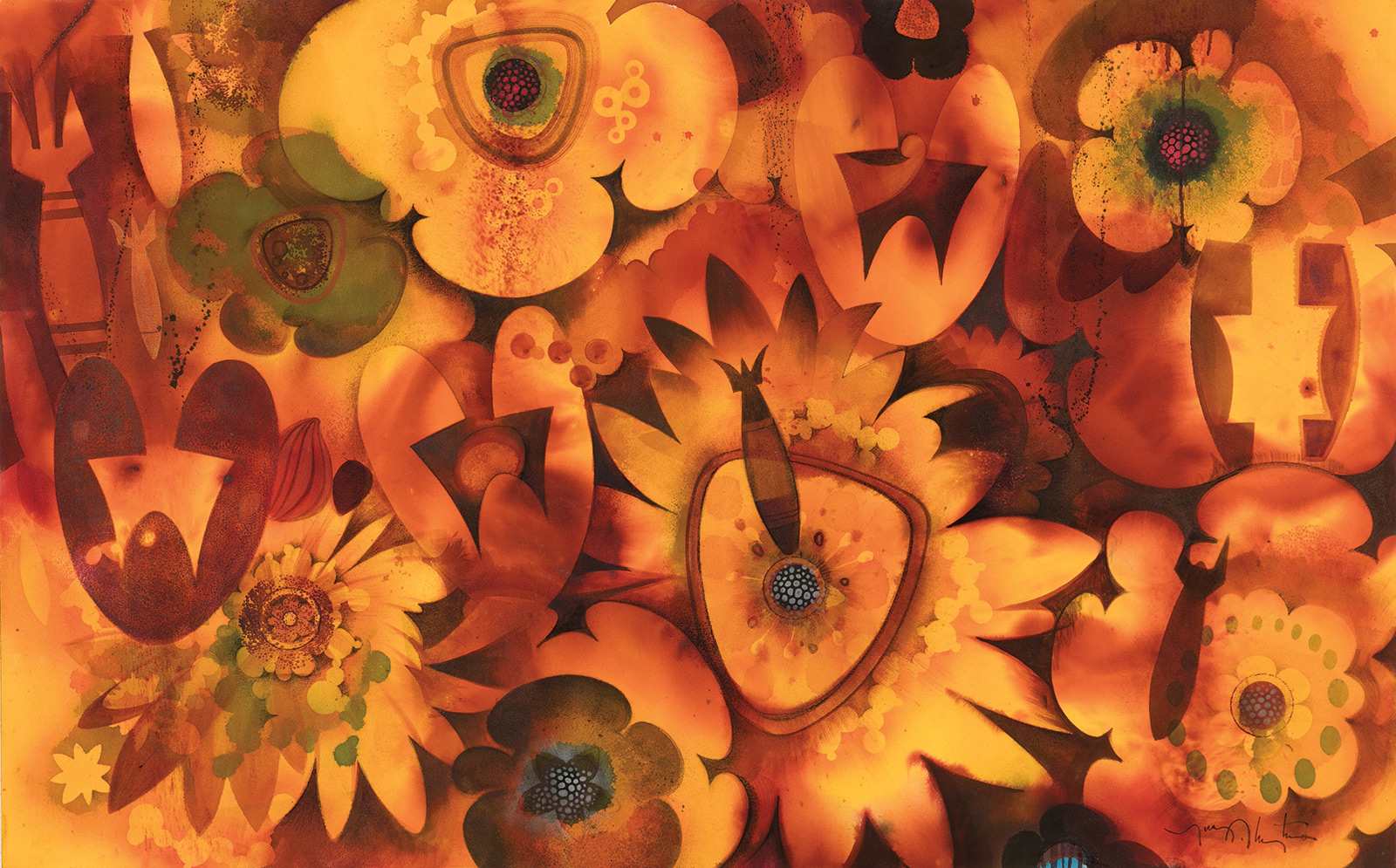 Tony Abeyta (Navajo), Autumnal Flower Bombs, 2019, acrylic on raw canvas. Photography by Addison Doty.
Elizabeth was also very dear to me, and we always talked about art at great length. She loved poetry, jewelry and sushi. She saw me as the golden boy of the family and would promote me as the next artist with a spit shine polish to anyone who inquired. I remember when she would come up to Santa Fe and we had such wonderful times getting ready for shows and we even showed at a few galleries together. She worked on her sculptures, and we shared many friends together. Elizabeth emerged from the latter manifestations of IAIA on the old campus and studied pottery with Ottelie Loloma, and adored her. Elizabeth was friends with many of the artists there in the 1970s such as Earl Biss, Presley LaFountain and Gina Gray. Her home was always a hub for artists and wet clay was always on the kitchen table. She raised two children, Adrian and Alexandria. Her romantic approach to making art was unique and there were always works covered in plastic all over the house.
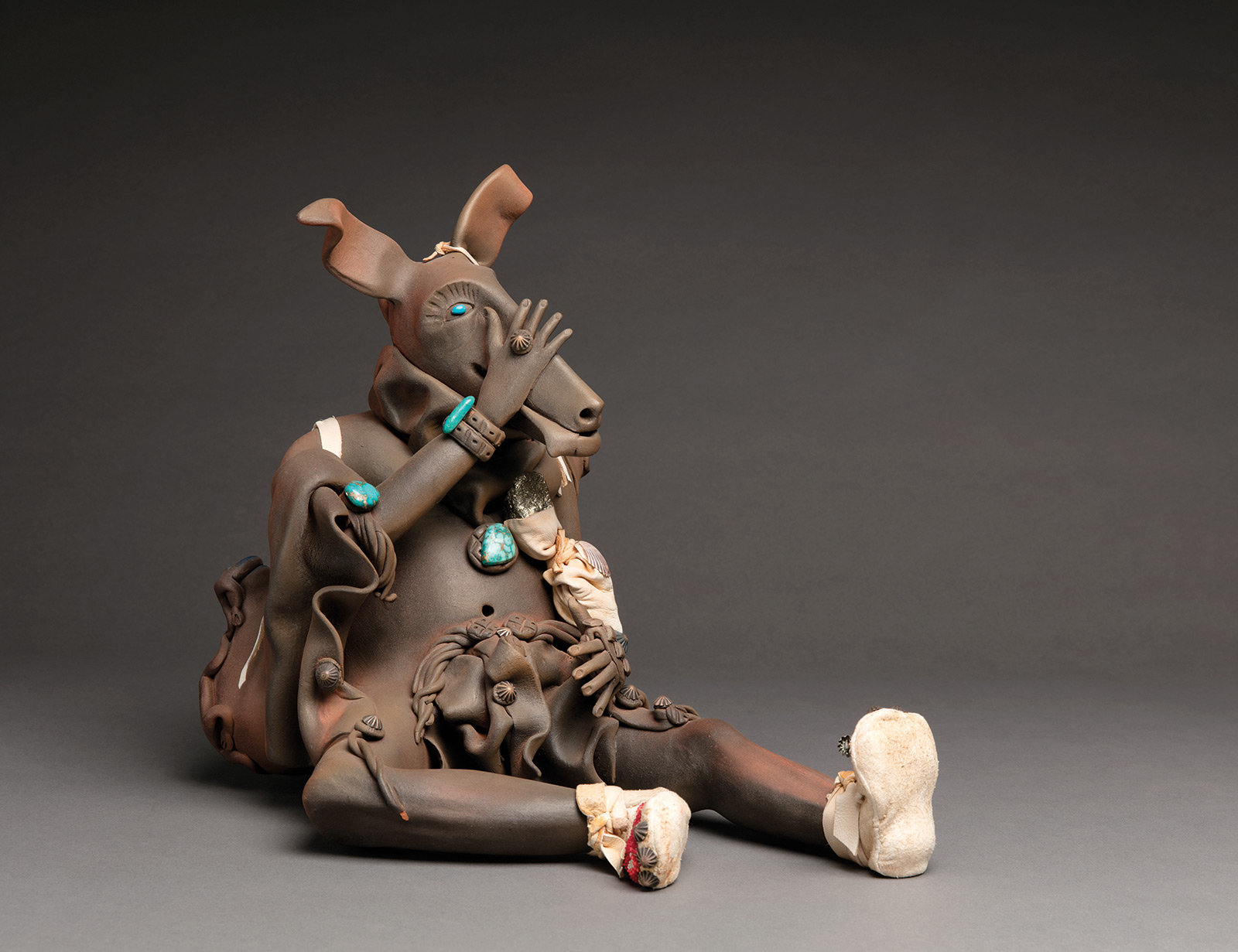 Elizabeth Abeyta (Navajo), Untitled (Trickster), 1984, clay, paint, leather, turquoise, silver, shell, beads. Private Collection. Photography by Addison Doty.
She was an art collector, as we all were, cultivating works by friends of our times. She was an animated storyteller and was much like me—a social butterfly. Her charm was magnanimous. Women loved to be in her midst and wanted to be long-time best friends with her. She preferred to be isolated and when people dropped in unannounced, they would find a locked door where she remained working on her pieces and raising her family along with her well-fed Persian cats. When she passed, it was very difficult on all of us and to this day, I remember the support that both of my sisters gave me, the loving nudges to go to school and to travel abroad.
I once called Elizabeth from a jackpot telephone at the top of the Eiffel Tower in Paris and asked if she could send me some money, as I had run out on a trip there to the newly opened Picasso Museum and she laughingly told me to “Go to Hell!,” but she reluctantly wired money to me the next day.
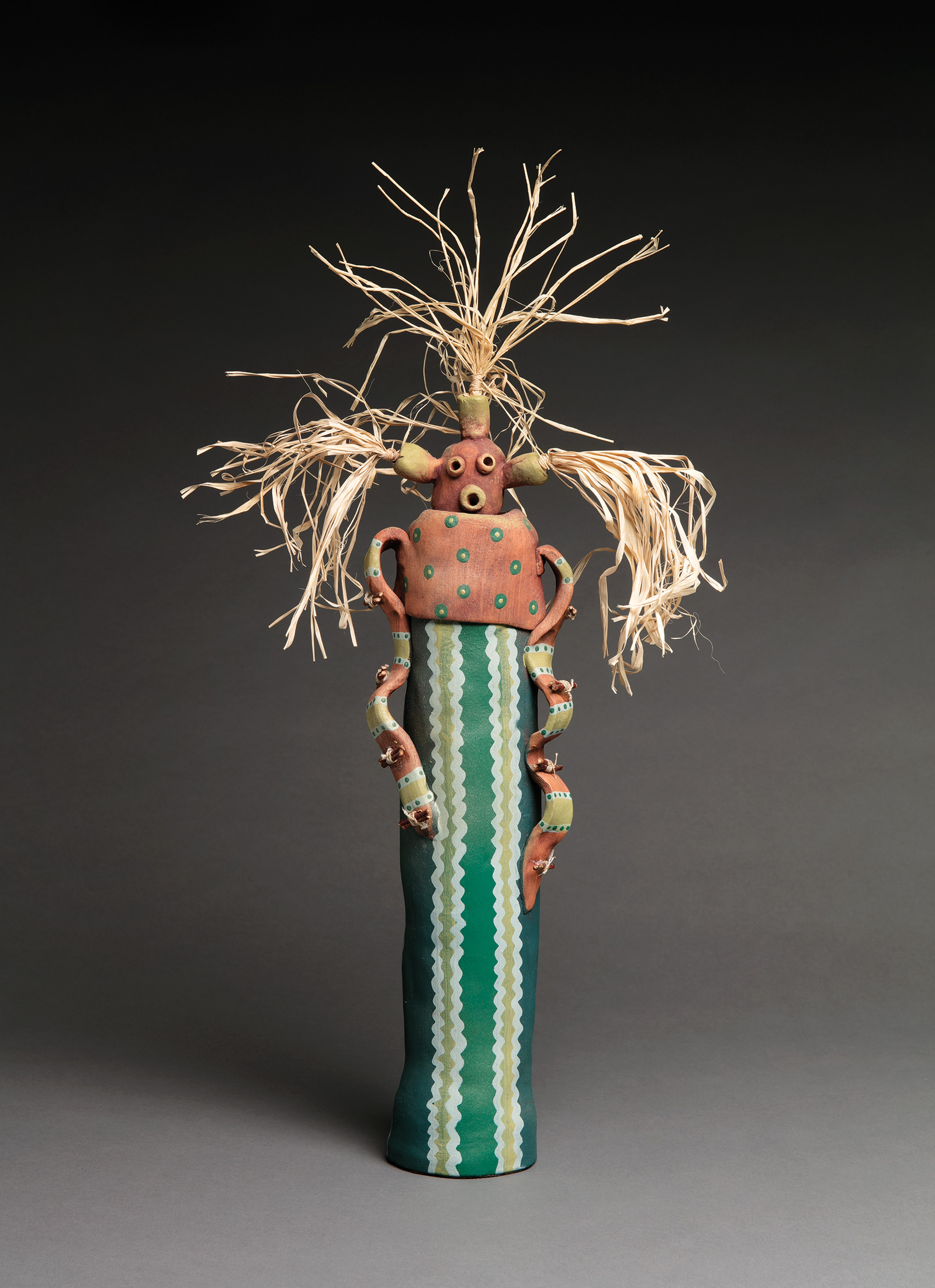 Pablita Abeyta (Navajo), Untitled (Mudhead), ca. 2000s, clay, paint, fiber, sticks, corn husk. Photography by Addison Doty.
Pablita would do the same, when I needed help with art supplies and plane fare.
I was fortunate to have these women in my life that were so dynamic…full of strength and character. They were powerful Navajo matriarchs, who managed to make the world a better place and bring people up along with them. Each of their sculptures are embodied with a love for clay and fire and each figure with a unique personality. This exhibition is the first time many of these works have been shown publicly and certainly all together. There is a common tie to one another and a narrative that tells the story of family, friends and our experiences, a family of artists and a legacy of storytelling through all of our art.
Through January 7, 2023
Abeyta | To’Hajiilee K’é
Wheelwright Museum of the American Indian
704 Camino Lejo, Santa Fe, NM 87505
(505) 982-4636, www.wheelwright.org
Powered by Froala Editor