
She smiles as she opens the door, slightly apprehensive about the coming interview. Wanesia Misquadace is a Native artist, educator, scholar and supporter of the Missing and Murdered Indigenous Women (MMIW) movement for justice. She is an enrolled citizen of the Minnesota Lake Superior Chippewa Tribe, one of the various bands of Anishinaabe peoples who populate large stretches of the Great Lakes into the Northern Plains. In Canada, they are also known as Ojibwe. She currently lives and works in the American Southwest.
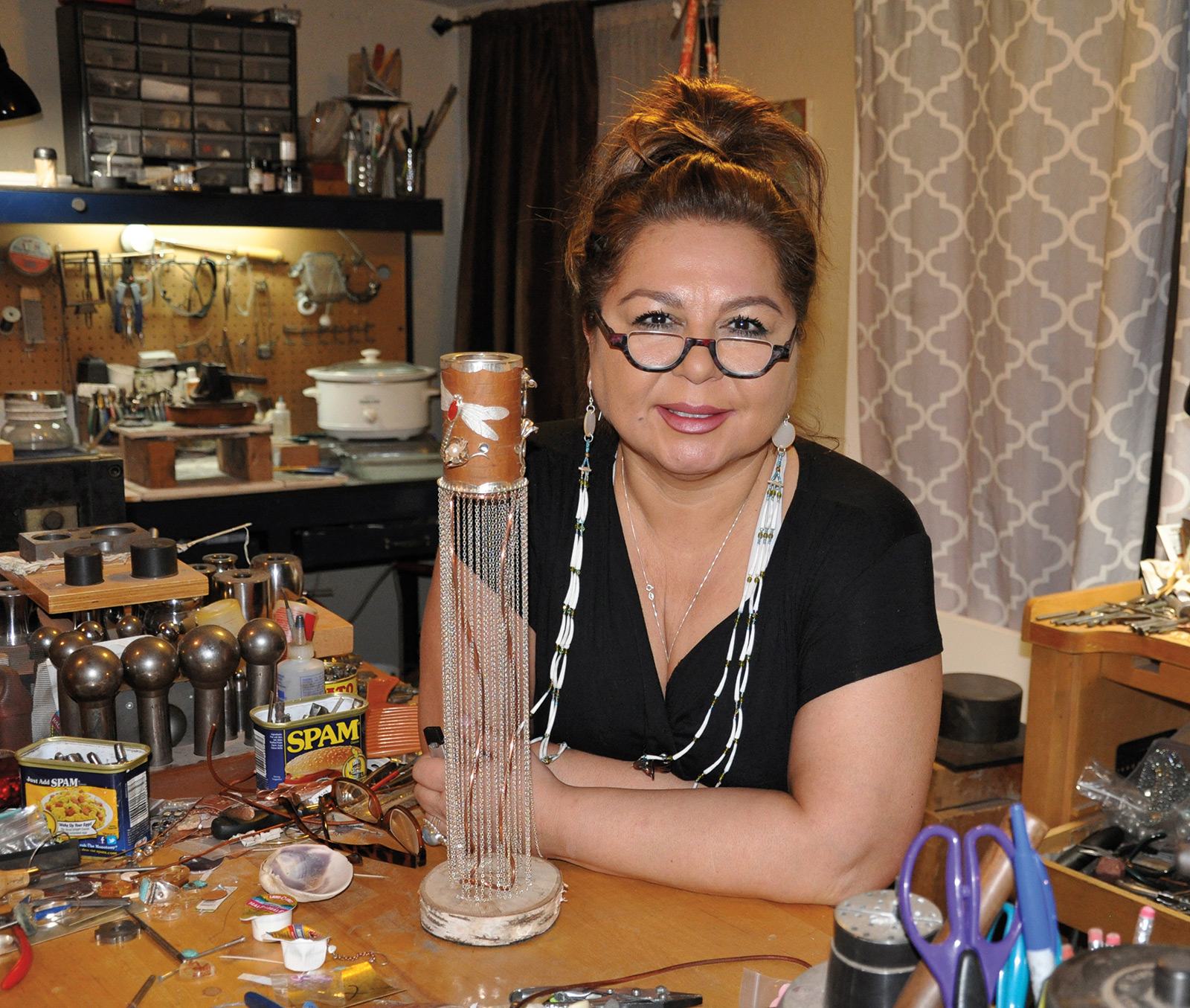 Wanesia Misquadace in her studio.
She describes her life since childhood as one where she used art as a way to connect to her spirituality. Misquadace also credits her inventiveness and abilities in multiple media to a DNA memory of her Native ancestors. She is naturally following her own path, one that has opened up to include a number of skills she hadn’t anticipated. As a result, she ranges from self-taught traditional forms of expression to the incorporation of new technology.
Misquadaces’ education has burnished her creative vision. She received her BFA in metals and museum studies from the Institute of American Indian Arts (IAIA) in 2005. Her eyes light up as she praises instructor Lane Coulter for guiding her to work with metal. Museum director Charles Dailey encouraged her to revive a tradition of her people that had all but vanished—birchbark biting. Her talent and drive for learning made her the recipient of a number of prestigious grants and awards, from the Doug Hyde Scholarship to becoming the first Native American woman intern in the conservation field at the National Museum of the American Indian in Washington, D.C. In 2010, she earned an art appraising certificate from the Rhode Island School of Design.
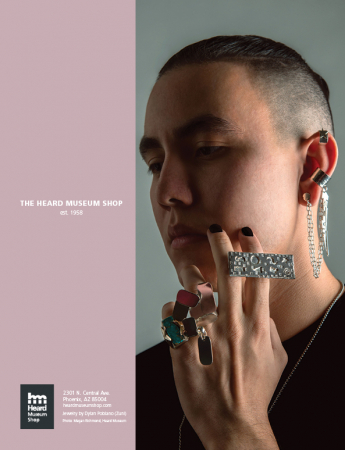
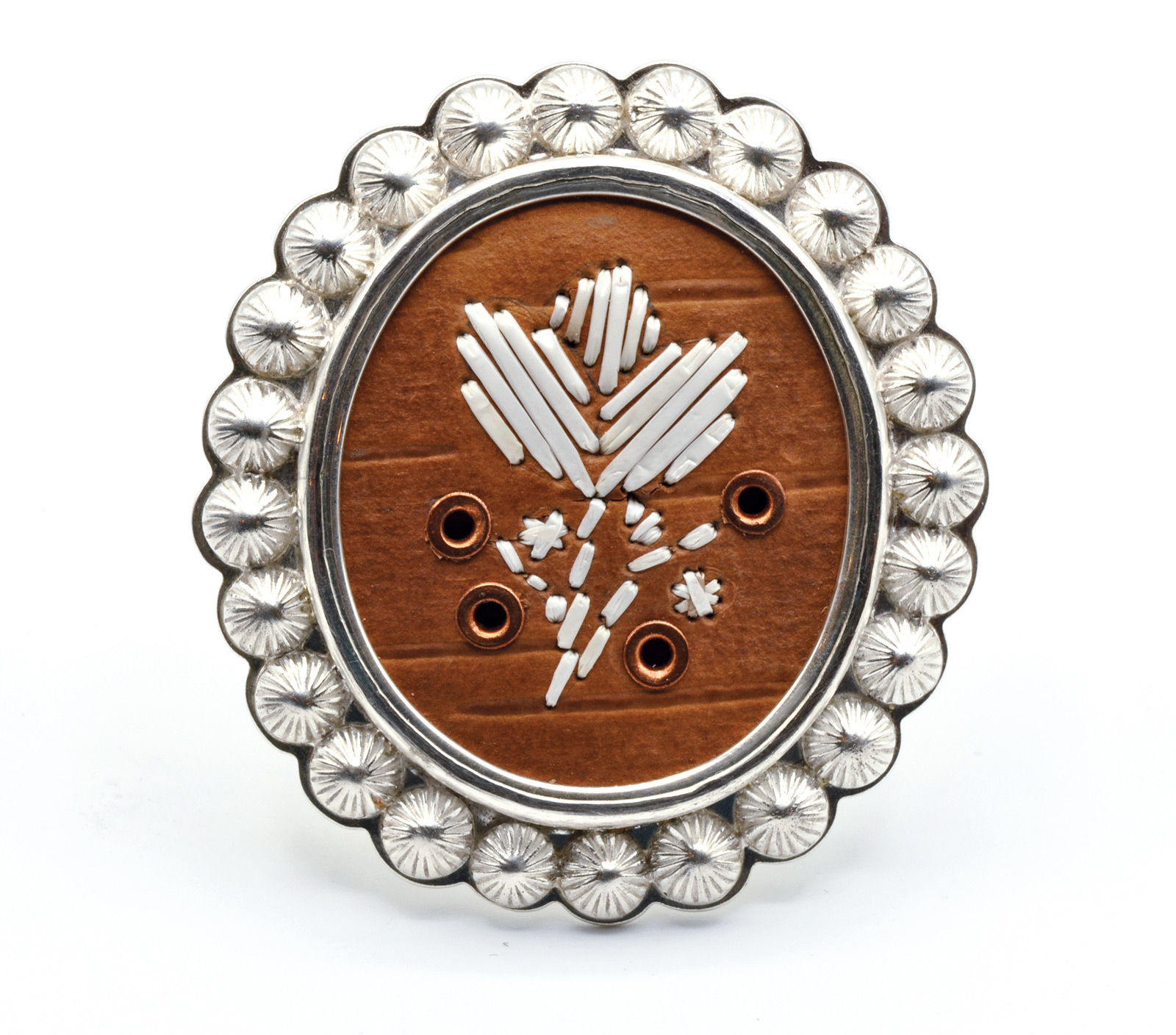 Silver ring with birchbark center and quillwork design, 2020.
Misquadace is one of just a few Indigenous artists who are actively revitalizing the ancient art of birchbark biting (wigwas mamacenawejegam). This technique permits an individual to form elaborate designs for body adornment, engineering, performance art and knowledge from storytelling. Native practitioners sometimes called these bark pieces “transparencies” or “chews.” Misquadace dismisses these terms, saying that birchbark biting created the first documented Anishinaabe “fashion patterns” or designs for decorative beadwork and quillwork. She likes the birchbark biting process possibilities for evolution and innovating; how the material renders itself thin and durable. “My pieces speak. I listen—and then I orchestrate.”
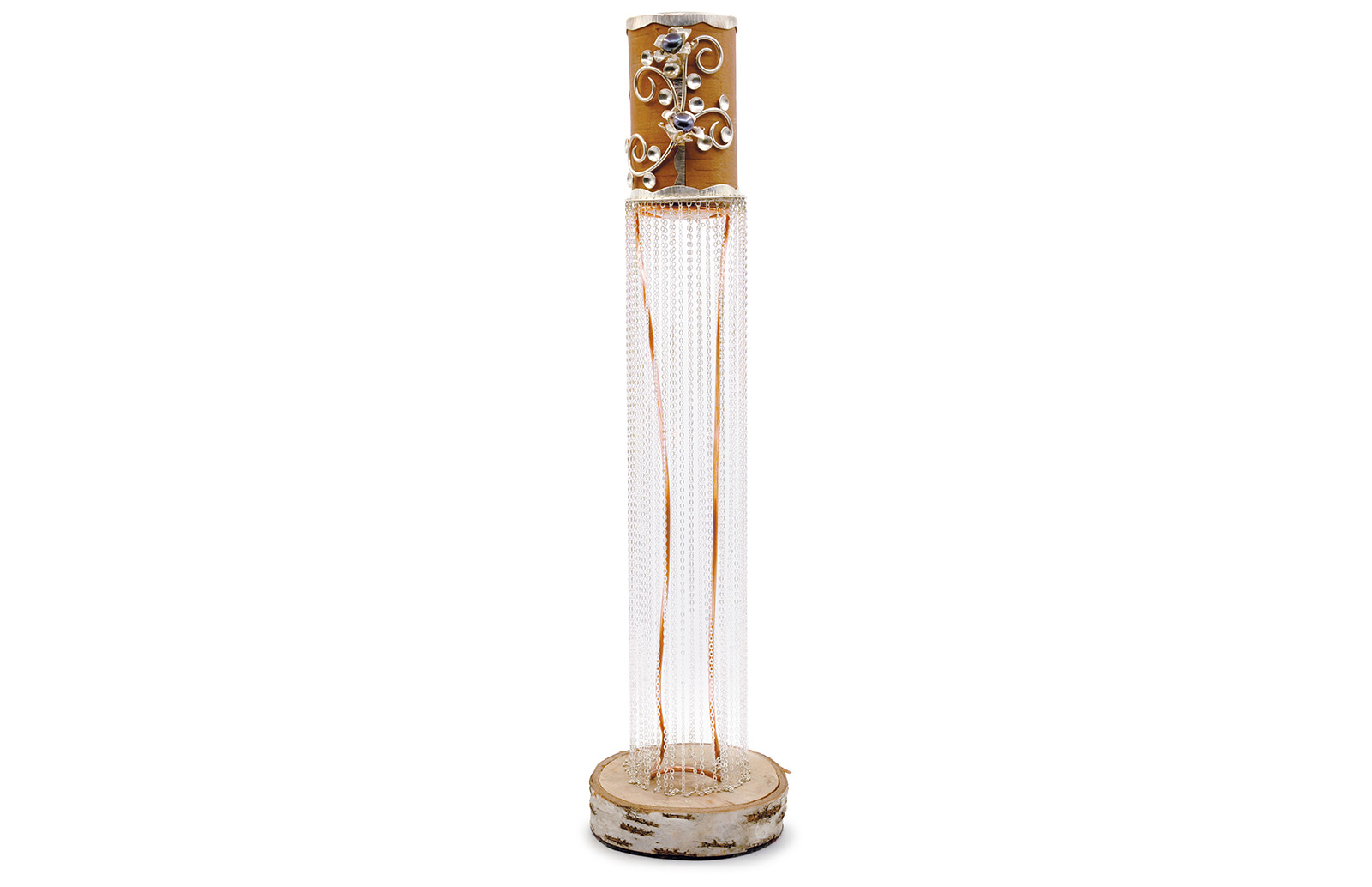 Water protector vessel, birchbark and silver, 2020.
Birchbark biting is done by selecting thin and supple strips of the bark, usually in the springtime. The maker uses their eyeteeth to bite the bark, putting pressure on the material to make the surface lacey or, more often, transparent to light. If a piece of bark is flexibly folded, attractively balanced designs can be produced. The artist points out her current role in using this process: “My research focuses on how to reawaken birchbark biting in innovative ways that connect the art of metallurgy with birchbark and fashion that are intrinsically connected to each other.”
These ambitions, she considers, have striking parallels to universal issues. The artist believes birchbark biting’s “fashion patterns” can reverse the disappearance of aspects important to Native culture: storytelling, history, performance art and identity. In addition, she works with precious metals and currently develops fine silver and gold settings for shell or stone jewelry. Much of her professional career has been spent in making these constructions work. “My research reconnects me to a time and place of my memories that hold resilience to my spirituality and the beyond,” she says.
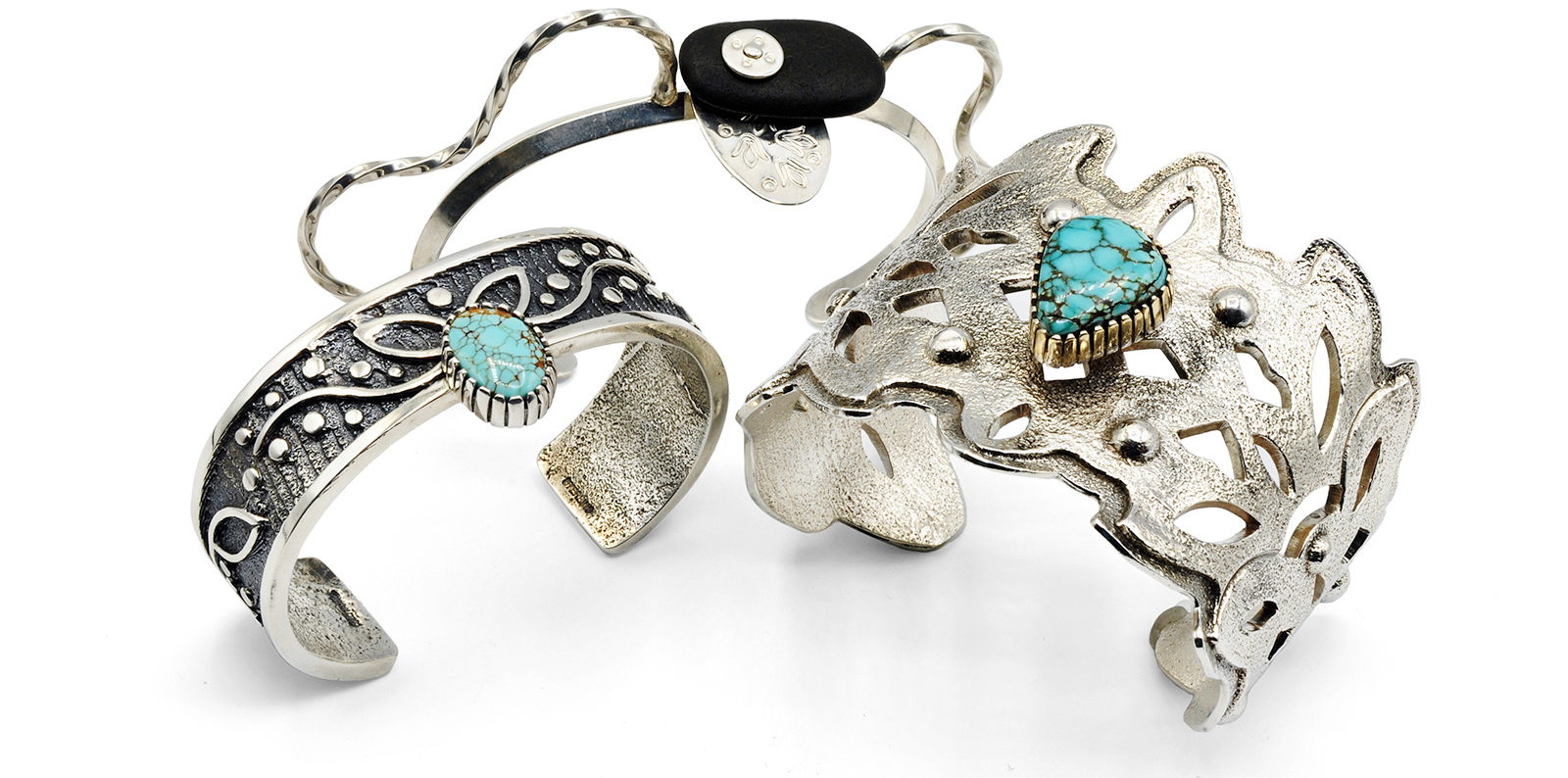 Three bracelets: cuff on left made from cuttlefish casting with patina to represent beadwork on black velvet; central bangle is unusual in presentation; large cuff is hand fabricated, all 2020.
This meant getting more training and education, as she pursued her goal of translating birchbark biting into metal. Misquadace was honored with the Chancellor’s Scholars and Edgar Fellows scholarships while she earned her MA in 2015 and MFA in metalsmithing and four-dimensional art from the University of Wisconsin-Madison in 2016. Later the following year, she was recruited by Arizona State University to become the first Native Anishinaabe enrolled scholar as an Assistant Professor of Metals and Indigenous Arts at the Herberger School of Arts.
Misquadace didn’t originally expect to become a professor. But she takes the education process seriously. She keeps her classroom open to wide-ranging discussions. Professor Misquadace has devised two new courses at ASU, “Indigenous Metals” and “Native Fashion.” She’s preparing for tenure review this year and is very naturally anxious about the substance of her portfolio. She also plans further research into trade silver connections, a subject which does not have substantive literature to date.
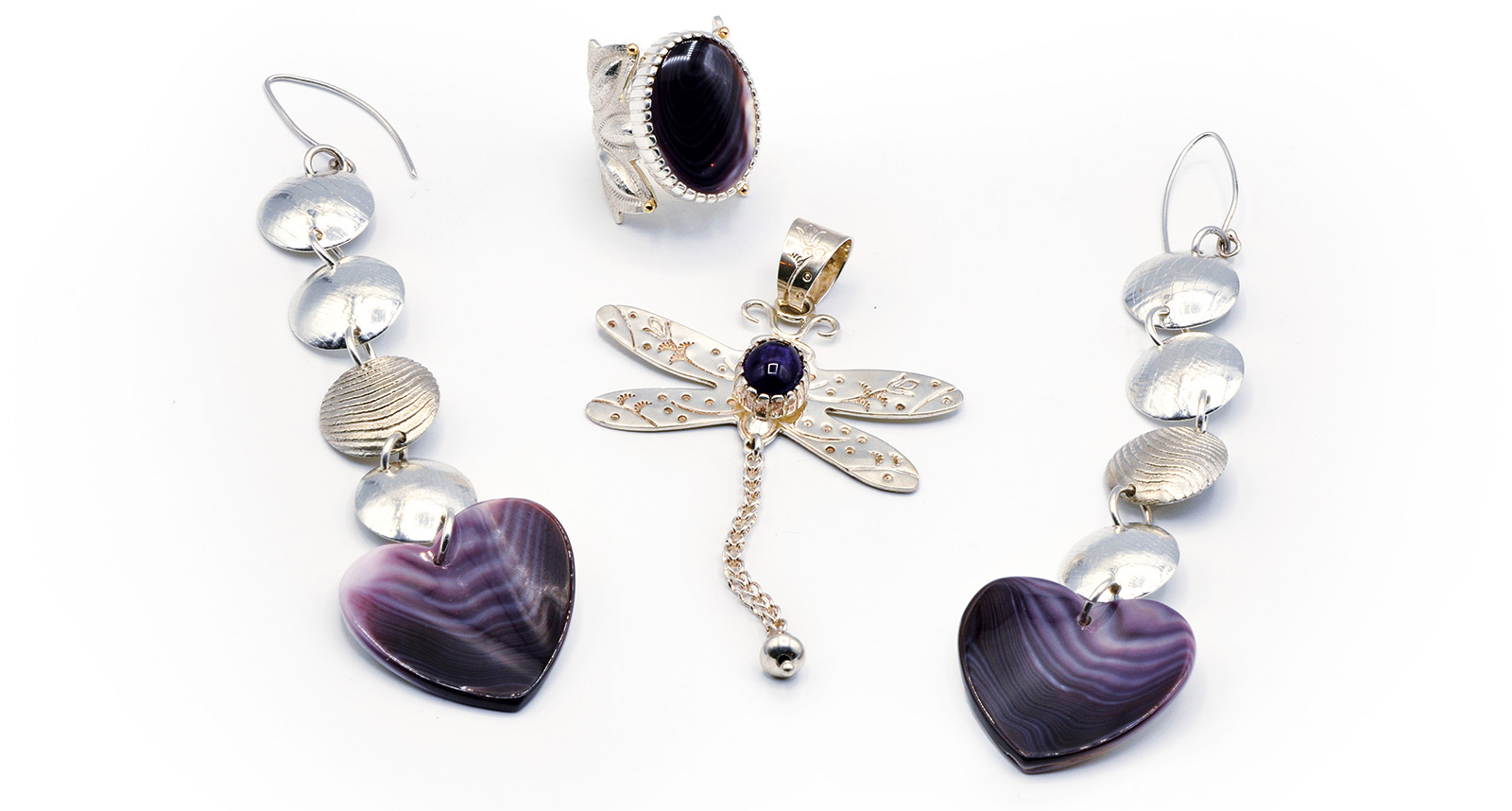 Three 2022 pieces with wampum shell adornment: dangle earrings, butterfly pendant and oval ring.
Her studio is a place of energy and purpose. Misquadace is preparing items for sale at various upcoming venues. Looking at her creations, all made within the last few years, the union of birchbark texture with silver and gold clearly stands out. Certain designs have a historical origin; she shows three silver pins with designs that derive from the early years of cross-cultural trade practiced by her ancestors. These handsome pieces backed by scraps of tartan cloth are based on Scottish Luckinbooth brooch designs and developed as trade silver in the mid-18th century. Her bracelets are stylish, as is a ring which displays a quillwork design on a birchbark center set into a fine silver frame.
She also fashions earrings with birchbark cutouts. A silver hair comb is lushly ornamented. An example of one of her birchbark biting designs reveals the artistry involved in devising a bandolier bag. Three pieces also made very recently with wampum shell are: a pair of silver disc earrings made by cuttlefish casting and finished with carved hearts; a silver dragonfly pendant with an ancient loop-in-loop chain design; and an oval ring with gold dots on its shank.
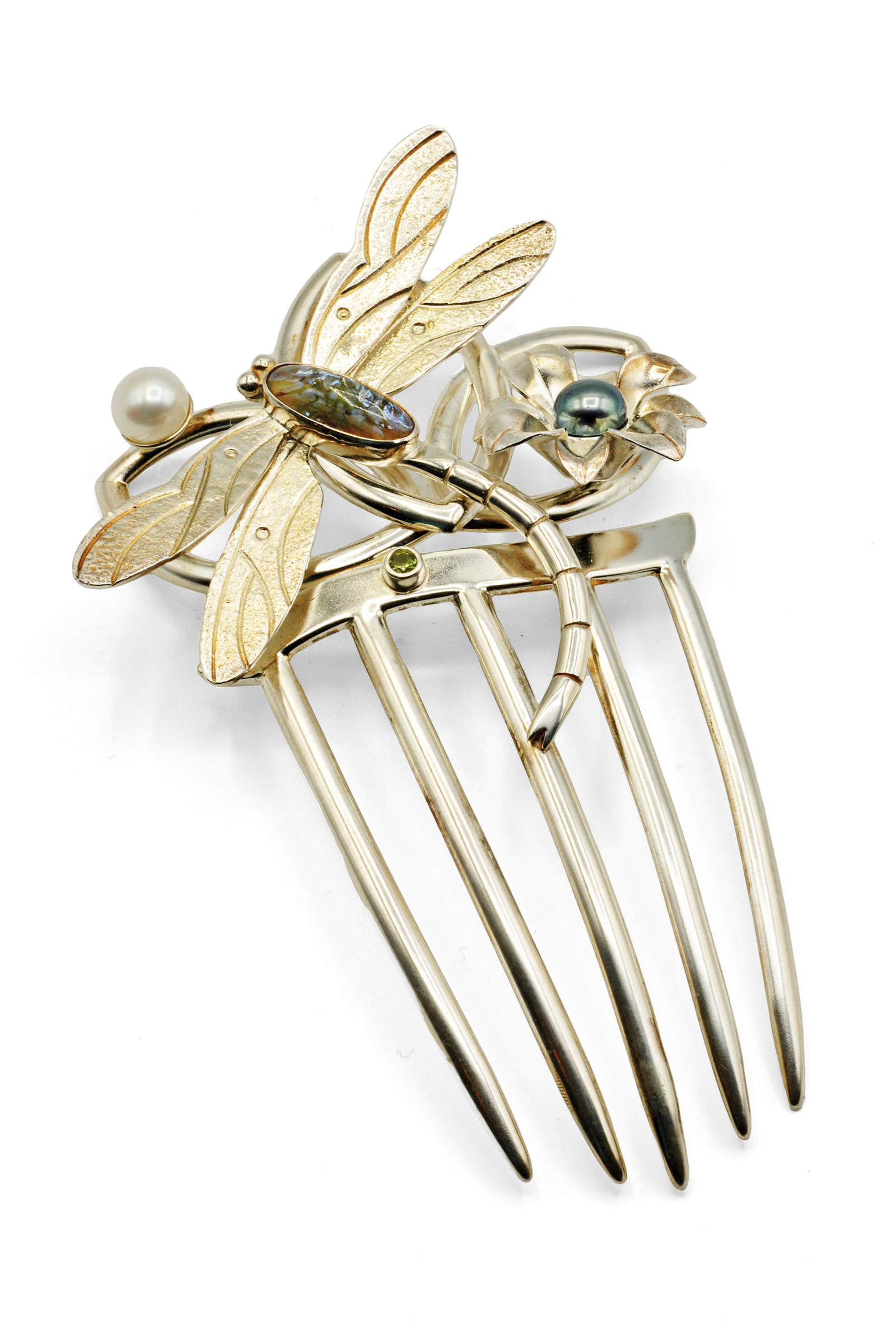 Silver hair comb ornament, 2021.
Misquadace also presents one of her most traditional, intricate and exquisitely engineered creations—a water protector vessel composed of a canister made from birchbark and silver atop a stream of silver chains that represent water and the healing sound of rain. She devised this piece during the tense first months of the pandemic in 2020, when activities shut down and confusion reigned about public safety. The artist has some future projects in mind, expanding her artistic expertise to working with enamel, and also with holograms, finding a way to fuse tradition with new technology.
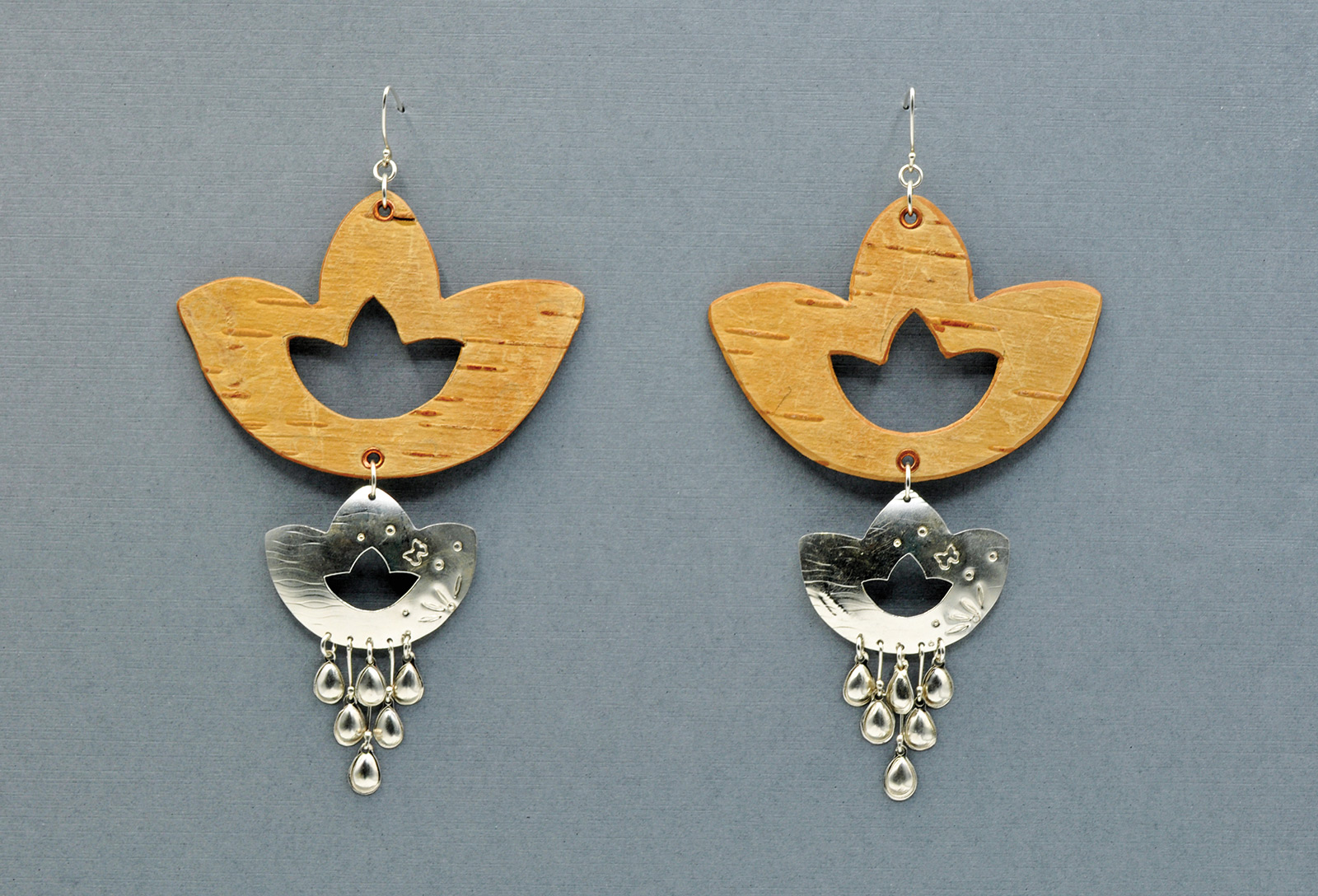 A pair of earrings with birchbark biting cutouts, 2021.
Most of all, Misquadace looks to the future. A survivor herself, she hopes that the growing MMIW movement will find ways to spur more national attention to how Native girls and women are the least acknowledged and most endangered victims of violent crime. “Every piece of art I make refers back to the healing process of being a survivor. In turn, I’m empowering my community of survivors and holding resonance to that space.” Others sources of concern are water and land rights, and investing in Native youth.
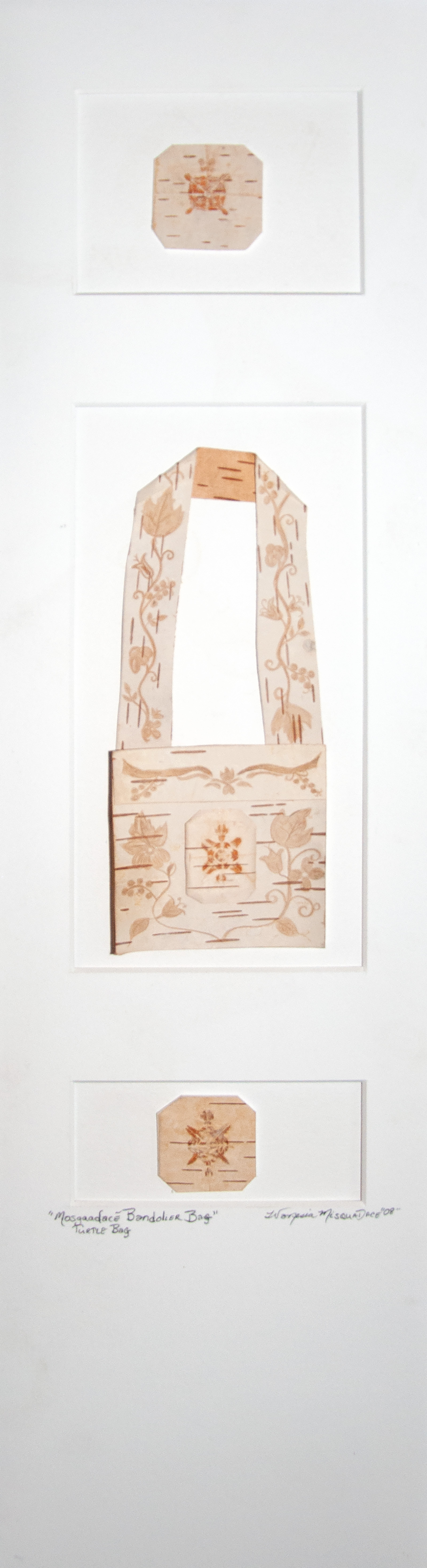 A birchbark design for a bandolier bag.
She makes a point of speaking to educational groups, as in a recent talk to the Heard Museum Guild in Phoenix. The artist is a wry, lively demonstrator of birchbark biting who makes her presentations appealing—this in an age where effective public speaking is much in demand. Native educators, especially those with the combination of skills she possesses, are underrepresented in America at present. Misquadace hopes this may change in the future. In the meantime, she feels that her work upholds and promotes Indigenous identity.
As the interview concludes, she more visibly relaxes, knowing that she’s made sound, engaging points. She’s also proud of connecting her art with the need for protecting Mother Earth and the power of plants. Misquadace, like many other Native American artists, feels a deep commitment to expanding her visual messages. “It is the body. It is the spirit. It is the adornment,” she says. “One does not exist without the other.”
Powered by Froala Editor