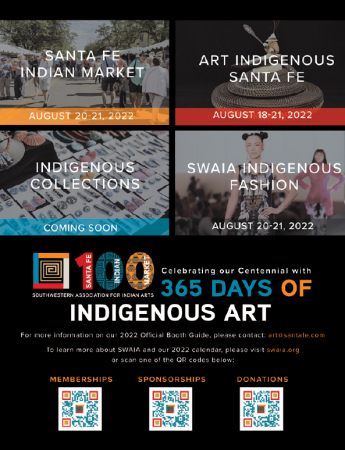
The year 2022 marks Santa Fe’s Southwestern Association for Indian Arts (SWAIA) centennial celebration: 100 years of Indigenous artists, designers, arts and, more recently, fashion! This year is also SWAIA’s ninth-annual fashion show, which has exponentially grown since its inception in 2014. Despite the increased interest in Indigenous fashion and apparel, Native designers are neither new nor an anomaly, showing their collections on alternative and innovative platforms for decades. Many exciting narratives of Native fashion have yet to be written and published from the Indigenous perspective to help expand the canon of fashion history. Over the course of SWAIA’s centennial year—in addition to the 50th year at the Museum of Contemporary Native Arts (MocNA), and the 60th for the Institute of American Indian Arts (IAIA)—my goal is to bring forth narratives essential for the discourse of Native fashion. A remarkable avant-garde space creating and showcasing fashion by Indigenous designers is Heat: A Freak Boutique, which opened in Santa Fe, New Mexico, on Valentine’s Day, 2002. This chronicle offers a small glimpse into one Santa Fe fashion scene that helped to make space for the headlining artists known today: the Original OG’s of Indigenous fashion in the Southwest.
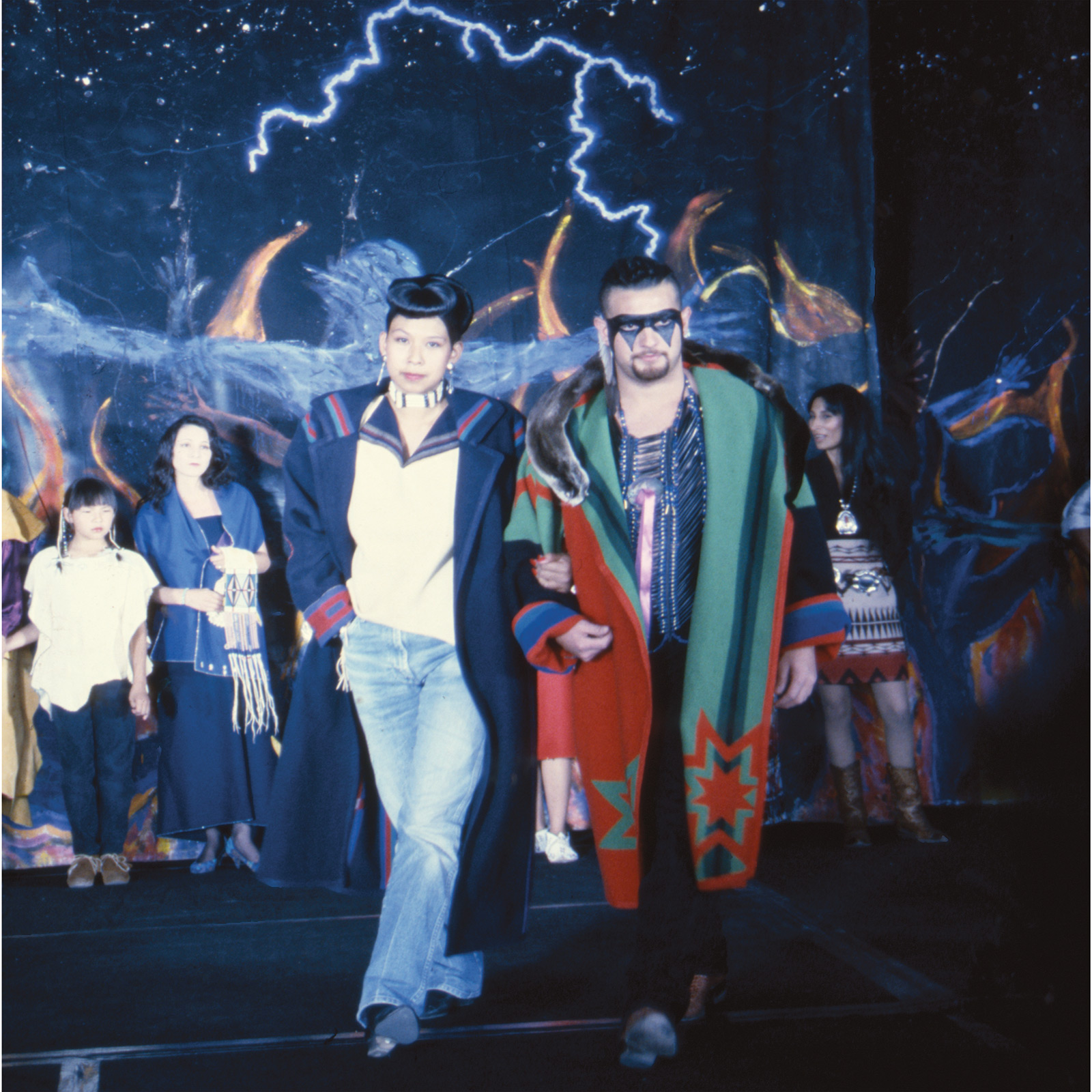 Pilar Agoyo (Ohkay Owingeh/Cochiti/Santo Domingo), center left, with several models wearing designs by Wendy Ponca (Osage), circa 1992.
========================================
“Indigenous designers/artists have been working meticulously in creating innovative clothing and what is called haute couture fashion for centuries, before the arrival of the Spaniards and colonization.”
========================================
Indigenous designers/artists have been working meticulously in creating innovative clothing and what is called haute couture fashion for centuries, before the arrival of the Spaniards and colonization. Quintessential designers who may be considered the matriarchs of Native fashion are Dorothy Grant, who opened her first physical store in the early 1990s located in Vancouver, Canada. Margaret Wood published one of the first books on Native fashion in 1981 titled Native American Fashion: Modern Adaptations of Traditional Designs. Going back further, Lloyd Kiva New, who has been widely considered the grandfather of Native American fashion, was also an important educator, serving as art director at the recently founded IAIA from 1967 to 1978. There he fostered Native artists and helped their work be taken seriously, as something dignified and beyond tourist art, impacting generations of students. One of those individuals was Patricia Michaels from Taos Pueblo, class of 1989 at IAIA.
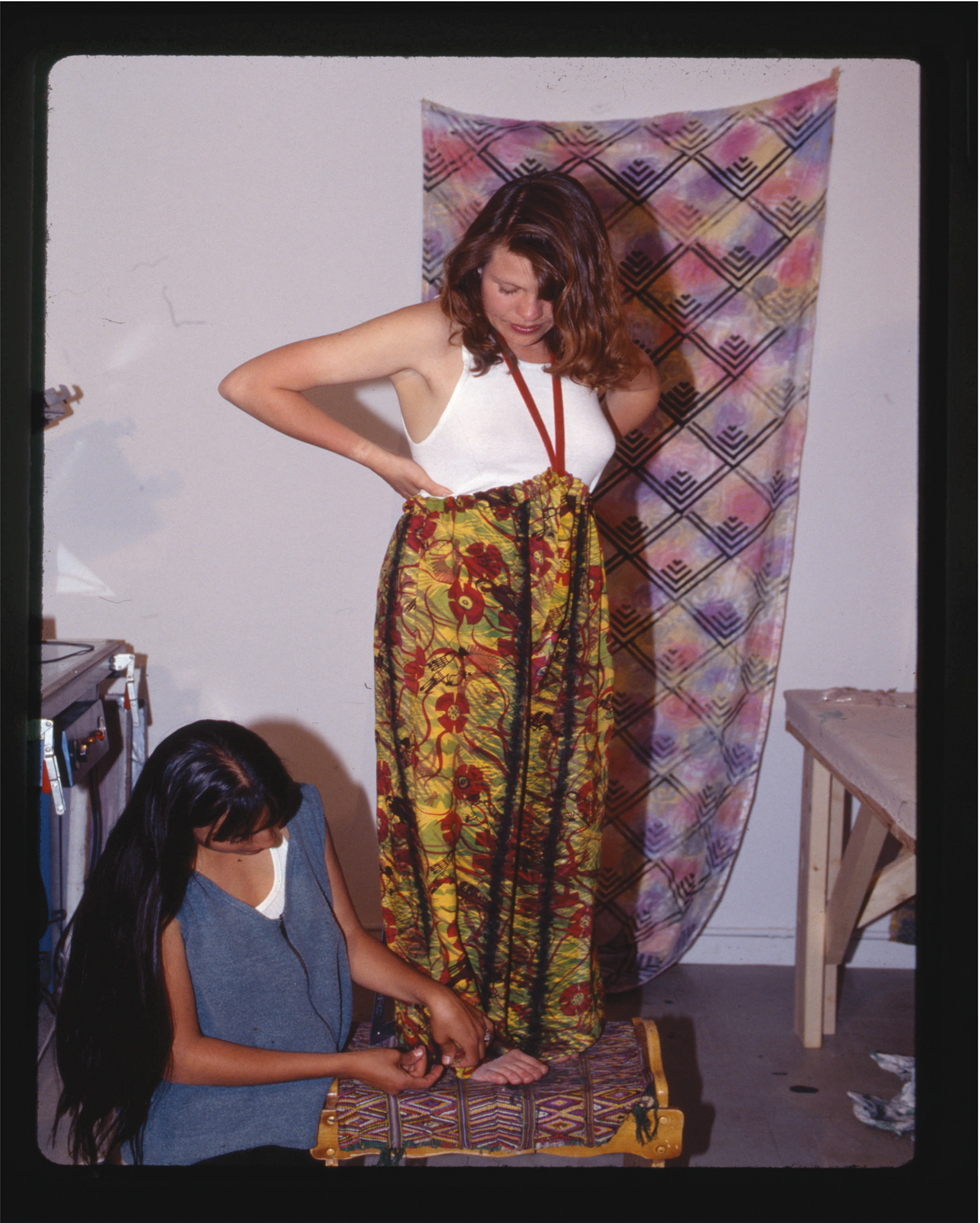 Textiles painted by Patricia Michaels (Taos Pueblo). “I was getting ready for my first fashion upon my return from college in Chicago the Summer of 1992,” Michaels says. “The fashion show was at IAIA. Alan Houser and Lloyd Kiva New were there. They gave a standing ovation.”
Although her student years preceded New’s position at IAIA, he had a great impact on her as a designer. “Lloyd use to come to my studio in Santa Fe,” she says, “and was a mentor to me.” New’s impression on Michaels is evident in her one-of-a-kind ensembles with hand-painted and printed textiles, drawing inspiration from nature and her Taos Pueblo roots. Some of her collections are a direct response to looking at pottery shards when walking in the Taos foothills. Virgil Ortiz is another artist and fashion designer who is influenced by his Pueblo pottery art and design beyond aesthetics. Ortiz makes fashion, ceramics and multimedia artworks, with each practice informing the other to create a visual language rooted in his Cochiti Pueblo culture. When talking about their early career, Michaels and Ortiz mention how much fun it was to create fashion shows. But these are much different from the soirees they participate in today! “The only places to create a makeshift runway in Santa Fe during the 1990s and early 2000s were nightclubs,” says Ortiz. Apparently, the city was a fun and popping place with a nightlife. Often, the “bar” fashion nights would go until 1 or 2 a.m. Further improvised runways included clubs Paramount and SWIG, and the Santa Fe Opera through the Pueblo Opera programs. Michaels and other artists mention how fashion shows at the Club West bar in the city were quite popular and “everybody and anybody went to this bar—the hangout, everyone went there.”
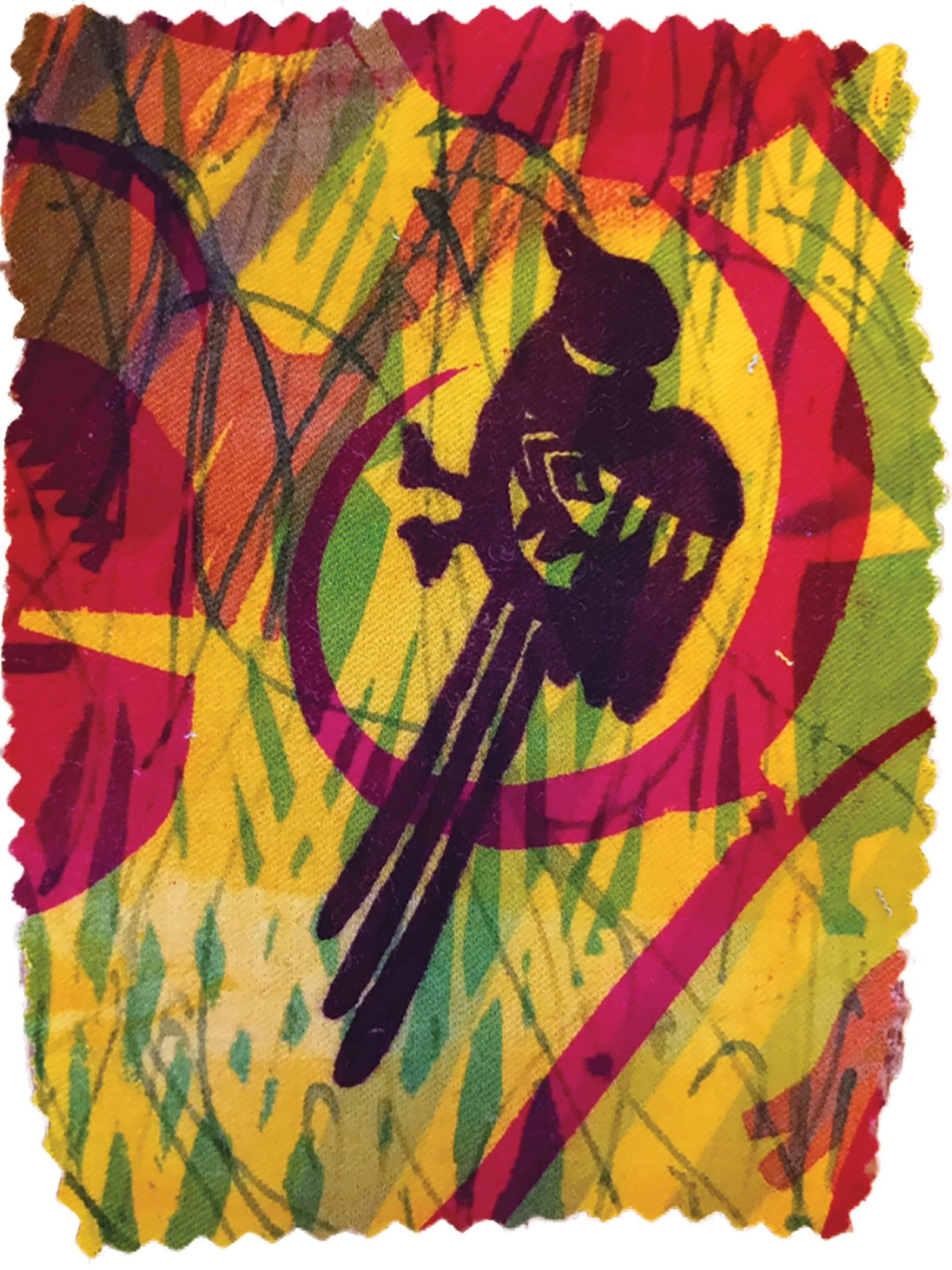 Early 1990s painted fabrics from Patricia Michaels (Taos Pueblo).
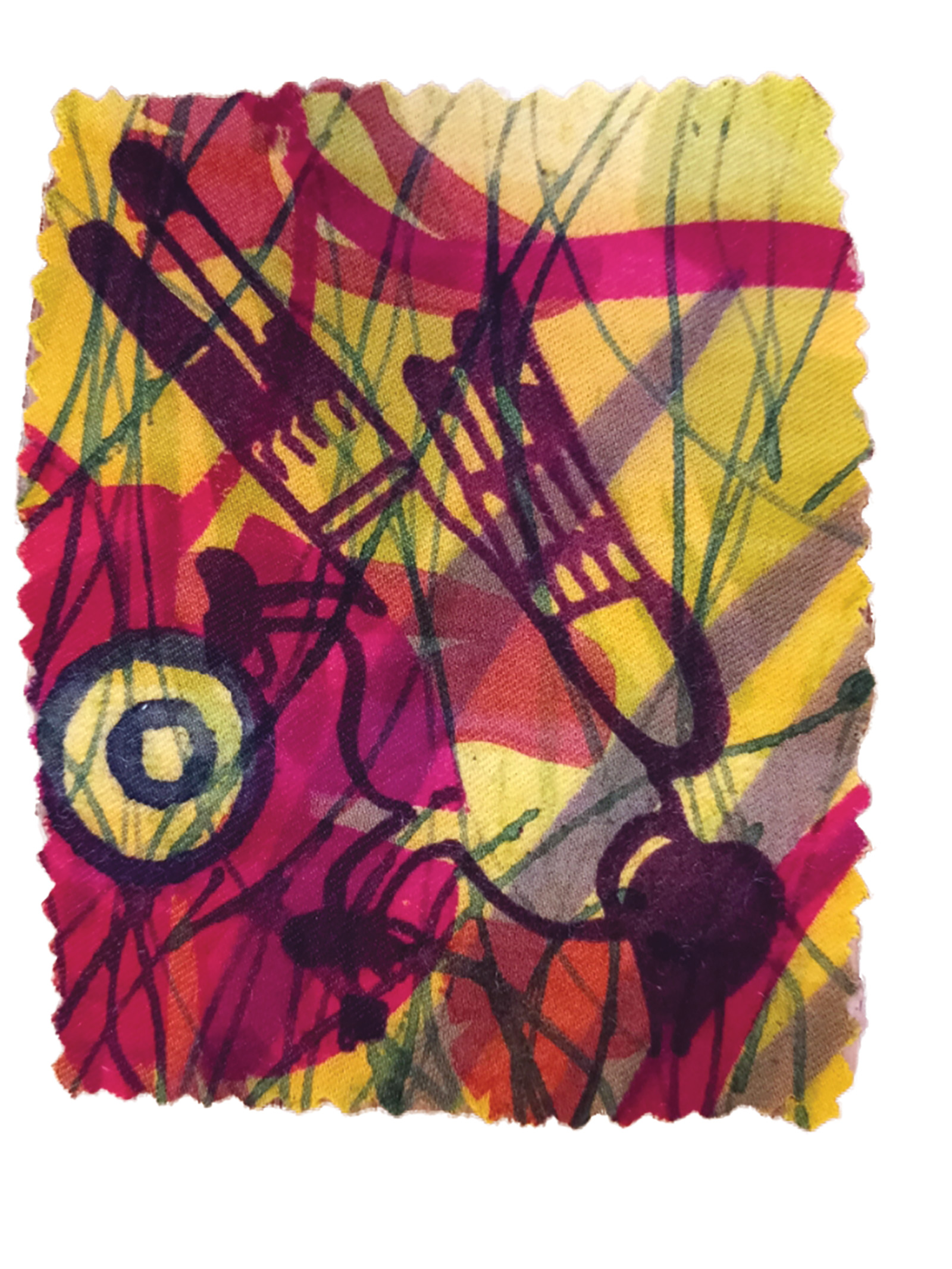 Early 1990s painted fabrics from Patricia Michaels (Taos Pueblo).
Part of this “everyone” crew included jewelry artist Cody Sanderson, designer Pilar Agoyo, artist Terrin Otis and Virgil Ortiz who opened a store called Heat: Fashion Boutique in 2002 on 218 Galisteo Street, Santa Fe. The boutique featured the original clothes of Agoyo and Ortiz, works of art by Otis, and the jewelry of Sanderson—all alums of IAIA. The store was a dream and wish shared by all of them, while the venue organically “fell on their lap,” Agoyo adds. This place served as an exhibition venue, a place for one-of-a-kind fashion, a collaboration think tank and a gathering hub for the cool cats of Santa Fe. “Why the name?” I pose to Agoyo. “Heat because the goal was to make people ‘hot’ with their designs, and ‘freak’ because the enterprise was a huge experiment.” Both Sanderson and Agoyo highlight how the store sign was designed to act as an anagram, either way with the sign flipped, the name was Heat.
In those years, Agoyo was making elaborate corsets, Sanderson was experimenting with different metals, with most everything being custom made and ordered on spot, and innovative concepts of ready-to-wear. Sanderson underscores how Pilar was the technical force behind the fashion and apparel of the boutique. With unique materials and fabrics they purchased from Los Angeles, custom orders flowed in from clientele extending beyond the southwest. All that was needed was a client’s measurements. Once the fabric was out, that was it, ensuring distinct creations! Sometimes commissions of a risqué or fetish nature would be placed. Places such as SWIG approached them to design attire for their staff, becoming a collaborative effort with the boutique team. A shared aesthetic between them helped the manifestation of cohesive designs—“[We] all thought as one, we knew each other’s style,” Agoyo recalls.
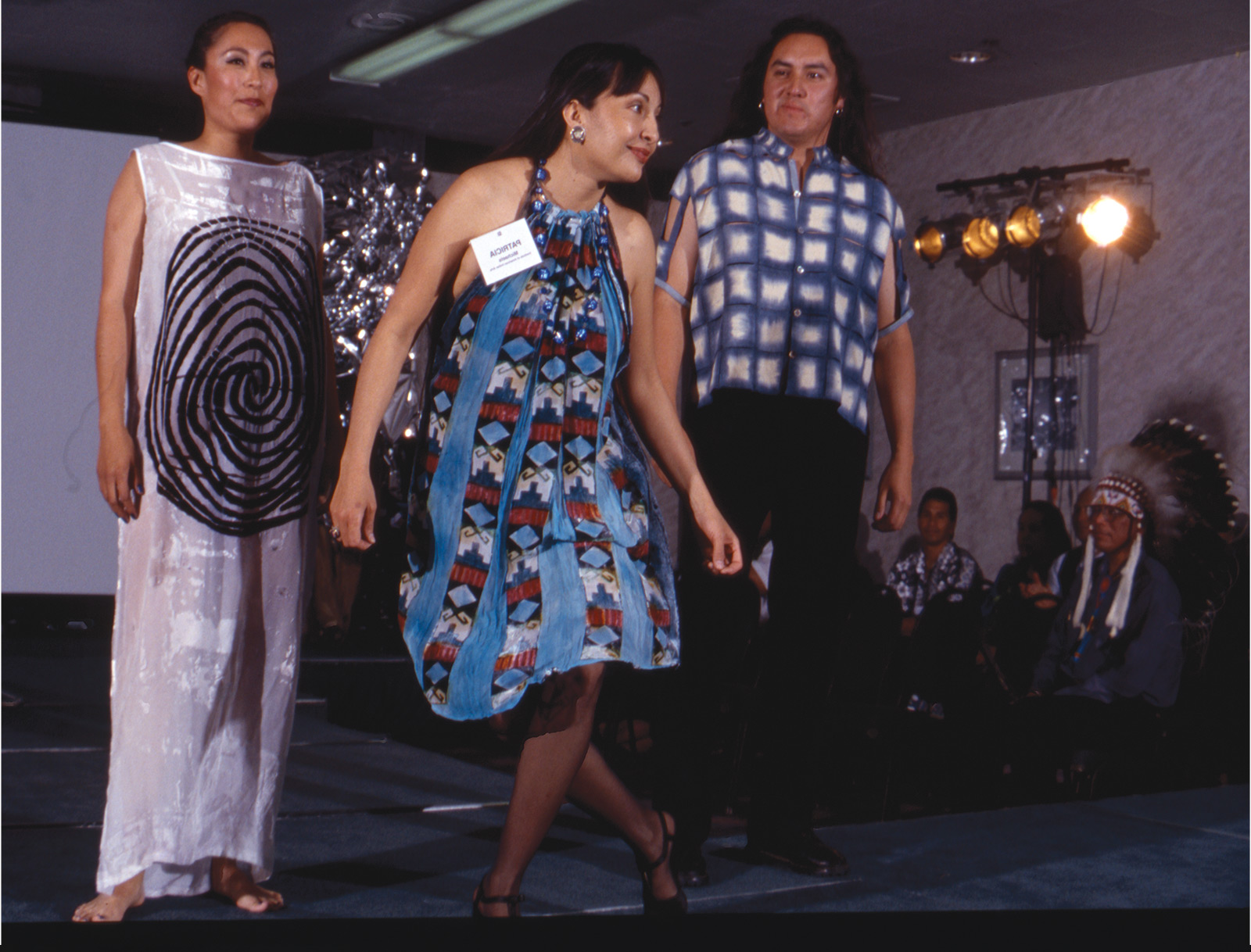 Models wearing designs by Patricia Michaels (Taos Pueblo), circa early 1990s.
The team was repeatedly asked, “How are you making money—selling clothes?” Heat had dedicated patrons. After bar hopping and fashion shows, the crew would bring the bar entourage back to the shop, recharging the evening’s festivities. All three talked about purchasing ad space in local magazines, such as the annual Indian Market booth guide. “It was a lot of fun!” Agoyo reflects. The boutique became such a popular gathering space that the taxi drivers assumed the store was an after-hours club. Fashionistas were often mingling till 4 in the morning with good music, ultra-modern art installations and fashion displays, including foam mannequins suspended from the ceiling.
“Most of their sales would happen after 2 p.m.,” Sanderson explains. The regular clientele were in their late 20s and 30s. The price point was good: $25 for custom t-shirts, corsets into the $100 range, with the experience as part of the appeal. Sanderson confirmed the uniqueness and high creative energy from that store kept the ongoing attraction. He also shared that a big bowl of condoms was readily available for boutique guests to take, as many as they wanted, free of charge. This highlights the free-flowing, forward-thinking nature of the venue. Agoyo adds, “Fashion shows happened wherever they went!” Most weekends, the Heat team would dress a few friends, creating a fashion show that moved with them as they went Santa Fe club hopping.
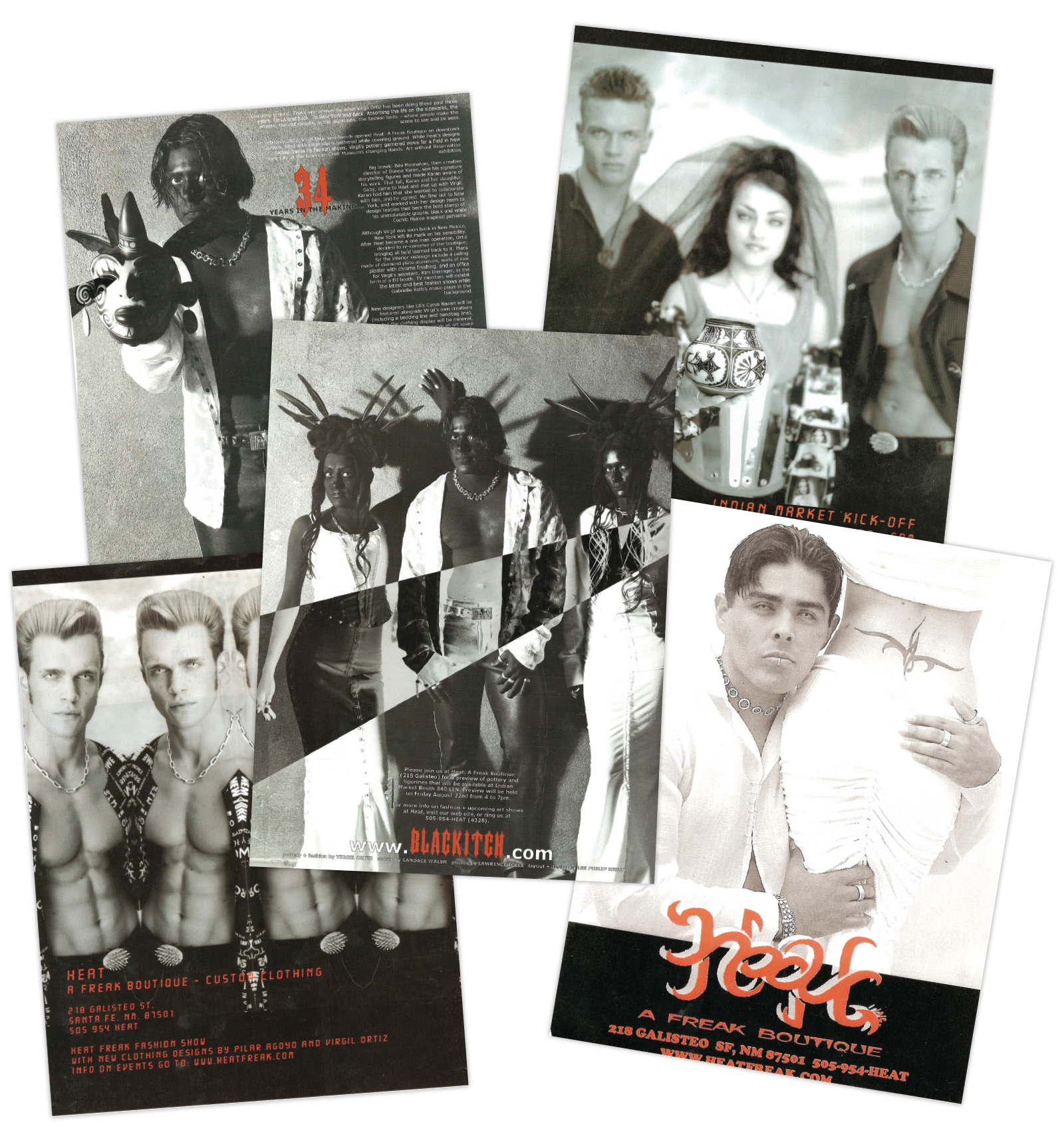 1990s advertisements for Heat, A Freak Boutique.
Agoyo shares how “everything was moving so fast” and they supported each other, particularly during Indian Market week. At the store’s inception, Ortiz was already highly sought after, with people lining up at his booth before it opened to collect his work. During market week, Agoyo would manage the shop and create ready-to-wear apparel available for the next day. Along with Otis, the two created what they anticipated would sell. Referring to their now successful careers, Agoyo is “proud of our adventures, [and] what came out of it,” with no pressure to create or boundaries that can often come with Santa Fe tourism. “It started opening doors for each and everyone of us.” Agoyo now works in the costume department for the film industry, with productions such as The Lone Ranger starring Johnny Depp and the TV series Manhattan on her credentials, while Sanderson became an international jewelry brand, with celebrities such as Lady Gaga and Sharon Stone wearing his creations. Ortiz’s art path exploded after Donna Karen commissioned him to collaborate with her. In 2002, they closed the store for Karen, and during one of the busiest times for Santa Fe, SWAIA Indian Market. Ultimately, they all became super busy, thinly spread and in demand, leading to the eventual closure of the boutique. Agoyo witnessed the boutique as a place that “allowed people to come into the space to play, be free for the night and to express themselves in different ways.”
Although all went their separate ways, and maybe not on the best of terms, Sanderson, Agoyo and Ortiz hold the utmost respect for all of the Heat team and the work they create. For Agoyo, the boutique became “a close family unit” creating lifelong friendships. Ortiz recalled how the venue thrived before the time of social media and free advertising—“So much has changed from back then.” He continues: “They were the OGs” and they paved the road for new designers. Today they support the up-and-comers even as their own stories are reflected back onto them. Ortiz adds: “The OGs have a lot of stories.”
Powered by Froala Editor