The Peabody Essex Museum is showcasing a significant exhibition of 250 historical and contemporary works in a collection installation of their Native American and American art gallery, titled On This Ground: Being and Belonging in America. In a variety of media, the exhibition explores the relationship and history of Native American art alongside American art, and is a semi-permanent collection installation and fixture of the museum through January 2027.
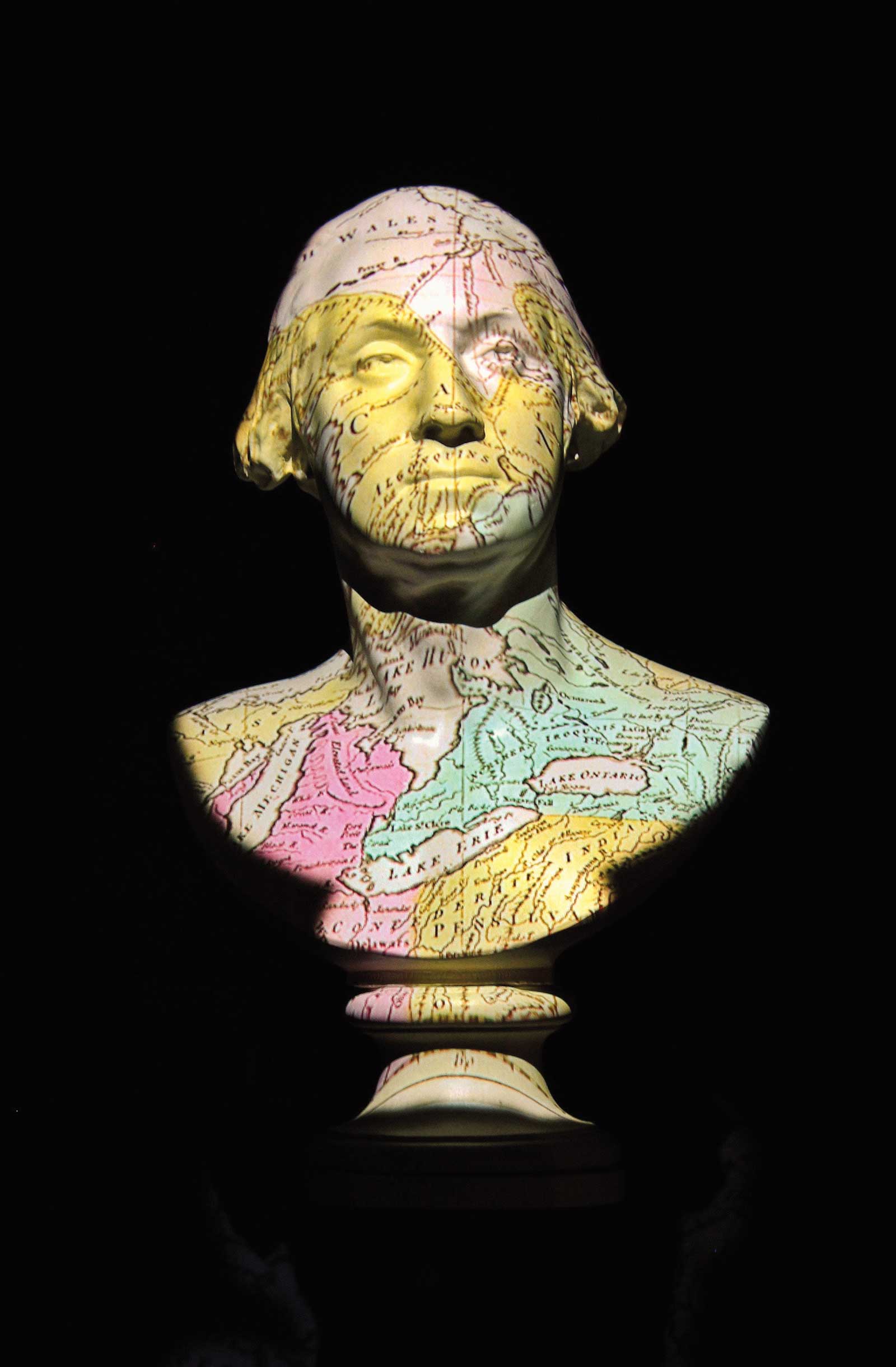
Alan Michelson (Mohawk), Hanödaga:yas (Town Destroyer), 2018, ed. 1 of 3, high-definition video, bonded stone replica of Jean-Antoine Houdon’s bust of George Washington, antique surveyor’s tripod and artificial turf. Sound: members of Six Nations of the Grand River Territory. Digital video looped, 5:57 minutes. Museum purchase, by exchange. 2019.38.1. © Alan Michelson. Courtesy of Peabody Essex Museum.
“Over the past 20 years, we’ve been working to change how our audience understands Native American art and culture, and we’ve been inviting and inciting change in the perception of Native art and culture, and trying to break down barriers and stereotypes,” explains Karen Kramer, PEM curator of Native American and oceanic art and culture. “This installation builds on this momentum. Across the nation, people are starting to think more about what it means to be American. We are trying to show through the installation, that there can be no American art or history without Native American art and history.”
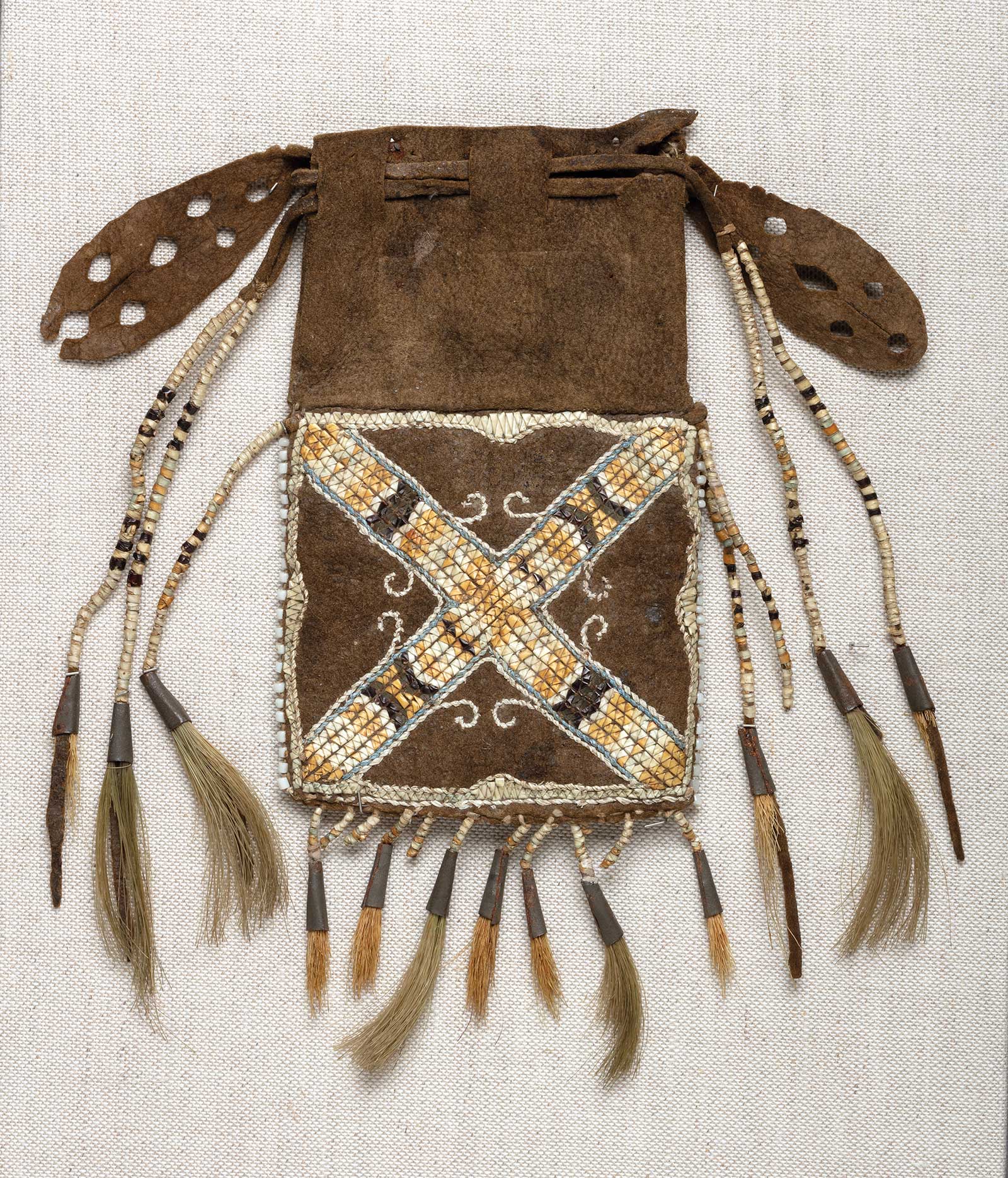 Northeastern Native Artist, Pouch, late 1600s to mid-1700s, deerskin, porcupine quills, porcelain beads, animal hair and metal. Gift of Edward S. Moseley, 1979 E28561. Courtesy of the Peabody Essex Museum. Photo by Kathy Tarantola.
Placing these two collections on equal ground emphasizes that the American experience is unimaginable without the inclusion of Native American culture. “Across the gallery space, each collection stands alone to emphasize ideas and strengths, but they also come together to explore greater themes: historical figures and approaches to art-making across cultures in greater depth,” says Kramer.
Almost all of the artworks are from the museum permanent collection, with a healthy mix of fan favorites, never before seen and pieces that haven’t been on display in a long time, or haven’t been in a thematic arrangement such as this. Giving deeper significance to the installation, the earliest Native American objects on display date back to approximately 10,000 years.
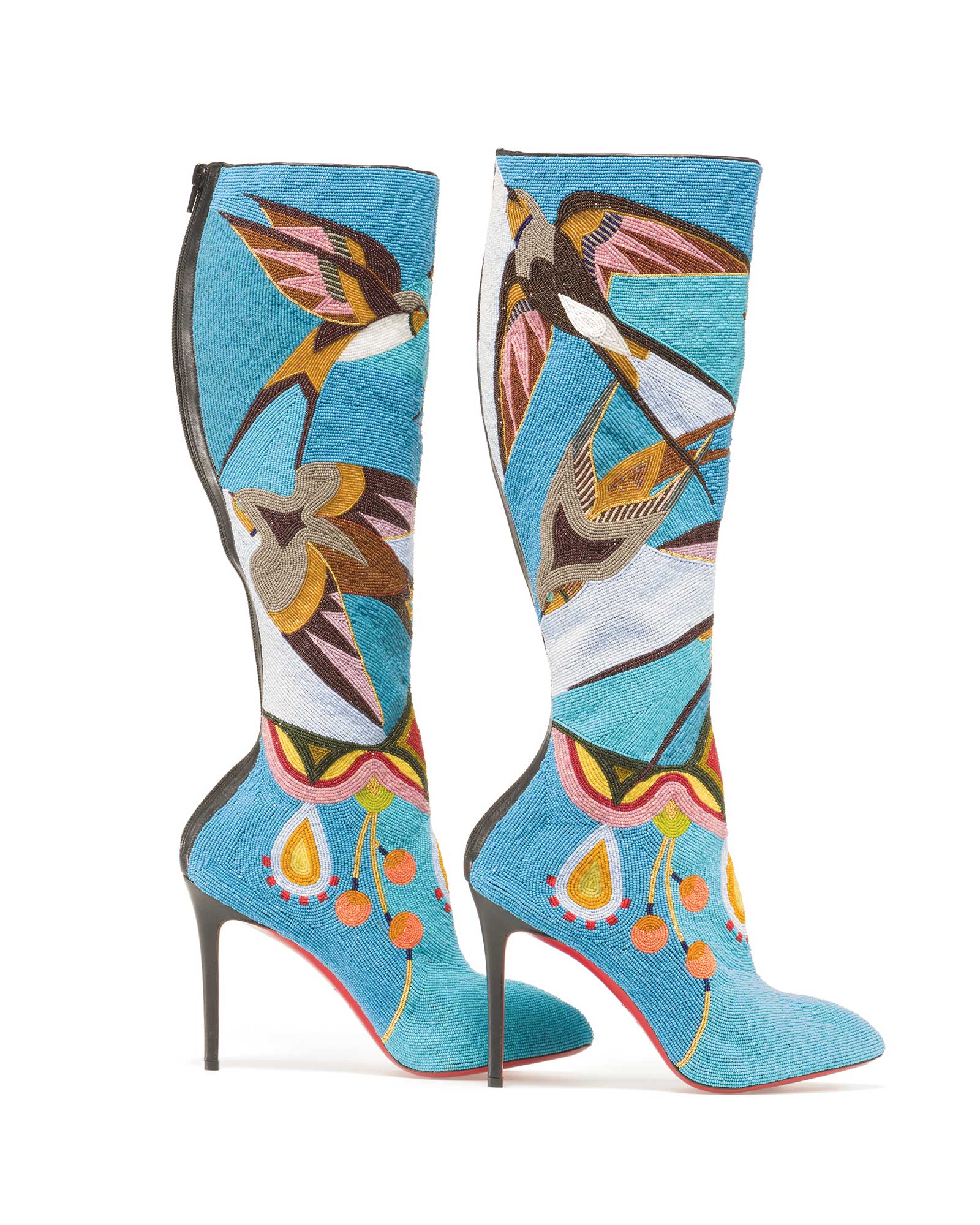
Jamie Okuma (Luiseño/Shoshone-Bannock), Boots, 2014, glass beads on boots designed by Christian Louboutin. Museum commission with support from Katrina M. Carye, John Curuby, Karen Keane and Dan Elias, Cynthia Gardner, Merry Glosband, and Steve and Ellen Hoffman and the Willoughby Stuart Memorial Fund 2014.44.1AB. Courtesy of the Peabody Essex Museum. Photo by Walter Silver.
Pictured here is a deerskin pouch, dating to the 1600s to mid-1700s, and is attributed to a Northeastern Native artist. “This utilitarian object, likely worn in the belt of the artist’s husband for carrying tobacco and for giving prayer offerings while hunting, was transformed into a portable work of art,” Kramer adds. “It is a profound container of her worldview. The quilled designs embody ideas of balance, evoking a world in constant flux between humans, animals and supernatural beings.”
A more contemporary, yet pertinent work by Alan Michelson (Mohawk) titled Hanödaga:yas (Town Destroyer), is a 2018 multi-media piece of archival material such as maps and images of historical site markers projected onto a bust of George Washington. “The bust has been a wonderful signature piece for the show because Washington’s face is instantly recognizable in the American consciousness, but something more is happening here,” says Kramer. “As we speak, America is reconsidering the founding fathers as heroes—people are calling this into question and rethinking our roots. [The piece] explores a devasting ‘scorched earth campaign’ that George Washington put into motion. Washington, through General Sullivan, ordered the military to burn entire Indigenous villages, homes and farms to the ground to claim their land, displacing thousands of Haudenosaunee ancestors. Michelson is really asking us: ‘are we ready to learn new stories?’”
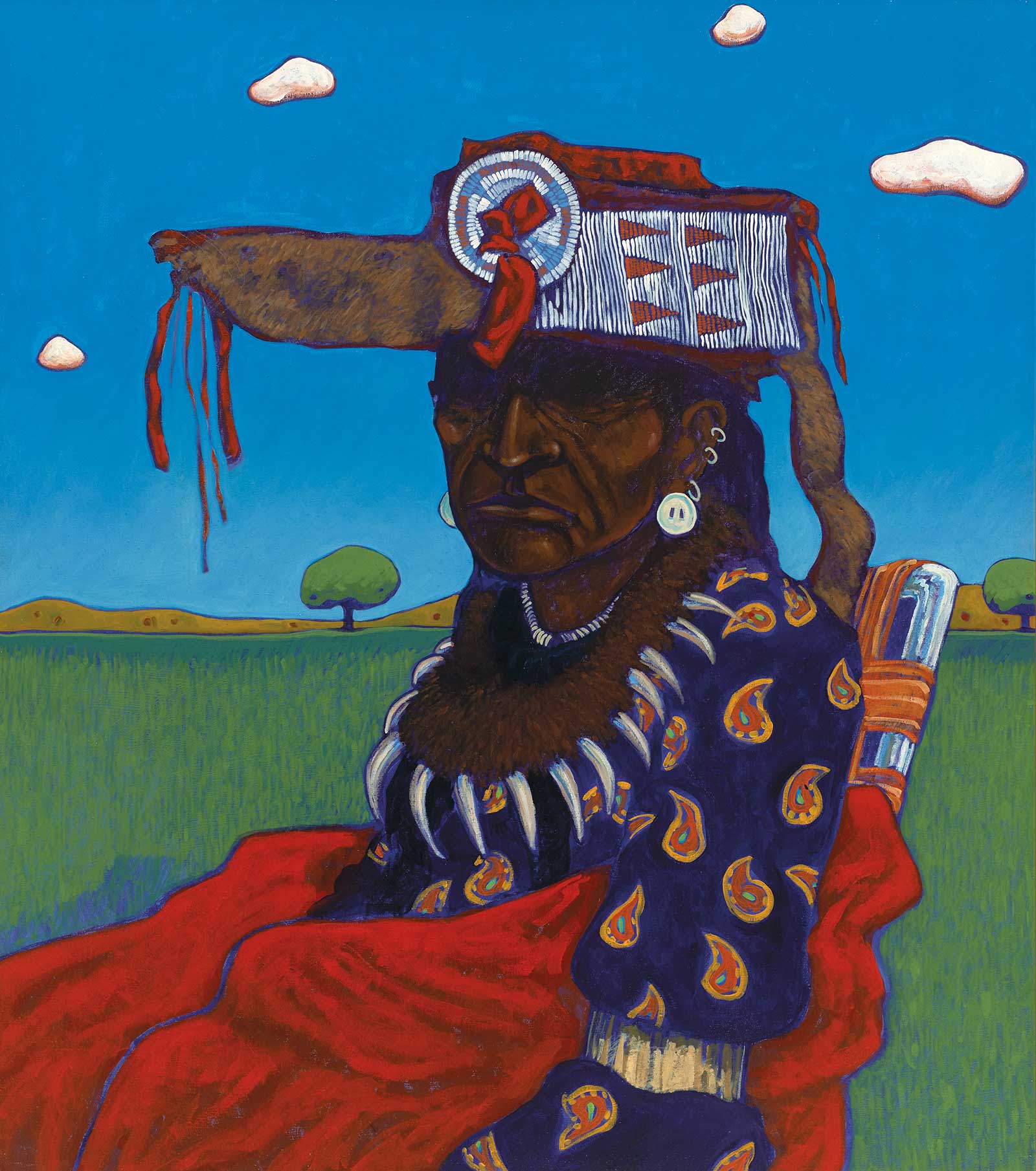 T.C. Cannon (Kiowa/Caddo, 1946–1978), Indian with Beaded Headdress, 1978, oil on canvas. Museum purchase 2015.35.1. © The Estate of T.C. Cannon. Courtesy of the Peabody Essex Museum.Other important works in the exhibition are pieces like Jamie Okuma’s (Luiseño/Shoshone-Bannock) beaded boots, where the artist hand stitched thousands of antique glass beads on Christian Louboutin boots with swallows circling around floral motifs. T.C. Cannon’s (Kiowa/Caddo) oil painting Indian with Beaded Headdress, 1978, will also be on display, adding his distinctive style and bold vision to the installation.
Overall, the installation and the Peabody Essex Museum aims to give the public “an opportunity to grapple with the links, continuities and disjunctions of our complex histories in America in order to shape a more connected and empathetic present and future.”
Through January 3, 2027
Native American and American Art
Peabody Essex Museum
161 Essex Street, Salem, MA 01970
(978) 745-9500, www.pem.org
Powered by Froala Editor