I first encountered Preston Singletary’s work during a visit to the Denver Art Museum in 2016. As soon as I entered the gallery, I was captured by the glowing presence of the vivid blue Killer Whale Crest Hat (2004). The piece was displayed in the center of a pedestal, with the gallery lights shining down from directly above. This not only illuminated the hat itself, but also created an incredibly detailed reflection of the “carved” killer whale designs onto the surface of the pedestal. As someone who works in the museum field, I have visited countless galleries and museums in the years since this experience, but the memory of this particular piece has stuck with me.
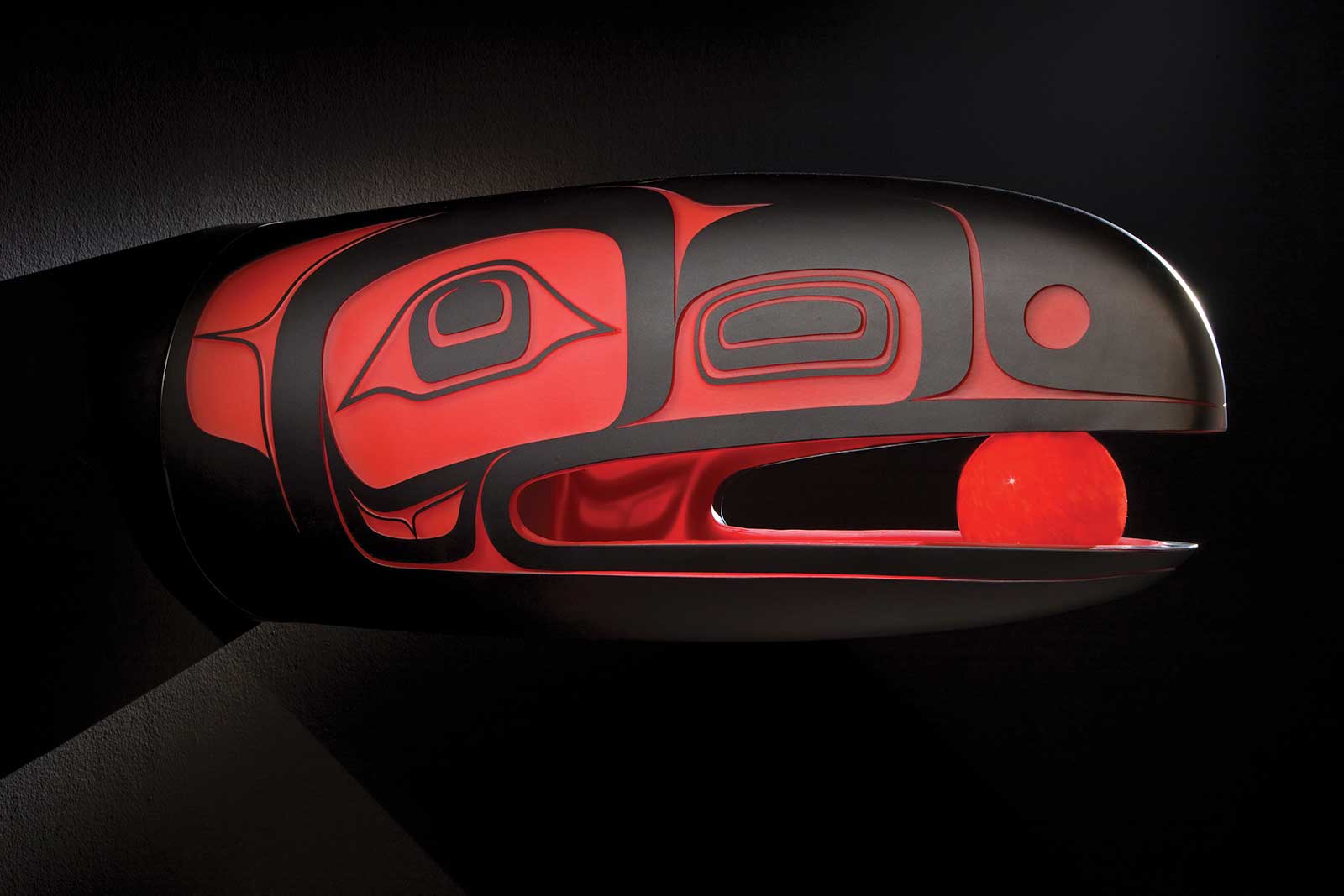 Raven Steals the Sun, made at the museum in 2008, blown, hot-sculpted and sand-carved glass, 9½ x 26 x 9½”. Collection of Museum of Glass, gift of the artist.
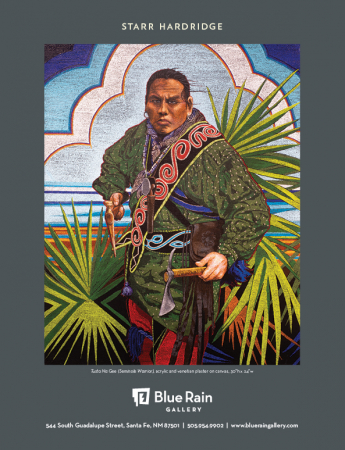
Before speaking with Singletary over the phone, I decided to take a trip to Blue Rain Gallery in Santa Fe, New Mexico, to visit with some of his work. It was a Saturday afternoon in October, and the gallery was buzzing with visitors who had just come from the weekly farmer’s market. The gallery staff informed me that much of Singletary’s work was meant to travel to a show in Chicago that had been canceled, so it remained on display. Of course, I was disappointed to hear of yet another pandemic-related cancellation, but it was a pleasant surprise to see so many works by Singletary within the gallery. Several of the pieces sat on pedestals near the floor-to-ceiling windows, and the warm autumn sun filled them with light. I could hear hushed gallery voices reading his name from the labels, and like myself, many of the other gallery visitors stood in awe as they took in the glass sculptures that dotted the room. Singletary’s work has a presence that extends far beyond the actual physical form of any given piece. There is something about his technique that both captures and expands the light and shadow within a given space.
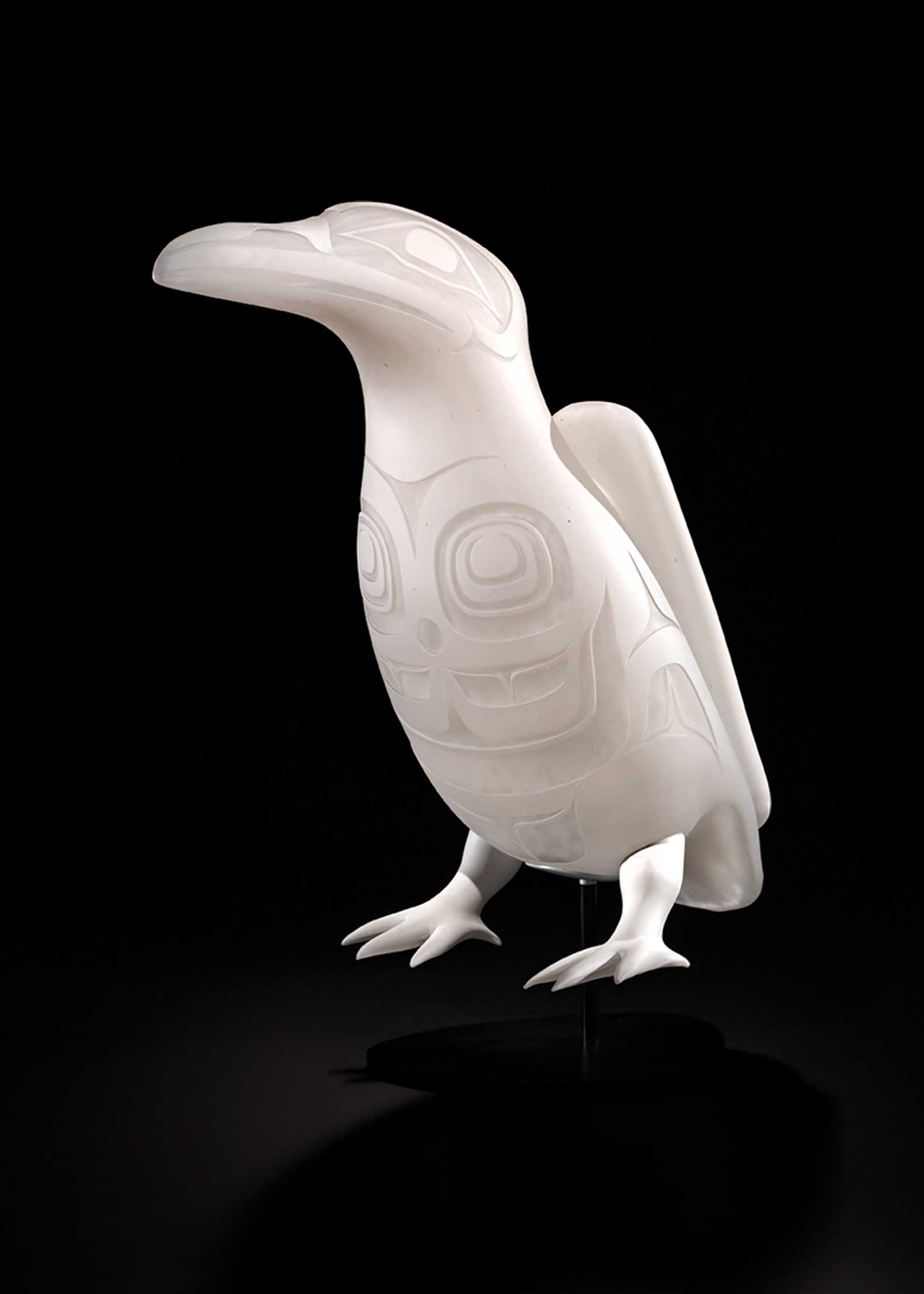 White Raven (Dleit Yéil), 2018, blown, hot-sculpted and sand-carved glass on steel stand, 19¼ x 9 x 14”. Courtesy of the artist.
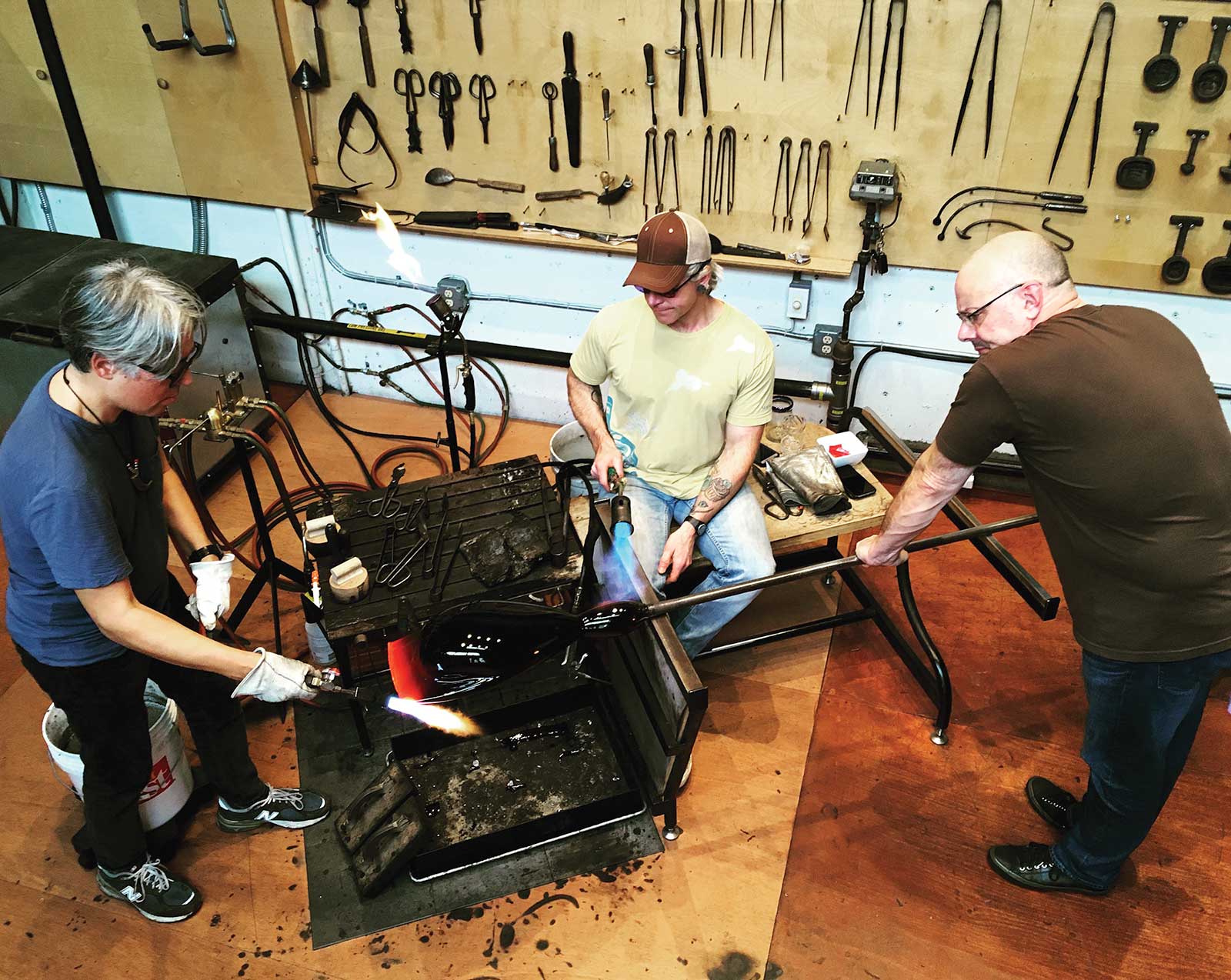
Singletary let me know that he would be giving me a call after blowing glass all day. He first began glassblowing in 1982 at a production studio called Glass Eye Studios in Seattle. After training there for about three years, he attended Pilchuck Glass School as a student. Around that time, he also began working with Benjamin Moore in his studio and continued to work with him and his team for about 18 years. During his tenure at Moore’s studio, Singletary developed a strong foundation as he worked with a number of different artists and gained experience in a range of glassblowing techniques.
 Raven Steals the Sun, made at the museum in 2008, blown, hot-sculpted and sand-carved glass, 9½ x 26 x 9½”. Collection of Museum of Glass, gift of the artist.
Throughout his career, he has maintained a connection with Pilchuck Glass School where he now teaches, and it was there in 1988 that he developed his signature stenciling technique. At that stage in his trajectory in the late 1980s, Singletary began to incorporate more elements of his Tlingit cultural background into his artistic practice. He explained to me that in his experimentation, he realized that he could draw designs directly onto the piece of glass with an X-Acto blade, and then carve into the thickness of the glass by sandblasting to create the design work. This is a process he describes as “sandcarving.”
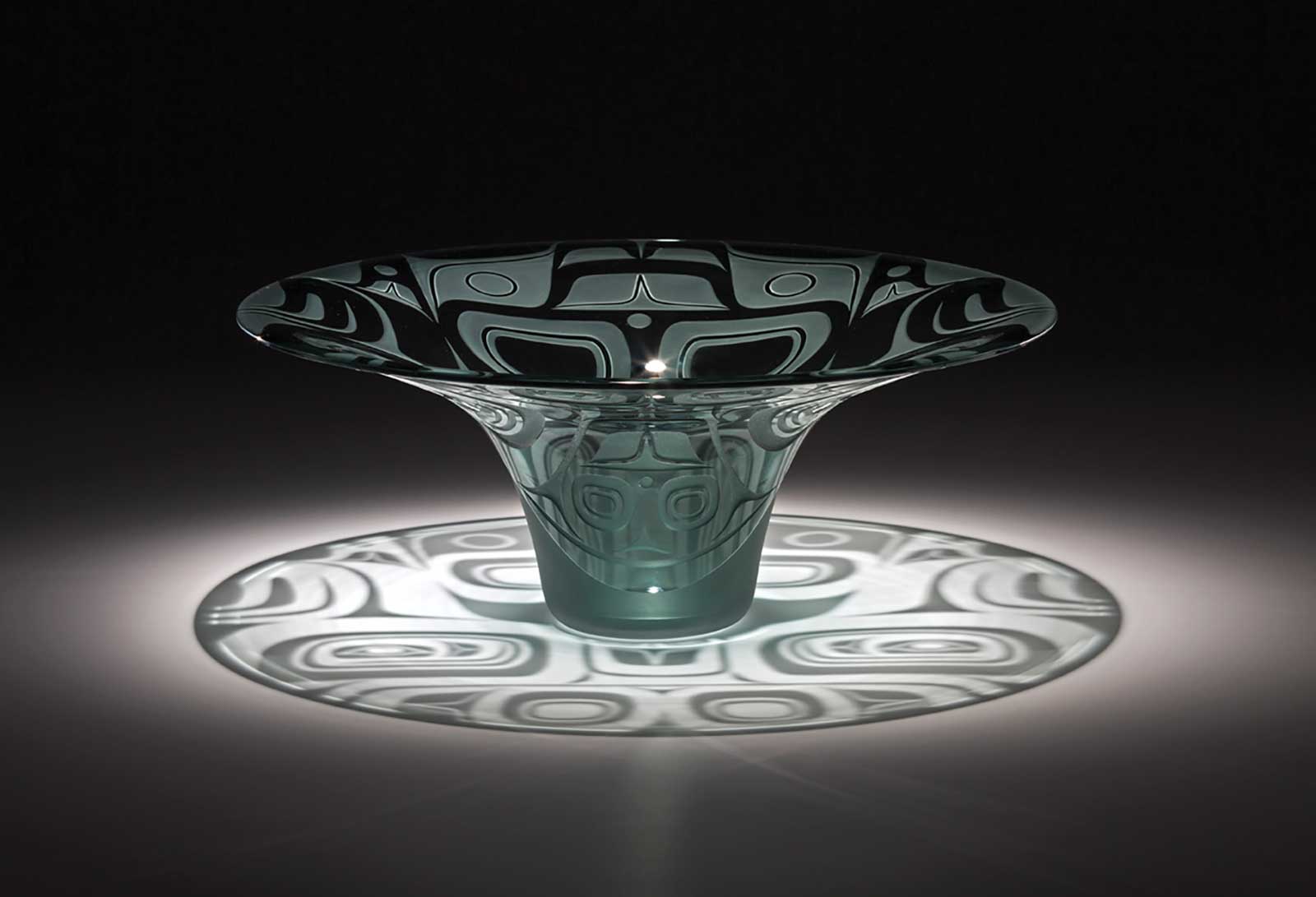 Hat (S’aaxw), 2018, blown and sand-carved glass, 6¾ x 16½”. Courtesy the artist.
Since the late 1990s, Singletary has primarily focused on his own work and vision, which often involves collaboration with other artists from the international Indigenous community. He mentioned that he has worked with Maori individuals from Aotearoa (New Zealand), Aboriginal community members from Australia, Native Hawaiians and countless Native American artists from tribes around the country. Singletary explained to me that his work has become a full-time process that requires extensive exploration and research and development. His projects range in size from smaller works that comfortably fit on a standard-size pedestal to glass totem poles that tower at 8 feet tall and weigh about 2,800 pounds. When I inquired about his studio practice, Singletary described a strong sense of camaraderie and collaboration amongst the team of glass artists that work in his studio. He mentioned that he has been working with many of them for close to 20 years, so they are intimately acquainted with his process and vision.
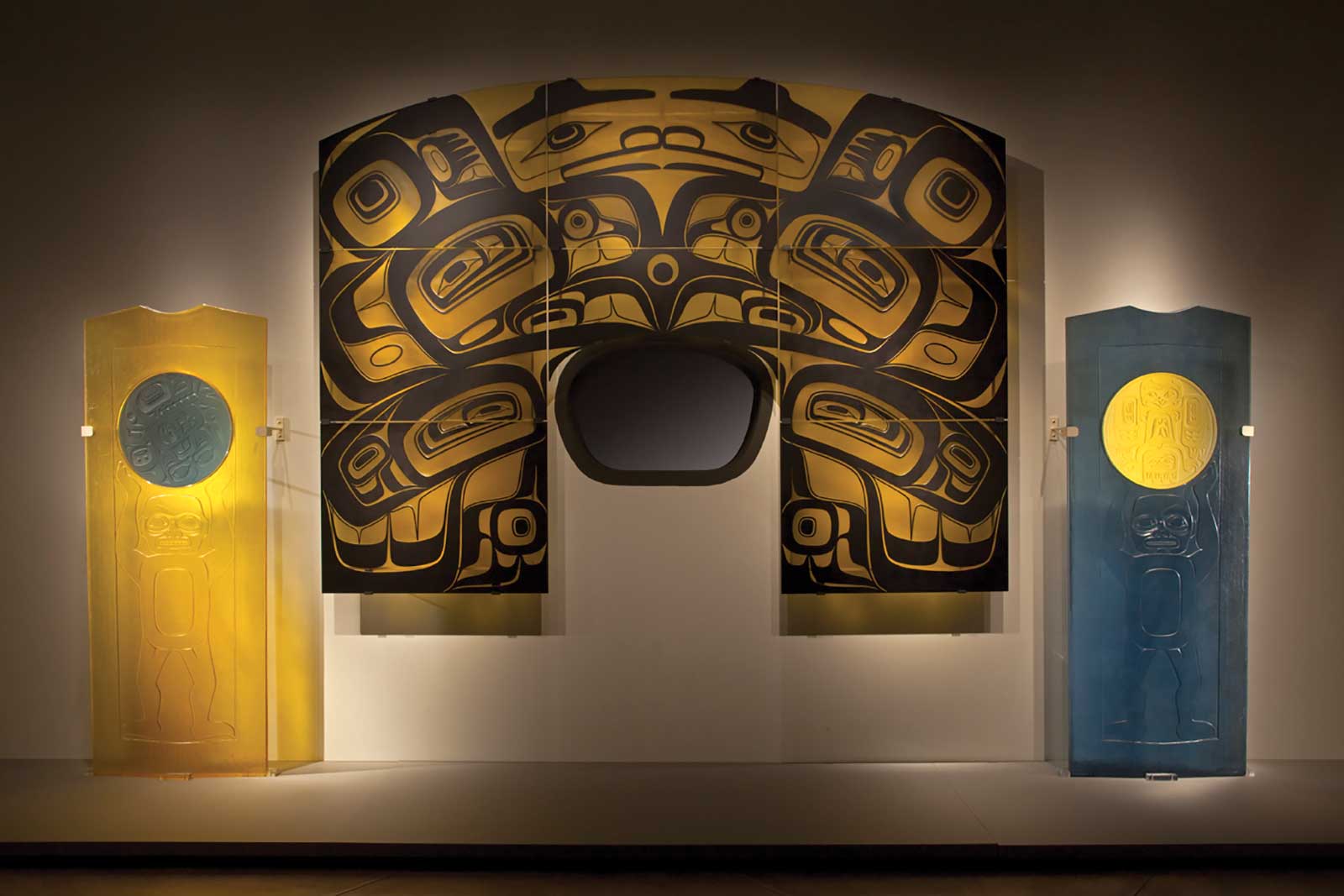 Clan House (Naa Kahídi), 2008, kiln-cast and sand-carved glass; water-jet cut, inlaid, and laminated medallion, 90½ x 120½ x 8”. Collection of Museum of Glass commissioned with funds provided by Leonard and Norma Klorfine Foundation.
I have been a fan of Singletary’s collaborative works for a number of years now. Singletary often works with fellow Indigenous glass artists, such as Raven Skyriver (Tlingit), but he also works with Indigenous artists who specialize in other mediums. I have been lucky enough to see some of his collaborations with Jody Naranjo (Santa Clara) and Harlan Reano (Santo Domingo/Kewa) in person at Blue Rain Gallery.
When I asked Singletary what inspires him to create, he explained: “Well, I’ve found, a real sense of purpose with my work and working with the material of glass. I kind of see myself as an ambassador of glass to Indigenous communities in general...All of the collaborations I’ve done, it’s given me a really broad perspective on how Indigenous people create their work for the modern art markets…I get a lot of inspiration, obviously, from my culture and all of this interaction with other artists.”
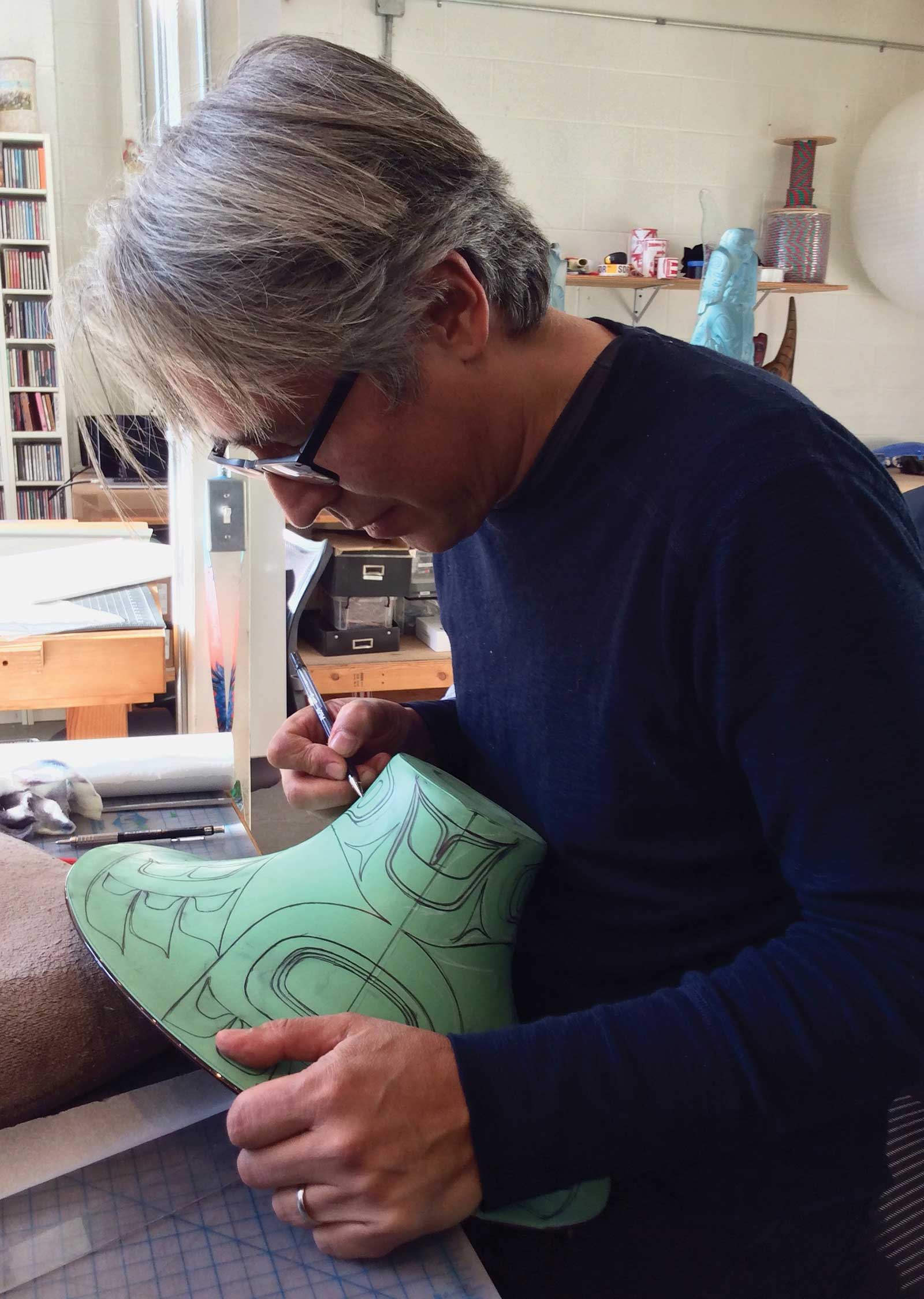 Preston Singletary (Tlingit) works in his glass studio. Courtesy the artist.
He mentioned that he is presently interested in utilizing his work to speak to certain stories and cultural symbolism. This is evident in one of his most recent exhibitions, Raven and the Box of Daylight, which tells the story of Raven, the creator of the world and giver light through the stars, moon and sun. This exhibition was guest curated by Miranda Belarde-Lewis (Tlingit/Zuni) for the Museum of Glass in Seattle, where it opened in October 2018. The show will travel to the Smithsonian’s National Museum of the American Indian (NMAI) in Washington, D.C., where it will be on display from January 28, 2022, through January 29, 2023. This body of work is primarily installation-based and features Singletary’s glasswork against a backdrop of projected images, Pacific Northwest soundscapes, storytelling and original music.
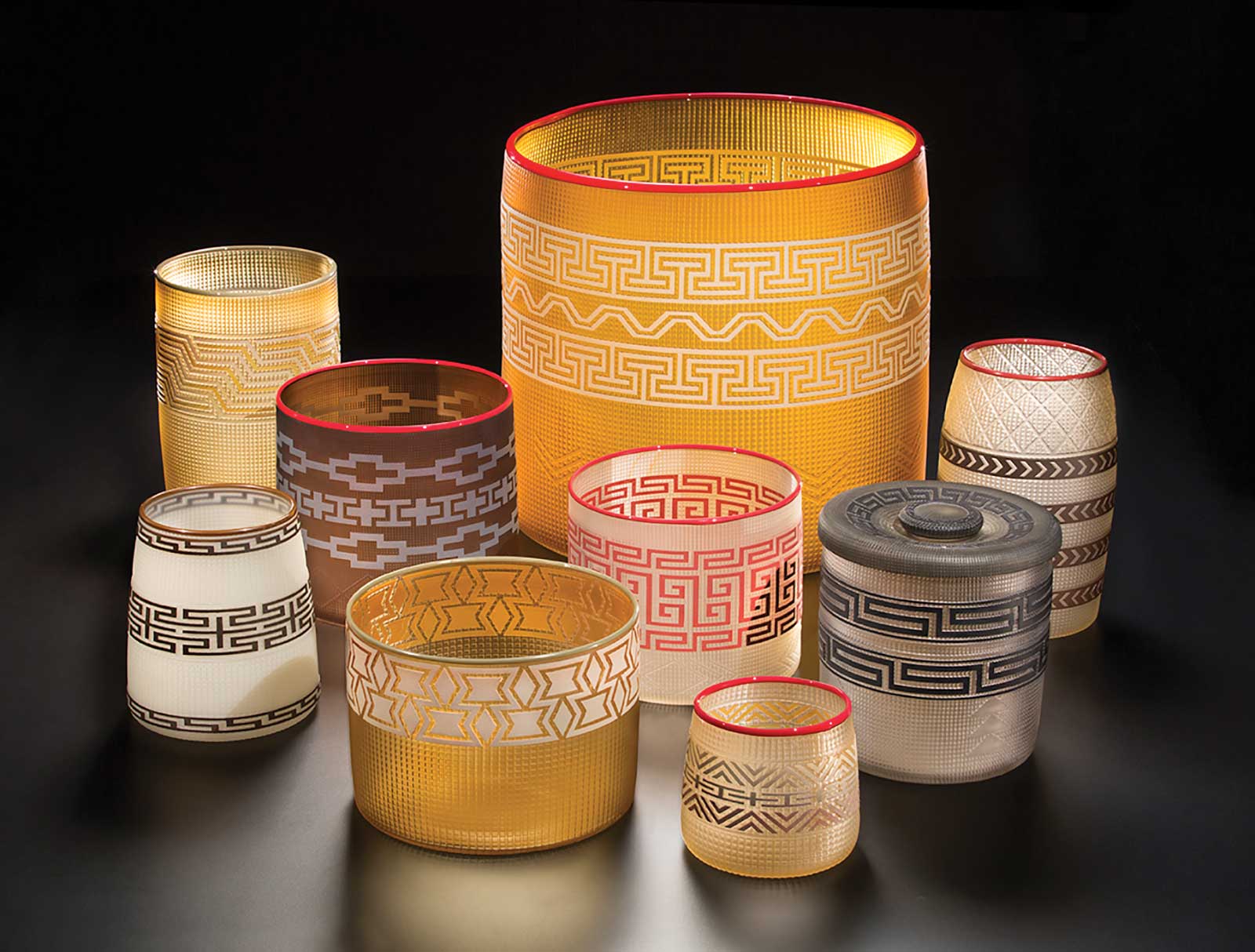 Works from the Basket (Kákw) series, 2016, blown and sand-carved glass. Courtesy the artist.
As described by the Museum of Glass’ website: “Visitors will be immersed in Tlingit culture through a dynamic, multi-sensory environment. Art objects and exhibition text will be supported by audio and video elements. This will include recordings by storytellers, music, recordings of Pacific Northwest coastal sounds, and a backdrop of shadows and projected images. The exhibition is active, surprising and dramatic, and engages the viewer through sight and sound.”
When asked about what he hopes visitors will take away from this exhibition, Singletary responded, “I’m hoping to expose people to the story and give them an interesting experience.” He also mentioned that this is one of the most well-known Tlingit stories, so many museum visitors may already have some familiarity with the narrative. The accompanying exhibition catalog, which I had a chance to flip through during my visit to Blue Rain, features an array of stunning photos of the work and details some of the symbolic references of the story.
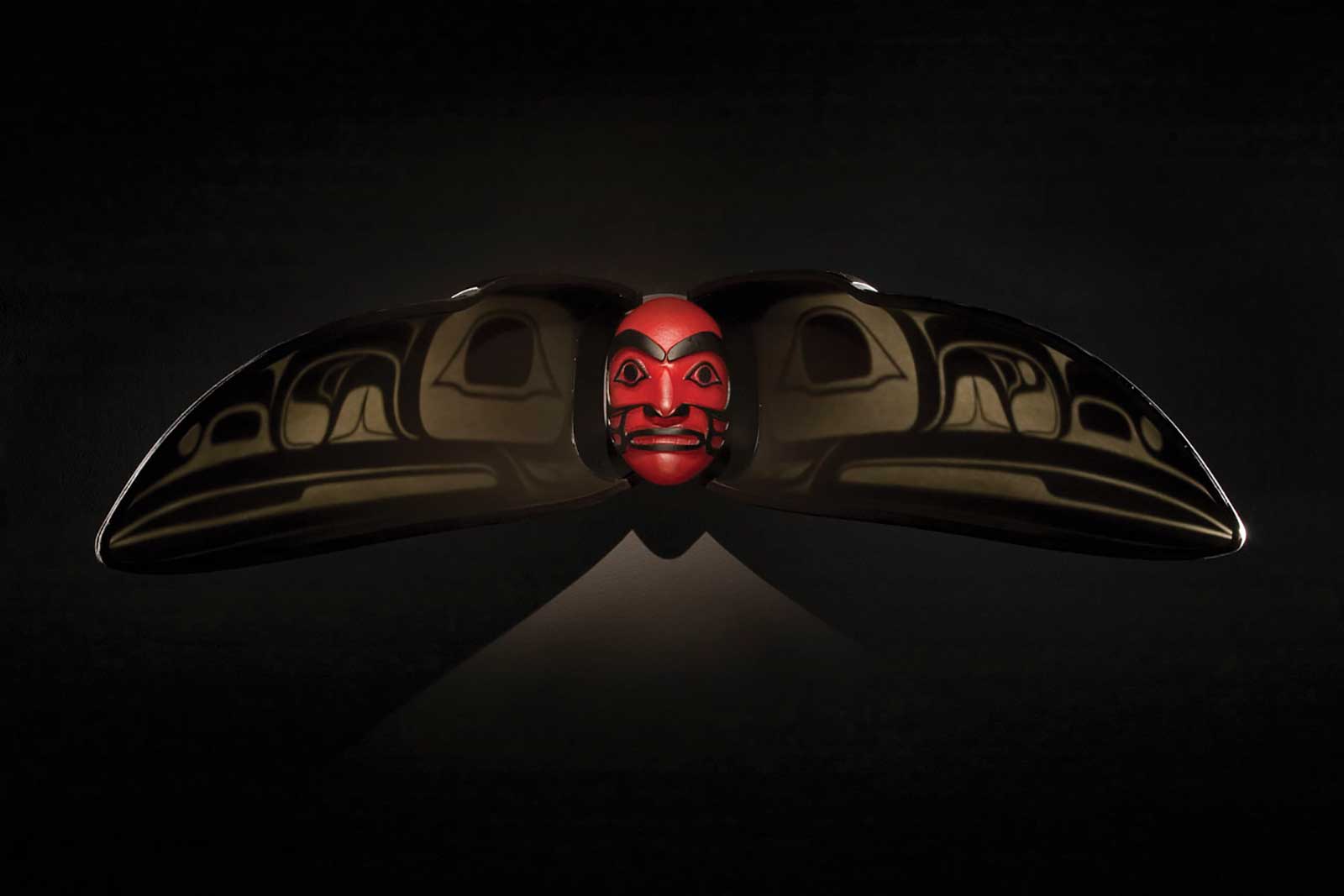 Raven Transformation Mask (L’axkeit), 2007, blown and sand-carved, glass on steel mount, 7 x 23 x 5”. Courtesy the artist.
Beyond this exhibition, Singletary has a number of forthcoming public art projects on the horizon, including a large-scale sculpture that was recently installed at the site of the Seattle Center’s Climate Pledge Arena, which served as the location for the 1962 World’s Fair. This sculpture, La Diab Pish, depicts a Pacific Giant Octopus and was created in collaboration with David Franklin. Singletary also noted that his band, Khu.éex, planned to release a new LP some time this winter. The band comprises several Indigenous musicians who often incorporate Tlingit, Haida and Yupik language into their music, which Singletary described as a fusion of jazz and rock. You can visit Singletary’s website for more updates on forthcoming projects and exhibitions at www.prestonsingletary.com.
Powered by Froala Editor