Artistic Native American rings made after 1980 are small pieces of aesthetic genius. Their success is generally achieved by at least one predominant design element. The skillful, original manipulation of this visual element produces cutting-edge design. Rings benefit from their makers’ ability to conceptualize and highlight such unique features. The best innovative rings appear to follow established conventions while accentuating one unexpected, interesting visual characteristic.
The roots of this talent go all the way back to the 19th century origins of Native metalwork. From the beginning, smiths sought a path to unity and harmony when designing a finger ring. Along the way, they experimented with controlling the visual order of its design. These silversmiths found that certain attributes help define a ring’s appeal. First, however, any ring’s underlying charm comes from its form.
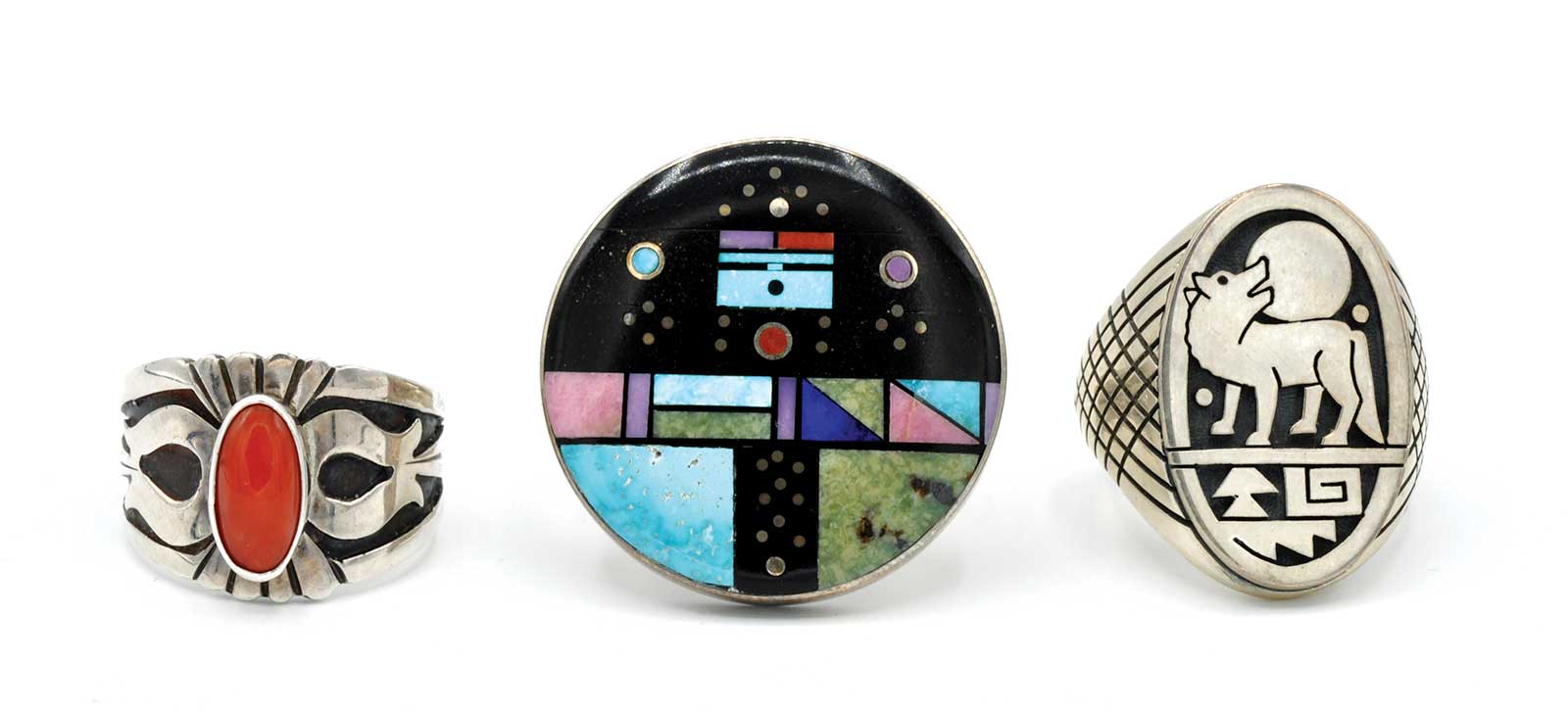 Ring Form palette (left to right): overlay band with coral by Leonard Nez (Navajo), ca. 1990s; cosmology scene inlaid on central plate by Jim Harrison (Navajo), 2015; wolf and moon on oval signet by Gary and Elsie Yoyokie (Hopi/Navajo), 2019.
Historically, three types of ring forms served as the palette of choice for artistic expression. Round bands established a narrative presentation, as can be seen in a ring by Leonard Nez, in which all elements culminate in the dominant stone setting. A ring’s visual focus also lies in its central plate, which usually takes on some kind of geometric shape, as in this round setting for Jim Harrison’s portrait of a luminous Yei figure bounded by a night sky. Another enduring design form is the oval center of a signet ring, illustrated here in an iconic wolf and moon overlay vignette by Gary and Elsie Yoyokie.
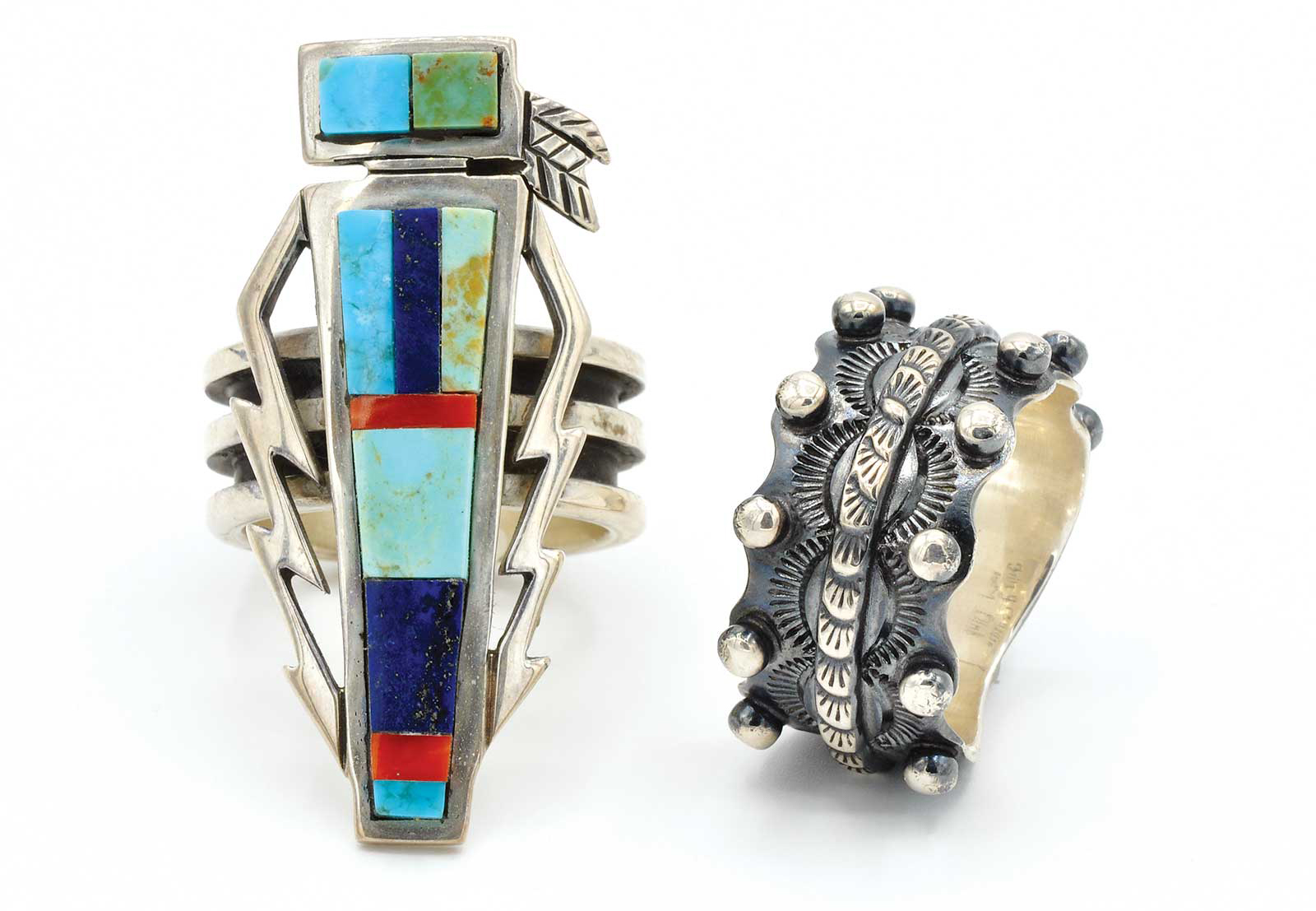 Shape (left to right): Yei figure by Aaron John (Navajo), 2016; ornamented band by Fritz Casuse (Navajo), 2021.
Two other important design elements with physical characteristics are shape and texture. Creative approaches to silver and stone shape can be seen in a dramatically detailed, cut-out Yei figure by Aaron John. Fritz Casuse, an artist known for his sense of space and dimension, brings sculptural ornament to the band form. He is also known for avant-garde experimentation with jewelry forms. Three artists proficient in tufa-casting, Marian Denipah, Philander Begay and Anthony Lovato, offer the exquisite moody effects of texture in their works; Denipah’s narrow rectangular central plate compels the viewer’s eye to its rounded center, while Begay’s band creates an atmospheric pueblo setting. Lovato, a member of Santo Domingo’s Corn Clan, uses texture to objectify and celebrate the life-giving corn cob.
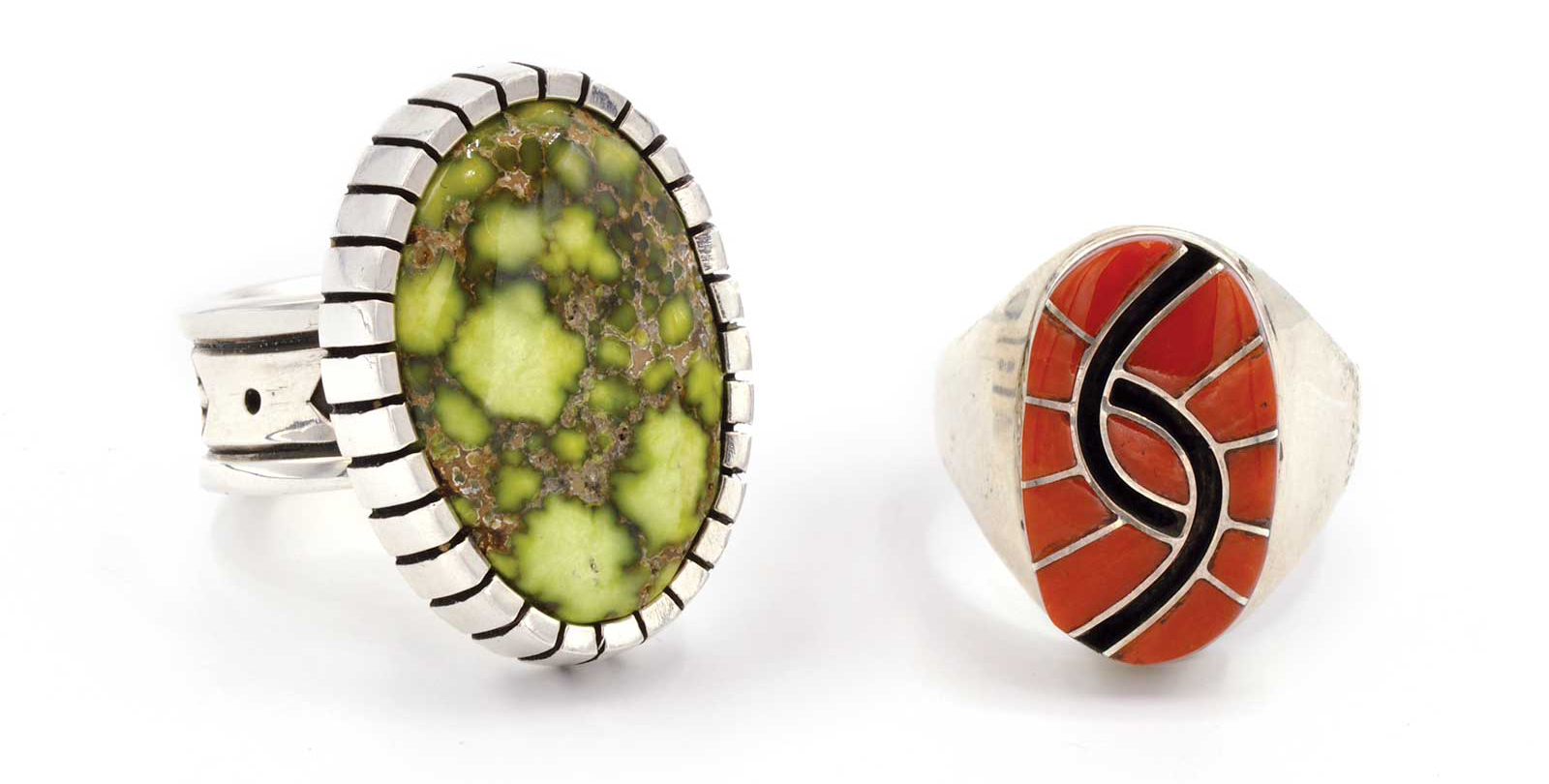 Color and Contrast (left to right): “hummingbird” abstract design in coral and jet by Amy Quandelacy (Zuni), 1990s; ring with damele turquoise stone by J.J. Otero (Navajo/Hopi), 2021.
Design elements which relate to surface decoration, are vital to artistic ring appearance. Color is among the most distinct features, as seen in J.J. Otero’s oval damele turquoise ring set in a 14-gauge castellated bezel. The turquoise’s rich green color and contrasting webbing hue draws attention to the vitality of the silver that holds it in place. Otero, serious from the day he started making jewelry in 2018, possesses a strong sense of design as statement. Contrast also marks Amy Quandelacy’s version of a famous Zuni abstract hummingbird design, made distinctive by the slash of jet that divides the coral oval. Line is a visual feature taken up by Native jewelry-makers from the start. Bryon Yellowhorse pays tribute to line in his multicolor rectangular ring plate designed to mirror the effect of an eye dazzler weaving. Using silver as his exclusive focal point, Ivan Howard is equally dazzling in his creation of intricate fan lines on a signet ring form. These pieces constitute artistry based on tradition and innovation.
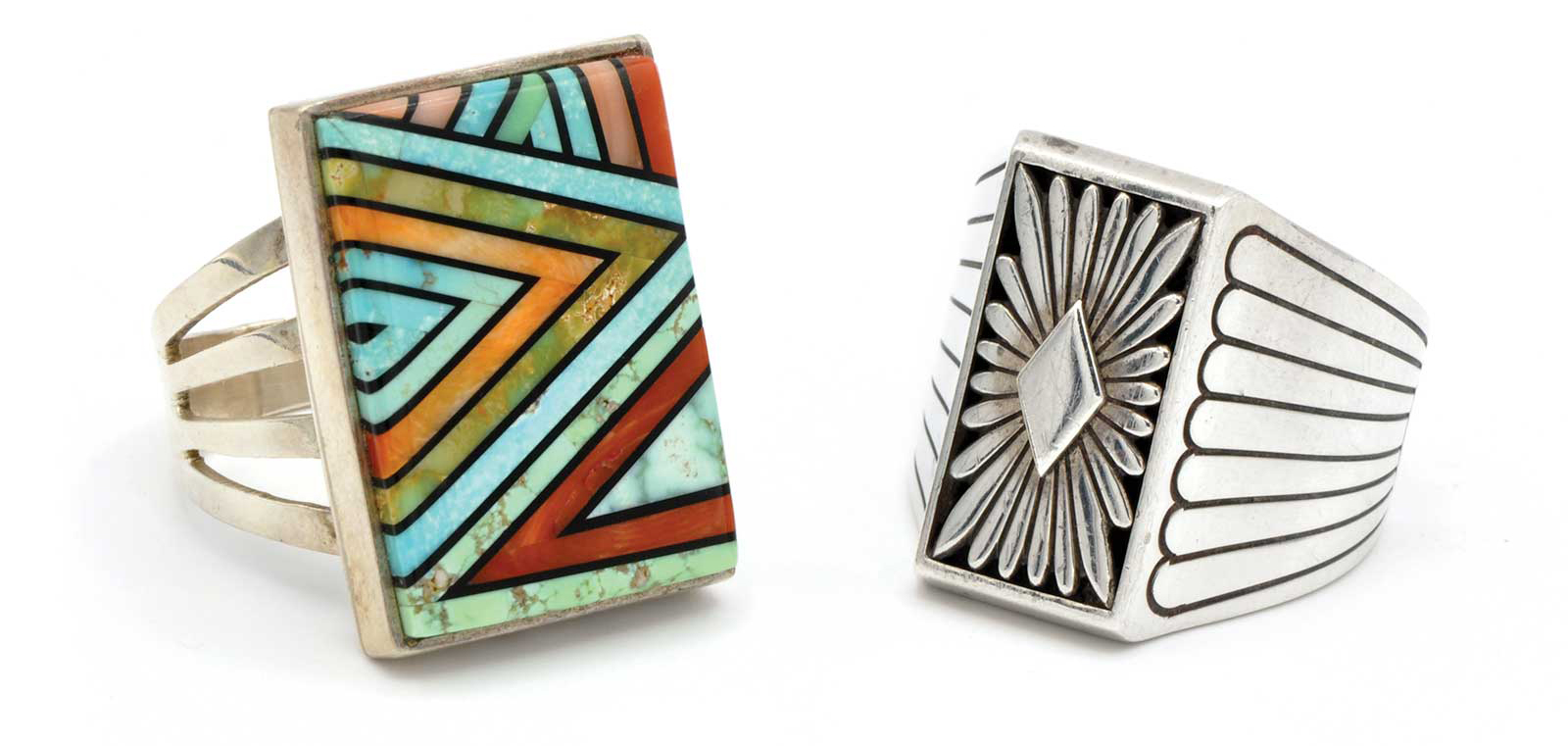 Line (left to right): “eye dazzler” ring by Bryon Yellowhorse (Navajo), ca. 2000; all-silver feather design ring by Ivan Howard (Navajo), ca. 2005.
Other design elements allow the viewer to grasp the creator’s intentions and aesthetic judgment. One of the most important qualities is balance; virtually all fine artistic rings possess this design trait. Two rings which typify balance in a new light also manage to show this feature through the interconnection of silver and stone. J.T. Willie is known for clever designs that are far from ordinary; a prime example is a ring with an oval plate framing a flood of turquoise pebbles with silver and coral rectangular beads all tossed together into an eccentric but balanced composition. A recent ring by Ken Romero offers a sophisticated and signature style of stone cutting and setting, which he calls Pueblo Design Inlay. He achieves his success through the angles and heights of the cut coral, the use of coral again on the silver frame, and the whole integration of these lapidary materials into an asymmetrical yet balanced composition.
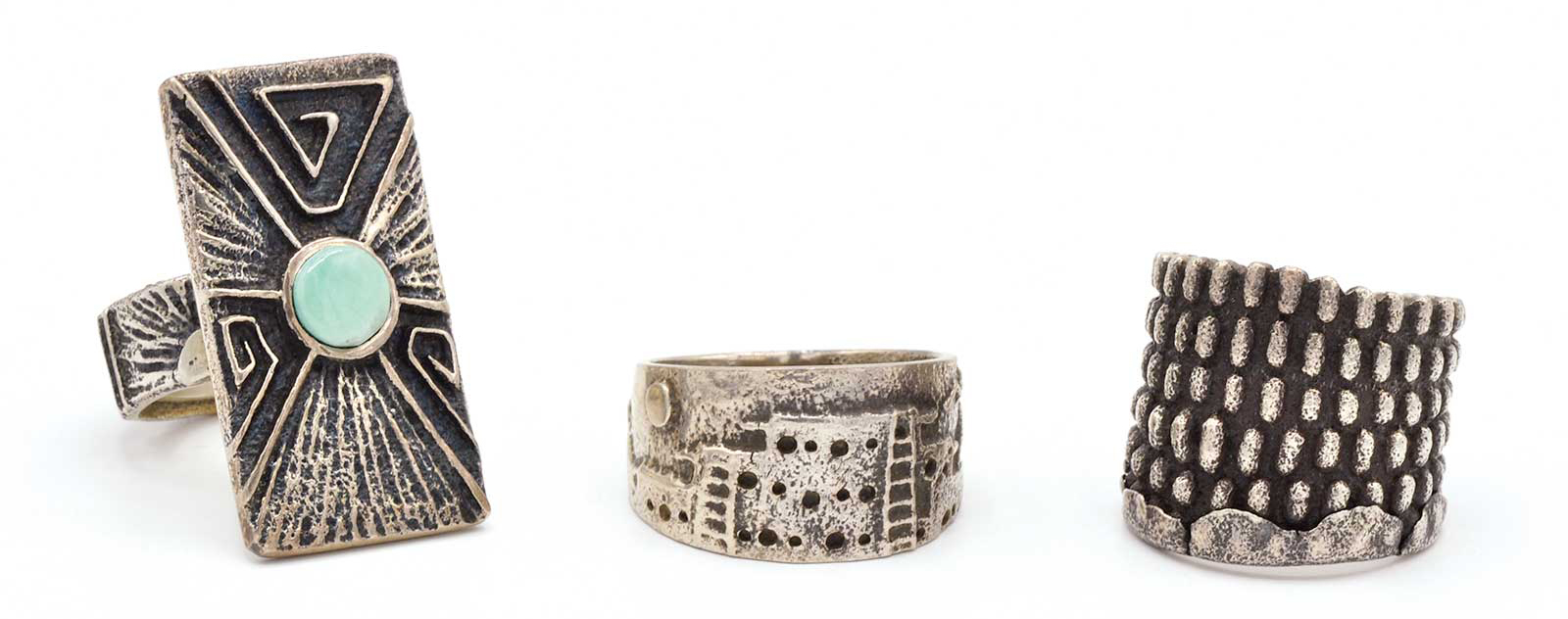 Texture (left to right): rectangular ring with center stone by Marian Denipah (Navajo/Ohkay Owingeh), late 1990s; pueblo scene by Philander Begay (Hopi), ca. 2016; corncob by Anthony Lovato (Santo Domingo), 2009.
Another design element utilized effectively by contemporary Native artists is the decorative power of repetition on jewelry pieces. Today’s artists understand that significant traditional images, which represent natural or sacred phenomenon, enhance their designs. The meaning and purpose of these erstwhile symbols can be shared or simply offered as a means of imbuing a piece with Native spirit. Harrison Jim and Steve LaRance effectively draw on the cross motif since its linked design elements possess dominance, emphasis, scale and proportion, all through the means of repetition. Jim makes use of a bold shield-like rectangular central plate for his cross motifs, while LaRance’s crosses present a pleasing narrative pattern statement on a band form.
The final, ultimate design elements to be deployed are unity and harmony. These qualities are the objective of all Native jewelers. One of the most interesting activities in this vein are artistic collaborations. Two jewelers merge personal designs to create a chosen, shared effect. The fruits of such an experience were revealed at the 2021 Santa Fe Indian Market, when Ray Tracey and Cody Sanderson, both represented by the Sorrel Sky gallery, showed their collaborative creations. One of their cooperative ventures was a series of rings with mingled motifs.
Ray Tracey first came upon the scene in 1977. A man of charm and presence, Tracey enjoyed an active acting career at the time but eventually chose to focus on his jewelry-making. Tracey’s designs helped to popularize Indian jewelry, and he worked in a number of modes. One of his most appealing, classic designs was an incised feather, which he used on earrings, rings and pendants. Over the years, his pieces retain a contemporary flair.
Cody Sanderson made his debut in 2002 at the Santa Fe Indian Market. He made a hit with his playful designs from nature and popular culture and talented use of technology in fabrication. One of his design series of the past decade featured the cosmic star shape. Rings with stars carried names like “Big Star in Star” and “Depp Star.” With both artists showing at the same gallery, a collaboration proved irresistible. They produced, among other things, a number of rings which featured Tracy’s feather pattern on one side, and Sanderson’s star motif on the opposite.
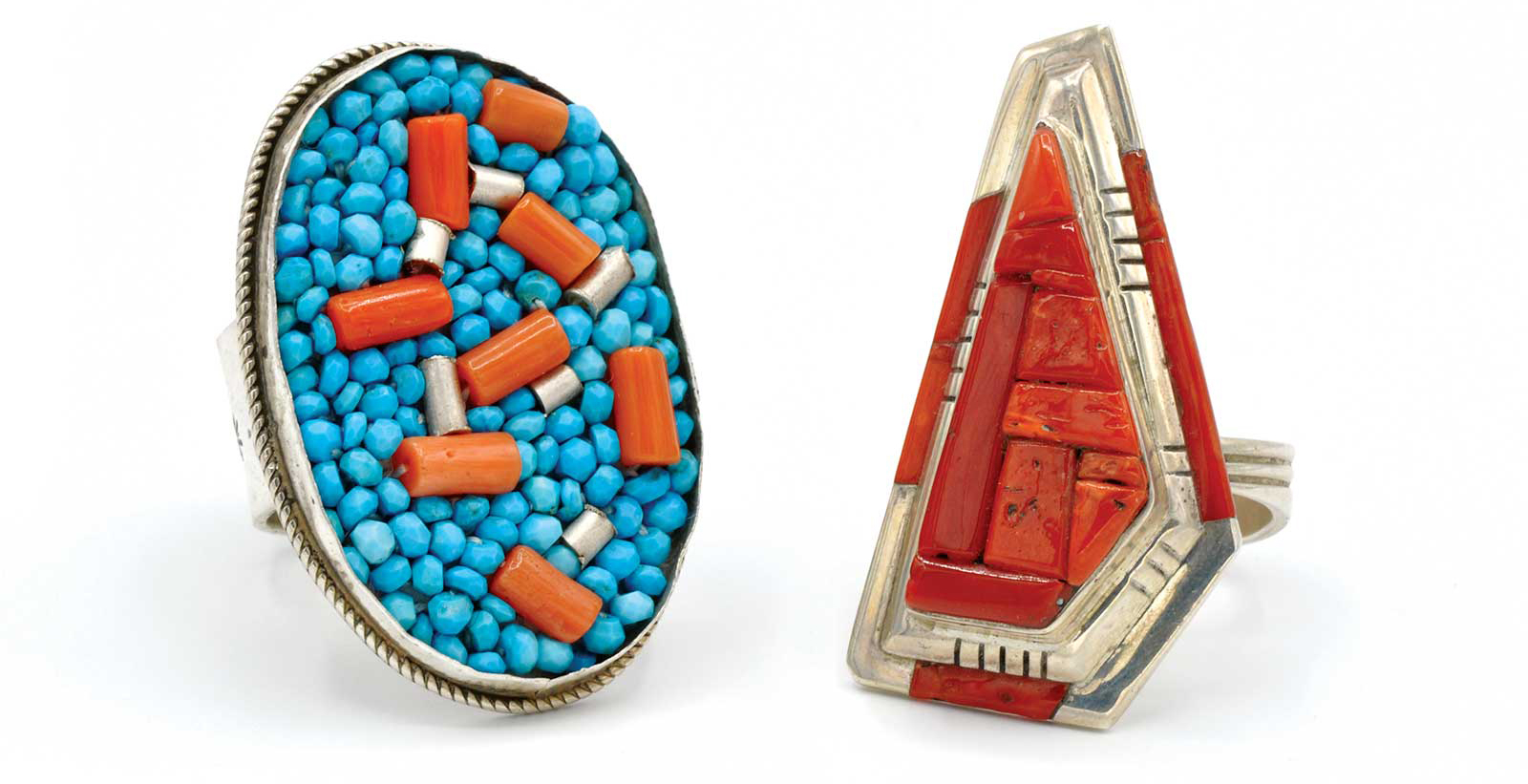 Balance (left to right): oval ring by J.T. Willie (Navajo) set with turquoise, silver and branch coral beads, 2018; coral and silver ring by Ken Romero (Taos/Laguna), 2020-21.
One design term to take care with when discussing American Indigenous jewelry is style. Non-Native jewelry history has adopted Western art historical terms for adornment, including the blanket labels “costume jewelry” and “decorative art.” This makes it more realistic to understand that while style and fashion have always been taken into consideration by Native artists, their design requirements come from uniquely blended cultural and personal vision. Post-1980 handmade Indian jewelry, including rings, are wholly fine art.
Every ring shown here will enhance its wearer. They do so by promoting a quintessential design element which is stimulating and pleasing to all viewers. Makers’ backgrounds vary. Some of these individuals, such as Casuse, Denipah, Lovato and Romero, have trained at the Institute of American Indian Arts. Others, including John, Howard, Otero and Quandelacy are self-taught. The remaining makers shown here learned from mentors. In addition, they all have in common the following: virtually every Native cutting-edge ring maker acknowledges the powerful prototypes of master designer and influencer Charles Loloma (1921–1991).
Originality is their mutual goal.
Powered by Froala Editor