Back in the early 2000s, Hopi artists Michael Kabotie and Delbridge Honanie were invited by the Museum of Northern Arizona to collaborate on large-scale paintings. These were based on murals that were excavated by Harvard archaeologists from the ancestral Hopi village of Awa’tovi in the 1930s. Today, the museum has all 12 panels (three paintings) together in one gallery for the exhibition Journey to Balance: Migration and Healing in Three Hopi Murals, now on view.
“Kabotie and Honanie first painted the Journey of the Human Spirit mural to go in our Kiva Gallery to look like a Hopi Kiva—a ceremonial chamber,” says Kelley Hays-Gilpin, curator of anthropology. “Some ancient Kivas had murals and a number of Hopi artists took inspiration from these, as they resonate between past and present. However, Hopi leadership was not comfortable with contemporary art displayed in a replica Kiva.”
 Michael Kabotie (Hopi, 1942-2009) and Delbridge Honanie (Hopi, 1946-2017), Journey of the Human Spirit, acrylic on canvas, 60 x 456"
Fast forward, and now all three paintings are together in a neighboring gallery, where the public can see them up close and interact with the different panels. “This is the first time they’ve all been on display together,” Hays-Gilpin says. “[When planning for the exhibition] I was really thinking of these two artists who are no longer with us and the difficulties we’re going through now. Not just locally, but the whole world. We had already been planning on getting the murals on display because of how beautiful they are, but they also talk about cultural continuity and change.”
Hays-Gilpin also notes that the Western art world has always been more about the artist as an individual or painting alone. This is not the case in Hopi life. Families work together, whether building a house or making pottery. “It’s always collaborative,” says Hays-Gilpin, “and it was really great to watch Kabotie and Honanie painting together on the same canvas and discussing it. They would invite Hopi leaders to comment and discuss the painting during their process and change things around.”
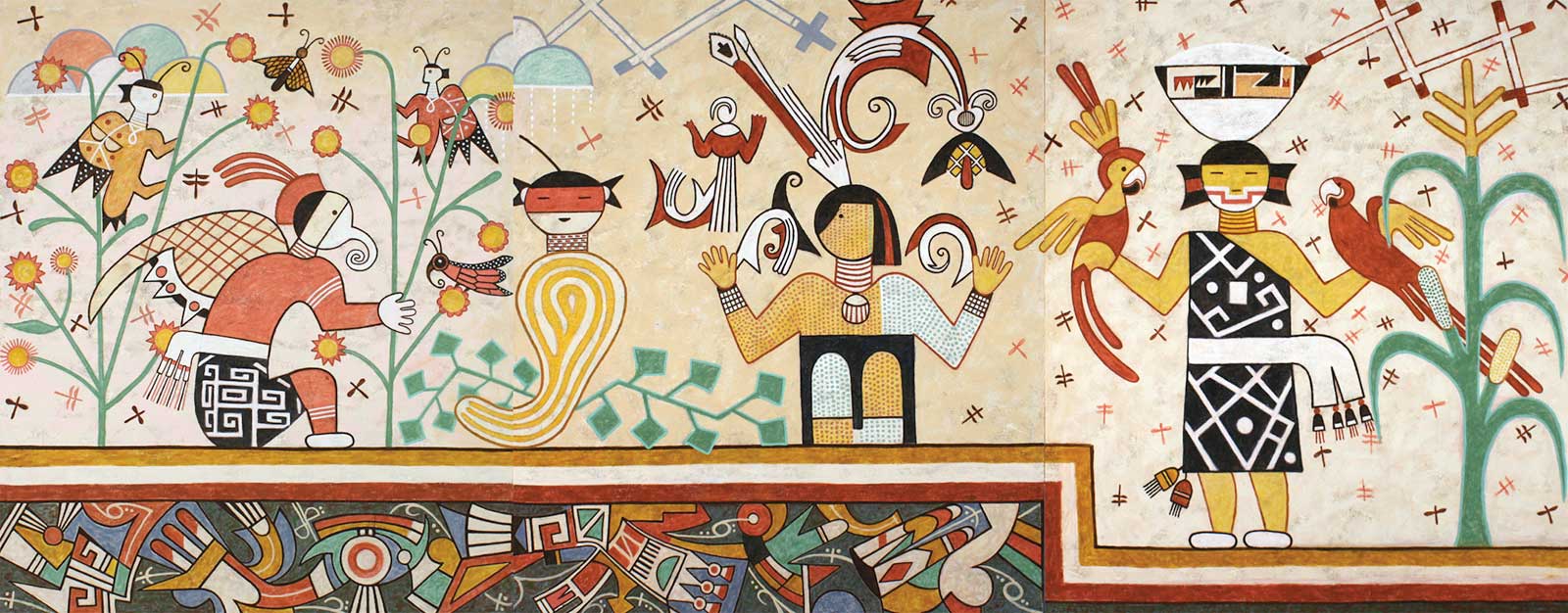 Michael Kabotie (Hopi, 1942-2009) and Delbridge Honanie (Hopi, 1946-2017), Pottery Mound: Germination, acrylic on canvas, 71½ x 177"
The artists created each piece based on the excavated murals, along with other cultures and spiritual traditions. “Their goal was not to reproduce the murals that existed before,” notes the museum, “but to create something new…Something that would speak to all people.”
Journey of the Human Spirit, is a 48-foot painting, that deals with themes involving the human experience, including the “shadow side,” or the unhealed side of all humans—a spiritual understanding in Hopi culture. “Our lives are a journey and we’re always trying to heal that unhealed side of us,” Hays-Gilpin says. “It could be a community or individual, and now, it feels like it’s the whole world.” The painting tells a visual story within six panels, dealing with these topics: The Emergence, The Pueblo Rebellion, A Middle Place, The Rational Side and Hope.
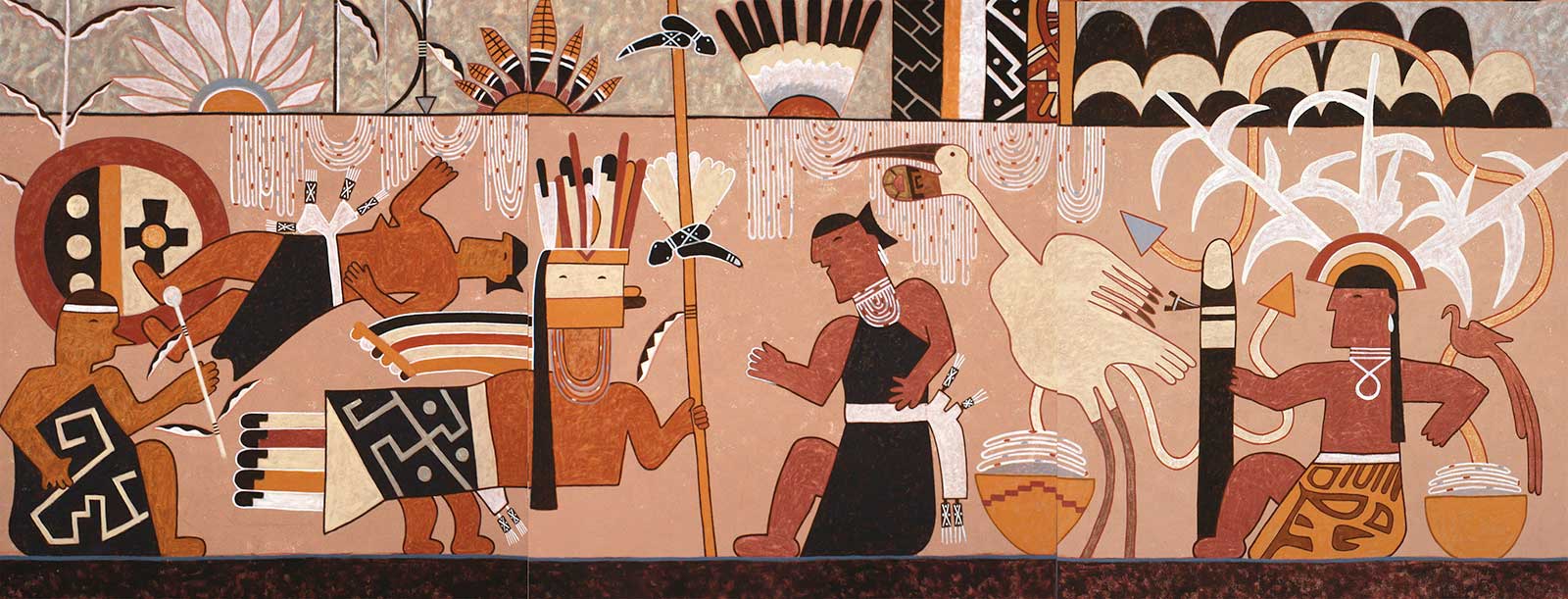 Michael Kabotie (Hopi, 1942-2009) and Delbridge Honanie (Hopi, 1946-2017), Pottery Mound: Meeting of the Agricultural and Hunter Warrior Cultures, acrylic on canvas, 71½ x 177"
The other two paintings Pottery Mound: Germination and Pottery Mound: Meeting of the Agricultural and Hunter Warriors Cultures, involve themes of our relationship with the earth; plants, seasons and the birth and death cycle. “Everything that dies decays in the earth and comes back as a new form,” Hays-Gilpin adds. Each of these paintings contains three panels, also telling a visual story, while remaining connected to Journey.
“Each of the three murals presents a dynamic relationship between order and chaos,” notes the museum, “but ultimately offers hope that by embracing our shadow side, our cultural differences, and the hard work of healing, we can find our way to life in balance and harmony.”
Through Spring of 2022
Journey to Balance: Migration and Healing in Three Hopi Murals
Museum of Northern Arizona
3101 N. Fort Valley Road, Flagstaff, AZ 86001
(928) 774-5213, www.musnaz.org
Powered by Froala Editor